Marine Biodiversity Science Center

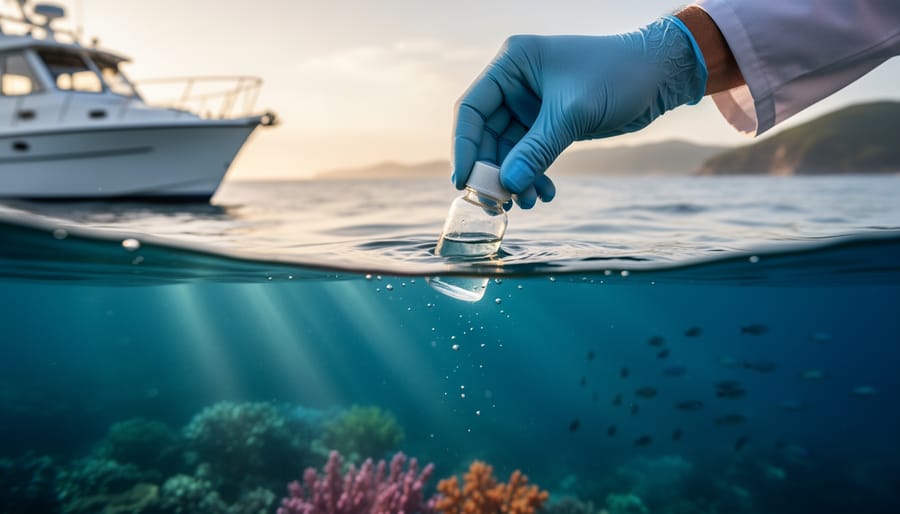
Imagine identifying every fish, invertebrate, and marine mammal in a coastal ecosystem without deploying nets, traps, or underwater cameras—just by analyzing a single water sample. Environmental DNA metabarcoding makes this possible by detecting microscopic genetic traces that organisms shed into their surroundings, then using high-throughput sequencing to identify dozens or even hundreds of species simultaneously. This revolutionary technique is transforming marine biodiversity monitoring from labor-intensive species-by-species surveys into comprehensive ecosystem snapshots that researchers, conservation managers, and even trained volunteers can collect efficiently and non-invasively.
The power of eDNA metabarcoding lies in its ability to detect rare species, track invasive organisms, and monitor biodiversity changes across vast ocean areas with unprecedented speed and cost-effectiveness. A marine biologist might spend weeks conducting traditional surveys of a coral reef, yet miss cryptic or nocturnal species entirely. That same ecosystem sampled through eDNA can reveal the genetic signatures of elusive creatures like seahorses hiding in seagrass or shark species passing through during nighttime migrations. Research teams worldwide are now using this technology to establish biodiversity baselines, assess marine protected area effectiveness, and detect early warnings of ecosystem shifts.
However, transforming raw genetic sequences into reliable species identifications requires rigorous standardized protocols. Without consistent methods for sample collection, DNA extraction, sequencing approaches, and bioinformatics analysis, results become difficult to compare across studies or regions. The marine conservation community is actively developing these standards to ensure eDNA metabarcoding fulfills its promise as a cornerstone tool for understanding and protecting ocean biodiversity in an era of rapid environmental change.
What Is eDNA Metabarcoding and Why Does It Matter?
The Science Behind the Sample
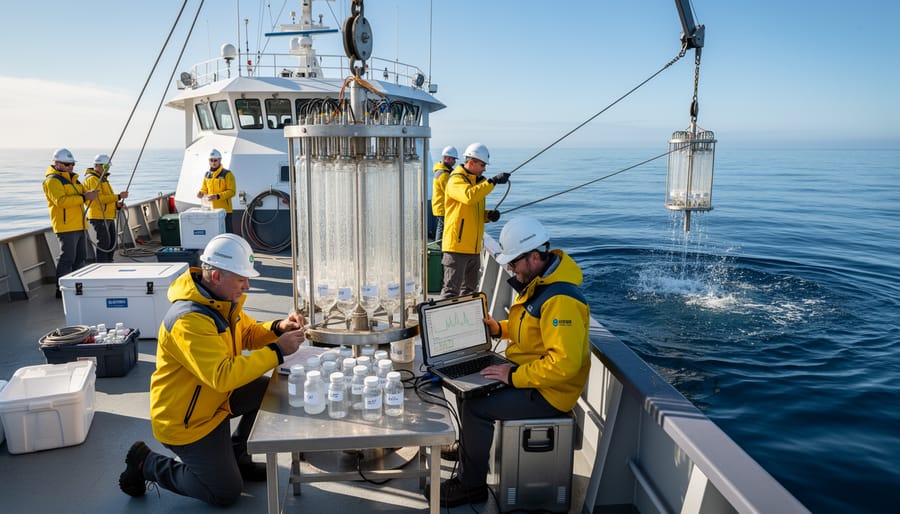
Think of eDNA metabarcoding as reading invisible signatures left behind in water, much like finding fingerprints at a scene. Every fish, mammal, or invertebrate that swims through the ocean leaves behind traces of genetic material through shed skin cells, scales, mucus, and waste. The process begins simply: scientists collect water samples, often just a liter or two, filtering them to capture these microscopic DNA fragments.
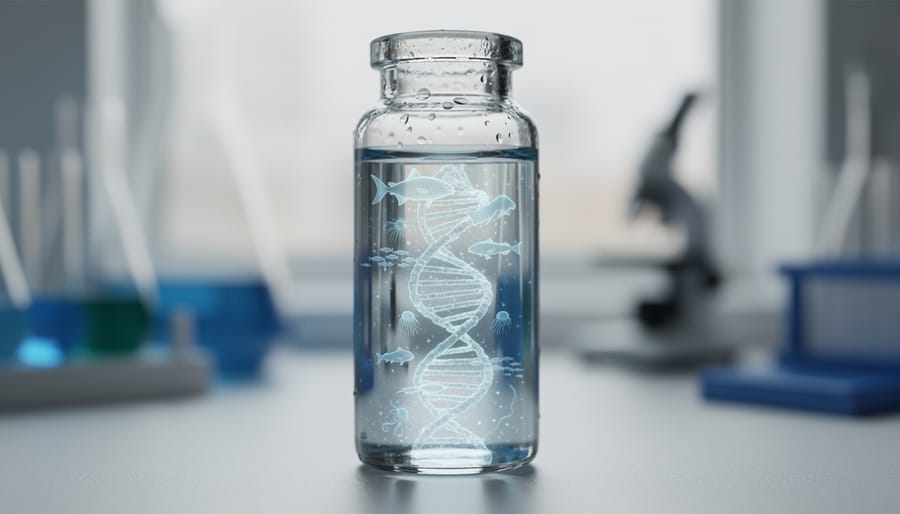
Next comes DNA extraction, where researchers isolate the genetic material from the filter, similar to separating wheat from chaff. This precious genetic library contains code from potentially dozens or even hundreds of species that recently passed through that location.
The real magic happens during sequencing. Scientists target specific gene regions that act like universal barcodes, unique identifiers that distinguish one species from another. Modern sequencing machines read millions of these genetic barcodes simultaneously, creating a comprehensive dataset in hours rather than the months traditional surveys might require.
Finally, sophisticated computer algorithms compare these sequences against reference libraries, matching them to known species. Marine biologist Dr. Sarah Chen explains, “It’s like having millions of tiny witnesses telling us who visited this spot, without us ever seeing them directly.”
The beauty of this approach lies in its efficiency and accessibility. Volunteers can collect samples from remote locations, democratizing marine research while maintaining scientific rigor through standardized protocols.
From Rare Fish to Microscopic Plankton: What We Can Detect
eDNA metabarcoding has revolutionized our ability to detect marine life across all scales. Scientists have successfully identified elusive species like the critically endangered sawfish in Australian waters, confirming their presence in areas where traditional surveys came up empty. The technology excels at detecting rare fish populations, from deep-sea dwellers to cryptic reef species that hide during daylight hours.
Beyond charismatic megafauna, metabarcoding shines when cataloging entire ecosystems. A single water sample can reveal hundreds of species simultaneously, from microscopic phytoplankton forming the ocean’s foundation to zooplankton, jellyfish, and larval fish. Dr. Sarah Chen, a marine biologist working in the Mediterranean, shares: “We detected 347 species from just five liters of seawater, including three fish species previously unrecorded in that region. It’s like having a snapshot of the entire food web.”
Conservation success stories continue emerging. In the Pacific Northwest, eDNA monitoring helped document the recovery of rockfish populations in marine protected areas. Meanwhile, citizen scientists collecting samples along coastlines have contributed to discovering seasonal migration patterns of squid and identifying spawning grounds for commercially important species, demonstrating how accessible this technology has become for community-driven conservation efforts.
Building a Reliable Framework: Why Standards Matter in Marine eDNA Research
The Challenge of Comparing Apples to Oranges
Imagine two research teams studying fish diversity in the same coral reef using eDNA metabarcoding. Team A filters 500ml of water through 0.22-micron filters, while Team B uses 2 liters through 0.45-micron filters. They extract DNA using different kits and amplify separate gene regions. When they publish their findings, Team A reports 47 fish species and Team B identifies 68 species, with only 30 overlapping. Which dataset should conservationists trust when designating marine protected areas?
This real scenario illustrates why science-backed standards matter tremendously. Dr. Maria Santos, a marine biologist in the Philippines, encountered this frustration firsthand when trying to establish baseline biodiversity data for a coastal restoration zone. “We had three different studies of the same bay showing completely different species compositions. It wasn’t that anyone did bad science—they just used incompatible methods,” she explains. Without standardized protocols, comparing results across studies becomes nearly impossible, delaying critical conservation decisions and potentially wasting limited resources on conflicting management strategies.
Current Standardization Efforts and Initiatives
The scientific community recognizes that for marine eDNA metabarcoding to reach its full potential, we need consistent, reliable methods that produce comparable results across laboratories and regions. Several organizations are leading the charge to develop these crucial frameworks.
The Ocean Best Practices System (OBPS) serves as a central repository where researchers worldwide share their field-tested methodologies. Meanwhile, the International Council for the Exploration of the Sea (ICES) has established working groups dedicated to creating standardized protocols for eDNA sampling and analysis in marine environments.
The European Marine Biological Resource Centre (EMBRC) coordinates collaborative efforts across institutions to validate these emerging standards through real-world testing. Similarly, the Marine Biodiversity Observation Network (MBON) connects research stations globally, enabling scientists to compare eDNA data from diverse ocean ecosystems using harmonized approaches.
These initiatives bring together marine biologists, molecular ecologists, and conservation practitioners who understand that standardization isn’t about limiting creativity—it’s about ensuring our discoveries can build upon one another. When researchers from Alaska to Antarctica follow compatible protocols, we create a powerful global network for monitoring ocean health and responding to environmental changes.
Best Practices for Sample Collection and Processing
Where, When, and How to Collect Water Samples
Successful eDNA sampling requires careful planning to ensure reliable, standardized results. Location selection depends on your research questions—coastal waters, estuaries, coral reefs, or deep-sea environments each tell different biodiversity stories. For marine environments, collect samples where organisms naturally congregate or pass through, such as near feeding grounds, migration corridors, or biodiversity hotspots.
Timing matters significantly. Seasonal variations affect species presence, while daily patterns influence detection rates. Early morning samples often yield different results than afternoon collections due to animal behavior and water circulation. Plan multiple sampling events across seasons to capture temporal biodiversity changes.
Water depth and volume are critical standardized parameters. Surface samples (0-1 meter) typically capture the most abundant DNA signals, though deeper samples may be necessary for certain species. Standard protocols recommend collecting 1-2 liters of water per sample, filtered through specialized membranes to capture genetic material. This volume balances detection sensitivity with practical handling.
Replication strengthens data reliability. Collect at least three replicate samples per location and time point, spacing them several meters apart. This approach accounts for natural DNA distribution variability and helps identify potential contamination.
Citizen scientists play an increasingly vital role in expanding eDNA monitoring coverage. Organizations worldwide now train volunteers to collect water samples following standardized protocols. These programs provide equipment, training sessions, and clear instructions, making participation accessible to non-scientists. From coastal monitoring initiatives to collaborative reef assessments, volunteers contribute invaluable data while connecting meaningfully with ocean conservation efforts. Contact local marine research centers or conservation groups to discover opportunities in your region.
Preventing Contamination: The Hidden Enemy of Accuracy
Contamination represents one of the most significant challenges in eDNA metabarcoding, capable of undermining even the most carefully designed studies. Think of it as an invisible saboteur that can infiltrate your samples at any stage, from the moment you collect water to the final laboratory analysis.
The field collection phase requires meticulous attention. Always use new, sterile gloves for each sample and change them frequently. Marine biologist Dr. Elena Martinez learned this lesson early in her career when cross-contamination between sampling sites initially suggested species distributions that didn’t match ecological expectations. “We now treat each sample location as a completely separate event,” she explains, emphasizing the importance of dedicated equipment whenever possible.
Sample containers should be sterile and never reused. Label everything immediately to prevent mix-ups. When filtering water samples, process them in order from areas you expect to have lower biodiversity to higher, minimizing the risk of DNA-rich samples contaminating less diverse ones.
In the laboratory, maintain a unidirectional workflow. DNA extraction should occur in a space physically separated from where PCR amplification happens, as amplified DNA fragments can easily become airborne. Regular cleaning of work surfaces with bleach solutions helps destroy residual DNA.
Include negative controls at every step—blank filters processed alongside samples, extraction blanks, and PCR negatives. These quality checks help identify when and where contamination occurs, allowing you to address problems before they compromise your entire dataset. Remember, preventing contamination isn’t just about following protocols; it’s about protecting the integrity of the marine biodiversity insights you’re working to reveal.
The Bioinformatics Pipeline: Turning Raw Data Into Conservation Insights
Quality Control: Separating Signal From Noise
Raw eDNA samples contain a mixture of genuine species signals and potential errors—from lab contamination to sequencing mistakes. Quality control acts as the essential filter, ensuring researchers can confidently identify which species are truly present in a marine environment.
The filtering process begins with bioinformatics pipelines that remove low-quality sequence reads, those unclear genetic snippets that likely represent errors rather than real organisms. Next, scientists eliminate sequences that appear only once or twice, as these singletons often indicate contamination or technical artifacts rather than actual species presence.
One marine biologist working on coral reef surveys describes this step as “detective work—you’re constantly asking whether each signal represents a fish that swam by or dust that landed in your sample.” Researchers compare sequences against reference databases, keeping only matches that meet strict similarity thresholds, typically 97-99% identity to known species.
Negative controls—samples processed without any environmental DNA—help identify contamination sources. Positive controls containing known species verify that methods work correctly. This rigorous approach transforms noisy data into reliable species lists that conservationists and resource managers can trust when making critical decisions about marine protection.
Reference Libraries: The Foundation of Accurate Identification
Think of genetic reference libraries as the massive identification guides that make eDNA metabarcoding possible. When researchers sequence DNA from seawater samples, specialized software compares those sequences against existing databases like GenBank, BOLD (Barcodome of Life Data Systems), and regional repositories. If there’s a match, the species gets identified. No match means the organism remains a mystery.
Here’s the challenge: current reference libraries have significant gaps, particularly for marine invertebrates, deep-sea species, and organisms from understudied regions. Some estimates suggest only 20-30% of known marine species have reliable genetic barcodes available. This creates a frustrating situation where scientists collect perfectly good eDNA samples but can’t identify what they’ve found.
The good news? Researchers worldwide are actively building more comprehensive libraries. Marine biologist Dr. Sarah Chen from the Pacific Marine Research Institute shares her experience: “We spent two years collecting and barcoding reef fish from previously under-sampled regions. Now those sequences help researchers across the globe identify species in their eDNA samples. It’s incredibly rewarding to know our work multiplies conservation efforts elsewhere.”
Universities, museums, and conservation organizations are collaborating to fill these gaps systematically. Some programs even welcome trained volunteers to help with specimen collection and preliminary identification work. As these libraries grow, eDNA metabarcoding becomes increasingly powerful, transforming from a tool that identifies common species into one that can detect rare, elusive, and even undiscovered marine life.
Real-World Applications: eDNA Metabarcoding in Action
Tracking Endangered Species and Invasive Newcomers
eDNA metabarcoding has proven remarkably effective at tracking both species we desperately want to protect and those we urgently need to stop. Consider the Mediterranean monk seal, one of the world’s most endangered marine mammals with fewer than 700 individuals remaining. Traditional monitoring required teams of researchers to stake out remote caves and coastlines for months. Now, researchers collect water samples from suspected habitats and use eDNA metabarcoding to confirm the seals’ presence within days. This approach has identified previously unknown populations in Greek waters and helped establish new protected areas.
On the flip side, this same technology serves as an early warning system for invasive species. When the northern Pacific seastar began spreading through Australian waters, threatening native shellfish populations, eDNA surveillance detected its arrival in new harbors weeks before visual sightings occurred. This advance notice allowed rapid response teams to implement containment measures before populations exploded.
Marine biologist Dr. Sarah Chen, who monitors coral reef fish populations in the Caribbean, shares her experience: “We detected lionfish DNA in areas where none had been spotted yet. That early detection meant we could alert dive teams and organize removal efforts immediately, potentially saving thousands of native reef fish.”
For volunteers interested in contributing to these monitoring efforts, many programs now accept citizen scientists to help collect water samples following standardized protocols. These contributions directly support conservation databases that inform protection policies worldwide.
Assessing Marine Protected Areas and Ecosystem Health
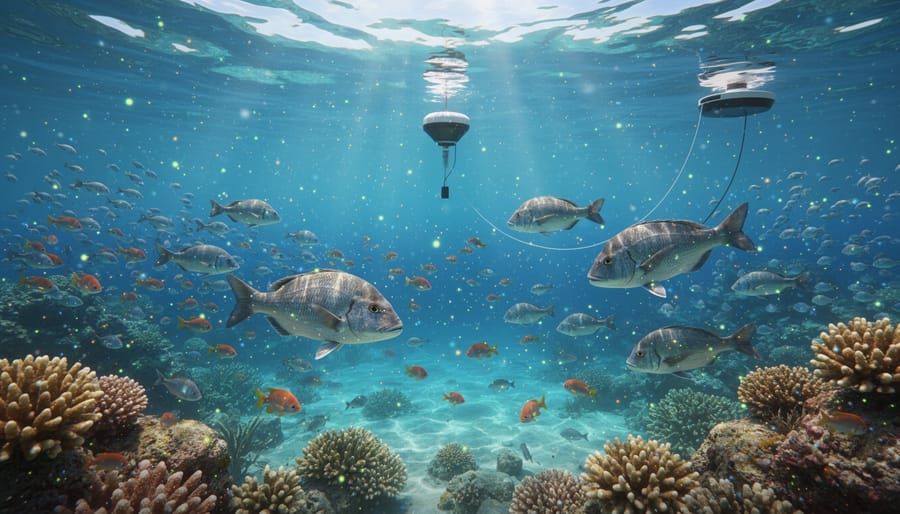
eDNA metabarcoding has emerged as a powerful tool for monitoring the success of marine protected areas and tracking ecosystem health over time. By collecting water samples at regular intervals, researchers can detect changes in species composition, identify the return of sensitive or endangered species, and spot early warning signs of ecosystem decline—all without disturbing the habitats they aim to protect.
For conservation efforts, this technology offers unprecedented insight into whether protected areas are meeting their goals. Marine biologist Dr. Sarah Chen recalls her experience monitoring a newly established sanctuary off British Columbia’s coast: “Within two years of protection, our eDNA samples revealed the return of rockfish species we hadn’t detected in decades. That data was crucial for demonstrating the reserve’s effectiveness to policymakers and local communities.”
The technique also enables long-term ecosystem monitoring at scales previously impossible with traditional surveys. Researchers can establish baseline biodiversity inventories and track how communities respond to climate change, pollution events, or restoration initiatives. Because samples can be archived and reanalyzed as genetic databases expand, historical eDNA collections become increasingly valuable over time.
Citizen scientists and volunteers play vital roles in these monitoring programs, collecting samples at designated sites and contributing to datasets that inform adaptive management strategies. This collaborative approach not only generates robust data but also builds community investment in marine conservation outcomes.
Current Limitations and the Path Forward
Like any emerging technology, eDNA metabarcoding faces several challenges that researchers are actively working to overcome. Understanding these limitations helps us appreciate both where the field stands today and where it’s heading.
One significant hurdle is quantification. While eDNA tells us what species are present, translating the amount of DNA detected into actual abundance or biomass remains tricky. A single large fish might shed the same amount of DNA as several smaller ones, and environmental conditions like water temperature and flow can affect how DNA disperses and degrades. Scientists are developing correction factors and standardized sampling protocols to improve these estimates, making the data increasingly reliable for population assessments.
Taxonomic resolution presents another challenge. Some closely related species share nearly identical DNA sequences in commonly used genetic markers, making them difficult to distinguish. Additionally, reference databases—the libraries scientists use to identify species from DNA sequences—still have gaps, particularly for rare or poorly studied marine organisms. The good news? These databases grow stronger every year as researchers contribute new genetic sequences from specimens worldwide.
Dr. Sarah Chen, a marine biologist working on coral reef monitoring in the Philippines, remains optimistic: “When I started using eDNA five years ago, we could identify maybe 60 percent of our samples to species level. Now we’re approaching 85 percent, and that number keeps climbing. Every expedition, every identified specimen adds to our collective knowledge.”
The path forward is collaborative. Citizen scientists and volunteers play a crucial role in filling database gaps by helping collect and catalog reference specimens. As standardization improves and technology advances, eDNA metabarcoding continues evolving from a promising tool into an indispensable conservation resource.
How You Can Get Involved
The future of marine biodiversity research depends on people like you getting involved, and there are meaningful opportunities for everyone, regardless of your background or experience level.
For students exploring marine biology careers, eDNA metabarcoding offers an exciting entry point into cutting-edge conservation science. The Marine Biodiversity Science Center provides internship programs where you can gain hands-on experience with sample collection, laboratory protocols, and data analysis. Many universities now offer courses specifically focused on molecular ecology and bioinformatics, equipping you with skills that are increasingly in demand across research institutions and environmental consulting firms.
Educators can transform their curricula by incorporating eDNA concepts and activities. The Marine Biodiversity Science Center has developed educational toolkits that include simplified sampling protocols suitable for high school and college students. These resources help students understand both the science and the real-world applications of molecular techniques in conservation. Classroom participation in actual research projects turns abstract concepts into tangible contributions to marine science.
Volunteers play a crucial role in expanding the geographic reach of eDNA monitoring programs. Citizen science initiatives train interested individuals to collect water samples following standardized protocols, dramatically increasing the data available to researchers. These programs typically provide all necessary equipment and training, requiring only your time and enthusiasm.
The general public can support eDNA research through donations, advocating for science-based conservation policies, and spreading awareness about the importance of marine biodiversity monitoring. Your engagement, whether through direct participation or financial support, accelerates our ability to protect ocean ecosystems for future generations.
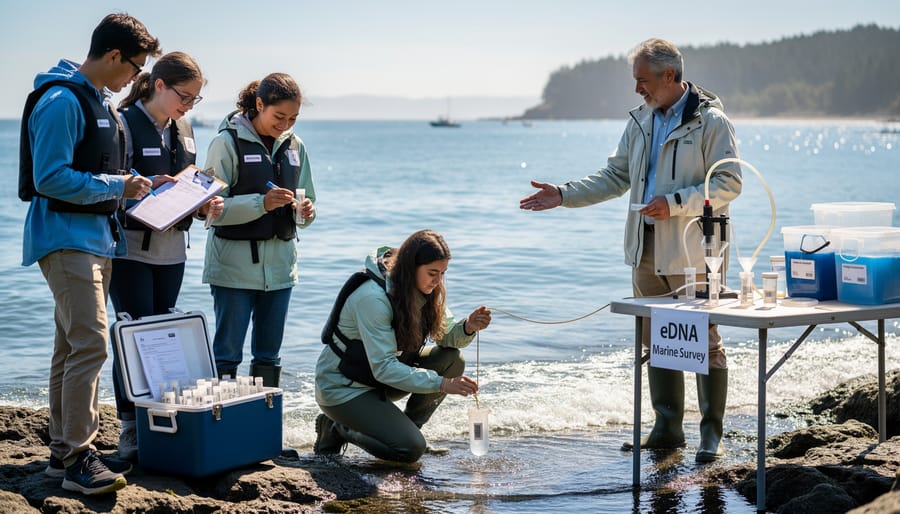
eDNA metabarcoding represents a revolutionary leap forward in our ability to understand and protect marine ecosystems. When paired with rigorous standards for sample collection, processing, and data analysis, this technology transforms from a promising tool into a cornerstone of effective conservation strategy. We now possess the capability to detect rare species, monitor ecosystem health, and identify biodiversity hotspots with unprecedented efficiency and accuracy.
The future of our oceans depends on collective action informed by reliable science. Whether you’re a researcher establishing monitoring protocols, an educator inspiring the next generation of marine biologists, or a citizen scientist participating in coastal sampling programs, you play a vital role in this conservation revolution. Volunteer opportunities through local marine research centers and conservation organizations offer hands-on experience with eDNA sampling, making cutting-edge science accessible to everyone passionate about ocean health.
Together, armed with innovation and standardized methodologies, we can build a comprehensive understanding of marine biodiversity that guides meaningful protection efforts. The ocean’s mysteries are revealing themselves through every water sample analyzed, every sequence decoded, and every dataset shared. Let’s embrace this scientific frontier with optimism and commitment to safeguarding marine life for generations to come.

jessica
Ava Singh is an environmental writer and marine sustainability advocate with a deep commitment to protecting the world's oceans and coastal communities. With a background in environmental policy and a passion for storytelling, Ava brings complex topics to life through clear, engaging content that educates and empowers readers. At the Marine Biodiversity & Sustainability Learning Center, Ava focuses on sharing impactful stories about community engagement, policy innovations, and conservation strategies. Her writing bridges the gap between science and the public, encouraging people to take part in preserving marine biodiversity. When she’s not writing, Ava collaborates with local initiatives to promote eco-conscious living and sustainable development, ensuring her work makes a difference both on the page and in the real world.