Marine Biodiversity Science Center

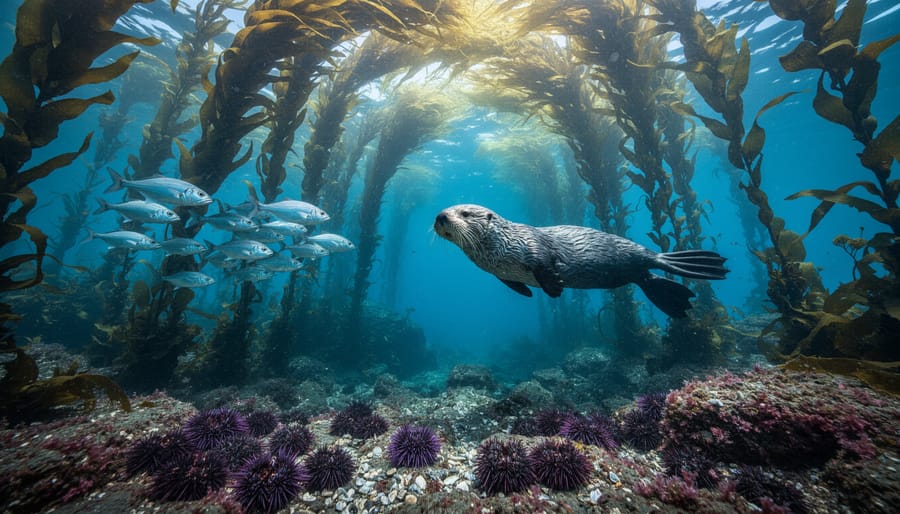
Yes, kelp is widely recognized as a keystone species—an organism whose impact on its ecosystem is disproportionately large relative to its abundance. When you wade through a kelp forest, you’re not just encountering underwater vegetation; you’re experiencing one of the ocean’s most vital life-support systems. These towering brown algae create three-dimensional habitats that shelter over 800 species, from microscopic invertebrates to sea otters, seals, and countless fish that rely on kelp forests for survival.
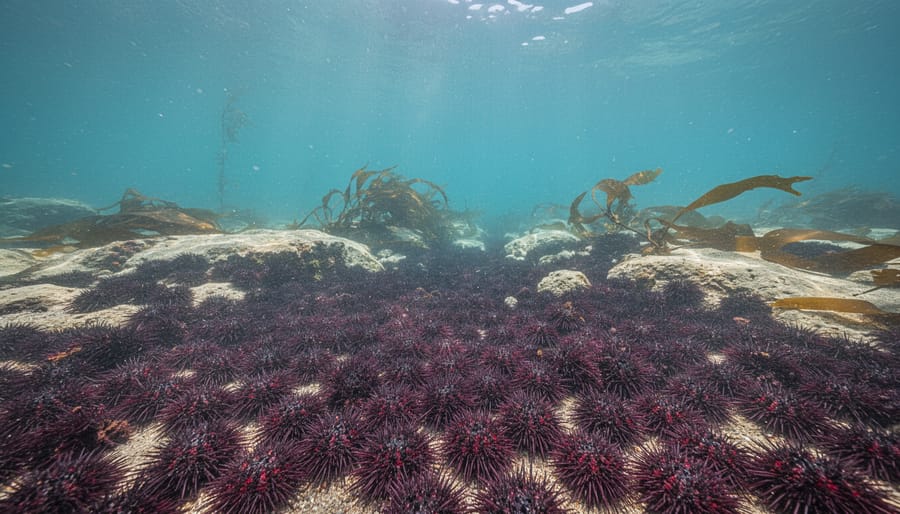
The keystone designation matters because it reveals how removing or declining kelp populations triggers catastrophic ecosystem collapse. Without kelp, urchin barrens expand across the seafloor—desolate underwater deserts where biodiversity plummets by up to 90%. The relationship works like an arch: remove the keystone, and the entire structure crumbles. Scientists have documented this phenomenon repeatedly in California, Alaska, and Tasmania, where kelp loss has devastated commercial fisheries and eliminated critical habitat for threatened species.
Some ecologists argue kelp functions more as a foundation species, like trees in a forest, providing the physical structure upon which communities depend. This distinction isn’t mere semantics—it reflects different ecological mechanisms. However, research increasingly shows kelp fulfills both roles simultaneously. Through complex interactions with sea urchins, sea otters, and nutrient cycles, kelp demonstrates the disproportionate influence that defines keystone status while also creating the foundational habitat structure ecosystems require.
Understanding kelp’s ecological role transforms how we approach marine conservation. When a single species holds such power over ecosystem health, protecting it becomes urgent. Every kelp restoration project, every effort to maintain healthy sea otter populations, and every volunteer monitoring expedition contributes to preserving these underwater forests and the remarkable biodiversity they sustain.
What Makes a Species a Keystone?
Imagine an architectural arch where a single wedge-shaped stone at the top holds the entire structure together. Remove that one piece, and the arch collapses. This is the essence of a keystone species—an organism whose impact on its ecosystem is disproportionately large compared to its abundance.
The concept originated in the 1960s when ecologist Robert Paine conducted groundbreaking research along the rocky shores of Washington State. Paine removed ochre sea stars from certain tide pool areas and observed what happened. Without these predators, mussel populations exploded, crowding out other species and dramatically reducing biodiversity. The sea stars weren’t the most numerous organisms in the ecosystem, but their removal triggered a cascade of changes that fundamentally altered the entire community structure. Paine coined the term “keystone species” in 1969, borrowing from architecture to describe organisms that hold ecological communities together.
What separates a keystone species from simply being important or abundant? Three defining characteristics stand out. First, keystone species have effects on their ecosystems that far exceed what you’d predict based on their population size or biomass. Second, their removal causes dramatic, cascading changes throughout the food web, often leading to reduced biodiversity. Third, they occupy a unique ecological role that isn’t easily filled by other species.
It’s crucial to distinguish keystone species from foundation species, which are typically abundant organisms that create or define habitat structure. Think of foundation species as the actual stones forming the bulk of the arch, while keystone species are that critical top piece.
Marine biologist Dr. Sarah Chen, who has studied Pacific kelp forests for two decades, explains it this way: “When students ask me about keystone species, I tell them to think about their favorite sports team. The keystone player isn’t necessarily the tallest or strongest—it’s the one whose unique skills make everyone else’s contributions possible. Remove them, and the whole team’s dynamics fall apart.”
The Architecture of Kelp Forests
From Seafloor to Surface: How Kelp Builds Habitat
Imagine a towering underwater forest where every floor of the building hosts different residents. That’s exactly what kelp forests provide—a three-dimensional apartment complex rising from the seafloor to the sunlit surface.
At the foundation level, the kelp holdfast anchors the entire structure to rocky substrate. This root-like mass, though it doesn’t absorb nutrients, creates a miniature ecosystem of its own. Hundreds of species find shelter within its crevices—brittle stars, crabs, juvenile fish, and countless invertebrates treat the holdfast as their permanent address. Marine biologist Dr. Sarah Chen describes her first dive studying holdfasts as “discovering an entire city I never knew existed within what looked like tangled roots.”
The midwater region features the stipe, or stem, which serves as a highway for mobile species. Fish navigate up and down this corridor, while sea stars and snails slowly traverse its length hunting for prey.
The canopy, where kelp blades float at the surface forming dense mats, becomes a nursery and feeding ground. Young rockfish hide among the fronds, sea otters wrap themselves in kelp while resting, and seabirds dive through the canopy chasing fish. Each blade photosynthesizes, producing oxygen and organic matter that fuels the entire ecosystem.
This vertical layering means a single kelp forest can support species with vastly different habitat requirements—from bottom-dwelling abalone to surface-feeding seabirds—maximizing biodiversity in ways few ecosystems can match.
The Species That Call Kelp Home
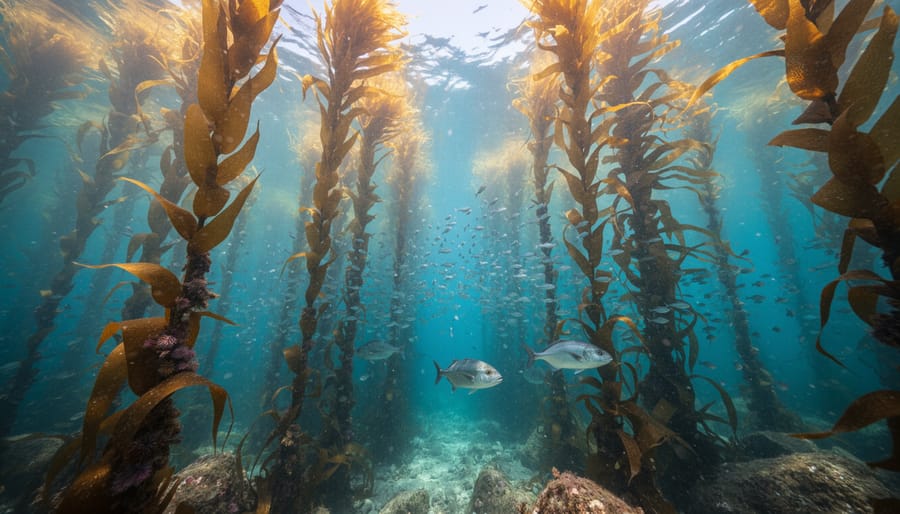
Kelp forests create complex three-dimensional habitats that rival coral reef ecosystems in their biodiversity. These underwater forests support an astonishing array of life at every level of the food web.
Among the fronds and holdfasts, invertebrates thrive in abundance. Sea urchins graze on kelp tissue, while abalone cling to rocky surfaces. Kelp crabs camouflage themselves among the blades, and numerous species of snails, sea stars, and brittle stars navigate the forest floor.
Fish populations depend heavily on kelp forests for survival. Rockfish seek shelter among the swaying kelp, while young salmon use these forests as nurseries before migrating to open ocean. Surfperch, kelp bass, and señoritas dart between the golden-brown fronds, finding both food and protection from predators.
Marine mammals complete this ecosystem’s food web. Sea otters, perhaps the most iconic kelp forest inhabitants, hunt urchins and other invertebrates. Harbor seals rest on nearby rocks, while gray whales occasionally swim through kelp beds during migration. Marine biologist Dr. Sarah Chen recalls her first encounter with a sea otter in a California kelp forest: “Watching it crack open an urchin while floating on its back reminded me why protecting these ecosystems matters so deeply.”
The Case for Kelp as a Keystone Species
Foundation vs. Keystone: Understanding the Distinction
The scientific community has engaged in thoughtful discussion about kelp’s precise ecological classification, with some researchers suggesting that kelp forests might be better described as foundation species rather than keystone species. Understanding this distinction helps clarify the unique role kelp plays in marine ecosystems.
Foundation species are organisms that literally create the physical structure of an ecosystem. Think of coral reefs built by coral polyps, or forests shaped by towering trees. These species modify the environment so dramatically that they enable countless other organisms to thrive. Kelp certainly fits this description—its towering fronds create the three-dimensional habitat that defines kelp forest ecosystems.
Dr. Sarah Chen, a marine ecologist who has studied California kelp forests for fifteen years, explains the perspective this way: “When I’m diving through a kelp forest, I see kelp functioning more like the trees in a terrestrial forest. They’re not just important—they’re the fundamental architecture of the entire system. Without them, you don’t just lose one critical species; you lose the physical habitat itself.”
The keystone species concept, in its strictest definition, refers to species whose impact on the ecosystem is disproportionately large relative to their abundance or biomass. Classic examples include sea otters or starfish, which control populations of herbivores or prey species through predation. Kelp, by contrast, exerts its influence primarily through habitat provision rather than trophic interactions.
However, many ecologists argue this distinction is somewhat semantic. Kelp demonstrably maintains ecosystem structure and supports biodiversity in ways that make its loss catastrophic. Whether we call it a keystone or foundation species, the conservation imperative remains identical: protecting kelp forests is essential for maintaining healthy, productive marine ecosystems.
When Kelp Forests Vanish: Real-World Evidence
The most compelling evidence for kelp’s keystone role comes from observing what happens when it disappears. Along the coasts of California, Alaska, and Tasmania, scientists have documented dramatic ecosystem collapses following the loss of kelp forests—transformations so complete they’ve earned a specific scientific term: urchin barrens.
The California coast provides a particularly well-documented case study. In the 1980s and again in recent years, sea otter populations declined due to disease and warming waters. Without these predators to control them, purple sea urchin populations exploded. What followed was ecological devastation. Urchin armies moved through kelp forests like underwater locusts, consuming the holdfasts that anchor kelp to the seafloor. Within months, thriving underwater forests transformed into barren rocky wastelands.
Marine biologist Dr. Laura Chen witnessed this transformation firsthand off the Mendocino coast. “I’d been diving the same sites for fifteen years,” she recalls. “In 2014, they were vibrant forests teeming with rockfish, harbor seals, and countless invertebrates. By 2016, I was swimming over what looked like a moonscape—just bare rock covered in purple urchins. Maybe ninety-five percent of the biodiversity had simply vanished.”
The cascading effects extend beyond visible marine life. Studies show that urchin barrens support less than ten percent of the species diversity found in healthy kelp forests. Fish populations crash. Seabirds that depend on those fish for food decline. Even nutrient cycling changes, as kelp’s role in transferring ocean nutrients to coastal ecosystems disappears.
Tasmania experienced similar devastation when warming waters allowed long-spined sea urchins to expand their range southward. Approximately thirty-five percent of Tasmania’s giant kelp forests have vanished since the 1940s, fundamentally altering the region’s marine biodiversity.
These real-world collapses powerfully demonstrate kelp’s keystone role. Remove this single species, and entire ecosystems unravel—a defining characteristic of keystone species. For those inspired to help prevent further losses, many coastal research stations offer volunteer opportunities in kelp forest monitoring and urchin removal programs, turning scientific understanding into conservation action.
The Sea Otter Connection: A Keystone Partnership
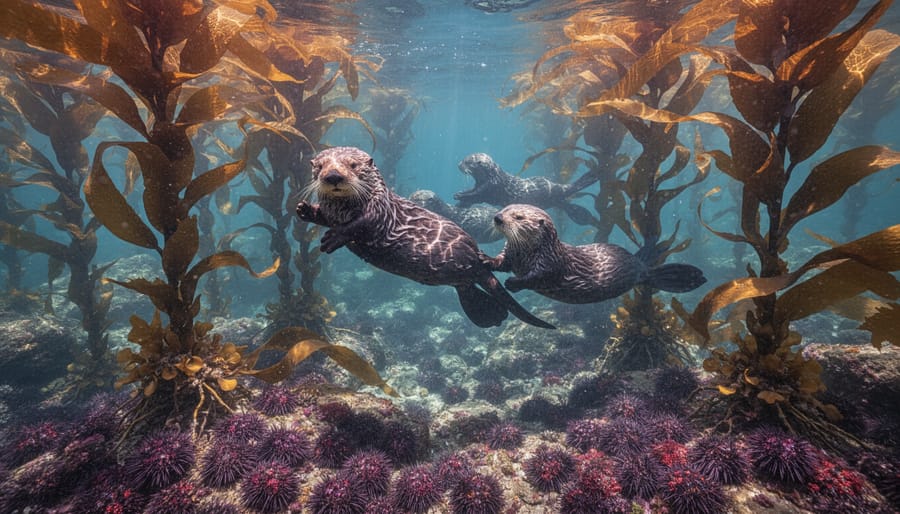
Perhaps no ecological relationship better illustrates the intricate balance of kelp forest ecosystems than the remarkable partnership between sea otters and kelp. This connection serves as one of the most celebrated examples of a trophic cascade, demonstrating how keystone species can protect and maintain foundation species like kelp.
The story begins in the 18th and 19th centuries, when commercial hunters nearly drove sea otters to extinction throughout their Pacific range. Between 1741 and 1911, an estimated 300,000 to one million sea otters were killed for their exceptionally dense fur, considered the finest in the animal kingdom. By the early 1900s, these charismatic marine mammals had vanished from most of their historical habitat, surviving only in small, isolated populations.
What followed was an ecological catastrophe that scientists would later recognize as a textbook trophic cascade. Without sea otters to control their populations, sea urchins multiplied explosively. These voracious grazers decimated kelp forests throughout the North Pacific, transforming vibrant underwater forests into barren seafloors dominated by encrusting coralline algae. The loss rippled through entire ecosystems, affecting hundreds of species that depended on kelp forests for food and shelter.
The turning point came with legal protection. The International Fur Seal Treaty of 1911 banned sea otter hunting, and later the Marine Mammal Protection Act of 1972 provided additional safeguards. As sea otter populations slowly recovered in certain areas, scientists witnessed something extraordinary: kelp forests returned.
Dr. James Estes, whose groundbreaking research in the Aleutian Islands documented this phenomenon, describes the transformation as “watching an ecosystem heal in real time.” His team’s work in the 1970s showed that areas with healthy sea otter populations maintained lush kelp forests, while nearby areas without otters remained barren. The otters, by keeping sea urchin populations in check, allowed kelp to flourish once again.
This relationship perfectly illustrates why the keystone versus foundation species distinction matters. Sea otters function as a keystone species because their presence has disproportionate effects relative to their abundance. A single otter can consume 25 percent of its body weight in sea urchins and other invertebrates daily. Meanwhile, kelp serves as a foundation species, creating the physical structure that supports the entire ecosystem.
Today, marine conservation organizations actively engage volunteers in sea otter monitoring programs along the California coast and Alaska. These citizen science initiatives not only track population recovery but also help participants understand the interconnectedness of marine ecosystems. By observing this keystone partnership firsthand, volunteers gain profound insights into how protecting one species can restore entire underwater forests.
Threats Facing Kelp Forests Today
Despite kelp’s remarkable resilience and ability to support thousands of marine species, these underwater forests face unprecedented challenges that threaten their very existence. Understanding these threats is crucial, as the decline of kelp forests ripples through entire ocean ecosystems, affecting everything from microscopic plankton to apex predators.
Ocean warming stands as one of the most pressing dangers to kelp forests worldwide. Kelp species thrive in cool, nutrient-rich waters, typically ranging from 5 to 20 degrees Celsius. As climate change drives ocean temperatures upward, kelp forests are experiencing stress at their southern range limits, with some populations already disappearing from historically productive areas. Marine biologist Dr. Sarah Chen, who has studied California kelp forests for over two decades, describes the change as heartbreaking: “I’ve watched forests that took centuries to establish vanish within just a few years as water temperatures climbed beyond kelp’s tolerance threshold.”
Marine heatwaves compound this warming trend, creating sudden spikes in temperature that can devastate kelp populations. These extreme events have become more frequent and intense, leaving kelp forests vulnerable and slow to recover. The loss of kelp canopy exposes the ecosystem to cascading effects that amplify the original disturbance.
Sea urchin population explosions represent another critical threat, often triggered by the loss of predators like sea otters or warming waters that stress kelp while favoring urchins. These voracious grazers can create “urchin barrens,” essentially underwater deserts where thriving kelp forests once flourished. Recent surveys off the Northern California coast revealed that over 90 percent of kelp forests in some regions have been reduced to barren rock covered with purple sea urchins.
Pollution, particularly nutrient runoff from agricultural and urban areas, degrades water quality and promotes algal blooms that block sunlight essential for kelp photosynthesis. Meanwhile, invasive species introduce competition and disease, further destabilizing these already-stressed ecosystems.
These interconnected threats to marine biodiversity demand urgent attention and coordinated conservation action, as protecting kelp means protecting the countless species that depend on these remarkable underwater forests.
How You Can Help Protect Kelp Ecosystems
Understanding kelp’s role as a keystone species highlights just how critical these underwater forests are to ocean health. The good news? There are meaningful ways you can contribute to kelp forest conservation, regardless of your location or background.
The Marine Biodiversity Science Center offers multiple volunteer opportunities for those passionate about protecting marine ecosystems. Their kelp monitoring program welcomes citizen scientists to help collect data on kelp forest health along coastal regions. Volunteers learn to identify key species, measure canopy coverage, and document changes over time—all contributing to vital research that informs conservation strategies.
Dr. Sarah Mitchell, a marine biologist leading kelp restoration efforts in British Columbia, shares her perspective: “When I started this work fifteen years ago, I often felt like we were fighting an uphill battle. But seeing community members—from retired teachers to high school students—show up month after month to transplant kelp and monitor recovery sites has completely transformed my outlook. These forests are resilient, and so are the people committed to protecting them.”
Citizen science programs like Reef Check and iNaturalist allow you to participate even if you’re not near kelp forests. By documenting marine life observations during coastal visits or diving trips, you contribute to global databases that scientists use to track ecosystem changes and identify conservation priorities.
Everyday actions matter too. Reducing your carbon footprint helps combat ocean warming and acidification, two major threats to kelp forests. Supporting sustainable seafood choices protects the delicate balance of kelp ecosystems. Advocating for marine protected areas in your region creates safe havens where kelp can thrive.
Marine biologist James Chen emphasizes the power of collective action: “Every data point collected, every restoration dive completed, every conversation about ocean health—it all adds up. We’re not just preserving kelp; we’re safeguarding entire ocean communities that depend on these remarkable organisms.”
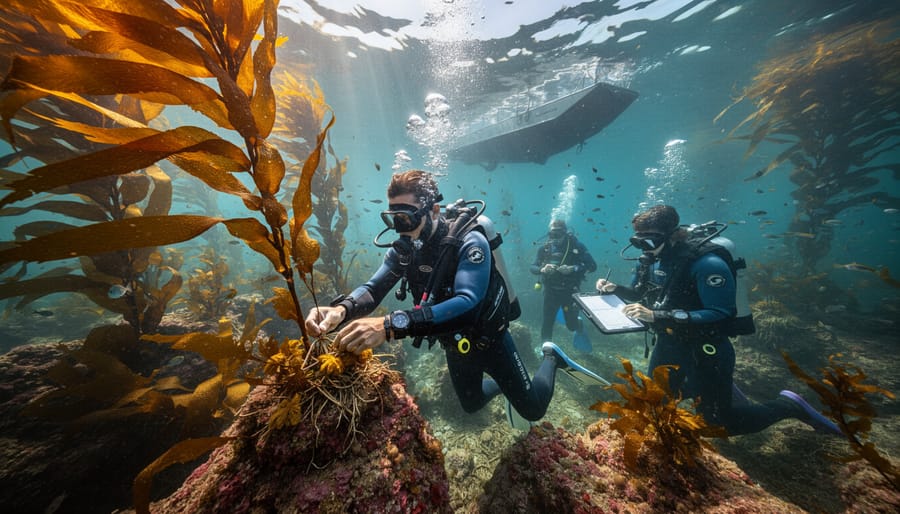
Whether kelp qualifies as a keystone species in the strictest ecological sense may continue to spark debate among scientists, but one truth remains undeniable: kelp forests are absolutely critical to ocean health. These underwater forests support hundreds of species, protect coastlines from erosion, sequester massive amounts of carbon dioxide, and provide essential nursery habitat for commercially important fish. The distinction between keystone and foundation species, while academically important, shouldn’t overshadow the urgent reality that kelp ecosystems worldwide face unprecedented threats from warming oceans, pollution, and overgrazing by sea urchins.
The loss of kelp forests would trigger cascading effects throughout marine food webs, devastating biodiversity and coastal communities that depend on healthy oceans. Understanding kelp’s ecological role—whatever we choose to call it—empowers us to become better stewards of these irreplaceable ecosystems.
You can make a tangible difference in protecting kelp forests and the incredible biodiversity they support. Consider joining our volunteer kelp monitoring programs, where you’ll work alongside marine biologists collecting vital data about forest health. As Dr. Maria Santos, one of our research coordinators, often shares with volunteers: “Every observation you record helps us understand and protect these ecosystems for future generations. Your contribution matters.”
Together, we can ensure that kelp forests continue thriving as vibrant underwater sanctuaries. The ocean’s future depends on the actions we take today—will you join us in protecting these remarkable marine ecosystems?

jessica
Ava Singh is an environmental writer and marine sustainability advocate with a deep commitment to protecting the world's oceans and coastal communities. With a background in environmental policy and a passion for storytelling, Ava brings complex topics to life through clear, engaging content that educates and empowers readers. At the Marine Biodiversity & Sustainability Learning Center, Ava focuses on sharing impactful stories about community engagement, policy innovations, and conservation strategies. Her writing bridges the gap between science and the public, encouraging people to take part in preserving marine biodiversity. When she’s not writing, Ava collaborates with local initiatives to promote eco-conscious living and sustainable development, ensuring her work makes a difference both on the page and in the real world.