Marine Biodiversity Science Center

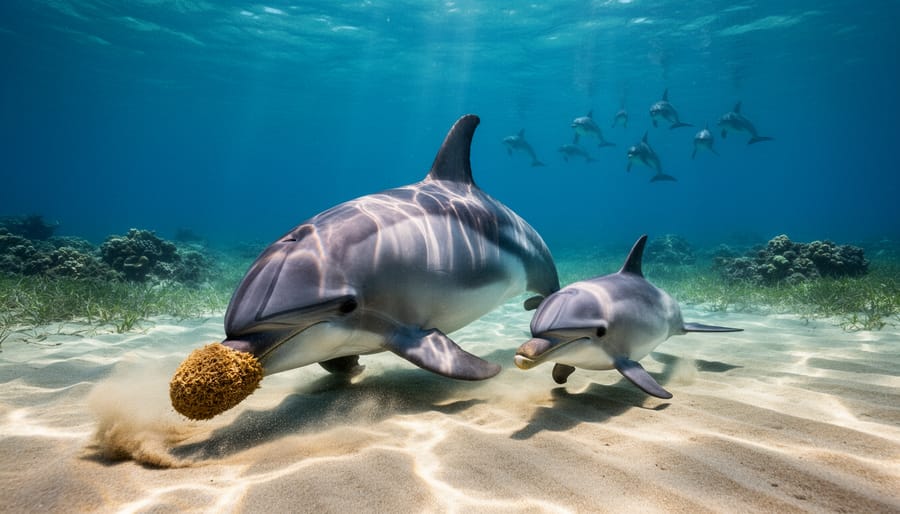
When a humpback whale teaches her calf a novel feeding technique, or a pod of dolphins passes down hunting strategies across generations, we witness something remarkable: culture in the ocean. For decades, scientists believed culture was uniquely human, but marine research has shattered this assumption. From orcas maintaining distinct dialects to sea turtles following traditional migration routes learned from their predecessors, the ocean pulses with transmitted knowledge.
Culture in marine species manifests through eight distinct traits that scientists use to identify and measure cultural transmission. These traits provide a framework for understanding how behaviors spread through populations not through genetic inheritance, but through social learning and teaching. Recognizing these patterns transforms how we view marine intelligence and carries profound implications for conservation.
A young bottlenose dolphin in Shark Bay, Australia, learns to wear a sponge on its rostrum while foraging, a technique passed exclusively from mothers to daughters for generations. This single behavior exemplifies multiple cultural traits simultaneously: innovation, dissemination, standardization, and longevity. Meanwhile, in the North Pacific, resident orcas maintain vocal traditions so distinct that family groups possess unique acoustic signatures unchanged for decades, demonstrating conformity and dialects that rival human regional accents.
Understanding these eight cultural traits matters beyond academic curiosity. When we recognize that marine populations possess irreplaceable cultural knowledge, we realize that protecting species means safeguarding their learned traditions too. A population’s survival depends not just on genetic diversity but on preserving the elders who carry generations of accumulated wisdom about migration routes, feeding grounds, and survival strategies.
This framework reveals an ocean far more complex and socially sophisticated than previously imagined, demanding conservation approaches that honor both biological and cultural heritage.
What Makes a Behavior ‘Cultural’ in Marine Species?
When we think about culture, we often imagine human societies passing down traditions, languages, and customs through generations. But culture isn’t uniquely human. In marine environments, culture refers to behaviors learned from others and transmitted through social learning rather than genetic inheritance. This distinction is fundamental to understanding how marine species develop and maintain unique traditions.
Scientists identify cultural behaviors by observing whether animals acquire skills through watching and imitating others in their group, rather than through instinct alone. Dr. Hal Whitehead, a marine biologist who has studied sperm whales for decades, explains that true cultural transmission requires three key elements: the behavior must be learned socially, persist over time, and show variation between different groups that can’t be explained by environmental differences alone.
The challenge in marine research is that observing these behaviors underwater requires patience and innovative technology. Researchers use underwater cameras, acoustic monitoring, and years of field observations to distinguish between innate responses and learned traditions. For instance, when orcas in different regions hunt using completely different techniques despite having access to the same prey, this points to cultural transmission rather than genetic programming.
Understanding these eight cultural traits helps us recognize that marine species possess complex social lives worthy of protection. Each trait represents a window into how ocean animals learn, communicate, and adapt. As we explore these traits, we’ll discover how culture shapes survival strategies, strengthens social bonds, and creates distinct identities among marine populations. This knowledge transforms how we approach conservation, recognizing that protecting marine species means preserving not just their populations, but their living traditions as well.
The Eight Cultural Traits in Marine Animals
Social Learning and Transmission
Unlike many animals whose behaviors are hardwired through instinct, marine species demonstrate remarkable abilities to acquire knowledge through observation and social interaction. This memory and learning process creates cultural knowledge that passes between individuals and across generations.
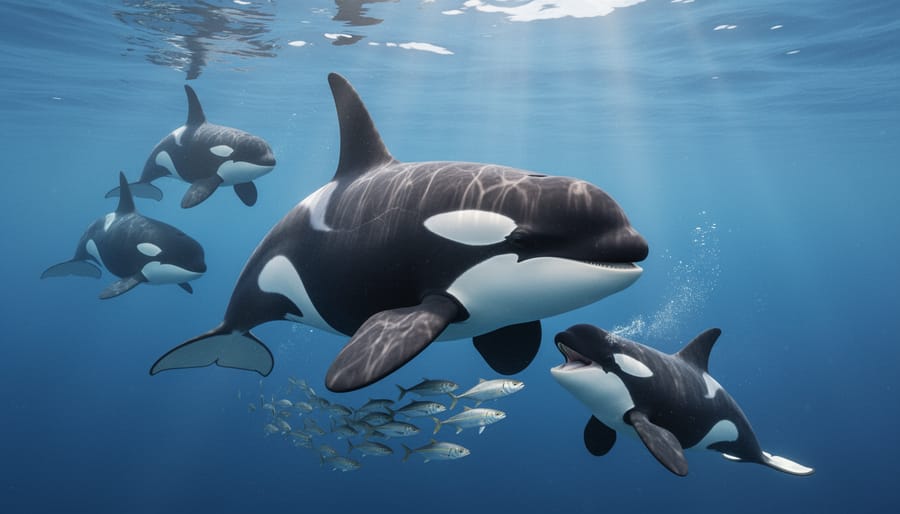
Orcas provide some of the most striking examples of socially learned hunting techniques. Different populations have developed specialized methods based on their local prey. In the Antarctic, some groups have mastered wave-washing, where they create coordinated waves to knock seals off ice floes. Meanwhile, populations in Patagonia have learned to intentionally strand themselves on beaches to catch sea lion pups, a risky technique that mothers carefully teach their young through patient demonstration.
Humpback whales showcase cultural innovation through feeding strategies. In the 1980s, researchers observed a single humpback in the Gulf of Maine performing bubble-net feeding, using exhaled air to create circular nets that concentrate fish. This technique spread rapidly through the population as whales observed and copied one another, demonstrating true cultural transmission.
Marine biologist Dr. Hal Whitehead has spent decades documenting these learning patterns in cetaceans. His research reveals that young whales spend years apprenticing with experienced individuals, practicing techniques until they achieve proficiency. This extended learning period mirrors educational processes in human societies, underscoring the sophisticated cognitive abilities required for cultural transmission and highlighting why protecting these populations means preserving irreplaceable libraries of accumulated knowledge.
Group-Specific Behaviors
Just as human communities develop distinct ways of speaking, dressing, and celebrating, marine populations of the same species exhibit remarkable behavioral variations that pass from generation to generation. These group-specific behaviors provide some of the most compelling evidence for marine culture.
Orcas offer perhaps the most striking example. Different pods maintain unique hunting strategies, dietary preferences, and orca dialects and vocalizations that distinguish one family group from another. Resident orcas in the Pacific Northwest feed primarily on salmon and use echolocation extensively, while transient orcas hunt marine mammals and remain relatively silent during hunts. Each pod’s vocal repertoire contains distinct calls that members use to maintain group cohesion, functioning much like regional accents in human populations.
In Shark Bay, Australia, researchers have documented an innovative tool-use behavior among bottlenose dolphins that exemplifies localized cultural transmission. Certain dolphins tear marine sponges from the seafloor and wear them over their rostrums while foraging in deeper channels. This sponging technique protects their sensitive beaks from sharp rocks and stingrays while probing for hidden fish. The behavior passes primarily from mothers to daughters and remains largely confined to specific family lines, demonstrating clear cultural boundaries within the population.
These group-specific behaviors reveal that marine species maintain distinct cultural identities, making each population uniquely valuable to ocean biodiversity and worthy of targeted conservation efforts.
Conformity and Social Norms
Just as humans often mirror the behaviors of those around them, marine animals demonstrate remarkable conformity to social norms within their communities. This social pressure to fit in serves an important evolutionary purpose, helping individuals learn successful survival strategies and maintain group cohesion.
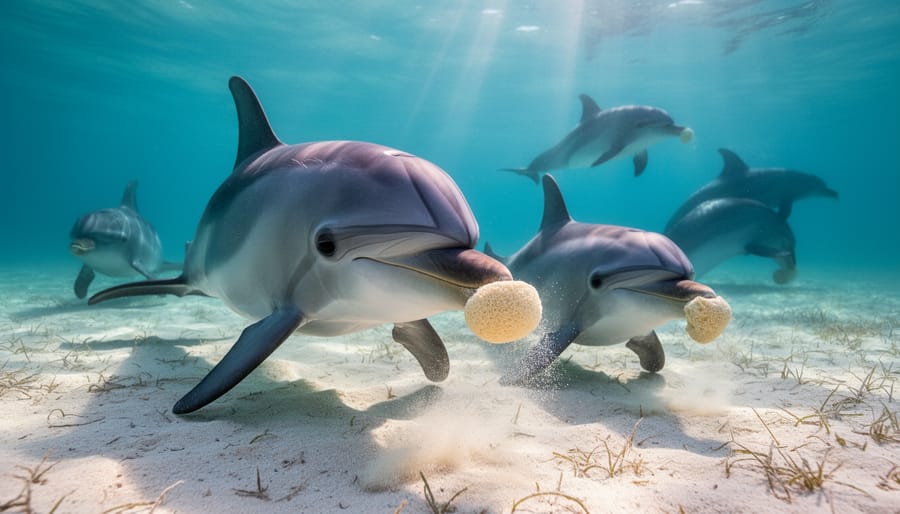
Dolphins provide compelling examples of conformity in action. In Shark Bay, Australia, researchers have documented how young dolphins adopt the specific foraging techniques practiced by their local group. While some populations use marine sponges as protective tools when searching for fish along the seafloor, others in nearby areas never exhibit this behavior, instead conforming to their own group’s traditional hunting methods. Young dolphins essentially learn what’s “normal” for their community and adjust their behavior accordingly.
Humpback whales offer another striking demonstration through their song patterns. Male humpbacks within the same ocean region sing nearly identical songs, which gradually evolve over seasons. When a whale migrates to a new area, it often abandons its original song and adopts the local version, conforming to the regional “hit single.” Marine biologist Dr. Ellen Garland describes witnessing these song revolutions spread across the Pacific, with whales choosing group harmony over individual expression.
This conformity strengthens social bonds and ensures younger generations learn proven survival techniques, highlighting how peer influence shapes marine culture across generations.
Innovation and Spread
Cultural innovation begins when a single individual discovers a novel solution to an environmental challenge. This groundbreaking behavior must then spread through social learning rather than genetic inheritance to qualify as true culture. The process demonstrates how marine intelligence and problem-solving creates adaptive advantages that ripple through entire populations.
One of the most remarkable documented cases involves a humpback whale named Salt, observed in 1980 off the coast of Massachusetts. Salt developed an innovative feeding technique called lobtail feeding, where she slapped her tail flukes on the water’s surface before diving to feed on prey stunned by the disturbance. This creative hunting method proved remarkably effective in certain conditions.
What happened next exemplifies cultural transmission in action. Other whales in Salt’s network began adopting the technique through observation and practice. By the late 1980s, dozens of humpbacks had learned lobtail feeding. Researchers tracking individual whales documented the innovation spreading through social bonds, with calves learning from mothers and peers picking up the behavior from feeding partners.
The spread wasn’t random. It followed predictable patterns based on social associations, much like trends spreading through human communities. Today, lobtail feeding remains part of the North Atlantic humpback behavioral repertoire, passed down through generations as a cultural tradition rather than an instinctive behavior encoded in their DNA.
Persistence Across Generations
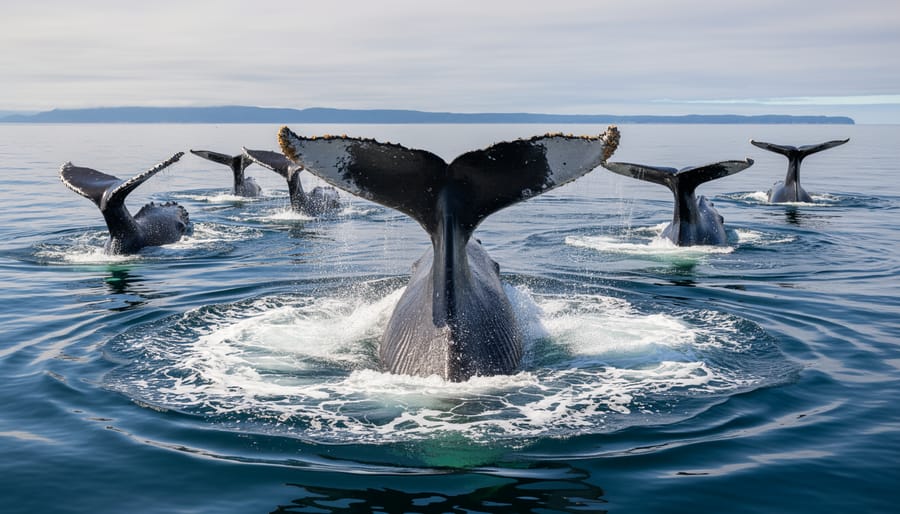
True culture isn’t hardwired in DNA—it’s taught, learned, and passed down through generations. This transmission creates behavioral lineages that can last decades or even centuries, shaping how marine populations interact with their environment long after the original innovators have disappeared.
Orcas provide stunning examples of multigenerational teaching. Grandmother orcas in the Pacific Northwest lead their pods to salmon runs using knowledge accumulated over 50-plus years. They actively teach younger whales specific hunting techniques unique to their family group. Some populations hunt seals by creating waves to wash them off ice floes, while others beach themselves intentionally to catch prey—behaviors requiring years of careful instruction to master safely.
Marine biologist Dr. Janet Mann has documented similar patterns in bottlenose dolphins at Shark Bay, Australia, where mothers spend years teaching their daughters to use marine sponges as foraging tools. This “sponging” technique protects their rostrums while probing sandy bottoms for hidden fish—a skill passed almost exclusively through maternal lines for generations.
Sea otters demonstrate persistence through tool-use traditions. Individuals favor specific rock types and techniques taught by their mothers, maintaining these preferences throughout their lives and passing them to offspring. Archaeological evidence suggests otter tool use has persisted for thousands of years.
This generational continuity means losing experienced individuals—particularly elders—can erase irreplaceable cultural knowledge, making population conservation critically urgent.
Non-Genetic Transmission
The most compelling evidence that marine cultural behaviors are learned rather than genetically programmed comes from cross-fostering experiments and observations of adopted individuals. When researchers have transplanted young marine animals into groups with different cultural practices, these individuals consistently adopt their new group’s traditions rather than expressing behaviors from their birth population.
Killer whales provide a striking example. When studying vocal dialects, scientists discovered that adopted calves learn the unique calls of their adoptive pod rather than developing the vocal patterns of their biological relatives. Similarly, bottlenose dolphins transferred between groups acquire the foraging techniques specific to their new community, even when these methods differ dramatically from those used by their birth group.
Cross-fostering studies with humpback whales have revealed that young whales learn migration routes and feeding strategies by following experienced individuals, not through genetic inheritance. Marine biologist Dr. Ellen Garland shares, “We’ve documented cases where a young humpback, separated from its birth group, adopted entirely new song patterns and migration timing from its adoptive population. This demonstrates the remarkable flexibility of cultural learning.”
These findings confirm that cultural transmission in marine species requires social learning opportunities, making the preservation of experienced individuals crucial for maintaining cultural diversity within populations.
Functional Significance
Cultural behaviors in marine species aren’t simply fascinating quirks—they serve essential survival functions that can mean the difference between thriving and struggling in challenging ocean environments. When young dolphins learn specialized foraging techniques from their mothers, such as sponging (using marine sponges as protective tools while searching for fish in rocky substrate), they gain access to food resources that untrained individuals cannot safely exploit. Research has shown that dolphins who practice sponging spend more time foraging successfully in areas where competitors cannot access prey, demonstrating a clear survival advantage.
Similarly, when orcas teach their calves specific hunting strategies tailored to local prey—whether it’s wave-washing seals off ice floes or coordinating herring roundups—they’re passing down knowledge accumulated over generations. These learned techniques often prove more efficient than trial-and-error learning, allowing populations to specialize in exploiting particular ecological niches.
Humpback whales that learn bubble-net feeding from experienced individuals can capture significantly more fish per dive than those using simpler feeding methods. This improved foraging efficiency translates directly into better body condition and reproductive success. Cultural transmission essentially accelerates learning, allowing animals to benefit from the collective experience of their social group rather than rediscovering effective strategies independently. For conservation efforts, understanding these functional benefits helps us recognize why protecting not just individual animals, but entire social groups and their accumulated knowledge, proves crucial for species resilience.
Cultural Diversity and Identity
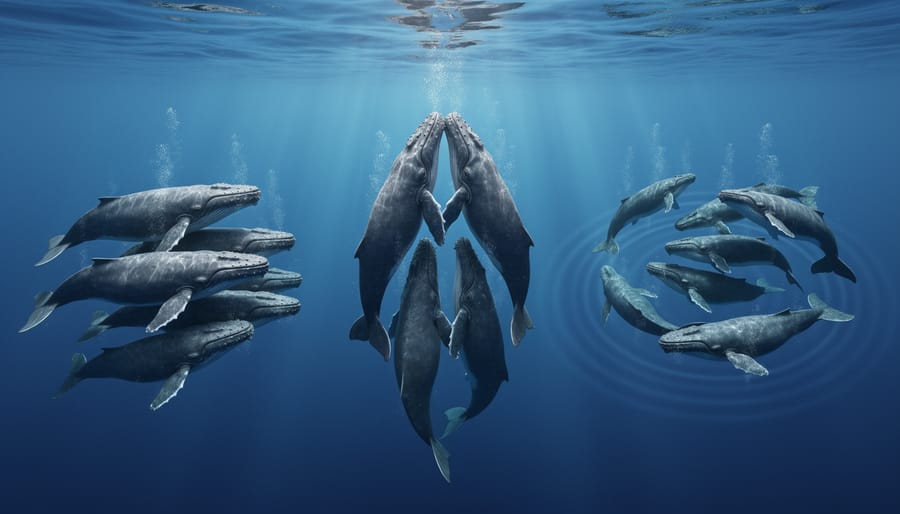
Just as human communities develop unique dialects and traditions, marine populations create their own cultural identities that distinguish one group from another. This remarkable phenomenon demonstrates that culture is not merely a human invention but a fundamental aspect of intelligent life across species.
Sperm whale clans provide perhaps the most striking example of marine cultural identity. In the Pacific Ocean, researchers have documented distinct clans, each with its own vocal dialect consisting of specific click patterns called codas. These codas function like family signatures, allowing whales to identify clan members across vast oceanic distances. The differences aren’t subtle variations but distinct communication systems that remain stable across generations, with mothers teaching daughters the clan’s unique vocal traditions. Some clans favor five regular clicks, while others use patterns of variable rhythms. These dialects shape everything from foraging locations to migration routes, creating separate cultural universes within the same species.
Bottlenose dolphins similarly develop alliance-based identities with unique signature whistles and cooperative hunting strategies. In Shark Bay, Australia, male dolphins form lifelong partnerships with distinctive bonding behaviors and coordinated tactics for securing mates. These alliances reflect complex social structures and hierarchies where cultural identity determines social success and survival. Understanding these cultural boundaries helps conservationists protect not just species, but the diverse cultural populations within them, preserving the rich tapestry of marine traditions that make each group unique.
Why Marine Cultural Transmission Matters for Conservation
Recognizing cultural transmission in marine animals fundamentally changes how we approach ocean conservation. When we understand that knowledge passes between individuals through learning rather than genetics alone, we realize that losing key members of a population can trigger cascading losses far beyond simple numbers.
Dr. Sarah Chen, a marine biologist who has spent fifteen years studying humpback whale populations in the North Pacific, recalls a pivotal moment that reshaped her conservation perspective. “We documented an experienced female who taught a unique bubble-net feeding technique to younger whales in her group,” she explains. “When she died from a ship strike, we watched that entire feeding strategy disappear within two seasons. The younger whales tried to replicate it but lacked the nuanced knowledge. That’s when I truly understood we weren’t just losing individual whales—we were losing libraries of survival knowledge.”
This insight carries profound implications for conservation strategy. Protecting marine cultures requires safeguarding entire social groups and their knowledge networks, not just maintaining population numbers. A species might appear numerically stable while simultaneously experiencing cultural collapse, particularly when experienced individuals who hold critical knowledge about migration routes, feeding grounds, or vocal traditions and communication are removed from populations.
Understanding cultural transmission also transforms how we design marine protected areas. Traditional approaches focus on habitat features and breeding grounds, but culturally informed conservation considers social connectivity, learning opportunities between generations, and the spaces where knowledge transfer occurs. For dolphin populations with distinct foraging cultures, for example, protecting specific foraging sites becomes essential for preserving those cultural practices.
Conservation efforts now increasingly recognize that recovery isn’t solely about population numbers rebounding—it’s about ensuring the survival of cultural knowledge that enables populations to thrive across changing ocean conditions. By protecting marine cultures, we preserve the adaptive capacity that helps species navigate an uncertain future.
How You Can Support Marine Cultural Research and Conservation
You can make a meaningful difference in advancing our understanding of marine cultural transmission and protecting the species that depend on these learned behaviors. Start by participating in citizen science programs that track marine animal behaviors—many research institutions welcome observations from boaters, divers, and coastal residents. These contributions help scientists map cultural variations across populations and identify critical habitats where learning occurs.
The Marine Biodiversity Science Center offers volunteer opportunities ranging from data analysis to field assistance. Whether you have an afternoon or can commit regularly, there’s a role for you. Dr. Elena Martinez, a behavioral ecologist at the Center, shares: “Our volunteers have helped identify previously unknown feeding traditions in coastal dolphin populations. Their fresh perspectives and dedication are invaluable.”
Support research initiatives through donations or by advocating for marine protected areas where cultural groups can thrive undisturbed. Join our e-network to receive updates on groundbreaking discoveries, upcoming volunteer opportunities, and ways to contribute to conservation efforts. By staying informed and engaged, you become part of a global community working to preserve not just marine species, but the rich cultural heritage they carry across generations.
The recognition that marine animals possess rich cultural traditions represents nothing short of a paradigm shift in how we understand ocean life. These eight cultural traits reveal that beneath the waves exists a tapestry of learned behaviors, social knowledge, and community traditions as complex and valuable as those found in any terrestrial species. Dolphins teaching their young to use sponge tools, orcas passing down hunting techniques through generations, and humpback whales collaboratively innovating new feeding methods all demonstrate that marine species are not merely acting on instinct—they are cultural beings.
This understanding carries profound implications for conservation. When we protect marine species, we must now recognize that we are safeguarding not just genetic diversity, but irreplaceable cultural knowledge accumulated over generations. The loss of a population means losing unique dialects, specialized foraging techniques, and migration routes that took centuries to develop. Each pod, school, or group represents a distinct cultural unit deserving protection.
Dr. Sarah Chen, a marine biologist studying Pacific orca populations, shares her perspective: “Witnessing a mother orca teaching her calf the specific vocalizations of their family group changed everything for me. We’re not just protecting animals; we’re protecting teachers, students, and entire knowledge systems.”
The encouraging news is that collective action works. Marine protected areas, sustainable fishing practices, and reduced ocean noise pollution all help preserve these cultural traditions. By supporting conservation initiatives, participating in beach cleanups, and advocating for marine protection policies, each of us contributes to safeguarding these remarkable underwater cultures for future generations to study, appreciate, and protect.

jessica
Ava Singh is an environmental writer and marine sustainability advocate with a deep commitment to protecting the world's oceans and coastal communities. With a background in environmental policy and a passion for storytelling, Ava brings complex topics to life through clear, engaging content that educates and empowers readers. At the Marine Biodiversity & Sustainability Learning Center, Ava focuses on sharing impactful stories about community engagement, policy innovations, and conservation strategies. Her writing bridges the gap between science and the public, encouraging people to take part in preserving marine biodiversity. When she’s not writing, Ava collaborates with local initiatives to promote eco-conscious living and sustainable development, ensuring her work makes a difference both on the page and in the real world.