Marine Biodiversity Science Center

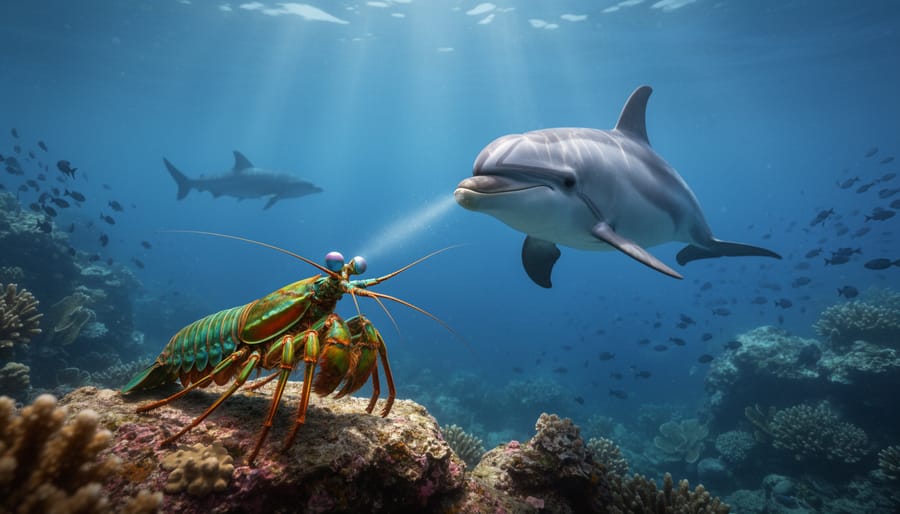
Beneath the ocean’s surface exists a sensory world beyond human imagination. A shark detecting a single drop of blood from miles away. A dolphin “seeing” through sound in complete darkness. A mantis shrimp perceiving colors we cannot even conceive. These are not science fiction scenarios but everyday realities for marine organisms that have evolved extraordinary sensory systems over millions of years.
Marine life has adapted to one of Earth’s most challenging environments, where light vanishes rapidly with depth, pressure intensifies dramatically, and chemical signals disperse unpredictably through currents. Understanding how specific organisms navigate these conditions through specialized sensory adaptations reveals the remarkable ingenuity of evolution and provides critical insights for conservation efforts. When we comprehend how sea turtles navigate using Earth’s magnetic field or how octopuses taste with their arms, we recognize what these creatures need to survive and why protecting their habitats matters urgently.
This exploration examines concrete examples across vision, echolocation, electroreception, chemoreception, and mechanoreception. Each organism demonstrates a unique solution to environmental challenges, from the bioluminescent communication of deep-sea anglerfish to the lateral line systems that allow fish to detect minute water movements. These sensory mechanisms are not merely fascinating biological curiosities; they represent evolutionary innovations that marine biologists and conservationists study to better protect vulnerable species and their ecosystems. For students, educators, and ocean advocates alike, these examples illuminate why preserving marine biodiversity means safeguarding millions of years of sensory evolution.
Vision in the Ocean Depths: Seeing Beyond Human Limits
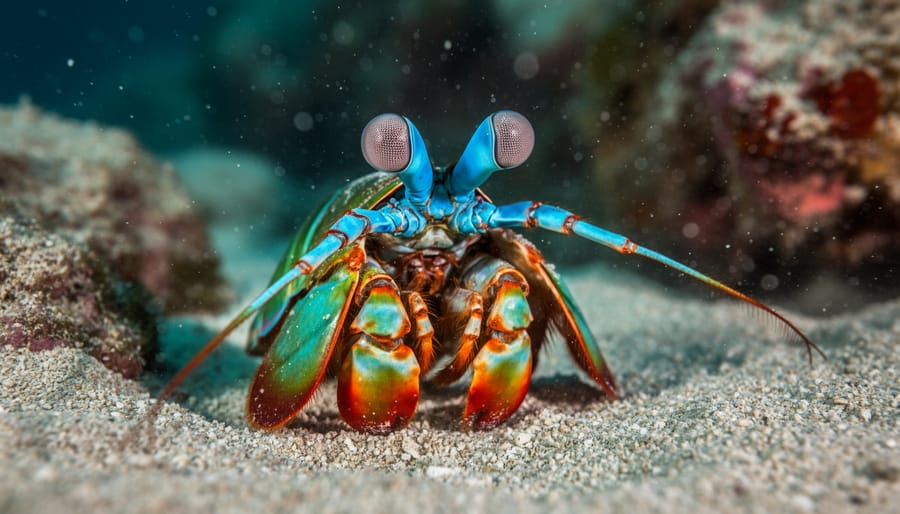
Mantis Shrimp: Masters of Color Perception
While humans navigate the world with three types of color receptors in our eyes, mantis shrimp possess an astonishing sixteen photoreceptor types, representing one of the most complex visual systems in the animal kingdom. These remarkable crustaceans, found in tropical and subtropical waters worldwide, challenge our understanding of how animals perceive their environment.
Interestingly, despite having more receptors, mantis shrimp don’t necessarily see more colors than we do. Instead, their visual system works differently. Rather than blending signals from different receptors to create a spectrum like human vision, mantis shrimp appear to process color information more rapidly. This speed advantage proves crucial for their survival.
Dr. Maya Rodriguez, a marine biologist studying mantis shrimp behavior in the Indo-Pacific, explains: “These animals live in a world of split-second decisions. When hunting or defending territory, processing visual information milliseconds faster than a competitor can mean the difference between eating and starving.”
Their extraordinary vision helps them identify prey, recognize rival mantis shrimp, and communicate through colorful body patterns invisible to most predators. Some species even possess specialized receptors for detecting polarized light, adding another layer to their perception.
Understanding mantis shrimp vision isn’t just fascinating science; it inspires technological innovations in camera design and helps conservationists protect coral reef habitats these creatures depend on. Citizen science programs now welcome volunteers to document mantis shrimp populations, contributing valuable data for reef conservation efforts worldwide.
Deep-Sea Fish: Bioluminescence and Light Detection
In the perpetual darkness of deep-sea environments, where sunlight cannot penetrate beyond 1,000 meters, fish have evolved extraordinary visual systems and bioluminescence and light production capabilities that challenge our understanding of sight itself.
The anglerfish exemplifies this remarkable adaptation. Female anglerfish possess a modified dorsal spine called an esca, which extends forward like a fishing rod and contains millions of bioluminescent bacteria. These bacteria produce light through a chemical reaction, creating an irresistible lure that attracts prey in the pitch-black depths. Their eyes, though relatively small, are highly sensitive to even the faintest glimmers of light, allowing them to detect both their own lure’s effectiveness and the bioluminescent signals of potential mates or prey.
Lanternfish, among the ocean’s most abundant vertebrates, take a different approach. These small fish possess rows of light-producing organs called photophores along their bodies. Each species displays a unique pattern, functioning like an underwater identification badge that helps individuals recognize their own kind in the darkness. Their large, tubular eyes maximize light capture, with specialized retinas packed with rod cells that detect minimal light levels.
Marine biologist Dr. Edie Widder, who has spent decades studying bioluminescence, describes her first encounter with these living lights as “witnessing an alien world where communication happens through flashes and glows rather than sound or color.”
Understanding these adaptations matters deeply for conservation. Deep-sea mining and bottom trawling increasingly threaten these fragile ecosystems. By studying how these fish navigate their dark world, we can better advocate for protected marine areas and support research initiatives. Organizations like the Ocean Conservancy offer volunteer opportunities to engage in deep-sea conservation efforts, ensuring these remarkable light-makers continue illuminating the ocean’s depths.
Echolocation and Sound: The Ocean’s Acoustic Highway
Dolphins and Whales: Biological Sonar Systems
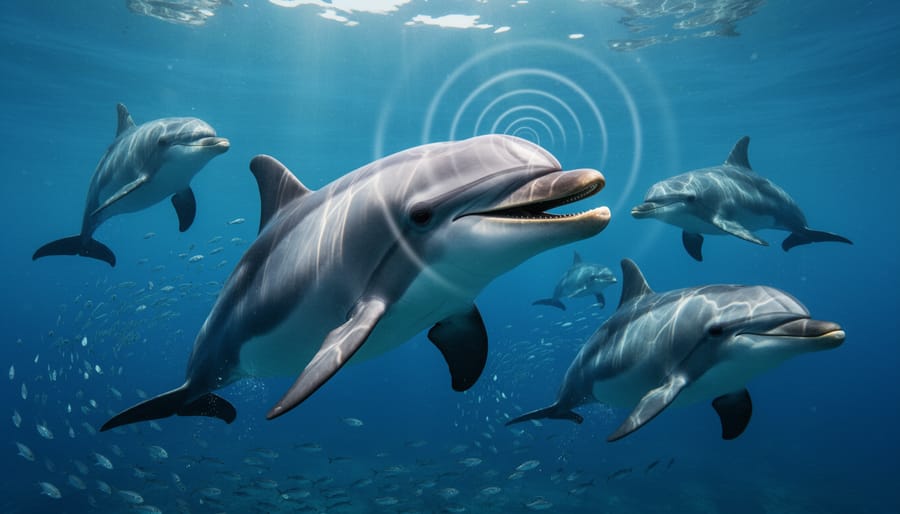
Toothed whales, including dolphins, orcas, and sperm whales, have evolved one of nature’s most sophisticated sensory systems: biological sonar, or echolocation. This remarkable adaptation allows these marine mammals to navigate, hunt, and communicate in environments where vision is often limited.
The process begins in the melon, a specialized fatty organ in the whale’s forehead. Dolphins produce rapid clicking sounds by forcing air through specialized structures in their nasal passages. These clicks are then focused by the melon into a narrow beam that projects forward into the water. When the sound waves encounter an object, they bounce back as echoes. The returning signals are received through the lower jaw, which contains fat channels that conduct sound to the inner ear. The dolphin’s brain then processes these echoes to create a detailed acoustic picture of their surroundings, revealing not just an object’s location and size, but also its texture, internal structure, and even whether it’s living or inanimate.
Dr. Sarah Mitchell, a marine biologist studying bottlenose dolphins off the coast of Florida, shares her experience: “The first time I recorded a dolphin’s echolocation clicks, I was amazed by their complexity. These weren’t just simple pings. Each click sequence tells a story about how the dolphin is perceiving its world. We’ve documented dolphins adjusting their click rates and frequencies depending on whether they’re searching for fish in murky water or examining something up close. It’s fundamentally changed how we understand marine communication.”
For those inspired to learn more about these incredible animals, several research institutions offer volunteer opportunities to assist with dolphin behavior studies and acoustic monitoring. Understanding echolocation not only deepens our appreciation for these intelligent creatures but also helps inform conservation strategies, particularly regarding noise pollution’s impact on their essential sensory system.
Why Ocean Noise Pollution Threatens These Sensory Systems
The remarkable sensory adaptations that allow marine mammals to thrive underwater now face an unprecedented threat: ocean noise pollution. Human activities have transformed the once-quiet ocean into an increasingly noisy environment, with shipping traffic, sonar operations, seismic surveys, and offshore construction generating sounds that interfere with the very systems these animals depend upon for survival.
For dolphins and whales relying on echolocation to navigate, find food, and communicate, industrial noise creates a confusing acoustic landscape. Imagine trying to have a conversation in a room where someone is constantly running a chainsaw—this is the reality for many marine mammals today. Ship propellers and drilling operations produce low-frequency sounds that can travel hundreds of miles underwater, masking the calls whales use to locate mates and maintain family bonds. Studies have documented whales abandoning critical feeding areas and mother-calf pairs becoming separated due to noise interference.
The consequences extend beyond mere annoyance. Beaked whales exposed to military sonar have stranded themselves on beaches, likely suffering from acoustic trauma. Chronic noise exposure raises stress hormone levels in marine mammals, weakening immune systems and reducing reproductive success.
Marine biologist Dr. Sarah Chen, who has studied noise impacts for fifteen years, shares a sobering observation: “We’re essentially blindfolding and deafening these animals in their own home. But the encouraging news is that noise pollution, unlike chemical contamination, stops the moment we turn off the source.”
Conservation efforts are underway, including establishing quiet zones in critical habitats and developing quieter ship technologies. Volunteer opportunities with organizations monitoring marine mammal populations help scientists track noise impacts and advocate for protective measures, turning concerned citizens into active participants in ocean conservation.
Electroreception: Sensing the Invisible Electric World
Sharks and the Ampullae of Lorenzini
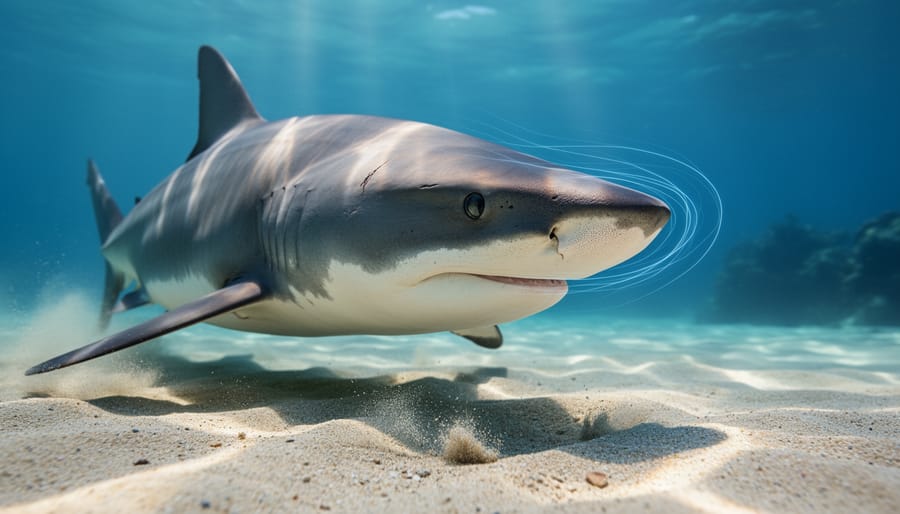
Sharks possess one of the ocean’s most extraordinary sensory abilities through specialized organs called the ampullae of Lorenzini. These remarkable structures, named after the Italian physician who first described them in 1678, appear as tiny pores scattered across a shark’s snout and head. Beneath the surface, each pore connects to a jelly-filled canal that leads to sensory cells capable of detecting the faintest electrical signals in the water.
Every living creature produces bioelectric fields through muscle contractions and nerve impulses. For sharks, the ampullae of Lorenzini can detect electrical fields as weak as five billionths of a volt per centimeter, making them among nature’s most sensitive electrical receptors. When a fish hides motionless beneath the sand, its beating heart still generates tiny electrical pulses that ripple through the surrounding seawater. A hunting shark sweeps its head from side to side, scanning with these electroreceptors until it pinpoints the hidden prey’s location with remarkable accuracy.
This electroreception ability represents one of many sophisticated survival strategies that allow sharks to thrive as apex predators. Beyond hunting, sharks use these organs for navigation by detecting the Earth’s magnetic field and for social communication during mating.
Marine biologist Dr. Sarah Chen, who studies shark sensory systems, shares an inspiring observation: “When volunteers join our tagging expeditions, they’re amazed to see sharks locate fish we’ve buried in the sand. It’s a powerful reminder that these animals aren’t mindless predators but highly evolved hunters deserving our protection and respect.” Understanding these adaptations helps conservationists develop better practices to reduce harmful shark-human interactions while preserving these essential ocean guardians.
Electric Fish: Both Sender and Receiver
Electric fish represent some of the ocean’s most remarkable sensory innovators, serving as both biological transmitters and receivers of electrical signals. Electric rays and electric eels possess specialized organs called electrocytes—modified muscle cells stacked like batteries—that generate powerful electrical discharges reaching hundreds of volts. These charges can stun prey or deter predators in an instant.
What makes these creatures even more fascinating is their dual capability. While they produce electricity, they simultaneously detect electrical fields through specialized receptors called ampullae of Lorenzini. This allows them to navigate murky waters, locate hidden prey beneath sand, and even communicate with other electric fish through species-specific electrical patterns.
Marine biologist Dr. Sarah Chen, who studies electric rays off the California coast, shares an inspiring observation: “Watching an electric ray hunt is like witnessing a living radar system. They’re incredibly efficient predators, perfectly adapted to their environment.” Understanding these electroreception abilities helps conservationists protect critical habitats where these fish thrive.
For those interested in supporting electric fish research, several marine research stations offer volunteer opportunities to assist with field studies. These programs provide hands-on experience while contributing valuable data about these remarkable organisms and their increasingly threatened coastal ecosystems.
Chemical Sensing: Taste and Smell Underwater
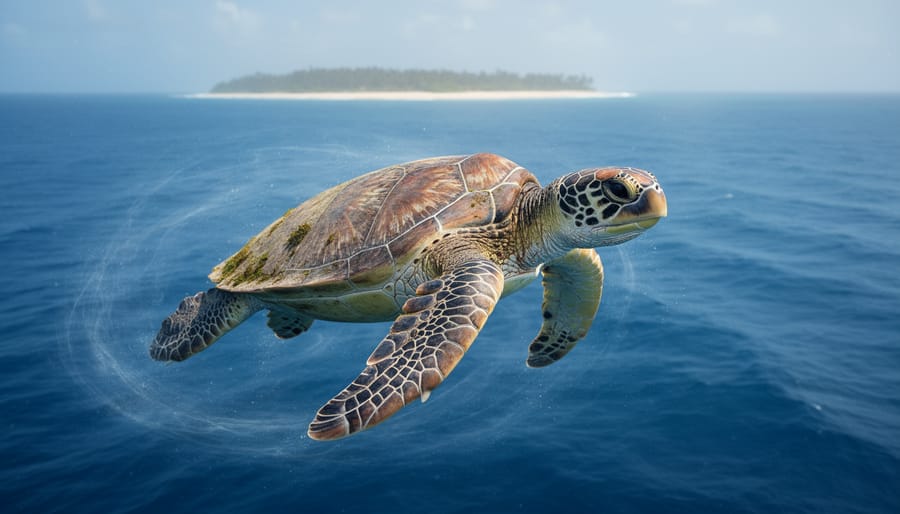
Sea Turtles: Following Chemical Trails Home
Sea turtles possess one of nature’s most remarkable navigation systems, using chemical signatures to find their way back to the exact beaches where they hatched, sometimes after 30 years at sea. Female loggerhead, green, and leatherback turtles traverse thousands of ocean miles, yet consistently return to their natal shores with pinpoint accuracy.
Scientists have discovered that sea turtles essentially follow an “olfactory map” created by unique chemical signatures in coastal waters near their birth beaches. Each beach area has a distinctive chemical profile created by local geology, vegetation, and freshwater runoff. Hatchling turtles imprint on these chemical cues during their first journey to the ocean, storing this information for decades.
Research by marine biologist Dr. Kenneth Lohmann demonstrated that sea turtles can detect minute chemical variations in ocean currents, using specialized olfactory organs. They essentially “smell” their way home through vast ocean expanses, following gradients of familiar chemical markers as they approach coastlines.
Understanding this chemical navigation has profound conservation implications. Coastal development, pollution, and climate change can alter these chemical signatures, potentially disrupting the turtles’ homing ability. Beach nourishment projects that import sand from different locations may confuse returning females.
Conservation efforts now focus on protecting not just nesting beaches but also the chemical integrity of coastal waters. Marine biologist Sarah Williams, who monitors nesting sites in Florida, shares: “Every time we preserve natural coastal ecosystems, we’re protecting invisible highways that turtles have followed for millions of years.”
Volunteers can support sea turtle conservation through beach monitoring programs and participating in efforts to reduce coastal light pollution and plastic waste that threaten these ancient navigators.
Octopuses: Tasting With Their Arms
Imagine being able to taste your surroundings simply by touching them. For octopuses, this isn’t science fiction—it’s their everyday reality. These remarkable cephalopods possess specialized chemoreceptors embedded within the suckers lining their eight arms, allowing them to simultaneously touch and taste their environment.
Each octopus arm contains hundreds of suckers, and each sucker is equipped with sensory cells that can detect chemical compounds. When an octopus explores a crevice or handles potential prey, it’s gathering detailed chemical information about texture, taste, and composition all at once. This dual-purpose system proves invaluable for hunting in murky waters or dark reef cavities where vision becomes limited.
Marine biologist Dr. Sarah Chen, who studies octopus behavior at a coastal research station, describes this ability as “like having taste buds on your fingertips.” Her team’s observations reveal how octopuses use this chemotactile sense to distinguish between food items and make split-second decisions about what to eat.
Understanding these sophisticated sensory adaptations helps researchers develop better conservation strategies, particularly when designing marine protected areas that preserve the complex habitats these intelligent creatures depend upon. Volunteers at marine research centers often assist in documenting octopus behavior, contributing valuable data about how these animals interact with their environment.
Mechanoreception: Feeling Vibrations and Pressure
The Lateral Line System in Fish
Imagine navigating a dark room by feeling the subtle movements of air around you—this is essentially how fish experience their underwater world through the lateral line system. This remarkable sensory organ runs along both sides of a fish’s body, appearing as a faint line of specialized scales containing tiny hair-like structures called neuromasts. These neuromasts detect even the slightest water movements and pressure changes, creating a three-dimensional map of the fish’s surroundings.
The lateral line functions like an underwater radar system, helping fish accomplish extraordinary feats. When schools of sardines or herring move in perfect synchronization, abruptly changing direction as one unified body, they’re responding to water displacement signals detected through their lateral lines. Each fish senses the movements of its neighbors within milliseconds, allowing thousands of individuals to coordinate without collision.
Predatory fish like sharks and bass use this system to hunt effectively, even in murky water or complete darkness. They detect the subtle vibrations created by prey swimming nearby—the flutter of fins or the displacement of water as smaller fish try to escape. Dr. Maria Santos, a sensory biologist studying reef ecosystems, shares that “watching a grouper hunt using its lateral line is mesmerizing. It can pinpoint prey hiding in coral crevices purely through water movement detection.”
This sensory adaptation also helps fish avoid obstacles and navigate strong currents, making it essential for survival. Understanding how pollution and underwater noise interfere with this delicate system has become crucial for marine conservation efforts, as environmental disturbances can disorient fish and disrupt their natural behaviors.
Harbor Seals: Whiskers as Precision Sensors
Harbor seals possess remarkable whiskers, called vibrissae, that function as underwater tracking devices of extraordinary precision. These specialized sensory organs can detect the faint water disturbances left behind by swimming fish, allowing seals to hunt successfully even in murky water or total darkness where vision becomes useless.
Each vibrissa contains thousands of nerve endings that detect minute pressure changes in the water. When a fish swims by, it creates a hydrodynamic trail—a wake of swirling water that persists for up to 30 seconds. The seal’s whiskers pick up these subtle water movements, enabling the animal to determine not just the direction of its prey, but also the size and swimming speed of the fish.
Marine biologist Dr. Sarah Jennings, who studies seal behavior in Alaska, shares an inspiring observation: “Watching a seal navigate pitch-black waters to catch fish demonstrates nature’s ingenuity. Understanding these adaptations helps us protect critical hunting grounds from pollution and noise that might interfere with their sensory abilities.” This research has practical conservation applications, informing marine protected area design and helping minimize human impacts on seal populations. Volunteers can support seal monitoring programs along coastlines, contributing valuable data about these fascinating predators.
Why Understanding Marine Sensory Systems Matters for Conservation
Understanding how marine creatures sense their environment isn’t just fascinating science—it’s essential for protecting ocean life. Knowledge of marine sensory systems directly informs conservation strategies, helping scientists design better protection measures and reduce human-caused threats.
Consider noise pollution. Knowing that whales rely on echolocation to navigate, communicate, and find food across hundreds of miles has transformed shipping regulations in critical habitats. Conservationists now advocate for designated quiet zones and seasonal speed restrictions during migration periods. Similarly, understanding that fish use their lateral line systems to detect vibrations has influenced offshore wind farm placement and construction methods to minimize disruption to spawning grounds.
Light pollution presents another challenge that sensory research helps address. Sea turtle hatchlings navigate toward the ocean using natural moonlight reflecting off waves. Beach communities near nesting sites now implement turtle-friendly lighting programs, replacing bright white lights with amber alternatives that don’t interfere with this ancient navigational system. This simple change, rooted in sensory science, has saved countless hatchlings.
Marine biologist Dr. Sarah Chen shares her experience: “When we documented how coral reef fish use chemical cues to locate suitable settlement sites, it completely changed restoration approaches. We now ensure water quality supports these chemical signals, dramatically improving juvenile survival rates on restored reefs.”
This knowledge also guides marine protected area design. Recognizing that sharks use electroreception to hunt means protecting areas with specific seafloor features and current patterns that concentrate prey. For migratory species using magnetic fields for navigation, conservation corridors account for geomagnetic pathways.
Volunteers can contribute to this work through citizen science programs monitoring marine mammal behavior, participating in beach cleanups that reduce sensory-disrupting debris, and supporting organizations conducting sensory research. Every action informed by understanding how marine life experiences their world creates tangible conservation benefits, protecting ocean biodiversity for future generations.
Get Involved: Opportunities to Support Marine Sensory Research
The remarkable sensory adaptations you’ve discovered in marine organisms need our protection, and you can play a vital role in safeguarding these evolutionary wonders. Conservation efforts focused on marine biodiversity directly preserve the unique sensory systems that allow these creatures to thrive.
The Marine Biodiversity Science Center offers hands-on volunteer opportunities for people of all backgrounds. From assisting with field research on bioluminescent organisms to helping catalog species diversity in local tide pools, volunteers gain firsthand experience while contributing valuable data. Dr. Maria Santos, a marine biologist at the center, shares that “our volunteer observers have identified previously undocumented behaviors in harbor seals, helping us understand how these animals use their vibrissae to hunt in murky waters.”
Citizen science projects provide accessible entry points for supporting research. Programs like Ocean Eyes recruit participants to photograph and report marine life sightings, building databases that track population changes and habitat use. The Soundscape Monitoring Initiative trains volunteers to record underwater environments, helping scientists understand how noise pollution affects echolocating dolphins and communicating fish.
Supporting marine protected areas ensures these sensory adaptations continue evolving. Contributing to organizations working to reduce ocean noise pollution, limit coastal light pollution, and protect critical habitats directly benefits the organisms we’ve explored. Even small actions matter: participating in beach cleanups removes debris that interferes with sensory systems, while advocating for sustainable fishing practices protects entire ecosystems.
Your involvement, whether through volunteering, citizen science participation, or conservation support, helps ensure future generations can continue discovering the extraordinary ways marine life experiences their underwater world.
The sensory worlds of marine organisms reveal an ocean far richer and more complex than we can perceive with our human senses alone. From the electrical fields detected by sharks to the bioluminescent displays of deep-sea creatures, these adaptations represent millions of years of evolutionary refinement. Each organism we’ve explored demonstrates not just survival, but remarkable sophistication in navigating the challenges of underwater life.
Yet this underwater symphony of senses faces unprecedented threats. Climate change, ocean acidification, pollution, and habitat destruction don’t just harm marine life; they disrupt the very sensory systems these organisms depend on. When ocean noise pollution interferes with whale communication or when acidification affects chemical sensing in crustaceans, we’re witnessing the unraveling of ancient biological connections.
But there’s genuine reason for hope. Dr. Sarah Chen, a marine biologist studying coral reef ecosystems, shares an inspiring perspective: “Every person who learns about these incredible adaptations becomes an ambassador for the ocean. I’ve seen volunteers with no scientific background become passionate advocates after just one encounter with bioluminescent plankton.”
Your engagement matters. Whether you support marine protected areas, participate in beach cleanups, reduce plastic consumption, or simply share what you’ve learned about these extraordinary creatures, you contribute to their protection. Consider joining local marine conservation groups or volunteering for citizen science projects that monitor marine biodiversity. Together, we can ensure that future generations will continue to discover and marvel at the sensory wonders thriving beneath the waves.

jessica
Ava Singh is an environmental writer and marine sustainability advocate with a deep commitment to protecting the world's oceans and coastal communities. With a background in environmental policy and a passion for storytelling, Ava brings complex topics to life through clear, engaging content that educates and empowers readers. At the Marine Biodiversity & Sustainability Learning Center, Ava focuses on sharing impactful stories about community engagement, policy innovations, and conservation strategies. Her writing bridges the gap between science and the public, encouraging people to take part in preserving marine biodiversity. When she’s not writing, Ava collaborates with local initiatives to promote eco-conscious living and sustainable development, ensuring her work makes a difference both on the page and in the real world.