Marine Biodiversity Science Center

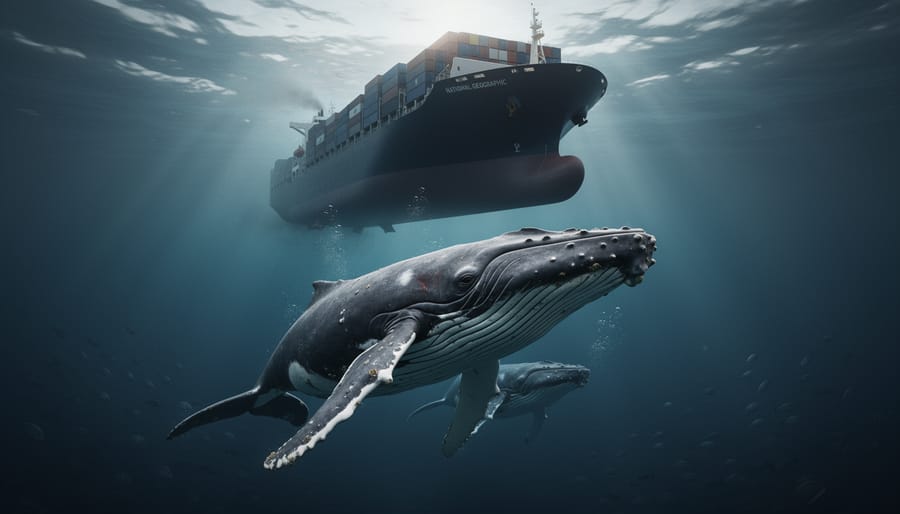
Beneath the ocean’s seemingly silent surface, a cacophony of human-generated noise is drowning out the natural soundscape that marine life depends upon for survival. Ship engines, seismic surveys, underwater construction, and military sonar create an invisible but devastating form of pollution affecting marine life across every ocean on Earth.
Sound travels four times faster through water than air, transforming our seas into echo chambers of industrial din. For whales navigating migration routes, dolphins hunting cooperatively, and fish larvae searching for suitable reef habitats, this underwater noise pollution disrupts critical life functions with consequences that ripple through entire ecosystems. Research shows that chronic noise exposure causes marine mammals to abandon feeding grounds, interferes with their ability to communicate across vast distances, and in severe cases, leads to physical trauma including hearing loss and tissue damage.
The impact extends far beyond charismatic megafauna. Scientists have documented behavioral changes in species from tiny shrimp to massive whale sharks, revealing that noise pollution affects the foundation of marine food webs. Commercial shipping alone has increased ocean ambient noise levels by 32 times since the 1960s, creating a global crisis that demands immediate attention.
Yet there is reason for hope. Unlike plastic waste or chemical contamination, noise pollution stops the moment the source is silenced. This article explores how underwater sound affects different marine species, examines compelling research from field biologists working to protect vulnerable populations, and presents proven solutions already making a difference. Most importantly, you will discover concrete ways to join the movement toward quieter oceans, from supporting ship speed reduction initiatives to participating in citizen science monitoring programs that track acoustic health in coastal waters.
What Is Marine Noise Pollution?
The Ocean’s Natural Symphony
Far from being a silent realm, the ocean is alive with sound. Natural underwater acoustics create a complex symphony—waves crashing against shorelines, rain pattering on the surface, ice cracking in polar regions, and the rumble of underwater volcanic activity. These ambient sounds form the ocean’s baseline acoustic environment, a soundscape that marine life has adapted to over millions of years.
For ocean dwellers, sound is essential for survival. Unlike light, which penetrates only the upper layers of water, sound travels efficiently through the marine environment—about four times faster than in air. Whales use low-frequency calls to communicate across entire ocean basins, with some songs traveling hundreds of miles. Dolphins employ sophisticated echolocation, emitting clicks that bounce off objects to create mental maps of their surroundings. Fish use sound to locate spawning grounds, avoid predators, and find suitable habitat.
Marine biologist Dr. Sarah Chen explains, “Imagine trying to navigate your neighborhood blindfolded while wearing earplugs—that’s what noise pollution does to marine animals. Sound is their primary sense.” This dependence makes ocean creatures particularly vulnerable to human-generated noise, which can mask these vital natural sounds and disrupt the delicate acoustic balance upon which marine ecosystems depend.
Human-Made Noise: The Disruptors
Our oceans have become unexpectedly noisy places, and humans are the primary culprits. Understanding the sources of this underwater cacophony is the first step toward protecting marine ecosystems.
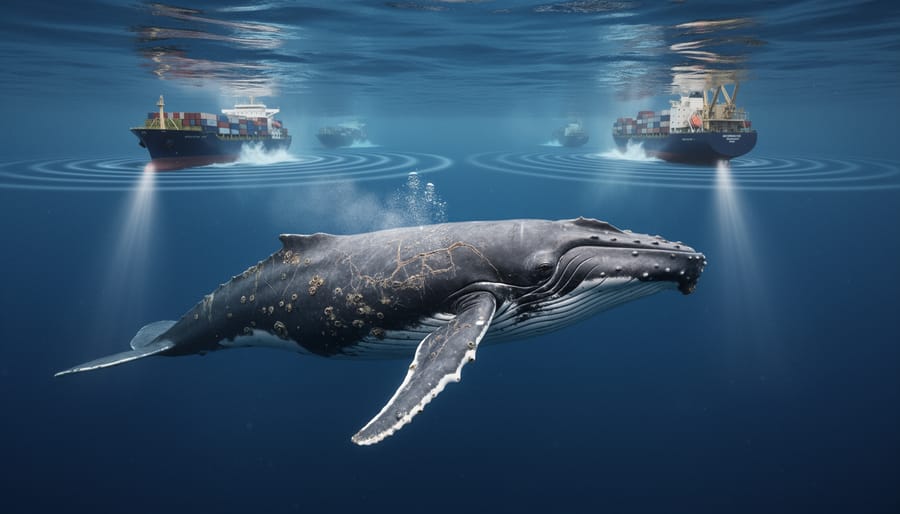
Commercial shipping generates the most pervasive anthropogenic noise, with massive cargo vessels producing low-frequency sounds between 20-200 Hz that can travel hundreds of miles underwater. These frequencies overlap precisely with the communication ranges of baleen whales, effectively drowning out their songs. Dr. Maria Santos, a marine acoustics researcher, recalls her first hydrophone deployment: “I expected to hear whale calls, but instead, I heard nothing but ship engines—a constant rumble that never stopped, even in supposedly remote areas.”
Military sonar systems emit intense mid-frequency sounds (1-10 kHz) that have been linked to mass whale strandings. Naval exercises can produce sound levels exceeding 235 decibels underwater, powerful enough to cause physical trauma to marine mammals.
Seismic surveys for oil and gas exploration use airguns that blast compressed air every 10-15 seconds, creating sounds at 215-260 decibels. These shock waves can travel across entire ocean basins, disrupting marine life thousands of miles away.
Coastal construction, pile-driving for offshore wind farms, and recreational boating add to the din. Even seemingly quiet activities accumulate; the collective hum of thousands of pleasure boats in popular coastal areas creates significant acoustic pollution.
Each noise source operates at different frequencies, but together they create an overwhelming soundscape that fundamentally alters how marine animals navigate, communicate, and survive.
How Marine Animals Experience Sound
Masters of Echolocation: Whales and Dolphins
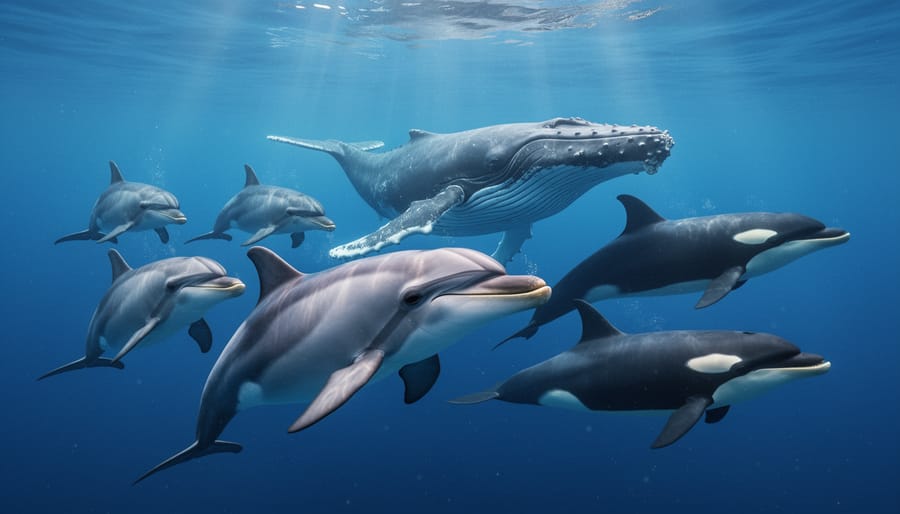
Whales and dolphins have evolved perhaps the most sophisticated sound-based navigation systems in the natural world. These remarkable marine mammals produce clicks, whistles, and songs that travel through the ocean, bouncing off objects and returning as echoes that paint detailed acoustic pictures of their surroundings. This echolocation allows them to hunt prey in complete darkness, navigate through murky waters, and detect predators from miles away.
Sound serves far more than a navigation tool for cetaceans. Humpback whales compose complex songs that can travel across entire ocean basins, allowing males to attract mates and establish territories. Orca pods develop unique dialects that identify family groups and strengthen social bonds across generations. Mother dolphins teach their calves signature whistles, essentially giving them names that they’ll carry throughout their lives.
Dr. Sarah Mitchell, a marine biologist who has studied dolphin communication for fifteen years, explains: “When we think about how cetaceans experience their world, we need to understand that sound is everything to them. It’s their vision, their language, their culture. Disrupting their acoustic environment is like turning off the lights in our own homes.”
For species that have spent millions of years perfecting these acoustic abilities, the rise of ocean noise pollution presents an unprecedented challenge to their very survival.
Beyond Mammals: Fish, Invertebrates, and Sound
While whales and dolphins often dominate the conversation about marine noise pollution, fish and invertebrates face equally serious threats. Researchers have discovered that over 800 fish species communicate through vibrations, grunts, and pops—essential for mating, defending territory, and navigating. Marine biologist Dr. Elena Rodriguez observed during her fieldwork that damselfish exposed to boat noise struggled to detect predator warnings from neighboring fish, leaving them vulnerable to attack.
Invertebrates, though seemingly simple, rely on sound in surprising ways. Scallops use acoustic cues to detect approaching predators, while larval crabs depend on reef sounds to locate suitable habitats for settlement. Studies reveal that squid experience stress responses to loud noises, affecting their hunting abilities and reproduction rates.
The impact extends beyond individual species. When noise disrupts fish spawning aggregations, entire food webs suffer. Citizen scientists can contribute to understanding these effects through programs monitoring fish vocalizations in local waterways—simple hydrophone recordings help researchers map communication patterns and identify noise hotspots. These lesser-known species remind us that ocean acoustics support biodiversity at every level, making noise reduction critical for complete ecosystem health.
Devastating Impacts on Marine Life
Behavioral Changes and Displacement
Underwater noise disrupts the carefully balanced lives of marine animals in profound ways, forcing them to make difficult choices about where to live and how to survive. When their acoustic environment becomes unbearable, many species simply leave, abandoning feeding grounds they’ve used for generations.
Research off the coast of British Columbia documented how orcas shifted their migration routes to avoid areas with heavy shipping traffic. Marine biologist Dr. Sarah Chen, who spent three years tracking these populations, shares: “We watched entire pods detour up to 50 kilometers out of their way, burning precious energy reserves just to escape the noise. Some traditional hunting grounds now sit completely empty during peak salmon runs.”
Humpback whales in the Atlantic have shown similar displacement patterns, with studies revealing a 30% reduction in their use of historically important breeding areas near busy shipping lanes. The animals don’t just move randomly—they’re seeking quieter waters, even if it means traveling to less productive feeding zones.
Feeding behaviors change dramatically too. Fish exposed to persistent noise show reduced foraging efficiency, spending more time in vigilance mode and less time actually eating. Reef fish studies demonstrate that chronic noise exposure causes juveniles to make poor habitat choices, selecting suboptimal locations that leave them more vulnerable to predators. These behavioral shifts have cascading effects throughout the ecosystem, ultimately threatening population stability.
Communication Breakdown
The ocean’s soundscape serves as a vital communication highway for marine mammals, but increasing noise pollution is drowning out the acoustic signals these animals depend on for survival. Whales, dolphins, and other marine species rely on vocalizations to find mates, maintain contact between mothers and calves, and coordinate group activities. When shipping traffic, seismic surveys, and sonar overlap with their communication frequencies, the results can be devastating.
North Atlantic right whales provide a particularly compelling example of this crisis. With fewer than 350 individuals remaining, every successful breeding opportunity matters. Dr. Susan Parks, a marine biologist studying these critically endangered whales, shares a sobering observation: “We’ve documented mothers and calves swimming just meters apart, calling to each other but unable to connect because vessel noise masks their contact calls.” Research shows that right whales have had to increase their call amplitude by nearly 15 decibels over the past few decades, similar to humans shouting over loud music.
For social species like orcas that hunt cooperatively and maintain complex family bonds, communication breakdowns fragment social structures and reduce hunting success. The acoustic interference effectively isolates individuals within their own pods, disrupting behaviors refined over millennia. Understanding these impacts helps researchers develop targeted conservation strategies that protect critical communication periods and habitats.
Physical Harm and Hearing Damage
The physical toll of underwater noise on marine animals can be devastating and, in some cases, lethal. Just as prolonged exposure to loud music can damage human hearing, intense underwater sounds cause temporary or permanent hearing loss in marine mammals and fish. Marine biologist Dr. Sarah Chen recalls examining stranded dolphins along the California coast: “The damage to their inner ear structures was unmistakable—these animals had essentially gone deaf, losing their ability to navigate, hunt, and communicate with their pods.”
Naval sonar exercises have been directly linked to mass strandings, particularly among beaked whales. These deep-diving mammals are especially vulnerable to mid-frequency sonar, which can cause them to surface too rapidly, leading to decompression sickness—similar to “the bends” in human divers. Autopsies reveal hemorrhaging around the brain, ears, and other organs, painting a grim picture of their final moments.
Beyond hearing damage, intense noise causes physical tissue trauma. Studies document lesions in fish swim bladders, ruptured blood vessels, and stress-induced organ damage. The impacts cascade through entire ecosystems—a deaf seal pup cannot respond to its mother’s calls, and disoriented fish schools become easy prey. Understanding these physical harms underscores why reducing ocean noise isn’t just about comfort; it’s about survival.
Chronic Stress and Population Effects
Prolonged exposure to underwater noise creates cascading effects that extend far beyond immediate behavioral changes. Marine mammals subjected to chronic noise pollution experience persistently elevated stress hormones, particularly cortisol, which weakens immune systems and makes animals more vulnerable to disease. Dr. Sarah Chen, a marine physiologist who has studied whale populations near shipping lanes, shares: “We’ve documented stress hormone levels in right whales that remain elevated for months, similar to what humans experience under constant anxiety.”
These physiological changes have profound reproductive consequences. Studies show that chronic noise exposure correlates with reduced breeding success across multiple species, from fish to dolphins. Female whales in noisy environments produce fewer calves, while fish populations show decreased spawning rates and lower egg viability. The cumulative ocean pollution impacts disrupt entire food webs, as prey species abandon traditional habitats and predators struggle to hunt effectively.
At the ecosystem level, noise pollution fragments marine habitats much like highways divide terrestrial landscapes, creating “acoustic barriers” that isolate populations and reduce genetic diversity. These disruptions threaten the resilience of marine ecosystems already stressed by climate change and overfishing.
Species in the Spotlight: Real Stories of Impact
The Lonely Whales: When Songs Go Unheard
Dr. Sarah Mitchell, a marine acoustics researcher with over fifteen years studying whale communication, describes the challenge with a poignant analogy: “Imagine trying to have a conversation with someone across a crowded highway. That’s what whales face in today’s oceans.”
Perhaps no case illustrates this struggle more powerfully than the 52 Hertz whale, nicknamed “the world’s loneliest whale.” This individual vocalizes at a frequency of 52 Hertz, higher than typical whale calls, making communication with others difficult. While scientists debate whether shipping noise caused this unique frequency, the whale’s story highlights a broader crisis: as ocean noise levels have doubled each decade since the 1960s, whales must “shout” over the din just to be heard by their pods.
Humpback whales have been documented increasing their song amplitude by 15 decibels in high-traffic shipping lanes, the equivalent of raising your voice in a noisy room. Blue whales, whose songs once traveled hundreds of miles across ocean basins, now find their communication range reduced by up to 90 percent in some regions.
“We’re witnessing a breakdown in the social fabric of whale communities,” Dr. Mitchell explains. “Mother-calf pairs struggle to maintain contact, mating songs go unheard, and feeding coordination becomes nearly impossible. The isolation is real, and it’s growing.”
These communication breakdowns don’t just affect individual whales; they threaten entire populations’ ability to survive and reproduce.
Reef Communities Under Acoustic Siege
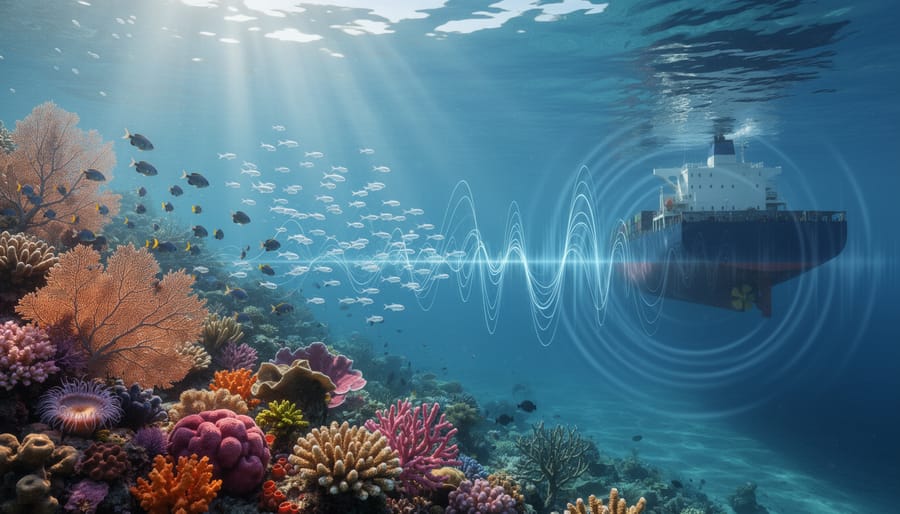
Coral reefs, often called the rainforests of the sea, depend on sound for their survival in ways scientists are only beginning to understand. These vibrant coral reef ecosystems create distinct soundscapes—a crackling symphony produced by snapping shrimp, grazing fish, and other reef inhabitants. Baby fish use these acoustic cues to locate suitable settlement sites, swimming toward healthy reefs from open ocean nurseries.
Dr. Sarah Mitchell, a reef ecologist who has studied reef soundscapes for over a decade, explains the problem: “When boat engines, construction, and shipping noise drown out natural reef sounds, fish larvae simply can’t find their way home. We’ve documented up to 40% reduction in larval settlement rates near chronically noisy areas.”
This disruption compounds other threats to coral reefs, preventing recovery after bleaching events and reducing biodiversity. Research shows that noise stress also affects coral spawning synchronization and the crucial communication between reef species.
The encouraging news? Marine protected areas with vessel restrictions show measurable improvement in soundscape quality within months. Organizations like the Reef Soundscape Monitoring Project welcome volunteers to help deploy acoustic recording equipment, contributing directly to research that informs better management strategies.
Solutions and What’s Being Done
Policy and Protection Measures
Recognizing the urgent need to protect marine life from acoustic harm, the international community has developed several protective frameworks. The International Maritime Organization (IMO) has issued guidelines encouraging quieter ship designs and operational practices, while regional bodies like the European Union have incorporated underwater noise into their Marine Strategy Framework Directive, requiring member states to maintain ocean soundscapes at levels that don’t adversely affect marine ecosystems.
Marine protected areas increasingly incorporate acoustic considerations, with some designated as quiet zones where vessel speeds are reduced and industrial activities restricted. The Stellwagen Bank National Marine Sanctuary off Massachusetts pioneered vessel speed reduction programs that successfully lowered noise levels in critical whale feeding grounds. Similarly, Canada’s voluntary slowdown initiative in shipping lanes near Vancouver reduced underwater noise by six decibels, demonstrating measurable benefits for resident orca populations.
Dr. Maria Castellanos, a marine policy specialist, shares her perspective: “Legal protections are expanding, but enforcement remains challenging. What excites me is seeing communities take ownership—I’ve worked with citizen scientists who monitor local noise levels and advocate for stronger protections. Their passion drives real change.”
Volunteer opportunities exist through organizations conducting acoustic monitoring and advocating for stricter regulations. By supporting these efforts and staying informed about policy developments, individuals can help shape a quieter, healthier ocean for future generations.
Innovation in Action: Quieter Technologies
The marine conservation community is responding to underwater noise pollution with innovative technological solutions that offer real hope for quieter oceans. Engineers and researchers are redesigning ship propellers with advanced blade configurations that significantly reduce cavitation—the bubble formation that creates much of a vessel’s noise signature. Some shipping companies have already retrofitted their fleets with these quieter propellers, achieving noise reductions of up to 75%.
During offshore construction projects, bubble curtains have emerged as an effective mitigation tool. These systems release compressed air that creates a wall of bubbles around pile-driving operations, absorbing and deflecting harmful sound waves before they travel through the water. When deployed properly, bubble curtains can reduce noise levels by 10-20 decibels, providing crucial protection for nearby marine life.
The oil and gas industry is also transitioning away from disruptive seismic airguns for seafloor surveys. Marine vibroseis technology uses controlled vibrations instead of explosive blasts, producing significantly less acoustic impact while still gathering necessary geological data. Dr. Sarah Mitchell, a marine acoustics researcher, shares her optimism: “These technologies prove we don’t have to choose between human activities and ocean health. With thoughtful innovation, we can accomplish both.” As these solutions become more widespread and affordable, they’re paving the way toward genuinely sustainable ocean use.
Success Stories: Where Progress Is Happening
Hope shines through inspiring initiatives already making waves in ocean conservation. In Canada’s Haro Strait, a voluntary vessel slowdown program reduced underwater noise by 25-30% during critical feeding times for endangered Southern Resident orcas. Marine biologist Dr. Sarah Chen, who monitors the population, shares: “We’ve observed calmer behavior and more successful hunting patterns during quiet periods—it’s proof that small changes create real impact.”
The International Maritime Organization’s new ship quieting guidelines have prompted innovative hull designs that cut noise emissions by up to 50%. Meanwhile, Boston Harbor’s seasonal shipping route adjustments helped right whale populations increase communication range significantly. These successes demonstrate that when science meets collective action, marine life responds positively. Volunteer monitoring programs now track these improvements, offering citizen scientists meaningful ways to document recovery and contribute to ongoing research efforts.
How You Can Make a Difference
Support Research and Monitoring
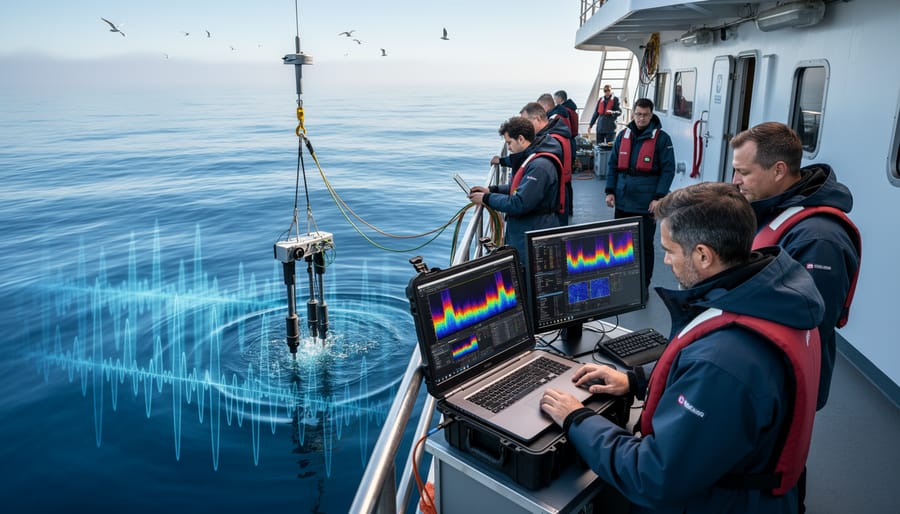
You can directly contribute to conservation efforts by participating in citizen science programs that monitor ocean noise. Acoustic monitoring networks worldwide rely on volunteers to help deploy hydrophones, analyze sound recordings, and report marine mammal sightings. These contributions provide scientists with invaluable data about noise levels and marine life behavior across vast ocean areas.
The Marine Biodiversity Science Center offers hands-on volunteer opportunities where you can work alongside marine biologists collecting acoustic data and learning monitoring techniques. Dr. Sarah Chen, who coordinates our citizen science program, shares: “Our volunteers have helped identify critical whale migration corridors affected by shipping traffic, directly informing policy changes.”
Even from home, you can participate by analyzing underwater recordings through online platforms, helping researchers identify marine mammal calls and distinguish them from anthropogenic noise. Your observations contribute to long-term datasets that reveal patterns scientists might otherwise miss, strengthening the scientific foundation for protective regulations and quieter ocean technologies.
Advocacy and Awareness
Protecting marine life from noise pollution requires collective action, and you can make a meaningful difference today. Start by supporting legislative efforts that promote quieter ocean technologies and establish marine protected acoustic sanctuaries. Contact your representatives to advocate for stricter regulations on shipping noise and offshore industrial activities.
Our marine conservation center offers numerous ways to get involved. Join our e-network to receive monthly updates on ocean noise research, upcoming advocacy campaigns, and volunteer opportunities. We regularly need citizen scientists to help monitor coastal soundscapes and document marine mammal behavior. Marine biologist Dr. Sarah Chen shares, “Having community volunteers assist with our acoustic monitoring program has expanded our research capacity tenfold. Their dedication directly contributes to policy recommendations we submit to maritime authorities.”
Spread awareness by sharing educational resources with your community, schools, and social media networks. Organize beach cleanups that incorporate discussions about underwater noise impacts. Support organizations working on ocean quieting technologies and participate in our quarterly webinar series featuring leading researchers.
Every voice matters in creating quieter oceans. Whether you donate, volunteer, educate others, or simply make conscious consumer choices supporting sustainable shipping practices, your actions contribute to a healthier marine ecosystem for future generations.
The ocean’s soundscape doesn’t have to become an unrecognizable cacophony. While the challenges marine life faces from noise pollution are real and urgent, the path forward is illuminated by science, strengthened by policy, and powered by people like you.
Every success story we’ve explored proves that change is possible. Quieter ship propellers are already cutting through waves. Protected quiet zones give whales refuge during critical migrations. Speed restrictions in shipping lanes have reduced vessel strikes and acoustic disturbance simultaneously. These victories weren’t accidents—they emerged from dedicated researchers who listened to the ocean, policymakers who acted on evidence, and citizens who demanded better stewardship of our seas.
Marine biologist Dr. Sarah Chen, who has spent fifteen years studying dolphin communication, reminds us: “The ocean isn’t too far gone. When we reduce noise in study areas, we see dolphins resume normal behavior within weeks. The resilience is there—we just need to give them space to recover.”
Your role in this mission matters more than you might think. Support organizations conducting acoustic monitoring research. Participate in citizen science programs that track marine mammal sightings. Advocate for stronger noise regulations in your coastal community. Choose sustainable seafood from fisheries using quieter methods. Share what you’ve learned with friends, family, and social networks.
The ocean has been speaking for millions of years. Together, we can ensure its voice—and the voices of all who call it home—continue to resonate through the depths for generations to come. Join the movement to restore the ocean’s natural symphony.

jessica
Ava Singh is an environmental writer and marine sustainability advocate with a deep commitment to protecting the world's oceans and coastal communities. With a background in environmental policy and a passion for storytelling, Ava brings complex topics to life through clear, engaging content that educates and empowers readers. At the Marine Biodiversity & Sustainability Learning Center, Ava focuses on sharing impactful stories about community engagement, policy innovations, and conservation strategies. Her writing bridges the gap between science and the public, encouraging people to take part in preserving marine biodiversity. When she’s not writing, Ava collaborates with local initiatives to promote eco-conscious living and sustainable development, ensuring her work makes a difference both on the page and in the real world.