Marine Biodiversity Science Center

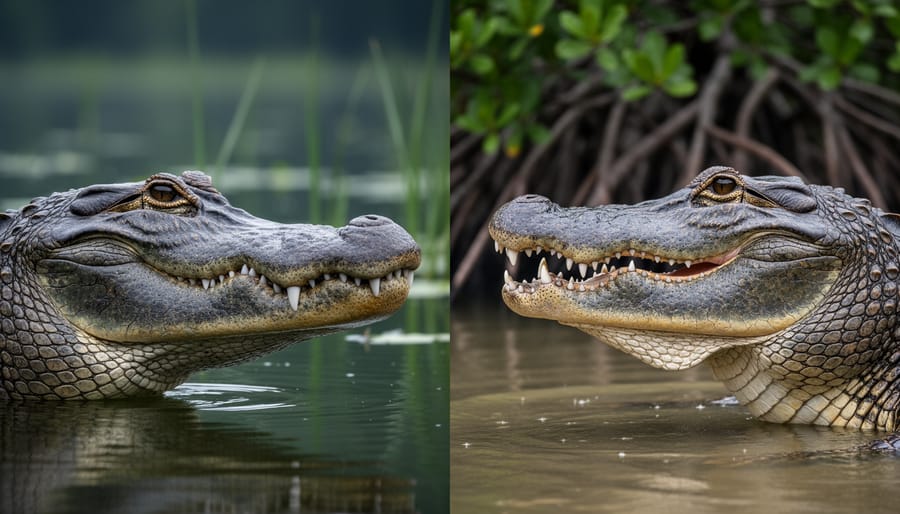
The quickest way to tell an alligator from a crocodile is to look at the snout: alligators have wide, U-shaped snouts built for crushing, while crocodiles sport narrower, V-shaped snouts designed for a vice-like grip. This distinction matters whether you’re a wildlife enthusiast planning a wetland expedition, an educator teaching students about reptilian biodiversity, or a conservationist working to protect these ancient predators in their shrinking habitats.
Despite 200 million years of separate evolution, alligators and crocodiles are still confused by casual observers, and that confusion carries real consequences. Knowing how to identify crocs and gators isn’t just academic trivia. It helps researchers track population health, guides safety protocols in crocodilian territory, and informs habitat restoration efforts in coastal and freshwater ecosystems where these reptiles serve as apex predators and environmental indicators.
The differences run deeper than snout shape. Geographic range separates them across continents, with American alligators thriving in freshwater swamps of the southeastern United States while saltwater crocodiles patrol brackish coastlines from India to Australia. Behavior varies too. Alligators tend toward shyness, retreating from human presence, whereas many crocodile species display aggressive territoriality that demands respect and caution.
For marine conservationists, crocodiles hold special significance. Species like the American crocodile and saltwater crocodile bridge freshwater and marine environments, their salt glands allowing them to venture into coastal waters and mangrove forests. These transitional habitats face mounting pressure from development and climate change, making crocodilian conservation a bellwether for broader marine biodiversity health.
This guide cuts through the confusion with side-by-side comparisons, visual identification tips, and practical knowledge drawn from field biologists who study these remarkable survivors daily. You’ll learn not just how to spot the differences, but why those differences matter for the ecosystems we’re working collectively to protect.
Alligators and Crocodiles at a Glance
Here’s a quick-reference guide to spotting the key differences between alligators and crocodiles. Whether you’re on a wetland tour, reviewing wildlife photos, or planning conservation fieldwork, these visual and behavioral markers will help you identify which reptile you’re observing.
| Feature | Alligators | Crocodiles |
|---|---|---|
| Snout Shape | Wide, U-shaped, rounded | Narrow, V-shaped, pointed |
| Teeth Visibility | Hidden when mouth closed | Visible, especially lower fourth tooth |
| Habitat | Freshwater (swamps, marshes, lakes) | Saltwater and freshwater (coasts, estuaries, rivers) |
| Geographic Range | Southeastern U.S., China | Africa, Asia, Australia, Americas (tropics) |
| Temperament | Less aggressive, more tolerant | More aggressive, highly territorial |
| Typical Size | 8-15 feet | 10-20+ feet (saltwater crocodiles largest) |
| Conservation Status | American alligator: recovered, stable | Varies by species; many threatened |
The snout is your most reliable field identifier. An alligator’s broad, rounded snout evolved for crushing prey like turtles, while a crocodile’s slender snout suits a more varied diet and faster strikes. Color offers another clue: alligators appear darker, almost black in many lighting conditions, whereas crocodiles lean toward olive, tan, or gray-green tones. These distinctions become second nature once you know what to look for, making species identification straightforward even from a distance.
What Alligators and Crocodiles Are
The Alligator: Freshwater Specialist of the Americas and China
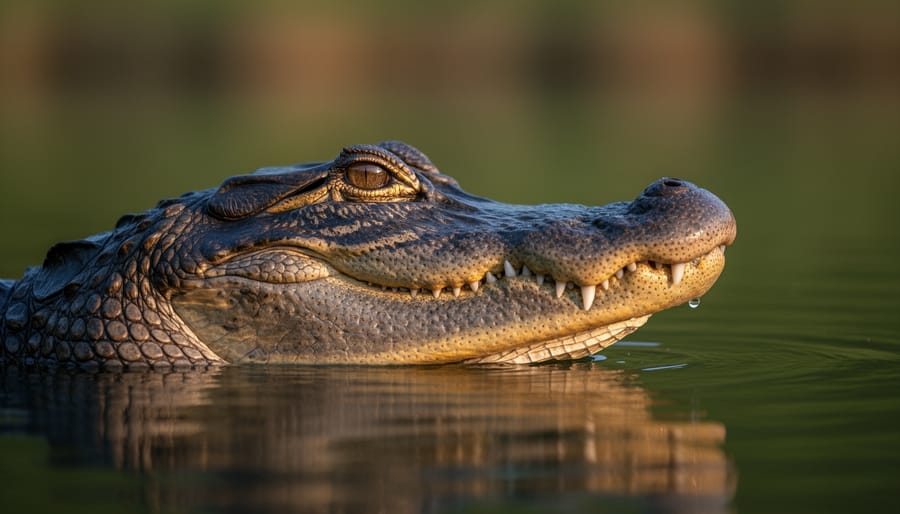
Alligators belong to the family Alligatoridae and comprise just two living species: the American alligator (Alligator mississippiensis) and the critically endangered Chinese alligator (Alligator sinensis). Both are freshwater specialists that have evolved to thrive in inland wetlands rather than coastal or marine environments.
The American alligator, found across the southeastern United States, is the larger and more abundant of the two species. Adult males typically reach 11 to 15 feet in length, with females considerably smaller at 8 to 10 feet. Their distinctive broad, U-shaped snout powers a crushing bite force designed for grabbing prey like fish, turtles, birds, and small mammals. Dark gray to black coloration helps them blend into murky swamps and slow-moving rivers. The American alligator range extends from North Carolina to Texas, with Florida and Louisiana hosting the largest populations.
Chinese alligators, by contrast, rarely exceed 7 feet and inhabit a small region along the Yangtze River in eastern China. Habitat destruction has pushed them to the brink of extinction in the wild, with fewer than 150 individuals remaining outside captivity.
Both species serve as ecosystem engineers, creating “gator holes” during dry seasons that provide vital water sources for countless other species. The American alligator represents one of conservation’s greatest success stories, once hunted nearly to extinction, protection under the Endangered Species Act allowed populations to rebound so dramatically that the species was removed from the endangered list in 1987.
The Crocodile: A Global Saltwater and Freshwater Predator
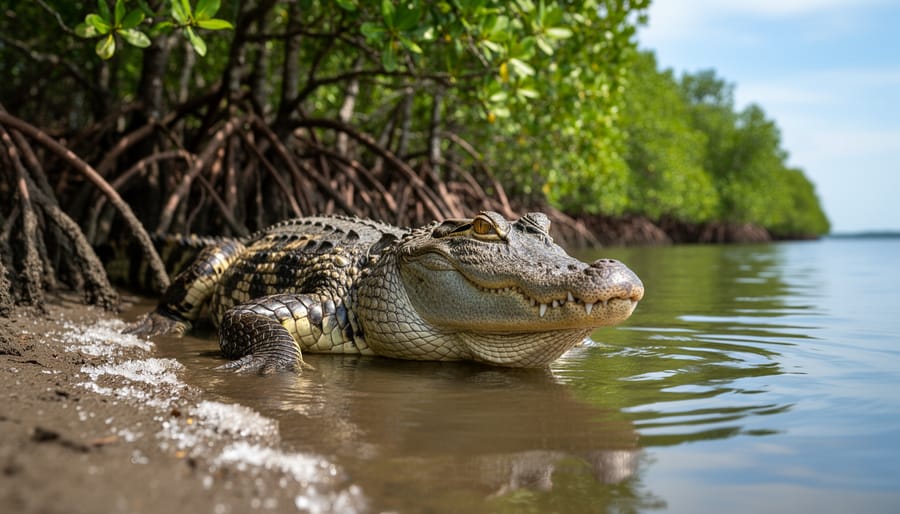
Crocodiles represent a far more diverse and geographically widespread group than alligators, with 14 recognized species distributed across tropical and subtropical regions of Africa, Asia, Australia, and the Americas. They belong to the family Crocodylidae and have evolved specialized adaptations that allow them to thrive in both freshwater and saltwater environments, a capability most alligators lack.
The saltwater crocodile (Crocodylus porosus) stands as the world’s largest living reptile, reaching lengths exceeding 20 feet and weighing over 2,000 pounds. Found from India’s eastern coast through Southeast Asia to northern Australia, this apex predator possesses specialized salt glands on its tongue that filter excess salt from seawater, enabling it to hunt in coastal estuaries, mangrove forests, and even venture into open ocean. The Nile crocodile (Crocodylus niloticus) dominates African freshwater systems from the Nile River basin to Madagascar, while the American crocodile (Crocodylus acutus) inhabits coastal areas from South Florida through the Caribbean and Central America to northern South America.
Crocodiles play crucial roles as apex predators in their ecosystems, controlling fish and mammal populations while their presence maintains habitat structure in mangrove systems and river deltas. Their V-shaped snouts and visible interlocking teeth reflect evolutionary pressures for catching fish in open water, while their tolerance for salinity has allowed them to colonize coastal environments where they intersect directly with marine conservation efforts.
Key Differences Between Alligators and Crocodiles
Snout Shape: The Most Reliable Visual Identifier
The snout offers the fastest way to tell these reptiles apart. Alligators have wide, rounded, U-shaped snouts built for crushing power. This design generates immense bite force, ideal for cracking turtle shells and breaking bones. Crocodiles sport narrower, pointed, V-shaped snouts that function like precision tools. The tapered shape lets them catch fish and smaller prey with quick sideways snaps.
These differences evolved from diet and habitat. Alligators, which dominate freshwater systems where they fulfill a vital alligators ecosystem role developed broader jaws to handle varied prey including hard-shelled animals. Crocodiles, facing more competition in diverse habitats from coastal mangroves to rivers, specialized in speed and agility.
When identifying them in photos or from a safe distance, look at the snout from above or the side. A broad, rounded profile suggests alligator. A long, triangular taper points to crocodile. This distinction holds across species and age groups, making it your most reliable field identification tool even when other features remain hidden underwater.
Teeth and Jaw Structure
When an alligator closes its mouth, its upper jaw completely overlaps the lower, concealing all teeth from view. Crocodiles, however, have jaws that interlock rather than overlap, the result is a visible “toothy grin” even when the mouth is shut, with the large fourth tooth on each side of the lower jaw fitting into notches on the outside of the upper jaw.
This structural difference reflects evolutionary adaptations to diet and hunting strategy. Alligators evolved powerful, broad jaws optimized for crushing force rather than precision. Their hidden teeth and massive bite pressure make them efficient at crushing hard-shelled prey like turtles and crustaceans. Crocodiles developed narrower, interlocking jaws that excel at gripping and holding struggling prey, particularly fish and mammals. The exposed teeth improve their grip on slippery, fast-moving targets.
You can use this feature for identification at any distance. If you see teeth when the animal’s mouth is closed, you’re looking at a crocodile. If the jaw appears smooth and toothless, it’s an alligator. This distinction holds true across all species in both groups.
Habitat and Geographic Range
Alligators and crocodiles occupy different ecological niches largely due to their physiological adaptations to water salinity. Alligators are freshwater specialists, thriving in swamps, marshes, slow-moving rivers, and lakes where salinity remains low. They lack efficient salt-excreting glands, so prolonged exposure to saltwater proves harmful. Crocodiles possess specialized salt glands on their tongues that allow them to excrete excess salt, enabling them to inhabit brackish estuaries, coastal mangroves, and even open ocean in some cases. This physiological difference shapes where you’ll encounter each species.
Geographic distribution reflects these habitat preferences:
- American alligators: Southeastern United States from North Carolina to Texas, concentrated in Florida and Louisiana
- Chinese alligators: Yangtze River basin in eastern China (critically endangered, small wild population)
- Saltwater crocodiles: Northern Australia, Southeast Asia, eastern India, and Pacific islands
- Nile crocodiles: Sub-Saharan Africa and Madagascar, in rivers, lakes, and coastal regions
- American crocodiles: Southern Florida, Caribbean islands, Central America, and northern South America
- Overlap zones: South Florida (especially Everglades) where American alligators and American crocodiles coexist in adjacent freshwater and brackish habitats
Crocodiles show far wider global distribution across tropical and subtropical regions, while alligators remain restricted to two limited ranges. The American crocodile’s presence in coastal Florida mangroves and the Florida Keys makes it relevant to marine conservation efforts, as these habitats connect freshwater, estuarine, and marine ecosystems. Climate and available habitat determine northern range limits for both groups.
Behavior and Temperament
Crocodiles have earned their reputation as more aggressive and territorial than alligators, though both deserve extreme caution and respect. Saltwater and Nile crocodiles, in particular, are responsible for more human fatalities worldwide than any other crocodilian species. They’re opportunistic hunters with less tolerance for human presence in their territory.
Alligators are generally more docile and less likely to view humans as prey, but “docile” is relative, they’re still apex predators capable of explosive speed and devastating attacks. American alligators typically avoid confrontation unless defending nests or if conditioned to associate humans with food, which makes feeding them especially dangerous and illegal in most jurisdictions.
The behavioral difference stems partly from habitat. Crocodiles in coastal and river systems encounter more diverse prey and competition, driving heightened aggression. Alligators in freshwater swamps face fewer threats and have adapted to more predictable food sources.
If you live or work in areas with either species, maintain distance of at least 30 feet, never feed them, keep pets away from water’s edge at dawn and dusk, and swim only in designated areas. Both animals are protected, and coexistence requires understanding their behavior while respecting their space.
Size and Physical Build
Alligators typically reach 10 to 15 feet in length, with males occasionally growing larger. American alligators max out around 15 feet and 1,000 pounds, though historical records suggest some exceeded 19 feet. Chinese alligators remain much smaller, rarely surpassing 7 feet.
Crocodiles show greater size variation across species. Saltwater crocodiles hold the record as the largest living reptiles, regularly exceeding 17 feet and occasionally reaching 23 feet with weights over 2,200 pounds. Nile crocodiles grow similarly large, while American crocodiles average 13 to 16 feet.
Coloration offers another distinction. Alligators appear darker, blackish gray to nearly black, helping them absorb heat in cooler freshwater environments. Crocodiles display lighter, olive-brown to tan hues that blend with sandy riverbanks and coastal habitats.
Skin texture differs subtly between the two. Crocodile scales appear more irregular and jagged, particularly along the back and tail. Alligator scales follow more uniform patterns, though both feature the tough, armored plating characteristic of crocodilians.
Conservation Status and Population Trends
Conservation status varies dramatically between alligator and crocodile species. American alligators represent one of conservation’s greatest success stories: once listed as endangered in 1967 due to hunting and habitat loss, they recovered so completely that they were removed from the endangered species list in 1987. Today, over five million American alligators thrive across the southeastern United States, thanks to strict protection, habitat restoration, and regulated hunting programs. Chinese alligators remain critically endangered, with fewer than 150 individuals surviving in the wild.
Crocodiles face more complex challenges. The saltwater crocodile, while not endangered, suffers from human-wildlife conflict in populated coastal areas. The Philippine crocodile numbers fewer than 200 individuals. American crocodiles, listed as vulnerable, occupy sensitive coastal habitats where sea-level rise, mangrove destruction, and development threaten nesting sites. Climate change affects both groups differently: rising temperatures skew sex ratios in eggs (determined by incubation temperature), while coastal crocodiles face habitat loss from storm surge and saltwater intrusion into freshwater zones. Effective conservation requires protecting coastal wetlands, mangrove corridors, and the interconnected freshwater-marine systems both groups depend on.
Who Should Care About Which Species
For Marine and Coastal Conservationists
For those working in coastal and marine conservation, crocodiles warrant special attention due to their unique saltwater tolerance and critical role in bridging terrestrial and marine ecosystems. Unlike alligators, which stick to freshwater, several crocodile species, particularly the American crocodile (Crocodylus acutus) and saltwater crocodile, possess specialized salt glands that allow them to thrive in brackish estuaries, mangrove forests, and even venture into open ocean. This makes them integral to coastal habitat health.
In Florida and throughout the Caribbean, American crocodiles serve as apex predators in mangrove ecosystems, regulating prey populations and maintaining the delicate balance these nursery habitats provide for countless marine species. Protecting crocodile populations means safeguarding the mangrove corridors that sequester carbon, buffer coastlines from storms, and support juvenile fish and invertebrates essential to ocean food webs.
Your location will determine which one you’ll see during fieldwork. Volunteer opportunities for crocodile monitoring exist through coastal wildlife agencies and research institutions conducting nesting surveys, population assessments, and habitat restoration projects in mangrove zones, work that directly advances marine biodiversity conservation.
For Freshwater and Wetland Managers
Alligators dominate freshwater management priorities across the southeastern United States because they shape entire wetland ecosystems. These apex predators create and maintain “gator holes”, deep depressions they excavate during dry seasons that become critical refuges for fish, turtles, wading birds, and other wildlife when water levels drop. This engineering behavior sustains biodiversity through drought cycles that would otherwise eliminate species from isolated wetlands.
In most management zones, you’ll focus exclusively on alligator populations. They’re resilient, well-studied, and generally predictable in their habitat use. Standard protocols address nest monitoring, nuisance animal response, and population surveys in marshes, swamps, and retention ponds.
South Florida presents unique challenges where American crocodile and alligator ranges overlap. Here, managers must distinguish between species for regulatory compliance, crocodiles remain federally threatened while alligators are common, and apply different handling protocols. Crocodiles frequent brackish coastal areas and canals with tidal influence; alligators stay in freshwater. Both use Florida Bay’s transition zones, requiring coordinated management that protects crocodile nesting beaches while managing recreational alligator harvest inland. Staff training on field identification becomes essential, as misidentification carries legal and conservation consequences in these overlap zones.
For Educators and the General Public
For teachers and curious observers, knowing the difference between alligators and crocodiles transforms a simple wildlife sighting into a teachable moment about adaptation and biodiversity. When you spot a crocodilian in the wild or at a nature center, checking the snout shape gives students an instant hands-on lesson in evolutionary biology, why would one species need a broader jaw while another developed a narrower one? These questions open conversations about diet, habitat, and survival strategies.
Safety matters too. If you’re hiking near water in Florida, recognizing whether you’ve encountered an alligator or the rarer American crocodile helps you gauge appropriate distance and behavior. Crocodiles demand more caution.
Marine biologist Dr. Sarah Chen recalls tracking a saltwater crocodile through a mangrove estuary in Queensland. “We were collecting water samples when this massive four-meter croc surfaced ten meters away. That pointed snout and visible teeth were unmistakable. In that moment, I wasn’t just identifying a species, I was witnessing a perfectly adapted coastal predator that’s survived millions of years. That encounter changed how I teach students about marine biodiversity. These animals aren’t museum specimens; they’re living links to prehistoric oceans.”
What Each Option Is
At their most basic, alligators and crocodiles are large, semi-aquatic reptiles that belong to the order Crocodylia, an ancient lineage that has survived virtually unchanged for over 200 million years. Despite their similar appearance and shared evolutionary history, they represent distinct families with different adaptations.
Alligators belong to the family Alligatoridae. Only two species exist today: the American alligator, found in the southeastern United States, and the critically endangered Chinese alligator, restricted to the Yangtze River basin. Alligators are freshwater specialists with broad, rounded snouts optimized for crushing prey like turtles and snails. Their darker coloration helps them blend into murky swamp waters.
Crocodiles belong to the family Crocodylidae and encompass roughly fourteen species distributed across tropical regions of Africa, Asia, Australia, and the Americas. They feature pointed, V-shaped snouts suited for catching fish and a diverse range of prey. Most species possess specialized salt glands that allow them to tolerate brackish and marine environments, a capability alligators lack. This physiological difference has enabled crocodiles to colonize coastal habitats and even venture into open ocean, making them relevant to marine conservation efforts.
Who Should Choose Which
Obviously, you can’t “choose” between alligators and crocodiles like picking a product, but understanding which species matters most to your situation helps focus your efforts, safety awareness, and conservation support.
If you live in or visit the southeastern United States (Louisiana, Florida, Georgia, South Carolina, Texas), alligators are what you’ll encounter in freshwater areas. Learn alligator safety protocols, support local wetland restoration, and participate in population monitoring programs through state wildlife agencies.
If you work in coastal or marine conservationespecially in Florida, the Caribbean, or tropical regions, crocodiles are your priority. Saltwater crocodiles and American crocodiles inhabit mangroves, estuaries, and coastal zones where marine biodiversity work happens. Focus your research and volunteer efforts on species that bridge freshwater and saltwater ecosystems.
If you’re an educator teaching biodiversityuse both as examples of convergent evolution and niche partitioning. The comparison illustrates how closely related species adapt to different environments.
If you’re traveling internationally to tropical areascrocodile awareness is essential for safety. Always assume bodies of water in Africa, Asia, Australia, and Central America may contain crocodiles and follow local wildlife guidelines.
Common Questions About Alligators and Crocodiles
Can alligators and crocodiles mate with each other?
No, alligators and crocodiles cannot interbreed because they belong to different families within the crocodilian order and are too genetically distinct. They diverged evolutionarily millions of years ago, making successful reproduction between them biologically impossible.
Which is more dangerous to humans: alligators or crocodiles?
Crocodiles are generally considered more dangerous due to their aggressive territorial behavior and tendency to view humans as potential prey, particularly saltwater and Nile crocodiles. While alligators can be dangerous and should always be treated with caution and respect, they’re typically less aggressive toward humans unless provoked or protecting nests.
Are there any places where alligators and crocodiles live together?
Yes, southern Florida is the only place in the world where American alligators and American crocodiles coexist in the wild. The two species occupy slightly different niches, alligators prefer freshwater habitats while crocodiles favor brackish coastal areas, which reduces direct competition.
Why are alligators darker in color than crocodiles?
Alligators evolved darker, nearly black coloration as camouflage in the murky, vegetation-dense freshwater swamps and marshes they inhabit. Crocodiles tend toward lighter olive, tan, or gray tones that blend with the sandy riverbanks, coastal mudflats, and clearer waters where many species live.
How can I help protect alligators and crocodiles?
You can support conservation by respecting their habitats, never feeding wild crocodilians (which makes them associate humans with food), and participating in wetland and coastal restoration projects. Many organizations offer volunteer opportunities for habitat monitoring, population surveys, and public education programs that directly contribute to protecting these ancient reptiles and the ecosystems they help maintain.
These questions reflect the most common concerns people have when learning about crocodilians, from basic biology to practical safety considerations. Understanding that these animals play vital roles in their ecosystems, controlling prey populations, creating habitat for other species, and serving as indicators of wetland health, helps frame conservation as a community responsibility rather than just a wildlife management issue.
The distinction between species matters particularly for those living in or visiting crocodilian habitat. Recognizing which species you’re near informs appropriate safety precautions and helps you appreciate the specific conservation challenges each faces. American alligators demonstrate what’s possible when legal protection, habitat preservation, and public education align: a species brought back from the brink of extinction. Many crocodile species still need that level of coordinated effort, especially as coastal development and climate change threaten their remaining strongholds.
Alligators and crocodiles diverged millions of years ago, yet both remain vital threads in the fabric of healthy wetland and coastal ecosystems. The differences between them, from snout shape and salt tolerance to habitat preference and temperament, reveal how evolution sculpts species to fit precise ecological niches. Understanding these distinctions helps us appreciate the biodiversity thriving in marshes, swamps, and tidal zones from Florida to the Sundarbans.
The conservation success of American alligators proves that targeted protection works. Populations rebounded from near extinction in the 1960s to sustainable numbers today because scientists, policymakers, and communities acted together. Many crocodile species still need that same commitment. Saltwater crocodiles face habitat loss in mangrove forests. Nile crocodiles contend with human-wildlife conflict. Chinese alligators teeter on the brink in fragmented wetlands.
You can help. Citizen science programs need volunteers to monitor nesting sites, track population trends, and report sightings. Coastal clean-ups remove debris that threatens crocodile habitat. Supporting wetland restoration projects protects the freshwater systems alligators depend on. Visit the Marine Biodiversity Science Center’s volunteer page to find opportunities matching your interests and location.
When researchers, educators, and engaged communities work together, we create lasting change. Every observation logged, every habitat restored, and every person who learns to coexist with these ancient predators strengthens the future for both alligators and crocodiles, and for the rich ecosystems they anchor.

jessica
Ava Singh is an environmental writer and marine sustainability advocate with a deep commitment to protecting the world's oceans and coastal communities. With a background in environmental policy and a passion for storytelling, Ava brings complex topics to life through clear, engaging content that educates and empowers readers. At the Marine Biodiversity & Sustainability Learning Center, Ava focuses on sharing impactful stories about community engagement, policy innovations, and conservation strategies. Her writing bridges the gap between science and the public, encouraging people to take part in preserving marine biodiversity. When she’s not writing, Ava collaborates with local initiatives to promote eco-conscious living and sustainable development, ensuring her work makes a difference both on the page and in the real world.