Marine Biodiversity Science Center

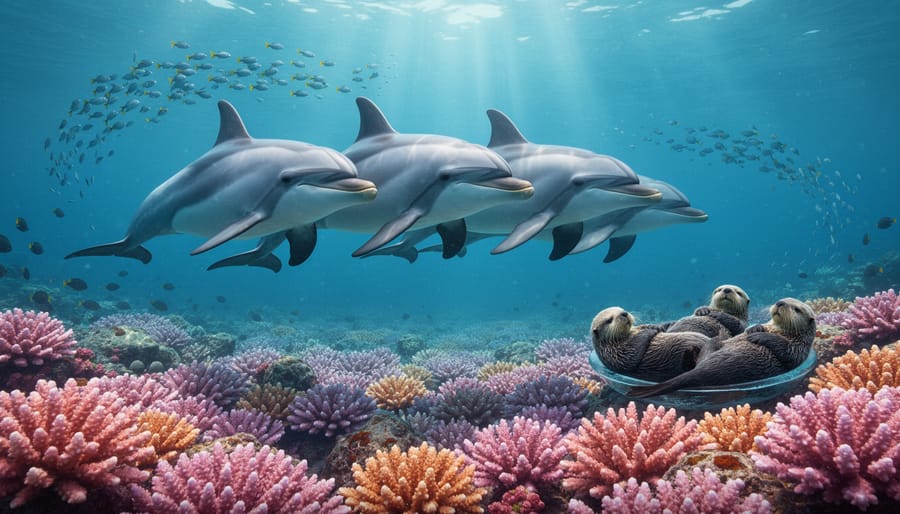
A marine social worker is a researcher who studies the social behaviors, hierarchies, and group dynamics of ocean animals, from dolphin pods to fish schools to sea otter rafts. These scientists observe how marine species communicate, cooperate, compete, and form complex relationships beneath the waves. Their work reveals that the ocean is not a silent, solitary place but a vibrant network of social communities as intricate as any found on land.
Understanding marine social structures matters far beyond academic curiosity. When we know how orcas pass down hunting techniques through generations or how parrotfish coordinate their reef-cleaning efforts, we can design smarter conservation strategies that protect not just individual animals but entire social networks. A disrupted social group can mean lost knowledge, failed reproduction, and cascading effects throughout an ecosystem.
The confusion around the term is understandable. Unlike human social workers who provide support services to people, marine social workers are behavioral ecologists and biologists who decode the language of underwater societies. They spend years tracking the same groups of whales, documenting fish coalitions, and mapping out who associates with whom in coral reef communities. Their tools range from underwater cameras and acoustic monitors to genetic analysis and GPS tags.
This field has grown dramatically since the early 2000s as technology has made long-term observation possible and as we’ve come to recognize that social bonds in the ocean are as vital to survival as finding food or avoiding predators. The implications stretch from marine protected area design to animal welfare standards in captivity. Every discovery about how marine animals live together reshapes how we work to keep them alive.
In the sections ahead, you’ll learn exactly how these researchers conduct their work, the main types of social structures they study, and why their findings are changing marine conservation in 2026.
What Marine Social Workers Study
Marine social workers are scientists who specialize in studying the social lives of ocean animals, how they interact, communicate, form relationships, and organize themselves into groups with distinct roles and rules. Unlike human social workers who help people navigate societal challenges, these researchers decode the hidden social worlds beneath the waves, revealing that marine species engage in behaviors every bit as complex as those found in primate societies or human communities.
The scope of this discipline is remarkably broad. Marine social workers examine cooperation among dolphins hunting together in coordinated patterns, where individuals take on specific roles to corral fish into tight balls. They document conflicts between rival males competing for mates or territory, analyzing how these disputes get resolved through displays, vocalizations, or physical confrontations. Mating rituals receive intense scrutiny, from the elaborate dances of seahorses to the strategic spawning aggregations of groupers, because understanding reproductive social systems helps protect critical breeding populations.
Parenting behaviors form another major area of focus. Researchers observe how orca mothers teach their calves hunting techniques over years of patient demonstration, or how octopus mothers guard their eggs without eating for months, ultimately sacrificing their lives. Community structures reveal themselves through careful observation: which individuals associate most frequently, who defers to whom, how information spreads through a population, and even cultural traditions passed between generations.
- Dominance Hierarchy
- A ranking system where individuals occupy higher or lower positions based on competitive interactions, determining access to food, mates, and prime habitat. These hierarchies reduce constant fighting by establishing a predictable social order.
- Kin Selection
- The evolutionary strategy where animals help close relatives survive and reproduce, even at personal cost, because shared genes benefit. This explains why dolphins may assist injured family members or why siblings cooperate in raising young.
- Reciprocal Altruism
- Cooperative behavior between unrelated individuals based on the expectation that favors will be returned in the future. Cleaner fish relationships demonstrate this principle, cleaners remove parasites, and their clients return regularly for service.
- Territoriality
- The defense of a specific area against intruders, often to secure food resources, mating opportunities, or safe breeding sites. Territorial boundaries and disputes reveal much about social organization.
- Social Learning
- The transmission of knowledge and behaviors between individuals through observation and imitation rather than genetic inheritance. This cultural transmission drives problem-solving innovations that spread through populations.
The field combines patient observation with systematic documentation. Researchers create detailed behavioral catalogs, essentially dictionaries of specific actions and signals, then analyze thousands of hours of footage to identify patterns. Who associates with whom, and how often? Which vocalizations correlate with which behaviors? How do social bonds change over an individual’s lifetime? These questions drive the discipline, transforming what might look like random ocean activity into comprehensible social systems with measurable structure and purpose.
How Marine Social Workers Conduct Their Research
Field Observation Methods
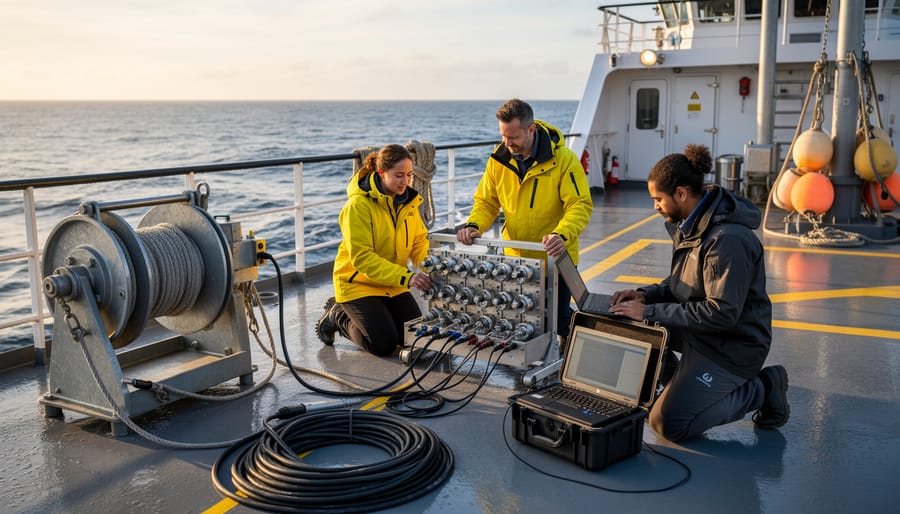
Observing marine animals in their natural environment requires patience, specialized equipment, and careful protocols designed to minimize human interference. Marine social workers spend countless hours underwater, watching how dolphins greet each other, how fish establish territories, or how octopuses signal during encounters. The standard approach combines direct observation through SCUBA diving with strict behavioral protocols: researchers maintain consistent distances (typically 10-30 meters for cetaceans, closer for smaller species), avoid sudden movements, and document every interaction without intervention.
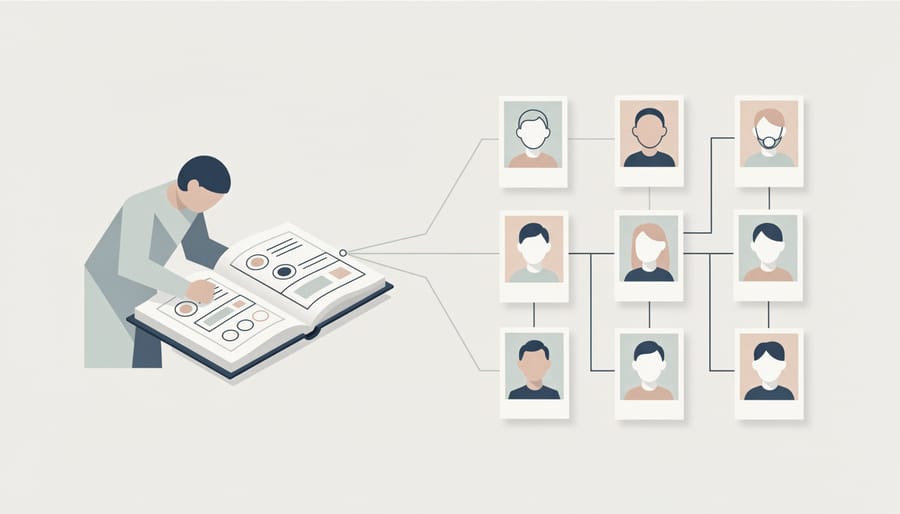
Long-term study sites form the backbone of this research. By returning to the same locations, coral reef patches, kelp forests, or coastal aggregation zones, over months or years, scientists can identify individual animals and track relationship changes over time. Photo-identification of unique markings, scars, or color patterns allows researchers to build social network maps showing who associates with whom.
Remote monitoring has revolutionized field work since the 2010s. Stationary underwater cameras capture interactions when divers aren’t present, revealing nocturnal behaviors and reducing observer effects. Acoustic recording devices document the complex world of underwater communication the clicks, whistles, and rumbles that maintain social bonds even when animals can’t see each other. Drone technology now enables observation of surface behaviors in large cetaceans without boats disturbing natural patterns. These methods combined create comprehensive behavioral records that reveal the true complexity of marine social life.
Data Collection and Analysis
Once researchers collect observations in the field, the real work begins: transforming hours of footage and field notes into scientific insights about social behavior. Marine social workers employ a behavioral coding system to categorize every interaction they witness. They create detailed catalogs that assign specific codes to behaviors like tail slaps, synchronized swimming, aggressive displays, or nurturing touches. Each action gets logged with timestamps, participants, context, and environmental conditions.
This systematic recording allows researchers to spot patterns invisible to casual observation. A dolphin pod’s vocalizations before a hunt, repeated across dozens of events, reveal coordinated planning. Aggression between male seals follows predictable escalation patterns that establish rank without injury. Researchers quantify these observations, tracking frequencies, durations, and sequences to identify social hierarchies and relationships.
Statistical analysis transforms raw behavioral data into testable hypotheses about social structure. Software programs calculate association indices showing which individuals spend time together, creating social network maps of entire communities. Researchers correlate behaviors with outcomes, discovering which strategies succeed in mating competition or food acquisition. They even analyze how marine senses like echolocation or chemical signals facilitate social communication within groups. This rigorous approach separates speculation from evidence, revealing the true complexity of marine social systems.
Types of Social Structures Marine Workers Document
Dominance Hierarchies and Pecking Orders
Many marine species organize themselves through ranked systems where some individuals consistently win resources or conflicts with others. In fish schools, these hierarchies often shift quickly, a grouper that dominates at feeding time might lose that position after an injury or when a larger individual joins the group. Researchers studying these linear dominance chains watch who gives way during encounters at food sources or shelter spots.
Shark aggregations show more fluid rankings. Gray reef sharks at specific dive sites maintain loose pecking orders based on size and residency, but these rankings aren’t absolute. A smaller resident shark often outcompetes a larger newcomer for prime hunting territory, demonstrating that familiarity with an area can trump physical dominance.
Pinniped colonies reveal some of the clearest hierarchies. Male elephant seals establish brutal linear rankings during breeding season, with alpha males controlling harems while subordinates wait at the colony’s edges. Female sea lions form separate, more stable hierarchies that determine access to the best haul-out rocks and pupping sites. These structures illustrate how social power in marine environments depends on species-specific factors, sometimes it’s size, sometimes experience, sometimes simply who arrived first.
Cooperative Societies
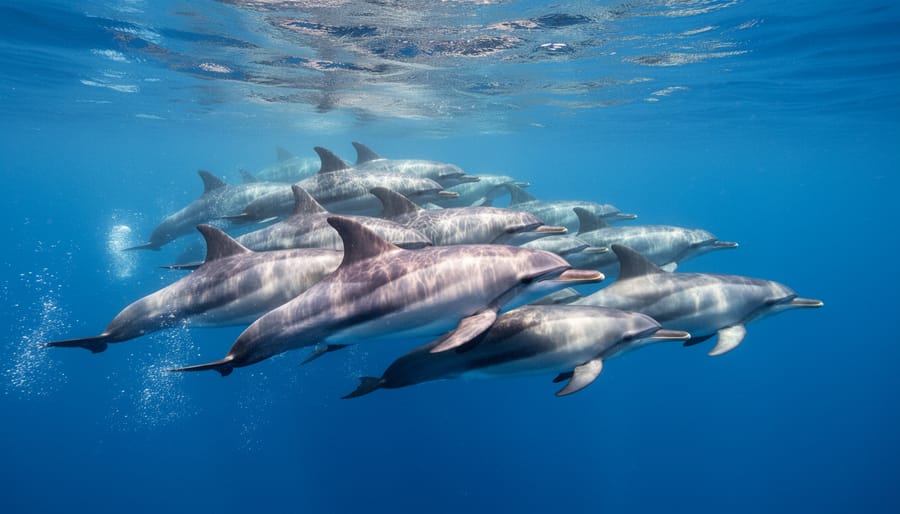
Cetaceans, whales, dolphins, and porpoises, form some of the most sophisticated cooperative societies in the ocean. Pod structures vary dramatically across species, from the tight-knit family groups of resident orcas to the fluid, fusion-fission communities of bottlenose dolphins where individuals move between subgroups while maintaining long-term bonds.
Matrilineal societies, where knowledge and social status flow through female lineages, define many whale populations. Orca pods center around elder females who hold decades of ecological knowledge about hunting grounds, migration routes, and prey behavior. These matriarchs lead multi-generational families where daughters and their offspring remain together for life, creating stable social units that pass down culture through vocal dialects, hunting techniques, and behavioral traditions unique to each pod.
Cooperative care behaviors extend beyond immediate offspring. Sperm whales practice allomaternal care, where non-mothers babysit calves while mothers dive to feed at depths young whales cannot reach. Dolphins coordinate group defenses against predators, with multiple adults positioning themselves between threats and vulnerable young. These care networks allow cetacean societies to raise offspring successfully in challenging ocean environments where individual parents alone would struggle.
Symbiotic Social Relationships
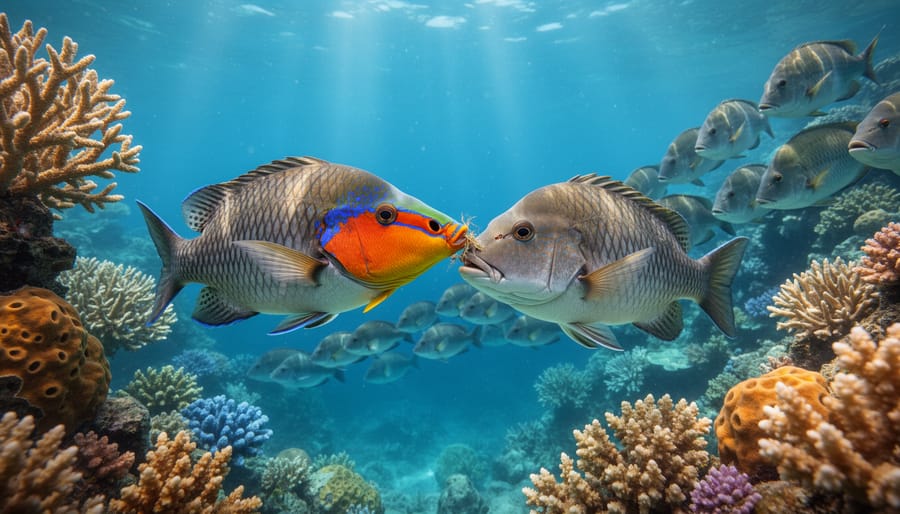
Marine social workers frequently document relationships that cross species boundaries, revealing social dynamics that benefit both partners. At cleaner fish stations scattered across coral reefs, wrasses and gobies establish what researchers call “service sites” where larger fish queue patiently to have parasites removed. These interactions follow consistent social protocols, clients signal readiness by adopting specific postures, cleaners inspect predictable body areas, and both parties communicate through tactile signals that maintain the relationship.
The shark-remora partnership demonstrates a mobile version of this social exchange. Remoras attach to sharks using specialized suction discs, gaining transportation and food scraps while removing parasites from their hosts. Studies tracking individual pairs show that some sharks tolerate specific remoras for months, suggesting recognition and preference rather than random association.
In anemone-clownfish systems, entire family groups coexist with their stinging hosts in strict hierarchies. The largest female dominates, with a breeding male second in rank and smaller juveniles occupying lower positions. When the female dies, the male transforms into a female and the largest juvenile becomes the new breeding male, a social succession pattern that marine researchers document across Pacific reef systems.
Applications of Marine Social Research for Conservation
Understanding how marine animals interact, form bonds, and organize their communities has revolutionized conservation strategy over the past decade. When we recognize that a pod of dolphins isn’t just a collection of individuals but a tightly-knit family with learned traditions, or that a coral reef hosts intricate networks of cooperative relationships, protection efforts become far more nuanced and effective.
Marine protected areas have evolved beyond simple geographical boundaries. Researchers now use social behavior data to identify critical habitats where specific groups gather for breeding, raising young, or teaching survival skills to juveniles. A sanctuary that protects feeding grounds means little if it excludes the traditional calving areas where mothers bond with newborns and pass down cultural knowledge. Social mapping reveals these essential spaces that MPAs preserve marine resources most effectively when they encompass entire social territories rather than fragmenting communities across arbitrary lines.
This understanding translates into several concrete conservation applications:
- Identifying critical social habitats where specific communities gather for breeding, teaching, or cooperative hunting
- Preventing disruption of breeding aggregations by timing human activities around sensitive social periods
- Maintaining family units during rescue and rehabilitation operations to preserve social bonds
- Reducing acoustic pollution impacts on social communication networks in shipping lanes and industrial zones
Rehabilitation programs have been transformed by social research insights. When rescuing stranded dolphins or sea turtles, facilities now prioritize keeping related individuals together and matching rescued animals with compatible companions based on their species’ social requirements. Releasing a rehabilitated seal back into waters where its original colony resides dramatically improves survival compared to dropping it in unfamiliar territory among strangers.
Captive breeding programs for endangered species have also shifted their approach. Rather than simply pairing genetically suitable mates, modern programs respect natural hierarchies and mate selection processes. Allowing animals to choose partners and maintain their preferred social structures results in higher breeding success, healthier offspring, and better preparation for eventual reintroduction to wild populations.
Perhaps most critically, social behavior research has exposed how human noise pollution disrupts communication networks that marine species depend on for survival. Shipping traffic, sonar, and offshore construction can fragment dolphin pods, interfere with whale migration coordination, and mask the subtle signals fish use to synchronize spawning. Armed with this knowledge, conservation managers now establish quiet zones during critical periods and require vessels to reduce speed in areas where acoustic communication is essential to social cohesion.
Real Stories from Marine Social Workers
Dr. Sarah Chen spent three consecutive summers in the San Juan Islands tracking J-Pod, one of the most studied orca families in the world. “People think marine research is glamorous, but I’ve spent countless hours in a small boat waiting for a five-minute encounter,” she says. Her doctoral work focused on how orca grandmothers transmit hunting knowledge to younger generations. Through photo identification and acoustic recordings, Chen documented how post-reproductive females led their pods to salmon-rich areas during crucial feeding periods. “I watched J17, a 43-year-old matriarch, teach her grandson a specialized technique for stunning chinook salmon against the surface,” Chen recalls. “That single observation confirmed what we’d suspected: these whales have cultural traditions passed down through specific family lines.” The research took patience. Some days brought perfect visibility and active pods. Others meant returning with nothing but seasickness and rain-soaked notebooks.
Dr. Marcus Williams studies an entirely different social world beneath Caribbean reefs. His team documents Caribbean reef octopuses at a research station in Bonaire, where these typically solitary animals occasionally gather in small groups. “Octopuses challenge everything we think we know about intelligence and communication,” Williams explains. Using underwater cameras with infrared capabilities, his team captured footage of octopuses using rapid color changes and posture shifts during territorial disputes. “We recorded one individual flashing dark stripes while raising two arms, essentially making itself look larger, to ward off a rival,” he notes. The breakthrough came when they identified consistent patterns: specific color combinations appeared during mating approaches versus aggressive encounters. Williams’s work requires night diving, when octopuses are most active, and reviewing hundreds of hours of footage to catch moments that last mere seconds.
Marine social work demands equal parts endurance and wonder. These researchers return season after season, building datasets that span decades, driven by glimpses into societies as complex as our own. Their patience reveals what rushed observations would miss: the intricate social threads holding marine communities together.
How A Marine Social Worker Understanding Behavior Specialists Works
The work of a marine social worker operates through systematic observation cycles that build knowledge incrementally over time. A researcher typically begins by identifying a focal population, say, a pod of dolphins or a kelp forest community, then returns repeatedly to document interactions using consistent protocols. Each encounter adds data points that gradually reveal patterns invisible in single observations.
The process relies on recognizing individual animals through natural markings, scars, or fin shapes. This identification allows researchers to track the same individuals across months or years, mapping their relationships and social positions. When a marine social worker spots a familiar dolphin interacting with another known individual, they record the context: who approached whom, whether the exchange was cooperative or competitive, and how long it lasted.
These behavioral snapshots accumulate into detailed social networks. Researchers code behaviors using standardized categories, affiliative contact, aggressive display, coordinated hunting, then analyze frequency and patterns. Statistical models reveal which individuals associate most often, who occupies central positions in the network, and how relationships shift during breeding seasons or environmental changes.
The work also involves understanding how social behaviors intersect with physiological needs, including marine sleep patterns that shape when and how animals interact. By combining observational data with acoustic recordings and movement tracking, researchers construct comprehensive pictures of how social systems function in their underwater worlds.
Common Questions About Marine Social Work
How do you become a marine social worker?
The path typically starts with an undergraduate degree in marine biology, zoology, or animal behavior, followed by graduate research focusing on marine social systems. Most researchers in this field hold master’s or doctoral degrees and gain experience through fieldwork assistantships, internships at research stations, and collaborative projects with established marine behavioral ecologists.
What’s the difference between marine social work and behavioral ecology?
Marine social work is actually a specialized subset of behavioral ecology that focuses specifically on social interactions, communication, and group dynamics in marine species. While behavioral ecologists study all aspects of animal behavior in relation to environmental pressures, marine social workers concentrate exclusively on how ocean animals interact with each other and form social structures.
Do all marine animals have social structures?
Not all marine species form complex social groups, but even seemingly solitary animals often have social interactions during mating, territorial disputes, or temporary feeding aggregations. The complexity varies enormously, from simple aggressive encounters between moray eels to the intricate matrilineal societies of killer whales.
How does climate change affect marine social systems?
Rising ocean temperatures and acidification disrupt established social patterns by forcing species into new territories, altering migration routes that families have followed for generations, and changing the acoustic properties of water that many species rely on for communication. Some populations are fracturing as individuals respond differently to environmental stressors, while others are adapting by forming new social alliances.
Can we really understand what marine animals are thinking?
We can’t read minds, but researchers can document consistent behavioral patterns, measure physiological responses, and identify decision-making processes that reveal how animals perceive and respond to social situations. The goal isn’t to anthropomorphize or claim we know their subjective experience, but rather to understand the functional significance of their social behaviors and what drives those interactions.
Is this work just academic, or does it help conservation?
Understanding social structures directly improves conservation outcomes by informing how we design protected areas, manage fisheries, and rehabilitate injured animals. For instance, knowing that certain fish species rely on learned migration routes passed from older individuals means we must protect age-diverse populations, not just total numbers.
These questions reflect the curiosity and occasional confusion people have when they first encounter this specialized field. Many assume it’s a social work profession adapted for coastal communities, while others wonder if studying animal friendships is purely philosophical. The truth sits comfortably between pure science and practical application.
The career path requires patience and genuine fascination with observing the same individuals over months or years. You’ll spend considerable time analyzing video footage, coding behaviors into databases, and waiting for those rare moments when social dynamics reveal themselves. It’s not glamorous work, but researchers consistently describe the profound satisfaction of decoding a communication signal or witnessing a young dolphin learn social rules from its mother.
Get Involved in Marine Social Research
You don’t need a PhD to contribute to our understanding of marine social behavior. Research teams worldwide welcome volunteers, citizen scientists, and students eager to participate in groundbreaking studies of ocean social dynamics.
The Marine Biodiversity Science Center offers several entry points for involvement. Their volunteer research assistant program places participants on active field projects for three to six months, helping with boat operations, data entry, underwater photography, and behavioral observations. You’ll work alongside experienced researchers studying everything from sea lion colonies to reef fish communities. Applications open twice yearly, and no prior marine biology degree is required, just commitment and curiosity.
Photo-identification projects provide an accessible starting point for citizen scientists. Programs like Whale Track and Dolphin Watch rely on public-submitted photographs to track individual animals and map their social networks. When you photograph a humpback’s tail fluke or a dolphin’s dorsal fin during a boat trip, you’re potentially adding crucial data about who travels with whom, revealing family bonds and alliance structures. Submit your images through their online portals, and researchers will match them to known individuals in their catalogs.
Students exploring this career path should look into the center’s summer internship program, which pairs undergraduates with mentors conducting social behavior research. You’ll gain hands-on experience with acoustic monitoring equipment, video analysis software, and statistical methods while contributing to real publications. Many current marine social workers launched their careers through these programs.
Even from home, you can analyze underwater footage through platforms like Zooniverse, where volunteers classify behaviors in thousands of hours of video that researchers couldn’t possibly review alone. Your classifications help identify cooperation events, aggressive encounters, and courtship displays that reveal the hidden social lives beneath the waves.
The survival of marine species depends on more than just healthy individuals, it requires intact social systems. Marine social workers have shown us that when we disrupt pod structures, break apart mating coalitions, or interfere with established hierarchies, we threaten the very fabric that holds populations together. A lone dolphin separated from its family group loses access to generations of hunting knowledge. Coral colonies fragmented by anchors cannot coordinate their synchronized spawning. Whale calves removed from their matrilineal pods miss critical lessons in migration routes and feeding strategies.
Conservation efforts in 2026 increasingly recognize this reality. Effective marine protected areas now consider the home ranges of entire social groups, not just individual animals. Rehabilitation protocols maintain social bonds during treatment. Ship traffic regulations account for communication networks that span hundreds of miles. These approaches work because they’re grounded in the detailed behavioral research that marine social workers provide.
We stand at a pivotal moment. The ocean faces unprecedented pressures, yet our understanding of marine social dynamics has never been deeper. Every observation logged, every behavior cataloged, and every relationship documented adds to our collective knowledge. When we protect the social structures that sustain ocean life, the cooperative hunting strategies, the mentorship between generations, the complex communication systems, we give marine populations the resilience they need.
The future of ocean conservation lies in this holistic view: protecting not just the animals themselves, but the intricate social worlds they inhabit together.

jessica
Ava Singh is an environmental writer and marine sustainability advocate with a deep commitment to protecting the world's oceans and coastal communities. With a background in environmental policy and a passion for storytelling, Ava brings complex topics to life through clear, engaging content that educates and empowers readers. At the Marine Biodiversity & Sustainability Learning Center, Ava focuses on sharing impactful stories about community engagement, policy innovations, and conservation strategies. Her writing bridges the gap between science and the public, encouraging people to take part in preserving marine biodiversity. When she’s not writing, Ava collaborates with local initiatives to promote eco-conscious living and sustainable development, ensuring her work makes a difference both on the page and in the real world.