Marine Biodiversity Science Center

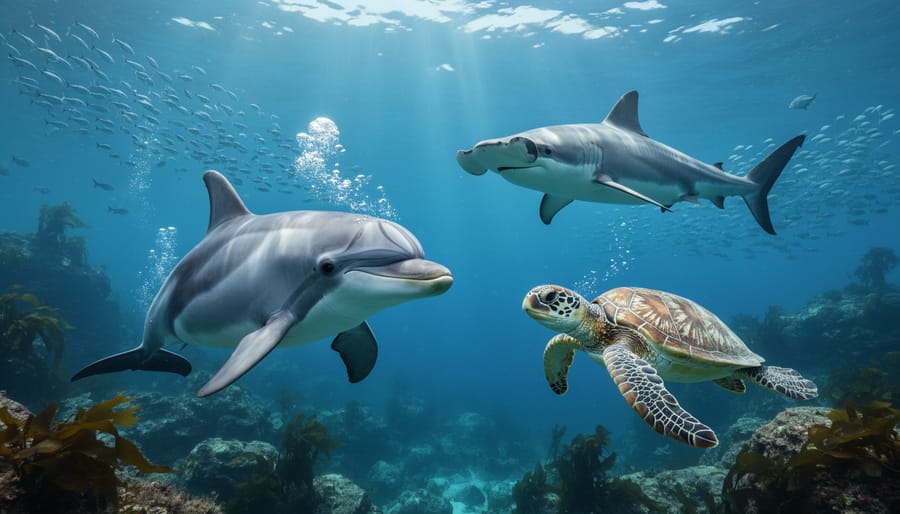
Dive beneath the surface of any ocean, and you’ll discover creatures navigating a sensory world far beyond human comprehension. While most of us learned about five basic senses in school, marine animals operate with at least eight distinct sensory systems, each finely tuned to survive in the underwater realm. A dolphin detecting prey buried in sand through biosonar, a sea turtle navigating thousands of miles using Earth’s magnetic fields, or a shark sensing electrical impulses from a heartbeat—these aren’t superpowers from science fiction. They’re evolutionary adaptations that reveal how incomplete our understanding of perception truly is.
The traditional five senses—sight, hearing, touch, taste, and smell—barely scratch the surface of how marine life experiences the ocean. Add vestibular sense for balance and spatial orientation, proprioception for body position awareness, and electroreception for detecting electrical fields, and you begin to grasp the sophisticated sensory toolkit that allows marine animals to communicate, hunt, migrate, and thrive in conditions that would leave humans completely disoriented. Understanding these eight senses isn’t just fascinating biology; it’s essential for effective marine conservation. Human activities like shipping noise, artificial lighting, and electromagnetic cables from offshore wind farms can disrupt these finely-tuned sensory systems, impacting everything from whale communication to fish migration patterns. By exploring how marine animals truly perceive their world, we gain critical insights into protecting the sensory landscapes they depend on for survival.
The Traditional Five Senses in Marine Environments
Vision: Seeing Through the Blue
In the ocean’s depths where sunlight barely penetrates, vision takes on extraordinary forms. Marine animals have evolved remarkable visual adaptations to thrive in conditions that would leave human eyes nearly useless.
Deep-sea fish showcase some of the most impressive low-light vision capabilities. Many species possess tubular eyes packed with light-sensitive rod cells, allowing them to detect the faintest glimmers of bioluminescence from prey or predators. Some dragonfish can even see red bioluminescent light that they themselves produce, creating a private communication channel invisible to most other creatures.
The mantis shrimp takes visual complexity to another level entirely. With 16 types of color receptors compared to our three, these vibrant crustaceans perceive a visual world we can barely imagine. They also detect polarized light, which helps them recognize prey, navigate, and communicate through patterns invisible to predators.
Marine biologist Dr. Sarah Chen explains how this research impacts conservation: “Understanding how animals perceive their environment helps us minimize light pollution’s effects on marine ecosystems. Artificial lights can disrupt navigation, predator avoidance, and breeding behaviors.”
These visual adaptations remind us that the ocean environment requires specialized sensory tools. Protecting water clarity and natural light conditions becomes crucial when we recognize how profoundly marine life depends on these sophisticated visual systems for survival.
Hearing: Sound Travels Faster Below
Sound behaves dramatically differently underwater than in air. While sound waves travel at approximately 343 meters per second through air, they move at an impressive 1,500 meters per second through water—nearly five times faster. This remarkable difference occurs because water molecules are packed more densely together, allowing vibrations to transfer more efficiently between them.
Marine mammals have evolved extraordinary hearing capabilities to capitalize on this acoustic advantage. Whales and dolphins rely on sophisticated auditory systems for underwater communication across vast ocean distances. Humpback whale songs, for instance, can travel hundreds of kilometers through the ocean, allowing these gentle giants to maintain contact with pod members and potential mates far beyond visual range.
Dolphins and toothed whales take auditory adaptation even further through echolocation, producing clicks that bounce off objects and return as echoes. Dr. Sarah Mitchell, a marine acoustics researcher, describes witnessing this ability firsthand: “Watching dolphins navigate murky waters with perfect precision using only sound is humbling—they’re essentially seeing with their ears in ways we’re only beginning to understand.”
Understanding these auditory systems helps conservationists address threats like ocean noise pollution, which can disrupt critical communication and navigation behaviors in marine mammals.
Smell and Taste: Chemical Detection Underwater
In the underwater realm, the distinction between smell and taste becomes beautifully blurred. Marine animals detect dissolved chemicals through specialized receptors, creating what scientists call chemoreception. Sharks exemplify this remarkable ability, using their nares (nostrils) to track a single drop of blood diluted in an Olympic-sized swimming pool. Unlike terrestrial animals that separate airborne scents from food-based tastes, aquatic species sample their environment continuously as water flows over sensory organs.
Marine biologist Dr. Elena Rodriguez shares her fascination: “Watching a reef shark navigate toward prey in complete darkness taught me how powerful chemical detection truly is. These animals essentially taste their way through the ocean.” Fish possess taste buds not just in their mouths, but distributed across their fins and bodies, allowing them to sense food before it reaches their lips. Catfish, for instance, have over 100,000 taste buds covering their whisker-like barbels and skin.
This chemical sensitivity makes marine species particularly vulnerable to pollution. Understanding chemoreception helps conservationists identify how contaminants disrupt feeding and reproduction, informing protection strategies that ensure these ancient sensory systems continue guiding ocean life.
Touch: More Than Surface Contact
Touch in the marine environment operates through remarkably sophisticated systems that go far beyond simple pressure detection. Harbor seals and sea lions, for instance, possess vibrissal whiskers that function as extraordinary sensory organs. These whiskers can detect the faint hydrodynamic trails left behind by fish swimming up to 180 meters away, even in complete darkness. Marine biologist Dr. Sarah Chen describes watching a blindfolded seal navigate an obstacle course using only its whiskers: “The precision was astounding. These animals essentially ‘see’ through touch, reading water movements like we read text on a page.”
Octopuses demonstrate equally impressive tactile abilities through their skin and suckers, which contain millions of chemoreceptors and mechanoreceptors. Each sucker can independently taste and feel textures, allowing these intelligent creatures to gather detailed information about objects without visual input. Their skin can also detect light directly, enabling texture-matching for camouflage.
Understanding these tactile systems helps conservationists assess how human activities like underwater construction and shipping noise might interfere with animals relying on subtle water movements for survival. Volunteer monitoring programs now track behavioral changes in seal populations near coastal development, providing crucial data for protecting these sensitive species.
Beyond the Basics: The Sixth Sense of Lateral Line System
How the Lateral Line Works
The lateral line system works through specialized receptor organs called neuromasts, which are distributed along the sides of a fish’s body and head in visible lines or canals. Each neuromast contains hair cells topped with a gelatinous cupula—imagine tiny underwater weather vanes that bend in response to water movement. When water flows past or when an object displaces water nearby, these hair cells detect the disturbance and send electrical signals to the brain.
Think of it like this: if you’ve ever felt someone walk past you in a swimming pool without seeing them, you’ve experienced a similar sensation. Fish experience this constantly, creating a three-dimensional map of their surroundings based purely on water pressure and movement patterns.
Marine biologist Dr. Sarah Chen describes her research moment: “Watching a blind cavefish navigate perfectly through obstacles using only its lateral line was transformative. These neuromasts detect vibrations as subtle as a single water molecule’s displacement.” This sensitivity allows predators to hunt in complete darkness and prey species to sense approaching danger from several body lengths away, making it essential for survival in murky coastal waters and the deep sea where vision fails.
Communication Through Water Currents
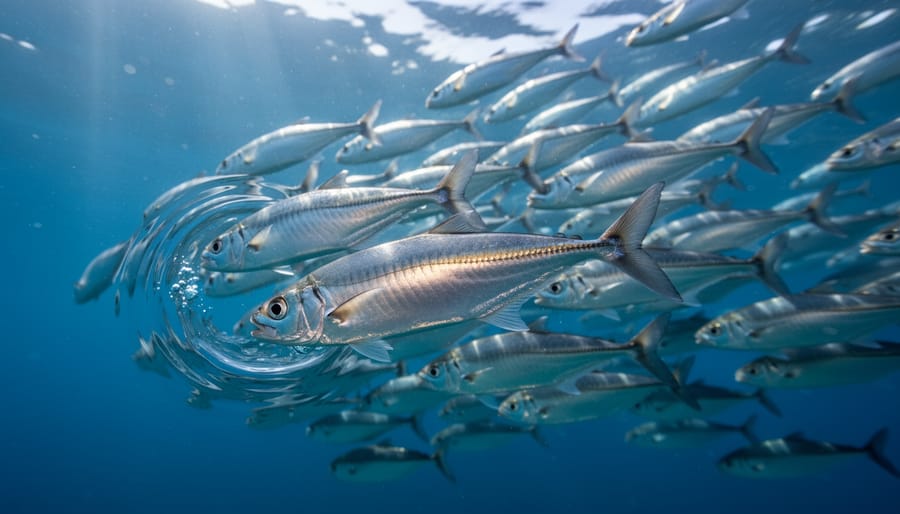
Fish harness their lateral line system to orchestrate remarkable feats of coordination and communication. When schools of sardines or herring move in perfect synchrony, they’re reading pressure waves created by their neighbors through specialized neuromast sensors. This allows hundreds of individuals to turn simultaneously without collision, creating the mesmerizing patterns we observe in underwater footage.
Dr. Elena Martinez, a marine biologist who spent three years studying Pacific bluefin tuna off the California coast, shares a memorable observation: “I watched a school of over fifty tuna execute a coordinated turn in less than a second. Each fish detected minute pressure changes from those around it, processing this information faster than visual cues alone could provide. It’s like they’re dancing to a rhythm we can’t hear.”
The lateral line also plays a crucial role in territorial displays. Damselfish, for example, generate specific water pulses by rapidly vibrating their bodies, sending unmistakable boundary warnings to intruders. These pressure signals travel effectively in murky waters where visual communication fails, demonstrating how evolution has optimized this sensory system for underwater life. Understanding these communication methods helps researchers assess fish stress levels in marine protected areas and design more effective conservation strategies.
The Seventh Sense: Electroreception
Ampullae of Lorenzini: Nature’s Voltage Detectors
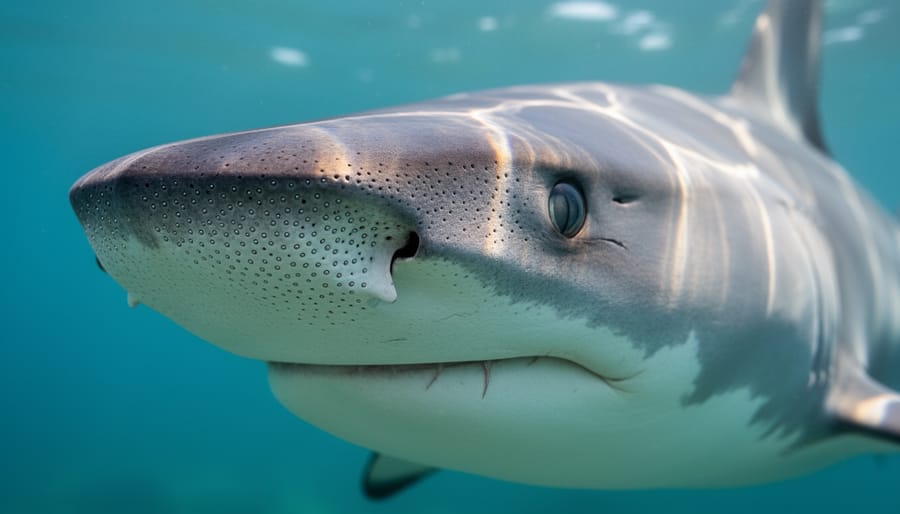
Sharks and rays possess one of nature’s most remarkable sensory systems: the ampullae of Lorenzini. These specialized gel-filled pores, scattered across their snouts and heads, function as living voltmeters capable of detecting electrical fields as weak as five billionths of a volt per centimeter. Every living creature produces tiny electrical signals through muscle contractions and nerve impulses, and these organs allow sharks to sense the bioelectric signatures of hidden prey buried beneath sand or concealed in murky water.
The ampullae work through electroreceptor cells connected to the shark’s nervous system via jelly-filled canals. This conductive gel amplifies even the faintest electrical signals, giving sharks an extraordinary advantage when hunting. Marine biologist Dr. Elena Rodriguez shares her fascination: “Watching a hammerhead sweep its wide head across the seafloor like a metal detector is witnessing evolution’s brilliance. They’re literally reading the electrical landscape.”
This sense also helps sharks navigate using Earth’s magnetic field and detect temperature changes in ocean currents. Understanding electroreception has proven crucial for conservation efforts, as researchers now design fishing gear that emits electrical signals deterring sharks, reducing bycatch while protecting these vital ocean predators. Citizen scientists can contribute by reporting shark sightings to help map migration patterns influenced by this electromagnetic sensitivity.
Electric Communication in Marine Life
In the murky waters where light barely penetrates, electric fish have evolved a remarkable eighth sense that transforms their world into a living electrical landscape. Electroreception allows these fascinating creatures to detect electrical fields in their aquatic environment, functioning through two distinct mechanisms that serve different purposes.
Passive electroreception enables sharks, rays, and some catfish to detect the weak electrical fields generated by the muscle contractions and nervous systems of other animals. These predators use specialized organs called ampullae of Lorenzini to locate prey buried beneath sand or hiding in darkness. Marine biologist Dr. Sarah Chen recalls her first encounter with a hammerhead shark hunting: “Watching it sweep its distinctive head across the seafloor like a metal detector was mesmerizing. It could sense fish hidden completely from view.”
Active electroreception, found in electric fish like the elephant nose fish and electric eels, involves generating their own electrical field and detecting distortions caused by nearby objects or organisms. This creates an “electric aura” used for navigation, hunting, and remarkably sophisticated communication. Males and females exchange electric pulses during courtship, with each species producing unique frequencies. Territorial disputes are often settled through electric signaling rather than physical confrontation, with dominant individuals broadcasting stronger, more complex patterns.
Understanding electroreception helps conservation efforts protect critical breeding habitats where these electrical conversations occur.
The Eighth Sense: Magnetoreception
The Mystery of Magnetic Navigation
Scientists are still unraveling the fascinating mechanisms behind magnetoreception, the ability to detect Earth’s magnetic fields. Two leading theories offer compelling explanations for how marine animals might navigate vast ocean distances with remarkable precision.
The first involves tiny magnetite crystals, essentially microscopic compass needles within specialized cells. These iron-rich particles may physically align with magnetic field lines, sending directional signals to the brain. Marine biologist Dr. Sarah Chen discovered concentrated magnetite deposits in sea turtle beaks during her research in the Pacific, suggesting these crystals act as biological navigation tools.
The second theory centers on cryptochrome proteins found in animals’ eyes. When light activates these proteins, they become sensitive to magnetic fields through quantum mechanical processes. This means some species might literally see magnetic fields as visual patterns overlaying their environment.
Many researchers now believe both systems work together, providing redundant navigation capabilities. Sea turtles, salmon, and migratory sharks likely rely on these mechanisms to traverse thousands of miles between feeding and breeding grounds. Understanding magnetoreception helps conservationists protect critical migration corridors, ensuring these animals can continue their ancient journeys. Volunteers participating in turtle tagging programs contribute valuable data helping scientists map these magnetic highways across our oceans.
Migration Miracles: Following Invisible Maps
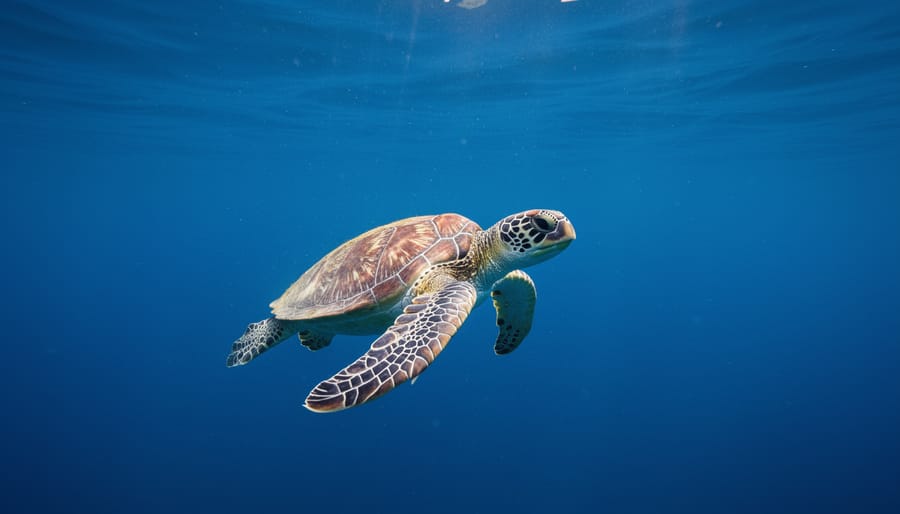
Sea turtles navigate thousands of miles across open ocean to return to the exact beach where they hatched decades earlier, relying on magnetoreception combined with memory and navigation abilities we’re still unraveling. Dr. Elena Martinez, who has tracked loggerhead turtles for fifteen years, describes finding the same female nesting on a Brazilian beach year after year: “She travels from feeding grounds off Argentina, crossing 2,000 kilometers of featureless ocean. It’s like she carries an invisible map encoded in Earth’s magnetic field.” Similarly, Pacific salmon detect subtle chemical signatures in their natal streams, using chemoreception to identify their birthplace among countless tributaries. These migration miracles demonstrate how multiple senses work together, creating navigation systems far more sophisticated than any human technology. Conservation efforts now focus on protecting these sensory pathways—reducing light pollution on nesting beaches and maintaining water quality in salmon rivers—so future generations can follow their inherited maps home.
How Multiple Senses Work Together in Marine Communication
Marine animals rarely rely on just one sense at a time. Instead, they masterfully combine multiple sensory inputs to create a complete picture of their underwater world, demonstrating sophisticated marine communication systems that rival our own sensory processing.
Consider the courtship ritual of cuttlefish. Males don’t simply flash their color-changing abilities and hope for the best. They integrate visual displays with chemical signals, tactile touches, and even adjust their body posture based on water movement they detect through their lateral line system. This multisensory approach ensures their message gets through in the complex underwater environment where a single sense might fail.
Dolphin hunting strategies provide another striking example of multisensory integration. These intelligent marine mammals combine echolocation with vision, electromagnetic detection, and social communication through clicks and whistles. When hunting in murky waters, they might rely more heavily on echolocation, but in clear conditions, they seamlessly blend visual tracking with acoustic monitoring. This flexibility in complex marine behaviors shows remarkable cognitive sophistication.
Dr. Elena Torres, a marine biologist who spent fifteen years studying shark behavior, shares her observations: “I’ve watched great white sharks circle their prey using at least five different senses simultaneously. They detect electrical fields from muscle contractions, smell blood from kilometers away, feel pressure waves, see shadows, and even taste the water. It’s like watching a biological supercomputer process multiple data streams in real-time.”
This multisensory integration extends to social bonding too. Humpback whales maintain group cohesion through vocalizations, visual recognition, and tactile contact during social activities. Mother and calf pairs especially rely on this combination to stay connected in vast ocean spaces.
Understanding how marine animals integrate sensory information helps conservationists design better protection strategies, from reducing acoustic pollution that disrupts echolocation to protecting chemical communication pathways essential for reproduction.
Conservation Implications: Protecting Sensory Environments
Underwater Noise and Marine Mammals
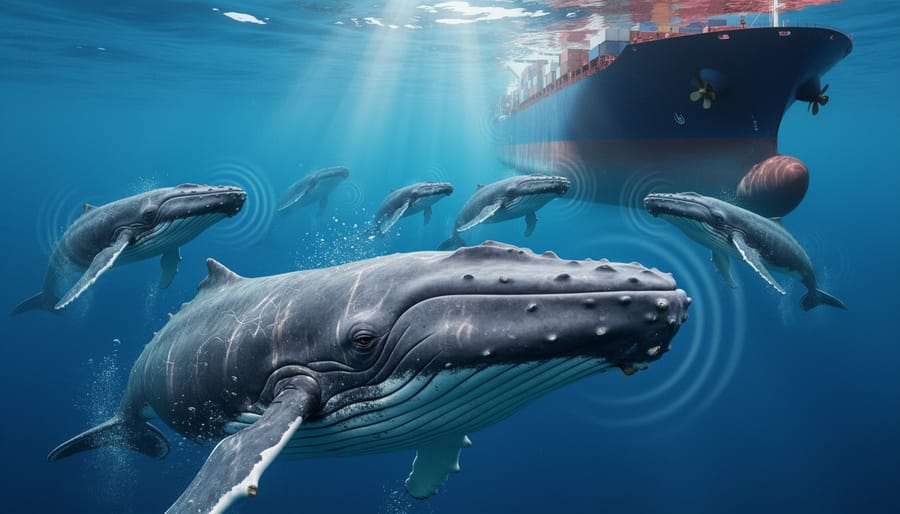
The underwater world should be a symphony of clicks, whistles, and songs, but increasing ship traffic and military sonar are drowning out the voices of whales and dolphins. These marine mammals rely on sound to navigate, find food, and communicate across vast ocean distances, sometimes spanning hundreds of miles. However, anthropogenic noise pollution now saturates their acoustic habitat.
Research reveals alarming consequences. Studies show that shipping noise can reduce the communication range of humpback whales by up to 90 percent, forcing them to vocalize more frequently and expend precious energy. Naval sonar, particularly mid-frequency active sonar, has been linked to mass strandings of beaked whales, who may panic and surface too rapidly, suffering decompression sickness.
Marine biologist Dr. Sarah Chen, who studies dolphin populations off California’s coast, shares: “I’ve witnessed pods separating because they simply couldn’t hear each other over container ship engines. It’s heartbreaking, but it’s also preventable.”
Conservation efforts are showing promise. Speed restrictions in critical habitats reduce noise levels while protecting whales from ship strikes. You can support these initiatives by advocating for quieter shipping corridors and participating in citizen science projects that monitor marine mammal behavior. Together, we can restore the ocean’s natural soundscape.
Light Pollution and Magnetic Interference
Modern human activity increasingly disrupts the remarkable navigational abilities of marine life. Coastal development introduces artificial light that confuses sea turtle hatchlings, which naturally orient themselves toward the brightest horizon—historically, the moon and stars reflecting off the ocean. Today’s beachfront lighting can cause hatchlings to crawl inland instead, drastically reducing their survival rates. Marine biologist Dr. Sarah Chen recalls witnessing disoriented hatchlings on a Florida beach: “We found dozens circling beneath streetlights, exhausted and vulnerable to predators. It’s heartbreaking when a simple solution like red-spectrum lights could save them.”
Electromagnetic fields from underwater power cables and communication infrastructure present another challenge. These fields interfere with the magnetic sense that fish, sharks, and sea turtles rely on for migration. Studies show some fish species avoid areas near submarine cables, potentially disrupting migration corridors and breeding patterns. The cumulative effect alters ecosystem dynamics in ways we’re only beginning to understand.
You can help by participating in beach lighting audits or supporting turtle-friendly lighting initiatives in coastal communities. These volunteer efforts demonstrate how addressing human-made sensory interference creates tangible conservation benefits.
What We Can Do to Help
You can directly support marine sensory research and conservation efforts through several meaningful actions. Advocate for marine protected areas that safeguard critical habitats where animals rely on sensory cues for survival. Reduce ocean pollution by minimizing plastic use and properly disposing of waste, as debris disrupts the sensory systems marine life depends on. The Marine Biodiversity Science Center offers volunteer opportunities in sensory ecology research, from assisting with electroreception studies to monitoring acoustic environments. Even small actions matter—sharing knowledge about marine senses helps build public support for protecting these remarkable creatures and their underwater world.
The remarkable sensory world of marine life reveals a universe far more complex and interconnected than we might have imagined. From the electroreception of sharks navigating vast oceans to the magnetoreception guiding sea turtles home, these eight senses demonstrate the extraordinary adaptations that have evolved over millions of years. Each sense represents not just a biological feature, but a vital communication channel connecting marine animals to their environment and to each other.
Understanding these intricate sensory systems transforms how we view ocean conservation. When we recognize that marine mammals rely on echolocation to find food and communicate across hundreds of miles, we understand why noise pollution from shipping and sonar becomes a conservation crisis. When we learn that fish use their lateral line systems to detect the slightest water movements, we appreciate how habitat destruction disrupts entire ecosystems. These sensory networks are as essential to marine life as the water itself.
Dr. Maria Santos, a marine biologist who has spent fifteen years studying dolphin communication, shares this perspective: “Every time I witness dolphins coordinating a hunt through sound alone, I’m reminded that we’re protecting not just individual species, but an entire language of survival that took millennia to develop.”
The good news is that understanding creates opportunity for action. By supporting marine protected areas, reducing ocean noise, and minimizing light pollution, we can preserve these sensory highways. We invite you to join our conservation e-network, where you’ll receive updates on research breakthroughs, volunteer opportunities for coastal monitoring, and practical ways to protect these magnificent sensory systems. Together, we can ensure that future generations will continue to marvel at the wonder of marine life.

jessica
Ava Singh is an environmental writer and marine sustainability advocate with a deep commitment to protecting the world's oceans and coastal communities. With a background in environmental policy and a passion for storytelling, Ava brings complex topics to life through clear, engaging content that educates and empowers readers. At the Marine Biodiversity & Sustainability Learning Center, Ava focuses on sharing impactful stories about community engagement, policy innovations, and conservation strategies. Her writing bridges the gap between science and the public, encouraging people to take part in preserving marine biodiversity. When she’s not writing, Ava collaborates with local initiatives to promote eco-conscious living and sustainable development, ensuring her work makes a difference both on the page and in the real world.