Marine Biodiversity Science Center

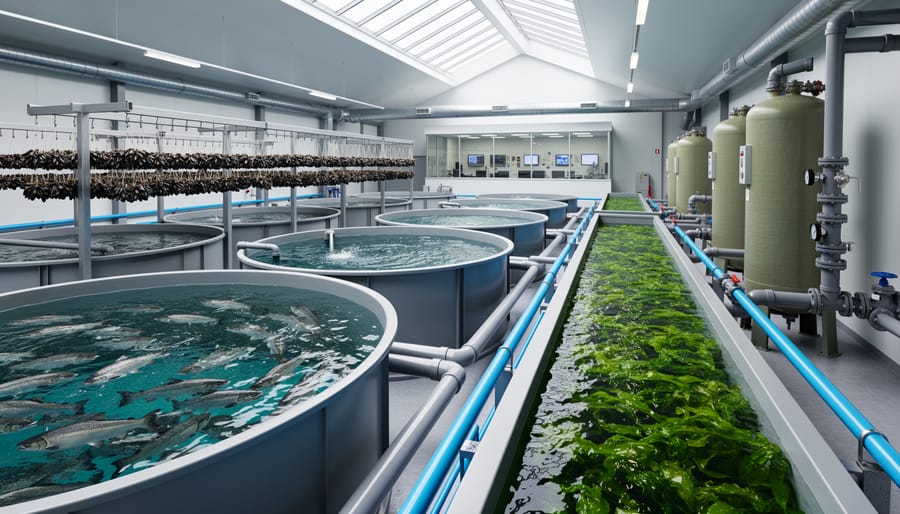
Prioritize recirculating aquaculture systems (RAS) that filter and reuse up to 99% of water, dramatically reducing environmental impact compared to traditional open-net pens while preventing disease transmission to wild populations. Integrate polyculture approaches by combining species like finfish with seaweed and shellfish, creating symbiotic relationships where waste from one organism becomes nutrients for another, mimicking natural ecosystem balance.
Choose certified sustainable farms displaying ASC (Aquaculture Stewardship Council) or BAP (Best Aquaculture Practices) labels, which verify reduced antibiotic use, responsible feed sourcing, and minimal habitat disruption. Support land-based facilities that eliminate ocean pollution risks entirely while allowing precise environmental control, though these systems require careful energy management to maintain true sustainability credentials.
As the global population approaches 10 billion by 2050, wild fisheries alone cannot meet growing protein demands. Aquaculture already provides over half the seafood consumed worldwide, yet its expansion has historically come at significant environmental cost: coastal habitat destruction, nutrient pollution, disease outbreaks affecting wild stocks, and feed sourced from overfished species. This paradox defines our current challenge.
Marine biologist Dr. Sarah Chen spent fifteen years documenting degraded coastal ecosystems around intensive shrimp farms in Southeast Asia before witnessing a transformation. “When farms adopted integrated multi-trophic aquaculture, I watched barren zones regenerate within three growing seasons,” she explains. Her experience illustrates that aquaculture sustainability isn’t merely damage control but rather represents genuine ocean sustainability potential.
The path forward combines technological innovation with ecological wisdom. From precision feeding algorithms reducing waste by 30% to breeding programs developing fish requiring less wild-caught feed, the industry stands at a critical juncture where economic viability aligns with environmental responsibility.
What Makes Aquaculture Sustainable—and Why It Matters
The Triple Bottom Line of Sustainability
Sustainable aquaculture rests on three interconnected pillars that together create a resilient framework for ocean farming. Think of it as a three-legged stool: remove one leg, and the entire system collapses.
The environmental pillar focuses on protecting marine habitats and minimizing ecological impact. This means reducing pollution, preventing disease transmission to wild populations, and avoiding the destruction of sensitive coastal ecosystems like mangroves. Dr. Maria Santos, a marine biologist who has worked with aquaculture operations in Southeast Asia for over a decade, explains: “We’ve seen remarkable progress when farms implement proper waste management and select appropriate species for their local environments. The key is working with nature, not against it.”
The economic pillar ensures that aquaculture provides sustainable livelihoods for coastal communities. Profitable operations create jobs, support local economies, and reduce pressure on wild fish stocks. However, profitability shouldn’t come at the expense of environmental health or worker welfare.
The social pillar addresses fair labor practices, food security, and community well-being. This includes ensuring safe working conditions, equitable distribution of benefits, and respecting the rights of indigenous communities who depend on marine resources.
These three pillars don’t exist in isolation. A farm that degrades the environment will eventually lose productivity and community support. Conversely, operations that balance all three create lasting positive change. Many organizations now offer volunteer opportunities to monitor farm practices and support communities in implementing sustainable techniques, allowing you to contribute directly to this balanced approach.
The Real Cost of Unsustainable Fish Farming
When aquaculture operations prioritize profit over environmental stewardship, the consequences ripple far beyond farm boundaries. Poorly managed fish farms generate substantial pollution through excess feed, fish waste, and chemical treatments that accumulate on seafloor sediments and degrade water quality. These nutrient-rich discharges can trigger harmful algal blooms that suffocate marine life and compromise marine ecosystem health in surrounding waters.
Disease transmission poses another critical threat. When thousands of fish crowd together in net pens, parasites and pathogens spread rapidly. Sea lice infestations from salmon farms, for example, can devastate wild salmon populations swimming past these operations during migration. Marine biologist Dr. Sarah Chen recalls surveying wild fish near intensive farm sites: “The infection rates we documented were heartbreaking, particularly among juvenile salmon with compromised immune systems.”
Habitat destruction compounds these problems. Coastal development for aquaculture infrastructure often destroys vital mangrove forests and seagrass beds that serve as nurseries for countless marine species. The good news? Recognition of these impacts has sparked innovation in sustainable alternatives that we’ll explore next.
Proven Practices That Are Transforming Marine Aquaculture
Integrated Multi-Trophic Aquaculture (IMTA): Nature’s Blueprint
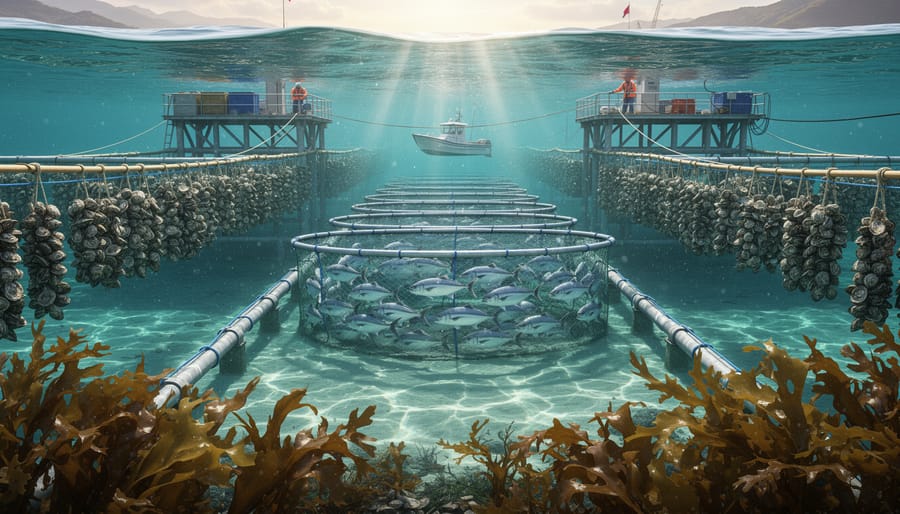
Nature operates on elegant efficiency—nothing goes to waste. Integrated Multi-Trophic Aquaculture (IMTA) applies this wisdom to seafood production by cultivating multiple species together, each occupying a different position in the food web. Instead of farming just one species, IMTA creates balanced ecosystems where the byproducts of one organism become nutrients for another.
Picture a coastal IMTA farm: salmon raised in sea cages produce waste containing nitrogen and phosphorus. Rather than polluting surrounding waters, seaweeds cultivated nearby absorb these nutrients for growth. Meanwhile, shellfish like mussels and oysters filter particulate matter from the water column. The result? Cleaner water, reduced environmental impact, and multiple marketable products from a single operation.
Dr. Sarah Chen, a marine biologist who helped establish IMTA systems in British Columbia, recalls her initial skepticism: “I couldn’t believe how well kelp thrived on fish waste nutrients. Within months, we were harvesting both premium salmon and restaurant-quality seaweed while significantly improving water quality.” Her experience demonstrates how circular economy principles transform aquaculture from a potential polluter into an ecosystem restorer.
These systems aren’t just theoretical—they’re operating successfully worldwide, from Norwegian fjords to Chinese coastal zones. For those interested in supporting this innovation, several research stations offer volunteer opportunities to help monitor IMTA systems, collecting data that refines these nature-inspired techniques. By working with ecological processes rather than against them, IMTA represents aquaculture’s sustainable future.
Recirculating Aquaculture Systems: Closing the Loop
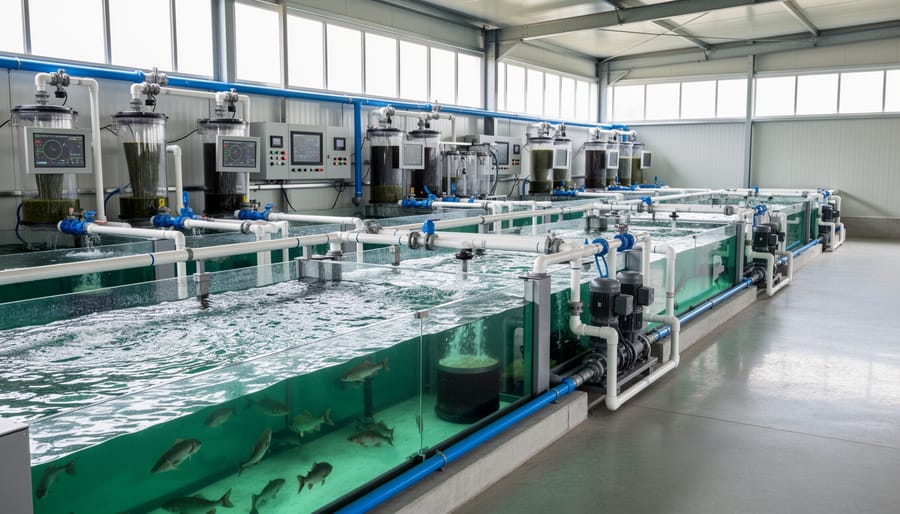
Recirculating Aquaculture Systems, or RAS, represent a groundbreaking approach to farming fish on land while virtually eliminating the environmental concerns associated with traditional ocean-based operations. These sophisticated systems work by continuously filtering and recycling water through mechanical filters, biological treatment units, and sometimes ultraviolet sterilization, removing waste products and maintaining optimal water quality.
The benefits are remarkable. RAS facilities use up to 99% less water than conventional aquaculture, transforming what was once a water-intensive industry into an efficient closed-loop operation. By keeping fish in controlled indoor environments, these systems dramatically reduce disease transmission, nearly eliminating the need for antibiotics that can harm marine ecosystems. Escapes become impossible, protecting wild fish populations from genetic dilution and competition.
Dr. Maria Chen, a marine biologist who transitioned from ocean conservation to sustainable aquaculture, shares her perspective: “When I first visited a RAS facility, I was amazed. We’re producing healthy protein without the environmental footprint. It’s aquaculture reimagined.”
These systems can be established anywhere, even in urban areas or regions far from coastlines, reducing transportation emissions and providing fresh, local seafood. While energy requirements remain a challenge, many facilities now incorporate renewable energy sources, further minimizing their carbon footprint and demonstrating that intensive fish farming and environmental stewardship can successfully coexist.
Seaweed and Shellfish Farming: The Ocean’s Natural Cleaners
Among aquaculture options, seaweed and shellfish farming stand out as true environmental champions. These organisms don’t just avoid harming marine ecosystems—they actively improve them.
Unlike finfish farming, seaweed and shellfish require zero feed inputs. Seaweed absorbs excess nutrients like nitrogen and phosphorus directly from the water, essentially cleaning up pollution from coastal runoff and other sources. Shellfish such as oysters, mussels, and clams are natural filter feeders, with a single oyster capable of filtering up to 50 gallons of water daily. This filtration removes excess algae and particulates, improving water clarity and quality for surrounding marine life.
The climate benefits are equally impressive. Seaweed farms sequester significant amounts of carbon dioxide through photosynthesis, with some species growing up to two feet per day. When harvested sustainably, this captured carbon can be used for food, biofuels, or animal feed, preventing its release back into the atmosphere.
Marine biologist Dr. Sarah Chen, who monitors shellfish restoration projects along the Atlantic coast, shares: “I’ve watched oyster reefs transform degraded harbors into thriving ecosystems within just a few years. The water becomes clearer, fish populations rebound, and the entire food web strengthens.”
For those interested in supporting these sustainable practices, many coastal restoration programs welcome volunteers to help with shellfish monitoring and seaweed cultivation initiatives, offering hands-on experience in ocean stewardship.

Smart Site Selection and Ocean Zoning
Choosing the right location for aquaculture operations is fundamental to protecting ocean ecosystems while maintaining productive farms. Marine spatial planning helps identify areas where aquaculture can thrive without compromising sensitive habitats like coral reefs, seagrass meadows, and critical spawning grounds. By mapping ocean resources and activities, coastal managers can designate zones that balance economic development with environmental protection.
Dr. Maria Santos, a marine biologist working with coastal communities in Southeast Asia, shares an inspiring example: “We worked with local fish farmers to relocate their operations away from a declining seagrass bed. Within two years, we saw dugong populations return to feed in the restored habitat, while the farms actually performed better in deeper waters with stronger currents that naturally dispersed waste.”
Smart site selection considers water depth, current patterns, proximity to wild fish populations, and existing marine protected areas. Strong currents help disperse nutrients and waste, reducing localized impacts, while adequate distance from wild stocks minimizes disease transmission risks. Many regions now require environmental assessments before granting aquaculture permits, ensuring operations won’t harm vulnerable species or ecosystems.
You can support these efforts by advocating for comprehensive ocean zoning in your region and volunteering with organizations that monitor coastal development impacts.
Breakthrough Innovations Shaping the Future
Feed Revolution: From Wild Fish to Insects and Algae
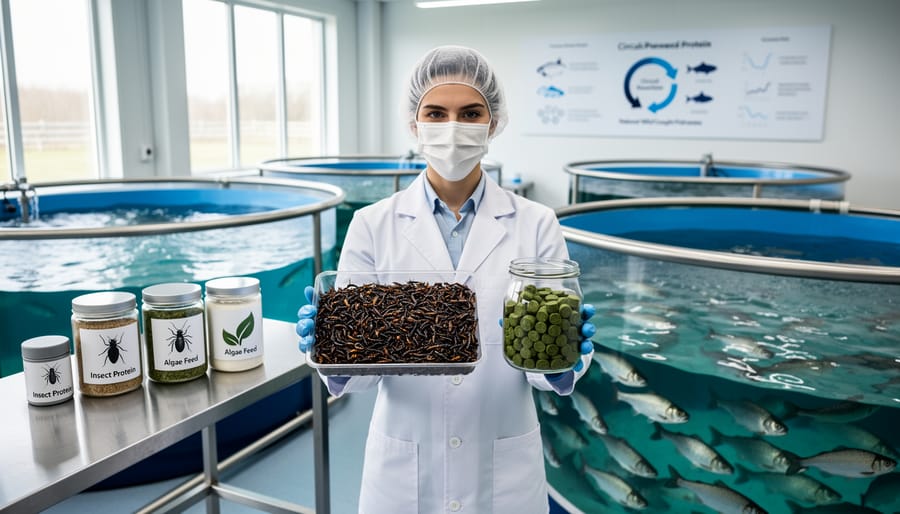
The traditional aquaculture diet has long depended on fishmeal and fish oil derived from wild-caught species, creating a troubling paradox: we’re depleting ocean fish populations to feed farmed fish. This unsustainable cycle has prompted researchers to develop revolutionary alternatives that could transform the industry.
Insect-based feeds represent one of the most promising innovations. Black soldier fly larvae, packed with protein and natural fats, thrive on organic waste and require minimal resources to cultivate. Marine biologist Dr. Elena Martinez, who pioneered insect feed trials at a coastal farm in Chile, recalls her initial skepticism: “I doubted fish would accept insects, but the salmon grew beautifully. We’re essentially closing the loop by converting food waste into high-quality protein.”
Microbial proteins and single-cell organisms offer another breakthrough. These microscopic powerhouses can be grown in bioreactors using renewable energy, producing protein-rich feeds without touching wild fish stocks. Similarly, algae and seaweed cultivation provides omega-3 fatty acids previously sourced from forage fish.
These alternatives aren’t just environmentally sound—they’re economically viable. Students and volunteers interested in aquaculture innovation can participate in research programs testing novel feeds at university marine labs. By supporting farms that use alternative proteins, consumers directly reduce pressure on wild fish populations while helping build a truly sustainable seafood future.
Genetic Advances and Selective Breeding
Selective breeding programs represent one of aquaculture’s most promising pathways toward sustainability. Through careful selection of superior traits across generations, scientists are developing fish and shellfish strains that grow faster, resist diseases naturally, and thrive in diverse conditions—all without genetic modification. These genetic advances reduce the need for antibiotics and chemical treatments while lowering feed requirements and mortality rates.
Dr. Sarah Chen, a marine geneticist working with Atlantic salmon, shares her excitement: “We’ve seen disease resistance improve by 40% in just three generations. This means healthier fish, less environmental impact, and more sustainable operations.” These improvements translate directly to reduced pollution and decreased pressure on wild fish stocks used for feed.
Students and aspiring marine biologists can participate in breeding research programs at universities and aquaculture facilities, gaining hands-on experience with cutting-edge conservation technology. These programs demonstrate how traditional breeding methods, enhanced by modern genomic understanding, can revolutionize sustainable food production.
Monitoring Technology and AI Solutions
Modern aquaculture is embracing cutting-edge technology to create healthier ocean environments while improving farm productivity. Underwater sensors now continuously monitor water quality parameters like oxygen levels, temperature, and pH, alerting farmers to potential problems before they escalate. These real-time data streams allow for precise adjustments that reduce chemical use and prevent harmful algal blooms.
Artificial intelligence systems analyze patterns from thousands of data points, predicting optimal feeding times and quantities to minimize waste that would otherwise pollute surrounding waters. Underwater cameras equipped with AI can even identify individual fish health issues, enabling targeted treatment rather than broad medication of entire populations. Marine biologist Dr. Sarah Chen notes that these technologies have reduced feed waste by up to 30% at farms she monitors, directly translating to less nutrient pollution in coastal ecosystems. For those interested in supporting this technological revolution, volunteer opportunities exist with organizations testing and refining these monitoring systems at demonstration farms worldwide.
Voices from the Water: Marine Biologists Share Their Insights
Dr. Maria Santos never imagined that her passion for marine biology would lead her to the coastal communities of Southeast Asia, where she now helps local fish farmers transition to sustainable practices. “When I first arrived, the fish pens were overcrowded, antibiotics were routine, and the surrounding mangrove ecosystems were suffering,” she recalls. “But the farmers weren’t the villains in this story—they simply lacked access to better methods. Once we introduced integrated multi-trophic aquaculture, where seaweed and shellfish naturally filter the water alongside fish farming, everything changed. The water quality improved, profits increased by 40%, and the mangroves began recovering.”
Stories like Maria’s illustrate the human side of aquaculture sustainability. For Dr. James Chen, who researches alternative feed ingredients in Norway, the biggest challenge has been shifting industry mindsets. “Convincing large-scale salmon operations to replace wild-caught fishmeal with insect protein or algae-based feeds seemed impossible five years ago,” he explains. “Now, we’re seeing major producers voluntarily adopting these alternatives because they recognize both the environmental necessity and the long-term economic benefits.”
The successes aren’t without obstacles. Dr. Amara Okafor, working with smallholder tilapia farmers in West Africa, notes that climate change presents unexpected complications. “Rising water temperatures affect breeding cycles and disease resistance. We’re constantly adapting our recommendations, which requires ongoing education and support for farmers who are already operating on tight margins.”
These researchers emphasize that sustainable aquaculture isn’t just for scientists—it needs community involvement. Organizations worldwide offer volunteer opportunities ranging from water quality monitoring and farm assessments to educational outreach in coastal communities. Programs like the Aquaculture Stewardship Council’s Volunteer Network connect enthusiasts with projects needing field assistance, while universities often welcome volunteers for research expeditions.
“Anyone can contribute,” Maria insists. “We’ve had retired teachers help develop training materials, college students assist with data collection, and even graphic designers create infographics explaining sustainable practices to local communities. The solutions to aquaculture challenges require diverse perspectives and passionate individuals willing to roll up their sleeves.”
For those interested in getting involved, many research stations offer short-term volunteer placements, and numerous conservation organizations maintain databases of aquaculture-related opportunities. The journey toward truly sustainable seafood production depends on collective action—from researchers and farmers to volunteers and conscious consumers.
How You Can Support Sustainable Aquaculture
Making Smart Seafood Choices
As consumers, we hold remarkable power to shape the future of aquaculture through our purchasing decisions. Look for trusted certification labels when shopping, such as the Aquaculture Stewardship Council (ASC), Best Aquaculture Practices (BAP), or Marine Stewardship Council (MSC) certifications. These labels indicate farms have met rigorous environmental and social standards.
Marine biologist Dr. Sarah Chen shares her approach: “I always check the Seafood Watch app before buying. It’s developed by Monterey Bay Aquarium and provides up-to-date recommendations based on sustainable seafood practices.” The app and similar resources like Ocean Wise help you identify which species and farming methods support ocean health.
Don’t hesitate to ask questions at your local fish counter about sourcing and farming methods. Many retailers now provide detailed information about their seafood origins. By consistently choosing certified sustainable options, you’re directly supporting responsible aquaculture operations and encouraging the industry to adopt better practices—making every meal an opportunity for positive ocean impact.
Join the Movement: Volunteer and Education Opportunities
Becoming part of the aquaculture sustainability movement starts with education and hands-on involvement. Our Marine Conservation Center offers several pathways for those eager to make a difference.
Our Sustainable Aquaculture Volunteer Program welcomes participants of all backgrounds to assist with daily operations at our research facilities. Volunteers help monitor water quality, feed fish using precision techniques that minimize waste, and collect data on growth rates and ecosystem health. Dr. Maria Chen, who leads our volunteer coordination, shares: “We’ve had high school students, retired teachers, and career-changers join us. Many volunteers tell us that working directly with aquaculture systems transformed their understanding of where seafood comes from and how we can produce it responsibly.”
Educational workshops run monthly, covering topics from recirculating aquaculture systems to integrated multi-trophic farming. These sessions blend classroom learning with facility tours, allowing participants to witness sustainable practices in action.
For educators, we provide free curriculum materials designed to bring aquaculture sustainability concepts into classrooms. Students can participate in our Youth Ambassador Program, which pairs them with marine biologists for mentorship opportunities.
Community members can also support sustainable aquaculture by choosing certified sustainable seafood, advocating for responsible farming policies, and spreading awareness. Every action, whether volunteering for a day or making mindful purchasing decisions, contributes to healthier oceans and more resilient food systems.
The future of our oceans—and our ability to feed nearly 10 billion people by 2050—depends significantly on how we approach aquaculture today. Sustainable aquaculture isn’t just an environmental imperative; it’s a practical solution that balances human nutritional needs with the health of marine ecosystems. When done right, it reduces pressure on wild fish populations, provides livelihoods for coastal communities, and can even restore damaged habitats.
What’s truly encouraging is that we’re not starting from scratch. Scientists are developing innovative closed-loop systems that eliminate waste. Fish farmers are adopting integrated multi-trophic aquaculture that mimics natural ecosystems. Consumers are making informed choices at seafood counters. Each action, no matter how small, contributes to a larger movement toward ocean health.
Dr. Maria Santos, a marine biologist who has spent decades researching sustainable aquaculture practices, often reminds us that “change happens when knowledge meets action.” This is where you come in. Whether you’re a researcher, educator, student, or simply someone who cares about our blue planet, there are meaningful ways to contribute. Our center offers volunteer opportunities in aquaculture research, community education programs, and citizen science initiatives that directly support sustainable seafood systems.
The path forward requires all of us—scientists pioneering new techniques, industry leaders implementing best practices, and individuals making conscious choices. Together, we can ensure that aquaculture becomes a powerful force for conservation rather than degradation. Join us in this critical work. Your involvement matters more than you might think.

jessica
Ava Singh is an environmental writer and marine sustainability advocate with a deep commitment to protecting the world's oceans and coastal communities. With a background in environmental policy and a passion for storytelling, Ava brings complex topics to life through clear, engaging content that educates and empowers readers. At the Marine Biodiversity & Sustainability Learning Center, Ava focuses on sharing impactful stories about community engagement, policy innovations, and conservation strategies. Her writing bridges the gap between science and the public, encouraging people to take part in preserving marine biodiversity. When she’s not writing, Ava collaborates with local initiatives to promote eco-conscious living and sustainable development, ensuring her work makes a difference both on the page and in the real world.