Marine Biodiversity Science Center

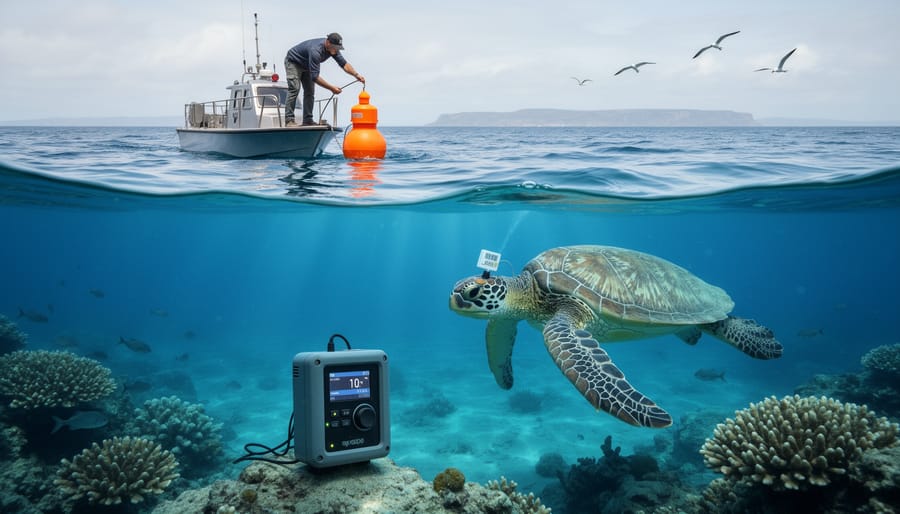
The ocean depths hide secrets that could reshape our understanding of climate change, biodiversity, and planetary health—but until recently, we’ve had few tools to unlock them. Frontier marine science is changing that reality. By combining advanced data analytics, machine learning algorithms, and real-time oceanographic sensors, researchers are now predicting marine ecosystem changes before they happen, tracking endangered species across vast ocean territories, and identifying conservation interventions that actually work.
Consider Dr. Sarah Chen, a marine biologist who spent fifteen years manually cataloging coral reef health only to watch her study sites bleach and die before patterns became clear. Today, she uses predictive models that analyze water temperature, acidity, and current patterns to forecast bleaching events months in advance—giving conservation teams time to implement protective measures. Her work represents a fundamental shift: marine science is no longer just about observing what has already occurred, but about anticipating what comes next.
This transformation matters because our oceans face unprecedented pressures. Over three billion people depend on marine biodiversity for their livelihoods. Climate change accelerates at rates that outpace traditional research methods. We cannot afford to wait years for studies to conclude when ecosystems collapse in months.
Frontier marine science democratizes ocean conservation. You don’t need a PhD to contribute. Citizen scientists now collect data through smartphone apps, volunteers analyze underwater footage to identify species, and community groups partner with researchers to monitor local coastlines. The technologies enabling professional breakthroughs—satellite imaging, acoustic monitoring, environmental DNA sampling—increasingly inform grassroots conservation efforts.
The ocean’s future depends on understanding it faster, predicting changes more accurately, and acting more decisively than ever before.
What Makes Marine Data Science a Frontier Field
The Data Revolution Beneath the Waves
The ocean, once a black box of mystery, is now transmitting data at unprecedented rates. A technological revolution has transformed how we observe and understand marine ecosystems, generating information volumes that seemed impossible just a decade ago.
Acoustic monitoring systems now eavesdrop on ocean soundscapes 24/7, detecting whale songs from miles away and tracking fish populations through their collective movements. Marine biologist Dr. Elena Rodriguez recalls the shift: “When I started my career, we’d spend weeks at sea hoping to spot a single blue whale. Now, underwater microphones let us monitor their movements year-round, revealing migration patterns we never knew existed.”
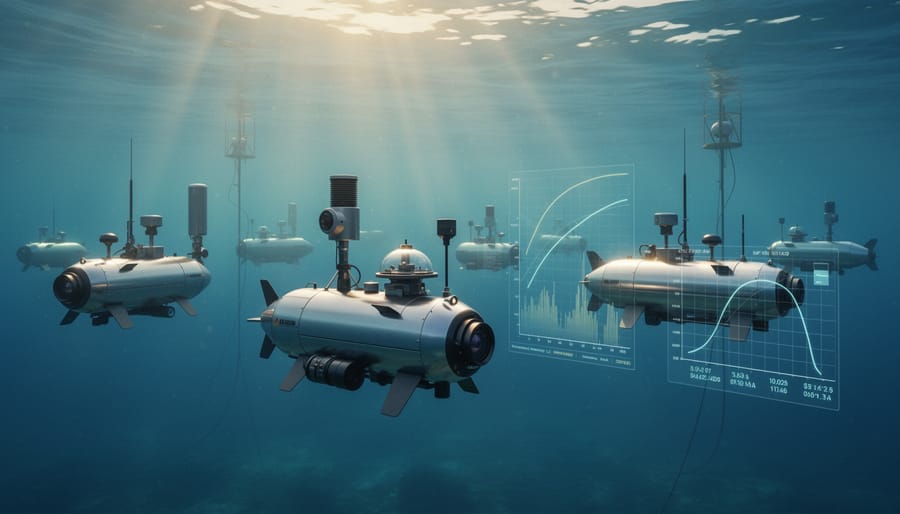
Satellites orbiting above capture ocean surface temperatures, algae blooms, and even detect large marine animals from space. Below, autonomous ocean drones glide through the depths for months, measuring temperature, salinity, and oxygen levels while dodging storms and marine life. Tagged animals have become living data collectors—sea turtles, sharks, and seals wearing sensors that transmit location, depth, and water conditions as they navigate their territories.
This data deluge represents more than technological advancement. It’s democratizing ocean science. Citizen scientists now contribute through apps that identify species from photos, while volunteers help analyze thousands of hours of underwater footage that would take researchers decades to process alone. The ocean’s secrets are surfacing faster than ever, and everyone can participate in the discovery.
From Observation to Prediction
Marine science is entering an exciting new era where we can anticipate ocean changes before they occur. Predictive oceanography uses sophisticated algorithms and digital ocean models to forecast everything from temperature shifts to species migrations, transforming how we protect our oceans.
Think of it as a weather forecast, but for marine ecosystems. By analyzing patterns in ocean temperature, currents, salinity, and nutrient levels, scientists can predict where certain species will travel in search of food or suitable breeding grounds. These predictions are remarkably accurate, sometimes forecasting movements weeks or even months in advance.
Dr. Elena Ramirez, a predictive oceanographer working in coral reef conservation, shares how this technology changed her approach: “We used to respond to bleaching events after they happened. Now we can predict thermal stress zones and deploy protective measures beforehand, giving corals a fighting chance.”
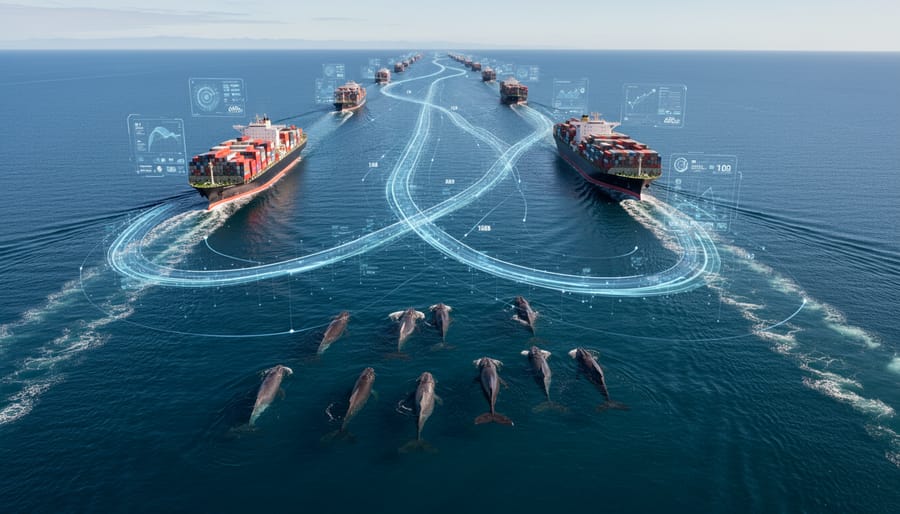
This shift from reactive to proactive conservation is revolutionary. When algorithms predict harmful algal blooms, authorities can close shellfish harvesting areas early, protecting both marine life and human health. When models forecast the arrival of endangered whale populations in shipping lanes, vessels can alter their routes to prevent collisions.
The real power lies in prevention. By understanding what’s coming, conservationists can position resources strategically, implement protective measures, and mobilize volunteer teams exactly where and when they’re needed most.
Real-World Applications Protecting Marine Life Today
Predicting Migration Routes to Prevent Ship Strikes
Every year, thousands of whales and sea turtles die from collisions with commercial vessels—tragedies that cutting-edge predictive models are now helping to prevent. Dr. Maria Santos, a marine biologist with the Pacific Whale Conservation Alliance, has witnessed this technology’s life-saving potential firsthand. “We’re using satellite tracking data, ocean temperature readings, and historical migration patterns to forecast where endangered species will travel weeks in advance,” she explains. “Then we work with shipping companies to temporarily adjust their routes.”
The models combine real-time environmental data with machine learning algorithms that identify critical feeding and breeding zones. When a North Atlantic right whale population was predicted to migrate through a major shipping corridor off Massachusetts, authorities successfully rerouted vessels, reducing collision risk by 80 percent. Similar initiatives protect leatherback sea turtles in the Pacific, where shipping lane management now incorporates seasonal turtle movement forecasts.
Dr. Santos recalls tracking a pregnant humpback whose predicted path intersected with container ship traffic. “We issued an alert, and within hours, three vessels adjusted their course. Two weeks later, we confirmed she’d given birth safely in protected waters. That moment reminded me why this work matters.”
These collaborations between scientists, shipping industries, and conservation groups demonstrate how data-driven approaches can harmonize economic activities with marine protection, turning potential tragedy into coexistence.
Early Warning Systems for Coral Bleaching Events
Imagine being able to predict a coral bleaching event weeks before it happens—giving scientists precious time to respond. Advanced data models now make this possible by analyzing sea surface temperatures, light intensity, and historical bleaching patterns to forecast stress events with remarkable accuracy. These early warning systems, developed through collaborations between marine scientists and data specialists, scan satellite data and oceanographic sensors to identify conditions that trigger coral bleaching.
When models detect rising threat levels, conservationists can deploy protective measures like temporary shading structures in critical reef areas or relocate particularly vulnerable coral fragments to nurseries. Marine biologist Dr. Elena Torres recalls receiving an alert for her research site in the Caribbean: “We had twelve days’ notice. Our team mobilized immediately, documenting baseline coral health and installing monitoring equipment. That advance preparation allowed us to capture the entire bleaching progression and subsequent recovery—data that’s proving invaluable for understanding coral resilience.”
These systems also help prioritize limited conservation resources by identifying which reefs face the greatest immediate risk. Volunteers often assist in rapid response efforts, collecting water samples and photographing coral colonies to track bleaching severity. As predictive models continue improving, they’re becoming essential tools for protecting coral ecosystems in our warming oceans.
Tracking Illegal Fishing with Machine Learning
Illegal fishing devastates marine ecosystems and costs the global economy billions annually. Fortunately, cutting-edge machine learning is revolutionizing how we detect and prevent these harmful activities. Advanced algorithms now analyze vast amounts of vessel tracking data from the Automatic Identification System (AIS), combined with satellite imagery, to spot suspicious behavior patterns that suggest illegal fishing in protected waters.
These intelligent systems learn to recognize telltale signs: vessels that disable their transponders in marine reserves, unusual movement patterns like zigzagging that indicate net deployment, or ships lingering in restricted zones. When algorithms detect these red flags, they alert authorities who can investigate and intervene quickly.
Dr. Sarah Chen, a marine data scientist, shares how this technology transformed enforcement: “We caught vessels in Marine Protected Areas that would have gone completely unnoticed using traditional patrols. The algorithms can monitor thousands of ships simultaneously, something humans simply cannot do.”
This technology addresses one aspect of human impacts on oceans by making enforcement more efficient and cost-effective. Conservation organizations are increasingly partnering with data scientists to deploy these tools, and many offer volunteer opportunities for individuals with coding skills to contribute to marine protection efforts.
The Human Element: Scientists Making Data Work for Conservation
Meet the Marine Data Scientists
Dr. Sarah Chen spent a decade surveying coral reefs the traditional way—diving with clipboards, manually counting fish species, and watching helplessly as bleaching events accelerated faster than she could document them. “I realized I was always analyzing yesterday’s data to understand today’s problems,” she recalls. That realization led her to pursue training in data science, combining her marine biology expertise with programming and statistical modeling.
Today, Sarah’s typical day looks vastly different. She starts by reviewing overnight data from autonomous underwater vehicles deployed across multiple reef systems. Machine learning algorithms she developed flag unusual patterns—temperature anomalies, unexpected species movements, or early signs of coral stress. By mid-morning, she’s collaborating with oceanographers via video call, integrating their current models with her biological datasets to predict which reefs face the highest risk in the coming weeks.
“The urgency of marine conservation demands we work smarter,” Sarah explains. “Data science allows us to monitor hundreds of sites simultaneously, predict threats before they become catastrophic, and direct limited conservation resources where they’ll have maximum impact.”
Her afternoons often involve mentoring students or refining predictive models. The combination of fieldwork expertise and computational skills has transformed her effectiveness. “I’m not just documenting decline anymore—I’m helping prevent it. That’s why every marine biologist today needs to embrace these tools. Our oceans can’t wait for us to catch up.”
Bridging the Gap Between Tech and Ocean Conservation
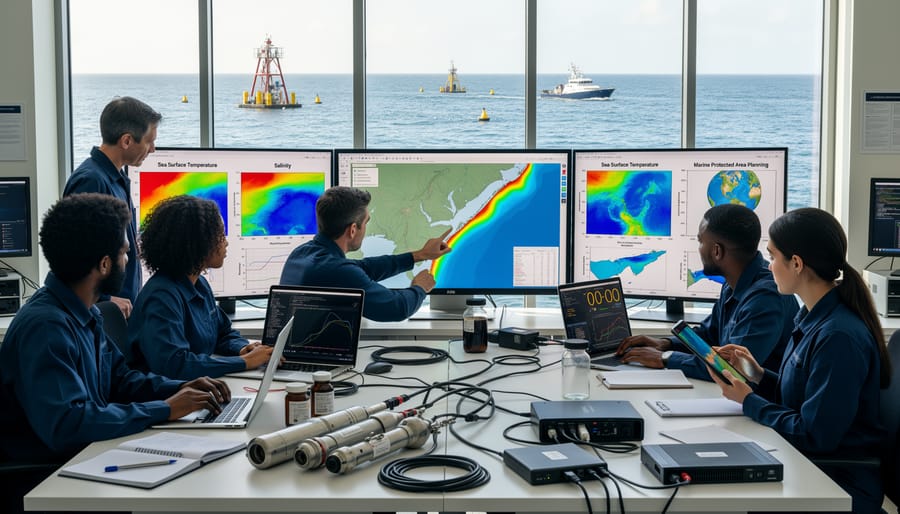
The most exciting developments in frontier marine science aren’t happening in isolated labs—they’re emerging at the intersection where tech-savvy data scientists meet passionate ocean advocates. Increasingly, marine conservationists without formal data science training are learning to harness powerful analytical tools, transforming how we approach ocean protection.
Dr. Sarah Chen, a field biologist with the Pacific Marine Institute, describes her journey: “Five years ago, I couldn’t write a line of code. Now I’m using machine learning models to predict coral bleaching events.” This transformation isn’t unique. Workshops and online platforms are democratizing access to data science skills, enabling conservationists to analyze satellite imagery, interpret acoustic monitoring data, and even apply techniques from marine genomics to their fieldwork.
Meanwhile, data scientists are gaining crucial ecological context from seasoned marine biologists, learning that effective conservation requires understanding animal behavior, ecosystem dynamics, and local community needs—not just algorithms. This two-way knowledge exchange is creating a new generation of hybrid professionals who can both collect water samples and build predictive models, strengthening our collective capacity to protect ocean biodiversity through informed, data-driven action.
Challenges at the Frontier
Data Gaps in the Deep Ocean
Despite decades of ocean exploration, we’ve mapped only about twenty percent of the seafloor in high resolution—meaning vast stretches of the deep ocean remain virtually unknown. This creates significant blind spots in our ability to predict ocean behavior and understand marine ecosystems. Dr. Maya Chen, a deep-sea ecologist, recalls her surprise during a recent expedition: “We discovered an entire hydrothermal vent community in an area we thought was barren. It made me realize how much we’re missing in our models.”
These data gaps affect everything from climate predictions to biodiversity assessments. Without comprehensive baseline information, scientists struggle to detect changes, identify critical habitats, or forecast how ocean currents might shift. The deep ocean—below 200 meters—is particularly underrepresented in monitoring networks, yet it plays a crucial role in regulating Earth’s climate and supporting unique life forms.
Excitingly, new technologies like autonomous underwater vehicles and AI-powered analysis tools are helping fill these gaps faster than ever before. Citizen science initiatives are also contributing valuable surface-level data. By acknowledging what we don’t know, we can better direct research efforts and resources toward the ocean’s most mysterious frontiers.
Making Predictions Actionable
Predictive models are only as valuable as our ability to act on their insights. Marine scientists face a significant challenge in translating complex oceanographic forecasts into concrete conservation policies and management strategies. This gap between knowledge and action often stems from limited funding, competing economic interests, and the difficulty of communicating scientific uncertainty to decision-makers.
Successful implementation requires bridging multiple sectors. Dr. Elena Martinez, who works at the intersection of marine science and policy, shares: “I’ve learned that speaking the language of stakeholders—whether they’re fisheries managers, coastal planners, or community leaders—is just as important as the science itself.” Her team collaborates with policymakers to develop integrated coastal management frameworks that incorporate predictive data into regulatory decisions.
Funding remains a persistent obstacle. While research grants support model development, resources for long-term monitoring and adaptive management are scarce. Advocates emphasize that investing in predictive capacity now prevents costly reactive measures later—whether responding to fisheries collapse, coastal erosion, or ecosystem degradation. Building political will requires persistent education, compelling communication of success stories, and demonstrating the economic value of healthy marine ecosystems to communities and governments alike.
How You Can Contribute to Marine Data Science
Citizen Science Opportunities
You don’t need a research vessel or advanced degree to contribute to cutting-edge marine science. Citizen science programs are transforming how we gather oceanographic data, and your observations can make a real difference.
Mobile apps like iNaturalist allow you to photograph and identify marine species during beach walks, creating biodiversity records that scientists use to track species distribution and migration patterns. The data you submit helps researchers understand how marine ecosystems respond to climate change and human activity.
Beach monitoring programs invite volunteers to conduct regular surveys of shoreline conditions, documenting everything from water quality to plastic pollution. These consistent observations across geographic regions provide invaluable datasets that would be impossible for professional scientists to collect alone.
Online platforms offer image classification projects where you can help researchers analyze thousands of underwater photographs and videos. By identifying fish species, coral health, or seabed characteristics from your computer, you’re training algorithms that power predictive models used in conservation planning.
Marine biologist Dr. Sarah Chen notes that citizen scientists have contributed to some of her most important discoveries: “Community volunteers spotted unusual jellyfish blooms three weeks before our monitoring equipment detected the pattern. Their early observations allowed us to issue timely warnings to coastal communities.”
These opportunities welcome participants of all ages and skill levels, transforming curiosity into meaningful conservation action.
Volunteer and Educational Programs
Getting involved in frontier marine science doesn’t require an advanced degree. The Marine Biodiversity Science Center and similar organizations worldwide offer volunteer programs designed for diverse skill levels and interests. These opportunities provide hands-on experience with data collection that directly supports predictive oceanography research.
Training programs teach volunteers essential skills like identifying marine species, recording water quality measurements, and using specialized equipment to monitor coastal ecosystems. Many centers offer weekend workshops where participants learn to collect plankton samples or document seasonal migration patterns. This citizen science data feeds into larger databases that help researchers build more accurate predictive models.
Educational programs extend beyond volunteering. Summer internships pair students with marine biologists conducting field research, while online courses make training accessible to remote participants. Community scientists have contributed to breakthrough discoveries, from tracking coral bleaching events to identifying previously unknown feeding patterns in marine mammals.
These programs democratize marine science, transforming passionate individuals into valuable research contributors. Whether you can commit to weekly beach surveys or occasional data entry from home, your participation strengthens our collective understanding of ocean systems and helps protect marine biodiversity for future generations.
The convergence of marine data science and predictive oceanography represents more than technological advancement—it’s a beacon of hope for our oceans. As we’ve explored throughout this journey, these tools are already transforming how we understand marine ecosystems, from tracking whale migration patterns to predicting coral bleaching events before they occur. The algorithms that process satellite imagery, the sensors monitoring water chemistry in real-time, and the models forecasting ocean conditions are revolutionizing marine conservation in ways previously unimaginable.
Yet technology alone cannot save our seas. The most sophisticated predictive model holds little value without scientists to interpret its findings, policymakers willing to act on its recommendations, and citizens committed to protecting marine environments. This is where collective action becomes essential. Every data point collected by coastal monitoring programs, every observation logged by citizen scientists, and every conservation decision informed by predictive analytics contributes to a larger tapestry of ocean stewardship.
The future of marine conservation depends on bridging the gap between cutting-edge research and community engagement. Whether you’re a student fascinated by marine biology, an educator looking to inspire the next generation, or simply someone who cares deeply about ocean health, there are meaningful ways to contribute. Volunteer opportunities abound—from participating in beach surveys to supporting data collection initiatives that feed these powerful predictive systems.
Our oceans have given us so much. Now, armed with unprecedented scientific tools and collective determination, we have the opportunity to give back. The question isn’t whether we can make a difference—it’s whether we will.

jessica
Ava Singh is an environmental writer and marine sustainability advocate with a deep commitment to protecting the world's oceans and coastal communities. With a background in environmental policy and a passion for storytelling, Ava brings complex topics to life through clear, engaging content that educates and empowers readers. At the Marine Biodiversity & Sustainability Learning Center, Ava focuses on sharing impactful stories about community engagement, policy innovations, and conservation strategies. Her writing bridges the gap between science and the public, encouraging people to take part in preserving marine biodiversity. When she’s not writing, Ava collaborates with local initiatives to promote eco-conscious living and sustainable development, ensuring her work makes a difference both on the page and in the real world.