Marine Biodiversity Science Center

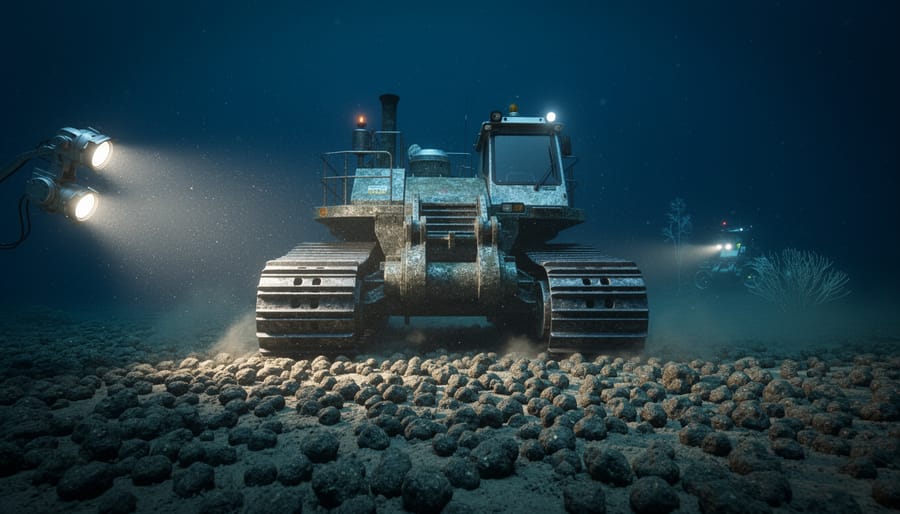
The ocean floor, Earth’s last frontier, stands at the center of an unprecedented industrial race. Right now, international mining corporations are positioning massive machines to extract valuable metals from depths where sunlight has never reached—and the decisions made in the next two years will determine the fate of ecosystems we’ve barely begun to understand.
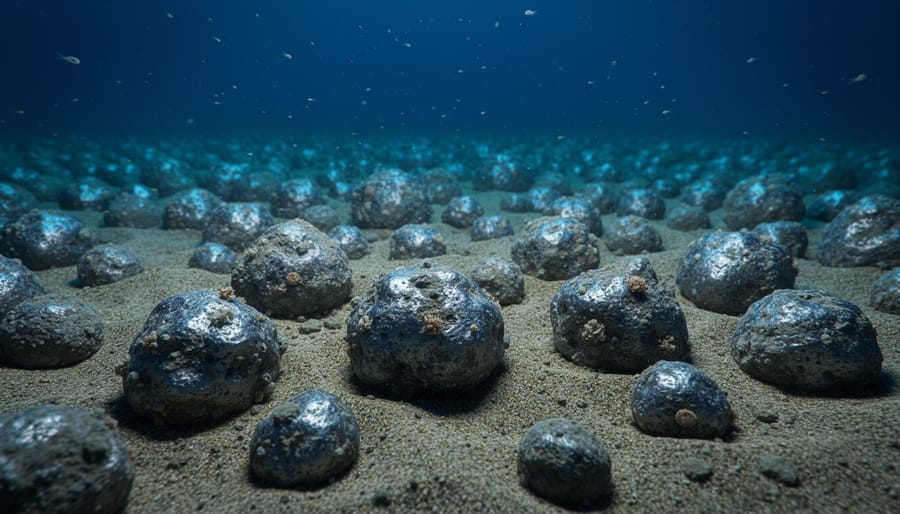
Deep-sea mining targets potato-sized nodules and mineral crusts containing cobalt, nickel, copper, and rare earth elements essential for batteries and electronics. These deposits rest 3,000 to 6,000 meters below the surface in areas like the Clarion-Clipperton Zone, a Pacific Ocean region spanning over 4.5 million square kilometers. What sounds like a remote concern carries immediate consequences: mining operations would destroy fragile habitats housing species found nowhere else on Earth, disrupt ocean currents, and create sediment plumes that could spread thousands of kilometers.
The International Seabed Authority, a UN body governing ocean floor resources, is finalizing regulations that could greenlight commercial extraction as early as 2025. Scientists warn we’re rushing toward irreversible damage. Recent studies reveal the deep sea supports more biodiversity than tropical rainforests, yet we’ve explored less than one percent of these environments. Marine biologist Dr. Lisa Watanabe, who witnessed firsthand the slow-growing coral gardens surrounding hydrothermal vents, describes these ecosystems as “living libraries we’re about to burn before reading.”
This moment demands informed engagement. Understanding what’s happening beneath our oceans—the policies, the science, and the alternatives—equips us to participate in decisions that will echo through generations.
The Current State of Deep-Sea Mining: What’s Happening Right Now
The Two-Year Rule That Changed Everything
In July 2021, the small Pacific island nation of Nauru, sponsored by mining company The Metals Company, delivered a notification to the International Seabed Authority that would transform the timeline for deep-sea mining regulation. Under a rarely invoked provision in the United Nations Convention on the Law of the Sea, this notification triggered a two-year countdown clock for the ISA to complete its mining regulations—whether they were ready or not.
The mechanism, embedded in international maritime law, stipulates that if regulations aren’t finalized within two years of such a notification, mining applications must be considered under whatever rules exist at that time. This deadline, which arrived in July 2023, created unprecedented pressure on an international body already struggling with the complexity of regulating activities in one of Earth’s least understood environments.
Marine biologist Dr. Sarah Chen, who has spent fifteen years studying hydrothermal vent ecosystems, describes the urgency: “We were suddenly on a timer to make decisions about ecosystems we’re only beginning to comprehend. It’s like being asked to write building codes for a structure you’ve barely sketched.”
The two-year rule fundamentally shifted the conversation from “should we mine the deep sea?” to “how quickly can we establish regulations?” This procedural maneuver has galvanized both industry proponents eager to begin operations and conservationists racing to ensure adequate environmental protections exist before any extraction begins.
Where Mining Companies Want to Dig
Mining companies have set their sights on three primary regions of the ocean floor, each offering different mineral treasures. The Clarion-Clipperton Zone, a vast abyssal plain between Hawaii and Mexico spanning over 4.5 million square kilometers, has become the epicenter of mining interest. This area contains billions of tons of polymetallic nodules—potato-sized rocks rich in manganese, nickel, copper, and cobalt, all critical for battery production and renewable energy technologies.
The Mid-Atlantic Ridge attracts companies seeking polymetallic sulfides formed by hydrothermal vents, which contain high concentrations of copper, zinc, and precious metals. Meanwhile, the western Pacific seamounts hold cobalt-rich ferromanganese crusts that formed over millions of years.
What makes these regions so attractive to industry? Simply put, high concentrations of valuable minerals in relatively accessible formations. Dr. Maria Santos, a marine geologist who has studied these ecosystems for fifteen years, explains: “These nodules took millions of years to form, yet companies see them as low-hanging fruit because they sit on the seafloor surface, requiring less complex extraction than traditional land mining.”
However, these same regions harbor unique biodiversity that scientists have barely begun to catalog, creating an urgent tension between industrial interests and conservation needs.
How We Got Here: A Brief History of Deep-Sea Mining Policy
The 1970s: When Deep-Sea Resources Became ‘Common Heritage’
The 1970s marked a pivotal turning point in how humanity viewed the ocean’s depths. As technology advanced and countries began eyeing the mineral wealth lying on the seabed beyond national jurisdiction, the international community recognized the urgent need for a unified framework. This led to years of intensive negotiations that culminated in the 1982 United Nations Convention on the Law of the Sea (UNCLOS), often called the “constitution for the oceans.”
At the heart of UNCLOS lay a revolutionary concept: the deep seabed and its resources would be designated as the “common heritage of mankind.” This philosophical framework meant that no single nation could claim ownership of these areas. Instead, any benefits derived from deep-sea resources should be shared equitably among all countries, with special consideration for developing nations. It was an idealistic vision born from the recognition that the ocean connects us all.
To oversee this shared inheritance, the International Seabed Authority (ISA) was established in 1994 when UNCLOS entered into force. Based in Jamaica, the ISA became the regulatory body responsible for managing mineral-related activities in international waters beyond national control. Understanding international waters law remains crucial today as we navigate the complex tensions between resource extraction and ocean protection.
Dr. Sylvia Earle, renowned marine biologist, recalls the optimism of that era: “We genuinely believed we were creating a system that would protect the ocean while ensuring fairness. The challenge has been living up to that promise.”
From Exploration to Exploitation: The Turning Point
For decades, deep-sea mining existed primarily on paper. The International Seabed Authority, established in 1994, initially granted exploration licenses that allowed countries and corporations to survey mineral-rich areas of the ocean floor. These contracts focused on scientific research and mapping rather than actual extraction. Companies studied manganese nodules, polymetallic sulfides, and cobalt-rich crusts scattered across the abyssal plains, but the technology and economic incentives to mine them simply weren’t there yet.
The turning point arrived gradually, then suddenly. Rising global demand for battery metals, particularly nickel, cobalt, and rare earth elements essential for electric vehicles and renewable energy storage, transformed these deep-sea minerals from geological curiosities into potential profit centers. Simultaneously, terrestrial mining operations faced increasing scrutiny over environmental destruction and human rights concerns, making the deep ocean appear, misleadingly, like a cleaner alternative.
By the early 2020s, several factors converged. Mining technology advanced significantly, with remotely operated vehicles capable of operating at extreme depths. Metal prices surged. And crucially, global ocean policy began shifting toward commercialization discussions. In 2021, the small Pacific nation of Nauru triggered a little-known provision requiring the International Seabed Authority to finalize mining regulations within two years, effectively fast-tracking the transition from exploration to exploitation and catching many scientists and conservationists off guard.
What Scientists Have Discovered About Deep-Sea Ecosystems
Life in the Abyss: Species We’re Only Beginning to Understand
The ocean floor in targeted mining zones harbors creatures that seem plucked from science fiction. Scientists estimate that up to 90% of species living in the Clarion-Clipperton Zone—a mineral-rich area spanning 4.5 million square kilometers between Hawaii and Mexico—remain undiscovered. Each research expedition reveals organisms with extraordinary adaptations to crushing pressures and complete darkness.
Marine biologist Dr. Elena Ramirez recalls her first encounter with a translucent sea cucumber during a recent expedition: “It moved across manganese nodules like a ghostly vacuum cleaner. We later discovered it plays a crucial role in nutrient cycling that supports entire food webs.” These nodules, ironically, are exactly what mining companies seek to harvest.
The creatures thriving here demonstrate remarkable survival strategies. Glass sponges filter nutrients through skeletal structures that inspired fiber optic technology, while yeti crabs farm bacteria on their hairy claws for food. Deep-sea corals, some over 4,000 years old, create complex habitats supporting hundreds of species we’re only beginning to catalog.
Thanks to ocean technology advances, remotely operated vehicles now capture high-definition footage of these ecosystems, revealing their fragility and interconnectedness. Yet scientists warn that mining operations could destroy species before we even know they exist, eliminating potential medical breakthroughs and disrupting ecological processes we don’t yet understand. The race continues between discovery and destruction in Earth’s final frontier.
Why Deep-Sea Recovery Takes Centuries, Not Years
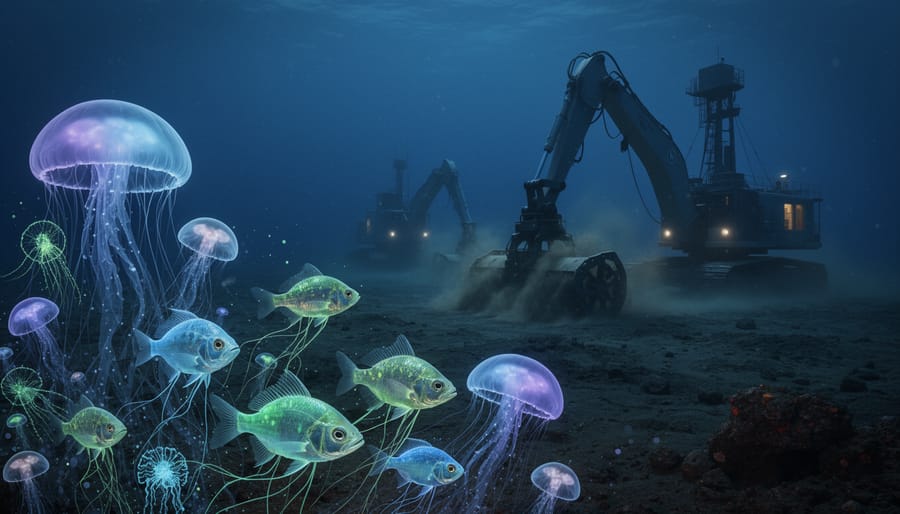
Deep-sea ecosystems operate on dramatically different timescales than shallow-water environments, making them exceptionally vulnerable to mining disturbance. Many deep-sea organisms grow extraordinarily slowly due to cold temperatures, limited food availability, and low metabolic rates. Orange roughy, for instance, can live over 150 years and don’t reach reproductive maturity until age 30. Deep-sea corals grow just millimeters per year and can exceed 4,000 years in age.
Marine biologist Dr. Sarah Chen, who has studied abyssal plains for two decades, explains: “When we see trawl marks from the 1980s still visible on the seafloor, unchanged after forty years, we realize these ecosystems have essentially no recent history of major disturbance. They’ve evolved in remarkable stability for millennia.”
This stability means communities lack resilience mechanisms that help shallow ecosystems recover from damage. The organisms haven’t faced selective pressure to develop rapid reproduction or colonization abilities. When mining equipment removes or buries these slow-growing communities, recovery could require centuries or even millennia. Early studies of experimental disturbances show virtually no recovery after 26 years, suggesting the timescale may extend far beyond human lifespans.
Voices from the Deep: A Marine Biologist’s Perspective
Dr. Elena Ramirez has spent fifteen years exploring hydrothermal vents and abyssal plains, witnessing ecosystems that exist nowhere else on Earth. “I’ve watched octopuses guard their eggs for four years in the cold darkness, relying on mineral-rich structures that mining operations would destroy in minutes,” she shares. During a recent expedition, her team documented over forty potential new species in a proposed mining zone. “These organisms have evolved over millions of years in extreme conditions, developing unique biochemical adaptations that could revolutionize medicine and biotechnology. Once they’re gone, that opportunity vanishes forever.”
What troubles Elena most is the pace of mining proposals outstripping scientific understanding. “We’ve explored less than five percent of the ocean floor, yet we’re rushing to industrialize it.” She encourages concerned citizens to support deep-sea research initiatives and contact policymakers about precautionary approaches. “Every voice matters in protecting these irreplaceable ecosystems before it’s too late.”
The Conservation Movement Responds: Opposition Gaining Momentum
Countries Leading the Charge for Protection
Several nations have emerged as champions for ocean protection, calling for precautionary approaches to deep-sea mining. France and Palau have advocated for outright bans, citing irreversible damage to marine ecosystems. Pacific Island nations, including Fiji, Samoa, and Vanuatu, have led diplomatic efforts requesting moratoriums until comprehensive environmental assessments can be completed. These countries recognize their cultural and economic dependence on healthy ocean ecosystems.
Dr. Meredith Tanaka, a marine biologist working with Pacific conservation groups, shares: “The leadership from island nations is inspiring. They understand that protecting the deep sea is inseparable from protecting shallow-water marine reserves and coastal communities.”
Chile, Costa Rica, and Ecuador have joined this coalition, building momentum at the International Seabed Authority. Germany and Spain have also expressed strong support for precautionary measures. These diplomatic efforts aim to establish broad consensus that mining should not proceed until science proves it can be done without causing significant harm to biodiversity and ecosystem functions that benefit all humanity.
When Corporations Said ‘No’: Industry Allies in Conservation
In an unexpected turn that has energized the conservation movement, major corporations across multiple industries have voluntarily pledged not to source minerals from the deep ocean floor. This corporate resistance represents a powerful market-based approach to protecting our least-explored ecosystems.
Technology giants Google, Samsung, and Microsoft have committed to keeping deep-sea minerals out of their supply chains, joined by automakers BMW, Volvo, and Volkswagen. These companies collectively represent billions of dollars in purchasing power, sending a clear signal that sustainable alternatives exist for obtaining the metals needed in electronics and electric vehicle batteries.
The BMW Group’s sustainability director shared that “we can meet our resource needs through improved recycling and responsible land-based mining,” demonstrating that industry leaders recognize deep-sea mining isn’t the only path forward. Similarly, tech companies have invested in developing better recycling technologies for existing electronics, which contain the same metals targeted by deep-sea mining operations.
Marine biologist Dr. Patricia Chen, who has worked with several corporate sustainability teams, notes that “when I show executives footage of the unique creatures living around hydrothermal vents, something shifts. They realize we’re not just talking about rocks on the seafloor, but irreplaceable living communities.” Her work illustrates how scientific education can influence corporate decision-making.
This alliance between environmentalists and industry creates a formidable obstacle for mining companies seeking contracts. With major buyers refusing their product before extraction even begins, the economic case for deep-sea mining weakens considerably, offering genuine hope for ocean protection.
The Environmental Case Against Deep-Sea Mining
Sediment Plumes: The Invisible Destroyer
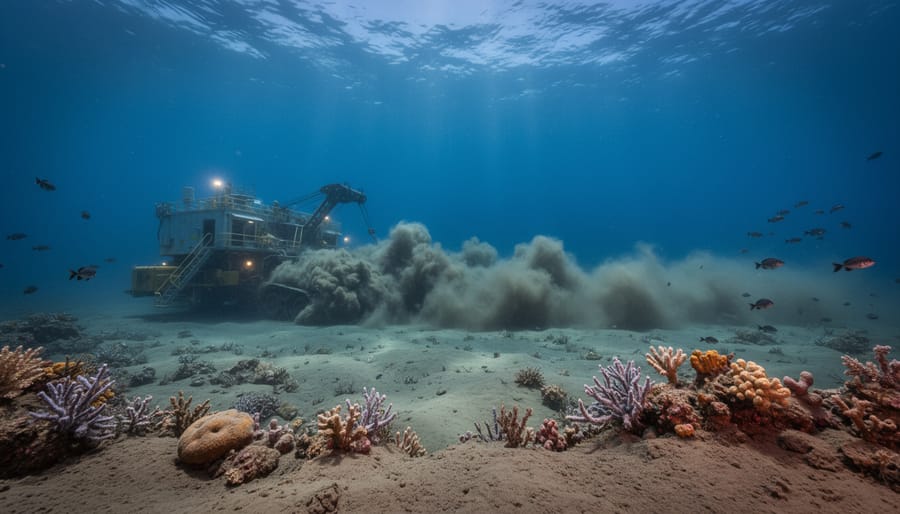
Deep-sea mining operations create massive sediment plumes that function as underwater dust storms, disrupting marine ecosystems in ways we’re only beginning to understand. When mining equipment excavates the seafloor, it releases fine particles that form dense clouds extending hundreds of kilometers from the extraction site. These plumes operate on two levels: the benthic layer near the seafloor where mining occurs, and a secondary layer created when sediment is discharged from surface vessels after mineral processing.
Marine biologist Dr. Lisa Chen, who has studied these impacts in Pacific test sites, describes the phenomenon: “Imagine a snowstorm that never settles. These particles remain suspended for weeks, sometimes months, traveling with ocean currents far beyond the mining zone.”
The consequences are particularly severe for filter feeders like sponges, corals, and certain fish species that strain nutrients from water. Sediment clogs their filtering systems, essentially suffocating these organisms. The plumes also block sunlight penetration, disrupting the limited photosynthesis that occurs in deep-sea zones and smothering slow-growing organisms that took centuries to develop. Research indicates these sediment clouds can persist far longer than initially predicted, creating a cascade of ecological disruption across vast ocean territories.
Noise, Light, and Chemical Pollution in the Silent Deep
The deep ocean evolved over millions of years in conditions of near-total darkness, silence, and chemical stability. Deep-sea creatures developed extraordinary adaptations to this environment, including bioluminescence for communication, ultra-sensitive hearing, and metabolisms finely tuned to specific chemical conditions. Mining operations shatter this ancient equilibrium with industrial-scale disturbances these ecosystems have never encountered.
Heavy machinery generates constant noise pollution that can travel thousands of kilometers underwater, potentially disrupting navigation, communication, and feeding behaviors in marine mammals and fish. Dr. Elena Rodriguez, a marine biologist who has spent two decades studying deep-sea soundscapes, shares, “We’re introducing the equivalent of a construction site into what was previously a cathedral of silence. Species that rely on detecting the faintest sounds of prey or predators may be completely overwhelmed.”
Mining vehicles also emit bright artificial lights in the lightless depths, while sediment plumes release metals and chemical compounds into the water column. These pollutants can persist for decades, spreading far beyond mining sites through deep ocean currents. The cascading effects remain largely unknown, but preliminary research suggests they could fundamentally alter food webs and biodiversity patterns across vast ocean regions.
The Carbon Storage We Can’t Afford to Lose
The deep ocean acts as our planet’s largest carbon sink, storing approximately 38,000 gigatons of carbon—roughly sixteen times more than all terrestrial ecosystems combined. This remarkable storage system works through a process marine biologists call the “biological carbon pump,” where organic matter and marine snow drift downward, locking carbon away for centuries in deep-sea sediments.
Dr. Elena Martinez, who has studied abyssal ecosystems for fifteen years, explains it simply: “When we disturb these sediments through mining, we’re essentially opening a vault that nature sealed long ago.” Mining operations create sediment plumes that can resuspitate stored carbon and disrupt the microbial communities responsible for processing and sequestering it.
The consequences extend beyond carbon release. Deep-sea organisms contribute to nutrient cycling that supports surface ocean productivity, which in turn absorbs atmospheric carbon dioxide. Breaking this connection could weaken the ocean’s capacity to regulate our climate precisely when we need it most. Protecting these underwater carbon reserves isn’t just about preserving biodiversity—it’s about maintaining a critical climate defense system that has taken millennia to develop.
What Happens Next: Critical Decisions on the Horizon
The next twelve months will prove pivotal for the future of our ocean floors. The International Seabed Authority is scheduled to hold critical sessions in 2024 and 2025, where member states will debate whether to finalize regulations governing deep-sea mining in international waters. These meetings represent a crossroads: will nations prioritize precautionary approaches that protect marine ecosystems, or will commercial pressures push forward extraction before we fully understand the consequences?
Several scenarios could unfold from these deliberations. In the most conservation-friendly outcome, nations might establish a moratorium or pause on mining activities until comprehensive environmental assessments are completed. This would give scientists crucial time to study deep-sea ecosystems and develop protective measures. Some countries, including France, Germany, and several Pacific island nations, have already called for such precautionary action, building momentum for ocean protection.
Alternatively, regulations could be approved with varying degrees of environmental safeguards. Strong protections would include extensive no-mining zones, rigorous impact assessments, and mandatory long-term monitoring. Weaker frameworks might allow companies to begin operations with minimal oversight, potentially triggering irreversible damage to ecosystems we’re only beginning to understand.
Dr. Maria Santos, a marine biologist who has spent fifteen years studying hydrothermal vent communities, emphasizes the stakes: “These decisions will echo through generations. Once we disturb these ancient ecosystems, there’s no reset button.”
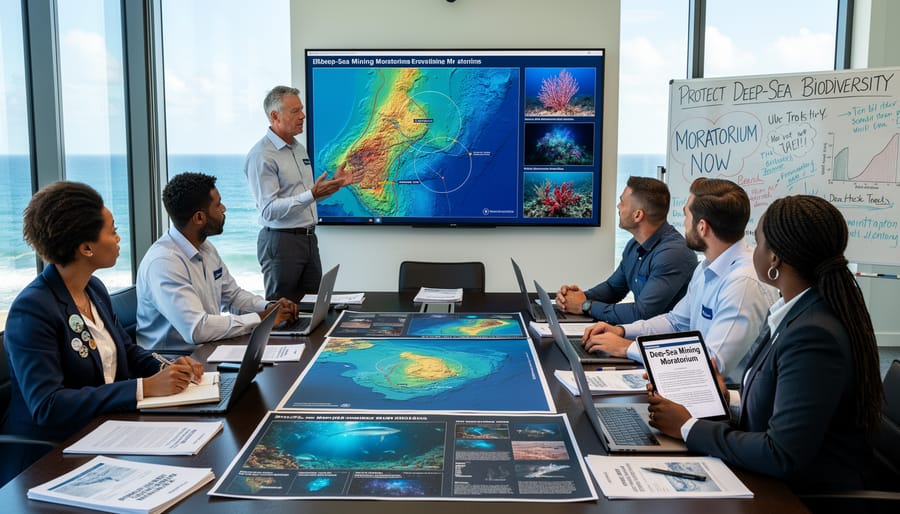
For those passionate about ocean conservation, this decision window offers unprecedented opportunities for engagement. Organizations like the Deep Sea Conservation Coalition and Mission Blue welcome volunteers to help with advocacy campaigns, public education efforts, and petition drives. Your voice matters in this critical moment when collective action can still shape outcomes.
How You Can Make a Difference
Join the Research Effort
You don’t need a PhD to contribute meaningfully to deep-sea ecosystem research. Marine research organizations worldwide are actively recruiting volunteers for citizen science projects that directly inform our understanding of these fragile habitats threatened by mining activities.
The Deep-Ocean Stewardship Initiative offers remote volunteer positions analyzing video footage from remotely operated vehicles, helping catalog species and document biodiversity in mining target zones. No specialized training is required—just dedication and attention to detail. Similarly, Ocean Networks Canada’s data annotation program trains volunteers to identify organisms captured in thousands of hours of seafloor imagery.
For those with technical skills, organizations like the Schmidt Ocean Institute welcome data analysts to help process acoustic surveys and environmental DNA samples. These contributions create baseline biodiversity assessments crucial for evaluating mining impacts.
Dr. Elena Ramirez, a marine biologist coordinating volunteer programs, shares: “Our citizen scientists have discovered previously undocumented species and migration patterns. Their work strengthens our arguments for protecting these ecosystems at international policy forums.”
Whether you can dedicate two hours weekly or join expedition support teams, your involvement accelerates research that policymakers desperately need as mining proposals advance. Visit organization websites to explore current opportunities and find the role that matches your skills and schedule.
Amplify Your Voice
Your voice matters in shaping the future of our ocean floor. Start by contacting your elected representatives to express concerns about deep-sea mining and urge support for international moratorium efforts. Organizations like the Deep Sea Conservation Coalition and Mission Blue offer petitions you can sign and share within your networks. Consider joining advocacy groups that provide regular action alerts when critical decisions approach at the International Seabed Authority.
Marine biologist Dr. Sarah Chen shares: “I witnessed firsthand how collective public pressure delayed destructive mining proposals. Every email, every signature creates ripples that reach policymakers.”
Subscribe to e-networks from organizations like Greenpeace Oceans and the High Seas Alliance for timely updates on regulatory developments and targeted campaigns. Many groups offer volunteer opportunities, from social media advocacy to organizing local awareness events. Even small actions compound when thousands participate. The crucial ISA meetings determining mining’s future happen throughout this year, making your immediate engagement especially powerful in protecting ecosystems we’re only beginning to understand.
Spread the Word
You don’t need to be an expert to make a difference in protecting our ocean floor. Start by sharing credible articles and updates about deep-sea mining on your social media platforms, using hashtags like #ProtectTheDeepSea and #DeepSeaMining to reach broader audiences. When discussing this issue with friends, family, or colleagues, focus on these accessible talking points: deep-sea ecosystems take thousands of years to recover from disturbance, we’ve explored less than 5% of our ocean floor, and rushing into mining could destroy species we haven’t even discovered yet.
Consider organizing or participating in community presentations at local libraries, schools, or environmental groups. Marine biologist Dr. Elena Rodriguez shares, “When I speak at community centers, I bring photos from deep-sea expeditions. People are amazed to see bioluminescent creatures and ancient coral gardens, and suddenly the issue becomes personal to them.”
Your conversations matter because policy decisions often reflect public awareness. Whether you’re chatting at a coffee shop or presenting to a classroom, you’re building the collective knowledge needed to make informed decisions about our ocean’s future.
We stand at a pivotal moment in ocean history. The decisions made today about deep-sea mining will echo through generations, determining whether these ancient ecosystems survive or vanish before we fully understand them. Yet this challenge arrives alongside extraordinary reasons for hope.
History shows us that informed communities can shift the tide. When the International Whaling Commission faced mounting pressure from engaged citizens in the 1980s, commercial whaling bans followed. When coral reef destruction reached crisis levels, grassroots movements helped establish marine protected areas worldwide. Each victory began with people like you choosing to learn, share knowledge, and take action.
Marine biologist Dr. Elena Rodriguez, who has spent fifteen years studying hydrothermal vent communities, reminds us why this matters: “Every time I descend to the seafloor, I discover species science has never documented. These aren’t just curiosities. They hold potential medical breakthroughs, climate solutions, and ecological connections we’re only beginning to comprehend. Losing them before we understand them would be an irreversible tragedy.”
The path forward requires your voice. Whether you volunteer with ocean conservation organizations, contact policymakers, share scientific findings with your networks, or simply commit to staying informed, your engagement matters. Collective action has protected oceans before, and it can again. Together, we possess the knowledge, passion, and tools to ensure that deep-sea ecosystems thrive for centuries to come. The question isn’t whether we can make a difference, but whether we will.

jessica
Ava Singh is an environmental writer and marine sustainability advocate with a deep commitment to protecting the world's oceans and coastal communities. With a background in environmental policy and a passion for storytelling, Ava brings complex topics to life through clear, engaging content that educates and empowers readers. At the Marine Biodiversity & Sustainability Learning Center, Ava focuses on sharing impactful stories about community engagement, policy innovations, and conservation strategies. Her writing bridges the gap between science and the public, encouraging people to take part in preserving marine biodiversity. When she’s not writing, Ava collaborates with local initiatives to promote eco-conscious living and sustainable development, ensuring her work makes a difference both on the page and in the real world.