Marine Biodiversity Science Center

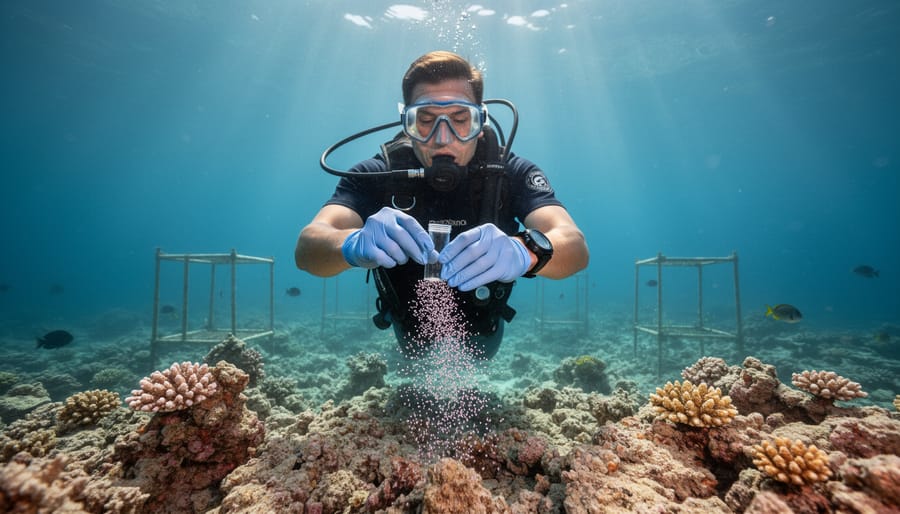
Imagine borrowing techniques from human fertility medicine to save one of Earth’s most vital ecosystems. Just as in vitro fertilization has revolutionized reproductive medicine—techniques you might explore on this website—scientists are now applying similar principles underwater to rescue dying coral reefs through a groundbreaking approach called coral IVF.
The connection between medical IVF and coral restoration runs deeper than metaphor. Both processes involve collecting reproductive cells, fertilizing them in controlled environments, nurturing embryos through critical early stages, and carefully introducing new life into the world. For corals, this means harvesting eggs and sperm during rare annual spawning events, creating hundreds of thousands of baby corals in floating nurseries, and transplanting these resilient larvae onto damaged reefs.
Coral reefs face unprecedented threats. Climate change, ocean acidification, pollution, and destructive fishing practices have decimated nearly half of the world’s reef systems in recent decades. Traditional restoration methods—breaking off coral fragments and reattaching them—work slowly and offer limited genetic diversity. Coral IVF changes this equation dramatically. A single spawning event can produce enough larvae to populate football-field-sized areas of degraded reef, introducing genetic variation that helps corals adapt to warming oceans.
This technique represents more than laboratory innovation. From the Great Barrier Reef to the Caribbean, marine biologists are witnessing remarkable results: survival rates exceeding 60 percent, accelerated growth patterns, and renewed ecosystem vitality. The approach combines cutting-edge science with hands-on conservation, offering opportunities for volunteers, educators, and communities to participate directly in reef recovery.
Understanding how coral IVF works reveals both the fragility of marine ecosystems and our capacity to heal them through informed, collaborative action.
The Coral Crisis: Why Our Reefs Need Intervention
Our planet’s coral reefs are in crisis. Over the past three decades, we’ve lost approximately 50% of the world’s coral cover, with some regions experiencing even more devastating losses. The Great Barrier Reef alone has suffered five mass bleaching events since 1998, each leaving vast underwater landscapes ghostly white and struggling to survive.
The threats facing these vital ecosystems are intensifying. Rising ocean temperatures trigger bleaching events where corals expel the symbiotic algae they depend on for survival. When water temperatures remain elevated for too long, bleached corals starve and die. Meanwhile, ocean acidification weakens coral skeletons, making it harder for them to grow and recover. Add pollution, destructive fishing practices, and coastal development to the mix, and you begin to understand why scientists predict that 90% of coral reefs could disappear by 2050 without intervention.
Dr. Maria Santos, a marine biologist who has studied Caribbean reefs for fifteen years, recalls her shock at witnessing entire reef systems collapse. “I watched vibrant ecosystems I’d documented for years turn into rubble fields in just months,” she shares. “That’s when I realized we couldn’t just sit back and hope reefs would recover on their own.”
Traditional coral reef restoration techniques, while valuable, face significant limitations. Breaking coral fragments and reattaching them to damaged reefs can help, but this method is slow, labor-intensive, and often doesn’t keep pace with the rate of reef destruction. More critically, it doesn’t increase genetic diversity, which corals desperately need to adapt to changing ocean conditions.
The situation demands innovation. We need restoration methods that work faster, build genetic resilience, and give corals the best possible chance to survive in warming oceans. This urgent reality has driven scientists to look beyond conventional approaches and embrace groundbreaking solutions like Coral IVF.
From Human Medicine to Ocean Conservation: The IVF Connection
The Science Behind Coral Reproduction
Corals may appear as stationary underwater structures, but they reproduce in one of nature’s most spectacular events. Most coral species release eggs and sperm simultaneously into the ocean during mass spawning events, typically synchronized with lunar cycles and water temperature. These synchronized releases create underwater blizzards of coral gametes, giving new life to coral reef ecosystems. When eggs and sperm meet in the water column, fertilization occurs, producing larvae that eventually settle and develop into new coral colonies.
However, this natural process faces mounting challenges in degraded reefs. Marine biologist Dr. Sarah Chen explains, “When coral populations decline, there simply aren’t enough colonies spawning simultaneously to ensure successful fertilization. It’s a numbers game, and degraded reefs are losing.” Factors like coral bleaching, disease, and physical damage reduce the number of healthy reproductive colonies. Additionally, pollution and warming waters can disrupt the precise timing corals need for successful spawning.
This is where assisted reproduction becomes crucial. Just as human IVF helps overcome fertility challenges, coral IVF addresses the reproduction barriers facing threatened reefs. By collecting coral spawn during natural events, scientists can ensure fertilization occurs in controlled conditions, dramatically increasing survival rates. This process creates millions of viable coral larvae that might never have survived in the wild, offering hope for rebuilding damaged reef systems and restoring marine biodiversity.
Adapting Fertility Technology for the Ocean
Translating medical technology to the ocean floor required reimagining IVF principles for an entirely different biological system. While human IVF involves carefully controlled laboratory environments, coral IVF needed to work within the unpredictable marine ecosystem. Scientists had to ask fundamental questions: How do you collect coral gametes during a brief, once-yearly spawning event that happens only at night? How do you fertilize and raise millions of microscopic larvae without sophisticated medical equipment?
The breakthrough came from understanding that corals, despite their differences from humans, share the same reproductive challenge—bringing egg and sperm together at the right moment. Marine biologists developed floating collection nets to capture spawned eggs and sperm directly from the water during mass spawning events. They created larval pools—essentially nurseries in the ocean—where fertilized eggs could develop safely, protected from predators.
Dr. Emma Chen, who participated in early coral IVF trials, recalls the innovative spirit required: “We were essentially marine midwives, working with headlamps in the dark ocean, adapting fertility concepts to creatures without wombs or medical clinics. Every solution had to be simple, portable, and work with saltwater and ocean currents.”
This adaptation proved that conservation technology doesn’t always need to be complex—sometimes it just needs to be cleverly redesigned for its environment.
How Coral IVF Works: A Step-by-Step Process
Collecting Coral Spawn During Mass Spawning Events
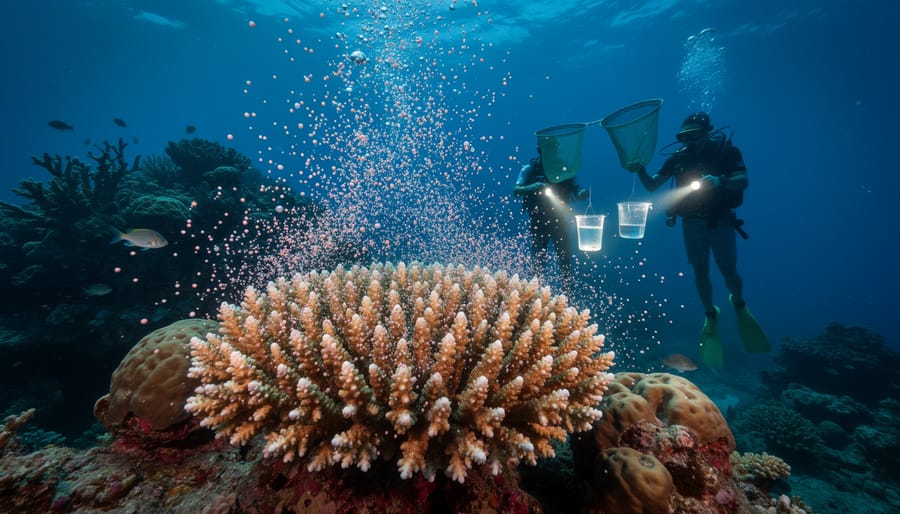
Once a year, under specific lunar and temperature conditions, coral reefs participate in one of nature’s most spectacular events: mass spawning. Across entire reef systems, corals simultaneously release millions of tiny eggs and sperm bundles into the water, creating an underwater snowstorm of pink, orange, and white particles. This brief window, lasting just a few nights, presents both a challenge and an opportunity for coral restoration scientists.
Timing is everything. Marine biologists like Dr. Emma Chen, who has worked on the Great Barrier Reef for over a decade, describe the preparation as meticulous. “We spend months monitoring water temperatures and lunar cycles,” she explains. “Miss the event by even one night, and you’ve lost your chance for the entire year.”
During spawning, teams of divers work through the night, carefully collecting the buoyant spawn bundles using fine mesh nets and collection funnels positioned above coral colonies. These floating parcels contain both eggs and sperm, which scientists must quickly transport to floating nurseries or shore-based facilities. The collected gametes, numbering in the millions, become the foundation for coral IVF, offering hope for creating genetically diverse coral populations that can help restore degraded reefs. Volunteers often join these collection efforts, contributing to conservation while witnessing this remarkable natural phenomenon firsthand.
Fertilization and Larval Rearing
Once eggs and sperm are collected during the coral spawning window, scientists quickly transfer them to specially designed floating pools or land-based aquaculture facilities. Here, fertilization occurs in controlled conditions that mirror the ocean environment but protect the developing embryos from predators and environmental stressors. Marine biologist Dr. Sarah Chen describes this moment as magical: “Watching millions of coral larvae form under our care feels like witnessing the future of the reef take shape.”
The fertilization process happens within hours, and soon tiny swimming larvae called planulae emerge. These microscopic coral babies go through several critical developmental stages over 5-7 days. Scientists carefully monitor water temperature, salinity, and quality while ensuring gentle water flow that keeps larvae suspended and healthy. This stage requires round-the-clock attention from dedicated teams, often including trained volunteers who help with water changes and larvae monitoring.
The care during this period is remarkably similar to the precision required in human fertility treatments, requiring controlled environments and constant monitoring. As the larvae mature, they develop the ability to settle and begin forming their calcium carbonate skeletons. Understanding these early life stages has proven essential for successful reef restoration, with survival rates improving dramatically through refined techniques developed over years of collaborative research and hands-on experience.
Settlement and Growth
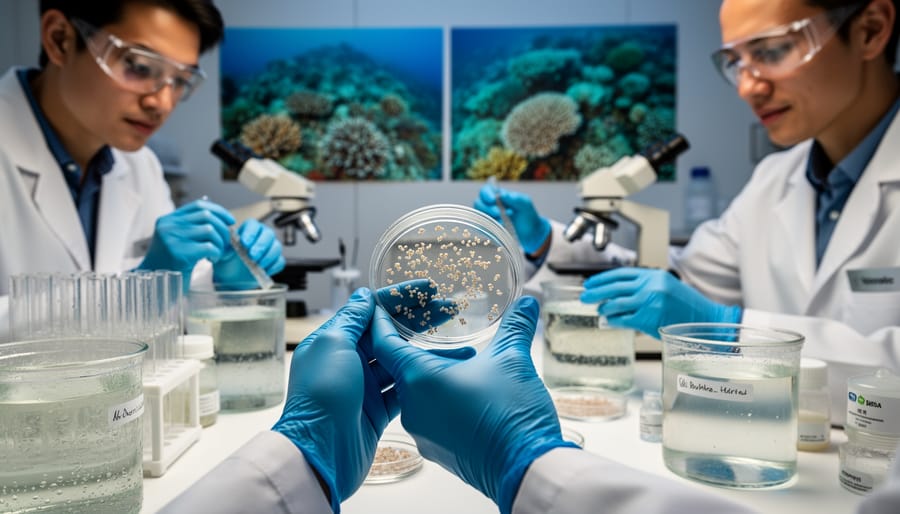
Once the coral larvae are ready, scientists carefully introduce specially designed settlement substrates—often ceramic plugs or tiles with textured surfaces that mimic natural reef conditions. These substrates are placed in holding tanks where larvae naturally gravitate toward surfaces, a process marine biologist Dr. Emma Rodriguez describes as “watching tiny architects choose their building sites.” The larvae cement themselves to the substrate within days, beginning their transformation into polyps.
During the critical first months, these baby corals require careful monitoring. Research teams track survival rates, growth patterns, and overall health, adjusting water quality and conditions as needed. Early survival rates typically range from 30-60%, varying by species and environmental factors. Once the corals reach sufficient size—usually thumbnail-sized after several months—they’re ready for outplanting onto degraded reef areas. Many restoration programs invite volunteers to participate in monitoring activities, offering hands-on opportunities to witness coral growth firsthand and contribute valuable data to conservation efforts.
Outplanting to Degraded Reefs
Once juvenile corals reach approximately two centimeters in diameter, typically after six to twelve months of growth, they’re ready for the crucial final step: transplanting to degraded reef sites. Marine biologists carefully select outplanting locations based on water quality, current patterns, and substrate stability to maximize survival rates.
The attachment process requires precision and care. Restoration teams use biodegradable adhesives or small frames to secure corals to stable reef surfaces, ensuring they won’t be dislodged by waves or currents. Many programs invite trained volunteers to participate in these underwater planting missions, creating meaningful connections between communities and their local reefs.
Dr. Sarah Chen, a marine biologist leading restoration efforts in the Caribbean, shares: “Watching volunteers plant their first coral is incredible. They become ambassadors for reef conservation, understanding firsthand the patience and dedication required for restoration.”
Post-outplanting monitoring tracks survival rates, growth patterns, and eventual reproduction. Success rates vary by location and species but typically range from 60-80%, with some sites achieving remarkable recovery within just a few years.
Success Stories: Coral IVF in Action Around the World
From the turquoise waters of Australia to the vibrant reefs of the Caribbean, coral IVF is transforming how we approach reef restoration. What began as an experimental technique has now generated measurable success across multiple ocean ecosystems, offering genuine hope for our planet’s embattled coral communities.
On the Great Barrier Reef, the team at Southern Cross University has achieved remarkable results since implementing coral IVF in 2016. Dr. Peter Harrison, who pioneered the technique, reports survival rates of up to 65% for IVF-assisted coral larvae compared to less than 1% survival in natural spawning. Over 100 square meters of reef have been successfully restored using this method, with coral colonies showing impressive genetic diversity that strengthens their resilience to environmental stressors.
“The first time we saw those tiny larvae settle and begin growing into thriving colonies, it felt like witnessing a miracle,” shares marine biologist Taryn Foster, who has worked on the Great Barrier Reef project for three years. “We’re not just growing coral; we’re giving entire ecosystems a second chance. Each successful colony supports hundreds of fish species and countless invertebrates.”
In the Caribbean, the Coral Restoration Foundation has adapted coral IVF techniques to address the devastating tissue loss disease affecting Florida’s reefs. Their initial trials demonstrated a 70% survival rate after 12 months, with treated areas showing increased genetic diversity by incorporating coral from multiple parent colonies. This genetic mixing creates populations better equipped to withstand rising ocean temperatures and disease.
The Philippines has embraced coral IVF as part of community-based restoration efforts. Local fishers trained in larval rearing techniques have restored over 50 square meters of reef in degraded areas. These projects report not only ecological success but also renewed community engagement with marine conservation.
Perhaps most encouraging is the data on genetic diversity. Traditional coral restoration often relies on fragmentation, essentially creating clones. Coral IVF, however, combines genetic material from multiple parent colonies, producing offspring with varied traits. Studies show IVF-restored reefs maintain genetic diversity levels comparable to natural reefs, a critical factor for long-term survival.
“What makes this work so rewarding is seeing communities rally around their reefs,” explains Dr. Margaret Miller, a coral restoration specialist working in the Caribbean. “We’re providing the scientific framework, but local volunteers and citizen scientists are making it happen on the ground.”
These success stories demonstrate that coral IVF isn’t just a laboratory concept but a practical, scalable solution that combines cutting-edge science with community action to rebuild our ocean’s most vital ecosystems.
The Advantages Over Traditional Reef Restoration
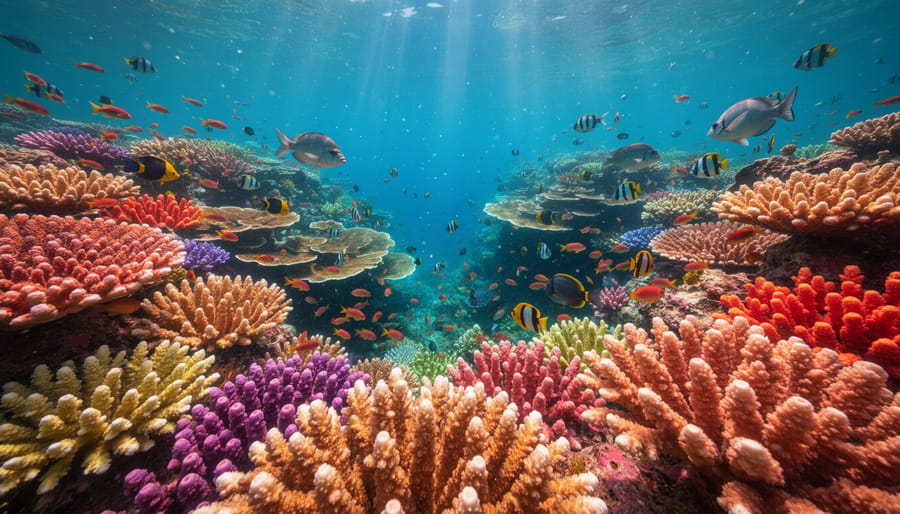
Traditional coral restoration has long relied on methods like fragmentation and transplantation, where healthy coral pieces are broken off and relocated to damaged reefs. While these techniques have shown success, they face significant limitations that coral IVF elegantly overcomes.
The most transformative advantage lies in genetic diversity. Traditional fragmentation essentially creates clones of parent corals, producing genetically identical offspring that share the same vulnerabilities to disease and environmental stress. Coral IVF, however, captures millions of coral eggs and sperm during natural spawning events, allowing sexual reproduction to create genetically diverse offspring. This diversity acts as an insurance policy for reef resilience, as different genetic combinations may possess varied tolerances to warming waters, ocean acidification, and emerging diseases.
Dr. Emma Hastings, a marine biologist who participated in a coral spawning expedition in the Great Barrier Reef, recalls the moment this clicked for her: “Watching millions of coral larvae develop, each one genetically unique, I realized we weren’t just planting corals—we were restoring the reef’s evolutionary potential.”
Scalability represents another crucial benefit. While fragmentation requires physically cutting existing corals and careful individual placement, coral IVF can produce hundreds of thousands of larvae from a single spawning event. These larvae can be settled onto specially designed substrate and deployed across vast reef areas, dramatically accelerating restoration timelines.
The speed of recovery also differs markedly. Fragmented corals need time to recover from cutting stress before resuming growth, whereas coral IVF works with natural reproductive cycles, creating larvae primed for rapid settlement and growth from day one.
Perhaps most importantly, coral IVF offers volunteer scientists and conservationists hands-on opportunities to participate in cutting-edge restoration work, transforming passive observers into active ocean stewards who witness reef recovery firsthand.
Challenges and Future Innovations
While coral IVF has shown remarkable promise in reef restoration efforts, this innovative technique faces several significant hurdles that must be addressed to achieve large-scale impact. Understanding these challenges helps us appreciate both the complexity of marine conservation work and the exciting innovations on the horizon.
The most immediate constraint is timing. Coral spawning events are highly synchronized but brief, occurring only once or twice annually during specific moon phases and water temperature conditions. This narrow window means restoration teams must mobilize quickly, often working through the night to collect gametes. Dr. Sarah Chen, a marine biologist who has participated in multiple coral spawning expeditions, describes the experience as “equal parts exhilarating and exhausting—you have maybe two hours to collect millions of eggs and sperm before the opportunity vanishes for another year.”
Cost and labor intensity present additional barriers. Each coral IVF project requires specialized equipment, trained personnel, and substantial funding. Scaling up from restoring small reef patches to rehabilitating entire ecosystems remains financially prohibitive for many regions most affected by climate change impacts.
However, emerging technologies offer hope for overcoming these obstacles. Cryopreservation, or coral sperm banking, could revolutionize the field by allowing year-round fertilization attempts and preserving genetic diversity from threatened species. Scientists are also exploring assisted evolution techniques to breed corals with enhanced heat tolerance and disease resistance—essentially accelerating natural adaptation processes.
Automation represents another frontier. Researchers are developing robotic systems to monitor settlement substrates and AI-powered tools to track coral growth more efficiently, reducing the human labor required for long-term monitoring.
Perhaps most encouragingly, these innovations are creating new volunteer opportunities. As technologies become more accessible, citizen scientists can contribute to data collection and monitoring efforts, transforming coral IVF from a specialized technique into a community-driven conservation movement that multiplies its impact across vulnerable reef systems worldwide.
How You Can Support Coral IVF Efforts
The future of coral reefs depends on collaborative action, and there are numerous meaningful ways you can contribute to coral IVF and broader marine conservation efforts.
For those interested in hands-on involvement, the Marine Biodiversity Science Center offers volunteer opportunities during coral spawning seasons. These volunteers assist researchers in collecting coral spawn, preparing larval cultures, and monitoring settlement substrates. Dr. Emma Richardson, a marine biologist leading our coral restoration program, shares that “volunteers are absolutely essential to our success. Their enthusiasm and dedication during those critical spawning nights make projects of this scale possible.” No previous experience is required, just a passion for ocean conservation and a willingness to work during unusual hours when corals spawn.
Citizen science programs provide another accessible entry point. Through smartphone apps and guided training sessions, you can help monitor reef health, document coral coverage, and report spawning events in your local area. This data proves invaluable for planning restoration initiatives and tracking long-term outcomes.
Financial support directly accelerates research progress. Donations fund essential equipment like specialized aquarium systems, genetic analysis tools, and underwater monitoring technology. Even modest contributions help purchase settlement substrates or support student researchers working on innovative techniques.
Perhaps most importantly, everyday lifestyle choices matter. Reducing carbon footprints, choosing reef-safe sunscreen, supporting sustainable seafood, and minimizing plastic use all help create healthier ocean conditions for restored corals to thrive. When communities worldwide embrace these practices alongside cutting-edge restoration techniques like coral IVF, we create a powerful movement capable of reversing reef decline and securing vibrant underwater ecosystems for future generations.
The parallels between human fertility and reef fertility extend beyond the laboratory—they both represent profound hope for the future. Just as IVF has brought joy to countless families struggling with infertility, coral IVF offers our planet’s struggling reefs a genuine chance at recovery and renewal. This innovative technology demonstrates that when we combine scientific ingenuity with passionate conservation efforts, seemingly insurmountable challenges become opportunities for transformation.
The success stories emerging from coral restoration projects worldwide remind us that ocean recovery is not just possible—it’s happening. From the Great Barrier Reef to Caribbean waters, millions of coral babies are being given their chance at life, rebuilding ecosystems that support countless marine species and coastal communities. Marine biologist Dr. Emma Chen, who has worked on coral restoration for over a decade, shares: “Every time I see those tiny corals settle and grow, I’m reminded why this work matters. We’re not just saving coral—we’re preserving entire underwater worlds.”
But coral IVF cannot succeed through scientific innovation alone. This technology requires community engagement, from volunteer divers monitoring coral health to beachgoers reducing their environmental footprint. Whether you support marine conservation organizations, participate in citizen science programs, or simply spread awareness about reef protection, your actions contribute to this global restoration movement.
The ocean has sustained humanity for millennia. Now, through coral IVF and collective action, we have the tools and knowledge to return the favor, ensuring vibrant reefs thrive for generations to come.

jessica
Ava Singh is an environmental writer and marine sustainability advocate with a deep commitment to protecting the world's oceans and coastal communities. With a background in environmental policy and a passion for storytelling, Ava brings complex topics to life through clear, engaging content that educates and empowers readers. At the Marine Biodiversity & Sustainability Learning Center, Ava focuses on sharing impactful stories about community engagement, policy innovations, and conservation strategies. Her writing bridges the gap between science and the public, encouraging people to take part in preserving marine biodiversity. When she’s not writing, Ava collaborates with local initiatives to promote eco-conscious living and sustainable development, ensuring her work makes a difference both on the page and in the real world.