Marine Biodiversity Science Center

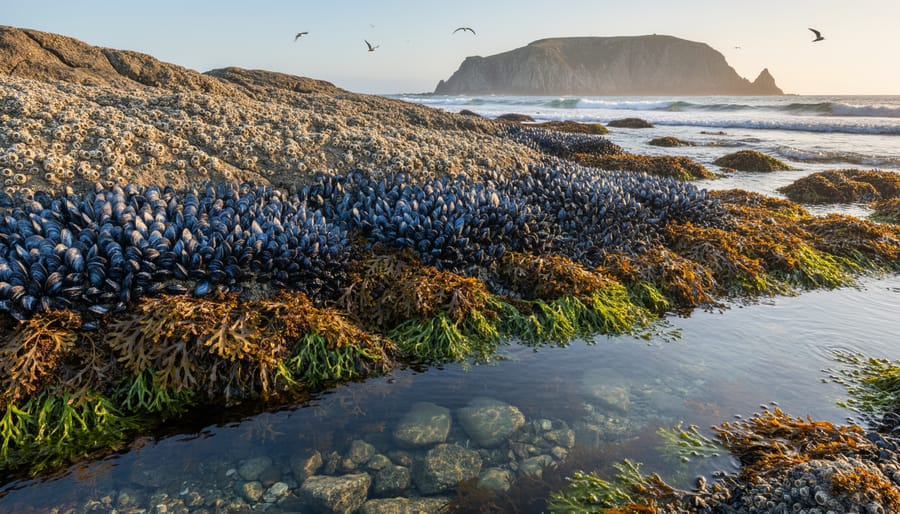
Walk along any rocky shoreline at low tide and you’ll witness one of nature’s most striking patterns: distinct horizontal bands of life stretching from the spray zone down to the submerged rocks below. Barnacles dominate one level, mussels another, while seaweeds create underwater forests in the lowest zones. This vertical layering, called rocky intertidal zonation, reveals a fierce competition for space where organisms arrange themselves according to their ability to withstand exposure to air, waves, and predators.
Understanding this pattern matters far beyond academic interest. Rocky intertidal zones serve as living laboratories where scientists first discovered how single species can control entire ecosystems. In the 1960s, ecologist Robert Paine’s groundbreaking work with sea stars along the Pacific coast revealed that removing just one predator could collapse the diversity of an entire community, introducing the concept of keystone species that now guides conservation worldwide.
These accessible shorelines offer something rare in marine science: ecosystems you can study without scuba gear or research vessels. Every tide pool becomes a window into ecological principles governing life in the oceans. The zones shift and respond to environmental changes, making them sensitive indicators of climate impacts, ocean acidification, and pollution. When sea star wasting disease devastated populations along the West Coast, researchers and volunteers alike could document the cascading effects simply by monitoring their local beaches.
Whether you’re a student conducting your first field study, an educator bringing ecology to life, or a concerned citizen wanting to understand coastal health, rocky intertidal zonation provides tangible evidence of how marine communities organize, survive, and sometimes collapse under pressure.
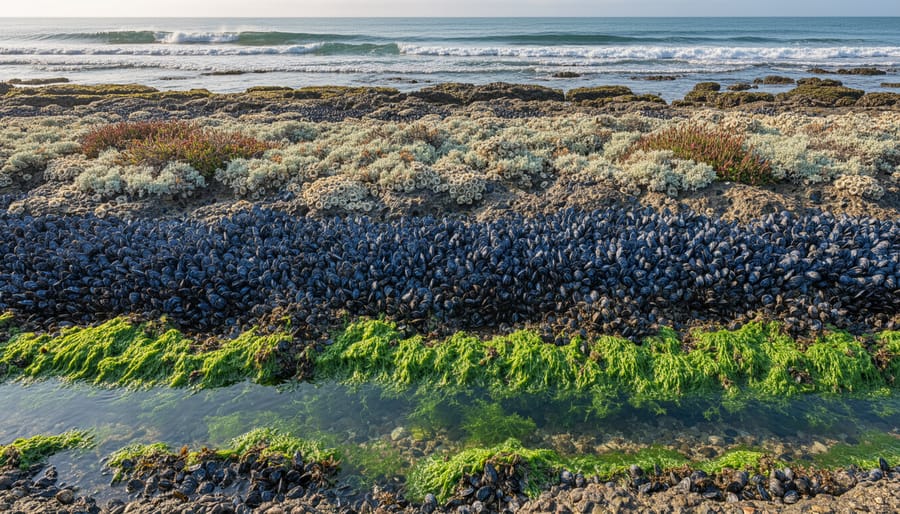
What Is Rocky Intertidal Zonation?
The Three Primary Zones
The rocky intertidal habitat divides naturally into three distinct zones, each shaped by its relationship with the tides and characterized by unique communities of diverse marine organisms that have evolved remarkable adaptations to survive there.
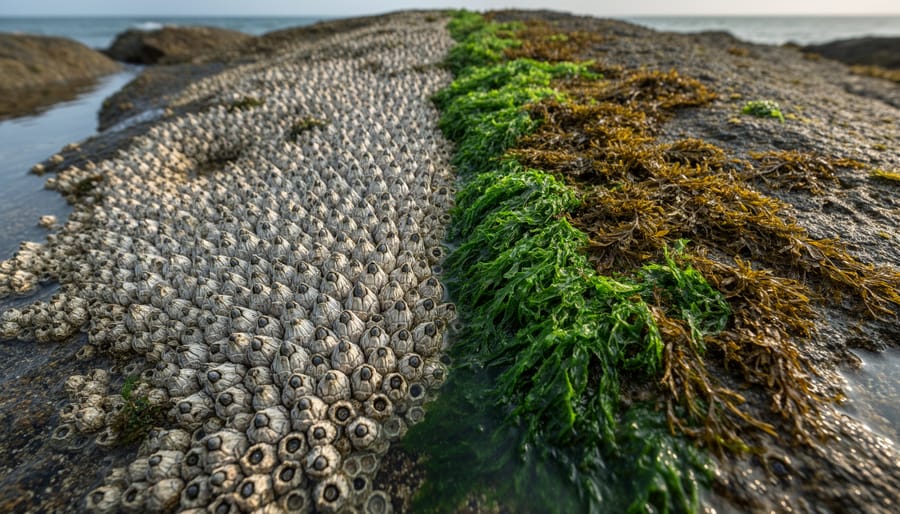
The splash or spray zone sits highest on the shore, experiencing ocean spray but rarely full submersion except during extreme high tides or storms. This harsh environment demands extraordinary resilience. Organisms here must withstand intense sunlight, dramatic temperature fluctuations, and extended periods of desiccation. Tough periwinkle snails cling to rocks, sealing themselves inside their shells during dry periods. Acorn barnacles cement themselves permanently to rock surfaces, closing their plates tightly to retain moisture. Black lichens paint the upper rocks, representing a partnership between fungi and algae that can survive these extreme conditions.
Moving downward, the mid-intertidal zone experiences regular exposure and submersion with each tidal cycle, typically submerged during high tide and exposed during low tide. This zone hosts incredible biodiversity because organisms must balance terrestrial and marine existence. Here you’ll find dense mussel beds, their byssal threads anchoring them against crashing waves. Ochre sea stars patrol the rocks, playing their famous role as keystone predators. Barnacles carpet available surfaces, extending feathery legs to filter-feed when submerged. Seaweeds like rockweed develop gas-filled bladders to stay buoyant underwater, while sea anemones retract their tentacles during low tide, resembling gelatinous blobs.
The low intertidal zone remains underwater most of the time, exposed only during the lowest tides. This zone explodes with life and color. Delicate sea urchins graze on kelp forests, while nudibranchs display brilliant patterns. Tide pools here become miniature marine sanctuaries, harboring small fish, hermit crabs, and colorful coralline algae. Larger kelp species anchor here, their holdfasts gripping tight while fronds reach toward sunlight.
Marine biologist Dr. Sarah Chen recalls her first low-tide exploration: “Peering into those pools felt like discovering hidden worlds. Each zone tells a story of adaptation and survival that never stops inspiring me.”
Understanding these zones helps us appreciate how even slight changes in sea level or temperature can dramatically reshape these communities, making their protection essential for maintaining coastal biodiversity.
Physical Forces That Shape the Zones
The rocky intertidal zone is one of the most physically demanding environments on Earth, shaped by powerful forces that dictate where organisms can establish their homes. Understanding these physical stressors helps us appreciate why certain creatures thrive in specific zones while others cannot.
Wave action stands as the most dramatic force. Crashing waves deliver powerful impacts that can dislodge organisms, but they also bring essential nutrients and oxygen. Upper zone inhabitants must withstand tremendous mechanical stress during storms, while lower zone species experience more consistent wave energy. Marine biologist Dr. Sarah Chen recalls her first research expedition: “Watching waves pound the rocks made me realize these organisms aren’t just surviving—they’re engineered for this chaos.”
Temperature fluctuation presents another significant challenge. During low tide, exposed rocks can heat to scorching temperatures under direct sunlight or cool dramatically during winter nights. Organisms in the upper splash zone might experience temperature swings of 30 degrees Celsius in a single day, while those in lower zones enjoy more stable conditions thanks to frequent submersion.
Desiccation stress, or water loss, becomes increasingly severe in higher zones. When the tide recedes, organisms lose their protective water blanket and must prevent their tissues from drying out. Barnacles seal their shells tightly, while certain seaweeds produce protective mucus layers. Species inhabiting the upper zones have evolved remarkable adaptations to survive extended dry periods, sometimes remaining exposed for days during neap tides.
Salinity changes add another layer of complexity. Rainfall can dilute tidepools, creating freshwater conditions that stress marine organisms, while intense evaporation concentrates salt to extreme levels. These physical forces work together, creating a gradient of harsh conditions that fewer species can tolerate as elevation increases.
The Biological Architecture of Zonation
Competition for Space and Resources
In the rocky intertidal zone, prime real estate is scarce. Every square centimeter of rock surface represents survival, and organisms engage in fierce competition for these limited spaces. This battle for territory is one of the primary forces shaping zonation patterns along the shore.
Barnacles and mussels provide perhaps the most studied example of spatial competition. Barnacles, with their cone-shaped calcium carbonate shells, cement themselves permanently to rocks during their larval stage. Once attached, they filter-feed by extending feathery appendages called cirri. California mussels, on the other hand, secure themselves using byssal threads and can slowly shift position. When mussel larvae settle near barnacles, they initially coexist peacefully. However, as mussels grow, they gradually overgrow barnacles, smothering them and claiming the space.
Marine biologist Dr. Sarah Chen, who has studied these interactions for over fifteen years, describes it vividly: “I’ve watched individual barnacles become completely engulfed by expanding mussel beds over just one season. It’s like watching a very slow-motion takeover.” Her research with volunteer citizen scientists has documented how this competition varies with wave exposure and predation pressure.
Algae also compete intensely for attachment sites, especially in lower zones where moisture is abundant. Rockweeds and other seaweeds can monopolize surfaces, preventing larvae of sessile animals from settling. This competition for space doesn’t just determine which species live where—it fundamentally shapes the entire community structure we observe when exploring tide pools.
Predation Pressure Across Zones
Predators act as powerful architects of the intertidal landscape, primarily controlling where prey species can live by setting their lower boundaries. This creates a fascinating pattern: while physical stress limits how high organisms can venture up the shore, predation determines how low they can safely reside.
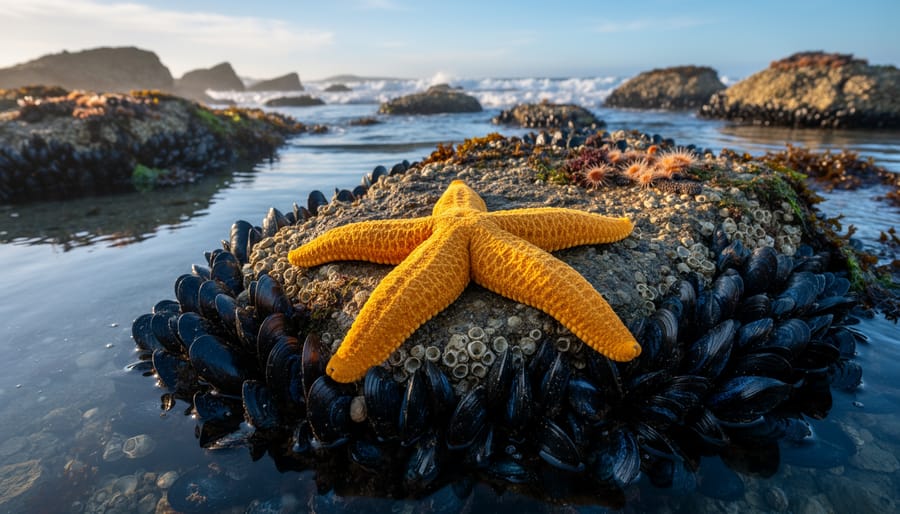
Sea stars exemplify this dynamic beautifully. These slow-moving hunters patrol the lower intertidal and subtidal zones, feeding on mussels, barnacles, and other sessile prey. Their presence keeps these prey populations from expanding downward into areas with longer submersion times and more favorable feeding conditions. Remove the sea stars, and mussels quickly colonize lower zones where they previously couldn’t survive, not due to physical constraints, but because they’d be eaten.
Crabs add another layer of complexity to this predatory control. Green crabs and other species actively hunt smaller invertebrates, creating refuges in the upper zones where their prey can escape. Marine biologist Dr. Sarah Chen, who has monitored intertidal sites for fifteen years, shares an observation: “During low tides, you can watch small shore crabs retreating upward as the water recedes, literally following the water’s edge to avoid larger predators below.”
Even predatory snails like dog whelks influence zonation patterns by consuming barnacles and mussels, though their impact varies with shore height and wave exposure. This predation pressure creates a delicate balance where species occupy zones representing their best compromise between avoiding predators and tolerating physical stress.
Keystone Species: The Architects of Intertidal Communities
The Classic Example: Sea Stars and Mussel Beds
In the 1960s, ecologist Robert Paine conducted experiments along the rocky shores of Washington State that would revolutionize our understanding of how ecosystems maintain their diversity. His subject was a charismatic purple sea star, Pisaster ochraceus, and the question was deceptively simple: what happens when you remove a single species from its habitat?
Paine carefully selected sections of the intertidal zone and removed all the sea stars he could find, then watched what unfolded. Without the sea stars patrolling these rocky areas, California mussels began to dominate completely. These fast-growing filter feeders quickly crowded out barnacles, algae, limpets, and other species that had previously coexisted in the same space. Within just a few years, areas that once supported over a dozen species were reduced to monotonous mussel beds.
Meanwhile, in control areas where sea stars remained, diversity flourished. The sea stars actively preyed on mussels, preventing any single species from monopolizing the limited rocky substrate. This predation created open spaces where different organisms could settle and thrive, maintaining the distinct zonation patterns we observe today.
This elegant research introduced the concept of the keystone species, organisms whose impact on their ecosystem is disproportionately large compared to their abundance. Like the keystone in an arch, remove them and the entire structure collapses. The sea star didn’t just eat mussels; it maintained the ecological architecture of the entire intertidal community.
Dr. Sarah Chen, a marine ecologist who volunteers with coastal monitoring programs, shares this perspective: “Paine’s work reminds us that every species plays a role we might not immediately see. When I’m teaching volunteers to survey tide pools, I always point out sea stars. People love seeing them, but understanding their ecological importance transforms that appreciation into genuine conservation commitment.”
This classic example demonstrates why protecting predators matters just as much as preserving habitat. The zonation patterns we observe aren’t just pretty to look at; they’re maintained by intricate ecological relationships that took millennia to develop.
Other Keystone Species in Rocky Intertidal Zones
While sea stars often steal the spotlight, rocky intertidal zones host numerous other keystone species that shape these remarkable ecosystems. Understanding their roles reveals the intricate web of relationships that maintain coastal biodiversity.
Sea otters serve as keystone predators along the Pacific coast, though they forage primarily in subtidal kelp forests adjacent to intertidal areas. Their appetite for sea urchins prevents these grazers from decimating kelp beds and encroaching into lower intertidal zones. Where sea otters thrive, entire communities flourish. Marine biologist Dr. Sarah Chen recalls her first survey after sea otter recolonization: “The transformation was astounding. Within five years, we documented a 300% increase in species diversity. It reminded me why I fell in love with marine science.”
Certain limpet species also function as keystone grazers. These unassuming mollusks maintain the balance between algae and bare rock, creating microhabitats for other organisms. By scraping algae in specific patterns, they influence which species can settle and grow, effectively curating the community composition.
Interestingly, mussels themselves act as ecosystem engineers, a concept closely related to keystone species. Their beds create three-dimensional structure, transforming flat rock into complex habitat. The spaces between mussel shells provide refuge for crabs, worms, and juvenile fish. This engineering role demonstrates how a single species can physically modify the environment to benefit countless others.
Volunteers participating in intertidal monitoring programs often help track these keystone species populations. These citizen science efforts provide crucial data about ecosystem health and resilience. Whether you’re documenting limpet abundance or counting sea stars during low tide, your observations contribute to our understanding of how these communities function and respond to environmental change. Every data point matters in protecting these vital coastal ecosystems.
Why Rocky Intertidal Zonation Matters for Conservation
Early Warning Signs of Ecosystem Change
Rocky intertidal zones function as sensitive barometers of ocean health, and changes in their characteristic banding patterns often serve as early warnings of environmental stress. When species begin shifting their vertical ranges or disappearing from their traditional zones, scientists recognize these shifts as crucial indicators that something in the ecosystem is changing.
Temperature-induced range shifts represent one of the most visible signals of climate change impacts. As ocean waters warm, many species are gradually moving upward in the intertidal zone or poleward along coastlines to find cooler conditions. Marine biologist Dr. Sarah Chen, who has monitored California’s rocky shores for fifteen years, shares a telling observation: “We’re now finding warm-water barnacle species in areas where they were never recorded before, while cold-water specialists are retreating northward or disappearing entirely from their southern range limits.”
These vertical migrations disrupt the classic zonation patterns that have existed for thousands of years. Species once restricted to lower zones may expand upward, creating competition with established residents. Conversely, organisms unable to tolerate warming waters may find their habitable zones shrinking, sometimes disappearing altogether from historically occupied areas.
Pollution presents another significant driver of zonation changes. Oil spills, heavy metals, and agricultural runoff can eliminate sensitive species while allowing pollution-tolerant organisms to flourish. These shifts in community composition alter the characteristic color bands and textures that define healthy intertidal zones. Monitoring programs that track such changes help scientists identify threats to marine ecosystems before they become irreversible.
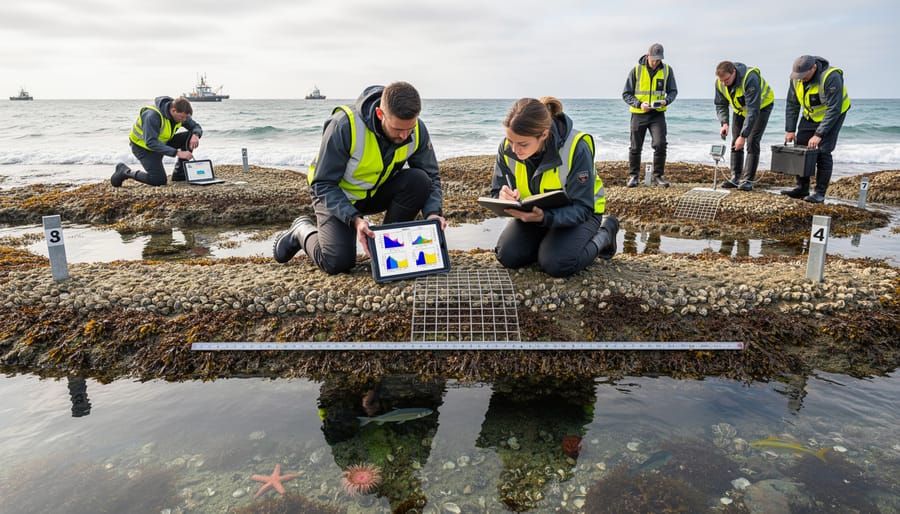
Citizen scientists play a vital role in detecting these early warnings. Many coastal monitoring programs welcome volunteers to document species distributions, creating long-term datasets that reveal subtle shifts scientists might otherwise miss. Your observations could help identify emerging problems while solutions remain within reach.
Personal Story: A Marine Biologist’s Perspective
I still remember my first visit to the rocky shores of Oregon’s coast in 1998, armed with enthusiasm and a brand-new marine biology degree. I spent that summer cataloging sea stars, mussels, and barnacles along permanent transects, carefully documenting which species lived where. At the time, I was simply fascinated by the neat horizontal bands of life painted across the rocks—the precision of zonation patterns seemed almost too perfect to be real.
Twenty-five years later, those same transects tell a very different story. The upper limits of several key species have shifted upward by nearly half a meter in some locations. The once-predictable boundaries between zones have become blurred. Ochre sea stars, which used to dominate the mid-intertidal zone and kept mussel populations in check, have suffered devastating losses from sea star wasting disease. Without these crucial predators maintaining balance, I’ve watched mussel beds expand and crowd out the diverse communities that once thrived there.
These changes aren’t just data points in my research journal—they represent fundamental shifts in an ecosystem that has maintained these patterns for thousands of years. But here’s what keeps me returning to these shores every season: understanding zonation gives us a baseline to measure change and, more importantly, the knowledge to respond. Local volunteers now help me monitor these sites monthly, creating a network of citizen scientists who’ve become deeply invested in protecting these ecosystems. Their dedication reminds me why this work matters.
How You Can Help Protect Rocky Intertidal Ecosystems
Protecting rocky intertidal ecosystems requires action at multiple levels, and every individual can make a meaningful difference. Whether you’re a seasoned marine enthusiast or just beginning to explore these fascinating habitats, numerous opportunities exist to contribute to their conservation and study.
One of the most impactful ways to get involved is through citizen science programs. Organizations like the Marine Biodiversity Science Center regularly recruit volunteers to help monitor intertidal communities, collecting valuable data that informs conservation decisions. These programs require no previous experience, as trained biologists provide thorough instruction on identification techniques and data collection protocols. Participants not only contribute to real scientific research but also develop a deeper connection to these ecosystems.
Dr. Elena Rodriguez, a marine ecologist who coordinates volunteer programs, shares: “We’ve had everyone from retired teachers to college students join our monitoring efforts. One volunteer, a former accountant, has become so skilled at identifying species that she now leads training sessions for newcomers. That’s the power of hands-on engagement.”
If you enjoy exploring tide pools, practice responsible wildlife viewing. Never remove organisms from their habitat, carefully replace any rocks you overturn, step only on bare rock or sand to avoid crushing life, and observe animals without touching them. The stress from handling can be harmful, particularly during low tide when organisms already face exposure challenges.
Supporting marine protected areas through advocacy and donations helps ensure these ecosystems receive necessary legal protections. Many conservation organizations offer memberships that directly fund habitat restoration and research initiatives.
Finally, reduce your environmental footprint by minimizing single-use plastics, supporting sustainable seafood choices, and educating others about the importance of rocky intertidal zones. Small actions, multiplied across communities, create significant positive change. These remarkable ecosystems have persisted for millennia, and with collective stewardship, they’ll continue thriving for generations to come.
The elegant tapestry of rocky intertidal zonation reveals nature’s intricate design, where physical forces and biological interactions create distinct bands of life along our coastlines. These patterns, visible to anyone who explores a rocky shore at low tide, tell a profound story about resilience, adaptation, and interconnection. At the heart of these systems stand keystone species like sea stars, mussels, and certain algae, whose influence ripples through entire communities, maintaining the diversity and structure we observe.
Understanding these dynamics empowers us to become better stewards of our coastal environments. Just as in other marine ecosystems, the health of rocky intertidal zones depends on our collective commitment to protection and restoration. Dr. Sarah Chen, a marine biologist who has monitored intertidal sites for two decades, reflects on this hope: “Every citizen scientist who documents zonation patterns, every volunteer who helps with cleanup efforts, contributes to our understanding and protection of these vital habitats.”
The beauty of intertidal ecology is that it’s accessible to all of us. You don’t need specialized equipment to observe zonation or contribute to conservation efforts. Local monitoring programs welcome volunteers year-round, offering training in species identification and data collection. By participating, you join a growing movement of people translating scientific knowledge into meaningful action, ensuring that these remarkable systems continue to thrive for generations to come.

jessica
Ava Singh is an environmental writer and marine sustainability advocate with a deep commitment to protecting the world's oceans and coastal communities. With a background in environmental policy and a passion for storytelling, Ava brings complex topics to life through clear, engaging content that educates and empowers readers. At the Marine Biodiversity & Sustainability Learning Center, Ava focuses on sharing impactful stories about community engagement, policy innovations, and conservation strategies. Her writing bridges the gap between science and the public, encouraging people to take part in preserving marine biodiversity. When she’s not writing, Ava collaborates with local initiatives to promote eco-conscious living and sustainable development, ensuring her work makes a difference both on the page and in the real world.