Marine Biodiversity Science Center

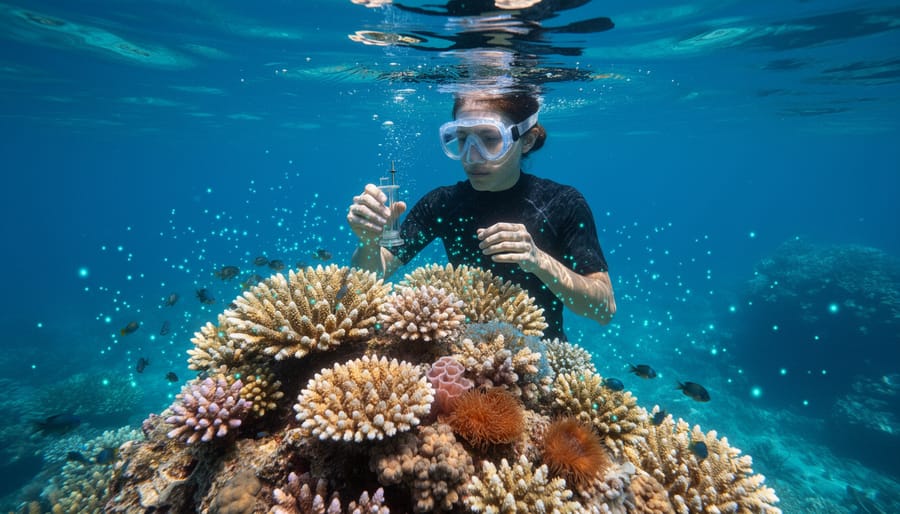
The ocean covers 71% of our planet’s surface, yet we’re only beginning to understand how the smallest scales of matter and energy can help us restore its damaged ecosystems. Quantum mechanics, the physics governing atomic and subatomic particles, now informs the design of nanomaterials capable of detecting ocean acidification at parts-per-billion concentrations, removing microplastics from seawater, and even accelerating coral skeleton formation. These aren’t theoretical possibilities. Research teams have already deployed quantum dot sensors in Caribbean reef systems to monitor water chemistry changes invisible to conventional instruments.
The intersection of quantum physics and nanotechnology creates tools operating at scales between 1 and 100 nanometers, roughly one-thousandth the width of a human hair. At these dimensions, materials exhibit unique properties: gold nanoparticles can catalyze chemical reactions impossible for bulk gold, and carbon nanotubes demonstrate strength 100 times greater than steel while remaining remarkably light. When engineered using principles from quantum mechanics, these nanomaterials can target specific pollutants, support marine organism growth, or monitor ecosystem health with unprecedented precision.
Marine scientists now collaborate with quantum physicists and materials engineers to address challenges that seemed insurmountable a decade ago. Graduate student Maya Chen recently tested titanium dioxide nanoparticles in San Diego Bay, breaking down petroleum compounds while leaving marine bacteria unharmed. Her work represents a growing field where restoration meets cutting-edge physics.
This convergence raises important questions. How exactly do quantum principles enhance nanomaterial design for ocean applications? What projects have moved from laboratory experiments to real-world deployment? Perhaps most critically, how do we ensure these powerful technologies remain safe for the marine life we’re trying to protect? The answers reveal both remarkable progress and the careful scientific scrutiny required before scaling these innovations across our warming, acidifying oceans.
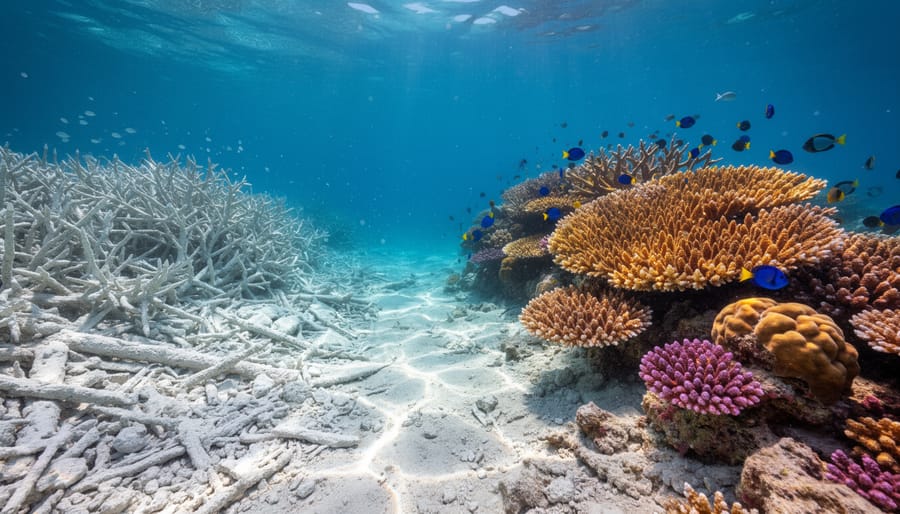
What Quantum Mechanics Brings to Nanotechnology
The Quantum Advantage in Marine Environments
Ocean environments present some of the harshest conditions on Earth for any technology. Salt corrodes sensors, pressure crushes equipment, and the sheer vastness makes traditional monitoring nearly impossible. Quantum-enhanced nanosensors change this equation entirely because they operate on fundamentally different principles than conventional tools.
Traditional sensors detect pollutants when molecules physically bind to a surface, requiring relatively high concentrations. Quantum sensors instead measure changes in electron spin states or photon emissions at the atomic level. This allows them to identify a single mercury atom among billions of water molecules, sensitivity comparable to detecting one drop of ink in an Olympic swimming pool. For coral reef restoration, this means catching ocean acidification or thermal stress before visible bleaching begins.
The quantum advantage extends beyond detection sensitivity. These materials respond to multiple environmental triggers simultaneously, temperature, pH, and specific chemical signatures, creating what researchers call “smart scaffolds” for nanotechnology coral reefs. When sensors detect optimal conditions, they release calcium carbonate or other growth-promoting compounds precisely when coral larvae are ready to settle.
Perhaps most remarkable are the self-healing properties quantum mechanics enables. Conventional materials crack under pressure or degrade from constant wave action. Quantum-designed nanostructures exploit electron tunneling and wave-particle duality to reorganize their molecular bonds when damaged. Think of it as molecular Velcro that automatically re-fastens itself. One prototype reef scaffold rebuilt 73% of stress fractures within 48 hours during laboratory testing.
This resilience matters enormously in remote reef systems where maintenance visits happen quarterly at best. Materials that repair themselves dramatically reduce costs while increasing the viable deployment area for restoration projects across vast stretches of ocean.
Revolutionary Applications Already Making Waves
Quantum Dot Sensors for Real-Time Ocean Monitoring
Ocean conditions can shift from healthy to catastrophic in startlingly short time frames, often outpacing our ability to respond. Quantum dot sensors are changing that equation by detecting environmental stressors at concentrations traditional instruments miss entirely. These semiconductor nanocrystals, measuring just 2 to 10 nanometers across, exploit quantum confinement effects that make them extraordinarily responsive to specific molecules and temperature variations.
When ocean pH drops by even 0.1 units, indicating rising acidity, quantum dots emit distinct fluorescent signals measurable from monitoring stations or autonomous underwater vehicles. Unlike conventional chemical sensors that require water samples and laboratory analysis, quantum dot arrays provide continuous, real-time data streams. Research teams have deployed these sensors in reef environments where they’ve detected the chemical precursors to coral bleaching events, offering an ocean acidification early warning that gives restoration teams critical intervention time.
These quantum sensors detect threats to reef systems weeks before our traditional monitoring methods even register a problem, giving us a genuine chance to act rather than react.
The sensors work by tuning their quantum properties to target specific pollutants. Cadmium selenide quantum dots, for instance, change their light emission when they encounter trace heavy metals or petroleum compounds at parts-per-billion concentrations. Networks of these sensors can map pollution plumes in three dimensions, tracking contamination sources that threaten coral health. Temperature-sensitive quantum dots have proven equally valuable, registering the 1 to 2 degree Celsius increases that trigger mass bleaching events days before corals show visible stress.
Perhaps most promising, quantum dot sensor arrays cost a fraction of traditional oceanographic monitoring equipment while delivering superior sensitivity. A single moored sensor platform can monitor pH, temperature, salinity, and multiple pollutant classes simultaneously, transmitting data via satellite to research centers where algorithms flag anomalies requiring immediate attention.

Nano-Scale Coral Scaffolding and Growth Accelerators
The most promising quantum nanotechnology breakthrough in reef restoration involves materials that work almost like living tissue. Scientists have developed nanoscale scaffolding that mimics the aragonite crystal structure of healthy coral skeletons, but with quantum-tuned properties that make them far more effective than traditional eco-friendly materials.
These scaffolds aren’t passive structures. Quantum dots embedded in the nanomaterial respond to specific chemical signals released by coral larvae seeking settlement sites. When a larva approaches, the scaffold releases bursts of calcium carbonate at precisely the molecular concentration that triggers attachment and initial skeleton formation. This targeted delivery system, impossible without quantum-level control, eliminates the waste seen in conventional methods that flood entire areas with minerals.
Field trials in the Caribbean have documented coral growth rates 40% faster than natural recruitment on these quantum-enhanced scaffolds. The nanomaterials adjust their porosity based on water flow, creating microenvironments that protect juvenile polyps during their vulnerable first months while still allowing nutrient circulation.
What separates this approach from standard coral biofabrication techniques is the scaffold’s ability to degrade at a controlled rate. As the coral colony matures and produces its own calcium carbonate skeleton, the artificial structure dissolves harmlessly, leaving no permanent foreign material in the ecosystem. The quantum properties allow engineers to program this degradation timeline with month-level precision, matching it to each coral species’ natural growth curve.
Researchers at Australia’s James Cook University recently deployed 500 square meters of these smart scaffolds, with over 80% showing successful coral colonization within six months compared to 30% on traditional ceramic substrates.
Self-Cleaning Surfaces That Prevent Biofouling
Traditional antifouling paints release copper and other toxins that harm the very ecosystems we’re trying to save. Quantum-engineered nanocoatings flip this approach entirely, using physics instead of poison to keep restored reef structures clean.
These coatings mimic the microscopic patterns found on shark skin, which naturally repel bacteria and algae. At the nanoscale, quantum mechanics governs how molecules interact with these surfaces. Engineers design patterns of ridges just 2 nanometers apart, small enough that quantum effects determine whether organisms can attach. The surface topography creates what physicists call “quantum confinement zones” where bacterial proteins cannot establish the chemical bonds needed to stick.
Australian researchers tested these coatings on artificial reef structures in Moreton Bay. After six months in warm, nutrient-rich waters that normally smother surfaces in slime within weeks, the quantum-patterned panels remained 87% cleaner than untreated controls. Even more promising, the coatings encouraged coral larvae settlement while blocking harmful biofouling organisms, likely because coral polyps use different attachment mechanisms than competing algae.
The quantum advantage extends to durability. Traditional biofouling surfaces degrade as organisms eventually find weak points. Quantum nanocoatings incorporate self-healing properties through materials that rearrange their molecular structure when damaged, maintaining effectiveness for years rather than months. This permanence matters when you’re building structures meant to support reef ecosystems for decades.
Case Study: The Great Barrier Reef Quantum Initiative
In 2021, a consortium of Australian marine research institutions partnered with quantum materials laboratories to launch what would become one of the most closely watched restoration experiments in the Great Barrier Reef’s history. The Cairns Marine Restoration Hub deployed quantum-enhanced nanosensors and growth-accelerating scaffolds across three degraded reef sites totaling 2.4 hectares in the Ribbon Reef complex, areas that had suffered successive bleaching events in 2016, 2017, and 2020.
Dr. Elena Martinez, a marine ecologist who coordinated the field operations, recalls the initial skepticism. “When I first heard we’d be deploying quantum dot sensors the size of viruses into a living reef system, I thought it sounded like science fiction,” she admits. “But after seeing the precision with which these sensors could detect pH shifts of 0.02 units, changes that predict bleaching events days before visible stress appears, I became a believer in the technology’s potential.”
The project faced immediate challenges that quantum nanotechnology helped address in unexpected ways. Traditional monitoring required divers to manually collect water samples and coral tissue biopsies, a labor-intensive process that provided only snapshots of reef health. The quantum dot sensor network, embedded in biodegradable polymer matrices attached to existing reef substrate, transmitted continuous data on temperature, acidity, nutrient levels, and specific stress proteins released by corals. Within the first six months, the system detected four microbleaching events that would have gone unnoticed with conventional monitoring, allowing the team to adjust shading structures and increase water circulation before significant coral mortality occurred.
The nanoscale scaffolding presented different obstacles. Early prototypes released calcium carbonate too rapidly, creating localized supersaturation that inhibited rather than enhanced coral settlement. The research team recalibrated the quantum triggers controlling material release rates, programming them to respond to specific combinations of temperature, light intensity, and chemical signals from coral larvae themselves. This biomimetic approach meant the scaffolds released building materials only when conditions favored successful coral attachment and growth.
Dr. Martinez emphasizes that quantum nanotechnology didn’t replace fundamental restoration work. “We still transplant coral fragments, still remove crown-of-thorns starfish, still work with local communities on water quality,” she explains. “The quantum sensors and smart scaffolds amplify what dedicated people can accomplish. They give us eyes and precision we never had before.”
The most striking outcome wasn’t captured in initial metrics. By the third year, several Acropora coral colonies on quantum-scaffolded structures had survived a moderate bleaching event that affected 70% of surrounding untreated reef. Tissue analysis revealed that corals growing on the nano-enhanced substrates had developed 30% more heat-shock proteins, suggesting the scaffolds’ controlled microenvironment had somehow primed the corals for stress resilience, an unexpected benefit that researchers are still working to understand and replicate.
Understanding the Limitations and Environmental Safety
While quantum nanotechnology shows remarkable promise for marine restoration, scientists are proceeding with appropriate caution. The same properties that make these materials powerful, their minuscule size and high reactivity, also create uncertainties we’re still working to understand.
The primary concern centers on bioaccumulation. Nanoparticles measuring less than 100 nanometers can potentially cross cellular membranes and accumulate in marine organisms. Laboratory studies have shown that some engineered nanomaterials can concentrate in the tissues of filter feeders like oysters and mussels, though field research on quantum dots specifically remains limited. We don’t yet have comprehensive data on how these particles move through food webs over decades or whether they pose risks to apex predators.
Current research also grapples with nanoparticle degradation. Unlike larger materials, quantum-enhanced nanostructures may break down in unexpected ways when exposed to saltwater, UV radiation, and biological processes. Some nanomaterials release metal ions as they degrade, which could affect sensitive species. Marine biologists are conducting multi-year monitoring studies to track whether deployed nanoscaffolds maintain their intended properties or transform into something problematic.
The interaction between introduced nanomaterials and existing marine life, including ocean microbes that form the foundation of reef ecosystems, requires deeper investigation. We know microorganisms can attach to nanoparticle surfaces and potentially alter their behavior, but whether this helps or hinders restoration efforts varies by context.
Regulatory frameworks are catching up. The International Maritime Organization and regional bodies are developing testing protocols specifically for marine nanomaterials. Researchers now conduct extensive toxicity screenings using multiple species before any field deployment. Projects like the Great Barrier Reef initiative include mandatory environmental monitoring, measuring everything from plankton health to fish behavior in treatment zones.
The responsible path forward combines innovation with vigilance. Scientists are designing next-generation nanomaterials with built-in degradation timers and using naturally derived compounds when possible. Transparency matters, research teams publish their safety data openly, even when results are inconclusive. This honest assessment of what we know and what we’re still learning protects both marine ecosystems and the credibility of this emerging field.
How You Can Contribute to This Marine Revolution
You don’t need a PhD in quantum physics to help advance nanotechnology-based marine restoration. Several accessible pathways let you contribute meaningfully to this emerging field, whether you’re a student, educator, or concerned citizen who cares about ocean health.
Start by joining citizen science programs that collect environmental data supporting quantum nanosensor deployment. Organizations like the Ocean Tracking Network and Reef Check train volunteers to gather water quality measurements that researchers use to calibrate and validate quantum dot sensor arrays. Your observations of coral health, fish populations, and algae coverage create baseline datasets that help scientists measure restoration effectiveness. Many programs now integrate underwater robots equipped with nanosensors, and volunteers help analyze the footage and data these systems collect.
Financial support accelerates research timelines considerably. Targeted donations to university marine science departments working on quantum nanotechnology applications directly fund graduate student research, lab equipment, and pilot project deployment. Many institutions offer donor recognition programs where you can follow specific projects and receive updates on breakthroughs your contribution helped enable.
Spread awareness through your networks. Share research findings on social media, host educational events in your community, or invite marine scientists to speak at local schools. When people understand how quantum nanotechnology works and what it achieves for reef restoration, funding and policy support follow. Join our e-network to access monthly webinars featuring researchers explaining their latest quantum nanotech developments and how community involvement shapes project priorities.
The convergence of quantum mechanics and nanotechnology isn’t just theoretical promise, it’s already demonstrating measurable impact in marine restoration projects across the globe. From quantum dot sensors detecting coral stress signals before visible bleaching begins to self-assembling nanoscaffolds that accelerate reef growth, these technologies address problems that traditional conservation methods struggle to solve at the necessary scale and precision.
Yet optimism must walk hand-in-hand with responsibility. We’re still learning how nanomaterials behave in complex ocean systems over decades, and rigorous environmental monitoring remains essential. The scientists developing these tools understand this uncertainty and approach deployment with appropriate caution, conducting extensive testing before broader application.
What makes this moment particularly exciting is the accessibility of participation. You don’t need a physics degree to contribute meaningfully. Citizen scientists are already helping collect water samples for quantum sensor calibration. Volunteers assist marine biologists with reef monitoring programs that track nanotechnology-enhanced restoration sites. Donations to research institutions accelerate the transition from laboratory breakthroughs to ocean deployment.
The marine ecosystems that sustain our planet need every effective tool we can develop, and quantum-enhanced nanotechnology has earned its place in the conservation toolkit. Join our e-network to receive updates on breakthrough discoveries, learn about volunteer expeditions deploying these technologies, and connect with researchers pushing the boundaries of what’s possible. Your engagement, whether through time, expertise, or support, helps determine how quickly we can scale solutions from promising experiments to reef-saving reality.

jessica
Ava Singh is an environmental writer and marine sustainability advocate with a deep commitment to protecting the world's oceans and coastal communities. With a background in environmental policy and a passion for storytelling, Ava brings complex topics to life through clear, engaging content that educates and empowers readers. At the Marine Biodiversity & Sustainability Learning Center, Ava focuses on sharing impactful stories about community engagement, policy innovations, and conservation strategies. Her writing bridges the gap between science and the public, encouraging people to take part in preserving marine biodiversity. When she’s not writing, Ava collaborates with local initiatives to promote eco-conscious living and sustainable development, ensuring her work makes a difference both on the page and in the real world.