Marine Biodiversity Science Center

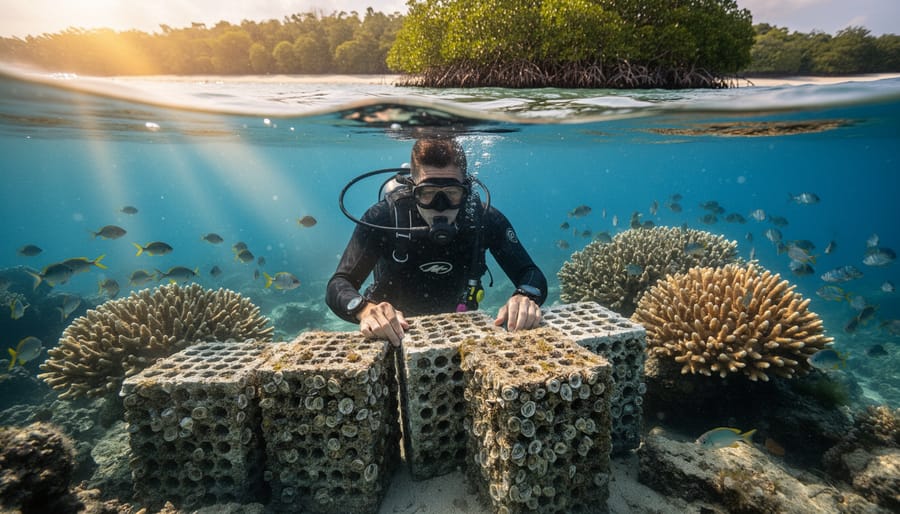
Nature has been solving complex engineering challenges for 3.8 billion years, and marine ecosystems offer some of the most elegant solutions to problems that plague modern conservation efforts. When coral reefs naturally heal themselves after damage, when mangrove roots create wave-resistant shorelines, and when kelp forests sequester carbon more efficiently than terrestrial forests, they demonstrate principles that scientists and engineers are now translating into practical restoration tools.
Bio-inspired design—also called biomimicry—looks to these natural systems as blueprints for solving human challenges. In marine conservation, this approach has moved beyond theory into transformative action. Researchers study how oyster reefs filter water and protect coastlines, then design artificial reef structures that mimic these functions while accelerating ecosystem recovery. They observe how sea urchins maintain their purple pigment in harsh UV conditions and develop non-toxic, longer-lasting marine coatings. They analyze the spiral patterns in nautilus shells to create more efficient water pumps for aquaculture systems.
The power of bio-inspired design lies in its dual benefit: it provides effective solutions to conservation challenges while deepening our understanding of the very ecosystems we aim to protect. Unlike conventional engineering that often works against natural processes, biomimicry works with them, creating interventions that integrate seamlessly into existing marine environments. This approach has proven particularly valuable as ocean conditions change rapidly, requiring adaptive strategies that can evolve alongside the ecosystems themselves.
The following exploration reveals how learning from marine life is reshaping conservation efforts and opening new pathways for both professionals and concerned citizens to participate in ocean protection.
What Bio-Inspired Design Really Means for Our Oceans
When marine biologist Dr. Sarah Chen first observed how kelp forests bend gracefully in powerful ocean currents instead of breaking, she realized nature had already solved problems that engineers struggle with daily. This moment of recognition captures the essence of bio-inspired design, also known as biomimicry: the practice of learning from and mimicking nature’s time-tested patterns and strategies to solve human challenges.
At its core, bio-inspired design asks a deceptively simple question: How would nature solve this? Rather than reinventing solutions from scratch, scientists and designers study organisms that have spent millions of years adapting to similar challenges through evolution. Marine environments make particularly valuable classrooms for this approach because ocean life has developed extraordinary innovations to thrive in some of Earth’s most demanding conditions.
Consider the obstacles marine organisms face daily: extreme pressure at depth, corrosive salt water, powerful currents, temperature fluctuations, and the constant need to balance energy efficiency with survival. The creatures that flourish in these conditions aren’t just survivors—they’re master engineers whose designs have been refined through countless generations of evolutionary testing.
The fundamental principles of biomimicry involve three key steps: identifying a specific challenge, finding organisms that have successfully addressed similar problems, and translating their biological strategies into practical applications. For instance, studying how mussels create incredibly strong adhesives that work underwater has inspired new methods for reef restoration that don’t rely on harmful chemicals.
What makes this approach particularly powerful for ocean conservation is that marine organisms have already developed sustainable, efficient solutions. Unlike human-designed systems that often require significant energy inputs or create waste, nature’s designs typically work in harmony with their surroundings, using minimal resources while supporting broader ecosystem health.
Volunteer divers and citizen scientists play crucial roles in bio-inspired research by documenting marine species behaviors and adaptations, observations that sometimes spark breakthrough innovations. Their field notes have led researchers to examine everything from shark skin’s antibacterial properties to coral’s methods for filtering nutrients from seawater.
Nature’s Blueprint: Marine Structures Worth Copying
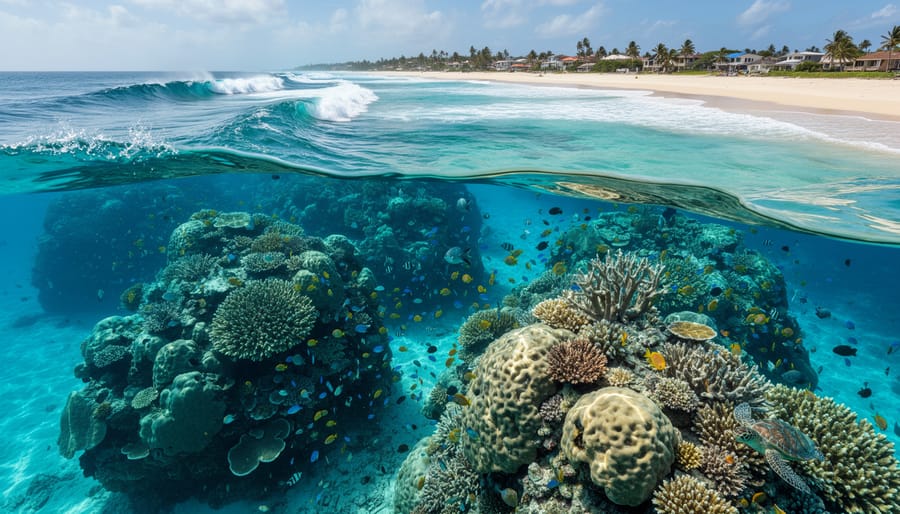
Coral Reefs: Masters of Wave Dissipation
Coral reefs rank among nature’s most effective coastal defense systems, dissipating up to 97% of wave energy before it reaches shorelines. This remarkable capability stems from their complex three-dimensional structure—a maze of ridges, branches, and crevices that forces incoming waves to slow down, break apart, and lose momentum. As waves crash against the reef’s rough surface, friction converts kinetic energy into harmless turbulence. The result? Communities behind these natural barriers experience significantly reduced erosion and storm damage.
Scientists and coastal engineers are now translating this ancient wisdom into artificial reef designs that serve dual purposes: protecting vulnerable coastlines while creating habitat for marine life. These bio-inspired structures mimic the texture, porosity, and height profiles of natural reefs, using materials like limestone, recycled concrete, or even specially designed ceramic modules. Unlike traditional seawalls that reflect wave energy and cause scouring, these biomimetic barriers work with ocean dynamics rather than against them.
Dr. Maria Santos, a marine biologist working on artificial reef projects in the Philippines, shares her excitement: “We’re seeing fish populations increase by 40% within just two years of installation. These structures don’t just protect people—they rebuild entire ecosystems.”
The integration of coral reef restoration techniques with wave-dissipation engineering represents a powerful convergence. By studying how living corals grow and adapt their forms to maximize wave reduction, researchers continuously refine artificial designs, creating solutions that grow more effective over time as marine organisms colonize and enhance these human-made foundations.
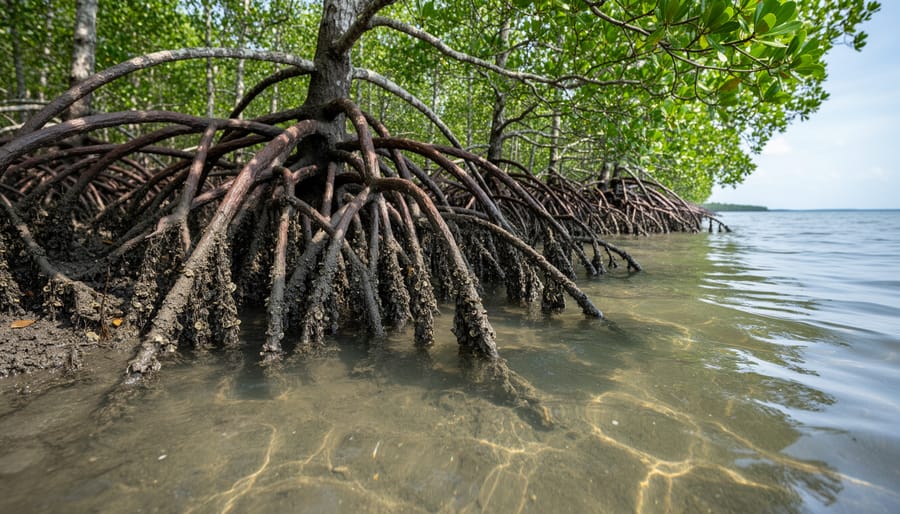
Mangrove Root Systems: Natural Water Filters
Mangrove forests possess one of nature’s most elegant filtration systems, hidden beneath the waterline. Their complex root networks—featuring aerial prop roots and underground anchoring systems—create a labyrinth that dramatically slows water flow. This architectural marvel allows sediments, pollutants, and excess nutrients to settle out before reaching deeper coastal waters.
The roots themselves host thriving communities of filter-feeding organisms like oysters and mussels, adding biological filtration to the physical process. Studies show mangroves can remove up to 80% of sediment from runoff and significantly reduce nitrogen and phosphorus levels that would otherwise fuel harmful algal blooms.
Coastal engineers are now mimicking these principles in shoreline restoration projects. Bio-inspired structures called “living shorelines” incorporate artificial root-like frameworks that replicate mangrove filtration while supporting native vegetation establishment. In Florida, researchers have successfully deployed biomimetic root structures that reduced coastal erosion by 60% while improving water clarity.
Marine biologist Dr. Sarah Chen shares her experience: “When we installed bio-inspired filtration units modeled after mangrove roots in Tampa Bay, we saw immediate improvements in water quality. Local communities now have clearer beaches and healthier seagrass beds.”
These innovations demonstrate how studying mangrove architecture provides blueprint solutions for protecting vulnerable coastlines while naturally purifying our waters—a win for both engineering and conservation.
Sponge Communities: Living Water Treatment Plants
Marine sponges are nature’s quiet champions of water purification, filtering staggering volumes—up to 20,000 times their own body mass daily—through specialized cellular structures. These ancient organisms, which have existed for over 600 million years, create microscopic channels and chambers that efficiently trap bacteria, organic particles, and even marine microorganisms without clogging. Dr. Elena Martinez, a marine biologist studying Caribbean reef sponges, recalls her amazement: “Watching a single sponge community clear turbid water in our observation tank demonstrated nature’s engineering at its finest.”
This remarkable filtration capability has inspired innovative pollution mitigation designs. Engineers are now developing bio-inspired water treatment structures that mimic sponge architecture, using branching patterns and flow-optimized chambers to clean contaminated waterways. Port cities like Rotterdam have implemented sponge-inspired floating wetlands that combine synthetic materials with natural filtration principles, removing heavy metals and excess nutrients from harbor waters.
Universities worldwide offer research opportunities for students interested in studying sponge biomimicry applications. Conservation organizations also welcome volunteers to monitor sponge populations in marine protected areas, collecting data that informs both ecological understanding and technological innovation. By learning from these humble filter feeders, we’re discovering sustainable solutions to water pollution challenges.
From Observation to Action: Real Projects Making a Difference
Biomimetic Artificial Reefs Restoring Biodiversity
Around the world, coastal degradation and climate change threaten marine ecosystems, but innovative artificial reef projects are fighting back by mimicking nature’s own designs. These biomimetic structures replicate the complexity of natural coral formations, providing essential habitat for fish, invertebrates, and coral larvae.
The Reef Design Lab in Melbourne, Australia, has pioneered 3D-printed reef structures that mirror the intricate branching patterns of staghorn and elkhorn corals. Using eco-friendly materials like marine-grade ceramic, these structures feature carefully calculated crevice sizes, surface textures, and geometric configurations that encourage colonization. Within just six months of deployment in Port Phillip Bay, researchers documented 30 percent higher fish abundance compared to traditional concrete blocks.
Dr. Maria Santos, a marine ecologist working on reef restoration in the Philippines, shares her observations: “What amazes me is how quickly marine life recognizes these biomimetic structures as home. The nooks and crannies we’ve designed based on natural coral architecture provide perfect nursery spaces for juvenile fish. We’re seeing species return that haven’t been documented here in over a decade.”
The Monaco Reef project demonstrates similar success, with biomimetic modules designed after Mediterranean coral formations. Coral recruitment rates exceeded expectations, with larval settlement occurring 40 percent faster than on conventional artificial reefs. The secret lies in understanding how water flow, light penetration, and surface chemistry interact in natural systems.
These projects prove that working with nature, rather than against it, produces measurable conservation wins. Volunteer divers regularly monitor these sites, contributing valuable data while witnessing restoration firsthand. Their participation transforms abstract conservation concepts into tangible hope for ocean recovery.
Living Shorelines That Heal Themselves
Along coastlines worldwide, a revolutionary approach to shoreline protection is taking root—literally. Living shorelines represent a powerful application of bio-inspired design, replacing traditional concrete seawalls with structures that mimic the natural ecosystems they protect. These innovative systems work with nature rather than against it, providing both coastal resilience and critical habitat for marine life.
Unlike rigid concrete barriers that reflect wave energy and accelerate erosion, living shorelines incorporate natural materials like oyster reefs, salt marshes, and native vegetation. The oyster reefs are particularly remarkable: as waves crash against them, the reef structure dissipates energy while simultaneously providing habitat for juvenile fish, crabs, and countless invertebrates. As the oysters grow and reproduce, they continuously strengthen and expand the protective barrier—essentially creating infrastructure that heals and improves itself over time.
Dr. Sarah Chen, a coastal ecologist who has studied these systems for over a decade, shares an inspiring observation: “Within two years of installation, we’ve documented over 80 species utilizing a living shoreline that was previously just eroding sand. The oysters filter water, the marsh grasses trap sediment, and the entire system becomes more effective with each passing season.”
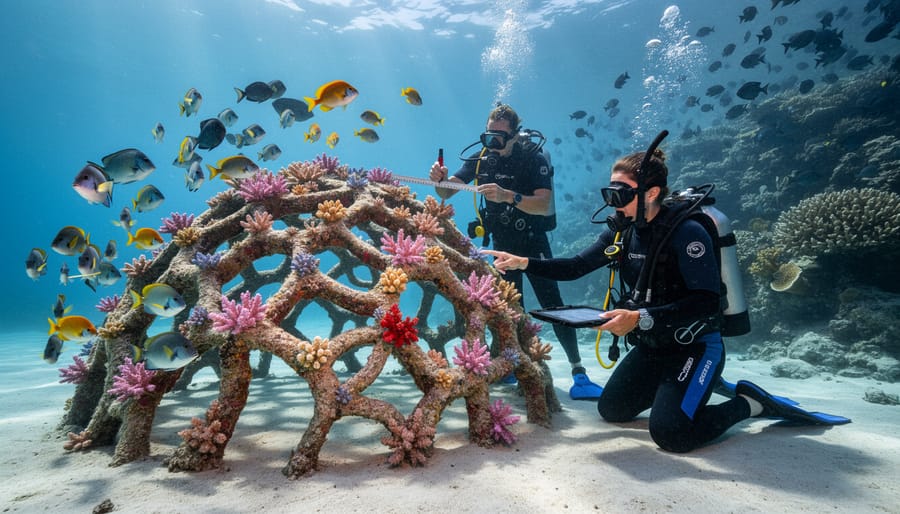
Modern underwater monitoring technology now allows scientists to track how these ecosystems develop and adapt, providing valuable data for future projects.
The best part? Community members can actively participate in creating these solutions. Volunteer opportunities include oyster shell collection, marsh grass planting events, and ongoing monitoring programs. Organizations like the Living Shoreline Stewardship Network coordinate regular community build days, where participants learn restoration techniques while directly contributing to coastal protection. These hands-on experiences transform abstract environmental concepts into tangible action, creating both ecological benefits and lasting connections between people and their coastal environments.
The Science Behind the Success
Nature has spent 3.8 billion years perfecting designs that withstand storms, resist predators, and adapt to changing conditions—a track record that far surpasses human engineering’s few centuries of experience. When scientists examine why bio-inspired structures outperform traditional engineered solutions in marine environments, they consistently discover three fundamental principles at work: redundancy, adaptability, and self-repair.
Redundancy in natural systems means that if one component fails, others can compensate. Coral reefs demonstrate this beautifully—when individual polyps die, neighboring colonies continue filtering water and providing habitat. Engineered breakwaters, by contrast, often fail catastrophically when a single section erodes. Dr. Maria Santos, a marine structural biologist, explains: “Traditional seawalls are designed with uniform materials that either stand or collapse entirely. Natural reefs have variable densities, multiple species, and interconnected structures that distribute stress across the entire system.”
Adaptability allows bio-inspired designs to respond to environmental changes rather than resist them rigidly. Living shorelines composed of oyster reefs and marsh grasses actually grow stronger during moderate storm events, as sediment accumulates and organisms reproduce. Meanwhile, concrete structures degrade with each wave impact. This dynamic flexibility proves essential as climate change brings unpredictable weather patterns.
Self-repair might be nature’s most valuable contribution. Oyster reefs recruit new larvae continuously, healing damage without human intervention. Scientists measure success through metrics like structural integrity over time, biodiversity indices, and sediment stabilization rates. Research teams often deploy AI-powered reef monitoring systems to track these variables continuously, revealing that bio-inspired structures maintain 70-90% functionality after storm events, compared to 40-60% for conventional alternatives.
These ecological principles translate into measurable benefits: reduced maintenance costs, enhanced ecosystem services, and genuine climate resilience. As one coastal engineer shared after witnessing a living breakwater survive a category-three hurricane intact: “We spent decades trying to outsmart the ocean. Turns out, we should have been learning from the organisms that already mastered it.”
How You Can Contribute to Bio-Inspired Marine Conservation
The exciting reality of bio-inspired marine conservation is that there are meaningful ways for everyone to participate, regardless of scientific background or experience level. Your involvement can directly advance these innovative solutions while deepening your connection to ocean ecosystems.
For those with scientific training, numerous research institutions actively seek collaborators for bio-inspired projects. Marine biologist Dr. Elena Rodriguez shares, “We regularly partner with citizen scientists to monitor artificial reef systems designed using coral biomimicry principles. Their observations about species colonization patterns have been invaluable to refining our designs.” Organizations like The Biomimicry Institute maintain databases of ongoing projects where researchers can contribute expertise in fields ranging from materials science to ecological modeling.
Students at all levels can engage through educational programs specifically focused on nature-based solutions. Many universities now offer biomimicry courses with marine conservation components, while high schools increasingly participate in design challenges that task students with developing bio-inspired solutions to local coastal issues. Summer internships with marine conservation organizations provide hands-on experience deploying and monitoring bio-inspired technologies like living shorelines or kelp-inspired wave energy dampeners.
The general public has equally important roles to play. Citizen science platforms such as iNaturalist and Reef Check allow anyone with a smartphone to document marine biodiversity, creating datasets that inform bio-inspired design. Volunteer beach cleanups often partner with organizations testing bio-inspired materials for marine debris collection. Even supporting ocean-friendly businesses that incorporate biomimicry principles—from sustainable aquaculture facilities using natural circulation patterns to shipping companies employing whale fin-inspired propeller designs—amplifies the impact of bio-inspired innovation.
Local aquariums and marine education centers frequently host workshops on biomimicry, offering accessible entry points for curious minds to explore how nature’s time-tested strategies can guide our conservation efforts forward.
The ocean has spent millions of years perfecting solutions to the very challenges we face today—from filtering pollutants to restoring damaged ecosystems. Bio-inspired design offers us a remarkable opportunity to learn from this ancient wisdom and apply it to protect the marine environments we depend upon. The coral-inspired reef structures, mangrove-mimicking coastal barriers, and kelp-based filtration systems we’ve explored demonstrate that nature provides blueprints for resilience, sustainability, and regeneration.
What makes this approach truly transformative is its accessibility. Researchers are uncovering new biomimetic applications daily, engineers are translating these discoveries into scalable solutions, and communities worldwide are implementing these innovations in their local waters. Dr. Sarah Chen, a marine biologist working on bio-inspired coastal protection, shares her perspective: “Every time I observe how seamlessly natural systems function, I’m reminded that we don’t need to reinvent the wheel. We need to be better students of the ocean.”
The path forward requires collective effort. Whether you’re a scientist conducting field research, an educator inspiring the next generation of conservationists, or a citizen volunteer monitoring your local coastline, you play a vital role in this movement. Consider joining beach restoration projects, participating in citizen science initiatives tracking marine biodiversity, or supporting organizations advancing biomimetic research.
The solutions exist within the very ecosystems we’re working to save. Now is the time to listen, learn, and act. Together, we can harness nature’s genius to secure a thriving ocean for generations to come.

jessica
Ava Singh is an environmental writer and marine sustainability advocate with a deep commitment to protecting the world's oceans and coastal communities. With a background in environmental policy and a passion for storytelling, Ava brings complex topics to life through clear, engaging content that educates and empowers readers. At the Marine Biodiversity & Sustainability Learning Center, Ava focuses on sharing impactful stories about community engagement, policy innovations, and conservation strategies. Her writing bridges the gap between science and the public, encouraging people to take part in preserving marine biodiversity. When she’s not writing, Ava collaborates with local initiatives to promote eco-conscious living and sustainable development, ensuring her work makes a difference both on the page and in the real world.