Marine Biodiversity Science Center

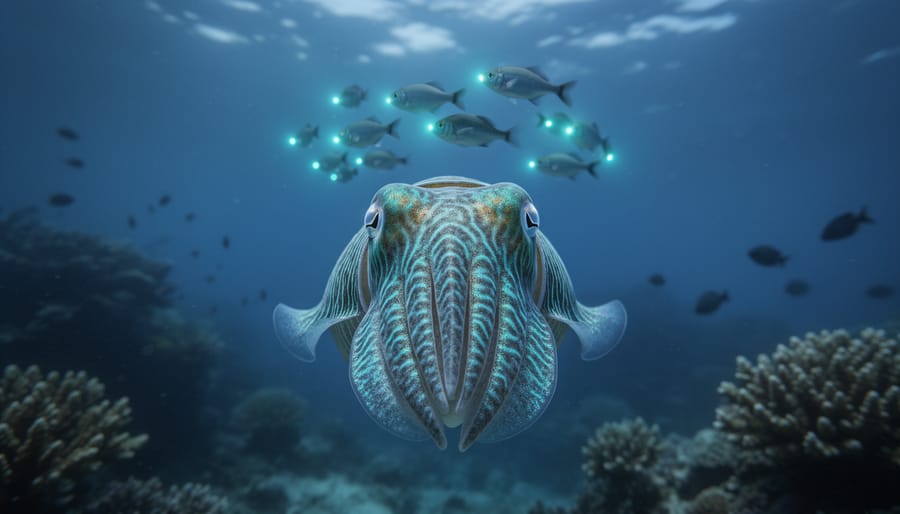
Beneath the ocean’s surface, every ripple of light tells a story. When a cuttlefish ripples waves of color across its skin in milliseconds, or a flashlight fish blinks its bioluminescent glow in precise patterns, these creatures are manipulating the fundamental physics of electromagnetic radiation to survive, attract mates, and warn competitors. Light and matter interaction—the process by which photons encounter atoms and molecules—forms the invisible foundation of marine communication, transforming fish scales into living mirrors and squid skin into dynamic canvases.
Understanding this phenomenon requires grasping three key principles: absorption, where matter captures photons and converts them to other forms of energy; reflection, where light bounces off surfaces at specific angles and wavelengths; and emission, where organisms generate their own light through chemical reactions. Marine animals have evolved extraordinary adaptations to control these interactions. Specialized cells called chromatophores expand and contract to reveal different pigments, while structural colors arise from nanoscale arrangements that bend light waves like underwater prisms.
Unlike chemical communication, which diffuses slowly through water, optical signals travel at 300,000 kilometers per second, enabling instant messaging across reef communities. This physics-based communication system has shaped marine ecosystems for millions of years, yet human activities now threaten these delicate light-dependent interactions through ocean warming, pollution, and artificial illumination. By exploring how photons and marine tissues interact, we unlock insights into both the spectacular diversity of ocean life and urgent conservation priorities.
The Physics Behind Ocean Light: How Water Changes Everything
Why Red Disappears and Blue Survives
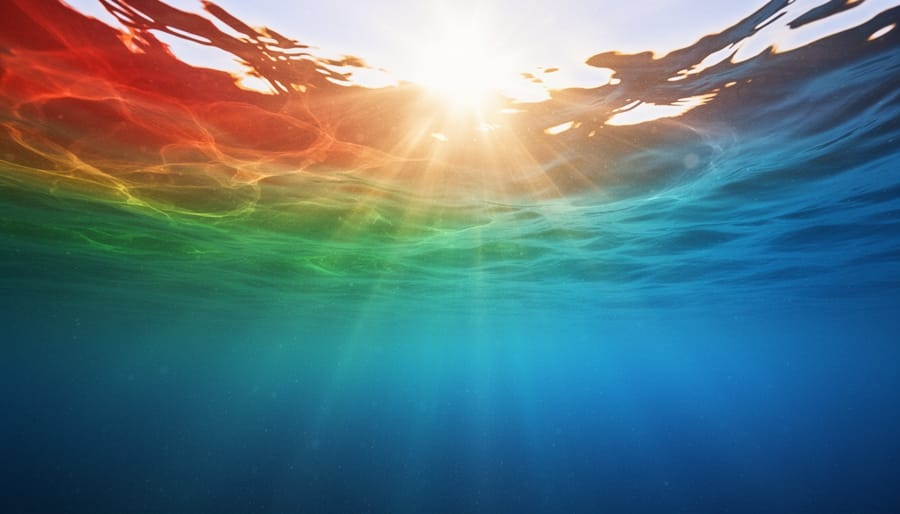
When sunlight penetrates the ocean surface, it embarks on a journey where different colors disappear at different depths, creating a fascinating underwater light show that profoundly shapes marine life. This selective absorption occurs because water molecules interact differently with various wavelengths of light.
Red light, with its longer wavelength, carries less energy and gets absorbed within the first 15 feet of water. This is why underwater photographers often find their images looking surprisingly blue-green, and why blood appears green at depth. Orange follows next, vanishing around 25 feet, then yellow at approximately 35 feet. Green light persists to about 75 feet, while blue light, with its shorter wavelength and higher energy, can penetrate to depths exceeding 600 feet in clear ocean waters.
This color-selective filtering has driven remarkable adaptations in marine species. Many deep-sea fish have lost their ability to see red altogether since it simply doesn’t exist in their world. Conversely, some predatory fish have evolved red coloration as natural camouflage, appearing black and invisible in the red-depleted depths. Dr. Sarah Chen, a marine biologist studying bioluminescence, shares: “We discovered that certain deep-sea shrimp use red bioluminescence to communicate secretly, invisible to most predators who cannot perceive red wavelengths.”
The dominance of blue light explains why so many shallow-water fish display brilliant blues and why coral reef communities appear bathed in azure hues. Understanding these light interactions helps conservationists protect critical habitats and reminds us how intimately marine life connects to its light environment.
The Twilight Zone: Where Light Becomes a Luxury
Between 200 and 1,000 meters below the ocean surface lies the mesopelagic zone, a realm where the physics of light create one of Earth’s most challenging environments. Here, sunlight penetrates with exponentially decreasing intensity, creating what marine biologists call the twilight zone. At these depths, the vibrant reds and oranges that color shallow reefs have already been absorbed by seawater, leaving only dim blue-green wavelengths that grow fainter with every meter of descent.
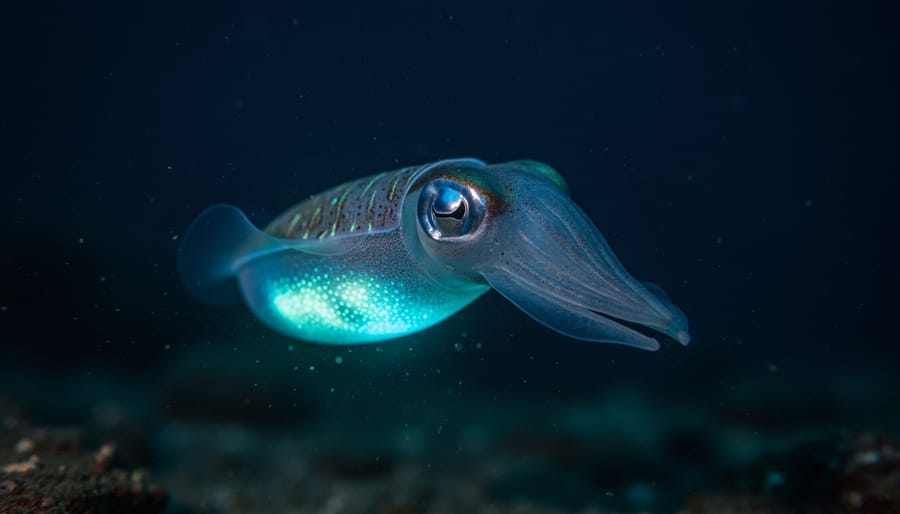
This dramatic reduction in natural light fundamentally transforms how life operates. In surface waters, animals rely on reflected sunlight to see and be seen. But as light becomes scarce, a remarkable adaptation emerges: bioluminescence. Rather than depending on the sun’s fading rays, twilight zone creatures evolved the ability to generate their own light through chemical reactions within specialized cells called photophores.
Dr. Sarah Chen, a marine biologist who has spent years studying mesopelagic ecosystems, describes this transition as nature’s most elegant solution to darkness. The shift from reflecting light to producing it represents a pivotal evolutionary milestone that enables complex social behaviors, predator-prey interactions, and communication in an environment where traditional vision would otherwise fail. Understanding this transition helps us appreciate how light and matter interaction shapes survival strategies throughout the ocean’s vertical frontier.
Nature’s Light Factory: How Marine Animals Create Their Own Glow
Bacterial Partnerships That Illuminate the Dark
In the ocean’s depths, some of nature’s most remarkable partnerships involve fish and luminous bacteria, creating living flashlights that illuminate the mysteries of deep-sea bioluminescence. These symbiotic relationships demonstrate how light-matter interaction extends beyond individual organisms to create cooperative survival strategies.
The flashlight fish carries specialized light organs beneath its eyes, housing colonies of Photobacterium bacteria. These bacterial partners produce a steady blue-green glow through a chemical reaction that converts energy into light. The fish controls this biological lantern with a movable shutter of dark tissue, flashing signals to communicate with potential mates or confuse predators. In return, the bacteria receive shelter and nutrients, creating a mutually beneficial arrangement perfected over millions of years.
Perhaps the most studied example is the Hawaiian bobtail squid and its partnership with Vibrio fischeri bacteria. Each evening, newly hatched squid must gather their luminous partners from surrounding seawater. The bacteria colonize a special light organ in the squid’s body, producing a glow that matches moonlight filtering through the water above. This phenomenon, called counterillumination, eliminates the squid’s shadow, making it invisible to predators hunting from below.
Marine biologist Dr. Margaret McFall-Ngai has spent decades studying this relationship, noting that understanding these partnerships could inspire new approaches to beneficial bacterial communities in other ecosystems, including human health. These glowing alliances remind us that survival often depends on cooperation rather than competition alone.
Conversations in Color: Structural Colors and Pigments Underwater
The Quick-Change Artists: Cephalopod Color Communication
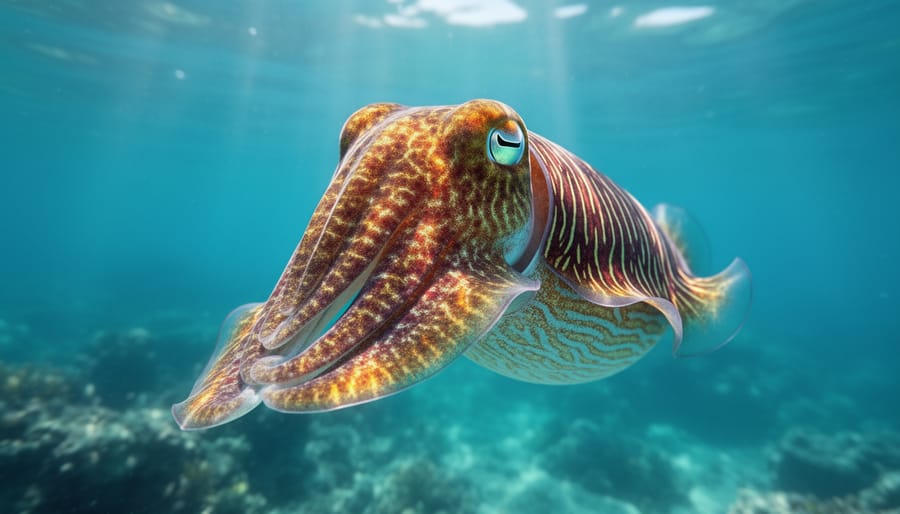
Cephalopods—squids, octopuses, and cuttlefish—are nature’s most sophisticated visual communicators, performing instant color transformations that would make any digital display envious. These remarkable creatures possess specialized skin cells called chromatophores, iridophores, and leucophores that work together as a living light-manipulation system. Understanding how these animals interact with light reveals fundamental principles of how matter can reflect, absorb, and scatter electromagnetic waves.
Chromatophores contain pigment sacs that expand or contract within milliseconds, controlled by tiny muscles connected directly to the animal’s nervous system. When expanded, these sacs display vivid reds, yellows, and browns. Beneath them, iridophores act as biological mirrors, containing stacks of reflective protein plates that manipulate light through constructive interference—the same physics that creates rainbow patterns in soap bubbles. By adjusting the spacing between these plates, cephalopods generate shimmering blues, greens, and even metallic silvers that shift with viewing angle.
This sophisticated system enables complex social signaling. Male cuttlefish create pulsating zebra stripes during courtship displays, while Caribbean reef squid flash rapid color waves across their bodies to establish dominance hierarchies. Perhaps most impressively, some species can split their display, showing aggressive patterns to a rival on one side while simultaneously presenting courtship colors to a potential mate on the other.
Marine biologist Dr. Sarah McAnulty, who studies bobtail squid communication, describes watching these animals as “observing a conversation in a language written in light itself.” Her research team has documented over thirty distinct color patterns used in social contexts.
These discoveries open opportunities for citizen scientists to contribute. Reef monitoring programs welcome volunteers to document cephalopod behavior patterns, helping researchers understand how environmental changes affect these visual communication systems and the broader marine ecosystems that depend on them.
Finding Love in the Dark: Bioluminescent Courtship Displays
In the midnight zone of the ocean, where sunlight never penetrates, finding a mate requires extraordinary adaptations. Marine species have evolved spectacular bioluminescent courtship displays that transform the dark depths into a luminous stage for romance.
Deep-sea anglerfish demonstrate one of nature’s most unusual mating strategies. Female anglerfish possess a modified dorsal spine called an esca that dangles above their mouths like a glowing lure. This bioluminescent organ doesn’t just attract prey; it serves as a beacon for males searching for mates in the vast darkness. The light comes from symbiotic bacteria living within the esca, creating a steady glow that can be seen from considerable distances in the deep ocean.
Marine ostracods, nicknamed sea fireflies, put on remarkable synchronized light shows during mating season. Males of certain Caribbean species release bioluminescent chemicals as they swim in precise spiral patterns, creating glowing trails that look like underwater fireworks. Each species has its own distinctive pattern and timing, ensuring females can identify suitable mates. Dr. Teresa Rivera, a marine biologist who has studied ostracod courtship for fifteen years, describes watching these displays as witnessing underwater constellations come to life. “The precision and beauty of their light patterns remind us how complex and sophisticated these tiny creatures truly are,” she shares.
Flashlight fish use specialized light organs beneath their eyes, filled with bioluminescent bacteria, to communicate during courtship. They can control these lights by rotating the organs or covering them with dark tissue, creating a blinking effect. Males flash specific patterns to signal their readiness to mate, while females respond with their own light sequences.
Understanding these behaviors helps researchers monitor population health and spawning success, critical information for conservation efforts. Volunteer programs now exist where citizen scientists can help document bioluminescent displays, contributing valuable data to ongoing research projects.
Safety Through Light: Warning Signals and Camouflage Strategies
In the vast expanses of the ocean, where predators lurk in every shadow, marine animals have evolved remarkable light-based defense mechanisms that blend physics with survival instincts. These strategies range from becoming invisible through clever light manipulation to broadcasting bold warnings that say “stay away.”
Counterillumination represents one of nature’s most ingenious invisibility cloaks. Many species living in the ocean’s twilight zone, including lanternfish and certain squid species, possess light-producing organs called photophores on their undersides. These organs emit a soft glow that precisely matches the downwelling sunlight from above. When predators look up from below, the prey’s silhouette effectively disappears against the bright surface waters. The physics here is elegant: by controlling the intensity and wavelength of their bioluminescent light, these animals essentially erase their shadow, making detection nearly impossible.
Marine biologist Dr. Sarah Chen describes her first encounter with counterillumination as transformative: “Watching a hatchetfish adjust its ventral lights in real-time, perfectly matching the changing light conditions above, made me realize how sophisticated these survival strategies truly are. It’s not just biology, it’s applied physics perfected over millions of years.”
On the opposite end of the spectrum, some marine creatures embrace visibility through aposematic coloration, using bright warning colors to advertise their toxicity or unpalatability. Nudibranchs, those flamboyant sea slugs, display electric blues, vivid oranges, and striking patterns that signal danger to potential predators. The pigments in their tissues interact with light wavelengths selectively, reflecting only certain colors while absorbing others, creating nature’s “do not eat” signs.
Understanding these defense mechanisms helps conservationists monitor ecosystem health and supports citizen science initiatives where volunteers can document color pattern changes in marine populations.
The Social Network: Group Coordination Through Visual Signals
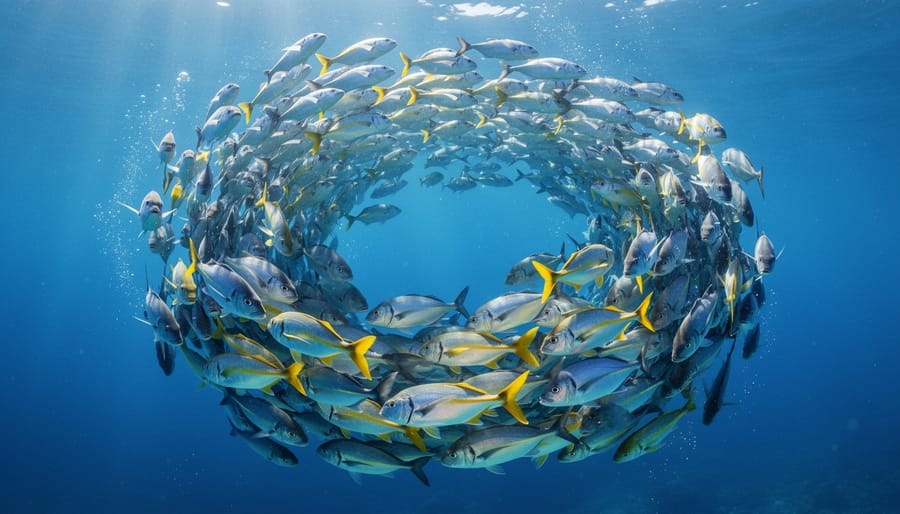
In the vast ocean, survival often depends on coordination. Schools of fish and other marine groups have evolved sophisticated visual communication systems that rival other sensory systems in their complexity and effectiveness. These animals use rapid color changes, reflective body patterns, and even synchronized light flashes to maintain group cohesion, execute coordinated hunting strategies, and respond collectively to threats.
Silversides and herring demonstrate remarkable visual coordination through their reflective scales. These mirror-like surfaces create flash expansion, a phenomenon where sudden movements by even a few individuals create cascading light patterns that ripple through the entire school within milliseconds. This allows thousands of fish to turn simultaneously, confusing predators and maintaining the protective geometry of the group.
Some squid species take coordination further through bioluminescent signaling. Caribbean reef squid use rapid chromatic displays to communicate hunting intentions, with specific color patterns indicating different behavioral states. During coordinated attacks on prey, these patterns help synchronize strikes without alerting their targets through sound or water disturbance.
Dr. Sarah Chen, a marine biologist studying schooling behavior, shares her observation: “Watching a school coordinate through light is like witnessing a silent conversation. Each flash, each color shift carries meaning that we’re only beginning to understand.”
Understanding these communication networks helps us appreciate the sophisticated social structures in marine ecosystems and reinforces why protecting these habitats matters for maintaining these intricate behavioral relationships.
When the Lights Go Out: Human Impact on Marine Light Communication
What We Can Do: Conservation Actions That Make a Difference
The future of marine bioluminescence and light-based communication depends on actions we take today. Fortunately, everyone can contribute to protecting these remarkable systems, regardless of scientific background.
The most immediate action is reducing light pollution in coastal areas. Participating in Dark Sky initiatives helps restore natural light cycles that countless marine species depend on. Simple steps like shielding outdoor lights, using motion sensors, and switching to amber-wavelength bulbs minimize disruption to marine ecosystems. Many coastal communities now offer training programs for citizens to conduct light pollution surveys, generating valuable data for conservation planning.
Supporting marine protected areas provides crucial refuge for bioluminescent species. Organizations like the Ocean Conservancy and local marine sanctuaries offer volunteer opportunities ranging from beach cleanups to citizen science programs. These efforts directly reduce pollutants that interfere with light production and detection in marine animals.
Dr. Elena Martinez, a marine biologist studying deep-sea bioluminescence, shares her perspective: “I’ve spent fifteen years documenting how dragonfish use red bioluminescence to hunt in the deep ocean. What keeps me hopeful is seeing more people engaged in protection efforts. Last year, volunteers helped us deploy recording equipment that captured never-before-seen light displays. Their enthusiasm reminded me that conservation isn’t just about scientists in labs—it’s about communities caring for their ocean.”
Research programs actively seek citizen scientists to help document bioluminescent events. Apps like iNaturalist allow anyone to report sightings of bioluminescent organisms, contributing to global databases that track population health and distribution changes.
Educational outreach represents another powerful tool. Sharing knowledge about how marine animals use light helps build public support for protective policies. Whether through school presentations, social media, or community events, your voice amplifies the importance of preserving these extraordinary communication systems for future generations.
The remarkable sophistication of marine light communication reveals an underwater world far more complex and interconnected than most people realize. From the quantum interactions between photons and specialized pigment molecules to the elaborate behavioral displays of cuttlefish and mantis shrimp, these phenomena demonstrate millions of years of evolutionary refinement. Understanding how light and matter interact in marine environments isn’t merely an academic exercise—it’s essential to protecting ocean health. When we recognize that communication systems this intricate exist throughout our oceans, we begin to appreciate why preserving water clarity, reducing light pollution, and protecting coral reef ecosystems matters so profoundly.
The Marine Biodiversity Science Center offers numerous opportunities to engage with these extraordinary natural phenomena. Whether you’re an educator seeking curriculum resources, a student passionate about marine biology, or simply someone who marvels at ocean wonders, our volunteer programs and citizen science initiatives welcome your participation. Marine biologist Dr. Elena Torres, who coordinates our bioluminescence monitoring project, often shares how volunteers have contributed to groundbreaking discoveries about deep-sea light communication patterns.
Every action to reduce ocean pollution, support marine protected areas, and advance conservation research helps preserve these living light shows for future generations. Together, we can ensure that the ocean’s brilliant conversations continue.

jessica
Ava Singh is an environmental writer and marine sustainability advocate with a deep commitment to protecting the world's oceans and coastal communities. With a background in environmental policy and a passion for storytelling, Ava brings complex topics to life through clear, engaging content that educates and empowers readers. At the Marine Biodiversity & Sustainability Learning Center, Ava focuses on sharing impactful stories about community engagement, policy innovations, and conservation strategies. Her writing bridges the gap between science and the public, encouraging people to take part in preserving marine biodiversity. When she’s not writing, Ava collaborates with local initiatives to promote eco-conscious living and sustainable development, ensuring her work makes a difference both on the page and in the real world.