Marine Biodiversity Science Center


When a cargo ship encounters a storm and the captain must jettison containers overboard to save the vessel, a 300-year-old maritime principle called general average springs into action. All parties with a financial stake in the voyage—ship owners, cargo owners, insurers—proportionally share the losses incurred to preserve the common venture. This ancient legal doctrine, rooted in the Rhodian Sea Law of 800 BC, remains embedded in virtually every modern marine insurance contract, distributing risk across an entire maritime community.
The same principle that protects commercial shipping interests could revolutionize how we fund marine conservation. Our oceans face a $700 billion annual funding gap for protection and restoration, while the maritime insurance industry processes over $30 billion in claims yearly. What if we adapted general average’s risk-sharing framework to create a conservation mechanism where all ocean users contribute proportionally to preserving the marine ecosystems that sustain their industries?
Marine biologist Dr. Sarah Chen, who spent fifteen years documenting coral reef degradation before transitioning to conservation finance, discovered this potential connection while researching maritime law. “General average proves that industries can collectivize risk and responsibility,” she explains. “The shipping sector already accepts that saving the whole sometimes requires individual sacrifice. Why not apply this thinking to the ocean itself?”
This approach isn’t merely theoretical. Emerging pilot programs in Caribbean waters are testing insurance-linked conservation bonds that function like general average pools, where tourism operators, fishing fleets, and shipping companies contribute to reef restoration funds. Understanding how general average works illuminates possibilities for transforming ocean protection from charitable afterthought into shared responsibility—a fundamental shift in how humanity values and protects the blue heart of our planet.
What is General Average? A Principle Born at Sea
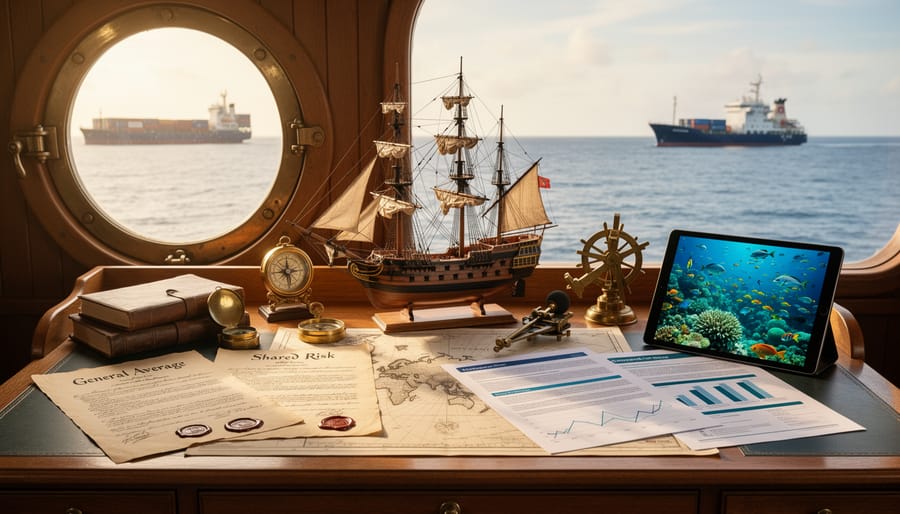
The Shared Burden Philosophy
At its heart, general average embodies a principle of shared responsibility that has sustained maritime commerce for millennia: when a ship faces danger and the captain makes a deliberate sacrifice to save the entire voyage, everyone with cargo or financial interest aboard shares the resulting loss proportionally.
Imagine a cargo vessel carrying containers of electronics, agricultural goods, and scientific research equipment destined for a marine research station. A severe storm strikes mid-ocean, and the ship begins listing dangerously. To prevent capsizing and save all lives and cargo aboard, the captain makes the difficult decision to jettison several containers overboard. This sacrifice stabilizes the vessel and saves the voyage.
Under general average, the cost of those lost containers doesn’t fall solely on their unfortunate owners. Instead, the financial burden is distributed among all cargo owners and the ship’s owners based on the saved value of their property. If your cargo represented 10 percent of the voyage’s total value, you contribute 10 percent toward compensating those whose containers were sacrificed for the collective good.
This centuries-old philosophy recognizes a profound truth: in maritime ventures, we’re all connected. One party’s loss in service of collective survival becomes everyone’s shared responsibility. The electronics importer, the agricultural exporter, and yes, even the marine research station receiving scientific equipment all contribute proportionally.
This principle of equitable burden-sharing offers a compelling framework that extends beyond commercial shipping, presenting intriguing possibilities for addressing shared environmental challenges facing our oceans today.
Modern Marine Insurance and General Average Today
Today, general average remains a foundational principle in maritime law, though its application has evolved with modern technology and global shipping practices. When a captain declares general average—such as jettisoning cargo during a storm or intentionally grounding a vessel to prevent sinking—a complex claims process begins. Independent adjusters calculate the total loss and determine each stakeholder’s proportional contribution based on the value of their saved property. Ship owners, cargo owners, and insurers all participate in this cost-sharing arrangement.
The declaration process now involves detailed documentation, satellite data, and forensic analysis to verify the emergency situation and assess damages. Marine insurers typically advance funds to cargo owners, then recover costs through the general average adjustment. This centuries-old mechanism demonstrates how shared financial responsibility can protect collective interests—a principle increasingly relevant to environmental challenges.
Just as shipping stakeholders pool resources to address maritime emergencies, the conservation community explores innovative funding models like marine conservation insurance to protect ocean ecosystems. Understanding these maritime financial frameworks offers valuable insights for developing collaborative approaches to marine protection, where multiple parties contribute to safeguarding our shared oceanic heritage.
The Conservation Crisis: Why Traditional Funding Falls Short
Our oceans face an unprecedented crisis. Coral reefs are bleaching at alarming rates, fish populations are collapsing, and marine ecosystems that support millions of species hang in the balance. Yet despite the urgency, marine conservation efforts remain chronically underfunded, struggling to secure the resources needed for meaningful, lasting impact.
Traditional funding sources have proven insufficient to meet the scale of the challenge. Government budgets fluctuate with political priorities and economic pressures, often leaving conservation programs vulnerable to sudden cuts. Dr. Maria Santos, a marine biologist who has spent two decades studying Pacific reef systems, shares a common frustration: “We’ve seen promising research projects halted mid-stream because grant funding dried up. You can’t protect an ecosystem in two-year increments.”
Grants and donations, while valuable, create a feast-or-famine cycle that makes long-term planning nearly impossible. Conservation organizations spend enormous resources competing for limited funds, diverting energy from actual fieldwork. Many rely on annual fundraising campaigns that, even when successful, barely cover operational costs, let alone ambitious restoration projects or continuous monitoring programs.
The gap between available funding and conservation needs grows wider each year. The United Nations estimates that protecting 30 percent of our oceans by 2030 requires investments far exceeding current commitments. Meanwhile, marine protected areas lack enforcement resources, research stations operate with outdated equipment, and critical habitat restoration projects remain on indefinite hold.
This reality demands a fundamental shift in approach. Rather than depending solely on charitable goodwill or political winds, marine conservation needs innovative funding mechanisms that generate consistent, predictable revenue streams. The solution may lie in unexpected places, including principles borrowed from maritime commerce that have ensured shared responsibility for protecting valuable assets for centuries.
Reimagining General Average for Ocean Conservation
Recognizing the Ocean as Shared Infrastructure
The ocean functions as Earth’s largest shared infrastructure—a global commons that supports every maritime enterprise, from shipping and fishing to tourism and resource extraction. Just as a cargo ship and all its freight share a common fate during a voyage, all industries and communities depend on healthy, functioning oceans for their survival and prosperity.
When we consider the ocean through this lens, a compelling parallel emerges with the maritime insurance principle we’re exploring. In general average, all parties benefit from saving the ship, so all parties contribute to emergency costs. Similarly, countless industries extract immense value from ecosystem services the ocean provides: climate regulation through carbon absorption, protein for billions of people, pharmaceutical compounds, coastal storm protection, and trade routes connecting continents.
The shipping industry alone moves over 80 percent of global trade across ocean waters. Fishing industries harvest approximately 90 million tons of seafood annually. Coastal tourism generates hundreds of billions in revenue. Yet these industries contribute minimally to maintaining the ocean ecosystems that make their operations possible.
Dr. Sarah Chen, a marine economist I spoke with recently, explained it beautifully: “We’re all passengers on the same vessel—our ocean planet. When coral reefs collapse or fish stocks crash, everyone loses. The shipping company loses reliable routes through healthy waters, fisheries lose their foundation, and coastal communities lose their protection.” This shared dependency creates both responsibility and opportunity for collective action.
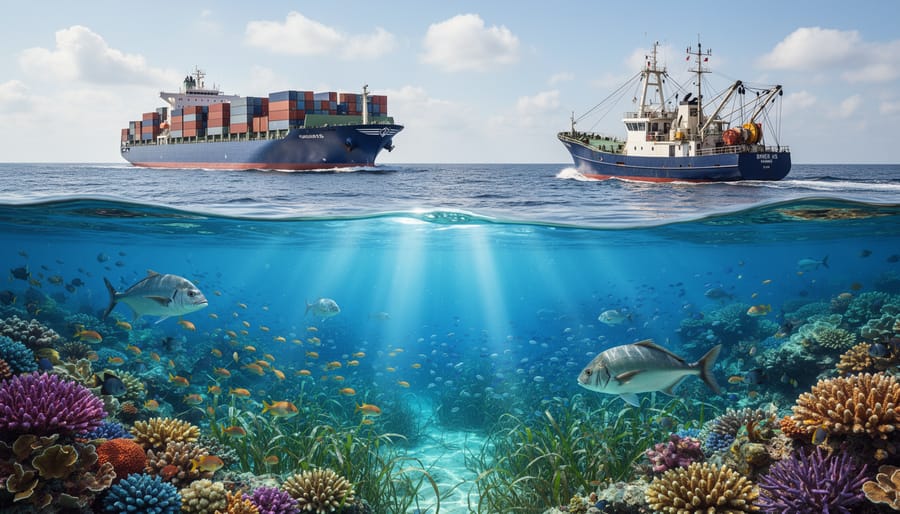
Creating a Conservation General Average Framework
Imagine a framework where those who profit from ocean resources collectively protect the marine environment they depend upon. A Conservation General Average system could revolutionize how we fund urgent environmental action by distributing costs across industries that share the ocean commons.
The contributing parties would include commercial shipping companies, industrial fishing operations, offshore oil and gas platforms, aquaculture facilities, and marine tourism operators. Each would contribute proportionally based on their ocean resource use and environmental impact footprint. Think of it as a shared responsibility insurance pool, where participants recognize that a healthy ocean ecosystem directly benefits their long-term operations.
Contribution triggers would activate when specific thresholds are reached: major marine pollution events requiring immediate cleanup, critical habitat degradation threatening biodiversity hotspots, endangered species population crashes, or climate-related emergencies like coral bleaching events. These triggers would be scientifically verified by independent marine research institutions to ensure legitimacy and prevent misuse.
Fund distribution would follow transparent protocols overseen by an international governing body comprising marine scientists, conservation organizations, and industry representatives. Money would flow to verified projects addressing the triggering emergency, whether that means deploying rapid-response cleanup teams, funding habitat restoration initiatives, or supporting breeding programs for threatened species.
Dr. Maria Santos, a marine biologist who has witnessed funding gaps firsthand, shares: “During the 2019 Mediterranean oil spill, we had the expertise and volunteers ready to help, but securing emergency funding took weeks. A pre-established conservation fund could have saved countless marine lives.”
This framework transforms ocean protection from voluntary charity into shared obligation, recognizing that collective survival depends on collective action. The system creates predictable funding streams while ensuring that those benefiting most from marine resources contribute most to their preservation.
Legal and Practical Considerations
Implementing a general average-inspired conservation funding system presents complex challenges that require collaborative solutions. International maritime law has developed over centuries, creating established frameworks through treaties like the York-Antwerp Rules. Adapting this proven system for conservation would require similar international agreements among governments, shipping companies, and conservation organizations.
The primary hurdle involves enforcement across different jurisdictions. Unlike traditional general average cases handled through maritime courts, conservation contributions would need transparent monitoring systems to track vessel impacts and verify payments. Blockchain technology and satellite monitoring could provide solutions, as demonstrated by pilot programs tracking illegal fishing activities.
Integration with existing maritime frameworks offers promising pathways. The International Maritime Organization already regulates environmental standards, providing a foundation for expanded conservation mechanisms. Marine biologist Dr. Sarah Chen notes that voluntary industry participation has shown success in regional programs, suggesting gradual adoption could build momentum for broader implementation.
Legal experts emphasize that starting with regional agreements in biodiversity hotspots allows testing and refinement before global expansion. This practical approach mirrors how maritime insurance practices evolved, building trust through demonstrated benefits to all stakeholders while protecting our shared ocean resources.
Real-World Applications: Where Insurance Meets Conservation
The concept of insurance protecting natural ecosystems might sound futuristic, but it’s already happening in waters around the world, with remarkable results that demonstrate how financial mechanisms can safeguard marine life.
In Quintana Roo, Mexico, a groundbreaking coral reef insurance policy made headlines in 2019 when it became the first of its kind to protect a natural ecosystem. The Mesoamerican Reef, stretching along Mexico’s Caribbean coast, faces constant threats from hurricanes and tropical storms. Recognizing that healthy reefs protect coastal communities by absorbing up to 97% of wave energy, local governments partnered with The Nature Conservancy and insurance providers to create a parametric insurance policy. When Hurricane Delta struck in 2020, the policy triggered an automatic payout of $800,000 within weeks, funding immediate reef restoration work. Divers quickly stabilized coral fragments and cleared debris, preventing further damage. Marine biologist Dr. Ana Giró, who participated in the emergency response, describes the experience as transformative: “We weren’t waiting for bureaucratic approvals or funding applications. We had trained brigades ready to deploy the moment the storm passed. That speed made all the difference in saving coral colonies.”
The Hawaii Coral Reef Insurance pilot program, launched in 2023, takes a similar approach but includes community education components. Local volunteers receive training in reef monitoring and emergency response, creating a network of ocean stewards ready to act when insurance payouts enable restoration work. This model demonstrates how insurance mechanisms can fund both immediate crisis response and long-term conservation capacity building.
In the Mediterranean, parametric insurance now protects several marine protected areas along the Spanish coast. When water temperatures exceed critical thresholds that trigger coral bleaching or mass mortality events, automatic payouts fund emergency interventions like shading structures or assisted coral migration to cooler waters. These public-private partnerships blend scientific monitoring with financial innovation, creating safety nets for vulnerable ecosystems.
The success of these programs lies in their predictability and speed. Unlike traditional conservation funding that requires lengthy grant applications, parametric insurance provides guaranteed resources when ecosystems need help most. Early results show restored reefs recovering 30-40% faster when insurance enables immediate intervention compared to areas where funding delays occurred.
These examples prove that insurance-based conservation isn’t theoretical—it’s a practical, scalable solution already protecting thousands of marine species and the communities that depend on healthy oceans.

The Ripple Effect: Benefits Beyond Funding
While the direct funding potential of marine insurance mechanisms is compelling, the ripple effects extend far beyond immediate financial resources. These frameworks introduce something equally valuable to marine conservation: systematic accountability and quantifiable risk assessment.
Insurance companies excel at one thing—calculating risk. When ecosystem services enter this equation, suddenly coral reefs aren’t just beautiful habitats; they’re storm surge protectors worth billions in coastal defense. Mangrove forests become quantified as natural water filtration systems. This financial valuation doesn’t diminish their intrinsic worth but creates a language that resonates in boardrooms and policy meetings where conservation decisions are made.
Dr. Maria Chen, a marine economist who has worked with conservation organizations for fifteen years, shares an observation: “Once we attached dollar values to the coastal protection services of a reef system, three major shipping companies voluntarily rerouted vessels to avoid potential damage. They recognized their own financial interest in preservation.”
This shift transforms corporate relationships with marine environments. Companies traditionally viewed as potential threats become stakeholders in protection. Insurance premiums can reward responsible environmental practices, creating direct financial incentives for pollution reduction and habitat preservation. Organizations that demonstrate strong environmental stewardship might qualify for lower rates, while those with poor track records face higher costs.
The accountability factor proves equally significant. Insurance mechanisms require monitoring, reporting, and verification—building the data infrastructure that conservation desperately needs. This documentation helps scientists track ecosystem health over time, identify emerging threats earlier, and make evidence-based management decisions.
For volunteers and citizen scientists, this creates meaningful opportunities to contribute to data collection efforts that directly influence financial protection for marine areas they care about, connecting individual action to systemic change.
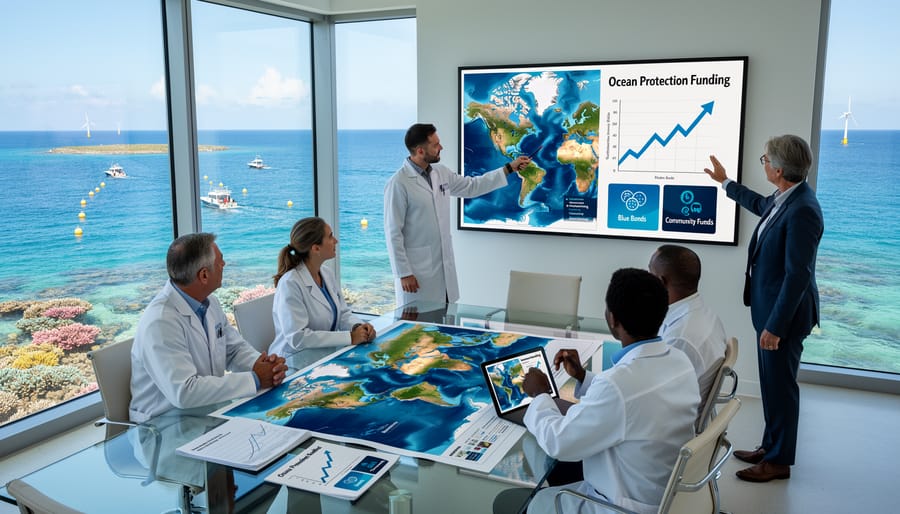
Voices from the Field: Marine Biologists Weigh In
Dr. Elena Morales still remembers the moment her coral restoration project nearly collapsed. After three years of painstaking work rebuilding reef structures off the Dominican Republic coast, a severe hurricane destroyed 60% of their progress. “We had no financial safety net,” she recalls. “Traditional grants don’t account for natural disasters. We scrambled for emergency funding while watching years of work wash away.”
This experience led Elena to explore alternative funding models, including risk-sharing mechanisms similar to maritime insurance principles. “The idea that stakeholders could collectively shoulder unexpected losses—much like general average in shipping—completely changed my perspective on conservation funding,” she explains. Today, she advocates for pilot programs where multiple organizations contribute to shared emergency funds that activate when climate events threaten marine restoration projects.
Dr. James Chen, who monitors sea turtle populations across the Pacific, shares similar frustrations with conventional funding. “Conservation operates project-by-project, grant-by-grant. There’s no continuity when disaster strikes,” he notes. James envisions insurance-based models where commercial fishing operations, tourism companies, and conservation groups pool resources. “These industries benefit directly from healthy marine ecosystems. Why shouldn’t they share responsibility when those ecosystems face extraordinary threats?”
Marine biologist Sarah Okafor brings a different perspective from her work in West African mangrove forests. “Small coastal communities are already practicing informal risk-sharing,” she observes. “When storms damage mangroves that protect villages, everyone contributes to replanting efforts. We’re simply proposing to formalize and scale these community practices using proven insurance principles.”
What unites these scientists is their optimism. They see insurance-based conservation funding not as replacing traditional grants, but as complementing them—creating resilient financial frameworks that protect both marine ecosystems and the communities depending on them. “We need systems as adaptive as the oceans themselves,” Elena emphasizes.
How You Can Make Waves: Taking Action
The future of marine conservation financing depends on collective action, and there are meaningful ways you can contribute regardless of your background or available time commitment.
If you’re ready to dive in hands-on, the Marine Biodiversity Science Center welcomes volunteers for data collection, public outreach programs, and citizen science initiatives. Marine biologist Dr. Elena Rodriguez shares that “some of our most innovative conservation solutions have emerged from conversations with volunteers who bring fresh perspectives from other industries.” Whether you’re dedicating a few hours monthly or seeking a more sustained engagement, these opportunities connect you directly with conservation research while building skills in marine ecology.
For those interested in advocacy, supporting policies that recognize ocean ecosystems as shared resources requiring collective protection is essential. Contact your representatives to express support for innovative conservation financing mechanisms and increased funding for marine protected areas. Share information about conservation finance approaches with your networks, translating complex concepts into conversations that inspire others to care.
Education is power in this movement. Explore online courses in marine conservation finance, attend webinars hosted by ocean policy organizations, and follow research publications examining ecosystem valuation. Understanding the economic dimensions of conservation strengthens your ability to advocate effectively.
Join our e-network to receive updates on emerging conservation financing models, success stories from marine protected areas worldwide, and opportunities to participate in policy consultations. Network members gain early access to educational resources and can connect with professionals working at the intersection of finance, law, and marine science.
Every action creates ripples. By engaging with these opportunities, you’re contributing to a growing movement that recognizes our oceans as shared treasures worth protecting through innovative, collaborative approaches. Start where you are, use what you have, and be part of the solution.
The centuries-old principle of general average demonstrates something powerful: when communities share risks and responsibilities, they can overcome extraordinary challenges together. This same spirit of collective action holds remarkable promise for marine conservation. By adapting proven financial mechanisms from maritime insurance, we can create sustainable, equitable funding streams that protect our oceans for generations to come.
The beauty of applying general average concepts to conservation lies in their practicality. These aren’t untested theories—they’re frameworks with centuries of success behind them. When paired with innovative approaches like blue bonds, marine insurance pools, and shared responsibility agreements, they offer real solutions to the conservation funding gap that has long plagued ocean protection efforts.
Yet financial mechanisms alone cannot save our seas. They work only when powered by collective will and action. Every individual has a role to play in this movement. Whether you’re a marine biologist documenting species recovery, an educator inspiring the next generation of ocean stewards, a policy advocate pushing for stronger protections, or simply someone who chooses sustainable seafood and supports conservation organizations—your contribution matters.
The ocean has sustained humanity since our beginning. Now it’s asking us to return the favor. By embracing collaborative approaches and innovative funding solutions, we can ensure thriving marine ecosystems become our shared legacy. The question isn’t whether we can afford to protect our oceans—it’s whether we can afford not to. Start today. Our blue planet is counting on us.

jessica
Ava Singh is an environmental writer and marine sustainability advocate with a deep commitment to protecting the world's oceans and coastal communities. With a background in environmental policy and a passion for storytelling, Ava brings complex topics to life through clear, engaging content that educates and empowers readers. At the Marine Biodiversity & Sustainability Learning Center, Ava focuses on sharing impactful stories about community engagement, policy innovations, and conservation strategies. Her writing bridges the gap between science and the public, encouraging people to take part in preserving marine biodiversity. When she’s not writing, Ava collaborates with local initiatives to promote eco-conscious living and sustainable development, ensuring her work makes a difference both on the page and in the real world.