Marine Biodiversity Science Center

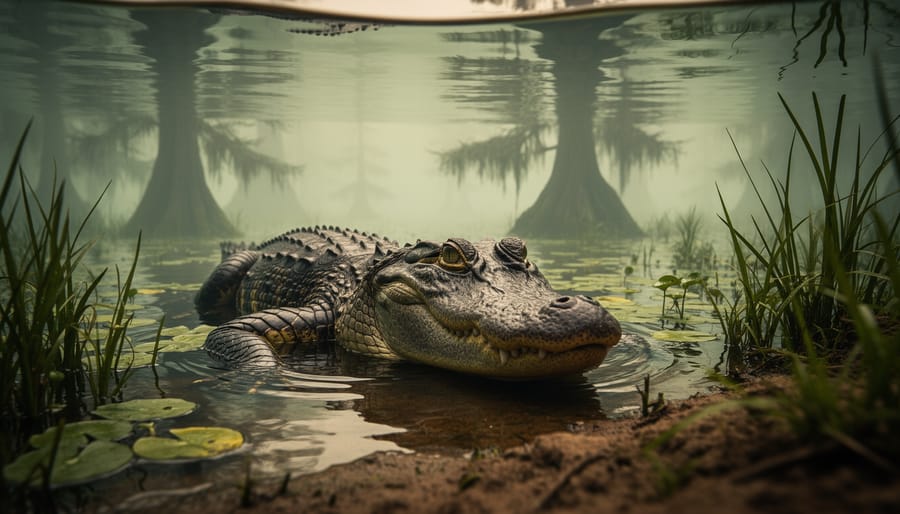
The American alligator range spans across the southeastern United States, from North Carolina south through Florida and west to eastern Texas, covering roughly 10 states where freshwater wetlands, swamps, and coastal marshes provide suitable habitat. This distribution is primarily limited by temperature, as alligators cannot survive prolonged freezing conditions that extend below the waterline.
The current range represents a remarkable conservation success story. Once hunted nearly to extinction by the mid-20th century, American alligators now thrive across approximately 120,000 square miles of wetland ecosystems, with the highest concentrations in Florida and Louisiana. These two states alone support millions of individuals, a testament to habitat protection efforts and science-based wildlife management.
Understanding where alligators live isn’t just about marking dots on a map. Their range tells us about the health of our coastal and freshwater ecosystems. Alligators are apex predators and ecosystem engineers, creating “gator holes” that provide critical dry-season refuges for fish, turtles, and wading birds. Where you find thriving alligator populations, you typically find robust wetland systems.
For anyone working in wetland conservation, studying herpetology, or simply curious about these ancient reptiles, knowing their geographic boundaries helps frame broader discussions about habitat connectivity, climate adaptation, and the future of southeastern waterways as conditions shift in the coming decades.
Geographic Distribution: Where American Alligators Are Found Today
Core Range vs. Peripheral Populations
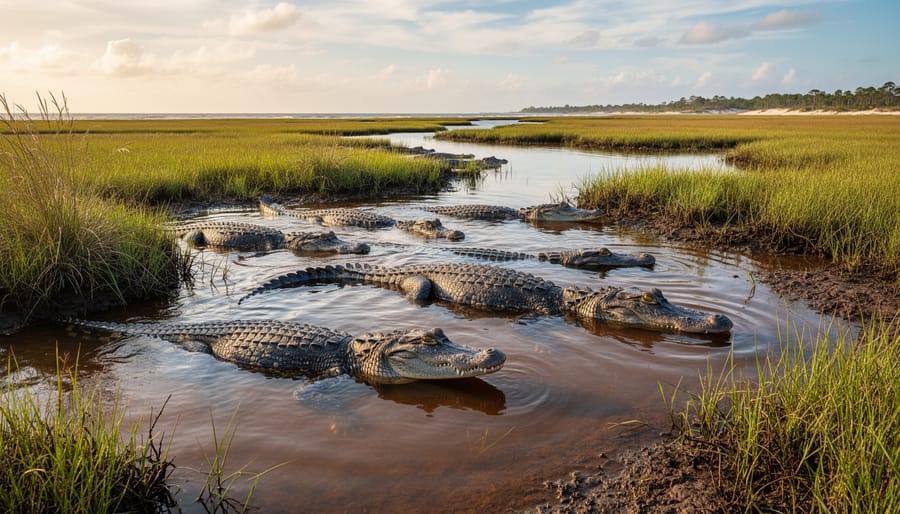
American alligators thrive in three core states where environmental conditions align perfectly with their biological needs: Louisiana, Florida, and Georgia. These states harbor dense, self-sustaining populations that have rebounded robustly since federal protection began. Louisiana alone supports an estimated 2 million alligators, concentrated in the coastal marshes and swamp systems of the Atchafalaya Basin and the wetlands surrounding Lake Pontchartrain. Florida holds similar numbers, with alligators occupying every county and inhabiting everything from the Everglades to suburban retention ponds. Georgia’s coastal plain and river systems, particularly around the Okefenokee Swamp, provide equally suitable habitat. In these core areas, alligators encounter mild winters, abundant food, extensive wetlands, and minimal temperature stress.
Beyond this stronghold, peripheral populations cling to the edges of the species’ range in North Carolina, South Carolina, Alabama, Mississippi, Arkansas, Oklahoma, and Texas. These outlying groups face harsher winters, less predictable water levels, and habitat patches that are smaller and more isolated. Population densities drop significantly. North Carolina’s alligators, for instance, rarely venture far inland and concentrate near the coastal sounds where temperatures stay moderate. Texas populations thin out west of Houston as conditions become drier and less hospitable. Peripheral alligators often experience higher winter mortality, slower growth rates, and lower reproductive success. They represent the biological frontier where the species tests its environmental limits.
Habitat Preferences That Shape Their Range
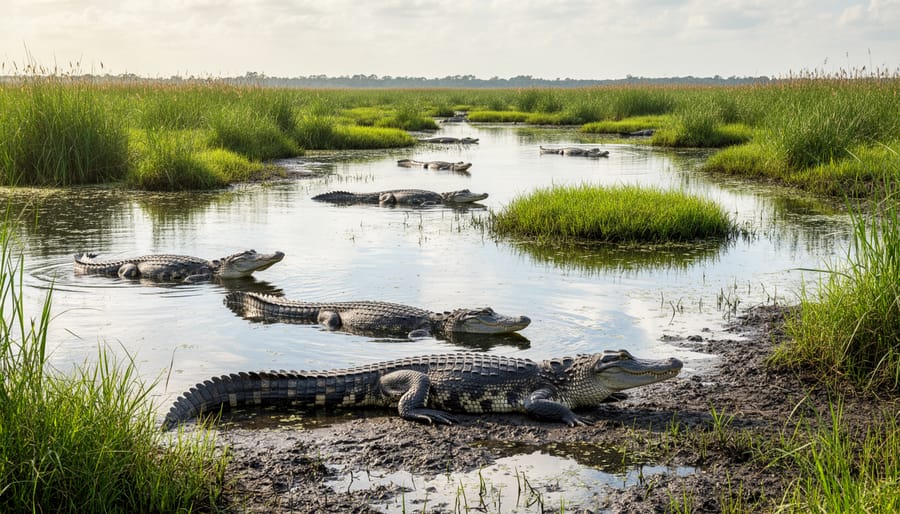
American alligators thrive in environments that meet a precise set of ecological requirements, and the availability of suitable habitat directly determines where populations can survive and reproduce. These reptiles primarily occupy freshwater wetlands, swamps, marshes, slow-moving rivers, lakes, ponds, and bayous, though they tolerate brackish conditions in coastal areas where freshwater mixes with saltwater. The key factor is access to relatively still or gently flowing water with abundant vegetation. In North Carolina, for example, alligators inhabit bay lakes, rivers and associated wetlands that provide these conditions year-round.
Water temperature plays a critical role in habitat suitability. Alligators need warm water to maintain body temperature and metabolic function, which explains why they concentrate in shallow wetlands that heat quickly in the sun. Dense stands of aquatic plants, emergent grasses, water lilies, cattails, provide essential cover for hunting, protection from disturbance, and cooler refuges during extreme heat. These vegetated areas support the fish, amphibians, turtles, and waterfowl that form the alligator’s diet.
Nesting habitat is equally crucial. Females require soft, elevated banks or vegetated mounds where they can excavate nests and deposit eggs above the waterline. The nest site must maintain consistent warmth and humidity throughout the 65-day incubation period, conditions best met in dense wetland vegetation. Without suitable nesting substrates, typically found in marshes with thick reed beds or forested swamps with leaf litter, populations cannot reproduce successfully.
This explains why alligators are absent from fast-moving mountain streams, deep open lakes without vegetation, or heavily channelized waterways. Their wetland ecosystem role as apex predator and habitat engineer depends entirely on these specific environmental features. As urbanization drains wetlands and fragments remaining habitat, the quality and connectivity of these ecosystems become the primary factors controlling alligator distribution across the Southeast.
Climate and Temperature: The Northern Boundary
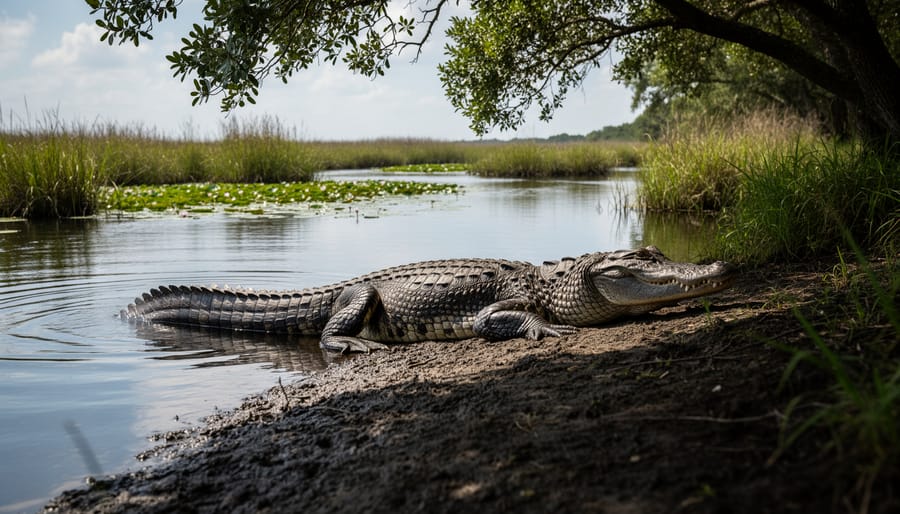
The American alligator’s northern range boundary follows a clear climatic line, defined primarily by winter temperatures that dictate where these reptiles can survive year-round. As ectothermic animals, alligators depend entirely on external heat sources to regulate their body temperature. They cannot generate their own warmth like mammals, making them vulnerable to extended cold periods.
The northern limit of their range typically corresponds to areas where average January temperatures remain above 40°F and where hard freezes are brief and infrequent. North Carolina represents the northeastern edge of this distribution, while southern Oklahoma and Arkansas mark the northwestern boundary. Below these latitudes, winter cold becomes too severe and prolonged for alligators to endure. While these reptiles have evolved remarkable survival secrets for tolerating brief cold snaps, such as entering a state of brumation or allowing their snouts to freeze into ice while maintaining an air hole for breathing, they cannot withstand weeks of subfreezing temperatures.
Freeze events present the most critical threat. During prolonged freezes, alligators may suffer frostbite, become unable to feed for extended periods, or experience lethal drops in core body temperature. Juvenile alligators are particularly vulnerable, as their smaller body mass offers less thermal protection.
Recent observations suggest warming climate trends may be enabling gradual northward range expansion. Wildlife biologists have documented increased alligator sightings and breeding activity at the northern edges of their traditional range, particularly in coastal North Carolina and Arkansas. These shifts remain modest as of 2026, but researchers continue monitoring populations to understand how changing temperature patterns might reshape distribution over coming decades.
Historical Range and Population Recovery
Before the 20th century, American alligators thrived throughout the southeastern United States in numbers that dwarfed today’s populations. Historical records and early naturalist accounts describe alligators as abundant in virtually every suitable wetland from the Carolinas to Texas, with populations extending further north along river systems during warmer climate periods. These apex predators occupied an ecological niche largely unchanged for millions of years.
That abundance collapsed dramatically between the 1800s and mid-1900s. Commercial hunting for valuable hides devastated alligator populations across their entire range. Hunters targeted the largest individuals first, removing breeding adults at unsustainable rates. A single hide could fetch significant money, driving a harvest that killed millions of alligators. By the 1950s, the species faced potential extinction in many states. Compounding the hunting pressure, wetland drainage for agriculture and urban development eliminated vast stretches of prime habitat, particularly in Louisiana, Florida, and coastal areas throughout the Southeast.
The turning point came in 1967 when the alligator received federal protection as an endangered species, formalized under the Endangered Species Act in 1973. State wildlife agencies implemented strict harvest bans, habitat protections, and captive breeding programs. The response was swift and remarkable. Alligator populations rebounded at rates that surprised even conservation biologists. Protected from hunting and with core wetlands preserved, breeding populations recovered first in Louisiana and Florida, then spread into peripheral areas.
By 1987, the U.S. Fish and Wildlife Service declared the American alligator fully recovered, downlisting it to “threatened due to similarity of appearance” to protect the critically endangered Chinese alligator. Today, populations have not only recovered but expanded into some previously occupied territories as suitable habitat remains available. Louisiana now supports over two million alligators, and Florida’s population exceeds 1.3 million. This recovery stands as one of conservation’s most successful interventions, demonstrating how targeted protections can reverse even severe population declines.
Human Impact on Range and Distribution
Human activities have dramatically reshaped where American alligators live today. Wetland drainage for agriculture and development has eliminated millions of acres of prime alligator habitat since the mid-1800s, particularly in Louisiana’s coastal plain and Florida’s interior wetlands. When developers fill marshes for housing subdivisions or shopping centers, they erase not just current alligator territory but potential expansion areas for recovering populations. Salt marsh loss along the Gulf Coast similarly removes brackish habitats that alligators use, especially for nesting and juvenile rearing.
Coastal development fragments what remains. A population that once moved freely through connected wetlands now faces highways, canals, and urban sprawl that isolate groups from each other. These barriers reduce genetic diversity and make local extinctions more likely when drought or disease strikes. Water pollution from agricultural runoff, industrial discharge, and urban stormwater degrades habitat quality even where wetlands physically survive, affecting prey populations and nesting success.
Yet alligators have proven remarkably adaptable to human-altered landscapes. Golf course ponds, suburban retention basins, and residential canal systems across Florida now host thriving populations. Some animals have learned to exploit these artificial habitats, which provide open water and often abundant prey like non-native fish. A golf course in Charleston or a planned community outside Houston can support multiple adult alligators if the water body is large enough and relatively undisturbed.
This adaptation creates new conflicts. Alligators in suburban retention ponds alarm residents unfamiliar with living near large predators. Dogs, children playing near water edges, and evening joggers on pond-side paths occasionally encounter animals that view the space as their territory. Wildlife managers in Florida and other states now handle thousands of nuisance alligator calls annually, often relocating or removing animals from neighborhoods where human safety concerns outweigh conservation priorities.
Current Conservation Status and Range Monitoring
The American alligator stands as one of the most successful conservation stories in U.S. history. Listed as endangered under the Endangered Species Act in 1967 and again when the act was strengthened in 1973, populations have recovered so dramatically that the species was reclassified to “threatened due to similarity of appearance” in 1987. This designation, which helps prevent confusion with the critically endangered American crocodile and aids enforcement against illegal trade, remains in place as of 2026. Despite this recovery, alligators are far from forgotten by conservationists. State wildlife agencies across the southeastern United States continue intensive monitoring programs to track population trends, reproductive success, and habitat quality.
These monitoring efforts rely on a combination of professional research and community engagement. Louisiana Department of Wildlife and Fisheries conducts annual nest surveys and population assessments, while Florida Fish and Wildlife Conservation Commission uses spotlight counts, aerial surveys, and public sighting reports to estimate numbers and track range expansion. Researchers employ satellite telemetry, genetic analysis, and water quality assessments to understand how alligator populations respond to environmental changes, including rising temperatures and coastal development pressures.
Citizen science has become vital to range monitoring efforts. Platforms like iNaturalist and state-specific reporting systems allow residents to document alligator sightings, helping scientists map distribution changes in real time. Educational programs engage volunteers in understanding the ecological differences between species such as alligators vs. crocodiles proper identification techniques, and safe coexistence practices. These collaborative approaches ensure that conservation gains continue and that the public remains informed stewards of freshwater ecosystems.
Frequently Asked Questions About Alligator Range
Can American alligators live in saltwater?
American alligators are primarily freshwater animals but can tolerate brackish water for limited periods. They lack salt glands, unlike crocodiles, so extended exposure to saltwater causes dehydration and stress. You’ll occasionally find them in coastal marshes, estuaries, and mangrove swamps where fresh and salt water mix, but they always need access to freshwater for drinking and long-term survival.
Are alligators moving north as the climate warms?
There’s emerging evidence that warmer winter temperatures may allow alligators to survive in areas slightly north of their historical range. Wildlife biologists have documented occasional sightings in coastal Virginia and Arkansas in recent years, though established breeding populations remain confined to the traditional southeastern range. Sustained cold snaps still limit their northern expansion.
Which states have the largest alligator populations?
Louisiana and Florida dominate, with Louisiana hosting an estimated 2 million alligators and Florida close behind with 1.3 million. These two states contain the vast majority of the species’ total population due to extensive suitable wetland habitat and successful conservation programs.
Do alligators live anywhere outside the United States?
The American alligator’s natural range is restricted to the southeastern United States, but a small population exists in the Tampico region of Mexico along the Gulf Coast. This represents the southernmost extent of the species. The American alligator should not be confused with the Chinese alligator, a separate species native to eastern China.
Why don’t alligators live in mountain lakes or rivers?
Elevation and cold temperatures exclude alligators from highland areas. Even within their geographic range, alligators avoid mountainous regions because higher elevations bring cooler temperatures year-round, and these ectothermic reptiles need warm conditions to regulate body temperature, digest food, and reproduce successfully.
These questions reflect what people most often wonder after learning about alligator distribution. The answers clarify boundaries and tolerances without overstating range expansion or habitat flexibility. Understanding these limits helps explain why alligators remain concentrated in low-elevation, warm-climate wetlands rather than spreading into every available water body across the continent.
The American alligator’s range across the southeastern United States stands as one of conservation’s most remarkable success stories. From North Carolina’s coastal marshes to the bayous of Texas, these ancient reptiles thrive in freshwater and brackish habitats where warm temperatures, abundant prey, and suitable nesting sites converge. Climate sets the northern boundary, while human activities continue to shape their distribution through both habitat loss and, increasingly, landscape adaptation.
What makes this recovery so significant is how rapidly populations rebounded once protections took hold. The Endangered Species Act transformed the alligator’s fate within a single generation, proving that decisive action works. Yet this success demands our continued attention. Wetland drainage, coastal development, and climate shifts still pressure alligator populations in ways we’re only beginning to understand fully.
You can be part of protecting these ecosystems. Support local wetland restoration projects, participate in citizen science monitoring programs, or volunteer with conservation organizations working to preserve coastal habitats. Share what you’ve learned about alligators with others, changing public perception reduces conflict and builds support for habitat protection. Every marsh preserved, every waterway restored, ensures that future generations will know these magnificent reptiles not just as survivors of the past, but as thriving inhabitants of functioning ecosystems we all helped protect.

jessica
Ava Singh is an environmental writer and marine sustainability advocate with a deep commitment to protecting the world's oceans and coastal communities. With a background in environmental policy and a passion for storytelling, Ava brings complex topics to life through clear, engaging content that educates and empowers readers. At the Marine Biodiversity & Sustainability Learning Center, Ava focuses on sharing impactful stories about community engagement, policy innovations, and conservation strategies. Her writing bridges the gap between science and the public, encouraging people to take part in preserving marine biodiversity. When she’s not writing, Ava collaborates with local initiatives to promote eco-conscious living and sustainable development, ensuring her work makes a difference both on the page and in the real world.