Marine Biodiversity Science Center

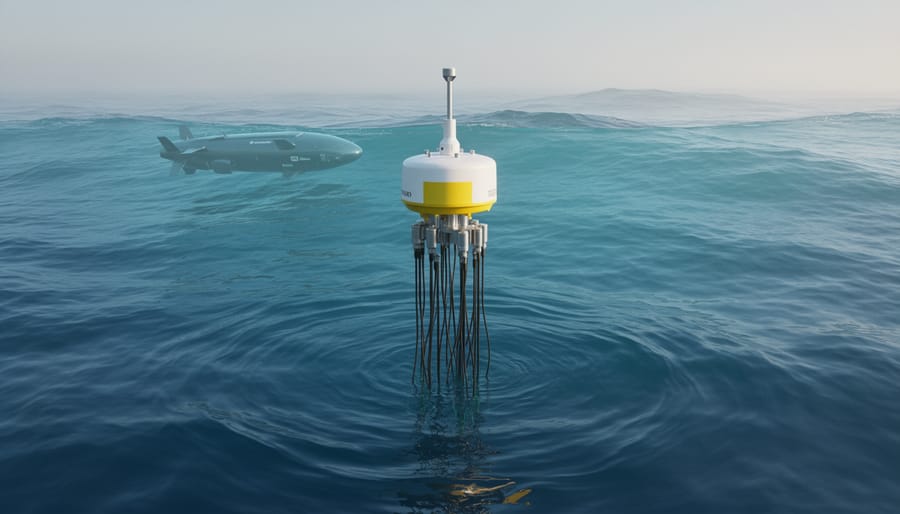
Next-generation oceanographic sensor networks are distributed arrays of autonomous instruments that collect, transmit, and process marine data in real time across vast ocean areas, fundamentally changing how scientists monitor and respond to changes in our seas. Unlike traditional ship-based surveys that provide snapshots of ocean conditions, these systems deliver continuous, high-resolution observations from depths and distances previously inaccessible to researchers.
The ocean remains one of Earth’s least understood frontiers. We’ve mapped Mars in greater detail than our own seafloor, and until recently, tracking critical changes in ocean chemistry, temperature, and biodiversity required costly expeditions that could sample only tiny fractions of marine ecosystems. That gap between what we need to know and what we can observe has real consequences for conservation. When coral bleaching events unfold, when fish populations shift, when oxygen-depleted dead zones expand, we often learn about these crises too late to intervene effectively.
This is where next-generation sensor networks prove transformative. By deploying interconnected instruments from surface buoys to autonomous underwater vehicles, marine scientists now monitor entire ocean basins with unprecedented detail. These systems track everything from microscopic phytoplankton blooms to the movements of whale populations, transmitting data through satellite and acoustic links to researchers worldwide. The technology has matured rapidly since 2020, with costs falling and capabilities expanding to include DNA sampling, chemical analysis, and even machine learning-powered species identification.
This article breaks down how these networks function, explores the different types of sensors and platforms that comprise them, and examines their practical applications in marine conservation. You’ll discover how volunteer citizen scientists increasingly contribute to these monitoring efforts and hear from researchers deploying these tools to protect vulnerable ecosystems.
What Next-Gen Oceanographic Sensor Networks Mean for Marine Science
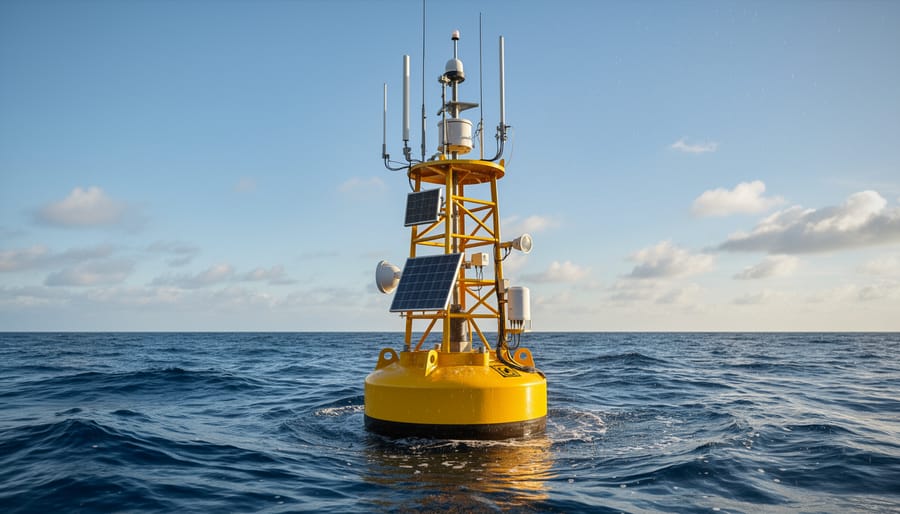
Think of traditional oceanographic research: scientists lowering instruments from ships, collecting water samples in bottles, retrieving data loggers months after deployment. Next-generation oceanographic sensor networks flip this model. These are systems of interconnected, intelligent devices that continuously monitor ocean conditions and transmit findings in real time, creating a living portrait of marine environments that updates itself around the clock.
What separates these networks from their predecessors isn’t just newer technology. It’s a fundamental shift in how we observe the ocean. Traditional instruments captured snapshots, a temperature reading here, a salinity measurement there. Next-gen networks create movies, tracking changes as they unfold across space and time. A sensor detecting a sudden temperature drop doesn’t sit silent until a research vessel returns months later. It sends that data immediately via satellite or underwater acoustic link, alerting scientists to potential ecosystem changes while they’re happening.
The intelligence built into these systems marks another departure. Earlier sensors were recorders. Modern networks think. Onboard processors analyze incoming data, distinguishing normal variations from meaningful anomalies. When AI algorithms detect patterns suggesting a harmful algal bloom forming or an unusual migration, the network can trigger additional monitoring or alert response teams without human intervention.
- Autonomous sensors
- Self-powered devices that collect and transmit ocean data without requiring human operation or retrieval for months or years.
- Telemetry
- The automated transmission of measurements from remote sensors to receiving stations via satellite, acoustic, or radio signals.
- Sensor nodes
- Individual monitoring units within a network that collect specific data types and communicate with other nodes and control centers.
- Data buoys
- Floating platforms equipped with sensors and communication equipment that serve as relay points between underwater sensors and satellites.
- Edge computing
- Data processing performed directly on the sensor device rather than sending raw information to distant servers, enabling faster analysis and reduced transmission costs.
These networks operate autonomously for extended periods, drawing power from solar panels, wave energy, or long-life batteries. They measure multiple parameters simultaneously, temperature, salinity, pH, dissolved oxygen, chlorophyll, turbidity, even acoustic signatures of marine mammals, building multidimensional datasets that reveal connections earlier tools missed. A single buoy might track how warming waters correlate with plankton blooms and subsequent fish movements, connections that required separate research projects to piece together before.
The networked aspect matters profoundly. Individual sensors communicate with each other, creating mesh systems where data flows through multiple pathways. If one node fails, others compensate. Information collected at the seafloor reaches satellites through a relay of acoustic modems, surface buoys, and radio transmitters, ensuring observations from the ocean’s most remote corners reach researchers’ screens within minutes.
This represents more than incremental improvement. We’ve moved from periodic sampling to persistent presence, from delayed discovery to immediate awareness, from isolated measurements to interconnected understanding. For marine conservation, that shift means the difference between documenting damage after it occurs and preventing it while there’s still time to act.
How Next-Gen Sensor Networks Monitor Our Oceans
From Ocean Floor to Research Lab: The Data Journey
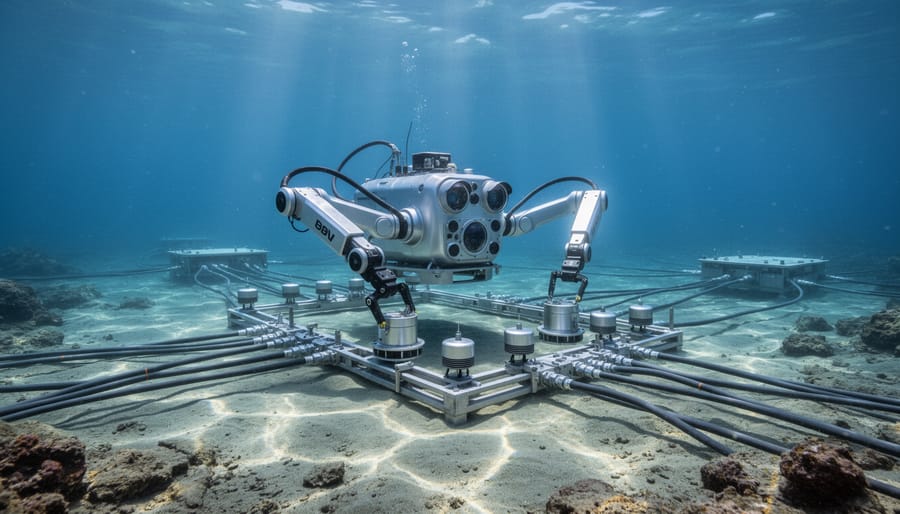
The journey begins at the sensor itself, often anchored to the seafloor or suspended in the water column. When a temperature probe detects a sudden two-degree drop, or an acoustic receiver picks up the distinctive click pattern of a dolphin pod, the sensor immediately converts this physical or biological signal into digital data. Within seconds, this information begins its transmission to the surface.
For many modern systems, data travels through underwater acoustic modems that send sound waves to a surface buoy equipped with satellite communications. The buoy acts as a relay station, packaging the sensor readings and beaming them to orbiting satellites. From there, the signal routes to ground stations and into cloud-based servers where researchers can access near real-time ocean data through secure web portals.
What once required a research vessel to physically retrieve instruments months after deployment now happens while a marine biologist sips morning coffee. The same pH sensor that detected an acidification event at 3 a.m. can trigger an alert on a scientist’s phone by 3:15 a.m., complete with location coordinates, severity metrics, and trend graphs showing the last 24 hours of measurements. This compression of time between observation and action has fundamentally changed how we respond to marine environmental threats.
The Intelligence Behind the Sensors
The real breakthrough in modern ocean monitoring isn’t just the sensors themselves, it’s the artificial intelligence that makes sense of the massive data streams they generate. Traditional oceanographic instruments simply recorded measurements, leaving researchers to sift through months of data long after events occurred. Today’s networks interpret information on the fly, spotting patterns and anomalies that human analysts might miss entirely.
Machine learning algorithms trained on years of oceanographic data can now recognize signatures of specific events within minutes. When water temperature rises and chlorophyll concentrations spike in a particular pattern, the system flags a potential harmful algal bloom before it spreads. If acoustic signatures match known whale vocalizations but appear in unexpected locations, the network alerts researchers to unusual migration behavior that might signal ecosystem changes or threats.
This AI-powered marine monitoring goes beyond simple threshold alerts. The systems build predictive models, learning from past data to forecast future conditions. They can estimate when and where coral bleaching might occur based on temperature trends, or predict fish movement patterns by analyzing current flows and historical behavior.
Edge computing pushes this intelligence directly onto the sensors themselves. Rather than transmitting raw data continuously, which drains batteries and requires constant connectivity, sensors process information locally. A glider surveying the ocean can analyze what it detects in real-time, deciding which observations warrant immediate transmission and which can wait. This local processing extends deployment times from weeks to months, covers larger areas, and ensures critical alerts reach shore even when connectivity is limited.
The result is an ocean monitoring system that thinks, learns, and adapts, transforming reactive science into proactive conservation.
Components and Types of Modern Ocean Sensor Networks
Fixed Stations and Mobile Platforms
Modern ocean monitoring relies on two complementary approaches: fixed infrastructure that continuously watches specific locations, and mobile platforms that roam the seas collecting data across vast areas.
Stationary systems anchor themselves to the ocean floor or float at fixed positions. Seafloor observatories, connected by undersea cables, monitor deep-water ecosystems for years without maintenance. Moored buoys drift within a limited radius while sensors dangle below, measuring everything from surface temperature to currents 100 meters down. Coastal stations, often mounted on piers or installed in shallow waters, track nearshore conditions where most marine biodiversity concentrates and where human activity intersects ocean health.
Mobile platforms bring flexibility to ocean research. Autonomous underwater vehicles navigate pre-programmed routes, their tiny sensor arrays mapping underwater terrain and recording water chemistry. Gliders, shaped like torpedos with wings, rise and fall through the water column for months, covering thousands of kilometers on a single deployment. Surface drifters ride currents, revealing ocean circulation patterns that dictate where nutrients and pollutants travel.
Perhaps most innovative are biologging tags attached to marine animals, turning whales, sharks, and sea turtles into living sensors. These creatures access habitats where marine robots struggle to reach: under ice sheets, in turbulent polar waters, or miles beneath the surface. A tagged elephant seal diving 1,500 meters collects temperature and salinity data scientists could never gather otherwise, all while pursuing its normal behavior.
The Network Architecture
Individual sensors form a coherent network through layered communication pathways designed to overcome the ocean’s challenges. Underwater, sensors transmit data via acoustic modems, sound waves that travel efficiently through water where radio signals fail. These modems create links between seafloor instruments and surface relay points, though transmission speeds remain relatively slow compared to terrestrial networks.
Surface buoys serve as critical gateways, receiving acoustic signals from below and relaying them via satellite or cellular connections to shore stations. Some networks incorporate next-gen radar networks that track surface phenomena while coordinating with subsurface sensors for comprehensive monitoring.
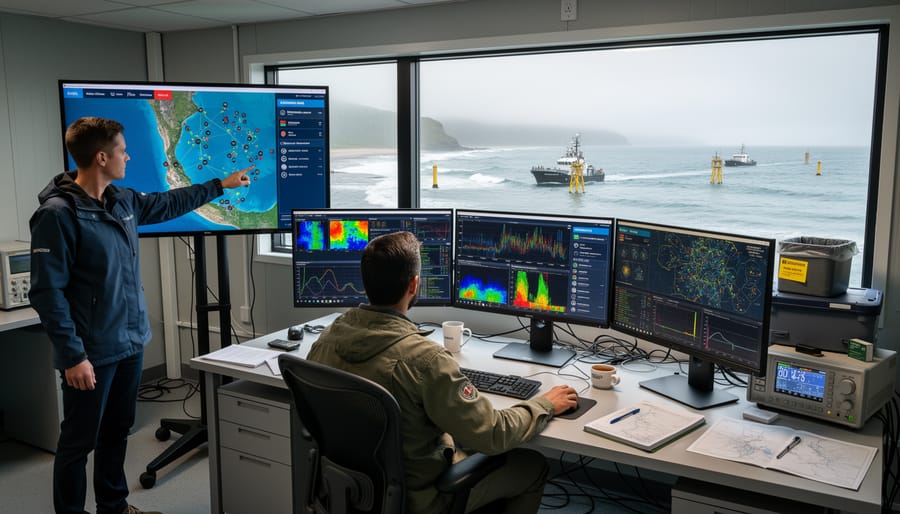
Shore-based control stations act as command centers, receiving data streams from multiple buoys and fixed stations. From here, researchers access real-time dashboards, adjust sensor parameters remotely, and route alerts when networks detect anomalies.
Many modern systems employ mesh network architecture, where sensors communicate with multiple neighbors rather than following a single pathway. If one node fails, data automatically reroutes through adjacent sensors, ensuring continuous monitoring even when individual components malfunction or require maintenance.
How Marine Scientists and Conservationists Use These Networks
Protecting Endangered Marine Species
Acoustic sensors deployed across whale migration routes now capture and analyze the distinct calls of individual whales, allowing researchers to track population sizes, breeding patterns, and stress indicators without ever seeing the animals. Networks off the coast of California have identified previously unknown feeding grounds for blue whales, enabling the creation of dynamic shipping lane adjustments that reduce fatal vessel strikes by up to 80 percent in monitored areas.
For sea turtles, miniaturized satellite tags combined with beach-based temperature sensors reveal exactly when females return to nest and how climate change affects hatchling sex ratios. Scientists can now predict nesting events within 48 hours, deploying volunteers to protect vulnerable nests from predators and human disturbance during critical windows.
In marine protected areas, networks of optical and acoustic sensors detect unauthorized fishing vessels in real time. When a sensor picks up engine noise or identifies boat shadows, alerts reach enforcement teams within minutes rather than days, dramatically improving patrol efficiency. These systems have documented a 60 percent reduction in illegal fishing activity in some monitored Caribbean reserves.
Continuous habitat monitoring reveals subtle ecosystem changes before they become crises. Sensors tracking water quality, prey abundance, and behavioral patterns in critical habitats provide early warnings when conditions deteriorate, giving conservationists time to investigate causes and implement protective measures.
Early Warning Systems for Marine Ecosystems
Real-time monitoring transforms how we protect marine ecosystems by enabling sensor networks to catch threats early often days or weeks before visible damage occurs. Temperature sensors on coral reefs detect the sustained warming that triggers bleaching, alerting scientists to take protective measures like deploying shade structures or relocating vulnerable species. Optical sensors measuring chlorophyll concentrations identify harmful algal blooms in their earliest stages, giving authorities time to close shellfish beds and protect public health.
Dissolved oxygen monitors flag developing hypoxic zones where marine life cannot survive, while hydrocarbon sensors detect oil spills within hours rather than days. Chemical sensors track pH changes that signal ocean acidification stress. This early detection capability is revolutionary for conservation: instead of documenting damage after the fact, scientists can mobilize response teams, redirect resources, and sometimes prevent ecological disasters entirely. A coral bleaching alert might save a reef; detecting a bloom early could prevent a massive fish kill that devastates local biodiversity and fisheries.
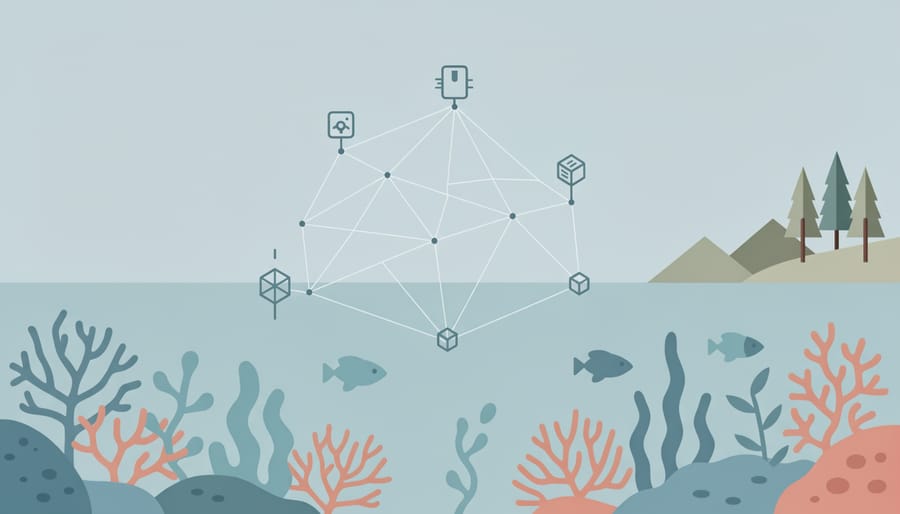
Advancing Marine Biodiversity Research
Beyond emergency response, next-gen sensor networks are reshaping fundamental marine biodiversity research. Long-term ecosystem monitoring that once required expensive ship expeditions now runs continuously through autonomous systems, capturing seasonal patterns, year-to-year variations, and subtle shifts that would’ve been impossible to detect with traditional sampling.
Migration tracking has become dramatically more precise. Acoustic arrays across ocean basins now follow tagged whales, sharks, and sea turtles in near real-time, revealing previously unknown routes, stopover sites, and behavioral responses to changing conditions. When sensors in the Pacific detected leatherback turtles altering their migration timing by three weeks over just five years, researchers could immediately link the shift to warming waters displacing their jellyfish prey.
Food web studies benefit enormously from simultaneous multi-parameter monitoring. A single network tracking temperature, chlorophyll, zooplankton density, and predator presence captures the cascading effects of environmental change through entire ecosystems. Scientists studying Antarctic krill populations now correlate their abundance with ice melt, water chemistry, and predator behavior, connections that inform fisheries management and climate impact predictions.
This comprehensive data directly supports conservation policy. When sensor networks documented seagrass meadow decline correlating with coastal development, regulators had quantifiable evidence to strengthen protections.
The Future of Ocean Monitoring and Conservation
The trajectory of ocean sensor technology points toward a monitoring revolution that will transform how we understand and protect marine ecosystems. Within the next decade, sensors no longer than your thumbnail will perform measurements that currently require equipment the size of a microwave. These miniaturized devices will slip into ecosystems with minimal disturbance, monitoring fragile coral reefs or tracking individual fish without altering their behavior.
Battery life has long constrained sensor deployments. Emerging energy harvesting technology changes that equation. Sensors now in development draw power from ocean currents, temperature gradients, and even wave motion, potentially operating indefinitely without battery replacement. Some prototypes generate electricity from the natural potential difference between seawater and freshwater, turning estuaries into self-powering observation posts.
The environmental impact of sensors themselves is shrinking. Biodegradable housings made from materials like compressed algae or modified cellulose will dissolve harmlessly after their mission ends, leaving behind only recyclable electronics or, in some experimental designs, nothing at all. One research team has created sensors that marine bacteria safely decompose within months.
Citizen scientists are becoming integral to these networks. User-friendly sensor kits allow recreational divers, fishermen, and coastal residents to contribute observations directly to research databases. A volunteer in California might deploy a temperature logger during a beach cleanup, feeding data into the same system professional oceanographers use.
Dr. Elena Rodriguez, our center’s Senior Marine Ecologist, sees this evolution as deeply personal. “Twenty years ago, I’d spend months at sea collecting samples we’d analyze back on land, always wondering what we missed between trips. Now I watch ecosystems respond to storms in real-time from my laptop. These tools let us catch problems early enough to actually do something about them. That changes everything about conservation work, we’re shifting from documenting decline to preventing it.”
The vision of a connected smart ocean inches closer each year, with sensor networks expanding across continental shelves and into the deep sea, creating an early warning system for the blue heart of our planet.
Common Questions About Ocean Sensor Networks
Ocean sensor networks raise practical questions among scientists, students, and potential volunteers. Here’s what you need to know about these technologies and how you can engage with them.
How accurate are these sensors?
Modern oceanographic sensors achieve accuracy within 0.01°C for temperature and 0.1 pH units for acidity measurements. Calibration occurs before deployment and data undergoes quality control checks against established baselines.
What happens to the data these networks collect?
Collected data flows to research institutions and databases where scientists analyze patterns, track environmental changes, and develop conservation strategies. Many datasets contribute to global ocean monitoring initiatives and peer-reviewed research.
Can the public access sensor data?
Yes, numerous networks share data through open-access platforms and visualization tools. Organizations like NOAA and regional ocean observatories provide real-time dashboards where anyone can view temperature, salinity, and other ocean conditions.
How long do ocean sensors last?
Deployment duration varies by sensor type. Battery-powered instruments typically operate six months to two years, while cabled seafloor observatories can function for decades with continuous power and maintenance.
Are these sensors harmful to marine life?
Properly deployed sensors pose minimal risk. Researchers design equipment to avoid entanglement hazards, use non-toxic materials, and position instruments to minimize habitat disturbance. Acoustic sensors operate at frequencies that don’t interfere with marine mammal communication.
How can people get involved with sensor networks?
Citizen scientists participate through beach monitoring programs, reporting tagged animal sightings, and helping analyze sensor images for species identification. The Marine Biodiversity Science Center offers volunteer training in sensor maintenance and data collection protocols.
Cost represents another common concern. A basic temperature sensor might run a few hundred dollars, while a complete multi-parameter monitoring station can cost tens of thousands. Networks require ongoing investment in maintenance, data processing infrastructure, and skilled personnel to interpret results.
The good news? Technology advances steadily drive costs down while improving capabilities. What required a research vessel and crew weeks at sea a generation ago now happens autonomously through sensors that transmit findings in real time. This democratization of ocean science means smaller institutions and conservation groups can deploy monitoring systems that were once accessible only to major research centers.
For those interested in contributing, opportunities extend beyond technical roles. Data interpretation benefits from diverse perspectives, and many projects need help identifying species in underwater photos, logging environmental observations, or assisting with sensor retrieval and cleaning during maintenance cycles.
The promise of next-generation oceanographic sensor networks extends far beyond technological achievement. These systems represent a fundamental shift in our capacity to understand and protect the ocean, transforming marine conservation from reactive crisis management into proactive stewardship guided by real-time knowledge.
Every sensor reading contributes to a growing picture of ocean health. When networks detect a coral bleaching event within hours instead of weeks, or track an endangered species through critical habitat, they create windows of opportunity that didn’t exist before. This rapid response capability, combined with long-term data gathering, empowers scientists and conservationists to make informed decisions that can genuinely protect marine biodiversity.
At the Marine Biodiversity Science Center, we see these technologies as tools that amplify collective action. Our sensor deployment programs welcome volunteers with no technical background, you might assist with coastal station maintenance, help tag animals as living sensors, or participate in citizen science data interpretation projects. These aren’t token gestures. Volunteers have helped identify unusual migration patterns and detected pollution events that might otherwise have gone unnoticed.
The ocean remains the least explored ecosystem on Earth, but networks of sensors and engaged people are changing that reality. Whether you’re a marine scientist or someone who simply cares about the blue planet, there’s a role for you in this expanding community of ocean observers. Together, we’re building the knowledge foundation that twenty-first-century conservation requires.

jessica
Ava Singh is an environmental writer and marine sustainability advocate with a deep commitment to protecting the world's oceans and coastal communities. With a background in environmental policy and a passion for storytelling, Ava brings complex topics to life through clear, engaging content that educates and empowers readers. At the Marine Biodiversity & Sustainability Learning Center, Ava focuses on sharing impactful stories about community engagement, policy innovations, and conservation strategies. Her writing bridges the gap between science and the public, encouraging people to take part in preserving marine biodiversity. When she’s not writing, Ava collaborates with local initiatives to promote eco-conscious living and sustainable development, ensuring her work makes a difference both on the page and in the real world.