Marine Biodiversity Science Center


Our oceans face an invisible crisis. Right now, beneath the waves, marine ecosystems are experiencing unprecedented threats—from illegal fishing operations to coral bleaching events to plastic pollution hotspots—often undetected until irreversible damage occurs. Traditional monitoring methods, while valuable, cannot match the scale and speed of these accelerating challenges. A single research vessel might survey a few square kilometers per day, while threats unfold across thousands of square kilometers simultaneously.
Artificial intelligence is transforming this equation. By processing vast streams of data from underwater cameras, acoustic sensors, satellite imagery, and environmental monitors, AI systems now detect threats in real-time that would take human observers weeks or months to identify. These algorithms recognize patterns invisible to the naked eye: the subtle color shifts indicating coral stress days before visible bleaching, the acoustic signatures of illegal fishing vessels operating under cover of darkness, or the population declines of keystone species that signal broader ecosystem collapse.
This technology represents more than computational power—it’s a force multiplier for conservation. Marine biologist Dr. Sarah Chen describes her experience: “We deployed AI-enabled camera systems on a threatened reef and within 48 hours identified a crown-of-thorns starfish outbreak we would have missed during our quarterly dive surveys. That early detection saved an entire coral community.”
The convergence of AI and marine science offers concrete hope, transforming how we protect our ocean’s biodiversity while creating unprecedented opportunities for citizen scientists, educators, and conservationists to participate in this crucial work.
The Silent Crisis Threatening Our Oceans
Why Traditional Monitoring Falls Short
Our oceans span over 139 million square miles, creating an impossible surveillance challenge for even the most dedicated conservation teams. Traditional monitoring methods rely heavily on human observers—whether researchers aboard vessels, coastal patrol teams, or satellite image analysts—but the sheer scale of marine environments means most areas remain unwatched for extended periods.
Dr. Sarah Martinez, a marine biologist with fifteen years of field experience, describes the frustration: “We might survey a coral reef system once every few months, but by the time we notice bleaching or disease outbreak patterns, the damage has often progressed beyond early intervention stages.”
Resource constraints compound these challenges. Conservation organizations operate on limited budgets, restricting the frequency and coverage of monitoring expeditions. A single research vessel costs thousands per day to operate, and trained observers require years of specialized education to accurately identify threats.
Human analysts face another hurdle: detecting subtle environmental changes that signal emerging problems. Temperature shifts of mere fractions of a degree, slight turbidity increases, or early-stage coral stress often escape notice until they cascade into visible crises. Response times measured in weeks or months allow threats to intensify, making recovery efforts exponentially more difficult and expensive. This reactive approach leaves our marine ecosystems perpetually vulnerable.
What AI-Driven Threat Detection Actually Means
From Data to Action: The AI Detection Process
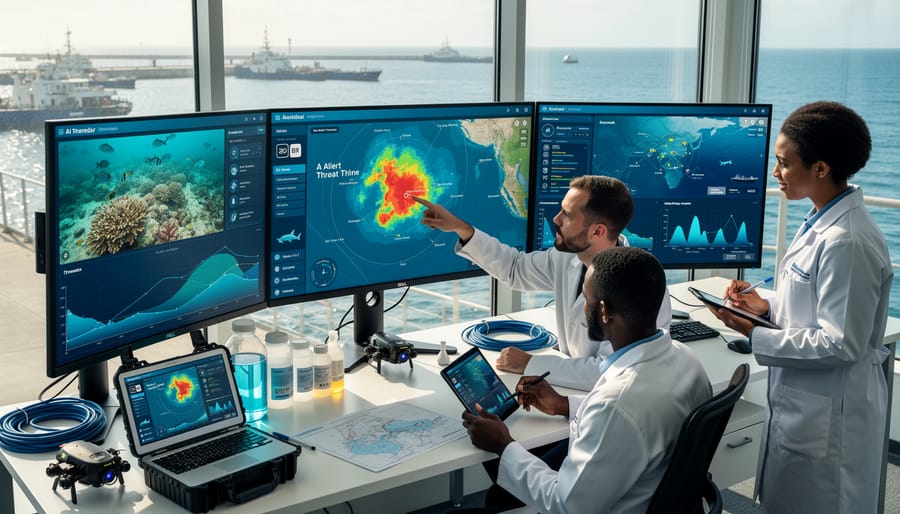
Modern AI-powered marine monitoring systems function like vigilant guardians, continuously processing vast streams of information to protect our oceans. The detection process begins with data collection from multiple sources working in harmony: underwater cameras capture visual footage of marine life and habitats, acoustic sensors record sounds from shipping traffic to whale calls, satellites track ocean temperatures and algal blooms, and environmental sensors measure water quality parameters like pH and oxygen levels.
Once collected, this raw data flows into sophisticated AI algorithms that have been trained to recognize normal patterns in marine ecosystems. Think of it as teaching a computer to understand the ocean’s daily rhythms. The system learns what healthy coral reefs look like, the typical movement patterns of fish schools, and the normal temperature ranges for different seasons.
When something deviates from these established patterns, the AI flags it as a potential threat. Perhaps underwater cameras detect unusual sediment clouds indicating illegal trawling, or acoustic sensors pick up ship propeller sounds in protected areas. Satellite imagery might reveal sudden temperature spikes signaling coral bleaching events, while water quality sensors could detect pollution plumes before they spread.
The system then prioritizes these alerts based on urgency and sends notifications to conservation teams, enabling rapid response. This automated vigilance means threats that once went unnoticed until significant damage occurred can now be intercepted within hours, giving marine life a fighting chance.
Real Threats AI Is Detecting Right Now
Illegal Fishing and Poaching Activities
AI technology is revolutionizing how we combat illegal fishing and poaching in marine protected areas. Advanced algorithms now analyze vast amounts of data from multiple sources to identify suspicious vessel behavior. By combining satellite imagery with vessel tracking systems, AI can detect boats entering restricted zones or exhibiting patterns typical of illegal fishing operations, such as turning off transponders or moving at unusual speeds during nighttime hours.
These systems also process acoustic signatures underwater, listening for sounds that indicate unauthorized fishing activities. Marine biologist Dr. Elena Rodriguez shares how this technology transformed enforcement in her region: “We identified three vessels operating illegally in a protected coral reef zone within hours of their entry. Before AI detection, they might have gone unnoticed for days, causing irreparable damage.”
Success stories demonstrate the real impact of these tools. In 2023, AI-driven monitoring helped authorities in the Galapagos Marine Reserve intercept over twenty illegal fishing vessels, protecting endangered shark populations. Similarly, systems deployed across Southeast Asian waters have reduced unauthorized trawling by forty percent in monitored zones.
This technology doesn’t replace human oversight but amplifies enforcement capabilities dramatically. Conservation teams can now monitor thousands of square miles simultaneously, directing patrol vessels precisely where they’re needed most, transforming ocean protection from reactive to proactive.
Early Warning Signs of Disease Outbreaks
AI systems excel at detecting subtle warning signs that might escape human observation during routine monitoring. By continuously analyzing underwater camera feeds and sensor data, machine learning algorithms can identify unusual fish behaviors such as erratic swimming patterns, surface gulping for air, or sudden schooling changes that often precede disease outbreaks. Temperature sensors integrated with AI platforms flag thermal anomalies that stress coral communities, making them vulnerable to bleaching and infection.
Dr. Maya Torres, a marine pathologist working with AI monitoring systems in the Caribbean, shares a compelling example: “Our AI detected a 30% decline in parrotfish activity across multiple reef sites three weeks before we visually confirmed a parasitic outbreak. That early warning allowed us to implement quarantine protocols and prevent spread to adjacent reefs.”
Population tracking algorithms also monitor species abundance shifts. When certain fish species suddenly disappear or concentrate in unusual areas, AI systems alert researchers to investigate potential disease vectors. This proactive approach transforms reef management from reactive crisis response to preventive care, giving marine ecosystems their best chance at resilience against emerging health threats.
Pollution Events and Chemical Spills
AI-powered sensors and monitoring systems are revolutionizing how we detect water contamination before it devastates marine ecosystems. These intelligent networks continuously analyze multiple water quality parameters—including pH levels, dissolved oxygen, temperature fluctuations, and chemical compositions—creating baseline profiles that help identify anomalies within minutes rather than days.
When detecting oil spills, AI algorithms process satellite imagery and sensor data to map contamination extent and predict drift patterns, enabling faster emergency response. Dr. Marina Chen, a marine chemist working with AI monitoring systems in the Pacific Northwest, shares that “we’ve detected agricultural nutrient runoff events 72 hours earlier than traditional sampling would allow, giving us precious time to alert wildlife managers and implement protective measures.”
These systems excel at tracking emerging threats like microplastic concentrations, using machine learning to distinguish between natural particles and synthetic pollutants. By identifying contamination sources and patterns, AI helps scientists understand pollution pathways and develop targeted intervention strategies, transforming reactive cleanup efforts into proactive protection measures.
Invasive Species Migration Patterns
Invasive species pose one of the greatest threats to marine biodiversity, but AI-powered monitoring systems are revolutionizing how we detect and respond to these biological invaders. Machine learning algorithms now analyze data from underwater cameras, environmental DNA samples, and satellite imagery to track the movement of non-native species like lionfish in Atlantic waters or crown-of-thorns starfish on coral reefs. These systems identify invasive populations in their early stages, often before human observers would notice them, by recognizing subtle changes in ecosystem composition and behavior patterns.
Dr. Maria Chen, a marine ecologist working with AI detection systems, shares an encouraging discovery: “We detected a potential outbreak of invasive green crabs in a protected estuary three months before traditional surveys would have caught it. This early warning gave local teams time to implement targeted removal efforts, preventing significant damage to native shellfish populations.” The predictive models don’t just track current locations; they forecast likely migration routes based on ocean currents, water temperature, and food availability, allowing conservationists to prepare intervention strategies proactively. Community scientists can contribute by reporting unusual species sightings through mobile apps that feed directly into these AI systems, making everyone a potential guardian of our ocean ecosystems.
The Technology Behind the Protection
Underwater Sensors and Smart Buoys
Modern ocean monitoring relies on networks of underwater sensors and intelligent buoys that serve as the eyes and ears of marine conservation efforts. These smart sensors continuously measure water temperature, salinity, pH levels, dissolved oxygen, and even detect acoustic signatures from marine life. Deployed across vast ocean areas, they transmit data to shore-based systems where AI algorithms process the information in real-time.
Dr. Maria Chen, a marine biologist working with these systems, shares her experience: “When our sensor network detected an unusual temperature spike last summer, AI analysis immediately flagged it as a potential coral bleaching event. Within hours, we had response teams mobilizing to document the situation and implement protective measures.”
These IoT devices operate autonomously for months, withstanding harsh marine conditions while generating crucial datasets. The AI systems learn to distinguish between normal environmental fluctuations and genuine threats, reducing false alarms while ensuring conservation teams respond swiftly to legitimate concerns.

Autonomous Underwater Vehicles and Drones
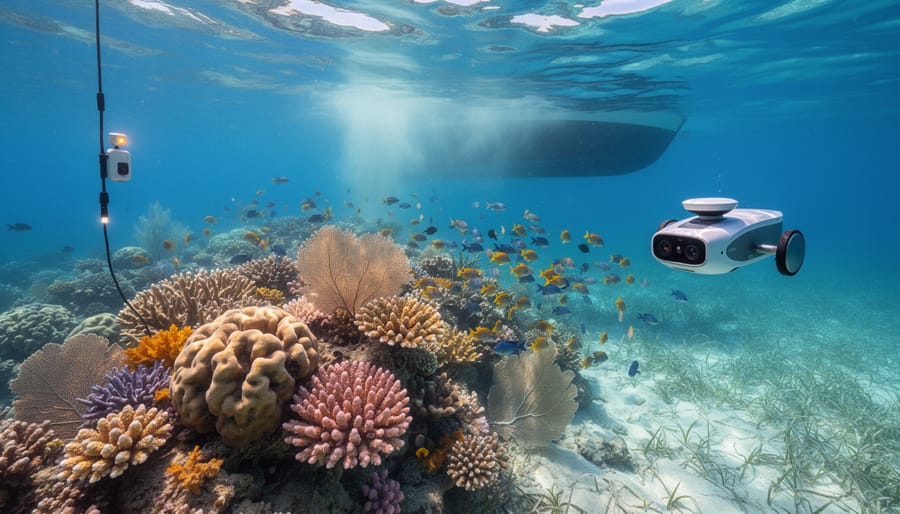
Marine protected areas now benefit from tireless robotic guardians that work around the clock beneath the waves. Autonomous underwater vehicles (AUVs) and surface drones patrol vast ocean territories, equipped with high-resolution cameras and sensitive acoustic sensors that continuously monitor ecosystem health. These AI-powered robots navigate pre-programmed routes or adapt their paths based on real-time environmental conditions, collecting visual footage of coral reefs, tracking fish populations, and recording underwater soundscapes without disturbing marine life.
Dr. Sarah Chen, a marine roboticist, explains how these systems transformed her research: “Our AUV can survey areas in a single day that would take human divers weeks to cover. The AI processes this data immediately, flagging potential threats like unusual fish behavior or temperature anomalies.” The robots operate in conditions too dangerous or deep for human divers, transmitting data to research stations where AI algorithms analyze thousands of images and hours of acoustic recordings, identifying everything from illegal fishing vessels to subtle changes in whale communication patterns that might indicate environmental stress.
Satellite Monitoring and Computer Vision
Advanced satellite monitoring systems now provide scientists with an unprecedented view of our oceans from space. Computer vision algorithms trained on machine learning can process thousands of satellite images daily, detecting patterns invisible to the human eye. These AI systems excel at identifying harmful algal blooms spreading across coastal waters, tracking sea surface temperature anomalies that signal coral bleaching events, and mapping habitat degradation in near real-time. Dr. Sarah Chen, a marine remote sensing specialist, shares how this technology transformed her research: “What once took our team weeks to analyze manually, AI now processes in hours, allowing us to alert conservation managers before damage becomes irreversible.” The combination of high-resolution satellite data and intelligent algorithms creates an early warning system for large-scale ocean threats, enabling rapid response and targeted intervention strategies that save critical marine habitats.
Stories from the Front Lines
Dr. Elena Rodriguez still remembers the moment the AI system flashed its first critical alert. Working off the coast of Papua New Guinea, she watched her screen light up with thermal signatures indicating an illegal fishing vessel operating within a protected coral reef zone. “My heart was pounding,” she recalls. “We had less than twenty minutes to coordinate with local authorities before significant damage could occur.” Thanks to the real-time detection system, enforcement arrived in time, preventing what could have been catastrophic trawling damage to a pristine reef ecosystem that had taken centuries to develop.
The emotional weight of these interventions runs deep for marine biologists on the front lines. Dr. Marcus Chen, monitoring the Great Barrier Reef, describes the moment his AI system detected early-stage coral bleaching patterns invisible to the human eye. “The algorithm identified temperature stress signatures three days before we would have noticed visually,” he explains. “Those three days allowed us to deploy emergency cooling measures and relocate the most vulnerable coral fragments to recovery tanks. We saved approximately 40 percent of that reef section.”
However, the technology hasn’t come without challenges. Dr. Amara Okafor, working in West African waters, faced initial skepticism from local fishing communities who feared the monitoring systems would threaten their livelihoods. “Building trust took months,” she shares. “We had to demonstrate that our goal was protecting their future catches by preventing illegal industrial fishing, not restricting their traditional practices.” Her persistence paid off when the system helped identify and stop a large-scale poaching operation, leading to a 30 percent increase in local fish populations within just eighteen months.
These personal victories represent more than data points. They’re moments when technology and human dedication converge to give struggling ecosystems a fighting chance, one real-time alert at a time.
The Challenges We Still Face
Data Gaps and Technology Access
Despite AI’s promise, significant challenges limit its effectiveness in marine threat detection. Remote ocean regions remain severely undermonitored due to inadequate data collection infrastructure. Many critical ecosystems lack the sensors, underwater cameras, and acoustic monitoring devices needed to gather quality information for AI training. Without sufficient data, even the most sophisticated algorithms struggle to identify threats accurately.
Funding constraints compound these issues, particularly for smaller conservation organizations and research stations in developing nations. The high costs of AI systems, specialized equipment, and technical expertise create barriers that prevent widespread adoption. Dr. Maria Santos, a marine biologist working in Southeast Asian coral reefs, shares her frustration: “We understand illegal fishing patterns threatening our reefs, but lack resources to implement AI monitoring that could help enforcement teams respond quickly.”
This technology gap means protection efforts remain uneven across oceans. While well-funded marine reserves utilize advanced AI tools, equally threatened ecosystems go unmonitored. Bridging this divide requires international collaboration, equipment-sharing programs, and volunteer initiatives that democratize access to life-saving technology for marine life worldwide.
Balancing AI with Human Expertise
While AI algorithms can process vast amounts of data at remarkable speeds, they remain powerful tools that enhance rather than replace the expertise of marine biologists. Dr. Sarah Chen, a coral reef specialist with fifteen years of field experience, explains: “AI can flag potential threats in seconds, but it takes human understanding to interpret context—whether that bleaching event is part of a natural cycle or an alarming trend requiring immediate intervention.”
Marine scientists bring irreplaceable knowledge to the equation: understanding species behavior, recognizing unusual patterns that algorithms might miss, and making nuanced decisions about conservation priorities. AI excels at pattern recognition, but humans provide the critical thinking, ethical considerations, and local ecological knowledge that transform data into meaningful action.
This partnership proves most effective when AI handles the heavy lifting of continuous monitoring and initial threat detection, freeing researchers to focus on fieldwork, community engagement, and developing targeted conservation strategies. The technology amplifies human capability, allowing small teams to protect larger areas while maintaining the scientific rigor and compassionate stewardship that conservation demands.
How You Can Support AI-Powered Ocean Protection
Volunteer Opportunities in Data Collection
You can directly contribute to AI-powered marine conservation efforts through several citizen science initiatives. The Wildbook for Whale Sharks platform welcomes underwater photographs from divers and snorkelers worldwide, using AI to identify individual animals through their unique spot patterns. Your vacation photos could help track whale shark migrations across ocean basins.
The iNaturalist Ocean program encourages beachgoers and ocean enthusiasts to photograph and upload sightings of marine life, from tide pool creatures to offshore encounters. Machine learning algorithms process these submissions to map species distributions and detect unusual occurrences that might indicate ecosystem changes.
For those interested in coral reef monitoring, the CoralWatch program trains volunteers to assess coral health using standardized color charts. These observations, combined with AI analysis of submitted photos, create early warning systems for bleaching events.
The Marine Debris Tracker app allows anyone to log plastic pollution findings during beach cleanups. AI systems analyze this crowdsourced data to identify accumulation hotspots and predict pollution patterns, informing targeted cleanup efforts. Each contribution, no matter how small, strengthens the datasets that make AI threat detection more accurate and responsive to emerging marine conservation challenges.

Advocacy and Awareness
Your voice matters in expanding AI-driven threat detection capabilities across our oceans. By sharing marine observations through citizen science platforms and social media, you contribute valuable data that helps train AI systems to recognize threats more accurately. Supporting research funding initiatives—whether through donations, grants, or advocacy campaigns—directly enables scientists to develop more sophisticated monitoring tools and deploy them in under-resourced marine areas.
Participating in online marine conservation networks amplifies collective impact. Join webinars hosted by marine biologists who share firsthand experiences with AI implementation, learning how your observations from beach cleanups or diving expeditions can feed into global monitoring databases. Dr. Sarah Chen, a marine ecologist, notes that community-submitted photos have helped AI systems identify fifteen new pollution patterns in coastal zones. Engage with conservation organizations on digital platforms, sign petitions supporting ocean monitoring budgets, and educate others about AI’s role in protection efforts. Every shared article, attended virtual event, or submitted sighting strengthens the network of eyes watching over our marine ecosystems, making threat detection faster and more comprehensive for future generations.
The transformative potential of AI-driven threat detection in marine conservation represents more than just technological advancement—it embodies our collective commitment to protecting the ocean’s irreplaceable biodiversity. As we’ve explored, artificial intelligence empowers us to monitor vast marine ecosystems with unprecedented precision, identify emerging threats before they escalate into crises, and respond with targeted interventions that make a measurable difference. From detecting illegal fishing activities in real-time to tracking coral bleaching events across entire reef systems, these intelligent tools are amplifying the impact of every conservation effort.
What makes this moment particularly exciting is that this technology doesn’t replace human passion and dedication—it enhances it. Marine biologists working with AI systems report feeling more effective and hopeful than ever before, knowing their expertise is multiplied across thousands of square miles of ocean. The data collected through these systems informs smarter policies, guides restoration projects, and helps us understand marine ecosystems with clarity our predecessors could only dream of achieving.
The Marine Biodiversity Science Center invites you to become part of this conservation revolution. Whether you’re a scientist seeking collaboration opportunities, an educator looking to inspire the next generation, or simply someone who cares deeply about our oceans, there’s a place for you in this work. Join our volunteer monitoring programs, participate in citizen science initiatives, or support ongoing research projects. Together, we’re not just observing change—we’re actively shaping a future where technology and human determination combine to safeguard marine life for generations to come.

jessica
Ava Singh is an environmental writer and marine sustainability advocate with a deep commitment to protecting the world's oceans and coastal communities. With a background in environmental policy and a passion for storytelling, Ava brings complex topics to life through clear, engaging content that educates and empowers readers. At the Marine Biodiversity & Sustainability Learning Center, Ava focuses on sharing impactful stories about community engagement, policy innovations, and conservation strategies. Her writing bridges the gap between science and the public, encouraging people to take part in preserving marine biodiversity. When she’s not writing, Ava collaborates with local initiatives to promote eco-conscious living and sustainable development, ensuring her work makes a difference both on the page and in the real world.