Marine Biodiversity Science Center

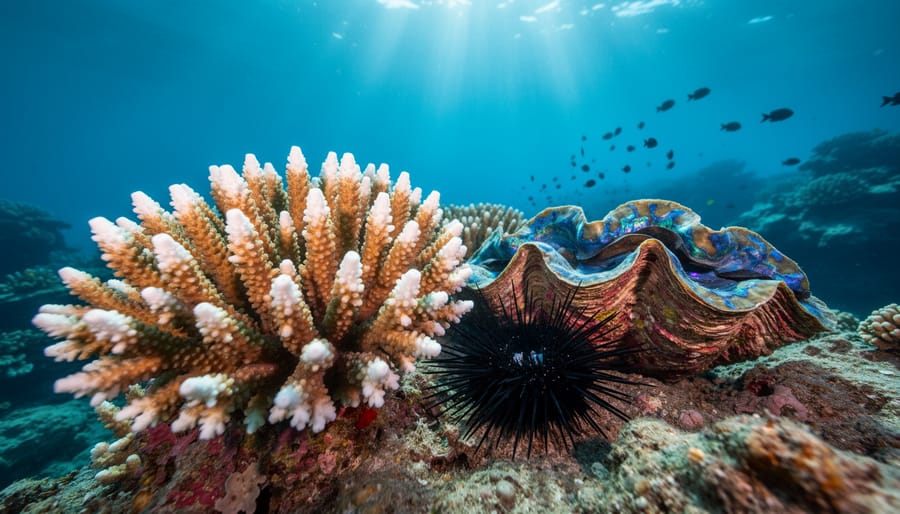
Beneath the ocean’s surface, a remarkable chemical orchestra plays out every moment as marine animals construct elaborate skeletons, shells, and protective structures from the simple ingredients dissolved in seawater. This process, called biomineralization, represents one of nature’s most sophisticated biochemical achievements—transforming calcium, carbonate ions, and specialized proteins into the architectural marvels that form coral reefs, mollusk shells, and the intricate skeletons of countless marine species.
Understanding marine biochemistry reveals why a sea urchin can build a perfectly geometric test, how a clam secretes a pearl, and what allows corals to construct reefs visible from space. These aren’t merely academic curiosities. The biochemical pathways that enable marine animals to create their hard structures are now under unprecedented threat from ocean acidification, warming waters, and pollution. As seawater chemistry shifts, the delicate balance of minerals and proteins required for biomineralization becomes disrupted, leaving marine organisms struggling to build and maintain their protective structures.
For students beginning their journey into marine science, educators developing curriculum, and concerned citizens witnessing coral bleaching events or declining shellfish populations, grasping the fundamentals of marine biochemistry provides essential context for today’s conservation challenges. The calcium carbonate that forms a coral’s skeleton or an oyster’s shell depends on specific pH levels, temperature ranges, and mineral concentrations—all of which are changing rapidly.
This exploration into marine biochemistry bridges the molecular world with visible ecological consequences, offering insights into both the extraordinary capabilities of marine life and the urgent need to protect the ocean chemistry that makes these biological processes possible. By understanding how marine organisms build themselves at the biochemical level, we gain powerful tools for predicting, preventing, and potentially reversing the damage threatening ocean ecosystems worldwide.
What Is Marine Biomineralization?
The Biochemical Building Blocks
Marine animals accomplish remarkable feats of construction, building intricate skeletons, shells, and protective structures from materials dissolved in seawater. Understanding these biochemical processes reveals the delicate chemistry that sustains ocean life.
Three key minerals form the foundation of marine skeletal structures. Calcium carbonate, the most common, appears in two forms: aragonite and calcite. Corals, mollusks, and many plankton species use this mineral to construct their protective homes. Calcium phosphate provides exceptional strength in fish bones and some invertebrate structures. Silica, a glass-like compound, forms the intricate skeletons of diatoms and sponges, creating structures of stunning geometric beauty.
These minerals don’t simply crystallize randomly. Marine organisms carefully control their formation using specialized organic molecules. Proteins act as scaffolds, directing where and how minerals deposit. Matrix proteins guide crystal formation, while other organic compounds regulate crystal size and shape. Think of it like a carefully orchestrated construction project, where proteins serve as both blueprint and construction crew.
The interplay between organic and inorganic components creates materials stronger than either alone. This biological control allows a delicate coral polyp to build massive reef structures or enables a tiny plankton to craft an elaborate silica shell. Marine biologist Dr. Sarah Chen describes it as “nature’s 3D printing technology,” where organisms precisely engineer materials at the molecular level to suit their survival needs.
From Molecules to Masterpieces
Think of building a coral skeleton like constructing a skyscraper, but on a molecular scale. It all begins with calcium and carbonate ions dissolved in seawater. Marine organisms actively pump these ions from the surrounding water into specialized spaces within their tissues. Here, the magic happens.
Specialized proteins act as scaffolding, creating templates where crystals can form in precise patterns. These proteins don’t just provide structure—they control crystal size, shape, and orientation, much like architects determining where each beam goes in a building. In corals and mollusks, this process occurs in layers. Calcium carbonate crystals, primarily in the form of aragonite or calcite, attach to the protein framework and gradually expand, forming intricate lattices.
Dr. Maria Santos, a marine biochemist studying Caribbean corals, describes it beautifully: “We’re watching nature’s most patient artists at work. A coral polyp deposits just micrometers of skeleton daily, yet over years, creates structures visible from space.”
This layer-by-layer construction ensures strength and flexibility. The resulting composite material—mineral crystals bound by organic proteins—is surprisingly resilient, supporting entire reef ecosystems while withstanding constant wave action.
The Incredible Diversity of Marine Skeletons
Coral Reefs: The Ocean’s Architects
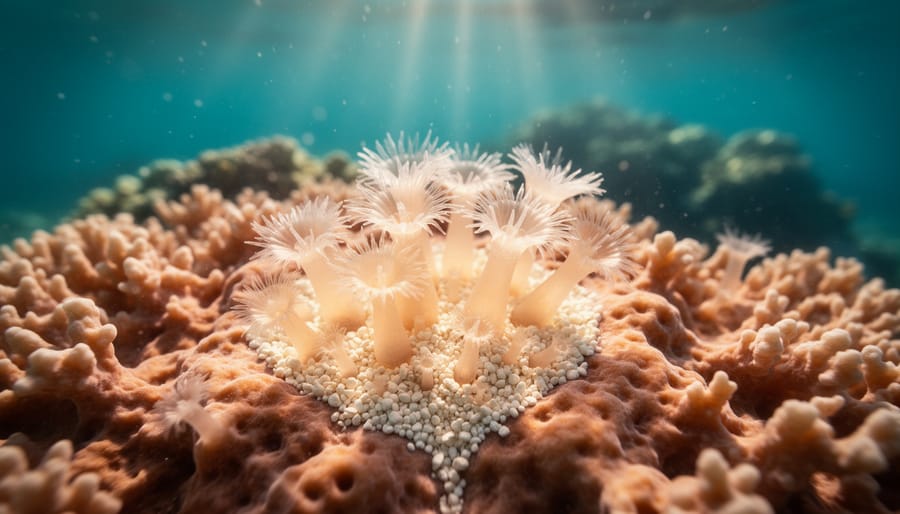
Coral reefs, often called the rainforests of the sea, owe their magnificent structures to remarkable biochemical processes. At the heart of reef formation lies biomineralization, where coral polyps extract calcium and carbonate ions from seawater to construct their protective calcium carbonate skeletons. This process requires significant energy and precise biochemical control.
The secret to this architectural feat involves specialized cells that pump calcium ions while managing pH levels to trigger crystallization. Corals work in partnership with zooxanthellae, tiny photosynthetic algae living within their tissues. These microscopic partners provide up to 90% of the coral’s energy through photosynthesis, fueling the demanding work of skeleton building. In return, the algae receive shelter and access to the coral’s waste products as nutrients.
Marine biologist Dr. Sarah Chen describes her first encounter with spawning corals as “witnessing nature’s most hopeful moment, millions of tiny architects beginning their life’s work of building tomorrow’s reefs.” Understanding these biochemical processes helps scientists develop strategies to support coral resilience in warming oceans. Conservation programs now offer volunteer opportunities for reef monitoring, where citizen scientists contribute valuable data tracking coral health and growth rates, directly supporting research that protects these essential ecosystems.
Mollusks and Their Protective Armor
Mollusks are master architects, crafting protective shells through a remarkable biochemical process called biomineralization. Clams, oysters, and abalone produce these sturdy defenses by secreting calcium carbonate crystals within an organic matrix of proteins and polysaccharides. Specialized cells in the mantle tissue orchestrate this intricate construction, carefully controlling crystal formation layer by layer.
The result is often breathtaking, particularly in the case of nacre, or mother of pearl. This iridescent material forms when mollusks deposit alternating layers of aragonite (a form of calcium carbonate) and conchiolin, an elastic protein. The microscopic structure creates a natural composite material that’s both strong and flexible, actually tougher than the ceramic components alone.
Dr. Maria Santos, a marine biochemist studying abalone shells, shares her fascination: “When you examine nacre under a microscope, you see nature’s engineering genius. These animals are solving structural problems that material scientists are still trying to replicate in laboratories.”
Understanding shell formation has become increasingly urgent as ocean acidification threatens mollusk populations worldwide. When seawater absorbs excess carbon dioxide, it becomes more acidic, making shell construction metabolically expensive and sometimes impossible. Conservation efforts now include monitoring programs where volunteers collect water samples and survey mollusk populations, providing vital data to track these vulnerable species and protect coastal ecosystems that depend on them.

Other Marine Biomineralizers
Beyond corals and mollusks, numerous marine organisms produce remarkable mineralized structures through sophisticated biochemical processes. Echinoderms, including sea urchins and sea stars, construct intricate skeletons from high-magnesium calcite, a mineral variant that makes their structures particularly vulnerable to ocean acidification. Their skeletal elements, called ossicles, form through specialized cells that carefully regulate mineral deposition, creating both protective armor and flexible joints.
Crustaceans like crabs and lobsters face a unique challenge: they must regularly shed and rebuild their calcium carbonate-reinforced exoskeletons as they grow. This molting process requires precise biochemical timing and mineral mobilization, representing one of nature’s most impressive survival adaptations. Marine fish, meanwhile, produce calcium phosphate-based bones similar to terrestrial vertebrates, but many species also create calcium carbonate structures in their inner ears for balance and hearing.
Understanding these diverse biomineralization strategies helps scientists predict how different marine species will respond to environmental changes. Conservation programs increasingly monitor skeletal growth rates as indicators of ocean health, offering volunteer opportunities for citizen scientists to contribute data collection at coastal monitoring sites, helping researchers track these vital biochemical processes across marine ecosystems.
The Environmental Threats to Marine Biomineralization
Ocean Acidification: A Chemical Crisis
Our oceans are silently absorbing a tremendous burden. Since the Industrial Revolution began, the world’s seas have absorbed approximately 30% of human-produced carbon dioxide emissions. While this might seem helpful in slowing atmospheric warming, it comes at a steep chemical cost. When CO2 dissolves in seawater, it forms carbonic acid, which releases hydrogen ions that lower the ocean’s pH. This process, known as ocean acidification, has already decreased surface ocean pH by about 0.1 units, representing a 30% increase in acidity.
This chemical shift creates a cascade of problems for marine life that depends on calcium carbonate for their shells and skeletons. As seawater becomes more acidic, fewer carbonate ions remain available for animals like corals, mollusks, and sea urchins to build their protective structures. The process becomes energetically expensive and inefficient. Even more concerning, existing calcium carbonate structures begin dissolving in increasingly acidic conditions.
Marine biologist Dr. Sarah Chen, who studies coral reefs in the Pacific, shares a sobering observation: “We’re seeing juvenile oysters with paper-thin shells that crumble under the slightest pressure. It’s like watching buildings deteriorate from the inside out.” The implications extend beyond individual animals. Coral reefs, often called the rainforests of the sea, support 25% of all marine species despite covering less than 1% of the ocean floor.
Understanding these chemical changes empowers us to make informed decisions about carbon emissions and support marine conservation efforts.

Temperature and Other Stressors
Marine organisms face mounting biochemical challenges as ocean temperatures rise and pollution intensifies. When water temperatures climb even a few degrees above normal, the delicate biochemical machinery of biomineralization can falter. Warmer waters reduce the saturation of calcium carbonate in seawater, making it harder for corals, mollusks, and other calcifying creatures to build their skeletal structures. Heat stress also disrupts the proteins and enzymes that guide crystal formation, leading to weaker, more brittle shells and skeletons.
Ocean acidification compounds these problems. As seawater absorbs excess carbon dioxide from the atmosphere, it becomes more acidic, dissolving existing calcium carbonate structures and inhibiting new growth. Dr. Elena Rodriguez, a marine biochemist studying coral reefs in the Caribbean, shares a sobering observation: “We’re seeing corals struggle to maintain their skeletons at rates we’ve never documented before. Their biochemical systems are working overtime just to survive.”
Pollutants like heavy metals and microplastics further interfere with biomineralization pathways, disrupting cellular signaling and enzyme function. These stressors don’t act alone—they combine to create cascading effects throughout marine ecosystems. While some species show remarkable adaptability to these extreme environmental conditions, many others cannot keep pace with rapid change.
Understanding these biochemical disruptions is crucial for developing conservation strategies. Volunteer monitoring programs worldwide help scientists track biomineralization health in local marine populations, providing essential data for protecting vulnerable species.
Why This Matters for Marine Ecosystems
When marine organisms struggle to build their skeletons and shells, the consequences ripple outward far beyond individual creatures. These biomineralization processes form the literal foundation of entire ocean communities, and their disruption threatens ocean ecosystem health in ways we’re only beginning to fully understand.
Consider coral reefs, often called the rainforests of the sea. These biodiversity hotspots depend entirely on coral polyps successfully depositing calcium carbonate skeletons. When ocean acidification interferes with this process, reefs grow more slowly and become structurally weaker. The effects cascade through hundreds of species that depend on reef structures for shelter, breeding grounds, and food sources. Fish populations decline, affecting both marine food webs and coastal communities that rely on fishing for their livelihoods.
Marine biologist Dr. Elena Rodriguez has witnessed these changes firsthand during her fifteen years studying Caribbean reefs. “We’re seeing corals that once grew robustly now producing thin, fragile skeletons,” she explains. “It’s like building a house with brittle bricks. The entire neighborhood suffers when the foundation crumbles.”
The story extends beyond reefs. Pteropods, tiny swimming snails with delicate shells, form a crucial link in polar food chains. Salmon, whales, and seabirds depend on them for nutrition. When acidifying waters dissolve pteropod shells faster than the animals can rebuild them, entire food webs become destabilized. Similarly, shellfish industries face economic challenges as oysters and clams struggle to develop properly in changing ocean chemistry.
Understanding these connections empowers us to protect marine ecosystems more effectively. Conservation efforts that address ocean acidification, reduce pollution, and establish marine protected areas give biomineralizing organisms the best chance to adapt and thrive. Volunteer opportunities with coastal monitoring programs allow citizens to contribute valuable data about shell thickness and skeletal health, directly supporting research that informs conservation policy. When we protect biomineralization processes, we’re safeguarding the architectural framework that supports ocean life itself.
Research and Conservation in Action

Breakthrough Research and Hope for the Future
Scientists around the world are making remarkable discoveries that illuminate how marine organisms build their intricate structures and how we can protect these processes for future generations. At research stations from California to Australia, marine biologists are uncovering the molecular mechanisms behind biomineralization, revealing insights that could transform conservation efforts.
Dr. Maria Chen, a marine biochemist studying coral reefs in the Pacific, describes her breakthrough moment: “We discovered that certain proteins in coral skeletons act like molecular architects, controlling exactly where and how calcium carbonate crystals form. Understanding this process helps us identify which corals might adapt to changing ocean conditions.” Her team’s work has led to innovative restoration techniques that select naturally resilient coral strains for reef rehabilitation projects.
Meanwhile, researchers examining shellfish in warming waters have identified genetic markers that predict which populations can maintain strong shells despite ocean acidification. This knowledge enables targeted conservation strategies, protecting the most vulnerable species while supporting those with natural resilience.
The field offers exciting opportunities for involvement. Many research institutions welcome volunteers to assist with specimen collection, data analysis, and monitoring programs. These hands-on experiences not only advance scientific understanding but also create passionate advocates for marine conservation.
Perhaps most encouraging is the collaborative spirit driving this research forward. Scientists are sharing data across borders, creating global databases that track biomineralization patterns and environmental changes. This collective effort gives us genuine hope that through understanding the biochemistry of marine life, we can develop effective strategies to preserve ocean ecosystems for generations to come.
How You Can Make a Difference
Understanding marine biochemistry is just the first step—taking action to protect our oceans makes the real difference. You don’t need a PhD to contribute to marine conservation; there are numerous ways to get involved right now.
Consider joining citizen science projects that monitor ocean health. Programs like coral reef surveys and water quality testing welcome volunteers of all experience levels. These initiatives provide scientists with valuable data about changing ocean conditions while giving you hands-on experience with marine ecosystems. Many research centers offer weekend workshops where you can learn to identify local species and contribute to ongoing biomineralization studies.
Making lifestyle changes can directly reduce ocean acidification, one of the greatest threats to calcifying organisms. Simple actions include reducing your carbon footprint by choosing sustainable transportation, minimizing single-use plastics that break down into microplastics, and supporting renewable energy initiatives. Every reduction in carbon emissions helps slow the rate at which our oceans absorb CO2 and become more acidic.
You can also support marine conservation by making informed seafood choices. Look for sustainably caught fish certified by reputable organizations, which helps protect marine habitats where calcifying organisms thrive. Share what you’ve learned about marine biochemistry with friends and family—education creates ripples of change.
Local beach cleanups offer another tangible way to help. Removing debris prevents physical damage to coral reefs and shellfish beds while reducing the chemical pollutants that interfere with biomineralization processes. These events also build community connections with other ocean advocates, creating networks of people committed to protecting marine life for future generations.
The intricate world of marine biomineralization reveals nature’s extraordinary capacity for innovation. From the delicate aragonite crystals in coral skeletons to the precisely engineered calcite plates of sea urchins, these biochemical processes demonstrate millions of years of evolutionary refinement. Understanding how marine organisms manipulate minerals at the molecular level not only deepens our scientific knowledge but also underscores what we stand to lose as ocean acidification and warming waters threaten these remarkable systems.
The urgency of protecting our oceans has never been greater. As we’ve explored throughout this article, the biochemical pathways that enable marine animals to build their structures are highly sensitive to environmental changes. When we allow carbon dioxide levels to alter ocean chemistry, we’re not just affecting individual species—we’re disrupting the fundamental processes that support entire ecosystems and the incredible marine biodiversity our planet depends upon.
Yet there is reason for hope. Every person who learns about marine biochemistry becomes an advocate for ocean health. Dr. Sarah Chen, a marine biologist at our center, often reminds volunteers that “understanding creates connection, and connection drives action.” Whether you’re a student beginning your scientific journey, an educator inspiring the next generation, or simply someone who cares about our blue planet, you have a role to play.
Join us in protecting these biochemical wonders. Volunteer at our research facilities, participate in citizen science programs, or support conservation initiatives. Together, we can ensure that marine biomineralization continues to thrive for generations to come.

jessica
Ava Singh is an environmental writer and marine sustainability advocate with a deep commitment to protecting the world's oceans and coastal communities. With a background in environmental policy and a passion for storytelling, Ava brings complex topics to life through clear, engaging content that educates and empowers readers. At the Marine Biodiversity & Sustainability Learning Center, Ava focuses on sharing impactful stories about community engagement, policy innovations, and conservation strategies. Her writing bridges the gap between science and the public, encouraging people to take part in preserving marine biodiversity. When she’s not writing, Ava collaborates with local initiatives to promote eco-conscious living and sustainable development, ensuring her work makes a difference both on the page and in the real world.