Marine Biodiversity Science Center

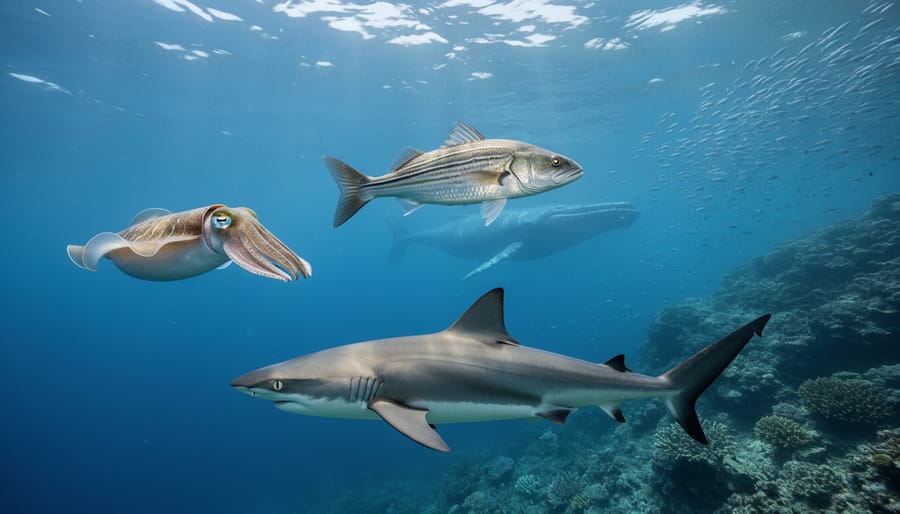
Beneath the ocean’s surface, a silent ballet of rising and sinking unfolds every moment as marine creatures navigate the water column with remarkable precision. This vertical movement depends entirely on sophisticated biological buoyancy control systems that rival any human-engineered technology. From the gas-filled swim bladders of reef fish to the oil-rich livers of deep-sea sharks, these anatomical adaptations represent millions of years of evolutionary refinement in survival mechanisms.
Understanding how marine animals achieve neutral buoyancy reveals fundamental principles of marine physiology and ecology. A fish hovering motionless at thirty meters depth maintains its position through constant physiological adjustments, balancing internal gas volumes against external water pressure. Marine mammals employ entirely different strategies, relying on lung capacity and body composition rather than specialized organs. Meanwhile, cephalopods like cuttlefish manipulate fluid levels within their chambered shells, and some gelatinous zooplankton adjust their ionic concentrations to match surrounding seawater density.
These buoyancy systems directly influence species distribution, feeding strategies, and energy expenditure throughout ocean ecosystems. When environmental conditions change due to warming waters or acidification, these delicate mechanisms face unprecedented challenges. Understanding the components and functions of biological buoyancy control becomes essential for predicting how marine species will respond to rapid environmental shifts.
This exploration examines the diverse anatomical structures and physiological processes that enable buoyancy regulation across marine taxa. We will investigate how swim bladders operate in bony fishes, why sharks need massive livers, and how deep-diving whales manage extreme pressure changes. By understanding these natural engineering marvels, we gain insights critical for marine conservation efforts and appreciate the extraordinary adaptations that allow life to thrive at every ocean depth.
The Physics of Staying Afloat: Why Buoyancy Matters
Imagine dropping a stone into water—it sinks immediately. Now picture a jellyfish drifting effortlessly through the ocean, or a whale diving hundreds of meters before gracefully ascending. What makes the difference? The answer lies in buoyancy, one of the most fundamental forces governing life in marine environments.
Buoyancy is the upward force that water exerts on any object immersed in it. Whether an organism floats, sinks, or hovers at a particular depth depends on its density compared to the surrounding seawater. An object denser than water will sink, while one less dense will rise. For marine animals, achieving neutral buoyancy—where their density matches the water around them—allows them to maintain their position without constantly swimming.
But ocean life isn’t simple. Water density increases with depth due to pressure changes with depth, meaning an animal perfectly balanced at the surface would become negatively buoyant as it descends. This presents a significant challenge: marine creatures must continuously adjust their buoyancy as they move through the water column.
Dr. Sarah Chen, a marine biologist studying deep-sea adaptations, explains it this way: “Think of it like being in an elevator where your weight changes at every floor. Marine animals need sophisticated systems to compensate for these constant shifts in pressure and density.”
Without active buoyancy control, fish would need to swim continuously just to stay in place, expending precious energy that could be used for feeding, reproduction, or avoiding predators. This is why evolution has favored remarkable adaptations—from gas-filled swim bladders in bony fish to oil-rich livers in sharks and specialized lung structures in marine mammals.
Understanding these buoyancy control mechanisms isn’t just academically interesting. As ocean conditions change due to warming waters and acidification, we need to know how these delicate systems might be affected, making this knowledge crucial for conservation efforts.
Swim Bladders: Nature’s Built-In Flotation Devices
How Fish Inflate and Deflate Their Swim Bladders
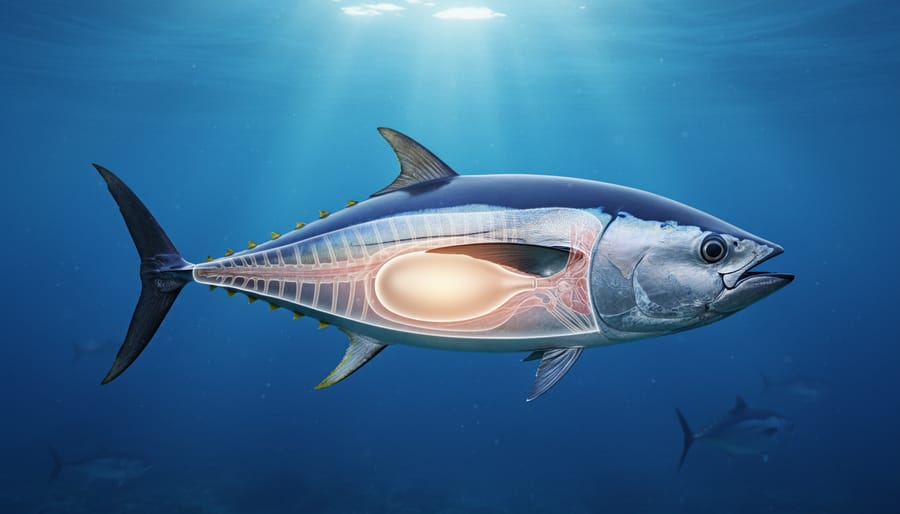
Fish possess a remarkably elegant system for inflating and deflating their swim bladders, allowing them to adjust their buoyancy without expending significant energy swimming up or down. This process involves two specialized structures working in concert: the gas gland (often featuring a network called the rete mirabile) and the oval body.
When a fish needs to inflate its swim bladder to ascend or maintain position at a shallower depth, the gas gland springs into action. This specialized tissue secretes gas, primarily oxygen, directly into the bladder. The rete mirabile, which translates to “wonderful net” in Latin, plays a crucial role in this process. This network of tiny blood vessels arranged in a countercurrent pattern acts as a biological gas concentrator. As blood flows through this maze of capillaries, oxygen molecules become increasingly concentrated through a process called countercurrent multiplication. Think of it as nature’s own compression system, where arterial blood bringing oxygen in flows right alongside venous blood carrying oxygen away, allowing oxygen to concentrate to levels far higher than found in regular blood.
Marine biologist Dr. Sarah Chen describes her first time observing this process under a microscope as “witnessing cellular choreography.” The dedication scientists like Dr. Chen show in studying these intricate systems helps us understand how vulnerable these mechanisms are to environmental changes, particularly ocean acidification and temperature shifts.
For deflation, fish rely on the oval body, a specialized region with dense capillaries that can reabsorb gas from the bladder back into the bloodstream. When a fish needs to descend, circular muscles surrounding the oval relax, allowing gas molecules to diffuse back into the blood and be transported away. This dual system gives fish precise control over their vertical position, conserving energy that would otherwise be spent constantly swimming to maintain depth.
When Swim Bladders Fail: Conservation Implications
When fish are brought up from deep water too quickly—whether caught by fishing lines, nets, or research equipment—their swim bladders can’t adjust to the rapid pressure change. This condition, called barotrauma, causes the gas inside the swim bladder to expand dramatically, sometimes forcing the organ out through the fish’s mouth or rupturing it entirely. The results are often fatal: internal injuries, inability to swim back down to safe depths, and vulnerability to predators.
Barotrauma represents a significant conservation challenge, particularly in commercial and recreational fisheries. Even when fishers practice catch-and-release, fish suffering from barotrauma rarely survive. Understanding how swim bladders function has led to practical solutions that save countless fish lives. Simple tools called descender devices help return affected fish to depth quickly, allowing their swim bladders to decompress naturally. Some fishing operations now use these devices routinely, dramatically improving survival rates for released fish.
Marine biologist Dr. Sarah Chen, who studies bycatch reduction, shares a hopeful observation: “When we educate fishers about barotrauma and provide them with simple solutions, most are eager to help. They understand the ocean’s health affects their livelihoods.” Her work with fishing communities has shown that knowledge of fish physiology transforms practices at sea.
Conservation organizations now offer workshops teaching proper fish handling techniques, and volunteers can participate in citizen science programs documenting barotrauma rates in different fisheries. These efforts demonstrate how understanding biological systems translates directly into actionable conservation strategies, protecting marine biodiversity one fish at a time.
Oil-Filled Livers: The Shark’s Secret to Staying Suspended
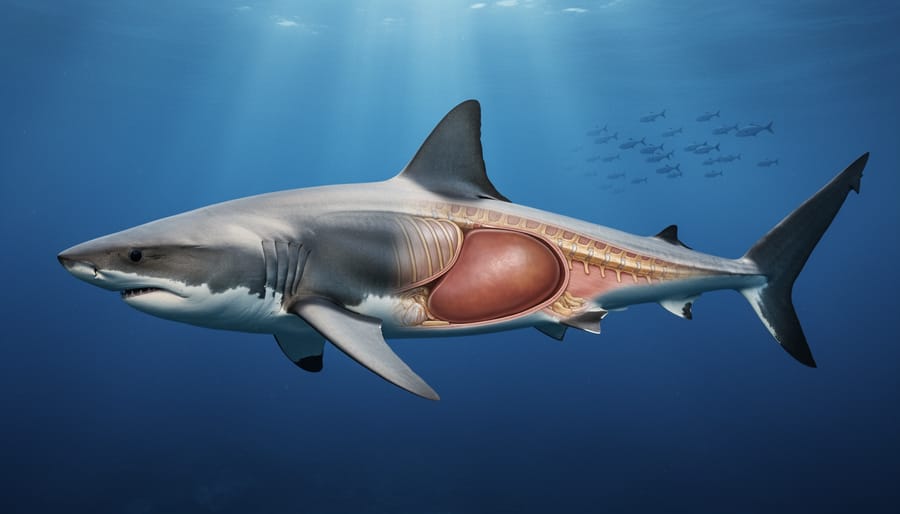
Unlike their bony fish cousins, sharks and their cartilaginous relatives have evolved a remarkably different approach to buoyancy control. Instead of relying on gas-filled swim bladders, these ancient predators depend on massive, oil-rich livers to maintain their position in the water column. This adaptation has allowed sharks to thrive in oceans worldwide for over 400 million years, making them one of evolution’s most successful stories.
The shark liver is an extraordinary organ, often accounting for up to 25 percent of the animal’s total body weight. In some deep-sea species, this proportion can reach an impressive 30 percent. To put this in perspective, imagine if a quarter of your body weight was devoted to a single organ. These oversized livers function as biological flotation devices, packed with low-density oils that provide the lift sharks need to counteract their naturally heavy cartilaginous skeletons and dense muscle tissue.
The secret ingredient in this buoyancy system is squalene, a hydrocarbon oil with a remarkably low specific gravity of approximately 0.86. This means squalene is significantly lighter than seawater, which has a specific gravity of about 1.026. When stored in large quantities within liver cells, squalene provides substantial lift. Deep-sea sharks, particularly species like the gulper shark and Portuguese dogfish, produce especially high concentrations of squalene to help them navigate the crushing pressures of depths exceeding 2,000 meters.
Marine biologist Dr. Sarah Chen, who has studied deep-sea shark adaptations for over a decade, shares her fascination with this system: “When I first dissected a Greenland shark liver during my graduate research, I was astounded by its sheer size and the oily consistency. These animals have essentially turned their livers into biological life preservers, perfectly calibrated for their depth range and hunting strategies.”
This lipid-based buoyancy system offers distinct advantages. Unlike swim bladders, which can rupture during rapid depth changes, oil-filled livers remain stable across varying pressures. This allows sharks to pursue prey vertically through the water column without risk of barotrauma. However, the system has trade-offs. Sharks must swim continuously to generate the hydrodynamic lift needed to complement their liver buoyancy, as the oils alone cannot achieve perfect neutral buoyancy. This constant motion demands significant energy expenditure.
For conservation-minded individuals, understanding these adaptations highlights why protecting shark populations matters. Organizations worldwide offer volunteer opportunities in shark research and monitoring programs, where participants can contribute to data collection that helps scientists better understand these remarkable buoyancy systems.
Spermaceti Organs and Blubber: How Marine Mammals Manage Depth
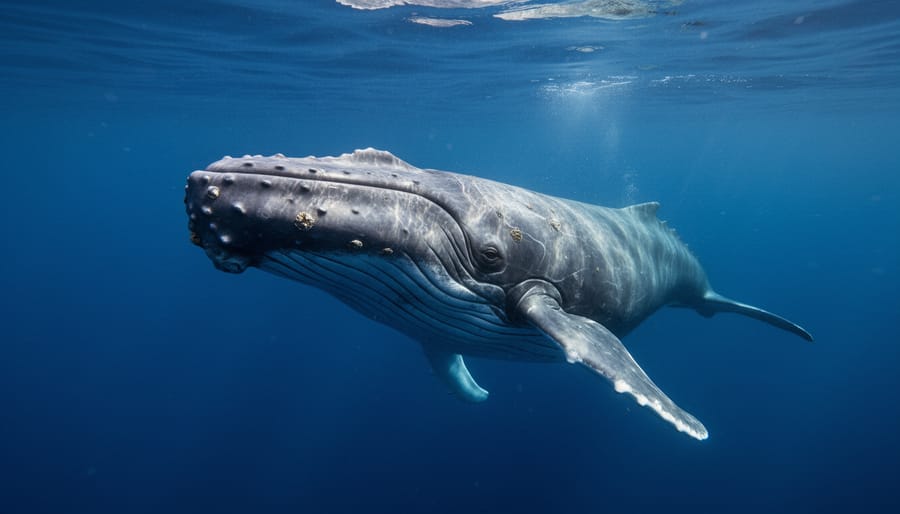
Marine mammals have evolved remarkable buoyancy control systems that allow them to dive to extraordinary depths while managing the physiological challenges of pressure changes. Unlike fish with their swim bladders, whales and dolphins rely on a sophisticated combination of specialized organs, tissue composition, and behavioral adaptations to navigate the ocean’s vertical realm.
The spermaceti organ in sperm whales represents one of nature’s most fascinating buoyancy mechanisms. This massive structure, located in the whale’s head and filled with waxy spermaceti oil, may function as a density-regulating system. The leading hypothesis suggests that by cooling or warming this oil through controlled blood flow, sperm whales can adjust its density, becoming heavier to descend or lighter to ascend. While this theory continues to be studied and debated among marine biologists, it highlights the complex physiological adaptations these deep-diving mammals possess.
Blubber serves multiple crucial functions beyond insulation. The lipid-rich tissue’s composition and distribution affect a marine mammal’s overall density and buoyancy. Different blubber layers have varying densities, and seasonal changes in blubber thickness can influence diving efficiency. Some species strategically adjust their body composition before extended diving periods.
Air in the lungs plays a dynamic role, though marine mammals typically exhale before deep dives to avoid nitrogen absorption and decompression sickness. Collapsible lungs and flexible rib cages allow safe compression at depth, while oxygen is primarily stored in blood and muscle tissues rather than air spaces.
Active diving behaviors complement these anatomical features beautifully. Marine mammals control their descent and ascent rates through swimming strokes and body positioning. Dr. Sarah Chen, a marine physiologist who has studied dolphin diving patterns for fifteen years, shares that “watching dolphins adjust their swimming angle to achieve neutral buoyancy is like witnessing underwater ballet—it’s precise, efficient, and absolutely mesmerizing.”
Understanding these mechanisms helps us appreciate how marine mammals, including deep-sea sharks, have conquered extreme ocean environments through evolutionary innovation.
Gas-Filled Chambers in Invertebrates: From Cuttlefish to Nautilus
Among the ocean’s most elegant buoyancy solutions are the gas-filled chambers found in cephalopods like cuttlefish and nautiluses. These anatomical features represent millions of years of evolutionary refinement, allowing these animals to hover effortlessly at various depths without expending energy on constant swimming.
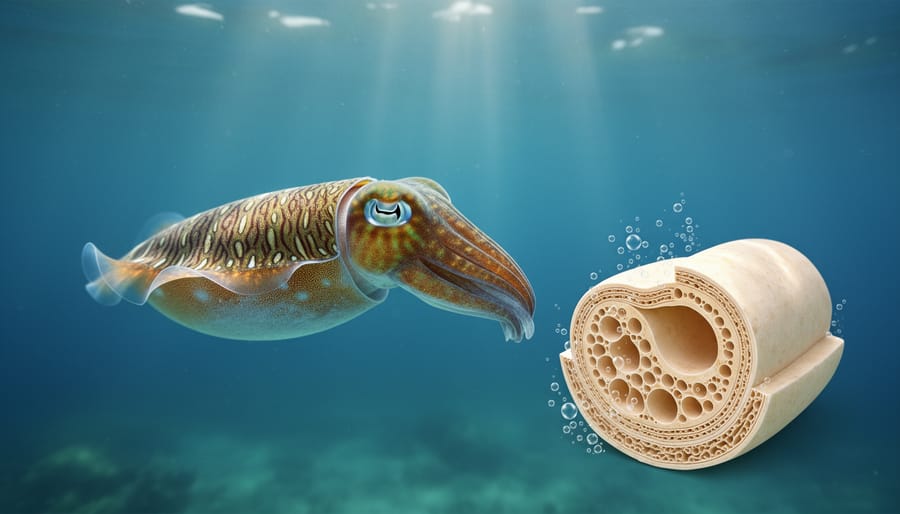
The cuttlebone, that chalky white structure often found washed up on beaches, is actually a sophisticated buoyancy organ inside the cuttlefish. This porous internal shell contains numerous tiny chambers filled with gas and fluid. By adjusting the ratio of gas to liquid in these chambers, cuttlefish can fine-tune their buoyancy with remarkable precision. They accomplish this through osmotic pumping, where specialized membranes actively transport ions to draw fluid out of chambers or allow it to seep back in, creating space for gas or adding ballast as needed.
The chambered nautilus employs a similar but more ancient system. As this living fossil grows, it continuously builds new, larger chambers in its spiral shell, sealing off older ones. These sealed chambers contain a mixture of gas and liquid that the nautilus regulates through a thin tissue called the siphuncle, which runs through all the chambers. This allows nautiluses to make vertical migrations of several hundred meters daily, rising to shallower waters at night to feed.
Marine biologist Dr. Sarah Chen, who studies cephalopod behavior in the Philippines, shares her fascination: “Watching a cuttlefish adjust its position in the water column is like observing a master engineer at work. They’re making constant micro-adjustments that we’re only beginning to understand fully.”
These buoyancy systems represent critical adaptations that have enabled cephalopods to thrive across diverse marine environments. Understanding these mechanisms helps us appreciate the complexity of marine life and underscores why protecting these species matters for ocean ecosystem health.
The Physiology Behind Gas Regulation
Understanding how marine animals regulate gases within their buoyancy organs reveals remarkable evolutionary adaptations that allow life to thrive at different ocean depths. These physiological processes involve intricate coordination between specialized tissues, blood chemistry, and cellular mechanisms that would make any engineer envious.
At the heart of gas regulation lies a fascinating network of capillaries called the rete mirabile, or “wonderful net.” This countercurrent exchange system functions like a biological gas concentrator, allowing fish to move oxygen from their blood into the swim bladder against tremendous pressure gradients. Marine biologist Dr. Elena Rodriguez, who has spent fifteen years studying deep-sea fish physiology, describes this process as “one of nature’s most elegant solutions to a complex problem.” The rete mirabile works by having arterial blood flowing in the opposite direction to venous blood, creating a concentration gradient that can increase oxygen levels in the swim bladder to hundreds of times atmospheric pressure.
The gas gland, a specialized epithelial tissue lining part of the swim bladder, produces lactic acid that lowers blood pH. This acidification triggers the release of oxygen from hemoglobin through the Root effect, a phenomenon unique to fish where even oxygen-saturated blood releases its cargo under acidic conditions. Simultaneously, carbon dioxide removal occurs through a separate structure called the oval, which contains muscles that can open or close to control gas release. This dual-system approach allows precise depth adjustments.
Nitrogen management presents its own challenges. Unlike oxygen, nitrogen doesn’t bind readily to blood proteins, requiring different strategies. Some deep-sea species replace nitrogen with other gases or use lipid-filled structures instead, avoiding nitrogen narcosis issues that human divers face.
For students and educators exploring these concepts, volunteer opportunities with marine research stations often include assisting with physiological studies. These hands-on experiences provide invaluable insights into how scientists measure blood chemistry changes and gas exchange rates in living specimens.
The efficiency of these systems depends on maintaining precise chemical balances, with specialized cells continuously monitoring and adjusting conditions to ensure survival across varying ocean depths and pressures.
Why Understanding These Systems Matters for Conservation
Understanding how marine animals control their buoyancy isn’t just fascinating science—it’s essential for protecting ocean life in our rapidly changing world. These delicate biological systems are among the first to show stress when environmental conditions shift, making them important indicators of ocean health.
Climate change is fundamentally altering the ocean environments where buoyancy systems evolved over millions of years. Rising water temperatures affect gas solubility, meaning fish swim bladders must work harder to maintain neutral buoyancy at their preferred depths. For species like deep-sea fish that have highly specialized buoyancy adaptations, even small temperature changes can force them into less suitable habitats. Many cannot migrate quickly enough to keep pace with warming waters, putting entire populations at risk.
Ocean acidification presents an equally serious threat, particularly for organisms that rely on calcium carbonate structures or lipid-based buoyancy. As seawater absorbs excess atmospheric carbon dioxide, its pH drops, making it harder for cephalopods to build and maintain their chambered shells. Research has shown that squid and cuttlefish in more acidic waters struggle with buoyancy regulation, affecting their ability to hunt, escape predators, and migrate.
Pollution compounds these challenges. Microplastics and chemical contaminants accumulate in the lipid-rich tissues that many sharks and marine mammals use for buoyancy control. Dr. Maria Sanchez, a marine physiologist studying shark migration patterns, shares: “We’ve documented how liver contamination in blue sharks correlates with altered diving behavior. These animals literally cannot maintain their normal depth ranges when their buoyancy organs are compromised.”
The good news is that research into these systems is helping conservation efforts worldwide. Scientists are using buoyancy behavior as an early warning system for ecosystem stress, while others develop better handling protocols for accidentally caught deep-sea species that experience barotrauma when brought to the surface too quickly.
You can contribute to this vital work. Organizations like the Marine Conservation Society and Oceana regularly seek citizen scientists to help monitor fish populations and document unusual behaviors that might indicate environmental stress. Even sharing your diving observations through platforms like iNaturalist provides researchers with valuable data about how marine animals are responding to changing ocean conditions.
The remarkable diversity of buoyancy control systems across marine life reveals nature’s extraordinary capacity for innovation. From the gas-filled swim bladders of bony fish to the oil-rich livers of deep-sea sharks, from the spermaceti organs of diving whales to the intricate shell chambers of nautiluses, each adaptation tells a story of millions of years of evolutionary refinement. These sophisticated mechanisms enable marine animals to occupy every depth of our oceans, from sunlit surface waters to the crushing pressures of the abyss.
Understanding these complex systems is more than an academic exercise. It equips us with crucial insights into how marine life may respond to environmental challenges like ocean acidification, rising temperatures, and changing ocean chemistry. When we comprehend how delicately balanced these buoyancy systems are, we recognize how vulnerable marine biodiversity truly is to disruption.
Dr. Sarah Chen, a marine physiologist studying deep-sea adaptations, reminds us that “every species we protect preserves millions of years of biological innovation.” Her research team regularly welcomes volunteers to assist with field observations and data collection.
You can make a difference. Support marine protected areas, participate in citizen science programs, or volunteer with local conservation organizations conducting marine surveys. Whether you’re sharing what you’ve learned with others, reducing your carbon footprint, or directly engaging in conservation fieldwork, your actions contribute to safeguarding these magnificent adaptations for future generations. The ocean’s biodiversity depends on our collective commitment to understanding and protecting it.

jessica
Ava Singh is an environmental writer and marine sustainability advocate with a deep commitment to protecting the world's oceans and coastal communities. With a background in environmental policy and a passion for storytelling, Ava brings complex topics to life through clear, engaging content that educates and empowers readers. At the Marine Biodiversity & Sustainability Learning Center, Ava focuses on sharing impactful stories about community engagement, policy innovations, and conservation strategies. Her writing bridges the gap between science and the public, encouraging people to take part in preserving marine biodiversity. When she’s not writing, Ava collaborates with local initiatives to promote eco-conscious living and sustainable development, ensuring her work makes a difference both on the page and in the real world.