Marine Biodiversity Science Center

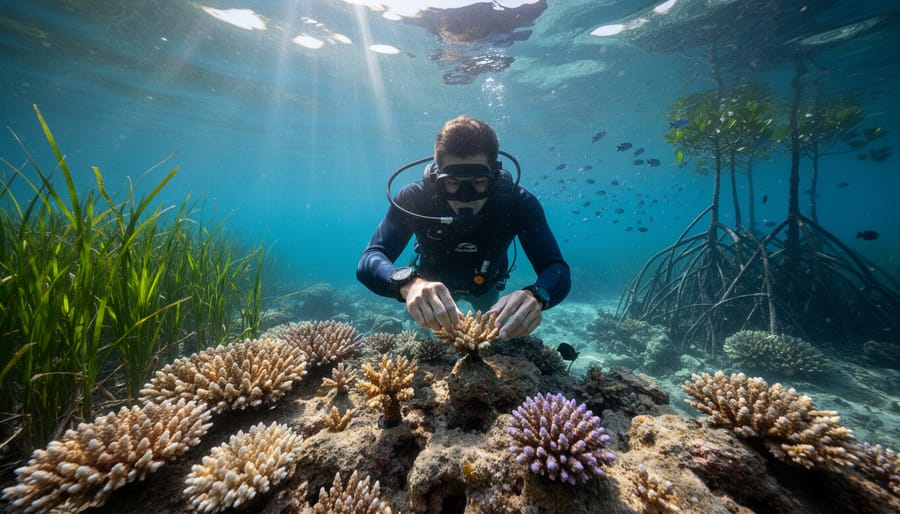
Ecosystem restoration is the process of assisting the recovery of an ecosystem that has been degraded, damaged, or destroyed, with the goal of returning it to a healthy, self-sustaining state. Unlike conservation, which protects ecosystems that are still relatively intact, restoration actively repairs ecosystems that have already suffered harm from pollution, overfishing, coastal development, or climate change.
In our oceans, restoration takes on particular urgency. Marine ecosystems like coral reefs, seagrass meadows, and mangrove forests support vast biodiversity while protecting coastlines and sequestering carbon. Yet human activities have damaged these systems at alarming rates. The good news? We now have proven techniques to rebuild them, and communities around the world are seeing tangible results.
The restoration process isn’t simply about planting corals or replanting seagrass and walking away. It requires understanding what caused the degradation in the first place, removing those stressors when possible, and then strategically rebuilding the ecosystem’s structure and function. Sometimes this means transplanting coral fragments onto degraded reefs. Other times it involves removing invasive species, improving water quality, or reintroducing native organisms that once thrived in the area.
What makes marine restoration especially compelling in 2026 is the combination of improved scientific understanding and expanding volunteer networks. Marine biologists have refined techniques that dramatically improve survival rates for transplanted corals and seagrasses. Meanwhile, dive clubs, schools, and coastal communities are joining restoration projects, transforming what was once the domain of specialists into a movement anyone can join.
This article breaks down exactly how ecosystem restoration works, the different approaches used in marine environments, and where these techniques are making measurable differences. Whether you’re considering joining a restoration project or simply want to understand this critical conservation tool, you’ll find the foundation you need here.
What Ecosystem Restoration Means for Our Oceans
Ecosystem restoration in the marine context is the process of assisting the recovery of ocean and coastal ecosystems that have been degraded, damaged, or destroyed by human activities or natural disasters. It goes beyond simply protecting what remains, restoration actively intervenes to rebuild habitat structure, reintroduce native species, and re-establish the ecological processes that sustain healthy marine life.
The urgency for restoration stems from decades of cumulative damage. Overfishing has stripped reefs of herbivorous fish that once controlled algae, allowing seaweeds to smother corals. Agricultural runoff and sewage have created oxygen-depleted dead zones where nothing can survive. Bottom trawling has scraped away complex seafloor habitats that took centuries to form. Climate change has warmed waters beyond the tolerance of temperature-sensitive species and acidified the ocean, weakening the shells and skeletons of countless organisms. In many locations, these pressures have pushed marine ecosystems past a tipping point where natural recovery alone would take generations, if it happens at all.
This is where restoration differs from related approaches. Understanding the distinctions helps clarify what each strategy can accomplish:
- Ecosystem restoration
- The active process of assisting recovery to return an ecosystem as closely as possible to its pre-disturbance condition, including its structure, species composition, and ecological functions.
- Rehabilitation
- A less intensive intervention that aims to repair ecosystem productivity and some services without necessarily recreating the original species mix or structure.
- Conservation
- Protecting existing healthy ecosystems from damage, preventing degradation before it occurs rather than repairing past harm.
- Baseline ecosystem
- The degraded current state of an ecosystem, used as the starting point for measuring restoration progress.
- Reference ecosystem
- A healthy, relatively undisturbed ecosystem used as a model or target for what a restored site should eventually resemble in structure and function.
- Ecological integrity
- The degree to which an ecosystem maintains its natural composition, structure, and processes, supporting native biodiversity and resilience to disturbance.
Marine restoration acknowledges that passive protection isn’t always enough. A coral reef choked by algae won’t spontaneously recover even if pollution stops, because the herbivorous fish that once grazed that algae are gone. A seagrass meadow scoured away by propeller scars may never naturally reseed if the nearest healthy meadow is miles away. In these cases, human intervention, transplanting corals, reintroducing fish, planting seagrass shoots, jumpstarts recovery and gives degraded ecosystems a fighting chance.
The goal isn’t to recreate a museum piece frozen in time, but to rebuild ecosystems resilient enough to adapt and sustain themselves. Restoration projects measure success by tracking species diversity, habitat complexity, and whether the ecosystem can maintain its functions, nutrient cycling, shoreline protection, fish production, without continued intensive management.
How Marine Ecosystem Restoration Works
The Role of Technology in Modern Marine Restoration
Technology has fundamentally changed how restoration scientists approach marine recovery work, compressing timelines that once stretched across decades into projects measurable in years. These advances matter because degraded ecosystems rarely bounce back on their own, the damage is too severe, the stressors too persistent.
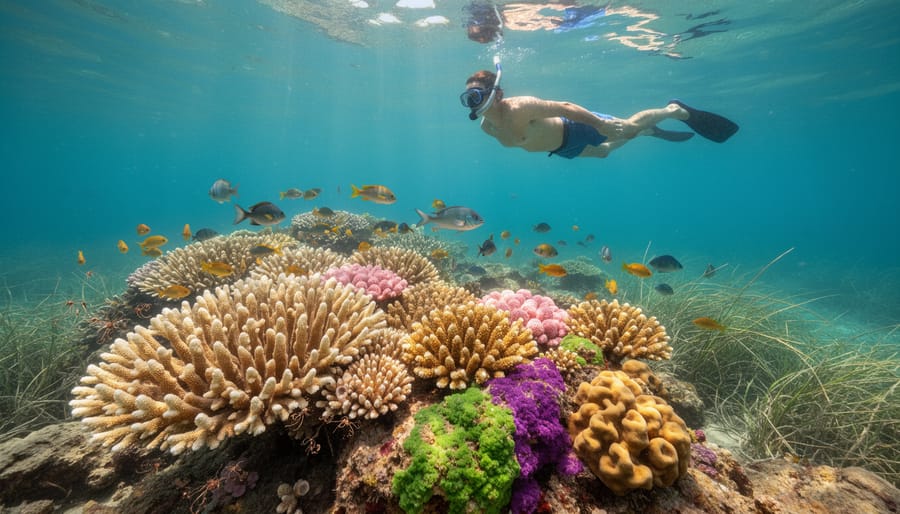
Coral micro-fragmentation exemplifies this acceleration. Instead of waiting years for coral colonies to mature naturally, scientists break healthy corals into thumbnail-sized fragments that grow 25 to 50 times faster than wild colonies. Within two years, these fragments can fuse into reef-building structures, creating habitat complexity that attracts fish and invertebrates almost immediately.
Three-dimensional printing now produces artificial reef structures with architectural precision impossible through traditional concrete moulds. Engineers design lattices that mimic natural reef topology, creating the nooks and overhangs that juvenile fish need for shelter. The calcium carbonate substrate encourages coral larvae to settle, jumpstarting colonization.
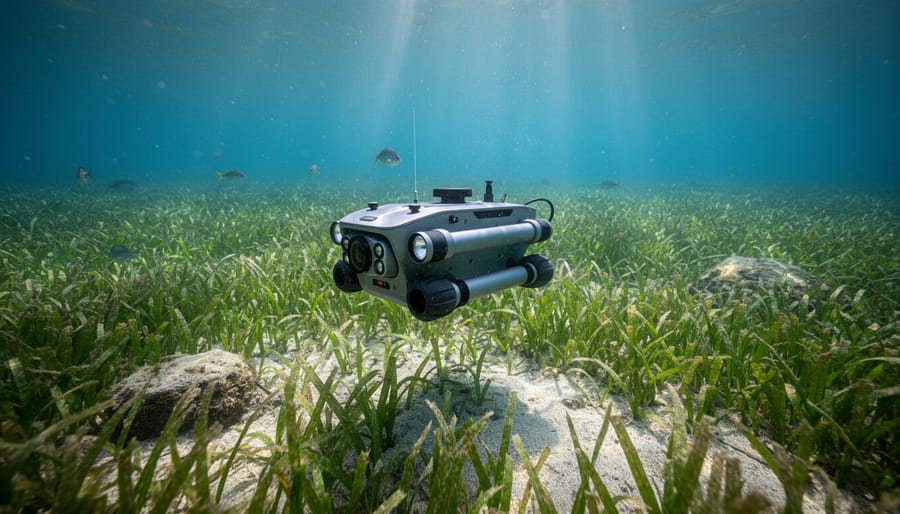
Underwater robots have transformed baseline assessment work. Before restoration begins, teams need detailed habitat maps showing substrate type, current patterns, and existing biodiversity. ROVs equipped with high-resolution cameras and sonar can survey vast areas in days, identifying optimal transplant sites and monitoring established projects without repeated diver deployments.
Genetic rescue techniques address a less visible problem: inbreeding depression in isolated populations. Restoration geneticists now mix coral or seagrass lineages from different regions to boost genetic diversity, producing offspring more resilient to warming waters and disease. Early trials show these hybrid populations withstand thermal stress that would bleach or kill genetically uniform colonies.
Marine monitoring systems using autonomous sensors track recovery in real time. Temperature loggers, pH meters, and acoustic recorders collect continuous data, alerting scientists to emerging threats like disease outbreaks or sudden temperature spikes. This constant vigilance lets teams intervene before small setbacks cascade into project failures, a level of responsiveness unimaginable when monitoring required monthly dive surveys.
Types of Marine Ecosystem Restoration
Coral Reef Restoration
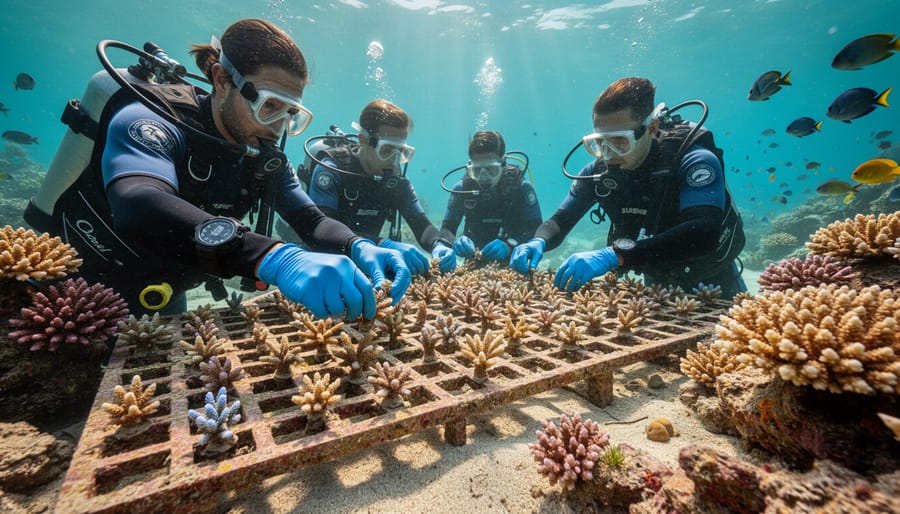
Coral gardening has emerged as one of the most promising approaches to reef recovery. Scientists collect small coral fragments from healthy donor colonies, grow them in underwater nurseries for 6-18 months, then transplant the mature pieces onto degraded reef areas. This method accelerates growth rates and allows practitioners to bring dead reefs back to functional ecosystems within years rather than decades.
Larval seeding introduces a complementary strategy. During annual coral spawning events, researchers capture millions of coral larvae and settle them directly onto prepared reef surfaces. This technique increases recruitment rates dramatically, recent projects in the Philippines achieved 40-times-higher settlement compared to natural processes.
Artificial reef structures provide immediate three-dimensional habitat. 3D-printed modules and steel frameworks give corals stable surfaces for attachment while creating shelter for fish and invertebrates. The Reef Stars project in the Maldives deployed 12,000 structures across degraded areas, with coral cover reaching 60% within two years. These engineered foundations work especially well where natural substrate has been destroyed by blast fishing or storm damage.
Seagrass Meadow Recovery
Seagrass restoration begins with a fundamental prerequisite: improving water clarity and quality. Without addressing nutrient pollution and sediment runoff, new plantings simply won’t survive. Once conditions stabilize, restoration teams employ two primary approaches.
Transplantation involves harvesting shoots with intact rhizomes from healthy donor beds and anchoring them in degraded areas using biodegradable mats or staples. This method establishes immediate coverage but requires significant labor and can stress donor populations if not carefully managed.
Seed broadcasting offers a less invasive alternative. Restoration practitioners collect reproductive shoots during flowering season, extract seeds, and distribute them across suitable substrate, either by hand or using specialized vessels that ensure even coverage. While germination rates vary and establishment takes longer than transplantation, this technique allows restoration at larger scales with minimal impact on existing meadows.
Most successful projects combine both methods: transplanted plots provide quick stabilization and serve as seed sources, while broadcast areas expand coverage over time. Continuous monitoring of shoot density and genetic diversity ensures the restored meadow develops resilience against future disturbances.
Mangrove Forest Rehabilitation
Mangrove restoration combines hands-on community planting with cutting-edge technology to rebuild these vital coastal forests. Traditional approaches involve volunteers hand-planting propagules, the seedlings that drop from mature mangroves, in cleared areas during low tide. Success depends heavily on restoring natural water flow patterns, since many mangrove forests were degraded by roads, dikes, or drainage systems that disrupted tidal exchange.
Modern projects increasingly use drones to broadcast mangrove seeds across large inaccessible areas, covering in hours what would take months by hand. Some restoration teams deploy 3D hydrological modeling to identify optimal planting sites and predict how water will move through restored areas. The technology works best when paired with community knowledge, local residents often remember where mangroves thrived decades ago and understand seasonal flooding patterns that datasets miss.
Rehabilitation projects typically see measurable canopy growth within three years if the underlying hydrology is corrected first. Without fixing water flow, even perfectly planted mangroves struggle to survive.
Oyster Reef Reconstruction
Oyster reef reconstruction creates the structural foundation for entire coastal communities to thrive. Unlike flat oyster beds, three-dimensional reefs provide vertical habitat that attracts fish, crabs, and other marine life while delivering tremendous water filtration, a single adult oyster can filter 50 gallons of water daily.
Restoration teams deploy recycled oyster shells collected from restaurants as substrate for hatchery-raised juvenile oysters, called spat. The shells give larvae a clean, hard surface to attach to, mimicking natural recruitment. Some projects use specially designed concrete reef balls or limestone modules that withstand wave action and create the complex structure oysters need.
Success depends on site selection. Ideal locations have moderate salinity, minimal sedimentation, and protection from boat traffic. Once established, oyster reefs are self-sustaining: adult oysters spawn millions of larvae that settle on the existing reef, expanding it naturally.
The ecological payoff extends beyond filtration. Restored reefs buffer shorelines from erosion, sequester carbon in their shells, and rebuild fish populations. Projects in Chesapeake Bay and coastal Louisiana demonstrate how strategic oyster restoration transforms murky, depleted waters into clear, productive ecosystems within five years.
Where and Why Marine Restoration Is Applied
Marine restoration projects launch in response to specific environmental crises and community needs, with success measured in recovering fish populations, rebuilt coastlines, and healthier ecosystems supporting both wildlife and people. The ecosystem restoration benefits extend far beyond ecological recovery alone.
Coastal communities turn to restoration when storm damage, erosion, or sea-level rise threaten homes and infrastructure. Mangrove forests along tropical shorelines act as natural breakwaters, absorbing wave energy that would otherwise destroy property and lives. After the 2004 Indian Ocean tsunami, countries including Thailand and Indonesia invested heavily in mangrove restoration, not just for wildlife, but because intact mangrove belts reduce coastal flooding by up to 66 percent compared to cleared areas. Similar oyster reef projects along the U.S. Gulf Coast rebuild three-dimensional structures that dampen wave action while providing nursery habitat for commercially important species.
Fisheries agencies pursue restoration to reverse decades of stock depletion. Seagrass beds and oyster reefs function as nurseries where juvenile fish find food and shelter before migrating to deeper waters. When Mobile Bay in Alabama restored 100 acres of oyster habitat between 2010 and 2018, researchers documented a five-fold increase in fish abundance within two years. These results drive ecosystem-based fisheries approaches that recognize habitat restoration as essential to sustainable harvests.
Climate mitigation programs increasingly fund marine restoration because healthy coastal ecosystems store carbon at rates surpassing terrestrial forests. Mangroves, seagrasses, and salt marshes sequester carbon in their soils for centuries. The Mikoko Pamoja project in Kenya, the world’s first blue carbon initiative, protects and restores 117 acres of mangrove while generating carbon credits that fund community development, schools, water systems, healthcare.
Restoration opportunities exist for people at every skill level. The Marine Biodiversity Preservation Center coordinates volunteer days where participants help transplant seagrass shoots, build oyster recruitment structures, or collect data during monitoring surveys. University students gain field experience through semester-long internships. Local divers photograph restored reefs to track coral growth. Community members raise awareness through social media and educational events. These collective efforts prove that marine ecosystem recovery isn’t just the work of scientists in remote locations, it happens through sustained, hands-on participation in regions from the Caribbean to Southeast Asia to the Pacific Northwest.
Stories from the Field: Marine Biologists Making a Difference
Dr. Elena Vasquez still remembers the moment she realized coral restoration could work. Kneeling on the seafloor off the Florida Keys in 2018, she watched a fragment she’d planted two years earlier spawn for the first time, releasing tiny pink bundles of eggs and sperm into the current. “I actually cried into my regulator,” she admits. “That colony came from a pencil-sized piece. Seeing it reproduce meant we’d created something resilient enough to sustain itself.”
Today, Elena leads a restoration team that maintains underwater coral nurseries across three Caribbean sites. Her typical day involves predawn boat departures, hours of underwater work cleaning algae from nursery frames, and evenings spent training volunteers in fragment handling techniques. The physical demands are real, she’s learned to ignore the shoulder aches from tank carrying and the perpetual sun damage, but what keeps her going are the incremental victories. Last month, her team’s restored patch reef attracted a hawksbill turtle, the first seen in that area in a decade.
Across the Pacific, marine ecologist James Keahi brings a different perspective to seagrass restoration in Hawaii. Growing up fishing with his grandfather, he watched meadows shrink from sedimentation and coastal development. His restoration work feels like repaying a debt. “We’re not inventing anything new,” he explains. “We’re helping the ocean do what it’s always done, heal itself when given the chance.”
James’s biggest challenge isn’t the science; it’s patience. Seagrass restoration moves slowly, and funders want immediate results. He’s learned to celebrate small wins: the first fish returning to a replanted plot, the gradual clearing of murky water as roots stabilize sediment.
Both scientists emphasize that restoration isn’t solo work. Elena’s projects rely on trained volunteers who collectively contribute thousands of dive hours annually. Our center’s volunteer programs connect people directly with practitioners like Elena and James, transforming abstract concern for ocean health into hands-on participation in its recovery.
Common Questions About Marine Ecosystem Restoration
Marine ecosystem restoration raises many practical questions for those new to the field. Understanding the realities of restoration work helps set appropriate expectations and reveals meaningful ways to participate in ocean recovery efforts.
How long does marine ecosystem restoration take to show results?
Initial signs of recovery often appear within months, new fish species returning to restored reefs or seagrass shoots establishing, but achieving a fully functioning, self-sustaining ecosystem typically requires 10 to 30 years of continued monitoring and adaptive management.
Can severely damaged marine ecosystems fully recover?
Many degraded systems can recover substantial ecological function, though the endpoint may differ from historical conditions due to climate shifts and species changes. Complete restoration to a pre-disturbance state is rare, but meaningful recovery that supports biodiversity and provides ecosystem services is achievable with sustained effort.
How much does marine restoration cost?
Costs vary dramatically by ecosystem type and scale, ranging from a few thousand dollars for small community seagrass projects to millions for large coral reef initiatives involving advanced technologies. Most projects require ongoing funding for monitoring and maintenance beyond initial installation.
How can individuals get involved in restoration work?
Many marine centers and conservation organizations offer volunteer opportunities for reef monitoring, beach cleanups preceding restoration, and citizen science data collection. No specialized training is typically required for entry-level participation, though some technical roles need certification.
The distinction between restoration and other conservation approaches sometimes confuses newcomers to marine work. While conservation focuses on protecting intact ecosystems from future harm and preservation aims to maintain current conditions without active intervention, restoration actively repairs damage that has already occurred. All three strategies work together in comprehensive ocean management, healthy reefs need protection, degraded ones need restoration, and everything benefits from reduced pollution and sustainable fishing practices.
Success rates depend heavily on how you define success and which ecosystem you’re working with. Projects that aim to jump-start natural recovery processes rather than maintain artificial conditions tend to achieve better long-term outcomes. Mangrove replanting succeeds in roughly 60 to 80 percent of well-planned projects, while coral restoration faces more variables but can achieve significant local improvements when water quality and temperature stress don’t overwhelm the effort. The key is setting realistic goals from the start, adapting methods based on monitoring data, and recognizing that partial recovery still provides substantial ecological value.
The promise of marine ecosystem restoration lies not in reversing every impact humans have made, but in demonstrating that recovery is possible when we apply scientific understanding and collective effort. Coral reefs thought lost forever have begun rebuilding. Seagrass meadows are filtering water again. Mangrove forests are protecting coastlines while sequestering carbon. These successes prove that degraded marine environments can heal when given the right support.
Your role in this recovery doesn’t require advanced degrees or specialized equipment. Staying informed about ocean health issues, supporting evidence-based conservation initiatives, and participating in local restoration efforts all contribute to broader change. Many marine research centers welcome volunteers for everything from water quality monitoring to habitat surveys to hands-on planting events. These experiences connect you directly to restoration work while building the community support that makes long-term projects viable.
The technologies and methods described throughout this article represent our growing capacity to restore what’s been damaged, but tools alone won’t save the ocean. Restoration succeeds when science meets sustained human commitment, researchers designing interventions, communities implementing them, and individuals like you ensuring they continue. Every restored hectare of habitat supports thousands of marine species while delivering benefits to coastal communities who depend on healthy oceans.
The question isn’t whether marine ecosystems can recover. We already know they can. The question is whether we’ll provide the support they need to do so.

jessica
Ava Singh is an environmental writer and marine sustainability advocate with a deep commitment to protecting the world's oceans and coastal communities. With a background in environmental policy and a passion for storytelling, Ava brings complex topics to life through clear, engaging content that educates and empowers readers. At the Marine Biodiversity & Sustainability Learning Center, Ava focuses on sharing impactful stories about community engagement, policy innovations, and conservation strategies. Her writing bridges the gap between science and the public, encouraging people to take part in preserving marine biodiversity. When she’s not writing, Ava collaborates with local initiatives to promote eco-conscious living and sustainable development, ensuring her work makes a difference both on the page and in the real world.