Marine Biodiversity Science Center

Coral reefs do not know they live downstream of a mine. Fish do not know either. But the water carries that information regardless. Dissolved heavy metals, sulfuric acid, and suspended solids do not announce their arrival. They accumulate over the years while the reef slowly bleaches and the fish populations quietly reorganize themselves around a habitat that is no longer what it was.
By the time anyone draws the line between the decline and its cause, the investigation is long, the damage is documented, and the window for easy intervention is closed some time ago.
Modern technology has changed this story. Not by making mining clean, exactly, but by making contaminated mine water treatable before it travels anywhere it should not.
1. Treating Water at the Mine Is the Only Intervention That Works
Downstream remediation of marine pollution is genuinely difficult. Heavy metals that have settled into sediment do not come back out cleanly. Acid that has moved through a river system and reached a coastal environment has already done its work. Trying to fix marine pollution after the water has left the mine is the environmental equivalent of trying to un-ring a bell.
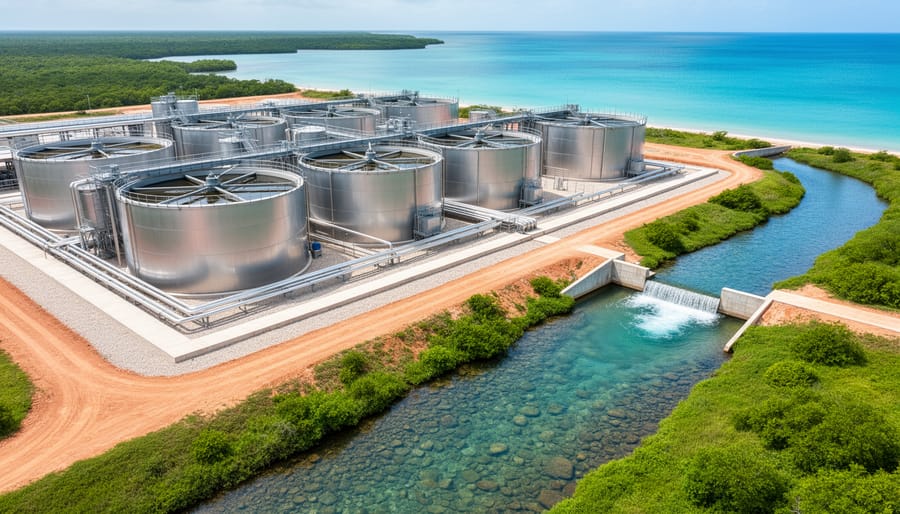
Mine water treatment solutions work differently. Treatment happens at the source, before contaminated water leaves the site. Heavy metals get removed. pH gets stabilized. Suspended solids get filtered out. The water that leaves the operation is water that coastal ecosystems can receive without consequence. The entire downstream problem disappears because it was addressed at the point where it was still addressable.
2. Monitoring Systems Catch Problems Before They Become Events
Mining operations do not usually contaminate waterways in one dramatic incident. Most of the time, there is no single incident. The contamination works its way out through a slow seep that nobody clocked, an infrastructure failure that looked minor until it wasn’t, a drainage system that handled normal rainfall fine and discovered its limits during an unusually wet March. By the time anything reaches a marine habitat, the source has typically been active for longer than anyone wants to admit. Continuous monitoring within mine water treatment solutions tracks pH, metal concentrations, conductivity, and flow across multiple site points in real time.
The alert arrives at the mine. Not at the river mouth, not at the coast, not at the point where fixing it requires a very uncomfortable series of conversations. The intervention happens while the problem is small rather than after it has traveled through a watershed.
3. Passive Treatment Works Where Infrastructure Cannot
Not every mining operation sits near reliable power and supply chains. Remote sites, legacy operations, and mines in developing regions face real constraints on the active treatment systems that require ongoing chemical inputs and mechanical maintenance. These are precisely the operations that historically sent untreated water downstream.
Passive mine water treatment solutions, constructed wetlands, permeable reactive barriers, and natural aeration systems use biological and chemical processes that require minimal ongoing inputs. They are not as precise as active treatment in every parameter. But they are dramatically better than nothing, and they can be deployed in locations where conventional infrastructure would not survive.
4. Treated Water Becomes a Resource, Not a Liability
The framing shift that has changed how thoughtful mining operations approach water management is this: treated water is not waste. Depending on the treatment standard achieved, it can be reused within the mine for processing or dust suppression, or discharged to receiving waterways at quality levels that support rather than suppress aquatic life.
Operations in water-scarce regions have particular reason to pursue mine water treatment solutions with recovery in mind. The water they are treating has value on-site. The marine habitats downstream have reason to benefit from the fact that it never arrived carrying what it once would have.
Conclusion
Marine habitats downstream of mining operations are not automatically casualties. Treatment technology that removes contaminants before they leave the mine site exists and is being deployed. The gap between what is technically possible and what is happening at every operation is a question of investment and enforcement, not capability.

jessica
Ava Singh is an environmental writer and marine sustainability advocate with a deep commitment to protecting the world's oceans and coastal communities. With a background in environmental policy and a passion for storytelling, Ava brings complex topics to life through clear, engaging content that educates and empowers readers. At the Marine Biodiversity & Sustainability Learning Center, Ava focuses on sharing impactful stories about community engagement, policy innovations, and conservation strategies. Her writing bridges the gap between science and the public, encouraging people to take part in preserving marine biodiversity. When she’s not writing, Ava collaborates with local initiatives to promote eco-conscious living and sustainable development, ensuring her work makes a difference both on the page and in the real world.