Marine Biodiversity Science Center

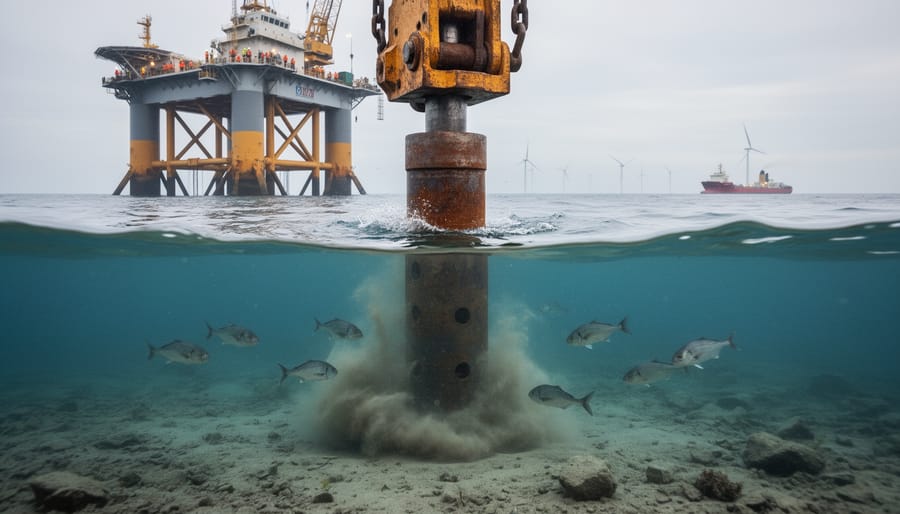
Massive steel monopiles weighing up to 1,500 tons pierce the seafloor with hydraulic hammers generating underwater noise levels exceeding 200 decibels—loud enough to physically injure fish and marine mammals within several kilometers. This forceful entry marks just the beginning of how offshore wind turbine installation reshapes ocean environments, from the moment construction vessels anchor in staging areas through the final blade attachment hundreds of feet above the waves.
Understanding the installation process reveals why renewable energy impacts on marine life extend far beyond a turbine’s operational phase. Each installation method—whether driving foundations deep into sediment, drilling into bedrock, or positioning gravity-based structures—disturbs habitats in distinct ways that marine biologists and conservationists must carefully assess.
The collision between renewable energy ambitions and ocean ecosystem protection creates urgent questions. Offshore wind farms promise clean electricity for millions while simultaneously displacing marine species, disrupting migration corridors, and altering seafloor communities that took decades to establish. Installation activities compress years of intensive construction into marine spaces where sound travels four times faster than in air and sediment clouds can drift for miles.
Marine biologists working at installation sites document behavioral changes in dolphins, displacement of commercial fish stocks, and burial of benthic organisms under redistributed sediments. These observations don’t argue against offshore wind development but rather emphasize the critical need to understand exactly how turbines enter our oceans—because only through this knowledge can we develop installation techniques that minimize harm while advancing renewable energy goals.
The following exploration examines each installation phase with equal attention to engineering requirements and ecological consequences, providing the technical foundation necessary for informed environmental stewardship.
The Complex Journey: How Wind Turbines Travel from Shore to Sea
Before a single turbine rises from the ocean, a remarkable logistical ballet unfolds across coastal ports and open waters. Understanding this journey reveals not only the impressive engineering behind offshore wind energy but also when and where marine ecosystems first encounter these massive structures.
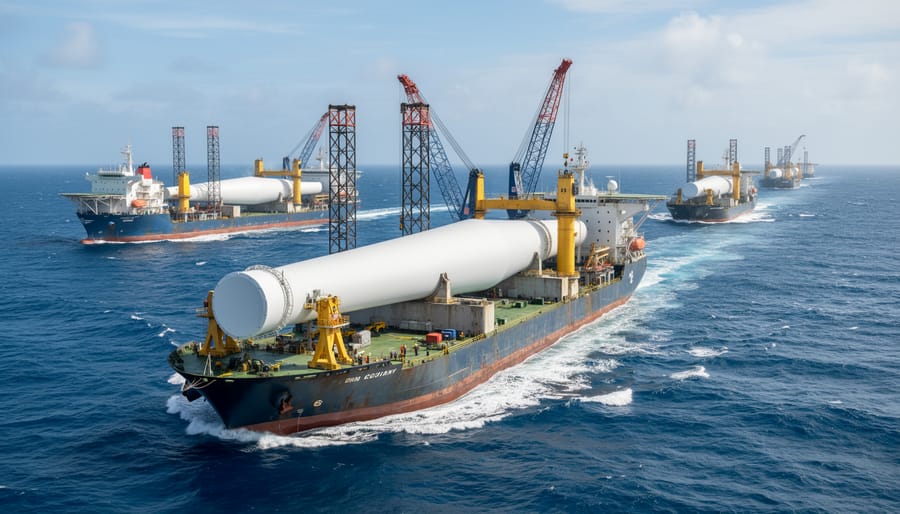
The process begins at specialized staging areas, typically located in deepwater ports equipped to handle extraordinary cargo. Individual turbine components dwarf everyday objects: a single blade can stretch over 80 meters long, while nacelles (the turbine’s power-generating housing) weigh upward of 400 tons. Tower sections, foundation pieces, and substations add to this colossal inventory. These components arrive at ports via truck or barge, where they’re carefully inspected and prepared for their ocean voyage.
Transportation relies on purpose-built vessels that function as floating construction platforms. Jack-up vessels, equipped with retractable legs that anchor into the seabed, provide stable working platforms in open water. Heavy-lift vessels transport foundations and tower sections, while specialized cable-laying ships handle the intricate work of connecting turbines to shore. Many marine biologists working in coastal assessment teams have shared how these vessels, some spanning football-field lengths, temporarily transform quiet marine areas into bustling industrial zones.
The timing of these voyages matters tremendously for ocean life. Weather windows dictate travel schedules, but increasingly, environmental considerations influence departure times. Operators may avoid certain seasons to minimize disruption during critical spawning periods or migration routes, though this practice varies by region and regulatory requirements.
Once offshore, components aren’t installed immediately. Vessels often stage equipment at the installation site itself, creating temporary floating warehouses. This phase marks the transition from transportation to installation, and it’s during this period that marine environments begin experiencing the physical presence of offshore wind development. For ecosystems accustomed to relatively undisturbed waters, this influx of activity represents a significant change, setting the stage for the more intensive impacts that installation itself will bring.
Foundation Installation Methods and Their Physical Footprint
Monopile Foundations: The Hammer That Echoes Through the Ocean
The installation of monopile foundations creates one of the most dramatic physical disturbances in offshore wind construction. These massive steel cylinders, measuring up to 10 meters in diameter and weighing several hundred tons, must be driven deep into the seabed using powerful hydraulic hammers that deliver thousands of blows over several hours.
The hammering process generates extraordinary forces that transform the immediate marine environment. Each strike drives the monopile several centimeters deeper, compacting sediments and displacing seafloor materials in all directions. This compression creates pressure waves that radiate outward, fundamentally altering sediment structure up to 50 meters from the installation point.
Dr. Elena Vasquez, a marine biologist who monitored installations off the Massachusetts coast, describes what she witnessed: “The sediment plume was visible from the surface, spreading like a massive underwater dust storm. We documented infaunal communities buried under redistributed sediments, essentially suffocating entire micro-ecosystems that had taken decades to establish.”
The physical penetration destroys everything in the monopile’s path. Burrowing organisms, shellfish beds, and complex sediment layers developed over centuries vanish within hours. The displaced sediment settles across surrounding areas, smothering benthic communities that depend on specific substrate conditions.
Perhaps most concerning is the immediate habitat fragmentation. Installation vessels, anchoring systems, and safety zones create exclusion areas spanning several square kilometers per turbine. Mobile species may relocate, but sessile organisms face complete habitat loss.
Yet understanding these impacts allows for strategic mitigation. Seasonal timing restrictions, pre-installation surveys, and careful site selection can reduce damage to critical habitats. Many installation companies now work with marine biologists to identify areas where ecological recovery potential remains highest, turning awareness into meaningful conservation action.
Jacket and Lattice Structures: Multiple Points of Seafloor Disruption
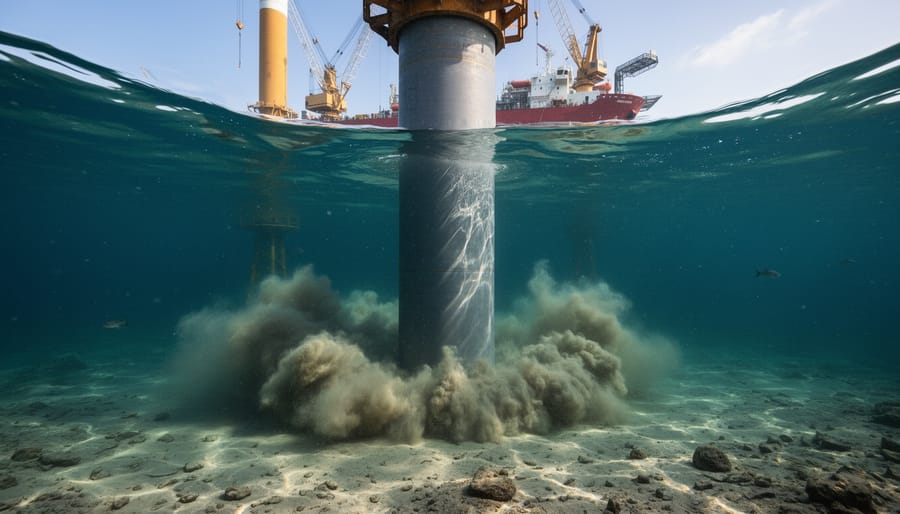
Jacket structures represent an alternative foundation design that distributes seafloor disruption differently than monopiles. These lattice-like frameworks, resembling oil rig platforms, stand on three to eight legs, each secured by smaller-diameter piles driven into the seabed. While individual piles measure only 1.5 to 3 meters in diameter, significantly smaller than monopiles, their cumulative impact creates a broader footprint across the ocean floor.
Installation begins with positioning the pre-assembled jacket structure, often weighing several hundred tons, using specialized vessels. Each leg requires separate pile driving, multiplying the number of impact zones. A four-legged jacket might disturb four distinct seafloor areas within a 20-meter radius, fragmenting habitat rather than concentrating damage in one location. This dispersed pattern affects benthic communities differently, potentially disrupting multiple microhabitats simultaneously.
Marine biologist Dr. Sarah Chen, who monitored a jacket installation off Massachusetts, observes that “the multiple disturbance points create corridors between impact zones where sediment plumes intersect, affecting larger swaths of seafloor than the pile footprints alone suggest.” Her research team documented how creatures like Atlantic rock crabs moved between disturbed zones, expending energy navigating the altered landscape.
The upside? Smaller piles generate less noise per strike and require fewer hammer blows. However, repeating the process across multiple legs extends the overall disturbance duration. For volunteers participating in pre-construction surveys, documenting baseline conditions across these wider impact areas becomes crucial for understanding long-term ecosystem changes and informing future installation practices that minimize habitat fragmentation.
Gravity-Based Foundations: The Weight of Renewable Energy
Gravity-based foundations represent one of the most visibly impactful installation methods for offshore wind turbines. These massive structures—typically constructed from steel-reinforced concrete and weighing up to 3,000 tons—rely purely on their enormous weight to remain stable on the seafloor.
Before installation, the seabed undergoes extensive preparation. Marine construction crews must level and sometimes excavate the installation site, removing existing sediment layers to create a stable base. This process causes immediate seafloor habitat destruction, displacing countless benthic organisms like crabs, worms, and mollusks that depend on undisturbed sediment.
Once positioned, these foundations permanently alter the benthic environment. The sheer footprint—often covering 1,000 square meters or more per turbine—eliminates natural habitat beneath the structure. Sediment patterns change around the base, affecting how nutrients circulate and where marine life can settle.
Marine biologist Dr. Sarah Chen, who has studied installation sites, notes that “recovery timelines for these altered areas span decades, not years.” However, she remains cautiously optimistic: “Understanding these impacts helps us develop better installation practices and identify opportunities for habitat restoration around existing structures.”
Floating Foundations: A Different Kind of Disturbance
Floating turbine technology represents a significant shift in offshore wind installation, offering access to deeper waters while creating different environmental challenges. Rather than fixed foundations, these turbines use buoyant platforms anchored to the seafloor through mooring systems, typically positioned 60 to 1,300 meters below the surface.
The installation process involves towing pre-assembled turbines to their locations and securing them with anchoring systems. Common designs include catenary moorings with heavy chains draped across the seafloor, creating drag zones that disturb sediment over wide areas. Suction anchors or driven piles penetrate the seabed, while drag embedment anchors require extensive seafloor contact during installation.
Each mooring line affects benthic habitats differently than traditional foundations. The constant movement of chains against the seafloor creates ongoing disturbance zones, preventing habitat recovery. Marine biologist Dr. Sarah Chen observed during a research dive that “the swept area beneath floating platforms can extend 200 meters in any direction, creating persistent sediment plumes that affect filter-feeding organisms.”
Though individual anchor points disturb smaller areas than monopiles, each floating turbine requires multiple anchors, multiplying the overall seafloor footprint considerably.
Cable Laying and Seafloor Trenching: The Hidden Infrastructure
While wind turbines capture our attention as they rise above the waves, beneath the surface lies an equally significant infrastructure: the network of subsea cables connecting each turbine to its neighbors and ultimately to shore. This hidden web of electrical transmission creates linear corridors of disturbance across the ocean floor, impacting marine habitats in ways that persist long after installation.
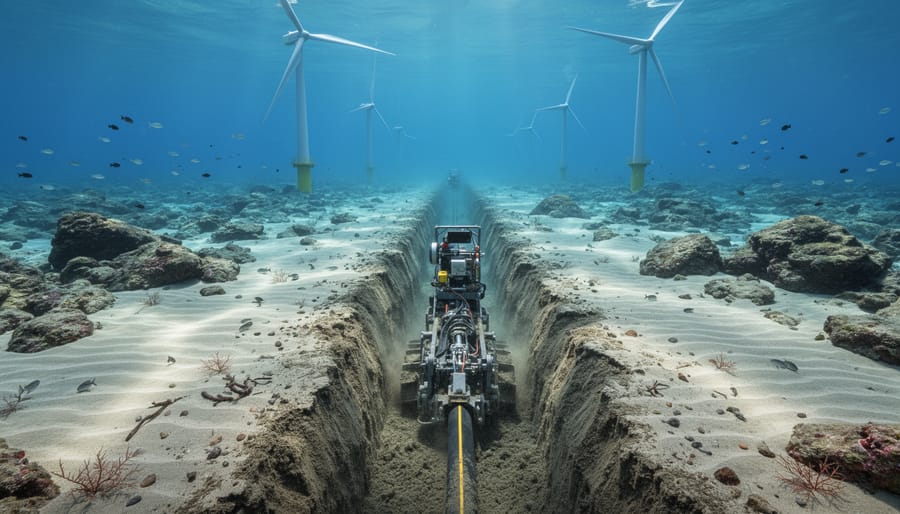
The cable installation process begins with route surveys using sonar and remotely operated vehicles to map the seafloor and identify sensitive habitats. Once routes are determined, specialized cable-laying vessels pay out thick armored cables along predetermined paths. These cables typically measure 10-30 centimeters in diameter and must connect individual turbines within the array before converging into larger export cables that deliver power to onshore substations.
To protect cables from fishing gear, anchors, and natural erosion, burial becomes essential. Trenching machines, either towed behind vessels or self-propelled, cut channels into the seabed typically 1-3 meters deep. Several methods achieve this: mechanical cutters physically slice through sediment, water jetting uses high-pressure streams to fluidize and displace material, and plowing techniques combine both approaches. Each method creates a temporary scar across the seafloor, disturbing everything in its path.
The scale of disturbance is considerable. A single wind farm might require 50-100 kilometers of inter-array cables plus additional export cables stretching to shore. The trenching corridor itself spans 3-5 meters wide, displacing sediment and crushing or burying bottom-dwelling organisms including shellfish, worms, crustaceans, and immobile species. Marine biologist Dr. Sarah Chen, who has monitored cable installation sites, describes finding “essentially sterile zones immediately after trenching, with recovery dependent entirely on sediment type and local conditions.”
These subsea cable impacts extend beyond the immediate trench. Sediment plumes generated during installation can drift considerable distances, smothering adjacent habitats. Rocky substrates prove particularly problematic, as trenching becomes impossible and cables must be surface-laid with protective mattresses, creating permanent habitat alterations.
Recovery timelines vary dramatically. Sandy bottoms may naturally refill trenches within months through wave action and currents, while muddy or biologically complex habitats might require years or decades for ecosystem function to return.
Immediate Physical Impacts on Marine Habitats
Sediment Plumes and Suspended Particles
When wind turbine foundations are driven into the seabed or when dredging occurs, enormous quantities of sediment become suspended in the water column, creating visible plumes that can extend for several kilometers from the installation site. These sediment clouds consist of fine particles including silt, clay, and organic matter that would normally remain settled on the ocean floor.
The impacts on marine life are multifaceted and concerning. Suspended sediments reduce water clarity, limiting the distance sunlight can penetrate and potentially disrupting photosynthesis in marine plants and phytoplankton. For fish and marine mammals, reduced visibility can interfere with navigation, feeding, and predator avoidance. Dr. Maria Santos, a marine biologist who has monitored multiple offshore wind projects, notes that “the plumes can persist for days depending on currents, affecting organisms far beyond the immediate construction zone.”
Filter feeders like mussels, oysters, and some whale species face particular challenges. While these organisms naturally process suspended particles, unnaturally high sediment concentrations can clog their filtering systems, reducing feeding efficiency and causing physiological stress. Benthic communities smothered by resettling sediments may experience localized mortality.
However, proper timing of installation activities during periods of lower biological activity and implementing turbidity monitoring programs can significantly reduce these impacts, offering hope for more sustainable installation practices.
Benthic Habitat Crushing and Removal
The moment foundation structures contact the seafloor, they irreversibly crush everything beneath them. Monopile and jacket foundations physically displace sediment and compress benthic habitat communities that have taken decades or centuries to establish. Slow-moving invertebrates like sea urchins, starfish, and crabs cannot escape the descending structures, while filter-feeding organisms such as clams and mussels are buried alive under displaced sediment.
The destruction extends beyond the immediate footprint. Installation vessels drop anchors weighing several tons, dragging across the seafloor and scarring habitats up to 100 meters away. Cable trenching operations carve channels through sediment, severing the connections between feeding grounds and nursery areas.
Marine biologist Dr. Sarah Chen, who documented installation impacts in the North Sea, recalls surveying a site days after foundation placement: “The seafloor looked like a construction zone. Where diverse communities once thrived, we found only compacted sediment and crushed shells.”
For sessile organisms—those permanently attached to hard surfaces—there is simply no escape. Reef-building species, sponges, and coral colonies vanish instantly, their complex structures providing no defense against thousands of tons of steel.
Displacement of Mobile Species
The intense noise and physical disturbance from pile driving, vessel traffic, and seafloor preparation force mobile marine species to temporarily or permanently abandon areas they depend on for survival. Fish species often flee construction zones within minutes of pile driving, with studies showing displacement extending up to 15 kilometers from the source. This retreat matters enormously when installation coincides with critical life stages like spawning migrations or seasonal feeding periods.
Marine mammals, including harbor porpoises and seals, demonstrate particularly pronounced avoidance behavior. Researchers tracking tagged porpoises during wind farm construction documented animals vacating their typical foraging grounds for weeks or months, forcing them to expend extra energy seeking alternative food sources. Dr. Maria Chen, a marine biologist who has monitored three offshore wind installations, shares a sobering observation: “We watched mother harbor seals with pups avoid their traditional haul-out sites during the loudest construction phases. These mothers faced impossible choices between exposing their young to harmful noise or swimming farther for rest and nursing.”
The timing of installation activities dramatically affects displacement severity. When construction occurs during breeding seasons or migration windows, consequences multiply. Some displaced species never return to historical habitats, even after construction ends, suggesting permanent behavioral changes.
Community scientists can contribute valuable displacement data through organized coastal observation programs. Volunteers documenting changes in local marine mammal sightings or fish catch locations provide crucial information helping regulators establish protective seasonal restrictions for future projects.
What Marine Scientists Are Learning from Installation Sites
Marine biologist Dr. Sarah Chen has spent three years monitoring installation sites off the Massachusetts coast, and her findings reveal a complex picture that challenges some assumptions. “What surprised us most wasn’t the disruption during pile driving, which we expected,” she explains. “It was how quickly certain species adapted and even thrived around the new structures.”
Her team documented unexpected colonization patterns, with blue mussels establishing dense populations on turbine foundations within months, creating artificial reef ecosystems that attracted fish species typically found in rocky coastal areas. These findings suggest that while installation creates immediate disturbance, the long-term ecological story involves both challenges and opportunities.
Research from European sites, where offshore wind has a longer history, provides valuable context. Scientists monitoring German North Sea installations discovered that pile driving noise caused harbor porpoises to temporarily relocate, but populations returned to pre-construction levels within two years. However, the data also revealed persistent behavioral changes in how these marine mammals navigate around operational turbines, emphasizing that impacts extend beyond the installation phase.
Dr. Marcus Rodriguez, who studies benthic communities off Rhode Island, shares a striking observation: “We found vibrant soft coral colonies growing on scour protection rock within eighteen months. These weren’t there before because the natural seabed was sandy. The installation fundamentally changed the habitat, and we’re still determining whether that’s beneficial or detrimental to the broader ecosystem.”
What excites many researchers is the growing involvement of citizen scientists. Volunteer monitoring programs now allow recreational divers and boaters to document marine life around installation sites, contributing valuable data while building public understanding. Organizations like the Ocean Conservancy offer training for volunteers interested in participating in baseline surveys before new installations begin.
These collaborative efforts help scientists answer critical questions: Which species are most vulnerable during installation? How can we refine techniques to minimize harm? And perhaps most importantly, what can each installation teach us to improve the next one?
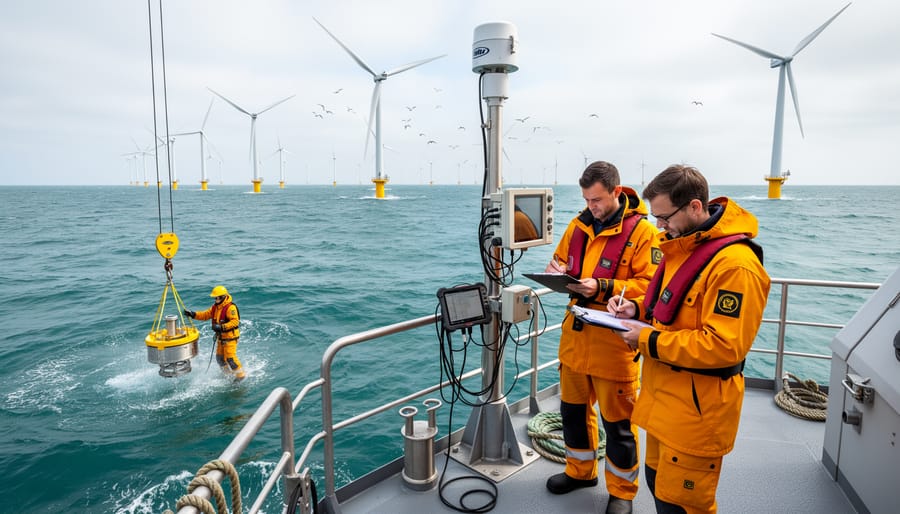
The installation of offshore wind turbines represents one of the defining challenges of our time: meeting urgent renewable energy needs while protecting the marine ecosystems we depend upon. As we’ve explored throughout this article, the physical impacts of pile driving, seabed excavation, cable installation, and vessel activity create real consequences for marine life during construction phases.
Understanding these impacts, however, is the crucial first step toward minimizing them. The marine science community has made significant progress in developing mitigation strategies that can reduce harm to marine mammals, fish populations, and benthic communities. From seasonal construction windows that avoid critical breeding periods to bubble curtains that dampen pile-driving noise, science-based approaches are already making a difference.
Yet the work is far from complete. Continued monitoring, research, and public engagement remain essential. Many coastal monitoring programs welcome volunteers to help track marine mammal movements, document fish populations, and assess habitat recovery. Your participation matters, whether through citizen science initiatives, supporting marine research, or simply staying informed about developments in your coastal waters.
The path forward requires balancing our climate goals with ocean stewardship. By staying engaged and supporting conservation efforts grounded in rigorous science, we can work toward offshore wind installations that power our communities while respecting the marine life that shares these waters. The future of both renewable energy and ocean health depends on this commitment.

jessica
Ava Singh is an environmental writer and marine sustainability advocate with a deep commitment to protecting the world's oceans and coastal communities. With a background in environmental policy and a passion for storytelling, Ava brings complex topics to life through clear, engaging content that educates and empowers readers. At the Marine Biodiversity & Sustainability Learning Center, Ava focuses on sharing impactful stories about community engagement, policy innovations, and conservation strategies. Her writing bridges the gap between science and the public, encouraging people to take part in preserving marine biodiversity. When she’s not writing, Ava collaborates with local initiatives to promote eco-conscious living and sustainable development, ensuring her work makes a difference both on the page and in the real world.