Marine Biodiversity Science Center

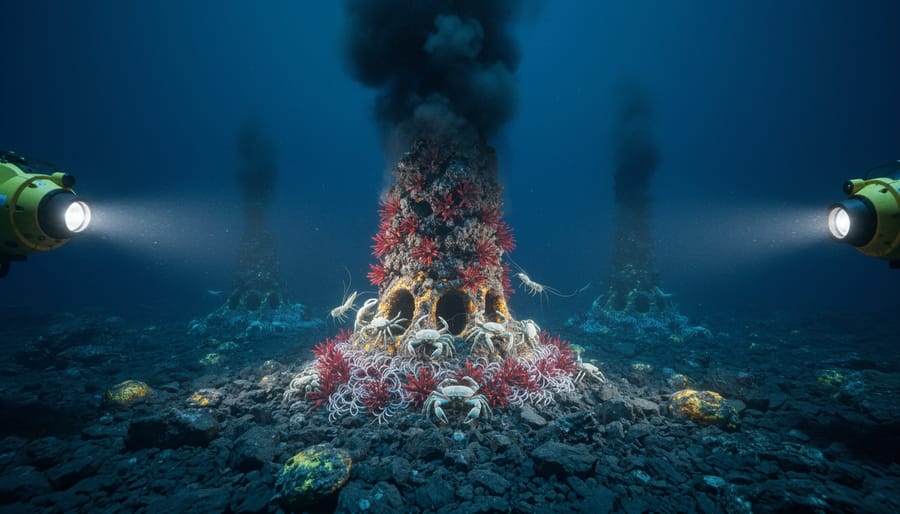
Deep beneath the ocean’s surface, where sunlight never penetrates and crushing pressure would destroy most known life, something extraordinary happens. Superheated water—reaching temperatures above 400 degrees Celsius—erupts from cracks in the Earth’s crust, creating towering chimneys of minerals that billow black or white plumes into the frigid abyss. These are hydrothermal vents, and they represent one of the most extreme and fascinating ecosystems on our planet.
Since their discovery in 1977 near the Galápagos Islands, ocean thermal vents have revolutionized our understanding of where and how life can thrive. Scientists initially believed these lightless, high-pressure environments could support nothing more than bacterial life. Instead, they found bustling communities of giant tube worms, eyeless shrimp, ghostly white crabs, and entirely new species that had never been seen before. These organisms don’t depend on photosynthesis like nearly all other life on Earth. Instead, they survive through chemosynthesis, converting chemicals like hydrogen sulfide from the vents into energy.
But hydrothermal vents offer more than scientific wonder. As our oceans face unprecedented warming and acidification from climate change, these extreme environments may hold vital clues for marine resilience. The organisms living around thermal vents have adapted to dramatic temperature fluctuations, toxic chemical conditions, and other stressors that would kill most marine life. Understanding how vent communities withstand thermal stress could help us predict which species might survive—or even thrive—in our rapidly changing oceans.
This exploration into thermal vents reveals not just ancient geological processes, but potentially the future of ocean conservation and the remarkable adaptability of life itself.
What Are Ocean Thermal Vents?
The Science Behind Hydrothermal Vents
Deep beneath the ocean’s surface, hydrothermal vents emerge from one of Earth’s most dynamic geological processes. These remarkable features form along mid-ocean ridges, where tectonic plates slowly pull apart, creating fractures in the seafloor. As seawater seeps through these cracks, it descends several kilometers into the oceanic crust, embarking on a transformative journey.
The water’s path takes it near magma chambers, where temperatures can exceed 400 degrees Celsius. This intense heat doesn’t boil the water due to the tremendous pressure at these depths. Instead, the superheated water becomes chemically reactive, dissolving minerals from surrounding rocks, including sulfides, iron, copper, and zinc. When this mineral-laden water finally bursts back through the seafloor, it meets the near-freezing ocean water, creating spectacular plumes.
This temperature collision produces the vent’s distinctive appearance. Black smokers, named for their dark mineral clouds, can reach temperatures of 400 degrees Celsius, while white smokers emit cooler, lighter-colored plumes. The expelled minerals crystallize and accumulate, building chimney-like structures that can grow several stories tall.
What makes these vents particularly fascinating to marine biologists is their role as natural laboratories. Dr. Rachel Chen, who has spent fifteen years studying vent ecosystems, explains that understanding how life thrives in these extreme conditions helps us predict how marine organisms might adapt to changing ocean temperatures. For those inspired to support this research, volunteer opportunities with oceanographic institutions offer hands-on experience documenting these extraordinary geological phenomena.
Where Thermal Vents Are Found
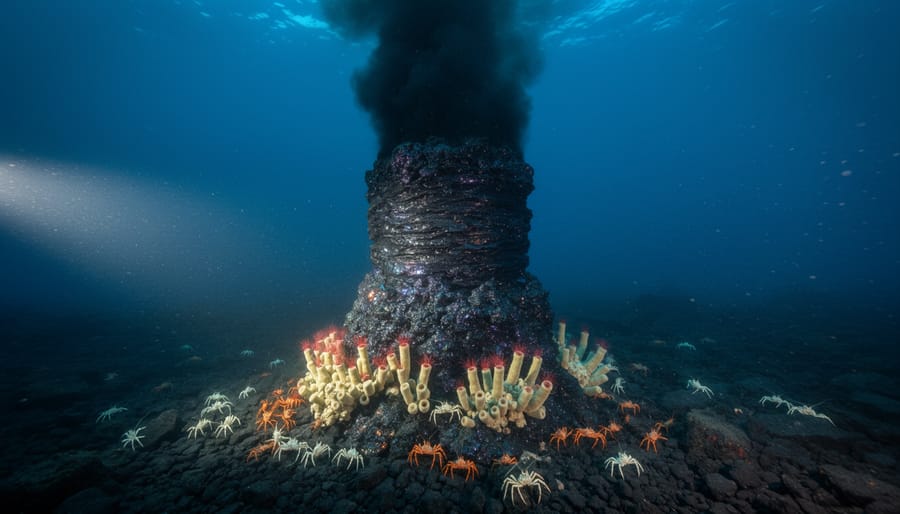
Thermal vents cluster primarily along mid-ocean ridges, the massive underwater mountain chains that circle our planet like seams on a baseball. These spreading centers, where tectonic plates pull apart, create the geological conditions necessary for vent formation. The Mid-Atlantic Ridge, East Pacific Rise, and Juan de Fuca Ridge host some of the most extensively studied vent fields.
The first thermal vents were discovered in 1977 near the Galápagos Islands, a groundbreaking moment that transformed our understanding of where life can thrive. Dr. Robert Ballard, part of that pioneering expedition, later described the discovery as finding “an oasis in the desert” of the deep sea. Since then, scientists have identified hundreds of vent sites across all major ocean basins, from the Arctic to Antarctic waters.
Beyond mid-ocean ridges, vents also appear in back-arc basins near subduction zones, particularly in the western Pacific. Notable sites include the Mariana Trough and Lau Basin, where unique chemical compositions support distinct biological communities. Even shallow-water vents exist in volcanic regions like Papua New Guinea, offering accessible research opportunities for marine biologists and occasionally welcoming volunteer research assistants during expedition seasons. These diverse locations continue revealing how remarkably adaptable life can be under extreme conditions.
The Remarkable Life Thriving in Extreme Heat
Chemosynthesis: Life Without Sunlight
In the complete darkness of the deep ocean, hydrothermal vents host thriving ecosystems that operate on an entirely different energy source than almost every other living system on Earth. While most life depends on photosynthesis, where plants and algae convert sunlight into usable energy, vent communities rely on chemosynthesis, a remarkable process that extracts energy from chemicals spewing from the seafloor.
Here’s how it works: Specialized bacteria, the foundation of these vent ecosystems, harness energy from chemicals like hydrogen sulfide, methane, and iron that pour out in superheated vent fluids. These microorganisms use that chemical energy to convert carbon dioxide and water into organic compounds, much like plants do with sunlight. The process creates sugars and other molecules that fuel not just the bacteria themselves, but entire food webs.
Dr. Maria Santos, a marine microbiologist who has spent fifteen years studying vent bacteria, describes her first encounter with these organisms as life-changing. “When you realize that life found a completely independent pathway to exist, it fundamentally shifts how you think about biology,” she explains. “These bacteria prove that life is far more adaptable and resilient than we ever imagined.”
The organisms living around vents, from giant tube worms to unique clams, form symbiotic relationships with chemosynthetic bacteria. The tube worms, for instance, host billions of bacteria within their bodies, essentially farming their own food source. This independence from sunlight means these ecosystems could theoretically survive even if the sun disappeared, making them crucial subjects for understanding life’s potential on other planets and the resilience of ocean ecosystems facing environmental change.
Iconic Vent Species and Their Adaptations
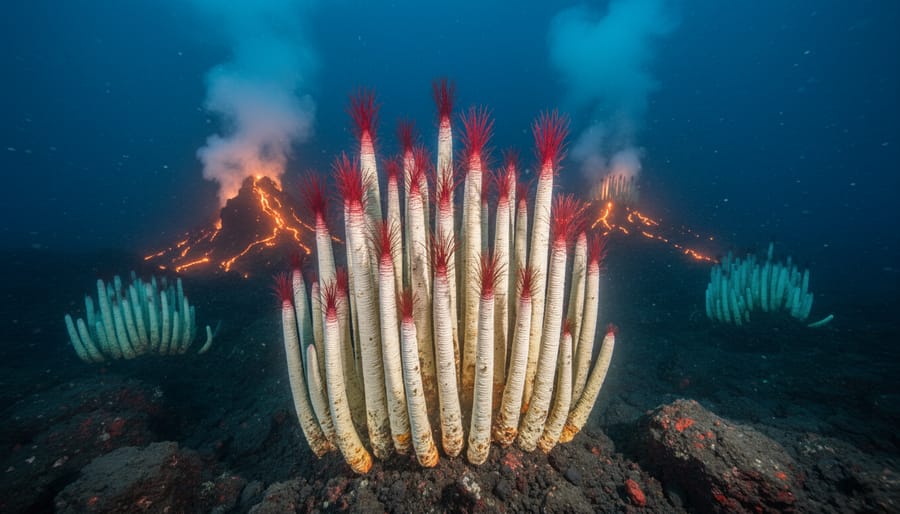
Life at hydrothermal vents seems impossible by surface standards, yet remarkable creatures have evolved extraordinary adaptations to thrive in these extreme environments. These species offer scientists valuable insights into the limits of life and the power of evolution.
The Pompeii worm holds the record as one of Earth’s most heat-tolerant animals. Living in tubes attached directly to vent chimneys, these segmented worms withstand temperatures exceeding 80°C (176°F) at their tail end while their heads remain in cooler water around 22°C (72°F). They achieve this incredible feat through a symbiotic relationship with heat-loving bacteria that coat their backs like a protective fleece, creating an insulating barrier. Dr. Maria Chen, a marine biologist who has studied these worms for fifteen years, describes her first encounter: “Seeing these delicate creatures flourishing in conditions that would instantly kill most life forms completely transformed my understanding of adaptation. It reminds us that nature always finds a way.”
Yeti crabs, discovered only in 2005, sport hairy arms covered in filamentous bacteria. These charismatic crustaceans cultivate their bacterial gardens by waving their claws through mineral-rich vent fluids, essentially farming their own food source. Different yeti crab species have been found at vents worldwide, suggesting this adaptation evolved multiple times independently.
Vent octopuses represent another fascinating adaptation story. Some species brood their eggs near warm vent waters, potentially accelerating development in an otherwise frigid deep-sea environment. Recent research suggests these octopuses may be monitoring egg development in ways we’re only beginning to understand.
For students and citizen scientists interested in contributing to vent research, organizations like the Ocean Exploration Trust offer opportunities to participate in live seafloor exploration events, bringing these alien worlds directly into classrooms and homes worldwide.
Ocean Thermal Stress: The Crisis Facing Marine Life
How Warming Waters Disrupt Marine Ecosystems
Rising ocean temperatures create ripple effects throughout marine ecosystems, disrupting the delicate balance that has evolved over millennia. When waters warm beyond normal ranges, the consequences extend far beyond individual species—they transform entire food webs from the bottom up.
At the foundation, warming waters affect phytoplankton, the microscopic organisms that form the base of marine food chains. These tiny powerhouses are temperature-sensitive, and even slight increases can alter their abundance, distribution, and nutritional content. When phytoplankton communities shift, the effects cascade upward through zooplankton, fish, and ultimately apex predators. Marine biologist Dr. Sarah Chen describes witnessing these changes firsthand during her research in coastal waters: “We’ve documented dramatic shifts in species composition within just a decade. Fish that once thrived here are moving poleward, seeking cooler waters, while their prey populations struggle to adapt.”
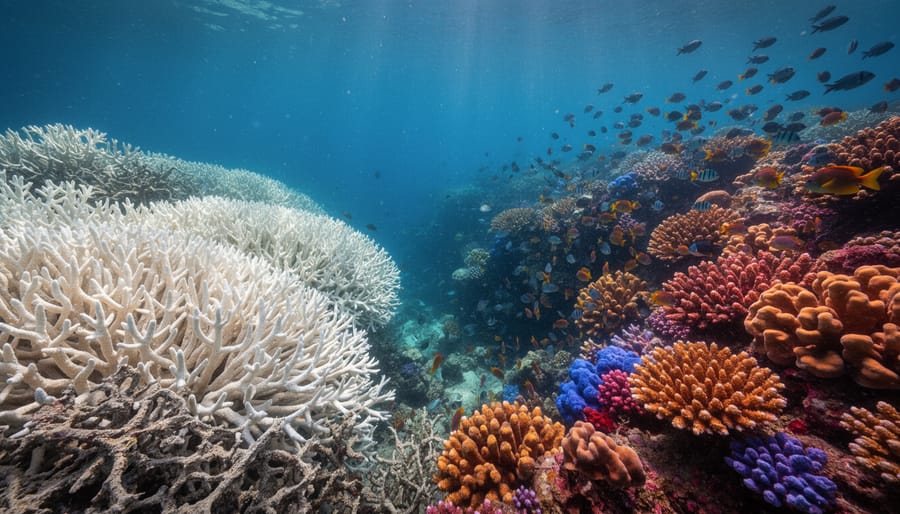
Temperature stress also disrupts critical life-cycle events. Many marine species rely on precise temperature cues for spawning, and warming waters can cause mistimed reproduction. Coral reefs experience bleaching when stressed by heat, expelling the symbiotic algae they depend upon for survival. Additionally, warmer waters hold less dissolved oxygen, compounding stress through oxygen depletion.
Understanding these ocean warming impacts is crucial for conservation efforts. Volunteer monitoring programs now track temperature changes and species shifts, providing vital data that helps scientists predict and mitigate ecosystem disruptions before they become irreversible.
The Species Already Paying the Price
The fragile communities thriving around hydrothermal vents face mounting pressures from multiple directions. Scientists have documented concerning changes in the populations of Pompeii worms, those remarkable creatures that withstand temperatures exceeding 80°C near vent chimneys. As mining exploration intensifies in vent regions along the Mid-Atlantic Ridge, these specialized organisms—found nowhere else on Earth—face potential habitat destruction before we fully understand their ecological roles.
Dr. Sarah Chen, a marine biologist who has spent fifteen years studying vent ecosystems, shares a particularly moving observation: “We’ve watched entire tube worm colonies collapse when nearby mining surveys disrupted their delicate chemical balance. These animals survived for decades in what we consider extreme conditions, yet they couldn’t adapt to sudden human interference.”
The ripple effects extend beyond vent sites themselves. Many commercially important fish species rely on vent-influenced currents during critical life stages. Recent studies show juvenile rockfish populations declining in regions where deep-sea activities have altered thermal gradients. These impacts mirror broader ocean challenges, including coral bleaching in shallow waters, demonstrating how interconnected marine systems truly are.
The silver lining? Recognition of these threats has sparked unprecedented international collaboration. Researchers are now racing to document vent biodiversity, creating comprehensive baselines that inform protection strategies. This knowledge becomes our foundation for effective conservation—and opportunities for citizen scientists to contribute are growing rapidly.
Could Thermal Vents Offer Clues to Climate Resilience?
What Vent Organisms Teach Us About Adaptation
The extreme conditions at ocean thermal vents have transformed these ecosystems into natural laboratories for understanding adaptation under stress. As our oceans warm due to climate change, scientists are increasingly looking to vent organisms for insights that could help predict and protect marine life elsewhere.
At the molecular level, vent species have evolved remarkable heat-shock proteins that act like cellular firefighters, protecting cells from damage when temperatures spike. These proteins refold damaged proteins and prevent others from clumping together, a discovery that has profound implications. Researchers are now investigating whether similar protective mechanisms exist in coral reef species or could be enhanced through selective breeding programs to create more resilient populations.
The genetic toolkit of vent organisms reveals equally fascinating adaptations. Studies of vent tubeworms and mussels have identified specific gene variants that allow these creatures to thrive in temperatures that would be lethal to their shallow-water relatives. Understanding these genetic blueprints helps scientists identify which species in warming oceans might possess hidden resilience and which require immediate conservation intervention.
Perhaps most intriguing are the symbiotic relationships at vents, where bacteria living inside host organisms convert toxic chemicals into energy. This partnership demonstrates nature’s ingenuity in creating survival strategies under impossible conditions. Marine biologist Dr. Sarah Chen, who has spent five years studying vent ecosystems, shares her perspective: “Every dive reveals another adaptation we never imagined possible. These organisms aren’t just surviving; they’re thriving. That gives me hope that nature has more solutions than we realize.”
For those inspired by this research, volunteer opportunities exist with organizations cataloging vent biodiversity and monitoring temperature changes. Your participation helps build the databases scientists need to develop effective conservation strategies for our changing oceans.
Personal Perspective: A Marine Biologist’s Journey to the Deep
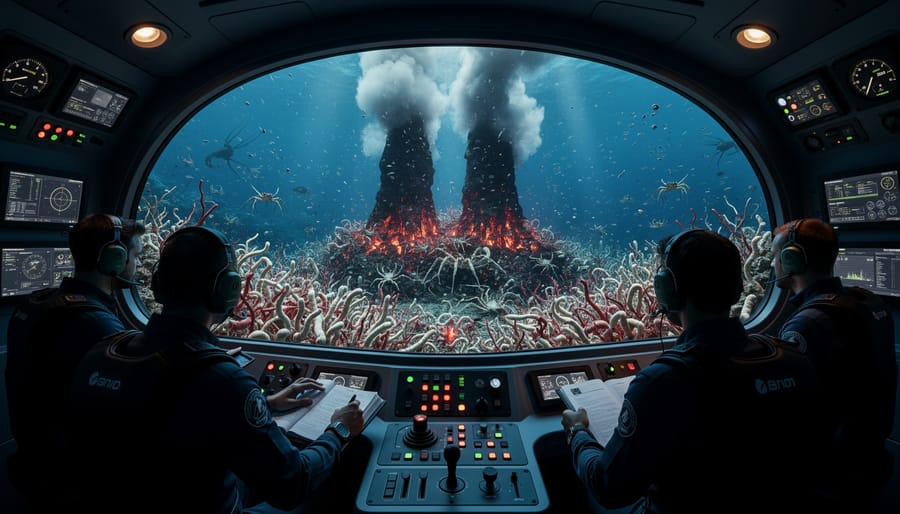
I’ll never forget my first descent to a hydrothermal vent site off the coast of the Galápagos Islands. As our submersible descended through layers of sunlit water into complete darkness, I questioned everything I thought I knew about where life could thrive. When our lights finally illuminated the vent field at 2,500 meters depth, I witnessed something extraordinary: towering black smoker chimneys surrounded by dense communities of tubeworms, eyeless shrimp, and ghostly white crabs, all thriving in water hot enough to brew tea.
That moment transformed my career. For fifteen years now, I’ve studied these remarkable ecosystems, collecting samples in conditions that would be lethal to most surface life. Each expedition reveals new species and adaptations that challenge our understanding of biological limits. What drives my passion is knowing these discoveries aren’t just academic curiosities. The extremophiles living at vents hold potential solutions for medicine, biotechnology, and understanding climate resilience.
If you’re inspired to contribute to vent research, volunteer opportunities exist through research institutions and conservation organizations worldwide. Every citizen scientist, student, and advocate helps protect these irreplaceable deep-sea laboratories.
The Threats Facing Thermal Vent Ecosystems
Deep-Sea Mining and Its Consequences
The mineral-rich chimneys surrounding hydrothermal vents have attracted significant commercial interest in recent years. These structures contain valuable metals including copper, zinc, gold, and rare earth elements used in electronics and renewable energy technologies. As terrestrial mineral deposits become scarcer, mining companies are increasingly looking to the deep ocean floor as the next frontier for extraction.
However, the potential consequences of deep-sea mining near vent ecosystems deeply concern marine scientists. Dr. Sylvia Earle, renowned oceanographer, warns that “we know so little about these environments that mining them now would be like burning down a library before reading the books.” The slow growth rates of vent communities mean recovery from disturbance could take decades or centuries. Mining operations would generate sediment plumes that could smother delicate organisms, destroy habitat structures, and disrupt the chemical gradients that vent species depend upon for survival.
Currently, the International Seabed Authority regulates mining in international waters, though comprehensive environmental protections remain under development. Scientists advocate for establishing marine protected areas around key vent sites before commercial extraction begins. Individuals concerned about preserving these ecosystems can support organizations monitoring deep-sea mining proposals and can participate in public comment periods when mining permits are under review, ensuring decision-makers hear conservation perspectives.
Why Protecting Vents Protects Our Future
Protecting hydrothermal vents means safeguarding far more than isolated underwater chimneys. These ecosystems serve as natural laboratories that help scientists understand life’s adaptability and resilience in extreme conditions. The unique organisms thriving at vents may hold secrets to developing new medicines, enzymes for industrial applications, and insights into how life might exist on other planets.
Dr. Sarah Chen, a marine biologist who has spent fifteen years studying vent communities, shares this perspective: “Every expedition to these sites reveals something unexpected. We’ve discovered bacteria that could revolutionize biotechnology and organisms that challenge our understanding of evolution. Losing these habitats means losing answers to questions we haven’t even thought to ask yet.”
Beyond their scientific value, healthy vent ecosystems contribute to overall ocean resilience. They demonstrate how life adapts to thermal stress and chemical extremes, lessons increasingly relevant as our oceans warm. By implementing effective marine conservation strategies for these sites, we preserve potential breakthroughs while maintaining the ocean’s biological diversity. Volunteers can support this work through citizen science programs that monitor deep-sea environments and advocate for protected marine areas, ensuring future generations inherit an ocean rich with undiscovered possibilities.
How You Can Support Marine Conservation Efforts
The wonders of hydrothermal vents and the extraordinary life they support need our protection, and there are numerous ways you can contribute to safeguarding these remarkable deep-sea ecosystems. Whether you’re a scientist, educator, student, or simply someone passionate about our oceans, your involvement matters.
The Marine Biodiversity Science Center offers hands-on volunteer opportunities that connect you directly with marine conservation efforts. Volunteers assist with data analysis, sample processing, and educational outreach programs. Dr. Elena Rodriguez, who coordinates our volunteer program, shares that many of her most dedicated team members started as curious volunteers who became captivated by vent ecosystems. “We’ve seen high school students develop into published researchers, and retirees discover new passions for marine science,” she notes with pride.
Citizen science projects provide accessible entry points for ocean enthusiasts at any level. Through our Deep Sea Discovery initiative, participants help identify organisms in remotely operated vehicle footage, classify species in photographs, and contribute to mapping efforts. These contributions directly support research publications and conservation assessments. You don’t need specialized training—just curiosity and attention to detail.
Educational programs offer another avenue for impact. Consider hosting a presentation at your local school, library, or community center using our free educational resources. Teachers can access our curriculum guides that bring hydrothermal vent science into classrooms through interactive lessons and virtual field trips. We’ve found that sparking interest in young minds creates lasting environmental stewardship.
Advocacy plays a crucial role in protecting deep-sea habitats. Support legislation that establishes marine protected areas in international waters where many vent fields exist. Contact your representatives about funding for deep-sea research and ocean exploration. Join organizations focused on ocean conservation and participate in public comment periods for deep-sea mining regulations.
Financial support, whether through donations or memberships, directly funds research expeditions, equipment maintenance, and conservation initiatives. Even modest contributions help purchase supplies, support student researchers, or maintain long-term monitoring programs.
Every action, no matter how small, contributes to preserving these ancient ecosystems and the secrets they hold for understanding life’s resilience in our changing ocean.
The story of ocean thermal vents reminds us that life finds extraordinary ways to persist, even in the most extreme conditions. These remarkable ecosystems, thriving in darkness and heat where scientists once thought nothing could survive, offer us more than just scientific curiosity. They represent living laboratories where resilience has been perfected over millions of years, and they may hold vital clues for understanding how marine life adapts to thermal stress.
As our oceans face unprecedented warming, the lessons from hydrothermal vent communities become increasingly relevant. The specialized organisms that flourish in these environments demonstrate nature’s capacity for innovation and adaptation. Yet this knowledge also underscores an urgent truth: while some species possess remarkable resilience, many others do not. The broader ocean community depends on stable temperatures, and the accelerating pace of change threatens ecosystems worldwide.
The interconnectedness of ocean health means that protecting thermal vents and addressing climate-driven thermal stress are not separate challenges but parts of the same mission. Marine biologist Dr. Sarah Chen, who has spent years studying vent ecosystems, reflects that “every discovery at the vents reinforces how much we still have to learn and how critical it is that we act now to protect what we’re only beginning to understand.”
You have the power to make a difference. Whether through supporting marine research, participating in citizen science programs, reducing your carbon footprint, or simply sharing what you’ve learned with others, every action contributes to ocean conservation. The deep sea has shown us what’s possible when life adapts together. Now it’s our turn to adapt our relationship with the ocean.

jessica
Ava Singh is an environmental writer and marine sustainability advocate with a deep commitment to protecting the world's oceans and coastal communities. With a background in environmental policy and a passion for storytelling, Ava brings complex topics to life through clear, engaging content that educates and empowers readers. At the Marine Biodiversity & Sustainability Learning Center, Ava focuses on sharing impactful stories about community engagement, policy innovations, and conservation strategies. Her writing bridges the gap between science and the public, encouraging people to take part in preserving marine biodiversity. When she’s not writing, Ava collaborates with local initiatives to promote eco-conscious living and sustainable development, ensuring her work makes a difference both on the page and in the real world.