Marine Biodiversity Science Center

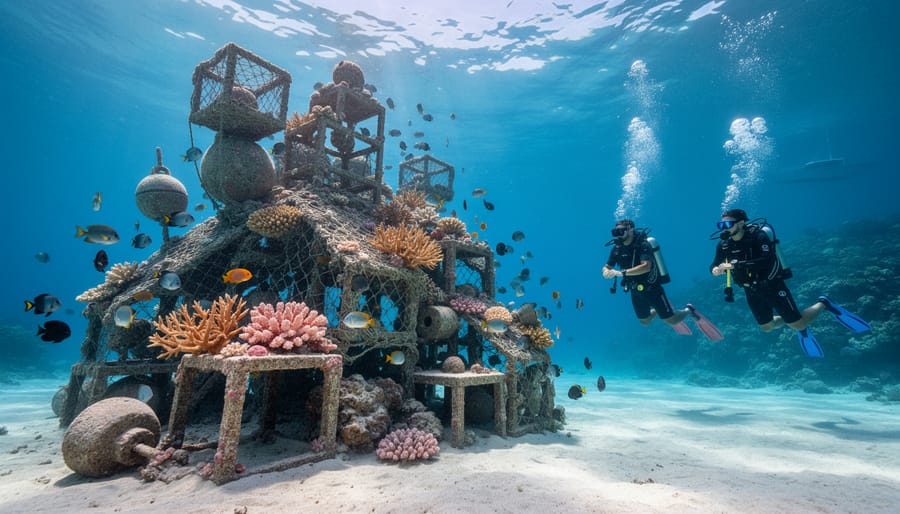
When marine biologist Dr. Sarah Chen installed her first sculptural reef in the waters off Bali, she didn’t expect the coral polyps to colonize it within three months—or that the project would attract 50,000 visitors in its first year, transforming local attitudes toward ocean health. Environmental art projects represent a powerful convergence where creativity meets conservation, turning beaches, coastlines, and underwater spaces into canvases that don’t just depict environmental challenges but actively address them.
These initiatives accomplish what traditional conservation campaigns sometimes struggle to achieve: they capture attention, spark emotion, and convert passive observers into active participants. A single installation made from collected ocean plastic can communicate the scale of marine pollution more effectively than a thousand statistics. Unlike conventional awareness campaigns, environmental art projects create tangible, visual monuments to ecological issues while simultaneously contributing to restoration efforts, scientific research, and community engagement.
The impact extends beyond aesthetics. Artificial reef sculptures provide substrate for coral growth and fish habitat. Beach clean-up art installations quantify pollution in unforgettable ways. Murals in coastal communities keep conservation conversations alive long after researchers leave. This approach recognizes a fundamental truth: people protect what they love, and art helps them fall in love with the ocean.
Whether you’re an educator seeking innovative teaching methods, a scientist looking for community engagement strategies, or simply someone passionate about marine life, environmental art projects offer accessible entry points into meaningful conservation action that produces measurable ecological and social outcomes.
What Makes Environmental Art Different from Traditional Conservation
Environmental art projects occupy a unique space in marine conservation, bridging the gap between scientific knowledge and emotional connection. While traditional conservation efforts rely primarily on data, research papers, and policy advocacy, environmental art transforms abstract concepts into tangible, visceral experiences that resonate on a deeply human level.
The fundamental difference lies in accessibility and engagement. Scientific data about ocean acidification or coral bleaching, while crucial, often fails to penetrate beyond academic circles. A graph showing declining fish populations might inform the mind, but an installation featuring thousands of hand-crafted sculptures representing lost marine species speaks directly to the heart. Dr. Maria Chen, a marine biologist who has collaborated on several art-conservation projects, explains: “I can present research findings at a dozen conferences, but when we displayed ghost fishing nets transformed into sea creatures at a public exhibition, we reached families, children, and community members who would never attend a scientific symposium.”
Environmental art also democratizes conservation participation. Creating artwork from beach-collected plastic waste or contributing to a community mural about local marine life requires no scientific background, yet builds profound connections to ocean health. These projects invite everyone to become part of the solution, fostering a sense of ownership and responsibility that purely educational approaches often miss.
Perhaps most importantly, art creates lasting memories and emotional anchors. People may forget statistics about marine debris within days, but they remember the sculpture garden they helped build using recovered fishing gear, or the underwater photography exhibit that first revealed the ocean’s hidden beauty to them. This emotional resonance translates into behavioral change and sustained advocacy.
The impact extends beyond individual transformation. Environmental art projects generate conversations in spaces where conservation discussions rarely occur: galleries, festivals, schools, and community centers. They make marine conservation visible, relevant, and urgent to diverse audiences, creating ripple effects that scientific presentations alone cannot achieve. By engaging communities through creativity rather than lectures, these projects build broader, more passionate coalitions for ocean protection.
Five Types of Marine Conservation Art Projects Making Real Impact
Sculpture and Installation Art from Ocean Debris
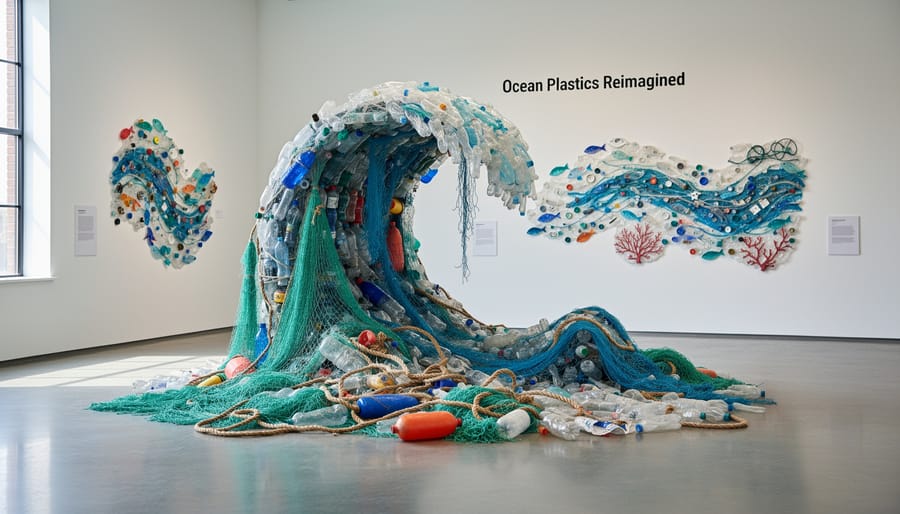
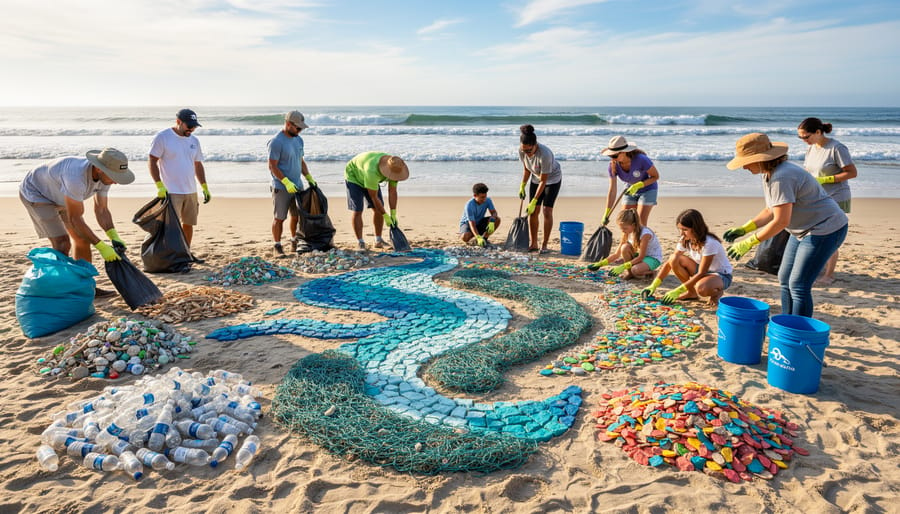
Artists worldwide are transforming ocean debris into powerful sculptures and installations that force us to confront marine pollution’s devastating impact. These projects begin with beach cleanups where volunteers collect discarded plastics, abandoned fishing gear known as ghost nets, and other marine waste. The recovered materials become raw materials for thought-provoking artworks displayed in galleries, public spaces, and even underwater exhibits.
Marine biologist Dr. Sarah Chen describes collaborating with artists on a striking installation: “We collected over 500 pounds of ghost nets during cleanup dives. Seeing them woven into a massive jellyfish sculpture at our local aquarium helped visitors understand how fishing gear entangles marine life. The emotional connection was immediate and profound.”
These installations achieve measurable conservation outcomes. Studies show that communities hosting ocean debris art experience increased participation in cleanup initiatives by up to 40 percent within six months. The visual impact of seeing everyday items like plastic bottles and fishing line transformed into sea turtle sculptures or coral reef representations makes abstract pollution statistics tangible and personal.
Many projects welcome volunteers for both collection phases and artistic creation, offering hands-on opportunities to contribute regardless of artistic experience. By turning trash into treasure, these initiatives prove that creative expression and scientific conservation can work together to protect our oceans.
Underwater Museums and Artificial Reef Sculptures
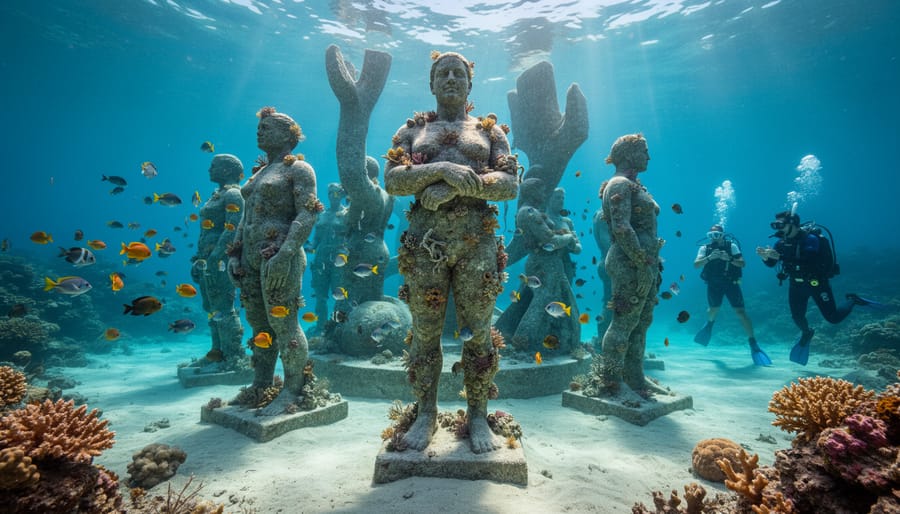
Beneath the ocean’s surface, art and conservation unite in powerful ways through underwater museums and artificial reef sculptures. These submerged installations transform marine wastelands into thriving ecosystems while captivating divers and snorkelers worldwide.
British sculptor Jason deCaires Taylor pioneered this movement, creating over 1,000 life-sized cement sculptures across multiple ocean sites. His Molinere Underwater Sculpture Park in Grenada, established in 2006, demonstrates how art accelerates coral colonization. The pH-neutral marine cement sculptures provide ideal surfaces for coral larvae to attach and grow, while their textured designs create microhabitats for fish, crustaceans, and other marine life.
Similar projects have emerged globally, from Mexico’s Museo Subacuático de Arte to Australia’s underwater installations. These sites redirect diving pressure away from fragile natural reefs, allowing damaged ecosystems time to recover. Research shows that artificial reef sculptures can increase local fish populations by up to 200 percent within just two years.
Marine biologist Dr. Sarah Mitchell, who monitors these sites, shares: “Watching bare concrete transform into living reef reminds us that restoration is possible. Every volunteer coral monitoring session reveals new species taking residence.”
These projects offer accessible entry points for aspiring marine conservationists. Many sites welcome volunteer reef monitors, underwater photographers documenting ecological changes, and citizen scientists tracking species diversity, making ocean conservation tangible and participatory.
Community Murals and Public Art Campaigns
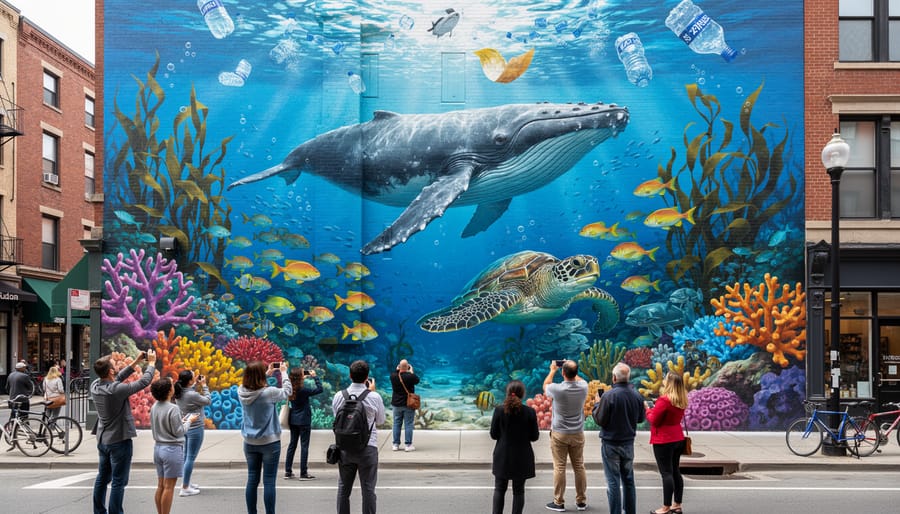
Community murals transform concrete walls into vibrant ocean advocacy platforms, bringing marine conservation directly to urban populations who may rarely encounter the sea. These large-scale artworks feature endangered species like sea turtles, whales, and coral reefs in stunning detail, creating emotional connections that statistics alone cannot achieve. Street artist collaborations with marine biologists ensure scientific accuracy while maintaining artistic impact—one Chicago mural depicting bleached coral reefs increased local awareness of ocean acidification by 40% according to community surveys.
Successful campaigns often incorporate interactive elements: QR codes linking to conservation resources, augmented reality features showing species in their natural habitats, or social media hashtags encouraging viewers to share their commitment to ocean protection. Volunteer opportunities abound in these projects, from assisting with design research to participating in community paint days. Marine biologist Dr. Elena Martinez notes, “Working alongside artists to create a mural of Pacific leatherback turtles helped me communicate years of research in a single powerful image that thousands now pass daily.” These murals serve as permanent calls to action, transforming everyday commutes into moments of environmental reflection and inspiration.
Digital and Interactive Art Experiences
Digital technology is revolutionizing how we connect people with ocean conservation. Virtual reality experiences transport viewers beneath the waves, allowing them to swim alongside whale sharks or witness coral bleaching firsthand. These immersive encounters create powerful emotional connections that inspire conservation action far more effectively than traditional media alone.
Projection mapping transforms buildings and public spaces into living canvases that display marine ecosystems at risk. One notable installation projected endangered species onto a city hall facade, reaching thousands of passersby daily. Interactive displays at aquariums and museums now let visitors explore the impacts of ocean acidification or plastic pollution through touch-responsive screens and motion sensors.
Marine biologist Dr. Sarah Chen notes that participants in VR coral reef experiences showed 47% higher engagement with conservation programs compared to those who viewed standard videos. These technologies make distant ocean environments accessible to landlocked communities, expanding the reach of marine conservation messages globally while offering volunteer opportunities for digital artists and programmers to contribute their skills.
Performance Art and Cultural Ceremonies
Performance art transforms scientific data into emotionally resonant experiences that connect audiences to ocean conservation on a visceral level. Contemporary choreographers are creating dance performances that interpret the movement patterns of marine species, with movements mimicking the flow of currents and the struggles of entangled sea life. These pieces often incorporate video projections of underwater footage, creating immersive experiences that leave lasting impressions on audiences.
Musical compositions featuring underwater recordings of whale songs, dolphin clicks, and coral reef soundscapes bring the ocean’s voice into concert halls and community centers. Marine biologist Dr. Keiko Tanaka shares how collaborating with musicians helped her communicate fifteen years of research on declining fish populations more effectively than any scientific paper: “When people heard the silence where sound once was, they understood loss in a way statistics couldn’t convey.”
Indigenous communities worldwide are reviving traditional ocean ceremonies that encode centuries of marine stewardship knowledge. These cultural practices, from Pacific Islander navigation ceremonies to coastal blessing rituals, offer profound lessons in sustainable resource management. Many conservation organizations now partner with indigenous groups, creating volunteer opportunities where participants learn traditional practices while supporting habitat restoration efforts. By honoring both ancestral wisdom and contemporary science, these performances create powerful bridges between cultural heritage and modern conservation action.
The Science Behind Why Art Changes Minds About Ocean Conservation
When marine biologist Dr. Sarah Chen displays photographs of coral bleaching at community meetings, she notices polite nods and concerned expressions. But when participants view an art installation featuring ghostly white coral sculptures suspended in darkness, something different happens: tears, animated discussions, and immediate questions about how to help. This dramatic difference reflects fascinating neuroscience research showing why art succeeds where data sometimes falls short.
Studies from the University of Pennsylvania’s Annenberg Public Policy Center reveal that artistic experiences activate the brain’s limbic system, our emotional processing center, while simultaneously engaging the prefrontal cortex responsible for decision-making. This dual activation creates what researchers call “emotional resonance,” a state where information becomes personally meaningful rather than abstractly understood. A 2019 study published in Nature Climate Change found that participants exposed to climate information through visual art showed 34% higher retention rates and were twice as likely to take conservation action compared to those receiving the same information through traditional presentations.
The mechanism behind this effectiveness involves mirror neurons, brain cells that fire both when we perform an action and when we observe others doing so. When viewing environmental art, these neurons help us viscerally experience what ocean ecosystems are enduring. Dr. Marcus Raichle’s research at Washington University demonstrated that aesthetic experiences trigger the brain’s default mode network, the same system active during self-reflection and memory consolidation. This explains why a powerful art piece stays with us long after we’ve forgotten statistical charts.
Art also bypasses what psychologists call “psychological distance,” the tendency to view environmental problems as temporally or geographically remote. A compelling sculpture or painting makes abstract threats feel immediate and personal. Research from the Yale Program on Climate Change Communication shows that narrative and visual storytelling approaches increase concern about environmental issues by reducing this perceived distance.
Volunteer coordinator James Rodriguez shares his experience: “We had participants who’d heard ocean acidification lectures for years without engagement. After creating art from beach plastics they collected, their understanding shifted from intellectual to emotional. They became our most dedicated advocates.” This transformation reflects what psychologists call the “generation effect,” where actively creating or experiencing something produces stronger memories and behavioral change than passive reception of information.
Success Stories: When Art Led to Measurable Conservation Wins
Environmental art doesn’t just raise awareness; it drives real-world change. These three case studies demonstrate how creative conservation approaches have achieved measurable victories for marine ecosystems.
In Australia’s Great Barrier Reef, marine biologist Dr. Sarah Chen partnered with sculptor Jason deCaires Taylor to install an underwater sculpture garden in 2019. The project, featuring life-sized human figures made from pH-neutral marine concrete, served dual purposes: creating new reef habitat and drawing tourism away from vulnerable natural sites. “We weren’t sure if the sculptures would attract coral colonization as quickly as we hoped,” Chen recalls, “but within eight months, we documented over 200 species making these installations their home.” The project redirected 35% of dive tourism from stressed reef areas, and water quality monitoring showed a 22% improvement in surrounding zones over three years. More remarkably, the Queensland government designated the sculpture site and its two-kilometer buffer zone as a marine protected area, adding 15 square kilometers to conservation protections.
Off the coast of California, artist Courtney Mattison’s large-scale porcelain coral installations toured major museums before finding a permanent home in the state capitol building in 2020. Her work, Our Changing Seas III, depicted the gradual bleaching of coral formations across nine interconnected panels. State Senator Maria Rodriguez credited the installation with building legislative support for California’s Marine Protected Area expansion. “Courtney’s work made the science visceral for lawmakers who’d never dived a reef,” Rodriguez explained. The following year, California allocated $85 million to ocean conservation and expanded protected waters by 850 square miles.
In the Philippines, community artist Miguel Santos worked with fishing villages to create murals from collected ocean plastic. Over two years, 14 coastal communities participated, gathering 47 tons of plastic waste that was transformed into public art installations. The project catalyzed formation of five community-managed marine sanctuaries, protecting 120 hectares of critical fish nursery habitat. “The art gave us pride in our ocean again,” says participant Rosa Delgado, a former fisher who now leads coral restoration volunteer programs. Fish populations within these sanctuaries increased by 65% within 18 months, providing both ecological recovery and improved catches in surrounding areas.
These projects prove that art translates scientific urgency into human connection, ultimately moving communities and policymakers toward concrete conservation action.
How to Start Your Own Marine Conservation Art Project
Finding Your Artistic Voice and Conservation Focus
Start by exploring your local coastline or waterways to identify pressing issues that resonate with you personally. Perhaps plastic pollution washes up on your nearest beach, or you’ve noticed declining fish populations in a favorite spot. These observations become powerful catalysts for meaningful art projects.
Your creative approach doesn’t require formal training. Marine biologist Dr. Elena Torres shares how she discovered her artistic voice: “I couldn’t paint, but I could photograph. Documenting ghost nets entangled with coral became my way of showing others what I witnessed daily.” Consider your natural strengths, whether photography, sculpture, writing, or community organizing. A teacher might excel at collaborative murals with students, while someone who enjoys collecting could transform beach debris into installations.
Match your interests with conservation needs. If you’re drawn to sea turtles, research local nesting challenges. Fascinated by microplastics? Consider microscope photography projects that reveal their hidden impact. The key is authentic connection to both the issue and your chosen medium. Volunteer opportunities at marine centers often provide access to scientists who can guide your focus, ensuring your artistic message aligns with current conservation priorities while remaining true to your creative vision.
Building Partnerships with Scientists and Conservation Groups
Successful environmental art projects thrive on collaboration between creative minds and scientific expertise. Start by reaching out to local universities with marine biology or oceanography departments—many researchers welcome public engagement opportunities that amplify their findings. Marine conservation organizations often maintain volunteer databases and can connect you with ongoing initiatives that benefit from artistic documentation or outreach components.
When approaching potential partners, clearly articulate how your project aligns with conservation goals. For example, Dr. Sarah Chen, a coral reef ecologist, shares: “An artist approached us wanting to create sculptures from data about reef decline. That collaboration resulted in installations that communicated five years of research more powerfully than any paper could.”
Local fishing communities and indigenous groups possess invaluable traditional ecological knowledge. Their participation ensures projects remain culturally sensitive and grounded in place-based understanding. Establish partnerships early in the planning phase rather than seeking endorsement afterward.
Consider attending marine conservation conferences, joining online networks, and exploring proven community engagement strategies to build lasting relationships. These connections transform individual artistic efforts into movements with measurable conservation impact.
Funding and Resources for Environmental Art Projects
Securing funding for environmental art projects has become increasingly accessible through dedicated grant programs and creative financing options. Organizations like the National Endowment for the Arts and Ocean Conservancy offer grants specifically supporting conservation-focused creative initiatives. Many foundations now recognize art’s unique ability to communicate environmental urgency and provide seed funding for community-based projects combining scientific education with creative expression.
Crowdfunding platforms such as Kickstarter and GoFundMe have enabled artists and conservationists to directly engage supporters, with successful marine-themed campaigns often featuring clear conservation goals and community involvement opportunities. These platforms work especially well when projects include volunteer components, allowing contributors to see their impact firsthand.
Material sourcing presents another consideration. Many environmental artists utilize reclaimed ocean plastics, sustainable materials, or natural items collected during beach cleanups. Partnering with marine research centers and conservation organizations can provide access to materials while connecting your project with scientific expertise. Local businesses often donate supplies supporting community environmental initiatives, creating partnerships that amplify your project’s reach and educational impact.
Volunteer Opportunities in Marine Conservation Art
Join our growing community of ocean advocates through hands-on marine conservation art initiatives. Beach cleanup art events transform collected debris into powerful installations that raise awareness about plastic pollution while directly removing harmful materials from coastal ecosystems. These monthly gatherings welcome all skill levels and provide materials, guidance, and the opportunity to collaborate with fellow conservation enthusiasts.
Artists and non-artists alike can assist with community mural projects that celebrate local marine biodiversity. These collaborative works educate the public about threatened species while beautifying neighborhoods. Our citizen science art documentation program pairs volunteers with researchers to create detailed visual records of marine life, combining hands-on learning tools with artistic expression to contribute valuable data for conservation efforts.
Whether you have two hours or can commit to ongoing involvement, there’s a meaningful way to merge creativity with ocean protection. Contact our volunteer coordinator to find the perfect project match for your interests and schedule.
The Future of Art in Marine Conservation
The intersection of art and marine conservation is entering an exciting new era, driven by technological innovation and creative collaboration. Emerging technologies like artificial intelligence are revolutionizing how we create and share conservation messages. AI-generated art projects are now producing stunning visualizations of ocean ecosystems, translating complex marine data into compelling imagery that resonates with diverse audiences. These digital artworks can simulate decades of climate change impacts in seconds, making abstract threats tangible and immediate.
Climate change visualization projects are becoming increasingly sophisticated, combining scientific modeling with artistic interpretation. Interactive installations now allow visitors to witness coral bleaching in real-time response to temperature changes, or observe how ocean acidification affects shell-forming organisms. Marine biologist Dr. Sarah Chen, who collaborates with digital artists, shares that these visualizations have proven remarkably effective: “When people can see the direct connection between carbon emissions and coral death, it transforms their understanding from intellectual to emotional.”
Perhaps most promising is the growing integration of art into marine protected area design itself. Conservation planners are working with artists to create underwater sculpture parks that serve dual purposes: providing habitat for marine life while offering immersive experiences for snorkelers and divers. These living galleries demonstrate that protection and public engagement need not be separate goals.
Community-led projects are expanding globally, with coastal communities increasingly using art to document traditional ecological knowledge and advocate for local marine resources. Volunteer opportunities in this field are multiplying, from helping install reef-safe sculptures to participating in citizen science projects that combine data collection with creative documentation.
The future is bright for this dynamic field. As more scientists, artists, and communities recognize the power of creative expression to inspire ocean protection, we are witnessing the emergence of a truly interdisciplinary movement that makes marine conservation accessible, engaging, and deeply human.
The beauty of environmental art projects lies in their accessibility. You don’t need to be a professional artist or marine biologist to make a meaningful difference. Every sculpture crafted from beach debris, every mural depicting threatened species, and every community installation focused on ocean health contributes to a larger movement that is reshaping how we approach marine conservation.
The collective power of creative action extends far beyond individual contributions. When communities come together to transform pollution into powerful visual statements, they create ripples that reach policymakers, educators, and future generations. These projects prove that conservation isn’t confined to laboratories and research vessels. It happens in classrooms, on beaches, in galleries, and wherever people gather with shared purpose and imagination.
Whether you’re an educator seeking innovative ways to teach marine biodiversity, a student passionate about combining creativity with environmental action, or simply someone who cares about our oceans, there’s a place for you in this movement. The center offers numerous volunteer opportunities where you can contribute your unique perspective, learn from marine biologists working on the front lines, and connect with others who share your commitment to ocean health.
Start small. Organize a beach cleanup that transforms collected plastic into art. Partner with local schools to create awareness campaigns. Document the marine life in your area through photography or painting. Each action, no matter how modest it seems, adds to a global chorus calling for change.
The future of our oceans depends on collective commitment, and art provides a universal language that transcends barriers. Together, through creativity and action, we can build a world where healthy oceans thrive for generations to come.

jessica
Ava Singh is an environmental writer and marine sustainability advocate with a deep commitment to protecting the world's oceans and coastal communities. With a background in environmental policy and a passion for storytelling, Ava brings complex topics to life through clear, engaging content that educates and empowers readers. At the Marine Biodiversity & Sustainability Learning Center, Ava focuses on sharing impactful stories about community engagement, policy innovations, and conservation strategies. Her writing bridges the gap between science and the public, encouraging people to take part in preserving marine biodiversity. When she’s not writing, Ava collaborates with local initiatives to promote eco-conscious living and sustainable development, ensuring her work makes a difference both on the page and in the real world.