Marine Biodiversity Science Center

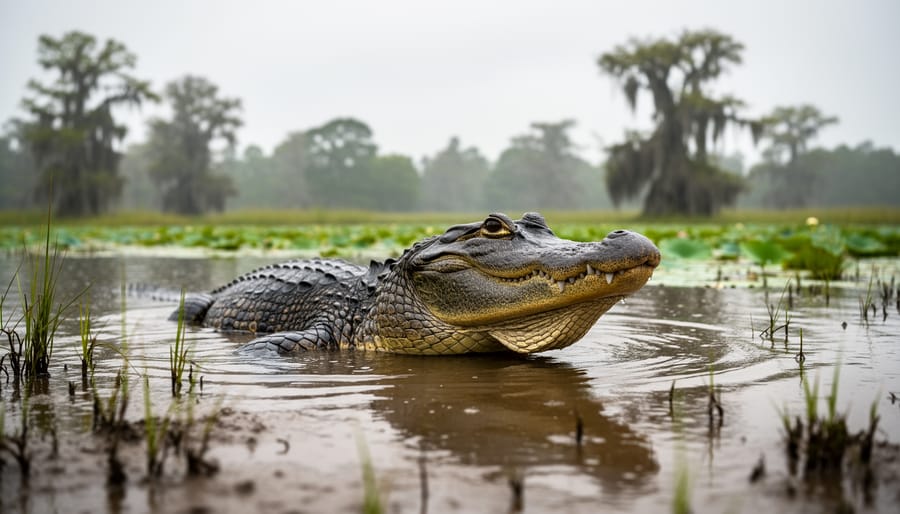
The American alligator is a modern-day dinosaur that has thrived in North America’s wetlands for millions of years, achieving one of conservation’s most remarkable success stories after nearly vanishing in the mid-20th century. These powerful reptiles can grow up to 15 feet long, live for 50 years or more in the wild, and play a critical role in maintaining the health of coastal and freshwater ecosystems from North Carolina to Texas.
Once hunted to near extinction for their valuable hides, American alligators have rebounded so dramatically since federal protection began in 1967 that they were removed from the endangered species list in 1987. This recovery demonstrates how targeted conservation efforts, combined with public awareness and habitat protection, can reverse even dire population declines.
Today, alligators serve as what biologists call a keystone species. They create “gator holes” that provide vital water sources during droughts, supporting dozens of other species. Their nesting mounds offer elevated ground for turtles and other reptiles to lay eggs. Even their presence as apex predators helps regulate fish and turtle populations, preventing any single species from dominating an ecosystem.
Understanding these ancient reptiles means recognizing their place not just in Southern folklore and tourism, but in the intricate web of wetland ecology that sustains countless species, filters water, and protects coastal communities from storm surge. The facts about American alligators reveal an animal far more complex and ecologically significant than popular culture suggests, one whose continued survival depends on protecting the vanishing wetlands they call home.
Ancient Survivors: Evolution and Longevity
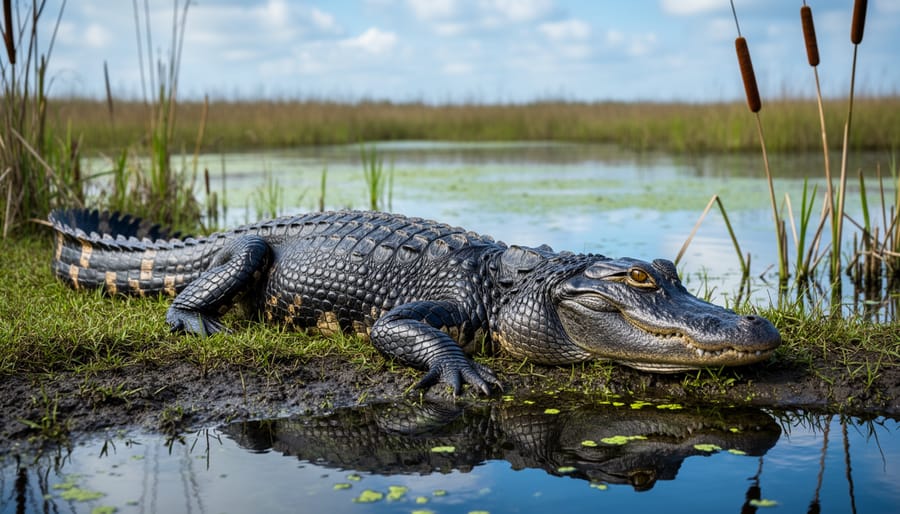
The American alligator (Alligator mississippiensis) stands as one of Earth’s most enduring survivors, a testament to the power of adaptation. While dinosaurs vanished 66 million years ago, alligators in their modern form have prowled wetlands for approximately 8 million years, weathering dramatic climate shifts, ice ages, and profound landscape transformations that wiped out countless other species.
Their lineage traces back even further. The order Crocodylia, which includes alligators, crocodiles, and gharials, emerged roughly 95 million years ago during the Late Cretaceous period. Fossil evidence shows that ancestors of today’s American alligator roamed North America when saber-toothed cats and mammoths still walked the continent. This deep evolutionary history reveals creatures refined by millions of years of natural selection, not evolutionary accidents but finely-tuned predators perfectly suited to their wetland niche.
Individual alligators also demonstrate remarkable longevity. In the wild, most American alligators live 30 to 50 years, with females typically outliving males due to lower territorial aggression and reduced injury rates. Protected populations in controlled environments push these boundaries further, captive alligators have reached 80 years old, suggesting their biological potential far exceeds what wild conditions typically allow.
This combination of species-level endurance and individual longevity creates a unique conservation advantage. Unlike short-lived species that depend on rapid reproduction to survive, alligators reproduce steadily over decades, allowing populations to recover from setbacks. Their evolutionary resilience, the same traits that carried them through millions of years of environmental upheaval, now helps them adapt to contemporary challenges including habitat fragmentation and climate variability. Understanding this deep-time perspective transforms how we view their role: not just as fascinating animals, but as living connections to ancient ecosystems whose survival enriches modern wetland biodiversity.
Size and Growth: Nature’s Living Dinosaurs
American alligators earn their reputation as living dinosaurs through sheer size alone. Adult males typically stretch 10 to 15 feet in length and pack on 500 pounds or more, with exceptional individuals reaching 14 feet and topping 1,000 pounds. Females remain considerably smaller, averaging 8 to 10 feet and weighing around 200 pounds. This size difference isn’t arbitrary, it reflects distinct ecological roles, with larger males defending territories while females focus on nest building and offspring protection.
What truly sets alligators apart is their indeterminate growth pattern. Unlike mammals that reach a fixed adult size, alligators continue growing throughout their entire lives. Growth rates vary dramatically with age and conditions. Hatchlings emerge at just 6 to 8 inches long but can gain 12 inches annually during their first few years when food is abundant. As they mature, this rate slows considerably, a 10-foot adult might add only an inch or two per year. Temperature, prey availability, and habitat quality all influence how quickly an individual grows.
This continuous growth creates fascinating population dynamics. The oldest, largest males dominate prime territories and breeding opportunities, having spent decades accumulating mass. In the wild, most alligators reach sexual maturity between 6 and 10 feet, typically at 10 to 12 years old. Their extended lifespan and perpetual growth make them apex predators that shape wetland ecosystems for generations.
Wetland Architects: Creating Habitat for Hundreds of Species
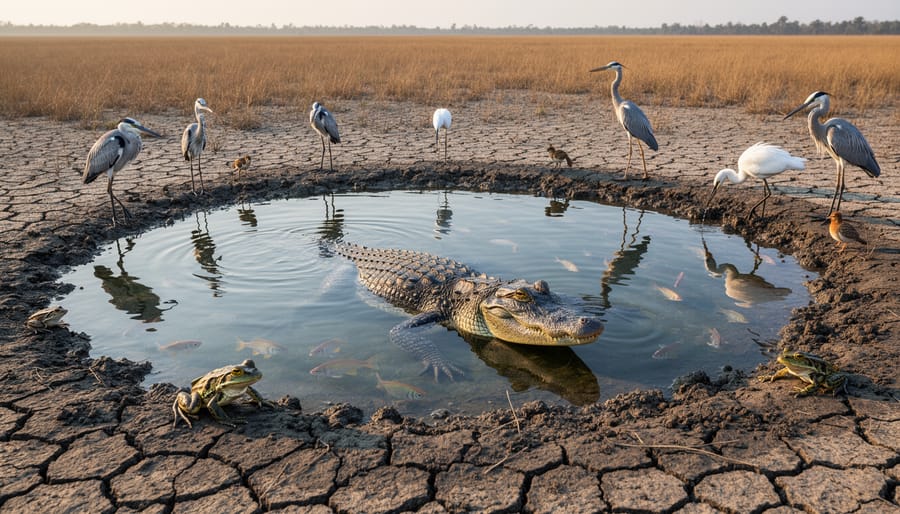
American alligators don’t just inhabit wetlands, they actively engineer them, acting as architects that create and sustain critical habitat for hundreds of other species. During dry seasons when water levels drop across the southeastern United States, alligators excavate and maintain depressions known as “gator holes” by using their powerful bodies, tails, and jaws to clear vegetation and sediment. These excavated pools retain water long after surrounding areas have dried up, becoming vital refuges that can mean the difference between survival and death for countless organisms.
The ecological importance of these gator holes extends far beyond simple water retention. As a keystone species, alligators shape their entire ecosystem in ways disproportionate to their numbers. Their wetland ecosystem role becomes most apparent during drought conditions, when these constructed pools serve as oases that concentrate and protect aquatic life until rains return. Fish, turtles, wading birds, insects, amphibians, and even mammals gather at these water sources, creating dense biological communities that wouldn’t otherwise persist through seasonal dry periods.
The species and ecosystem benefits sustained by alligator-created habitats include:
- Fish populations that survive droughts and repopulate surrounding wetlands when water returns
- Wading birds like herons, egrets, and wood storks that rely on concentrated prey during nesting season
- Freshwater turtles and snakes that find shelter and hunting grounds
- Amphibians including frogs and salamanders that require permanent water for breeding
- Nutrient cycling that enriches surrounding vegetation when water levels rise
Research in Florida’s Everglades has documented more than 220 species using gator holes during dry seasons. Without these alligator-maintained refuges, biodiversity across southern wetlands would plummet during drought cycles, disrupting food webs and reducing ecosystem resilience for decades to come.
Remarkable Adaptations: Biology Beyond the Bite
Sensory Superpowers
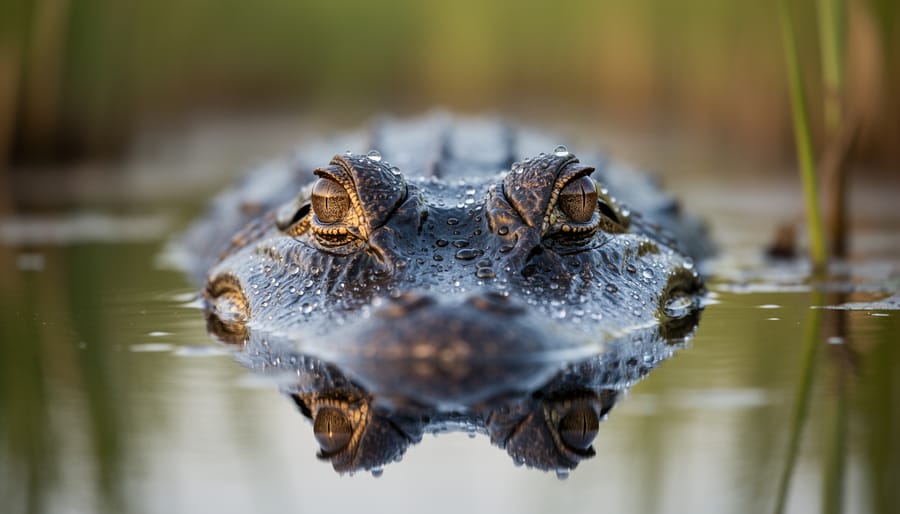
American alligators possess a sensory system that rivals the most sophisticated underwater detection technology. Their skin contains thousands of tiny black dots called integumentary sensory organs (ISOs), visible as small bumps concentrated around their jaws and scattered across their entire body. These organs detect minute pressure changes and vibrations in water, creating a detailed map of their surroundings without relying on sight.
Each ISO contains specialized nerve bundles more sensitive than human fingertips. When prey moves through water, even a small fish swimming several feet away, the resulting ripples trigger these sensors. The alligator’s brain processes signals from thousands of ISOs simultaneously, pinpointing the exact location, size, and movement pattern of potential meals. This system functions flawlessly in murky swamp water or complete darkness, giving alligators a decisive hunting advantage during nighttime hours.
These survival secrets explain how alligators thrive in low-visibility environments where visual predators struggle. Research shows ISOs can detect pressure changes as subtle as a single water droplet hitting the surface. This extraordinary sensitivity allows alligators to distinguish between different prey types and even sense approaching threats, making them remarkably efficient hunters and survivors in wetland ecosystems.
Temperature-Dependent Sex Determination
The sex of American alligator hatchlings isn’t determined by chromosomes like in mammals. Instead, it’s entirely controlled by the temperature of the nest during a critical 7-to-21-day incubation window. Nests that maintain temperatures above 93°F produce predominantly males, while cooler nests below 86°F yield females. The narrow temperature range between 86°F and 93°F results in a mix of both sexes.
Female alligators construct nests from vegetation and mud, which generate heat through decomposition. She instinctively positions her nest in sun or shade based on seasonal conditions, but she can’t adjust the temperature once eggs are laid. This means environmental factors like weather patterns, nest location, and vegetation type directly influence the sex ratio of each clutch.
Climate change poses a significant threat to this delicate system. Rising temperatures could skew populations heavily male, disrupting breeding dynamics and potentially threatening long-term population stability. Warmer springs and summers mean fewer females hatching, which scientists are closely monitoring across southeastern wetlands as an indicator of climate impacts on reptilian reproduction.
Communication and Social Behavior
American alligators are far from silent reptiles. During the spring mating season, males produce deep, resonant bellows that carry across the water, vibrating the surface and traveling up to a mile. These vocalizations serve multiple purposes: establishing territory, attracting females, and warning rival males. Females also bellow, though less frequently, and both sexes use head slaps against the water as acoustic signals.
What truly sets alligators apart is their maternal care, exceptional among reptiles. After guarding her nest for 65 days, a mother responds to the high-pitched chirping calls of ready-to-hatch babies by carefully excavating the nest. She gently carries hatchlings in her jaws to the water, making multiple trips to transport the entire clutch. For the next eight to twelve months, she remains vigilant, protecting her young from predators like herons, fish, and even other alligators.
Hatchlings stay near their mother, often seen riding on her back or clustering around her in protected areas throughout the alligator range. They communicate constantly through chirps and grunts, alerting her to danger. This extended parental investment, rare in reptilian species, significantly improves hatchling survival rates. Juvenile alligators produce distinct distress calls when threatened, prompting immediate defensive responses from nearby mothers, who will aggressively confront any perceived threat to their offspring.
From Endangered to Thriving: A Conservation Success Story
The American alligator’s comeback from the edge of extinction stands as one of wildlife conservation’s greatest achievements. By the 1960s, unregulated hunting for their valuable hides had decimated populations across the southeastern United States, pushing these ancient reptiles toward disappearance. Hunters killed hundreds of thousands of alligators annually, and populations in Louisiana alone plummeted from an estimated 2 million to fewer than 100,000.
The turning point came in 1967 when the U.S. Fish and Wildlife Service listed the American alligator as endangered under the Endangered Species Preservation Act, the predecessor to today’s Endangered Species Act. This federal protection made it illegal to hunt, kill, or trade alligators and their products. States across the Southeast implemented strict enforcement measures, deployed wildlife officers to patrol wetlands, and established severe penalties for poaching.
The results exceeded expectations. Protected populations rebounded rapidly throughout the 1970s and 1980s. Florida’s population grew from an estimated 300,000 in 1970 to over 1 million by the mid-1980s. Louisiana saw similar dramatic increases. In 1987, just 20 years after listing, the U.S. Fish and Wildlife Service removed the American alligator from the endangered species list, a milestone that inspired hope for other threatened species.
Today, more than 5 million American alligators inhabit wetlands across their range from North Carolina to Texas. This success stemmed from coordinated efforts between federal agencies, state wildlife departments, universities conducting population research, and wetland conservation programs that preserved critical habitat. Many states now manage sustainable alligator harvest programs that generate millions in revenue for continued wetland protection, creating a self-sustaining conservation model. The species’ recovery proves that legal protection combined with habitat preservation can bring even heavily exploited wildlife back from the brink.
Ecological Role in Marine and Coastal Systems
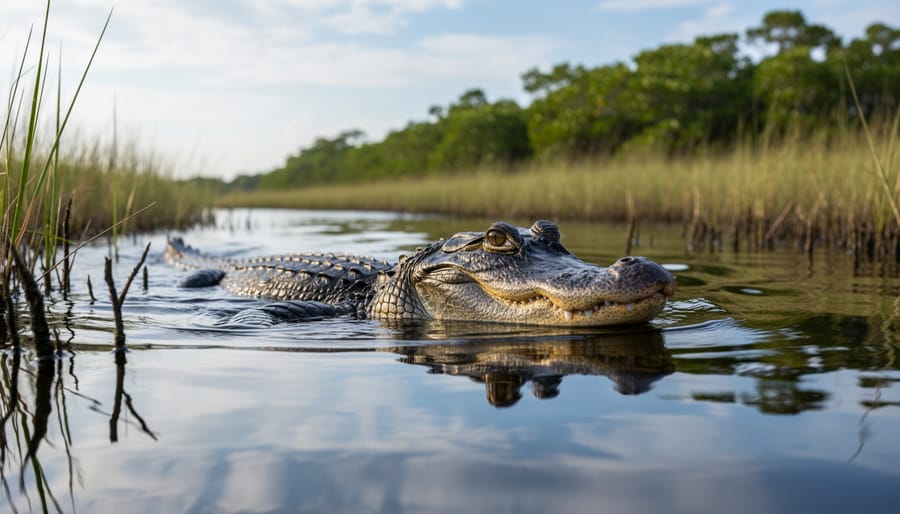
American alligators play a crucial role in coastal ecosystems where freshwater meets the sea. While they’re primarily freshwater reptiles, these adaptable predators regularly inhabit brackish estuaries, coastal wetlands, and mangrove systems throughout the southeastern United States. Their presence in these transitional zones links freshwater and marine food webs in ways scientists are still discovering.
Unlike their saltwater crocodile cousins, American alligators can tolerate brackish water for only limited periods. They lack functioning salt glands, so extended exposure to high salinity stresses their systems and can prove fatal. Despite this limitation, they routinely venture into low-salinity estuaries where freshwater rivers meet tidal influences, typically staying where salt concentrations remain below 10 parts per thousand.
In these coastal habitats, alligators serve as apex predators that regulate prey populations including blue crabs, mullet, and various shorebirds. Their gator holes become especially critical in coastal areas during droughts, providing refuges that maintain fish populations which then disperse into adjacent tidal creeks and marshes when water levels rise. This ecological service supports commercial fisheries and coastal food chains far beyond the holes themselves.
The health of coastal alligator populations also signals broader ecosystem conditions. Habitat degradation from salt marsh loss pollution, and altered freshwater flows directly impacts their ability to thrive in these transitional zones. Protecting and restoring coastal wetlands benefits not just alligators but the entire interconnected community of marine and freshwater species that depend on these productive edge environments.
Coexistence and Conservation Challenges in 2026
Despite their remarkable recovery, American alligators face new challenges as human populations expand into their wetland habitats. Coastal development across the Southeast has fragmented critical nesting and feeding areas, forcing alligators into closer contact with residential communities. This overlap has increased human-alligator encounters, though serious incidents remain rare when proper precautions are followed.
Climate change poses a particularly complex threat to alligator populations. Rising temperatures could skew sex ratios dramatically, since nest temperatures above 93°F produce almost exclusively male hatchlings. Extended droughts reduce the water levels in gator holes that serve as dry-season refuges for entire wildlife communities, while intensified hurricanes and storm surges can destroy nesting sites and alter salinity levels in brackish habitats beyond what alligators tolerate.
Wildlife managers across Florida, Louisiana, Georgia, and other southeastern states have responded with adaptive strategies. Nuisance alligator programs relocate problem animals from residential areas, though relocation success varies. Educational campaigns teach residents to avoid feeding alligators, which eliminates their natural wariness of humans and creates dangerous situations. Many communities now maintain buffer zones between developments and wetlands, preserving movement corridors that allow alligators to access multiple habitats without crossing populated areas.
Ongoing population monitoring through aerial surveys, nest counts, and citizen science programs provides data essential for sustainable management. These efforts balance conservation goals with public safety, ensuring that this keystone species continues shaping wetland ecosystems while coexisting with growing human communities.
Common Questions About American Alligators
Can alligators live in saltwater?
American alligators tolerate brackish water in estuaries and coastal marshes for short periods, but they lack the specialized salt glands that crocodiles possess. Extended exposure to high salinity can be harmful, so they primarily stick to freshwater and low-salinity environments.
How fast can alligators run on land?
Alligators can reach short-burst speeds of up to 11 miles per hour on land, but only for very brief distances of 10-20 feet. They tire quickly and aren’t built for sustained chasing, so maintaining distance and moving away calmly is generally sufficient to stay safe.
Are American alligators dangerous to humans?
While alligators are powerful predators, fatal attacks on humans remain extremely rare, averaging fewer than one per year in the United States. Most incidents involve people feeding alligators (which is illegal and dangerous) or approaching nests during breeding season. Respecting their space and never feeding them keeps encounters safe.
What do alligators eat?
Young alligators feed on insects, small fish, and crustaceans, while adults consume fish, turtles, birds, mammals like raccoons and deer, and occasionally carrion. Their diet shifts as they grow, and they’re opportunistic hunters that adapt to whatever prey is abundant in their habitat.
How can I tell an alligator from a crocodile?
The easiest way to spot the difference involves the snout shape: alligators have wider, U-shaped snouts while crocodiles feature narrower, V-shaped snouts. When an alligator’s mouth is closed, you won’t see its lower teeth, whereas a crocodile’s fourth tooth on each side of the lower jaw remains visible. For a deeper dive into physical and behavioral distinctions, check out our guide on alligator vs crocodile identification.
What’s the conservation status of American alligators today?
American alligators were removed from the federal endangered species list in 1987 after a remarkable recovery, and current populations exceed 5 million across the southeastern United States. They’re now classified as “Least Concern” and considered one of conservation’s greatest success stories, though habitat protection remains essential for their continued thriving.
These questions reflect the most common curiosities people have when encountering information about American alligators. Understanding their behavior, limitations, and ecological role helps foster the kind of informed coexistence that has allowed their populations to rebound so dramatically over the past five decades.
The American alligator’s story offers genuine hope in an era of biodiversity loss. These ancient reptiles have bounced back from the edge of extinction to thrive once again in wetlands across the Southeast, proving that dedicated conservation efforts can reverse even the most alarming population declines. Their recovery demonstrates what becomes possible when communities, scientists, and policymakers unite behind a common goal.
Beyond their own remarkable comeback, alligators remain irreplaceable architects of wetland ecosystems. The gator holes they create sustain countless species during droughts. Their presence indicates healthy, functioning wetlands that filter water, store carbon, and buffer coastlines against storms. Protecting alligator habitat means safeguarding these critical services for both wildlife and human communities.
You can contribute to this conservation success. Support organizations working to preserve wetland corridors and coastal ecosystems. The Marine Biodiversity Science Center welcomes volunteers passionate about protecting these transitional habitats where freshwater meets marine environments. Whether you participate in monitoring programs, habitat restoration, or educational outreach, your involvement strengthens the network of people ensuring that future generations will continue to share the landscape with these magnificent survivors. Every action, no matter how small, advances the collective mission of preserving biodiversity.

jessica
Ava Singh is an environmental writer and marine sustainability advocate with a deep commitment to protecting the world's oceans and coastal communities. With a background in environmental policy and a passion for storytelling, Ava brings complex topics to life through clear, engaging content that educates and empowers readers. At the Marine Biodiversity & Sustainability Learning Center, Ava focuses on sharing impactful stories about community engagement, policy innovations, and conservation strategies. Her writing bridges the gap between science and the public, encouraging people to take part in preserving marine biodiversity. When she’s not writing, Ava collaborates with local initiatives to promote eco-conscious living and sustainable development, ensuring her work makes a difference both on the page and in the real world.