Marine Biodiversity Science Center

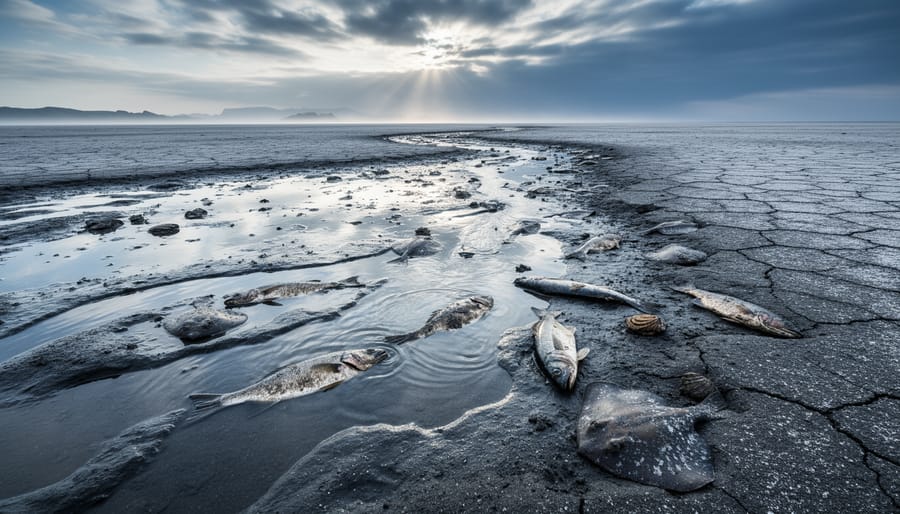
If the oceans disappeared, Earth would become uninhabitable within days. The blue expanse covering 71% of our planet’s surface isn’t just scenery. It’s the engine room of our climate, the primary source of atmospheric oxygen, and the foundation of the global food web that sustains billions of people.
This thought experiment might sound like science fiction, but exploring it reveals critical truths about how ocean systems work and why their health matters right now. Every breath you take contains oxygen produced largely by marine phytoplankton. The water cycle that delivers rain to crops and cities depends entirely on ocean evaporation. Global temperatures remain stable because oceans absorb 90% of excess heat trapped by greenhouse gases.
When we imagine oceans vanishing, we’re really asking: what would collapse first? The answer is nearly everything, and faster than most people realize. Within 24 hours, humidity would plummet. Within weeks, the climate would spiral into extremes that make current weather events look mild. Marine biodiversity, which took hundreds of millions of years to evolve, would vanish instantly, taking with it the protein source for three billion people.
Understanding this cascading failure helps us grasp why protecting ocean health isn’t optional. Marine biologist Dr. Sarah Chen, who has spent two decades studying coral reef ecosystems, puts it simply: “We don’t inherit healthy oceans. We’re borrowing them from a future that depends entirely on decisions we make today.” This article walks through the precise timeline of what would happen if oceans disappeared, and more importantly, what that teaches us about conservation priorities in 2026.
What Ocean Disappearance Really Means
When we imagine oceans disappearing, we’re picturing the sudden vanishing of roughly 1.335 billion cubic kilometers of seawater, an incomprehensible volume that currently fills basins averaging 3,688 meters deep. The oceans cover about 70.8% of our planet’s surface, meaning nearly three-quarters of Earth would transform overnight into exposed seafloor, revealing trenches, underwater mountain ranges, and vast abyssal plains never meant to see daylight.
This isn’t just a water drainage problem. Ocean disappearance means losing the interconnected systems that make Earth habitable. We’d lose the Atlantic’s Gulf Stream, the Pacific’s Kuroshio Current, and every oceanic conveyor belt that moderates our climate. The Antarctic Circumpolar Current, which moves more water than all the world’s rivers combined, would simply cease to exist.
- Water Column
- The vertical section of ocean from surface to seafloor, containing distinct layers with different temperatures, pressures, and light levels that support diverse marine life.
- Marine Biomes
- Large-scale ocean ecosystems, including coral reefs, kelp forests, deep-sea vents, and open ocean zones, each supporting specialized communities of organisms adapted to specific conditions.
- Thermohaline Circulation
- The global ocean conveyor belt driven by temperature and salinity differences, distributing heat and nutrients worldwide while regulating Earth’s climate.
- Carbon Sink
- The ocean’s capacity to absorb and store carbon dioxide from the atmosphere, currently sequestering about 30% of human-generated CO2 emissions.
- Ocean-Atmosphere Interface
- The dynamic boundary where ocean and air exchange gases, heat, and moisture, the engine driving weather patterns and the water cycle.
Beyond the water itself, we’d eliminate every chemical exchange between ocean and atmosphere that currently stabilizes our climate. The biological pump, where phytoplankton absorb carbon and sink it to ocean depths, would halt. Coastal wetlands, mangrove forests, and estuaries where freshwater meets saltwater would vanish entirely, taking their nursery habitats with them.
This thought experiment forces us to see oceans not as background scenery, but as active planetary machinery. Understanding what disappears helps us grasp what oceans actually do, and why even partial degradation of these systems threatens life as we know it.
How Oceans Work to Sustain Life on Earth
Climate Regulation and Heat Distribution
Oceans act as Earth’s thermostat, absorbing vast amounts of solar radiation that would otherwise make the planet’s surface uninhabitable. Water covers 71% of Earth’s surface and has an extraordinarily high heat capacity, meaning it can absorb and store enormous quantities of thermal energy without dramatic temperature changes. As sunlight strikes the ocean surface, water molecules absorb this energy and hold it, preventing the extreme temperature swings that would occur over land alone. This stored heat doesn’t simply sit in place. Ocean currents act as conveyor belts, constantly redistributing this thermal energy around the globe.
The thermohaline circulation, driven by differences in water temperature and salinity, forms the backbone of this planetary heat distribution system. Warm equatorial waters flow toward the poles along the surface, releasing heat into the atmosphere as they travel. When these waters reach polar regions, they cool and become denser, sinking deep beneath the surface and flowing back toward the equator. This continuous cycle prevents tropical regions from overheating and polar regions from becoming even colder, maintaining a habitable temperature range across latitudes.
Without this oceanic heat engine, equatorial regions would face scorching temperatures exceeding 60°C, while polar areas would plunge below -80°C. Coastal regions, which currently enjoy moderated climates due to oceanic proximity, would experience continental temperature extremes, blistering summers and frozen winters with no buffering effect.
Oxygen Production and Carbon Storage
Every breath you take connects you to the ocean, even if you live a thousand miles inland. Marine phytoplankton, microscopic organisms drifting near the ocean’s surface, generate between 50 and 80 percent of Earth’s oxygen through photosynthesis. These single-celled algae and bacteria convert sunlight, carbon dioxide, and nutrients into organic matter while releasing oxygen as a byproduct. Without oceans, this oxygen factory would shut down immediately, causing atmospheric oxygen levels to plummet while carbon dioxide concentrations spiked unchecked.
Oceans function as the planet’s largest carbon sink, absorbing roughly 30 percent of human-generated carbon dioxide emissions. This absorption happens through two mechanisms: physical dissolution at the ocean surface and the biological pump. The biological pump works like a planetary conveyor belt: phytoplankton absorb CO2 during photosynthesis, zooplankton eat the phytoplankton, and when these organisms die, their carbon-rich bodies sink to the deep ocean floor, locking carbon away for centuries or millennia. Ocean sediments store an estimated 38,000 gigatons of carbon, dwarfing the atmosphere’s 800 gigatons.
If oceans vanished, this carbon storage system would collapse entirely. The carbon currently locked in ocean waters and sediments would release into the atmosphere, creating a runaway greenhouse effect that would make Earth uninhabitable within decades.
Water Cycle and Weather Pattern Generation
Oceans function as the planet’s primary engine for the hydrological cycle, with over 86% of global evaporation occurring from ocean surfaces. When solar energy heats seawater, molecules escape into the atmosphere as water vapor, creating the moisture reservoir that generates precipitation across continents. This constant evaporation process transfers approximately 413,000 cubic kilometers of water from oceans to the atmosphere annually, water that eventually falls as rain and snow, replenishing freshwater sources thousands of miles inland.
Without oceans, this massive evaporation pump would cease immediately. The atmosphere would lose its primary moisture source, causing rainfall patterns to collapse within weeks. Deserts would expand rapidly from coastlines inward as existing atmospheric moisture depleted without replenishment. Rivers and lakes would dry up since most precipitation originates from ocean-sourced water vapor transported by wind systems.
Ocean surface temperatures also control weather system intensity. Warm water fuels tropical cyclones and influences jet stream positioning, which steers storms across continents. Temperature differentials between ocean regions and landmasses create the pressure gradients that drive prevailing winds. Without these oceanic influences, Earth would experience static, extreme conditions, scorching heat in equatorial zones with virtually no moderating precipitation, and frozen polar regions extending much farther toward the equator than current ice caps reach.
Marine Biodiversity and Ecosystem Services
Oceans harbour an estimated 2.2 million species, representing the planet’s richest concentration of life forms. This marine biodiversity spans every scale: microscopic bacteria that decompose organic matter and recycle nutrients, phytoplankton that form the base of oceanic food webs, zooplankton that convert primary production into animal protein, fish species numbering over 34,000, and apex predators like sharks and orcas that regulate entire ecosystems. Each organism plays a functional role. Coral reefs, built by tiny polyps, shelter 25% of all marine species while occupying less than 1% of ocean area. Filter feeders like mussels and oysters clean billions of gallons of water daily. Deep-sea organisms produce enzymes used in medical research and industrial processes. These organisms collectively provide ecosystem services humans depend on: nutrient cycling that fertilizes coastal waters and supports fisheries, food production that feeds 3.3 billion people, coastal protection through mangroves and reefs that buffer storm surge, and genetic resources yielding compounds for cancer treatment and biotechnology. Without this biological complexity, Earth loses not just species but the functional systems that make the planet habitable.
The Cascade of Environmental Catastrophes
Immediate Atmospheric and Climate Breakdown
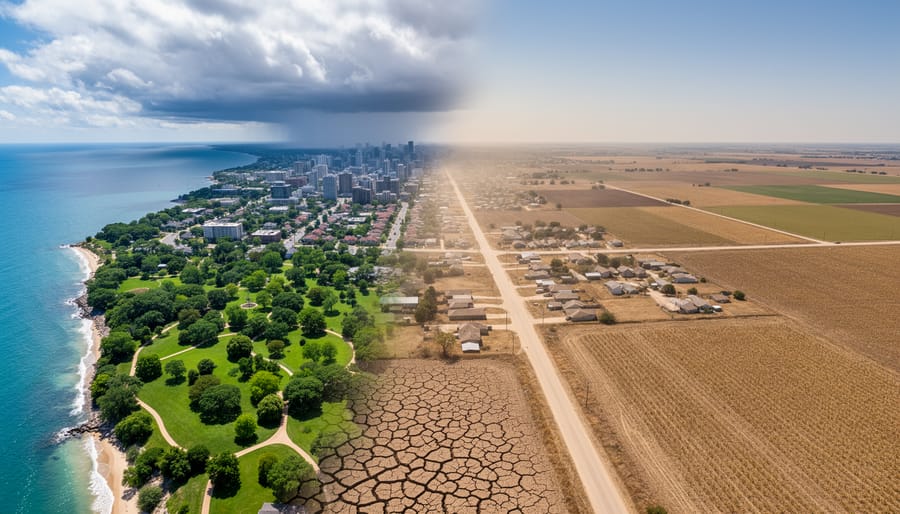
Within hours of ocean disappearance, Earth’s atmosphere would begin a catastrophic transformation. The immediate halt of phytoplankton oxygen production would start a slow atmospheric suffocation, though existing oxygen reserves would initially mask the crisis. More pressing would be the sudden end of evaporation, which feeds 86% of atmospheric moisture. Rain would cease almost immediately as existing water vapor precipitates out, leaving skies eerily clear but deadly dry.
Temperature chaos would strike first. Coastal regions accustomed to mild, ocean-moderated climates would experience violent swings, scorching days exceeding 50°C (122°F) followed by freezing nights plummeting below -20°C (-4°F). Without water’s thermal buffering, landmasses would heat and cool as drastically as the Moon’s surface. Equatorial zones would become blast furnaces while polar regions, no longer warmed by ocean currents, would see temperatures crash.
The collapse of ocean-driven weather systems would be equally swift. Hurricanes, monsoons, and mid-latitude storm tracks, all powered by ocean heat and moisture, would vanish. The jet stream, guided partly by temperature contrasts between ocean and land, would destabilize wildly. Atmospheric carbon dioxide would spike as oceans ceased absorbing 30% of emissions, accelerating into a runaway greenhouse effect that compounds the temperature extremes.
Within weeks, Earth would resemble a barren, hyperventilating desert planet, oscillating between baking heat and bitter cold with no moderating force to restore balance.
Mass Extinction of Marine and Terrestrial Species
The moment oceans vanished, 2.2 million known marine species, and countless undiscovered ones, would die instantly. Coral reefs, kelp forests, and seagrass meadows would cease to exist within hours, along with every fish, crustacean, mollusk, and marine mammal. Whales, dolphins, and seals would perish immediately. The biomass of life in former ocean basins would represent the largest extinction event in Earth’s history, dwarfing the end-Cretaceous asteroid impact.
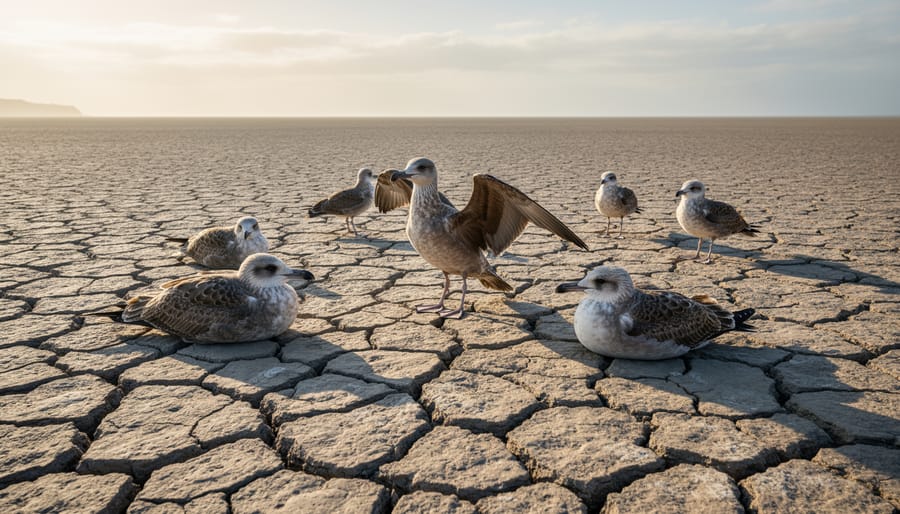
Land-based species would follow rapidly. Seabirds like albatrosses, pelicans, and penguins would lose 100% of their food supply, triggering starvation within days. Coastal predators, including polar bears, sea otters, and marine iguanas, would face immediate food web collapse. Within weeks, plummeting oxygen levels would begin suffocating air-breathing animals, starting with those in low-lying areas where heavier carbon dioxide would accumulate.
The cascade would accelerate as terrestrial food webs unraveled. Insects dependent on coastal ecosystems would vanish, eliminating pollination services. Migratory species relying on marine stopovers would die mid-journey. Predators at every level would face prey collapse. Scientists estimate that without ocean-produced oxygen and with spiraling climate chaos, 90% of terrestrial species would disappear within months. The few survivors would cling to existence in a barely recognizable, oxygen-depleted world where ecosystems as we understand them had fundamentally ceased to function.
Collapse of Human Water and Food Systems
The disappearance of oceans would immediately eliminate the source of 86% of global evaporation that drives Earth’s water cycle. Without oceanic moisture feeding atmospheric circulation, precipitation patterns would collapse within weeks. Coastal regions receiving abundant rainfall would become arid, while river systems dependent on ocean-influenced weather would dwindle to nothing. The Southwest Asian monsoons, African rains, and North American storm tracks, all powered by ocean evaporation, would cease, triggering worldwide drought conditions unprecedented in human history.
Food systems would face simultaneous catastrophic failures. The immediate loss of all seafood would erase 17% of global protein intake, affecting 3.3 billion people who rely on fish as their primary protein source. Coastal communities dependent on fishing would lose their entire food security and economic base overnight.
Agricultural devastation would follow swiftly. Crops dependent on ocean-moderated rainfall and consistent growing seasons would fail globally. The American grain belt, Asian rice paddies, and African farmlands all depend on predictable precipitation patterns originating from ocean evaporation. Without this moisture, irrigation systems would run dry as groundwater depleted and rivers failed. Global food production would collapse within a single growing season, creating immediate mass starvation affecting billions.
Geological and Planetary Changes
Beyond the immediate biological and atmospheric catastrophes, ocean disappearance would fundamentally alter Earth’s physical structure. The exposed ocean basins, covering 361 million square kilometers and reaching depths of 11 kilometers in trenches, would become vast, barren depressions. Without water’s immense mass distributed across the surface, Earth’s rotation would accelerate slightly, shortening days by fractions of a second as mass concentrates toward the core.
Tectonic activity would intensify dramatically. Ocean water exerts enormous pressure on seafloor crust, helping stabilize tectonic plates. Removing this weight would trigger widespread earthquakes and volcanic eruptions as the lithosphere rebounds. Mid-ocean ridges would cease producing new crust, fundamentally disrupting plate tectonics.
Earth’s gravitational field would shift measurably. Satellites would detect gravitational anomalies where ocean mass once existed. The planet’s albedo, reflectivity, would change radically as dark basins replace reflective water surfaces, further destabilizing climate. These geological transformations would render Earth unrecognizable, a fundamentally different planet from the water world that sustains life.
Real-World Applications: Why Understanding Ocean Functions Matters
While total ocean disappearance remains impossible, we’re already witnessing partial versions of this catastrophe. The thought experiment isn’t academic, it’s a magnifying glass on the real threats chipping away at ocean functions right now.
Ocean acidification warming waters, plastic pollution, and overfishing each represent incremental losses of the systems we’ve explored. When coral reefs bleach and die, we lose biodiversity hotspots that support millions of species. When warming disrupts thermohaline circulation, we compromise the climate regulation that keeps our planet habitable. When overfishing collapses fish populations, we damage the nutrient cycling that sustains marine food webs. These aren’t isolated problems, they’re the slow-motion version of what our thought experiment revealed in fast-forward.
Understanding what complete ocean loss would mean sharpens our priorities for 2026 conservation efforts:
- Protect marine biodiversity hotspots like coral reefs and kelp forests that support disproportionate ecosystem functions
- Reduce carbon emissions to prevent further warming and acidification of ocean chemistry
- Combat plastic pollution that disrupts marine food webs from plankton to apex predators
- Establish and enforce marine sanctuaries that allow ecosystems to recover and maintain resilience
- Support sustainable fishing practices that preserve population structures and trophic balance
- Restore coastal ecosystems like mangroves and seagrass beds that provide critical carbon storage and nursery habitat
Each of these actions prevents a piece of the catastrophe we’ve imagined. The oxygen-producing phytoplankton, the heat-distributing currents, the carbon-absorbing chemistry, these aren’t abstract concepts but tangible systems we can measure, monitor, and protect. When we prevent the death of a coral reef or reduce nutrient runoff that creates dead zones, we’re literally preserving the planetary life-support systems our thought experiment showed us we cannot live without.
From Thought Experiment to Conservation Action
The catastrophic scenario we’ve explored reveals a stark truth: we don’t need oceans to vanish completely to face dire consequences. Every piece of plastic entering the water, every degree of warming, every coral reef bleached represents a partial loss of ocean function. The urgency lies in recognizing that incremental degradation leads toward the same endpoint, just more slowly.
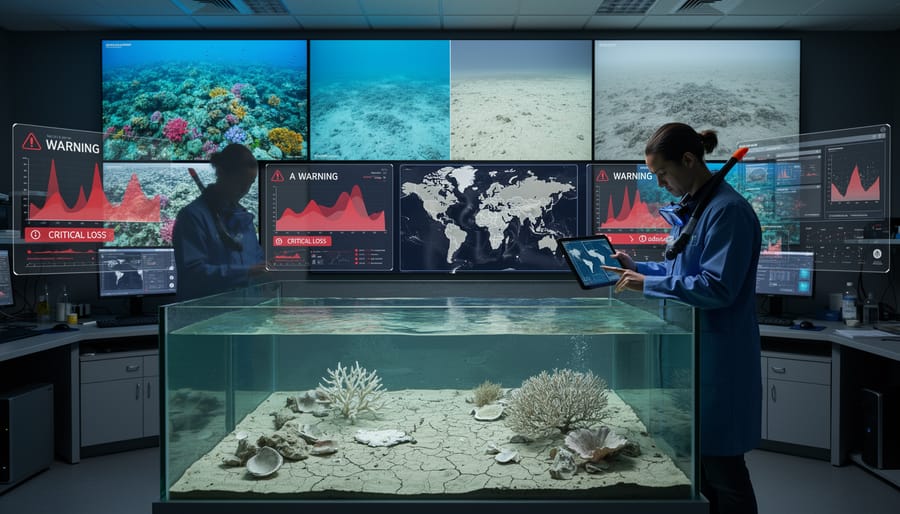
Marine biologist Dr. Elena Vasquez, who has spent fifteen years monitoring coral restoration projects in the Caribbean, puts it bluntly: “When I show people dying reefs, I’m showing them ocean functions disappearing in real time, oxygen production dropping, carbon storage failing, biodiversity collapsing. We’re not preventing a hypothetical disaster; we’re fighting one that’s already underway.”
The encouraging reality is that ocean conservation offers tangible entry points for everyone. Coastal cleanup initiatives need volunteers year-round, removing the plastics that kill marine life and disrupt ecosystems. Citizen science programs like reef monitoring, whale tracking, and water quality testing contribute essential data that shapes protection policies. For those inland, advocating for stronger marine protected areas, supporting sustainable seafood programs, and reducing personal carbon footprints directly counteract the forces degrading ocean health.
Organizations like the Marine Conservation Institute, Ocean Conservancy, and local aquarium volunteer programs provide structured opportunities to contribute meaningful work. Even small coastal communities run beach restoration projects that stabilize shorelines and protect marine habitats.
Dr. Vasquez’s perspective reflects a broader sentiment among conservation professionals: “Every volunteer who removes ghost nets, every person who chooses sustainable seafood, every voice demanding ocean protection, they’re collectively maintaining the planetary systems we’ve described. The thought experiment shows us what we’re fighting for. Now we need people willing to fight.”
While oceans won’t vanish overnight, this thought experiment reveals what we too often take for granted: oceans are the pulse of our planet, driving climate, producing oxygen, feeding billions, and supporting biodiversity beyond measure. Every breath we take, every rainstorm, every stable season depends on healthy ocean systems. The catastrophic scenario we’ve explored here underscores a simple truth, we cannot afford to lose even fractions of ocean function.
The good news? Unlike our hypothetical disaster, the real threats facing oceans today are reversible through dedicated action. Ocean acidification can be slowed by reducing carbon emissions. Overfishing can be halted through sustainable practices and marine protected areas. Pollution can be prevented through better waste management and policy changes. These aren’t distant goals, they’re happening now, driven by scientists, conservationists, and volunteers working in coastal communities worldwide.
You can be part of this effort. Join marine conservation projects, participate in beach cleanups, support sustainable seafood initiatives, or contribute to citizen science programs monitoring ocean health. Whether you’re a student, scientist, or concerned citizen, your involvement matters. The oceans have sustained life on Earth for billions of years. Now it’s our turn to sustain them.
Common Questions About Ocean Disappearance and Ocean Functions
Could the oceans actually disappear?
No, the complete disappearance of Earth’s oceans isn’t physically possible through natural processes. However, this thought experiment helps us understand the critical functions oceans perform, which are being degraded incrementally through acidification, warming, pollution, and overfishing.
How long would humans survive if the oceans vanished?
Without oceans, human survival would be measured in days to weeks at most. The combination of rapidly declining oxygen levels, catastrophic climate extremes, and the immediate collapse of the water cycle would make Earth uninhabitable almost instantly.
How much of Earth’s oxygen actually comes from the ocean?
Marine phytoplankton produce between 50 and 80 percent of the oxygen in Earth’s atmosphere through photosynthesis. This means oceanic organisms generate more breathable air than all terrestrial forests combined, making ocean health directly connected to atmospheric oxygen levels.
What happens if ocean currents stop flowing?
If major ocean currents like the thermohaline circulation ceased, global temperatures would swing to extremes, with polar regions becoming colder and tropical areas overheating. This disruption would devastate weather patterns, agriculture, and marine ecosystems dependent on nutrient upwelling from deep currents.
While these questions explore an impossible scenario, they point toward very real concerns facing ocean conservation today. The biggest current threat to ocean health isn’t sudden disappearance but gradual degradation. Climate change is warming ocean waters and disrupting currents, pollution introduces plastics and toxins into marine food webs, and overfishing depletes fish populations faster than they can recover.
Understanding what we’d lose if oceans disappeared completely sharpens our awareness of what we’re losing right now through incremental damage. Each degree of warming, each percentage point of increased acidity, and each species pushed toward extinction represents a small step toward the catastrophic scenario this thought experiment describes. That’s why ocean conservation work matters so urgently, and why every action to protect marine ecosystems helps preserve the planetary systems all life depends on.

jessica
Ava Singh is an environmental writer and marine sustainability advocate with a deep commitment to protecting the world's oceans and coastal communities. With a background in environmental policy and a passion for storytelling, Ava brings complex topics to life through clear, engaging content that educates and empowers readers. At the Marine Biodiversity & Sustainability Learning Center, Ava focuses on sharing impactful stories about community engagement, policy innovations, and conservation strategies. Her writing bridges the gap between science and the public, encouraging people to take part in preserving marine biodiversity. When she’s not writing, Ava collaborates with local initiatives to promote eco-conscious living and sustainable development, ensuring her work makes a difference both on the page and in the real world.