Marine Biodiversity Science Center

Microplastics contamination refers to the pervasive presence of plastic particles smaller than five millimeters in ecosystems worldwide, from ocean trenches to mountaintops, human bloodstreams to the food we eat daily. These fragments and fibers result from the breakdown of larger plastic items and the intentional manufacture of microbeads for industrial and consumer products, creating a pollution crisis that crosses every environmental boundary and raises profound questions about our relationship with synthetic materials.
The scale of this contamination is staggering. Scientists estimate that 14 million tons of microplastics now settle on ocean floors alone, with concentrations in some coastal waters exceeding hundreds of thousands of particles per cubic meter. We’ve found these pollutants in Arctic ice cores, Antarctic snow, drinking water supplies across six continents, and even in human placentas. Unlike other forms of pollution that dilute or degrade over time, microplastics persist for centuries while continuously fragmenting into smaller pieces, including nanoplastics that can penetrate cellular barriers.
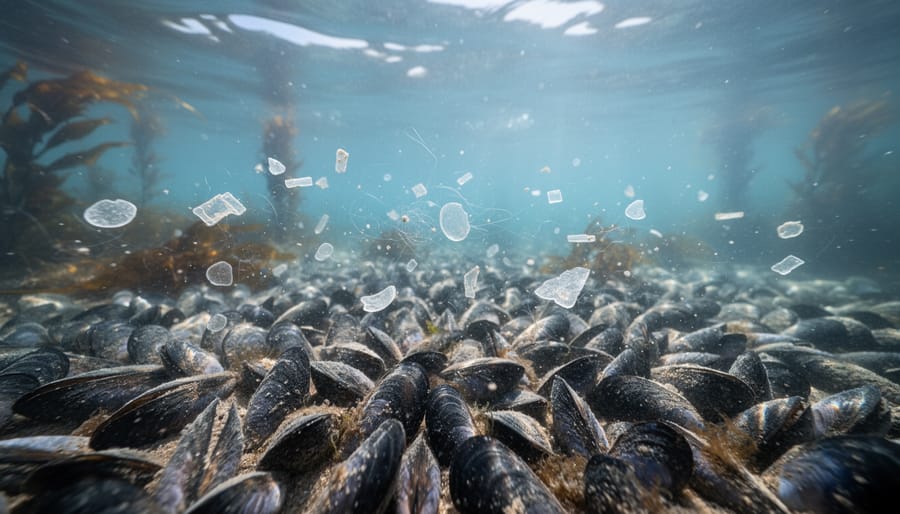
What makes microplastics contamination particularly challenging is its invisibility. You can’t see most of these particles without magnification, yet they’re present in the air you breathe, the water you drink, and the seafood on your plate. Marine ecosystems bear an especially heavy burden. Filter feeders like mussels and oysters concentrate these particles, while seabirds mistake plastic fragments for food, filling their stomachs with indigestible material that offers no nutrition.
This article examines how microplastics enter our environment, the different forms they take, where contamination is most severe, and the ethical dimensions of a pollution problem that affects every living organism on Earth. You’ll discover what current science reveals about impacts on marine life and human health, and learn concrete actions that individuals and communities can take to reduce this growing threat.
What Microplastics Contamination Means for Marine Ecosystems
Microplastics are tiny fragments of plastic debris measuring less than five millimeters in diameter, roughly the size of a sesame seed or smaller. These particles have become ubiquitous in marine ecosystems worldwide, from tropical coral reefs to polar ice, carrying with them both physical and chemical threats to ocean life.
Understanding the terminology helps clarify the scope of contamination facing our oceans:
- Microplastics
- Plastic particles smaller than 5mm but larger than 1 micrometer, visible under magnification and capable of being ingested by a wide range of marine organisms from zooplankton to whales.
- Nanoplastics
- Even tinier plastic particles smaller than 1 micrometer (one-thousandth of a millimeter), small enough to cross cell membranes and potentially accumulate in tissues and organs.
- Primary microplastics
- Particles manufactured to be small, such as microbeads in cosmetics, plastic pellets used in industrial production (nurdles), and synthetic fibers shed from textiles during washing.
- Secondary microplastics
- Fragments resulting from the breakdown of larger plastic items like bottles, bags, and fishing gear through UV radiation, wave action, and weathering in the marine environment.
- Plastic polymers
- The chemical building blocks of plastics, including polyethylene, polypropylene, and polyester, each with different densities, breakdown rates, and capacities to absorb toxic chemicals.
Size matters profoundly when it comes to biological impacts. Microplastics in the 1-5mm range can be mistaken for food by seabirds, fish, and filter feeders. Smaller microplastics, approaching the nanoplastic threshold, pose different risks: they can penetrate deeper into tissues, cross biological barriers, and potentially trigger inflammatory responses at the cellular level.
These particles enter marine environments through multiple pathways. Wastewater treatment plants, even modern ones, can’t capture all microfibers and microbeads, so they flow into rivers and eventually the ocean. Coastal winds carry tire dust and degraded plastic from land. Fishing gear lost or discarded at sea fragments over time. Once in the water, microplastics don’t biodegrade in any meaningful timeframe, they simply break into smaller and smaller pieces, persisting for decades or centuries.
How Microplastic Contamination Works in Marine Food Webs
From Ocean Surface to Seafloor
Microplastics don’t simply float on the ocean surface. Their density, shape, and biological interactions determine where they end up in the water column, creating contamination hotspots at different depths.
Buoyant plastics like polyethylene and polypropylene initially concentrate at the surface, forming visible patches in ocean gyres. But wave action, biofouling (when organisms grow on plastic surfaces), and ingestion by marine life quickly transport these particles downward. Once coated with algae and bacteria, even lightweight plastics gain density and sink.
Mid-water zones accumulate microplastics through a process called the “biological pump.” Zooplankton package particles into fecal pellets that sink rapidly, carrying plastics to deeper waters. Marine snow, aggregates of organic matter drifting downward, traps microplastics and delivers them to the seafloor.
Deep ocean sediments now serve as the ultimate repository for much of our plastic waste. Research expeditions in 2025 found microplastic concentrations in deep-sea sediments exceeding those at the surface in some locations. Submarine canyons and trenches act as funnels, channeling particles to the deepest parts of the ocean where they may persist for centuries, effectively beyond any cleanup technology we currently possess.
The Biological Uptake Process
Zooplankton, the tiny drifting organisms at the base of the marine food web, readily consume microplastic particles that fall within their typical prey size range of 10 to 500 micrometers. These organisms lack sophisticated feeding mechanisms to distinguish plastic from their natural food sources like algae and detritus. Laboratory studies show that copepods, essential zooplankton species, ingest polystyrene microspheres at rates comparable to their consumption of natural prey, leading to reduced feeding on nutritious items and slower growth rates.
As microplastics move up the food chain, fish mistake them for eggs, insect larvae, or other prey items. Filter feeders face particular vulnerability. Mussels, oysters, and other bivalves pump thousands of liters of water daily through their gills, trapping microplastics alongside plankton. A single mussel can accumulate hundreds of microplastic particles in its tissues within weeks of exposure.
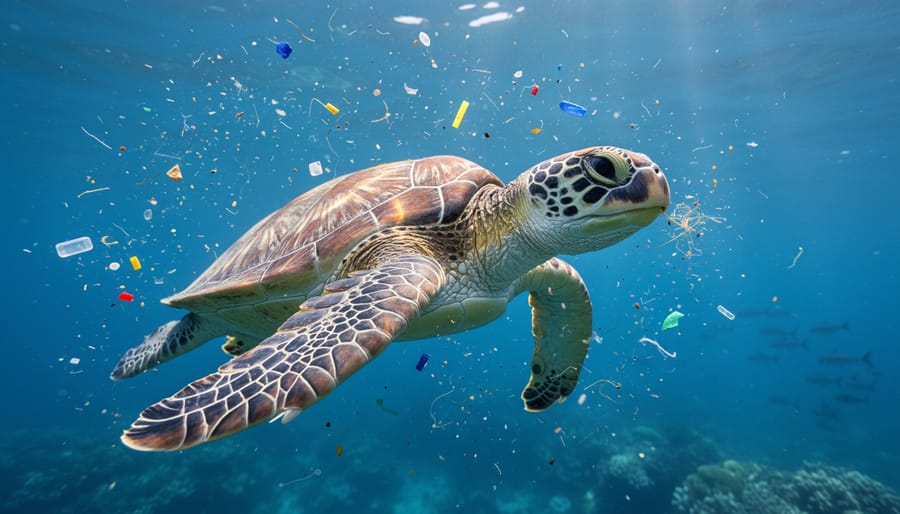
Larger marine animals face compounding risks. Sea turtles consume plastic bags resembling jellyfish, while seabirds feed microplastic fragments to their chicks. Baleen whales, gulping enormous volumes of water to strain krill, inevitably ingest microplastics suspended in that same water column.
The physiological consequences extend beyond gut blockage. Microplastics cause physical abrasion to digestive tissues, trigger inflammatory responses, and potentially transfer absorbed toxins like PCBs and pesticides into animal tissues. Reduced nutrient absorption, altered feeding behavior, and false satiation compound the problem, particularly threatening young or already-stressed individuals.
Categories of Microplastic Pollution in Marine Environments
Synthetic Textile Fibers
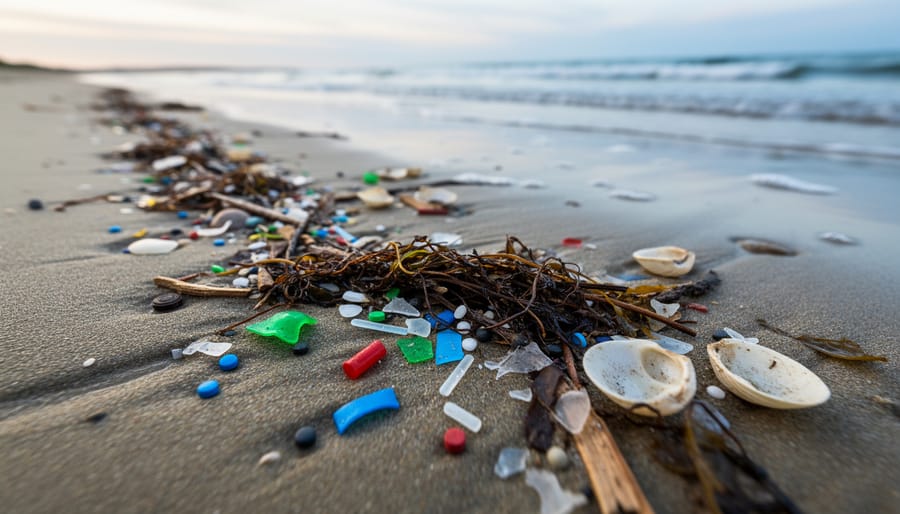
Synthetic textile fibers constitute the largest category of microplastics found in marine environments, accounting for roughly 35% of primary microplastic pollution in the world’s oceans. Every time you wash a polyester fleece or nylon jacket, hundreds of thousands of microscopic fibers shed and flow down the drain. Most wastewater treatment plants can’t filter particles this small, so these fibers pass directly into rivers and eventually the sea.
Fishing gear presents an even more persistent problem. Abandoned or discarded nylon and polypropylene nets, often called “ghost gear”, fragment slowly over decades, releasing millions of microfibers that marine animals mistake for prey. A single discarded fishing net can continue shedding fibers for 600 years.
These textile microfibers are particularly troublesome because their elongated shape makes them more likely to be ingested by filter-feeders like mussels and oysters. Once consumed, the fibers can block digestive tracts and transfer absorbed pollutants like PCBs and heavy metals into tissue, concentrating as they move up the food chain.
Personal Care Product Microbeads
Microbeads, tiny plastic spheres once ubiquitous in facial scrubs, toothpastes, and body washes, represent a deliberate introduction of plastic into our water systems. While many countries banned polyethylene microbeads between 2015 and 2018, these particles persist in marine sediments due to their non-biodegradable nature. More troubling, manufacturers have pivoted to alternative polymers like polyethylene terephthalate (PET) and nylon that aren’t always covered by existing bans. A 2025 study found that 23% of personal care products marketed as “natural exfoliants” still contained synthetic polymers. Even biodegradable alternatives like polyhydroxyalkanoates require specific conditions rarely met in marine environments, meaning they can persist for months or years before breaking down.
Tire Dust and Industrial Particles
Tire wear particles represent one of the largest yet most underestimated sources of marine microplastic pollution. Every time a vehicle brakes or turns, microscopic rubber and synthetic polymer fragments abrade from tires and wash into stormwater systems, eventually reaching oceans. Research in 2026 estimates that tire dust accounts for nearly 28% of ocean microplastics, more than textile fibers in many coastal regions.
Industrial plastic pellets, called nurdles, add another hidden layer. These lentil-sized raw materials, transported in bulk to manufacturing facilities, frequently spill during loading and shipping. A single cargo incident can release billions of pellets that fragment into smaller particles over time. Unlike fibers that clump and settle, tire particles and nurdles remain suspended in currents, traveling vast distances before concentrating in gyres and coastal sediments.
Both sources fly under regulatory radar because they’re classified as “unintentional” pollution, making accountability and prevention far more complicated than banning microbeads.
Fragmented Debris
The most insidious microplastics don’t start small, they’re carved from our discarded bottles, bags, and fishing gear. Larger debris fragments under relentless UV exposure, grinding wave action, and even bacterial activity that weakens polymer chains. A single plastic bottle abandoned on a beach doesn’t vanish; it slowly crumbles into thousands of particles over decades, each fragment retaining the original plastic’s chemical additives and pollutants. These secondary microplastics now outnumber primary sources in many ocean zones, testament to decades of accumulated waste still breaking down.
Where Microplastics Affect Marine Life and Human Communities
Impacts on Endangered Marine Species
Sea turtles mistake floating plastic fragments for jellyfish, filling their stomachs with indigestible material that provides no nutrition. A 2025 necropsy study of stranded loggerheads in the Mediterranean found microplastics in 94% of digestive tracts, with some individuals carrying hundreds of particles that blocked intestinal passages and leached phthalates into tissues.
Baleen whales face a different threat. Filter-feeding species like North Atlantic right whales, already critically endangered, consume massive quantities of microplastic-laden zooplankton daily. Research shows these particles accumulate in blubber and can cross the placental barrier, potentially affecting calf development. For a species with fewer than 350 individuals remaining, any additional reproductive stress compounds extinction risk.
Seabirds demonstrate the clearest evidence of harm. Laysan albatross chicks on Midway Atoll frequently starve with stomachs packed with plastic, fed by parents who cannot distinguish contaminated prey. Microplastic ingestion also impairs buoyancy in diving birds like penguins, reducing hunting efficiency and energy reserves needed for long migrations. These species-specific impacts reveal how microplastic contamination threatens the survival of populations already pushed to the brink by habitat loss and climate change.
Human Health and Seafood Safety
Microplastics enter the human diet primarily through seafood consumption. Fish, shellfish, and crustaceans ingest these particles either directly from water or through contaminated prey. When we eat these animals, often whole, as with sardines or mussels, we consume the microplastics accumulated in their digestive tracts and tissues. Studies from 2025 found microplastics in roughly 70% of commercial fish species tested globally, with filter feeders like oysters showing particularly high concentrations.
The health implications remain incompletely understood. Laboratory research demonstrates that microplastics can cross intestinal barriers and accumulate in human organs, potentially carrying toxic additives like phthalates and flame retardants. Early 2026 studies detected microplastics in human blood, liver, and lung tissue. However, we lack long-term epidemiological data linking specific exposure levels to disease outcomes. The World Health Organization acknowledges this uncertainty while noting that current evidence suggests greatest concern for chemical leaching and nanoplastic particles rather than larger microplastic pieces.
This knowledge gap creates an uncomfortable reality: millions consume marine pollutants daily through seafood, yet definitive guidance on safe consumption levels doesn’t exist. Vulnerable populations, pregnant women, children, coastal communities with seafood-dependent diets, face disproportionate risk and uncertainty. Until comprehensive human health studies conclude, precautionary approaches emphasize reducing plastic pollution at its source rather than altering seafood consumption, which provides irreplaceable nutritional benefits.
The Ethical Dimensions of Microplastic Contamination
Who Bears Responsibility?
Assigning blame for microplastic contamination is complicated because responsibility is genuinely shared, yet not equally. Plastic manufacturers and major corporations that package products in single-use plastics profit from a system that treats the ocean as a disposal site, often resisting meaningful regulation while funding campaigns that shift blame to individual consumers. Yet consumers in wealthy nations do make daily choices, buying bottled water, fast fashion, synthetic textiles, that feed demand for the very products that shed microfibers and fragment into marine debris.
Regulatory gaps widen this ethical chasm. Many governments have banned microbeads in cosmetics but ignore tire dust, the largest microplastic source in some regions. International waters lack enforceable plastic pollution standards, and waste management infrastructure remains desperately inadequate in developing nations that receive plastic waste exports from richer countries. This creates a system where those least responsible for production often bear the greatest burden of contamination.
The diffuse nature of microplastic pollution, originating from millions of sources across continents, makes traditional liability frameworks nearly useless. Who do we hold accountable when a fleece jacket washed in Ohio contributes particles that accumulate in Arctic seabird nests? These are precisely the kinds of ocean ethics questions that demand we move beyond finger-pointing toward systemic solutions that recognize both individual agency and structural responsibility.
Environmental Justice and Vulnerable Communities
Microplastic contamination doesn’t burden all communities equally. Indigenous coastal peoples who depend on traditional fishing grounds face a cruel irony: they contribute least to plastic pollution yet bear disproportionate health risks from contaminated seafood that forms the cornerstone of their diet and cultural identity. Small-scale fishers in developing nations confront similar injustice, navigating waters thick with plastic debris while lacking the political power to demand corporate accountability or the economic resources to shift to alternative livelihoods.
These communities also struggle with waste management failures not of their making. Wealthy nations ship plastic waste to countries with inadequate infrastructure, where it leaks into rivers and coastal zones, poisoning local fishing grounds. Meanwhile, the knowledge systems that could inform ethical fisheries decisions often exclude the voices of those most affected. Climate vulnerability compounds these burdens: rising seas and intensifying storms mobilize buried plastic waste, re-contaminating waters that coastal communities rely on for survival and sovereignty.
Our Duty to Future Generations
Intergenerational ethics forces us to confront an uncomfortable truth: we’re making choices today that will constrain the health and opportunities of people not yet born. Children coming of age in 2050 will inherit oceans saturated with microplastics we discarded decades earlier, facing contamination that persists for centuries.
Our moral obligation extends beyond avoiding direct harm. We owe future generations what philosopher Edith Brown Weiss calls “intergenerational equity”, the same quality of natural resources we received. Every plastic item we use carelessly today becomes tomorrow’s environmental debt, diminishing the biological inheritance we pass forward.
This isn’t abstract philosophy. Today’s children already carry microplastics in their bloodstreams from contaminated food and water. Future communities will navigate an ocean where baseline contamination is the norm, not the exception, unless we act decisively now.
Some argue we can’t sacrifice current economic needs for hypothetical future harms. But the precautionary principle suggests otherwise: when facing irreversible damage to systems that support all life, we have an ethical duty to choose restraint. Future generations can’t consent to inheriting our pollution. That powerlessness creates our responsibility.
Scientific and Policy Responses: Progress and Gaps
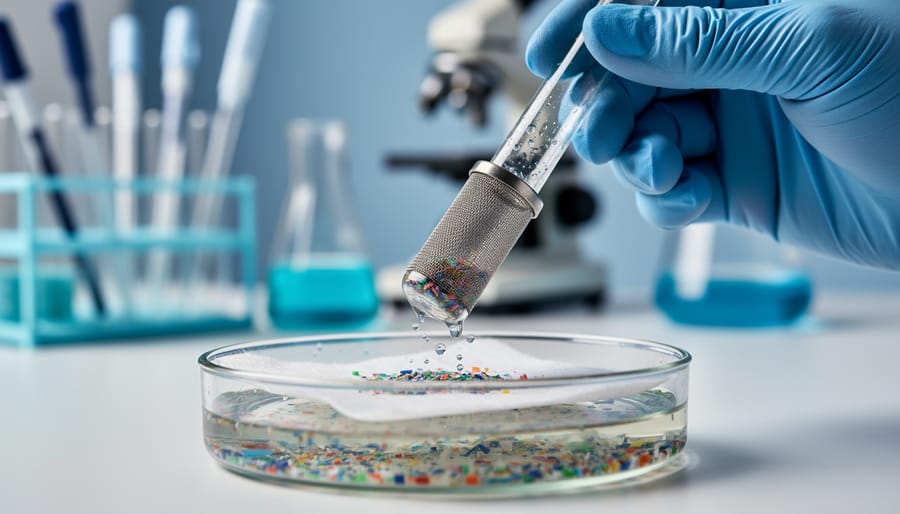
The global scientific community has mobilized impressive resources to understand microplastic contamination, yet policy responses remain frustratingly fragmented. Research initiatives in 2026 include satellite-based monitoring of plastic accumulation zones, standardized protocols for microplastic sampling developed by the International Ocean Observing System, and longitudinal studies tracking contamination in commercially important fish stocks. Scientists have made genuine progress in detecting particles as small as 100 nanometers and identifying polymer fingerprints that trace pollution back to specific industries.
On the policy front, the UN Environment Programme’s Global Plastics Treaty negotiations represent the most ambitious international framework to date, though implementation timelines stretch into the 2030s and enforcement mechanisms remain weak. The European Union’s Single-Use Plastics Directive has demonstrably reduced macroplastic inputs, but primary microplastic sources like tire dust and textile fibers fall outside its scope. California and several other jurisdictions now require microfiber filters on new washing machines, a practical intervention showing measurable results in wastewater treatment plants.
What isn’t working? Voluntary corporate commitments rarely translate to meaningful reductions. Many “compostable” and “biodegradable” alternatives fragment into microplastics just as readily as conventional plastics. Cleanup technologies for microplastics already dispersed in the ocean remain largely theoretical, the particles are too small, too widespread, and too deeply embedded in sediments and food webs. Beach cleanups address visible waste but can’t capture the microscopic contamination.
The honest assessment: we’re getting better at measuring the problem while making only incremental progress solving it. Regulatory gaps persist where industries overlap (is harmful tourism an environmental or economic issue?), and enforcement in international waters remains nearly impossible. Prevention, not cleanup, will determine whether contamination stabilizes or accelerates.
How You Can Make a Difference
You can start reducing microplastic pollution today through deliberate choices in your daily life. Switch to natural-fiber clothing made from cotton, wool, or linen instead of synthetic fabrics. When you do wash synthetic garments, use a microfiber-catching laundry bag like Guppyfriend or install a filter on your washing machine outflow. Choose personal care products without plastic microbeads, and support companies committed to sustainable packaging. Consider refillable containers and avoid single-use plastics whenever possible. Explore solutions like zero-waste fish farming that demonstrate how industries can operate without contributing to plastic contamination.
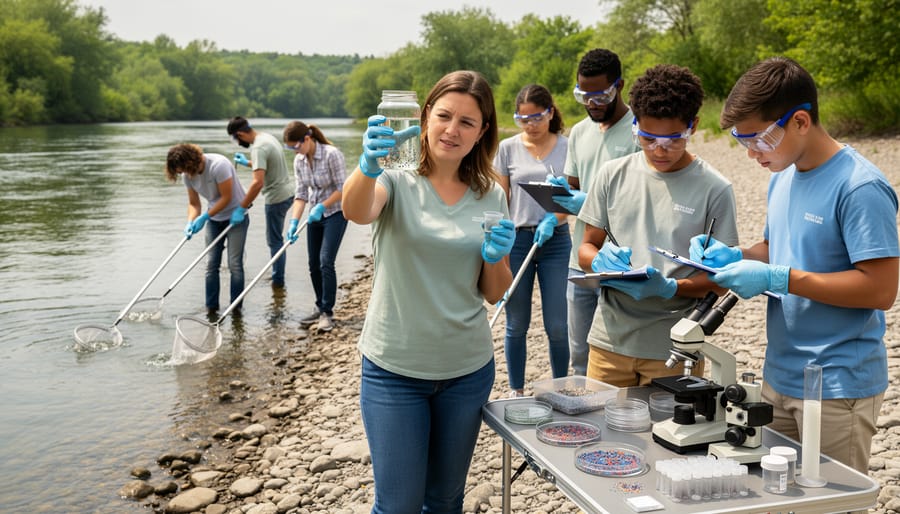
Your direct participation in research makes a measurable difference. The Marine Biodiversity Science Center runs regular beach cleanup events that double as data collection opportunities. Volunteers learn to identify, categorize, and document microplastic samples following standardized protocols used by scientists worldwide. This citizen science data feeds into global databases tracking pollution trends and helps researchers understand contamination patterns along coastlines.
Sarah Chen, a high school teacher from Vancouver, joined her first microplastic sampling program in 2024. “I expected to pick up bottles and bags,” she recalls. “Instead, I spent three hours with tweezers and a magnifying glass, sorting tiny fibers and fragments from sand samples. It was painstaking work, but seeing those thousands of particles from just one square meter changed how I understood the problem. Now I bring my students twice a year. They’ve become fierce advocates for plastic reduction at school.”
Educators can integrate microplastic awareness into science curricula through hands-on experiments. Simple classroom activities like filtering water samples or examining synthetic fibers under microscopes make the issue tangible for students.
Join the Marine Biodiversity Science Center’s e-network to receive notifications about upcoming beach cleanups, research expeditions, and advocacy campaigns. Your time and observations contribute to the scientific understanding we need to solve this crisis. Every microplastic particle documented, every synthetic purchase reconsidered, and every conversation started moves us toward cleaner oceans.
Common Questions About Microplastics in the Ocean
Understanding the science and scope of microplastic contamination naturally leads to practical questions about detection, solutions, and recovery. Readers often wonder whether we can reverse this pollution, how to protect themselves, and what progress looks like in 2026. These questions reflect both genuine concern and a desire for actionable knowledge.
Can microplastics be removed from the ocean?
Current technology cannot effectively remove microplastics from open ocean environments at scale. Their tiny size, vast distribution throughout the water column, and integration into marine sediments make extraction functionally impossible without also capturing plankton and other essential organisms. Prevention and source reduction remain our only viable strategies.
Are biodegradable plastics a solution to microplastic pollution?
Most biodegradable plastics require specific industrial composting conditions to break down and persist in marine environments much like conventional plastics. Some bioplastics also fragment into microplastics before decomposing. While promising innovations continue, biodegradable alternatives are not currently a comprehensive solution to ocean contamination.
How long do microplastics persist in marine ecosystems?
Most microplastics persist for decades to centuries in ocean environments, with degradation rates varying by polymer type, UV exposure, and water temperature. Even as they break into smaller nanoplastics, they remain in the ecosystem rather than disappearing, which is why prevention matters far more than waiting for natural breakdown.
How can I reduce microplastics in the seafood I eat?
Choose seafood lower on the food chain like sardines and anchovies, which accumulate fewer microplastics than predatory fish. Removing digestive tracts before cooking reduces exposure since microplastics concentrate in fish guts. However, complete avoidance is impossible given how widespread contamination has become across marine food webs.
Detection methods have improved dramatically since early research relied on visual sorting under microscopes. Scientists now use Raman spectroscopy and Fourier-transform infrared spectroscopy to identify polymer types in water samples, sediment cores, and animal tissues. These tools can detect particles as small as one micrometer, revealing contamination that earlier methods missed entirely. Standardized protocols developed by international research networks allow meaningful comparison across studies, though sampling techniques still vary enough to complicate global assessments.
Regulatory frameworks remain fragmented despite growing scientific consensus about risks. The European Union leads with restrictions on intentionally added microplastics in cosmetics and some industrial applications, effective since 2023. The United States maintains a patchwork of state-level microbead bans but lacks comprehensive federal microplastic legislation. International agreements like the developing UN Global Plastics Treaty aim to address the problem at its source, but enforcement mechanisms and binding targets remain contentious negotiating points as of 2026.
The timeline for ocean recovery depends entirely on actions we take now. Even if all plastic pollution stopped today, existing microplastics would persist for generations. Realistic scenarios involve reducing new inputs while accepting that contamination will remain part of marine ecosystems for the foreseeable future. This sobering reality underscores why immediate action on source reduction matters more than hoping for future cleanup technologies or natural degradation to solve the problem we have created.
Microplastic contamination presents us with a defining challenge of our time, one that demands both rigorous science and clear moral courage. We’ve explored how these tiny particles infiltrate every corner of marine ecosystems, from surface waters to the deepest trenches, and how they move through food webs with consequences we’re only beginning to understand. The science is sobering, but it also illuminates a path forward.
The ethical dimensions we’ve examined, questions of responsibility, justice, and intergenerational duty, transform this from an abstract environmental problem into an urgent call for action. We can’t undo decades of plastic pollution overnight, but we can change the trajectory. Every choice matters: the products we buy, the policies we support, the companies we hold accountable.
What gives me genuine hope is witnessing the power of collective effort. When communities organize beach cleanups, when volunteers contribute to microplastic monitoring programs, when educators bring these issues into classrooms, that’s how lasting change begins. The Marine Biodiversity Science Center has seen firsthand how citizen science participation accelerates research while building a informed, engaged network of ocean advocates.
You don’t need advanced degrees to make a difference. Join our e-network to stay informed about volunteer opportunities, from sampling programs to advocacy campaigns. Participate in local cleanup events. Share what you’ve learned with friends and family. Support legislation that addresses plastic pollution at its source.
The ocean’s resilience is remarkable, but it needs our help. Together, we can create a future where marine ecosystems thrive free from the burden of persistent plastic contamination. That future is within reach, if we act now, and act together.

jessica
Ava Singh is an environmental writer and marine sustainability advocate with a deep commitment to protecting the world's oceans and coastal communities. With a background in environmental policy and a passion for storytelling, Ava brings complex topics to life through clear, engaging content that educates and empowers readers. At the Marine Biodiversity & Sustainability Learning Center, Ava focuses on sharing impactful stories about community engagement, policy innovations, and conservation strategies. Her writing bridges the gap between science and the public, encouraging people to take part in preserving marine biodiversity. When she’s not writing, Ava collaborates with local initiatives to promote eco-conscious living and sustainable development, ensuring her work makes a difference both on the page and in the real world.