Marine Biodiversity Science Center

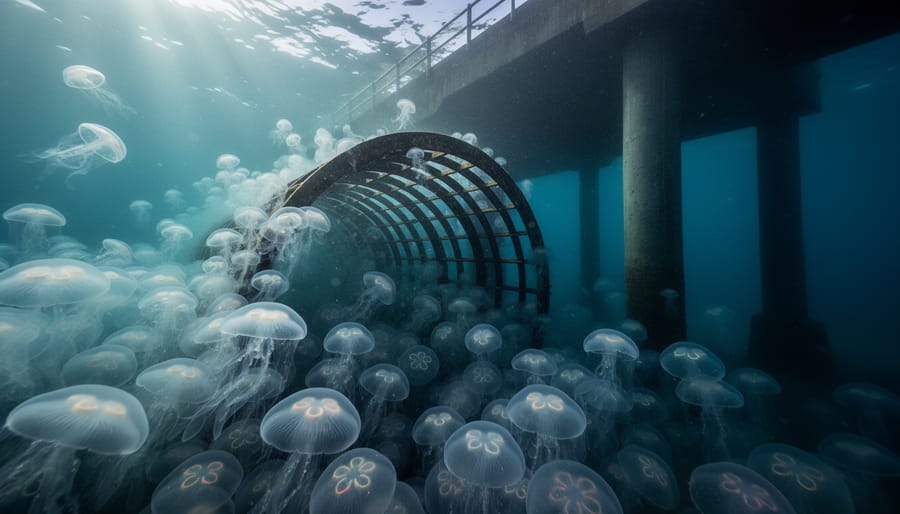
Imagine a world where jellyfish and their gelatinous cousins dominate our oceans, clogging fishing nets, shutting down power plants, and transforming once-vibrant marine ecosystems into pulsating, translucent wastelands. This isn’t science fiction. It’s happening now in waters around the globe, from the Mediterranean Sea to the Sea of Japan, where massive blooms of gelatinous zooplankton are emerging as one of the ocean’s most pressing biological threats.
Gelatinous zooplankton, a diverse group including jellyfish, comb jellies, salps, and other soft-bodied drifters, have thrived in Earth’s oceans for over 500 million years. Yet something has shifted in recent decades. Scientists are documenting unprecedented blooms that disrupt fisheries, damage coastal infrastructure, and fundamentally alter marine food webs. These explosive population surges aren’t random events. They’re warning signals of deeper ocean changes driven by warming waters, overfishing, pollution, and coastal development.
The consequences extend far beyond the ocean’s surface. When blooms collapse, massive amounts of gelatinous biomass sink to the seafloor, suffocating bottom-dwelling communities and releasing carbon in ways that complicate our understanding of ocean health. Commercial fisheries lose millions annually to clogged nets and compromised catches. Nuclear and desalination plants have been forced offline when jellyfish swarms overwhelm cooling systems.
But here’s the crucial truth: understanding these blooms is the first step toward managing them. Marine biologists worldwide are unraveling the complex factors driving these events, developing early warning systems, and identifying practical solutions. This growing threat demands our attention, but it also presents an opportunity for collective action, innovative research, and ocean stewardship that can make a measurable difference.
What Are Gelatinous Zooplankton?
The Diversity of Gelatinous Life
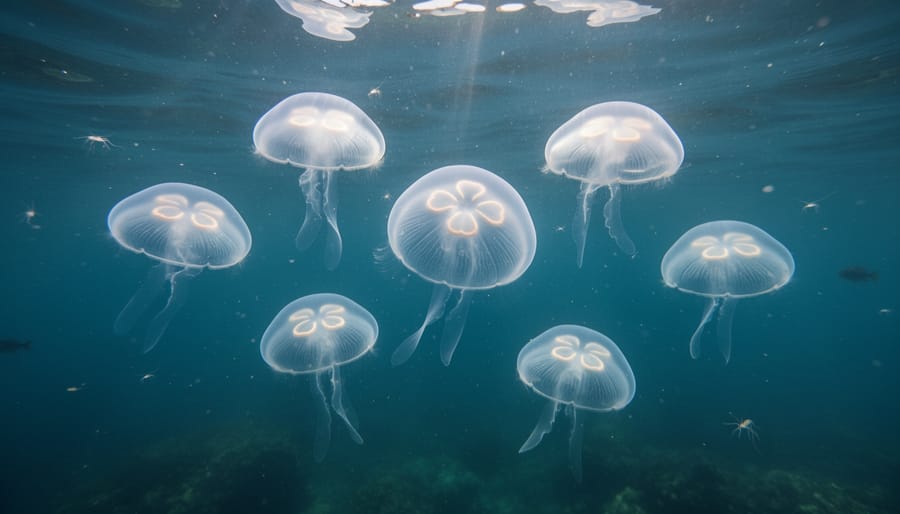
The term “gelatinous zooplankton” encompasses a remarkable variety of ocean drifters, united by their soft, water-filled bodies that often resemble transparent sculptures. True jellyfish, or medusae, are perhaps the most familiar members of this group. These bell-shaped creatures pulse through the water, trailing tentacles armed with stinging cells called nematocysts. They range from coin-sized moon jellies to massive lion’s mane jellyfish with tentacles extending over 100 feet.
Equally fascinating are the comb jellies, or ctenophores, which propel themselves using rows of shimmering, hair-like cilia that refract light into rainbow patterns. Unlike jellyfish, most comb jellies lack stinging cells and capture prey with sticky tentacles or large mouths. Marine biologist Dr. Sarah Chen describes her first encounter with a ctenophore as “watching living stained glass move through the water.”
Salps represent another unique group, forming barrel-shaped bodies that filter feed by pumping water through their gelatinous forms. These tunicates often link together in chains stretching several meters, creating what appears to be a single organism.
Perhaps the most complex are siphonophores, colonial organisms composed of specialized individuals working together. The Portuguese man o’ war, though often called a jellyfish, is actually a siphonophore whose float-and-tentacle system can deliver painful stings. Understanding this diversity helps scientists recognize why blooms of different species create varying challenges for marine ecosystems and human activities.
Their Natural Role in Ocean Ecosystems
In healthy ocean ecosystems, gelatinous zooplankton—including jellyfish, comb jellies, and salps—play vital ecological roles that maintain marine balance. These soft-bodied drifters are efficient predators, feeding primarily on smaller zooplankton, fish eggs, and larvae by capturing prey with their tentacles or filtering water through specialized structures. Dr. Maria Chen, a marine biologist studying jellyfish populations off California’s coast, explains that “these organisms are nature’s recyclers, converting tiny prey into biomass that larger predators can consume.”
Gelatinous zooplankton serve as important food sources for sea turtles, ocean sunfish, and certain seabirds, creating crucial links in marine food webs. When they die and sink, their bodies contribute to nutrient cycling by transporting carbon and nitrogen to deeper waters—a process scientists call the “jelly pump.” This biological mechanism helps regulate ocean chemistry and supports deep-sea communities.
Under natural conditions, their populations remain in check through predation and seasonal variations in food availability. However, understanding their normal function helps us recognize when blooms signal ecosystem imbalance. By participating in citizen science programs that monitor jellyfish populations at local beaches, volunteers provide essential data that helps researchers distinguish between natural fluctuations and concerning trends.
Why Blooms Are Exploding Across Our Oceans
Climate Change and Warming Waters
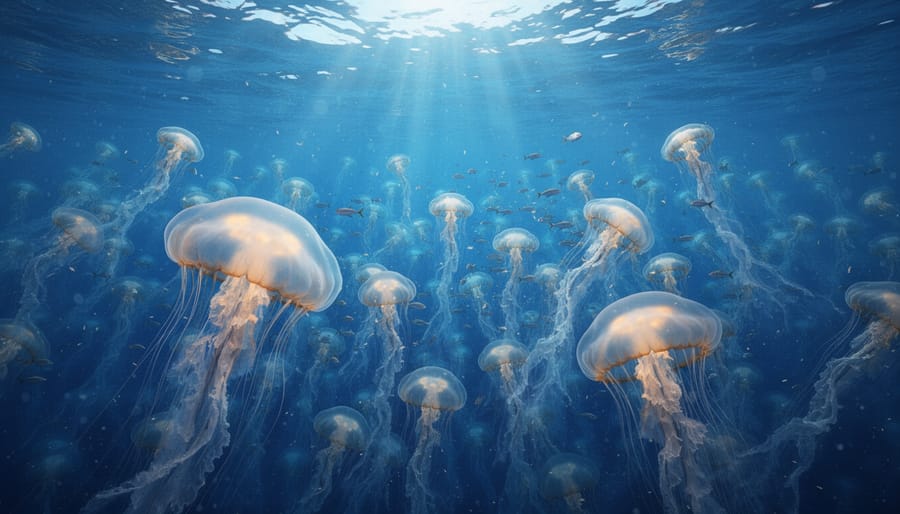
Rising ocean temperatures are creating a perfect storm for jellyfish populations to explode. As our oceans warm due to climate change impacts, gelatinous zooplankton are emerging as unexpected winners in the race to adapt. These resilient creatures thrive in warmer waters where many of their competitors struggle to survive.
Dr. Marina Chen, a marine biologist who has studied jellyfish blooms for over fifteen years, explains: “Jellyfish have a remarkable ability to tolerate temperature changes and low oxygen levels that would devastate fish populations. They’re essentially pre-adapted to the ocean conditions we’re creating.”
Ocean acidification, caused by increased carbon dioxide absorption, further tips the scales in favor of gelatinous species. Unlike shell-forming organisms that suffer as waters become more acidic, jellyfish face few physiological challenges from changing ocean chemistry. Additionally, warming waters disrupt the life cycles of jellyfish predators like sea turtles and certain fish species, removing natural population controls.
Volunteers participating in citizen science programs along coastlines worldwide are documenting these shifts firsthand, providing crucial data that helps researchers track bloom patterns and predict future changes.
The Overfishing Connection
The dramatic rise in jellyfish and other gelatinous creatures isn’t happening by chance. When overfishing depletes predators like sea turtles, tuna, and certain fish species that feed on jellyfish, these gelatinous populations lose their natural controls. Simultaneously, removing fish that compete with jellyfish for the same planktonic food sources creates a perfect opportunity for jellies to dominate.
The Namibian coast offers a stark example. Decades of intensive sardine and anchovy fishing created an ecological vacuum that jellyfish quickly filled. Today, jellyfish biomass there exceeds fish biomass, fundamentally altering what was once a thriving fishery. Similarly, the Black Sea experienced explosive jellyfish blooms in the 1980s after overfishing removed key predators and competitors, devastating local fishing communities.
Marine biologist Dr. Lisa-Ann Gershwin, who has studied jellyfish blooms for over two decades, describes this shift as “turning back the ecological clock to a more primitive ocean.” These transformations demonstrate how removing just a few key species can trigger cascading changes throughout entire marine ecosystems, with gelatinous zooplankton emerging as unlikely victors.
Nutrient Pollution and Dead Zones
Human activities have dramatically altered ocean chemistry, creating conditions where gelatinous zooplankton thrive while other marine species struggle. Nutrient pollution from agricultural runoff and sewage discharge triggers excessive algae growth, which depletes oxygen as it decomposes. These low-oxygen zones, called hypoxic areas or dead zones, expand globally each year.
Unlike fish and crustaceans that require high oxygen levels, jellyfish and other gelatinous species possess remarkable tolerance for hypoxic conditions. Their simple body structures and lower metabolic demands allow them to survive where competitors and predators cannot. Dr. Maria Santos, a marine biologist studying Chesapeake Bay, explains that she’s witnessed jellyfish populations explode in areas where fish once dominated: “It’s like watching an ecosystem transform before your eyes.”
This creates a troubling feedback loop. As gelatinous zooplankton dominate degraded waters, they consume fish larvae and compete with remaining fish for food, further preventing ecosystem recovery. Addressing this challenge requires reducing nutrient inputs through improved wastewater treatment and sustainable agricultural practices, solutions that communities and individuals can actively support.
The Cascading Threats to Marine Ecosystems
Competition with Fish Populations
Gelatinous blooms don’t just occupy ocean space—they directly compete with fish populations for the same food sources. Jellyfish, comb jellies, and salps consume vast quantities of zooplankton and phytoplankton that would otherwise nourish commercially important fish species. But the competition runs deeper than simple food rivalry.
These gelatinous predators actively hunt fish eggs and larvae, consuming them in enormous numbers during blooms. A single jellyfish can devour hundreds of fish larvae daily, devastating recruitment for already stressed fish populations. This creates a troubling feedback loop: as fish numbers decline due to overfishing or environmental stress, their predators—the adult fish that would normally eat jellyfish—disappear. With fewer natural enemies, gelatinous populations explode further, consuming even more fish eggs and larvae.
Marine biologist Dr. Elena Ramirez observed this phenomenon firsthand while studying anchovy populations in coastal waters. “We watched jellyfish swarms decimate an entire year’s fish recruitment,” she recalls. “It’s a vicious cycle that’s incredibly difficult to break once it starts.”
Understanding these competitive dynamics helps researchers develop targeted management strategies, though solutions require reducing the initial stressors—like overfishing—that trigger these cascading effects in the first place.
Disrupting Marine Food Webs
When jellyfish and other gelatinous zooplankton populations explode, they create ripple effects that cascade through entire ocean ecosystems. These blooms fundamentally alter marine food webs by consuming vast quantities of fish eggs, larvae, and the tiny plankton that normally sustain commercial fish populations. What makes this particularly concerning is that gelatinous species are largely unpalatable to most predators, essentially creating a nutritional dead-end in the ocean.
Seabirds and marine mammals that depend on fish populations suffer when jellyfish outcompete fish for food resources. Some leatherback sea turtles, which naturally feed on jellyfish, can benefit temporarily, but even they face challenges when blooms become too dense or toxic species dominate. Marine biologist Dr. Elena Rodriguez, who has studied Mediterranean blooms for fifteen years, shares that witnessing entire bays transformed into gelatinous masses is both scientifically fascinating and deeply troubling. The good news is that citizen scientists can help monitor these changes through coastal observation programs, providing crucial data that helps researchers understand and predict bloom patterns, ultimately supporting healthier ocean communities.
The ‘Jellyfish Stable State’ Scenario
Scientists are increasingly concerned about a phenomenon they call the “jellyfish stable state,” where marine ecosystems shift from fish-dominated to jellyfish-dominated systems. This transformation represents more than a temporary imbalance. Once established, these gelatinous-dominated ecosystems may resist returning to their former state, even when conditions improve. The mechanism behind this persistence is troubling: jellyfish consume fish larvae and compete with fish for food, while their own predators have often been depleted by overfishing. This creates a self-reinforcing cycle of ecosystem disruption. Dr. Maria Chen, who studies ecosystem resilience at the Pacific Marine Institute, explains, “We’re witnessing potential tipping points in several coastal regions. The challenge isn’t just preventing blooms, but understanding whether we can reverse these shifts once they occur.” This underscores the urgency of addressing the multiple stressors causing these blooms before ecosystems cross this critical threshold.
Beyond the Ocean: Impacts on Human Communities
Devastating Local Fisheries
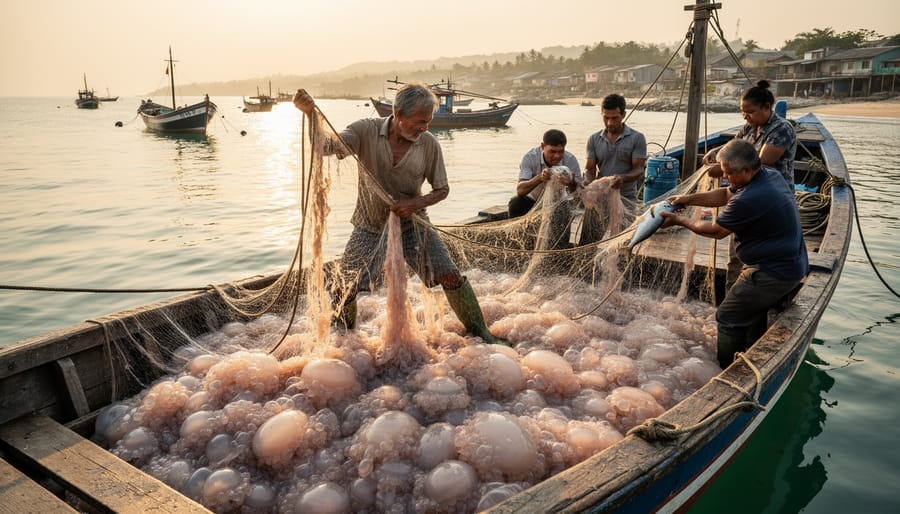
Fishing communities worldwide face mounting challenges from gelatinous zooplankton blooms. In the Sea of Japan, massive jellyfish blooms regularly clog fishing nets, sometimes weighing tons and rendering catches unsellable. The sheer weight can capsize smaller vessels, creating dangerous conditions for fishers already operating on thin margins.
Norwegian salmon farms have reported substantial losses when jellyfish blooms smother netted fish, causing mass die-offs worth millions of dollars. In the Mediterranean, fishers describe hauling up nets filled with jellyfish rather than marketable fish, forcing them to spend hours cleaning equipment instead of fishing.
Marine biologist Dr. Elena Martínez recalls working with fishing families in Spain: “One captain told me he’d been fishing these waters for thirty years, but now spends more time clearing jellyfish than catching fish. It’s heartbreaking.” These blooms don’t just damage individual livelihoods but threaten entire coastal economies dependent on fishing.
The contamination issue extends beyond nets. Gelatinous fragments mixed with catches reduce market value and processing efficiency. For communities already facing overfishing pressures and climate challenges, jellyfish blooms represent yet another threat to their economic survival and cultural heritage.
Coastal Tourism and Beach Closures
Massive jellyfish blooms washing ashore create significant challenges for coastal communities dependent on tourism revenue. When millions of gelatinous organisms blanket beaches, visitors understandably avoid the area, leading to cancelled bookings and economic losses during peak seasons. The visual impact alone—carpets of decomposing jellyfish creating unpleasant odors—drives tourists away, even after cleanup efforts begin.
Swimming hazards pose another concern. Box jellyfish and Portuguese man-of-war blooms force beach closures to protect public safety, sometimes for weeks at a time. Coastal towns have responded creatively: some now employ marine biologists to monitor bloom patterns and provide early warnings through apps and social media, giving tourists and locals advance notice.
Beach cleanup programs increasingly welcome volunteers, offering hands-on opportunities to understand these organisms while helping communities recover. Marine biologist Dr. Lisa Chen notes, “Working alongside local residents during bloom events helps people see jellyfish not as villains, but as indicators of ocean health needing our attention.” These collaborative efforts strengthen community resilience while building awareness about underlying environmental changes driving bloom frequency.
Industrial and Infrastructure Damage
Gelatinous zooplankton blooms have caused substantial economic disruption by clogging intake systems at critical infrastructure facilities. In 2013, a massive jellyfish swarm forced the shutdown of a nuclear power plant in Sweden when millions of organisms blocked the cooling water system. Similar incidents have occurred at power facilities in Japan, Israel, and Scotland, sometimes requiring days of costly downtime.
Desalination plants face particular vulnerability, as their fine filtration systems become overwhelmed by gelatinous masses. In 2006, jellyfish blooms disrupted operations at multiple Middle Eastern desalination facilities, affecting freshwater supplies for thousands of residents. The economic toll extends to aquaculture, where blooms can devastate fish farms overnight. Marine biologist Dr. Lisa Chen recalls responding to a salmon farm incident where jellyfish influx caused suffocation of stock valued at over $500,000. “The farmers were heartbroken,” she shares, “but it sparked their commitment to monitoring programs that now help predict and prevent such events.” These cases highlight why understanding bloom patterns matters for coastal communities and industries alike.
Monitoring and Research Frontiers
Tracking Blooms in Real-Time
Scientists and volunteers worldwide are joining forces to track jellyfish blooms as they happen, creating an unprecedented global monitoring network. Satellite imaging now allows researchers to detect large aggregations of gelatinous zooplankton from space, particularly in coastal waters where blooms concentrate near the surface. These technological advances complement traditional ship-based surveys, providing real-time data that helps predict bloom movements and intensity.
Citizen science has revolutionized bloom monitoring. Programs like Jellywatch invite beachgoers, divers, and boaters to report sightings through smartphone apps, creating detailed maps of jellyfish distributions. Dr. Lisa Chen, a marine ecologist coordinating one such initiative, shares her excitement: “Last summer, we received over 10,000 reports from everyday ocean enthusiasts. This data revealed bloom patterns we’d never have detected through conventional methods alone.”
You can contribute too. Download a jellyfish identification app, learn to recognize common species in your area, and submit your observations. Some programs even provide training webinars for participants. These collective efforts not only advance scientific understanding but also create early warning systems for coastal communities, helping beaches prepare for incoming blooms and protect swimmers.
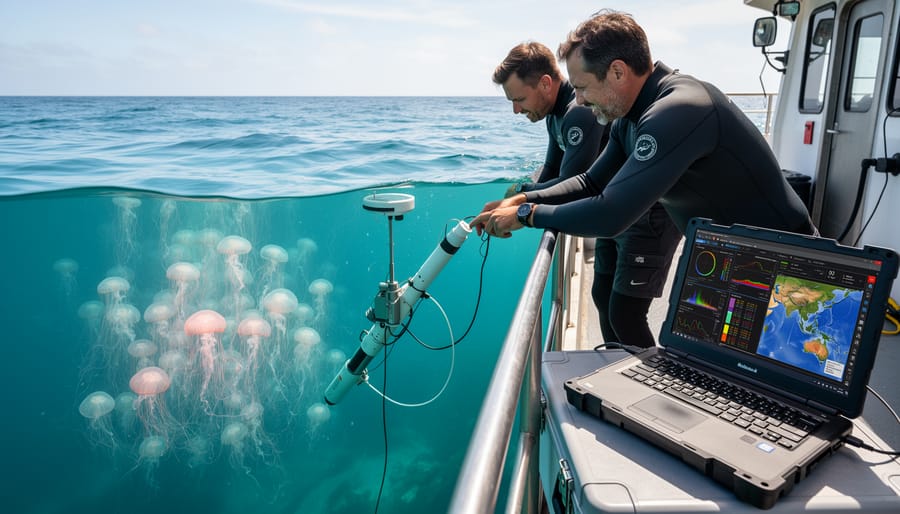
Voices from the Field
Dr. Maria Santos recalls her first encounter with a massive jellyfish bloom off the coast of Namibia. “The water looked like liquid glass filled with pulsing umbrellas,” she says. “It was beautiful and terrifying at once.” As a marine biologist studying bloom dynamics for over fifteen years, Maria has witnessed these events increasing in frequency. “What drives me is knowing that every data point we collect brings us closer to understanding how to coexist with these creatures.”
Graduate student James Chen offers a different perspective from his research vessel in the Baltic Sea. “People often see jellyfish as villains, but they’re survivors responding to the conditions we’ve created,” he explains. James monitors water temperatures and nutrient levels, tracking how human activities influence bloom patterns. His work has helped local fisheries anticipate and adapt to bloom events.
These researchers emphasize that understanding gelatinous zooplankton requires patience and collaboration. “The most rewarding part,” Maria notes, “is when citizen scientists join our surveys. Their observations from beaches and boats provide crucial data we couldn’t gather alone.” Their dedication reminds us that solving complex marine challenges requires both scientific expertise and community engagement.
Solutions and Hope for the Future
Restoring Ocean Balance Through Conservation
Restoring healthy ocean ecosystems offers our best defense against unchecked gelatinous zooplankton blooms. Marine protected areas (MPAs) serve as vital sanctuaries where fish populations can recover, rebuilding the natural predators and competitors that keep jellyfish numbers in check. When we protect spawning grounds and nursery habitats, we’re essentially restoring the ocean’s built-in balance system.
Sustainable fishing practices play an equally crucial role. By avoiding overfishing of species like tuna, sea turtles, and sunfish—all natural jellyfish predators—we maintain the food web’s integrity. Dr. Maria Santos, a marine biologist working in the Mediterranean, shares an encouraging observation: “In areas where we’ve implemented catch limits and reduced bycatch, we’ve seen jellyfish populations stabilize within just five years.”
Ecosystem restoration projects, including seagrass meadow rehabilitation and coral reef protection, create diverse habitats that support complex food webs less vulnerable to jellyfish takeovers. These efforts require collaboration between scientists, policymakers, and coastal communities.
You can contribute directly through citizen science programs that monitor jellyfish populations, or by volunteering with organizations conducting beach cleanups and habitat restoration. Every action—from supporting sustainable seafood choices to participating in conservation initiatives—helps tip the scales back toward ocean health. Together, we’re not just fighting jellyfish blooms; we’re rebuilding resilient marine ecosystems for future generations.
Addressing Root Causes
Preventing the escalation of gelatinous zooplankton blooms requires addressing the underlying environmental pressures driving these events. Climate action stands at the forefront of long-term solutions. Reducing greenhouse gas emissions helps stabilize ocean temperatures and slow the acidification processes that favor jellyfish proliferation over other marine species. Every effort to limit carbon emissions contributes to healthier ocean ecosystems.
Reducing nutrient pollution from agricultural runoff and wastewater is equally critical. When communities invest in better waste treatment facilities and farmers adopt sustainable practices that minimize fertilizer use, they directly reduce the eutrophication that triggers harmful blooms. These local actions create ripple effects throughout marine food webs.
Comprehensive ocean management requires coordination across sectors. Marine protected areas, sustainable fishing quotas, and ecosystem-based management approaches help maintain the balance that keeps jellyfish populations in check. As marine biologist Dr. Elena Rodriguez notes, “We’re not just managing individual species—we’re stewarding entire ocean systems. When we restore that balance, resilience follows.” This integrated approach, combining climate action with pollution reduction and thoughtful ocean stewardship, offers our best path forward in preventing future blooms and protecting marine biodiversity for generations to come.
How You Can Make a Difference
You can play a vital role in protecting marine ecosystems from harmful blooms. Join citizen science programs like Jellywatch, where volunteers report sightings to help scientists track population changes worldwide. Support marine protected areas through donations or advocacy campaigns that promote sustainable fishing practices and reduced nutrient pollution.
Make everyday choices that matter: reduce your carbon footprint to combat ocean warming, minimize fertilizer use in gardens, and choose sustainably sourced seafood. Participate in beach cleanups to prevent pollution that contributes to ecosystem imbalance.
Educators can incorporate jellyfish ecology into curricula, while students might pursue marine biology research opportunities. Dr. Rebecca Helm, a jellyfish biologist, shares: “Every observation, every conversation about ocean health creates ripples of change. When communities understand these creatures, they become passionate advocates for solutions.”
Consider volunteering with local aquariums or marine research stations conducting bloom monitoring. Your actions, combined with others, create meaningful impact for ocean health.
The challenge of gelatinous zooplankton blooms may seem daunting, but it’s important to remember that solutions are within our grasp. While these blooms represent a genuine threat to marine ecosystems and coastal communities, they also serve as powerful indicators of ocean health, urging us toward better stewardship of our seas.
Dr. Maria Santos, a marine biologist who has studied jellyfish populations for over fifteen years, puts it this way: “Every time I see a bloom, I’m reminded that the ocean is speaking to us. We just need to listen and respond with the urgency this crisis deserves.”
The good news is that we’re not powerless. Through coordinated monitoring efforts, reduced nutrient pollution, climate action, and adaptive management strategies, we can work together to restore balance to our marine environments. Every action counts, whether it’s participating in citizen science programs, reducing your carbon footprint, or supporting policies that protect ocean health.
We invite you to become part of the solution. Join our volunteer monitoring programs, where you can contribute valuable data on jellyfish populations in your local waters. Connect with our e-network to stay informed about the latest research and conservation initiatives. Share your observations, attend our workshops, and help us build a community dedicated to protecting marine biodiversity.
The ocean’s future depends on collective action, and that action begins with you. Together, we can turn the tide on gelatinous blooms and create healthier oceans for generations to come.

jessica
Ava Singh is an environmental writer and marine sustainability advocate with a deep commitment to protecting the world's oceans and coastal communities. With a background in environmental policy and a passion for storytelling, Ava brings complex topics to life through clear, engaging content that educates and empowers readers. At the Marine Biodiversity & Sustainability Learning Center, Ava focuses on sharing impactful stories about community engagement, policy innovations, and conservation strategies. Her writing bridges the gap between science and the public, encouraging people to take part in preserving marine biodiversity. When she’s not writing, Ava collaborates with local initiatives to promote eco-conscious living and sustainable development, ensuring her work makes a difference both on the page and in the real world.