Marine Biodiversity Science Center

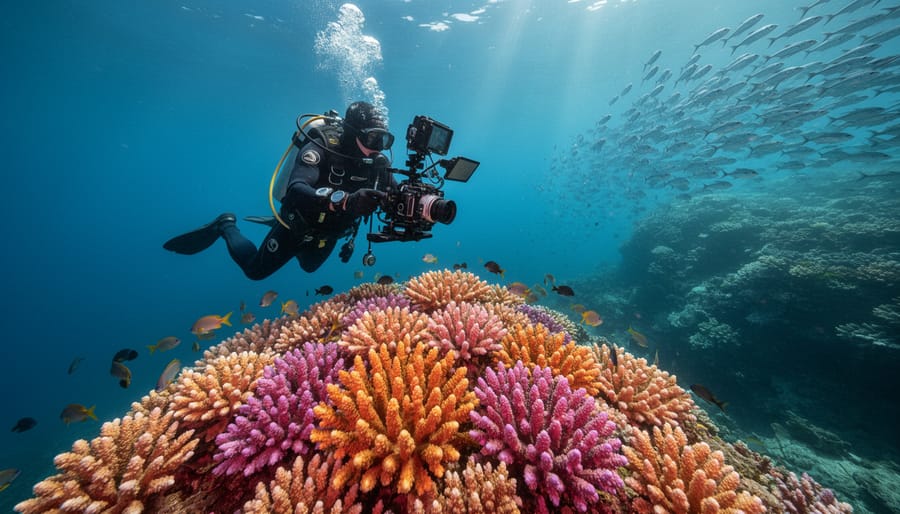
Beneath the ocean’s surface, coral reefs are vanishing at an alarming rate—but a revolutionary technology is capturing these underwater worlds before they disappear forever. Digital reefs are precise three-dimensional reconstructions of coral reef ecosystems, created through advanced photogrammetry and imaging techniques that transform thousands of underwater photographs into interactive virtual models. These digital twins preserve not just the visual appearance of reefs, but detailed measurements of coral size, health, and biodiversity that scientists can analyze for decades to come.
The urgency is real. We’re losing coral reefs faster than we can study them in traditional ways, with climate change, pollution, and overfishing degrading these vital ecosystems at unprecedented speeds. Digital reefs offer marine conservationists a powerful solution: the ability to document entire reef systems in extraordinary detail, monitor changes over time with millimeter precision, and share these underwater landscapes with researchers and the public worldwide—all without disturbing a single polyp.
What makes this technology transformative isn’t just its scientific precision. Digital reefs democratize ocean conservation in ways previously impossible. A marine biology student in Colorado can explore the same reef structure as a researcher in the Philippines. Educators can bring vibrant coral ecosystems into classrooms thousands of miles from any coastline. Conservation organizations can track restoration efforts by comparing digital models captured months or years apart, measuring success with unprecedented accuracy.
This technology represents more than data collection—it’s a bridge between cutting-edge science and collective action. By making reefs accessible to everyone, digital reconstruction tools are creating new opportunities for volunteers, students, and concerned citizens to contribute meaningfully to marine conservation efforts, transforming how we understand, protect, and advocate for our ocean’s most biodiverse ecosystems.
What Are Digital Reefs?
From Physical to Virtual: The Technology Behind Digital Reefs
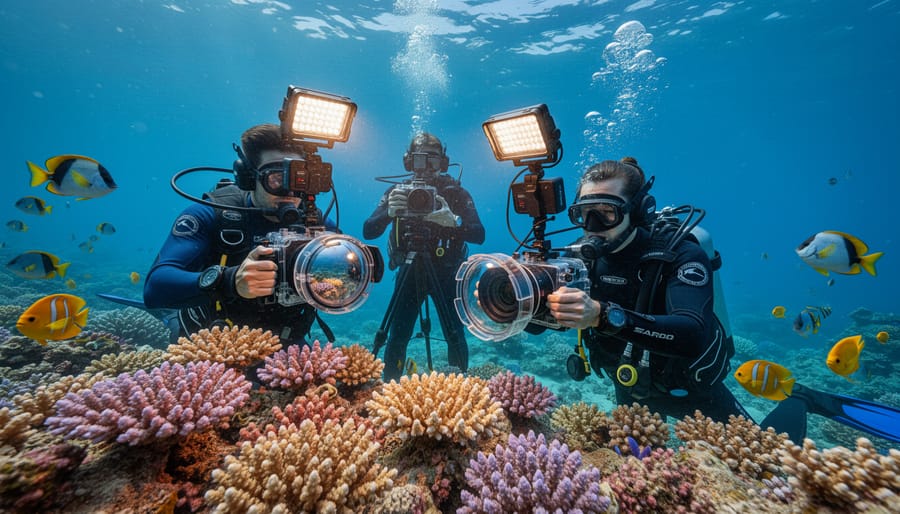
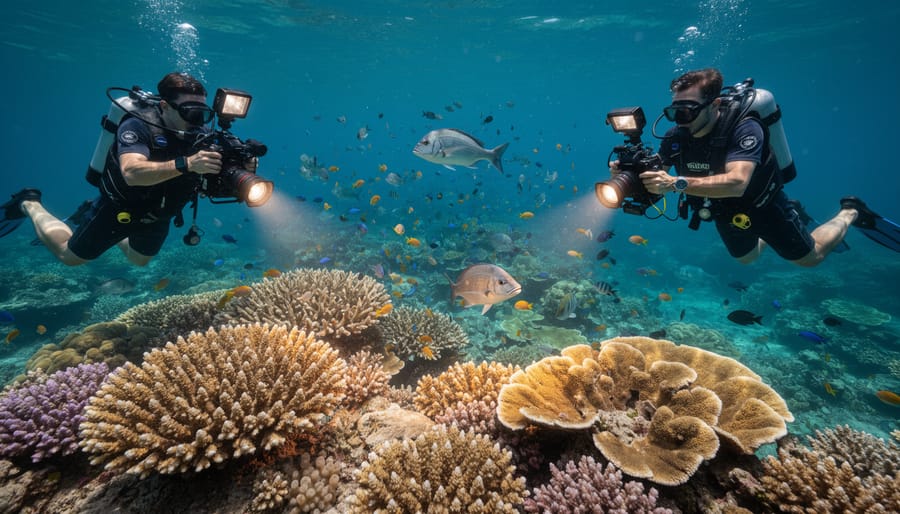
Creating a digital reef begins beneath the waves, where marine scientists employ a combination of advanced underwater technology to capture every detail of living coral ecosystems. The process starts with high-resolution underwater photography, where divers systematically photograph reefs from multiple angles, sometimes taking thousands of images during a single dive. These overlapping photos form the foundation for digital reconstruction.
Complementing photography, sonar mapping uses sound waves to chart the reef’s broader structure and depth profile. This technology proves especially valuable in murky waters or deeper environments where light doesn’t penetrate well. Sonar creates a skeletal framework of the reef’s geography, revealing features invisible to cameras alone.
LiDAR, or Light Detection and Ranging, represents another powerful tool in the digital reef toolkit. By emitting laser pulses and measuring their return time, LiDAR generates precise three-dimensional measurements of reef surfaces and structures. When deployed from boats or underwater vehicles, it captures data with remarkable accuracy, down to centimeter-level detail.
The magic happens when specialized 3D modeling software processes this collected data. Programs like photogrammetry software stitch together thousands of photos, identifying common points between images to build cohesive three-dimensional models. The result is a virtual reef so detailed you can zoom in to examine individual coral polyps or zoom out to understand entire reef systems.
Marine biologist Dr. Sarah Chen describes the experience: “The first time I explored our reef digitally after a dive, I spotted fish behavior I’d completely missed underwater. These models let us revisit sites without disturbing them, study changes over time, and share these ecosystems with people who may never dive themselves.”
More Than Just Pretty Pictures
While underwater photography captures beautiful moments, digital reefs represent something far more powerful for marine science. Think of the difference between a vacation snapshot and a detailed architectural blueprint. A single photograph freezes one angle at one moment, but a digital reef provides a complete, measurable, three-dimensional model that scientists can revisit and analyze indefinitely.
These virtual reconstructions unlock capabilities that traditional photography simply cannot match. Researchers can take precise measurements of coral colonies without ever touching them, tracking growth rates down to the millimeter. They can calculate the exact surface area of reef structures, measure distances between organisms, and monitor changes in reef topography over months or years. Dr. Sarah Chen, a marine biologist who has worked with digital reef technology for five years, explains: “I can measure the same coral head from my office in winter that I scanned during summer fieldwork. I can compare it with models from previous years, share it with colleagues across the globe, and students can explore it virtually before ever getting in the water.”
This transformation from static images to dynamic, analyzable datasets means we can detect subtle changes that might otherwise go unnoticed. A slight shift in coral positioning, early signs of bleaching, or gradual encroachment by invasive species all become visible through careful comparison of digital models over time.
Why We Need Digital Reconstructions of Our Reefs
Racing Against Coral Bleaching and Climate Change
Coral reefs are disappearing at an alarming rate. Rising ocean temperatures trigger mass bleaching events, turning vibrant underwater cities into ghostly white graveyards. Scientists estimate that we’ve already lost roughly half of the world’s coral reefs since the 1950s, and without significant intervention, we could lose most remaining reefs within our lifetime.
This sobering reality makes digital reef documentation not just valuable, but urgent. These 3D models function as ecological time capsules, preserving detailed snapshots of reef ecosystems before climate change alters or destroys them forever. When marine biologist Dr. Elena Vasquez first began scanning reefs in the Caribbean, she described the work as “creating memory banks for the ocean.” Her team has since documented over thirty reef sites, several of which have experienced significant bleaching in just the past five years.
These digital archives serve a crucial dual purpose. First, they provide scientists with precise baseline data, showing exactly what healthy reef ecosystems looked like before degradation occurred. This information proves invaluable when planning restoration projects, as researchers can identify which coral species thrived where, understand structural complexity, and replicate natural arrangements.
Second, these models allow future generations to experience reefs as they once existed. Students decades from now might explore thriving coral gardens through virtual reality, even if those physical reefs no longer survive. This preservation of beauty and biodiversity reminds us what we’re fighting to protect and restore, transforming abstract loss into tangible understanding that motivates conservation action.
Accessing the Inaccessible
Digital reef reconstructions are breaking down barriers that have long limited who can study and appreciate marine ecosystems. Deep-sea sites that lie hundreds of meters below the surface, far beyond recreational diving limits, can now be explored virtually by anyone with internet access. Protected marine reserves, where physical access is deliberately restricted to safeguard fragile ecosystems, become available for detailed study without risk of disturbance. Remote coral reefs in distant oceans that few researchers can afford to visit in person are suddenly within reach of classrooms worldwide.
Marine biologist Dr. Elena Torres recalls her first experience sharing a digital reef model with students: “Watching their faces light up as they zoomed through an underwater canyon was transformative. These kids in Kansas were exploring a Pacific seamount, asking questions I’d never considered.” This democratization of access means students in landlocked regions can conduct meaningful research on marine ecosystems, while the general public can witness the beauty and complexity of underwater worlds that might otherwise remain abstract concepts. For scientists, digital reconstructions provide opportunities to revisit sites repeatedly, comparing changes over time without the expense and environmental impact of multiple expeditions.
Creating Living Archives for Future Generations
Digital reef documentation creates invaluable time capsules of marine ecosystems, capturing the intricate details of coral communities, fish populations, and habitat structures as they exist today. These digital archives serve multiple crucial purposes beyond immediate research. They provide baseline data that scientists can reference decades from now to understand how reefs have changed, track species distributions, and identify long-term ecological trends. When restoration becomes necessary, these detailed 3D models and photographic records offer precise blueprints showing exactly what healthy reef systems looked like before degradation occurred.
Marine biologist Dr. Sarah Chen describes digital archives as “hope preserved in pixels.” She explains, “We’re documenting biodiversity that might disappear, but we’re also creating roadmaps for bringing it back. Future generations will have exact templates for restoration.” Similar to preserving underwater treasures threatened by rising seas, digital reef archives safeguard irreplaceable ecological information. These living libraries also democratize access to reef research, allowing educators, students, and communities worldwide to study marine ecosystems they might never visit in person, fostering a global community invested in ocean conservation.
How Digital Reefs Are Transforming Marine Research
Tracking Changes Over Time Without Disturbing Wildlife
Traditional reef monitoring methods often require physical contact with delicate marine structures—taking measurements with calipers, tagging fish, or collecting samples. Each visit, no matter how careful, creates stress for resident species and potential damage to fragile corals. Digital reef technology transforms this approach entirely.
By creating high-resolution 3D scans at regular intervals, researchers can track changes in coral colonies down to millimeter-level precision without ever touching them. Marine biologist Dr. Elena Rodriguez, who has spent fifteen years studying Caribbean reefs, describes the breakthrough: “We can now measure growth rates, monitor bleaching recovery, and detect disease spread by comparing sequential scans from our computers. The reef experiences no disturbance beyond a diver swimming overhead with a camera.”
These digital timelines reveal patterns invisible to the naked eye. Researchers track how individual coral heads respond to temperature fluctuations, map fish aggregation zones across seasons, and monitor sand movement reshaping the reef structure. Population counts become less invasive too—artificial intelligence can identify and count fish species appearing in scan imagery, eliminating the need for traditional netting or tagging operations.
For long-term ecosystem health assessments, this non-invasive approach proves invaluable. Scientists can revisit the same digital reef sites monthly or annually, building comprehensive datasets that would be impossible with traditional methods while ensuring the communities they study remain undisturbed and thriving.
Training the Next Generation of Marine Biologists
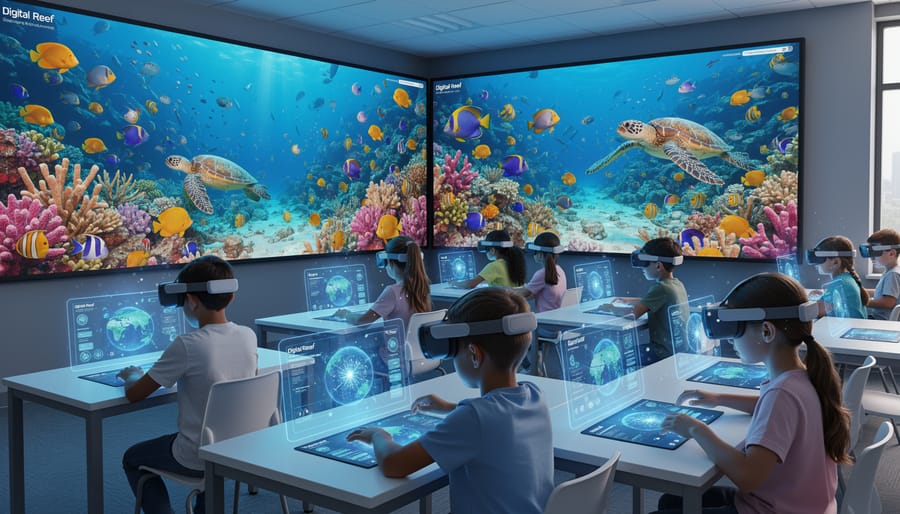
Digital reefs are revolutionizing how we prepare the next generation of ocean stewards. These virtual ecosystems transport students from landlocked classrooms to vibrant coral gardens, deep-sea trenches, and kelp forests—all without leaving their desks. A high school student in rural Montana can now explore the Great Barrier Reef alongside peers in coastal California, examining the same coral structures and marine species that marine biology students once needed expensive field trips to access.
Universities and educational institutions worldwide are integrating digital reef platforms into their curricula, allowing aspiring marine biologists to practice identification skills, study ecosystem interactions, and understand conservation challenges in immersive detail. Students can revisit the same virtual reef site repeatedly, tracking changes over time and developing critical observation skills.
Dr. Sarah Chen, a marine biologist who grew up far from the ocean, shares how digital reefs might have accelerated her career path: “If I could have explored these ecosystems virtually as a student, I would have entered graduate school far better prepared. Today’s students have that advantage.”
These platforms also democratize marine science education, making it accessible regardless of geographic or economic barriers. Teachers report increased student engagement when lessons incorporate 3D reef exploration, transforming abstract concepts into tangible, interactive experiences that inspire genuine passion for ocean conservation.
Personal Story: A Marine Biologist’s Perspective
The first time I captured a three-dimensional model of a degraded reef section in the Caribbean, I knew our conservation approach had fundamentally changed. Using nothing more than an underwater camera and specialized software, I created a precise digital twin of a coral formation that had suffered severe bleaching. What once took weeks of manual measurements now happened in hours, giving us an accurate baseline to track recovery over time.
Digital reef technology has transformed how I approach restoration projects. When explaining recovery strategies to local communities and stakeholders, I can show them interactive models rather than abstract data charts. They see exactly which coral species we’re prioritizing and why certain areas need immediate intervention. This visual connection has increased volunteer participation in our monitoring programs by over sixty percent.
Perhaps most remarkably, these digital archives allow us to share vulnerable reef ecosystems with researchers worldwide without adding physical stress to already fragile sites. We’re building a global library of reef health data that future generations of marine biologists will use to understand how our oceans responded to this critical period of environmental change.
Success Stories: Digital Reefs Making Real-World Impact
The Great Barrier Reef’s Digital Twin
One of the most ambitious digital reef initiatives is the comprehensive mapping of Australia’s Great Barrier Reef, the world’s largest coral reef system spanning over 2,300 kilometers. Scientists and conservationists have joined forces to create an incredibly detailed digital twin of this natural wonder, combining high-resolution imagery, 3D photogrammetry, and sonar mapping to capture every coral formation, cave, and crevice.
The project involves teams of divers equipped with specialized cameras systematically photographing reef sections, while autonomous underwater vehicles collect data from deeper areas inaccessible to humans. Marine biologist Dr. Emma Richardson, who has spent five years contributing to this effort, shares that “seeing the reef transformed into a digital model allows us to track coral bleaching events with unprecedented precision and identify which areas show resilience to warming waters.”
This digital archive serves multiple purposes: it provides a baseline for monitoring reef health over time, helps predict which sections are most vulnerable to climate change, and creates an invaluable educational resource. Students worldwide can now explore the reef virtually, examining individual coral polyps and observing fish behavior without ever leaving their classrooms.
Shipwrecks as Artificial Reefs
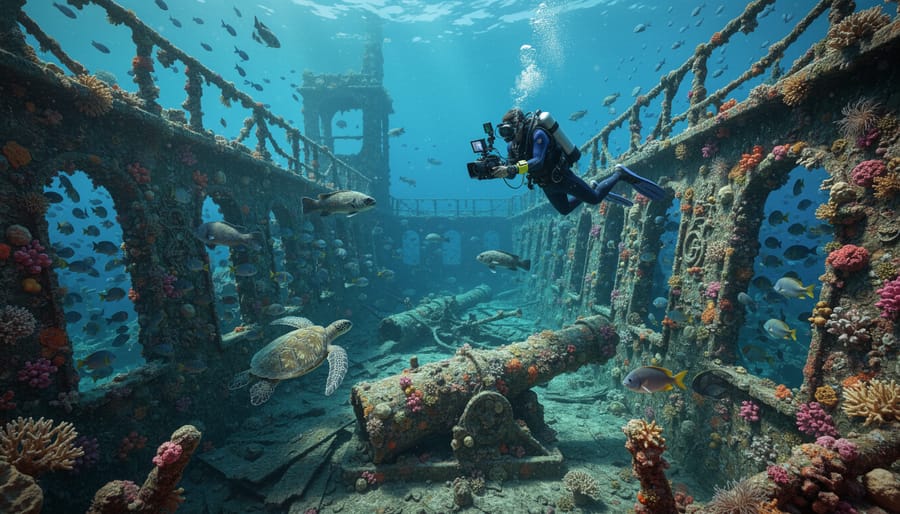
Sunken vessels transform into thriving underwater ecosystems, creating unique opportunities for both marine conservation and cultural preservation. When ships settle on the ocean floor, their structures provide hard surfaces where corals attach, fish shelter, and entire communities flourish. Digital reconstruction technology now allows researchers to document these dual-purpose sites with unprecedented detail, capturing their historical significance while monitoring their evolution as marine habitats.
Through 3D photogrammetry and sonar mapping, scientists create precise digital models of shipwrecks without disturbing the delicate balance between preserving submerged artifacts and protecting marine life. These virtual reconstructions enable researchers to track coral colonization patterns, monitor fish populations, and assess how artificial reef structures support biodiversity over time. Marine biologist Dr. Sarah Chen notes that digital documentation has revealed surprising biodiversity hotspots on century-old wrecks, with some hosting over 200 species.
This technology democratizes access to these underwater treasures, allowing educators and students worldwide to explore shipwreck ecosystems virtually while the physical sites remain undisturbed sanctuaries for marine life.
Restoration Guided by Digital Data
Digital models are revolutionizing how conservationists approach coral restoration. By creating detailed 3D maps of degraded reefs, scientists can identify the most strategic locations for coral transplantation, ensuring new colonies have optimal conditions for survival. These digital blueprints reveal patterns in water flow, light exposure, and substrate quality that might otherwise go unnoticed.
Marine biologist Dr. Elena Rodriguez uses photogrammetry to guide her restoration work in the Caribbean. “We can now see exactly where corals thrived historically and replicate those conditions,” she explains. This precision increases restoration success rates by up to 40% compared to traditional methods.
Digital reefs also help restoration teams track progress over time, comparing current conditions against baseline models to measure recovery. This data-driven approach allows for adaptive management, where techniques can be adjusted based on measurable outcomes. For underwater archaeological sites, these technologies enable balancing heritage and biodiversity preservation.
Volunteers increasingly participate in digital reef projects, collecting imagery during recreational dives that contribute to restoration planning databases.
How You Can Contribute to Digital Reef Conservation
Citizen Science and Virtual Reef Monitoring
Digital reef technology has unlocked exciting possibilities for anyone passionate about ocean conservation to make meaningful contributions. Through citizen science initiatives, volunteers worldwide can help analyze the vast amounts of 3D imagery and data collected from reef sites. Platforms like Coral Watch and Reef Life Survey invite participants to identify coral species, assess bleaching events, or count fish populations from digital reef models—all from their computers at home.
Dr. Maya Chen, a marine biologist working with the Smithsonian’s virtual reef program, shares her enthusiasm: “We’ve had retired teachers, high school students, and ocean lovers from landlocked states helping us catalog reef biodiversity. Their collective efforts have processed datasets that would have taken our small team years to complete.”
These community-driven marine science projects require minimal training but deliver maximum impact. Many platforms offer tutorial videos and species identification guides to help newcomers get started. Some programs even gamify the experience, allowing participants to track their contributions and see how their efforts directly support research publications and conservation decisions.
Whether you have five minutes or five hours to spare, virtual reef monitoring offers a tangible way to protect our oceans while learning about marine ecosystems firsthand.
Volunteer Opportunities and Training Programs
Getting involved with digital reef initiatives is more accessible than you might think. The Marine Biodiversity Science Center offers several pathways for volunteers of all skill levels. If you have technical expertise, consider joining their digital mapping teams, where volunteers learn to process underwater imagery and create 3D models using specialized software. No prior experience with modeling programs is required—comprehensive training workshops are provided quarterly, teaching participants everything from basic photogrammetry to advanced data processing techniques.
For those passionate about fieldwork, dive certification programs partnered with local conservation organizations prepare volunteers to assist with underwater photography missions. These programs combine traditional diving skills with scientific documentation methods, enabling participants to contribute directly to reef monitoring efforts.
Educators and students can participate in virtual reef annotation projects, where volunteers help identify species and catalog biodiversity from the comfort of home. This citizen science approach has proven invaluable, with thousands of volunteers worldwide contributing to vast digital reef databases.
The Center also welcomes non-technical volunteers for outreach programs, helping share digital reef discoveries with communities and schools. Training sessions occur monthly, both in-person and online, ensuring everyone can find a meaningful role in protecting our ocean’s underwater treasures.
Digital reefs represent more than just technological innovation—they embody our collective commitment to understanding and protecting the ocean’s most vital ecosystems. As we’ve explored throughout this discussion, these virtual reconstructions are transforming how we study, monitor, and conserve coral reefs and other marine habitats, creating unprecedented opportunities for scientists, educators, and concerned citizens worldwide to engage with underwater environments that might otherwise remain inaccessible.
The power of digital reef technology lies not just in the detailed 3D models or the vast datasets they generate, but in their ability to connect people with the ocean in meaningful ways. From marine biologist Dr. Elena Cortez, who uses these models to track coral bleaching patterns across remote Pacific atolls, to classroom students exploring virtual reefs from hundreds of miles inland, this technology is democratizing marine conservation in ways we couldn’t have imagined a decade ago.
However, technology alone cannot save our reefs. The digital tools we’ve discussed are catalysts for action, not substitutes for it. They provide us with knowledge, but we must transform that knowledge into meaningful conservation efforts. Whether you’re a researcher seeking to contribute data, an educator looking to inspire the next generation of ocean stewards, or simply someone who cares about marine biodiversity, there are numerous ways to get involved. Our center offers volunteer opportunities for reef monitoring projects, citizen science initiatives, and educational programs designed to turn digital engagement into real-world impact. Together, we can ensure that both our digital reconstructions and the living reefs they represent thrive for generations to come.

jessica
Ava Singh is an environmental writer and marine sustainability advocate with a deep commitment to protecting the world's oceans and coastal communities. With a background in environmental policy and a passion for storytelling, Ava brings complex topics to life through clear, engaging content that educates and empowers readers. At the Marine Biodiversity & Sustainability Learning Center, Ava focuses on sharing impactful stories about community engagement, policy innovations, and conservation strategies. Her writing bridges the gap between science and the public, encouraging people to take part in preserving marine biodiversity. When she’s not writing, Ava collaborates with local initiatives to promote eco-conscious living and sustainable development, ensuring her work makes a difference both on the page and in the real world.