Marine Biodiversity Science Center

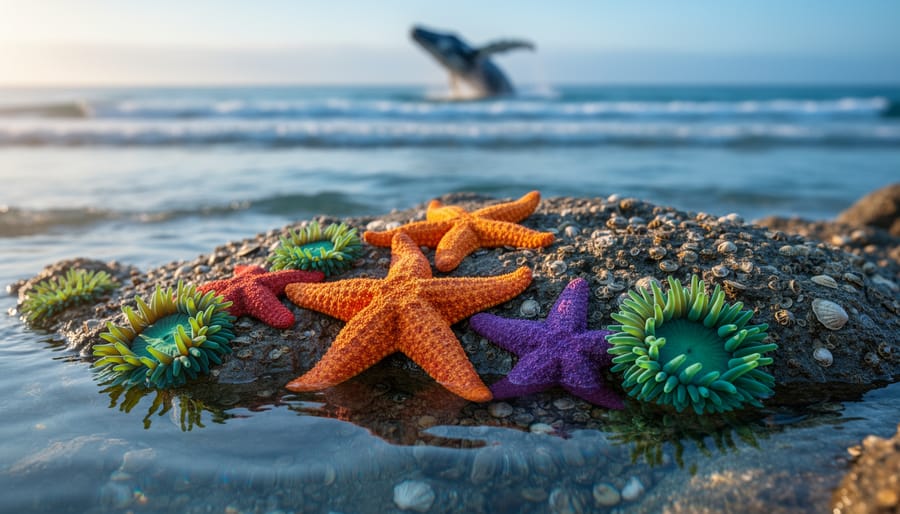
Capture the ocean’s vastness in three lines. This ancient poetic form—whether haiku, tercet, or triplet—distills marine wonder into moments of crystalline clarity, transforming complex ecological relationships into verses anyone can grasp and remember. When a researcher describes a whale’s breach, a student observes tide pool inhabitants, or a conservationist witnesses coral bleaching, three-line poetry becomes a bridge between scientific observation and emotional connection.
The format’s brevity mirrors the ocean itself: seemingly simple on the surface, yet containing profound depth. Marine biologists increasingly recognize how condensing their findings into three powerful lines makes climate change, habitat loss, and species interdependence accessible to audiences who might never read a research paper. This fusion of marine science into art creates memorable touchstones that linger in minds long after lectures fade.
Three-line poems demand precision—each word carries weight, much like every species plays a crucial role in marine ecosystems. Whether you’re an educator seeking classroom engagement tools, a poet drawn to oceanic imagery, or a conservationist searching for compelling ways to communicate urgent environmental messages, this compact form offers remarkable versatility. It requires no specialized equipment, welcomes all skill levels, and produces shareable content that spreads conservation awareness through social media, presentations, and community events.
The ocean’s rhythms—wave patterns, tidal cycles, seasonal migrations—naturally align with structured poetic forms, making marine themes particularly suited to three-line expression. Your observations matter, your voice strengthens the collective call for ocean protection, and your creative contributions can inspire others to look closer at the blue world covering seventy percent of our planet.
What Makes 3-Line Poetry Perfect for Ocean Themes
The Power of Compression
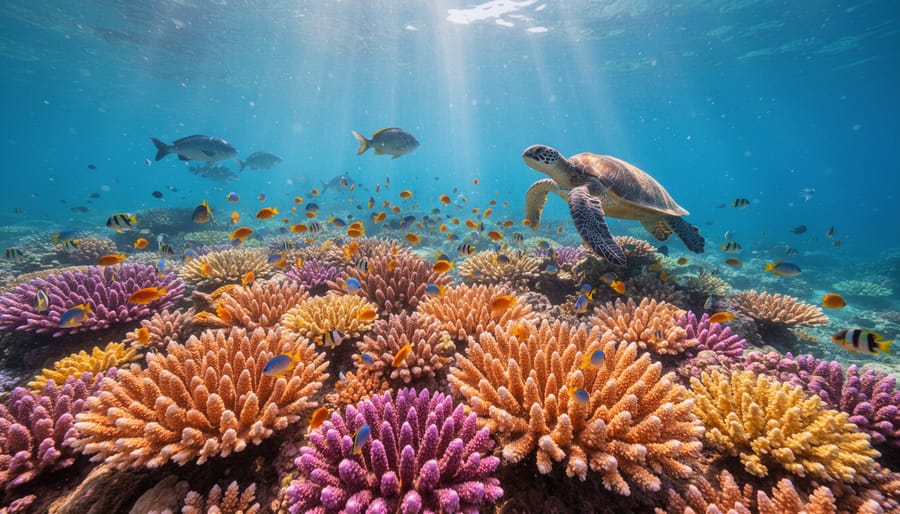
Three-line poetry demands ruthless efficiency, compelling writers to distill vast marine experiences into concentrated moments of clarity. When faced with describing an entire coral reef ecosystem or the urgency of ocean acidification, poets must identify the single image or sensation that captures everything. This constraint becomes liberation—instead of explaining every detail of a kelp forest’s biodiversity, a three-line poem might focus solely on sunlight filtering through swaying fronds, trusting that singular moment to evoke the forest’s essence.
Marine biologist Dr. Sarah Chen describes this process: “Writing three-line poems about my research forced me to find the emotional core of scientific observations. Instead of listing species data, I captured the moment a sea turtle hatchling first touched ocean water—that instant contained everything about vulnerability, determination, and hope for marine conservation.”
This compression creates immediate emotional resonance because readers aren’t wading through exposition. They experience a flash of recognition, a quick connection to marine environments they may never physically encounter. For educators and conservationists, this brevity makes complex ecological concepts suddenly accessible, transforming abstract concerns about ocean health into tangible human experiences that inspire protective action.
Ancient Forms Meet Modern Oceans
Three-line poetic forms have captured human emotions for centuries, and today’s marine poets are adapting these compact structures to address urgent ocean conservation challenges. The haiku, originating in 17th-century Japan, traditionally captures fleeting moments in nature through its 5-7-5 syllable pattern. Senryu, haiku’s cousin, applies the same structure to human nature and emotions, making it perfect for exploring our relationship with marine ecosystems. Tercets, three-line stanzas found across Western poetry traditions, offer more flexibility in rhythm and length.
Just as ancient tales shape conservation awareness today, these classical forms provide frameworks for modern environmental messages. Contemporary marine scientists and poets are breathing new life into these structures, using haiku to document coral bleaching events, senryu to express the emotional weight of species loss, and tercets to weave scientific observations with personal connection. Marine biologist Dr. Sarah Chen shares, “Writing haiku about the creatures I study helps me communicate complex ecological relationships in ways that resonate beyond academic journals.” This marriage of traditional form and contemporary content creates accessible entry points for discussing ocean acidification, plastic pollution, and habitat restoration.
Marine Science Through Three Lines
Coral Bleaching in Verse
Coral bleaching—the phenomenon where stressed corals expel their symbiotic algae, turning ghostly white—has inspired powerful three-line poems that capture this environmental crisis with striking brevity. These verses serve as both artistic expression and conservation calls to action, distilling complex marine science into memorable imagery.
Marine biologist Dr. Sarah Chen penned this observation after a 2019 survey: “Once gardens of gold / now bone-white monuments stand / silence in the reef.” Her haiku-style approach transforms scientific data into visceral experience, making temperature stress tangible for readers who may never dive these waters.
Another compelling example comes from conservation educator Marcus Webb: “Color drains like hope / warm waters steal their partners / corals wait alone.” This verse explains the biological process—the separation of coral polyps from zooxanthellae algae—while evoking the isolation and vulnerability these ecosystems face.
Student poet Amara Okafor wrote after visiting a restoration site: “Fragments planted deep / nurture tomorrow’s rainbows / hands can heal the blue.” Her optimistic lines remind us that coral restoration efforts, though challenging, offer genuine paths forward. By highlighting human agency and volunteer involvement in reef recovery, such poems inspire readers to transition from witnesses to participants in marine conservation.
Endangered Species, Eternal Words
Three-line poems possess a unique power to create immediate emotional connections with creatures facing extinction. When marine biologist Dr. Sarah Chen writes about leatherback sea turtles in verse, she transforms population decline statistics into something visceral: “Ancient navigator / plastic bag mistaken for jellyfish / one less shadow on the sand.” This approach bridges the gap between data and feeling in ways that spreadsheets cannot achieve.
Scientific reports tell us that shark populations have declined by 71% in the past fifty years, but poetry makes us feel that loss. Consider this haiku from conservation educator Michael Torres: “Apex predator / slips through darkening waters / silence fills the reef.” The brevity of three lines mirrors the urgency of species decline, creating a haunting parallel between form and content.
Whales, perhaps more than any marine creature, inspire verses that celebrate resilience while acknowledging threat. “Humpback song echoes / through shipping lanes and sonar / still they sing forward,” wrote poet and oceanographer Lisa Yamamoto. Her words remind us that these magnificent beings persist despite human interference, offering hope alongside awareness.
Research shows that people exposed to conservation poetry demonstrate increased empathy toward endangered species and greater likelihood of supporting protection measures. The three-line format proves particularly effective for social media sharing, transforming environmental education into viral moments of connection. When a student crafts a tercet about endangered vaquita porpoises, they become not just informed about the species but emotionally invested in its survival. Poetry creates advocates through emotional resonance, complementing scientific communication with heart-centered understanding that motivates action.
Conservation Voices: Marine Biologists as Poets
Field Notes in Three Lines
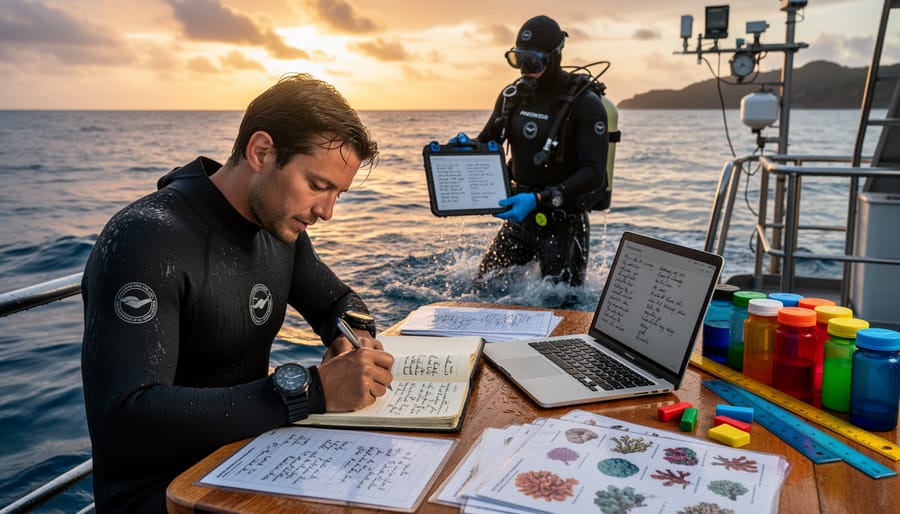
Scientists spend countless hours in the field, recording water temperatures, species counts, and behavioral observations in dive logs and monitoring sheets. But data alone doesn’t always capture the full story of what they witness beneath the waves. Many researchers have discovered that three-line poetry offers a powerful bridge between scientific observation and emotional truth.
Dr. Sarah Chen, a coral reef ecologist, began writing three-line entries in her dive logs after particularly moving encounters. “Elkhorn coral stretches toward filtered light / polyps opening like a thousand tiny fists / still fighting after decades of warming seas” emerged from her notes during a reef assessment in the Caribbean. These compressed observations help her team communicate research findings to funders and the public in ways that raw numbers cannot.
Marine mammal researcher James Torres transforms expedition notes into poetry for social media, reaching thousands beyond academic journals. His recent piece from a whale tagging project reads: “Humpback surfaces in morning mist / satellite tag records her ten-thousand-mile journey / connecting two oceans, reminding us everything flows together.”
The format’s brevity makes it ideal for field conditions. Researchers scribble verses on waterproof notepads between dives, capturing immediate impressions before they fade. Graduate student Maya Patel shares her three-liners during community presentations about sea turtle monitoring, finding that these poetic snapshots spark more questions and engagement than traditional slideshow data. The practice transforms scientists into storytellers, making their crucial conservation work both accessible and unforgettable.
A Researcher’s Story
I discovered 3-line poetry during a research expedition off the British Columbia coast, feeling overwhelmed by the disconnect between our critical findings and public awareness. After days documenting declining kelp forests, I scribbled three simple lines in my field notebook about what I’d witnessed. That moment changed how I approach science communication.
As a marine biologist, I’ve published dozens of peer-reviewed papers, but few people outside academia read them. Three-line poems became my bridge between rigorous research and accessible storytelling. When studying harbor seal populations, instead of just recording data, I began crafting brief verses capturing their behaviors, their habitat struggles, and our shared ocean connection. These compact poems distill complex ecological relationships into memorable snapshots that resonate with diverse audiences.
I now integrate this poetic form into my educational outreach programs. Students grasp concepts like predator-prey dynamics more readily when they craft their own ocean verses. During beach cleanups, volunteers write three-line reflections about marine debris they collect, transforming frustration into creative expression and meaningful dialogue about plastic pollution.
This practice reminds me why I chose marine science: wonder for ocean life. Each poem becomes a small act of advocacy, translating scientific observations into emotional connections that inspire conservation action. Whether documenting orca sightings or explaining ocean acidification, these three lines help me share not just data, but the profound beauty and urgency of protecting our marine ecosystems.
Writing Your Own Marine 3-Line Poetry
Finding Your Ocean Moment
The best poetry emerges from genuine observation and emotional connection. Start by spending time at the coast with a notebook, allowing yourself to simply notice what captures your attention. A tide pool might reveal a hermit crab’s determined march across barnacle-crusted rocks, or morning light could illuminate the intricate patterns of sea foam on sand. These small moments often carry profound truths about marine ecosystems.
Consider both the micro and macro perspectives. Individual encounters—a jellyfish pulsing through water, seabirds diving for fish—offer intimate subjects that readers can visualize and connect with emotionally. Meanwhile, broader concerns like ocean acidification, plastic pollution, or coral bleaching provide opportunities to distill complex scientific concepts into accessible verse. Marine biologist Dr. Sarah Chen notes that her most impactful outreach moments came from sharing three-line observations she jotted during research dives, transforming data points into relatable images.
Don’t overlook the power of local waterways. Whether you live near oceans, estuaries, or freshwater systems, your nearby aquatic environments deserve poetic attention. Document seasonal changes, notice which species appear when, and observe human interactions with these spaces. Your unique perspective on familiar waters can inspire others to protect what they might otherwise take for granted. Keep your observations specific and sensory-rich, allowing readers to experience your ocean moment alongside you.
Balancing Beauty and Truth
The most powerful three-line poems about marine life strike a delicate balance between scientific truth and emotional resonance. When writing about ocean creatures and ecosystems, resist the temptation to romanticize or anthropomorphize beyond recognition. A poem about dolphins need not portray them as mystical healers to be meaningful. Instead, ground your work in observable behaviors and documented characteristics while allowing the inherent wonder of these animals to shine through naturally.
Marine biologist Dr. Sarah Chen advises poets to “start with accurate observation and let the beauty emerge from reality itself.” Before writing about a species, research its actual ecology, behavior, and conservation status. A three-line poem about coral bleaching becomes more impactful when it reflects the true science of thermal stress and symbiotic algae loss, even if expressed poetically. This approach educates readers while moving them emotionally.
Avoid exaggeration that might mislead your audience. For instance, describing ocean plastics as “islands the size of continents” obscures the more complex reality of microplastic dispersal. Instead, focus on specific, verifiable details that carry their own weight. The image of a seabird’s stomach containing bottle caps requires no embellishment to convey urgency.
Remember that celebration and concern can coexist in honest poetry. You can honor the remarkable adaptations of deep-sea creatures while acknowledging threats from deep-sea mining. This truthfulness builds credibility and creates poetry that serves both artistic and educational purposes, inspiring informed action rather than vague sentimentality.
3-Line Poetry as a Conservation Tool
Social Media and Shareable Science
The compact nature of three-line poetry makes it perfectly suited for today’s digital landscape, where attention spans are brief and scrolling is constant. A well-crafted tercet can deliver a powerful marine conservation message in the time it takes to swipe past a social media post, making these poems valuable tools for raising awareness about ocean issues.
On platforms like Twitter, Instagram, and Facebook, three-line poems about marine life often gain significant traction through shares and retweets. Marine biologist Dr. Sarah Chen found that her haiku about coral bleaching reached over 50,000 people within a week, sparking hundreds of comments and questions about reef conservation. The brevity allows readers to absorb the message quickly, while the poetic format makes it memorable enough to stick with them long after they’ve moved on.
Educational organizations have discovered that pairing three-line poems with striking ocean photography creates highly shareable content that spreads conservation messages organically. These bite-sized verses serve as conversation starters, prompting followers to learn more about marine issues and share their own ocean observations. The format’s accessibility encourages participation, with many conservation groups hosting monthly poetry challenges that engage their communities while building awareness. This combination of artistic expression and digital reach transforms passive scrollers into active participants in marine conservation conversations.
Classroom Connections
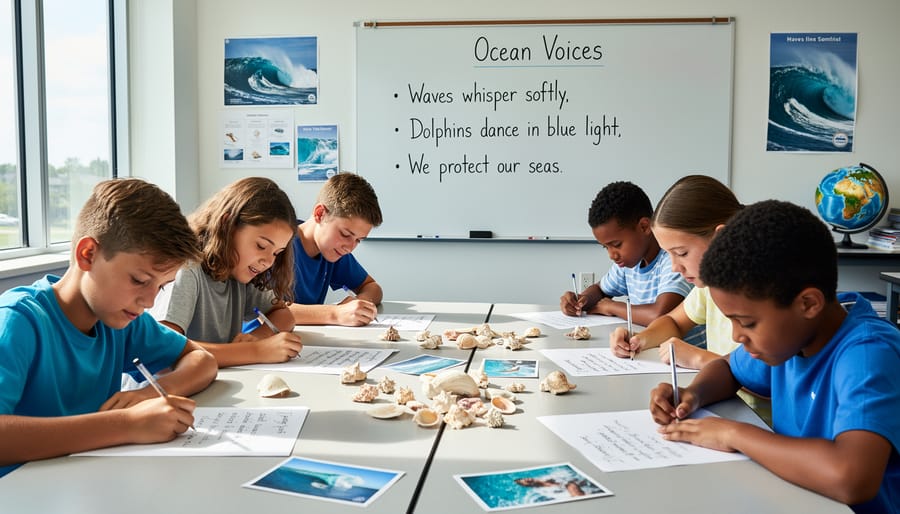
Teachers worldwide are discovering that three-line poetry opens remarkable doors to ocean literacy. In classrooms from coastal communities to landlocked regions, students craft haiku and tercets about marine life, connecting emotionally with creatures they might never encounter in person. Marine biology teacher Sofia Rodriguez shares how her eighth-graders transformed their understanding: “After writing poems about sea turtles, students began researching plastic pollution independently. Poetry made the science personal.”
Many educators pair poetry writing with virtual reef explorations or documentary viewing, asking students to distill complex concepts like coral bleaching or bioluminescence into three powerful lines. This exercise sharpens both creative and analytical thinking while building environmental stewardship. One California elementary school hosts an annual “Ocean Poetry Slam” where students perform their marine verses alongside presentations about conservation solutions.
The format also supports multilingual learners, as the brevity reduces language barriers while maintaining depth of meaning. Teachers report that reluctant writers often flourish with three-line constraints, finding freedom in focused creativity. These poems transform marine science education by making abstract threats tangible and inspiring students to become ocean advocates through words that ripple outward to their communities.
Get Involved: Poetry Meets Action
Your three-line poem about the ocean doesn’t have to remain on paper. At our marine conservation center, we believe creative expression serves as a powerful gateway to environmental stewardship. We invite you to share your marine-inspired poetry through our e-network, where your words can join a growing collection of ocean tributes that educate, inspire, and motivate others to protect our seas.
Whether you’ve penned a haiku about dancing jellyfish or a tercet celebrating coral resilience, your poetry can spark conversations about marine biodiversity. Submit your work to our online community platform, where educators download resources for classroom activities, scientists share field observations, and ocean enthusiasts connect over their shared passion. Many of our members report that writing poetry about marine life deepened their understanding of ecological concepts and strengthened their commitment to conservation.
Ready to take the next step? Our volunteer programs offer hands-on opportunities to experience the subjects of your poetry firsthand. From beach cleanups to citizen science initiatives monitoring coastal ecosystems, you can transform your artistic appreciation into tangible action. Marine biologist Dr. Sarah Chen shared that many volunteers first connected with our center through creative projects before becoming dedicated field researchers and advocates.
Join us in proving that poetry and action are complementary forces in marine conservation. Your three lines might be the catalyst that inspires someone else to protect our oceans.
Three-line poetry offers us something remarkable: a way to distill the vastness of our oceans into moments of clarity that both inform and move us. Throughout this exploration, we’ve seen how these compact verses bridge the gap between scientific data and human emotion, transforming statistics about coral bleaching or plastic pollution into lines that resonate in our hearts. This fusion matters because conservation requires more than understanding—it demands connection, the kind that sparks action.
Marine biologist Dr. Sarah Chen shared with us how writing haiku about her research subjects helped her communicate decades of findings more effectively than traditional reports ever could. Her students now begin field sessions by composing three-line observations, training themselves to notice both the measurable and the meaningful. This practice exemplifies how poetry serves dual purposes: personal expression that deepens our relationship with marine life, and advocacy that brings others into the conservation conversation.
The collective impact of individual voices cannot be overstated. When you share a three-line verse about the seahorse you observed during a volunteer beach cleanup, or the bioluminescent plankton that illuminated your evening swim, you contribute to a growing chorus demanding ocean protection. These poems become conversation starters, teaching tools, and testimonies to what we stand to lose—or save.
We encourage you to pick up your pen or open your notes app today. Write about the ocean you know, the marine creatures you love, or the threats that concern you. Share your verses on social media, in classrooms, or at community meetings. Join local conservation groups where your creative voice amplifies scientific efforts. Together, through words carefully chosen and passionately shared, we build the cultural shift our oceans desperately need.

jessica
Ava Singh is an environmental writer and marine sustainability advocate with a deep commitment to protecting the world's oceans and coastal communities. With a background in environmental policy and a passion for storytelling, Ava brings complex topics to life through clear, engaging content that educates and empowers readers. At the Marine Biodiversity & Sustainability Learning Center, Ava focuses on sharing impactful stories about community engagement, policy innovations, and conservation strategies. Her writing bridges the gap between science and the public, encouraging people to take part in preserving marine biodiversity. When she’s not writing, Ava collaborates with local initiatives to promote eco-conscious living and sustainable development, ensuring her work makes a difference both on the page and in the real world.