Marine Biodiversity Science Center

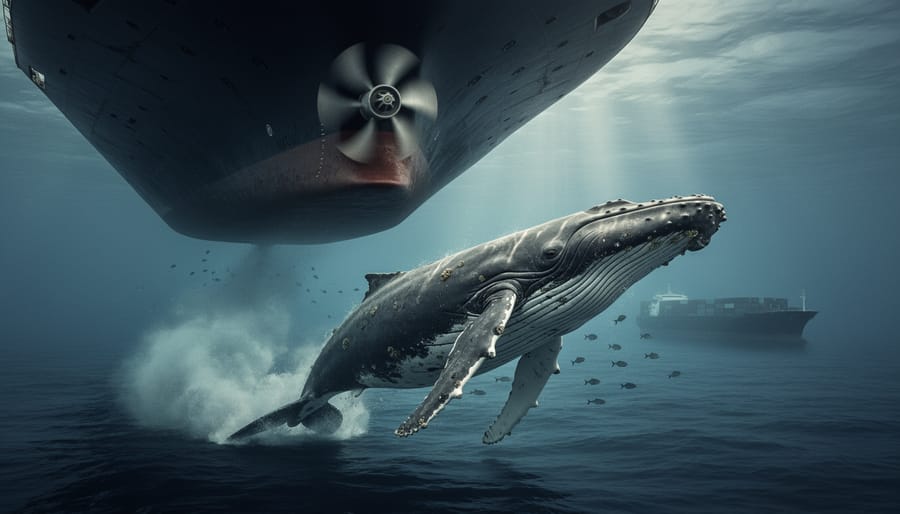
Beneath the ocean’s surface exists a form of contamination that receives far less attention than plastic debris or chemical runoff, yet poses an equally serious threat to marine life: underwater noise pollution. While other forms of pollution visibly mar our coastlines and waters, this invisible menace disrupts the fundamental communication, navigation, and survival behaviors of countless marine species.
The ocean, far from being the silent world Jacques Cousteau once described, functions as a complex soundscape where whales sing across thousands of miles, dolphins echolocate to hunt prey, and fish coordinate breeding through acoustic signals. Into this delicate acoustic environment, human activity introduces a relentless cacophony: commercial shipping vessels generate low-frequency rumbles that travel enormous distances, sonar systems emit powerful pulses for naval operations and oil exploration, and construction equipment pounds the seafloor during offshore development projects. This anthropogenic noise has intensified dramatically over the past century, with some ocean regions now ten times louder than they were just decades ago.
The consequences ripple through entire marine ecosystems. Beaked whales beach themselves in mass strandings following naval sonar exercises. Fish larvae lose their ability to locate suitable reef habitats. Orcas must call louder to communicate, expending precious energy and reducing their hunting efficiency. Yet unlike oil spills or toxic waste, noise pollution offers a unique advantage: when the source stops, the pollution disappears instantly, making it one of the most reversible environmental challenges we face.
Understanding this growing crisis represents the first step toward protecting marine biodiversity. The solutions exist, the technology is available, and opportunities for meaningful action await those willing to join the effort.
What Is Underwater Noise Pollution?
The Major Sources of Ocean Noise
Our oceans have become unexpectedly noisy, and humans are responsible for most of the racket. Understanding where this noise comes from is the first step toward protecting marine life from its harmful effects.
Commercial shipping stands as the single largest contributor to ocean noise pollution. With over 90,000 cargo vessels traversing our seas daily, their massive propellers and engines create low-frequency rumbles that can travel thousands of miles underwater. These sounds typically range from 20 to 200 hertz and can reach levels of 190 decibels, comparable to a rocket launch when heard in air.
Military and commercial sonar systems add another layer of intense sound to the underwater environment. Active sonar emits pulses at frequencies between 1 and 500 kilohertz, with some systems reaching 235 decibels. Marine biologist Dr. Sarah Chen recalls discovering disoriented whales near naval exercise zones: “The animals appeared confused, swimming in circles. It was heartbreaking to witness the immediate impact of sonar on these magnificent creatures.”
Seismic surveys for oil and gas exploration use airguns that fire every 10 to 15 seconds, sometimes continuously for months. These blasts can exceed 250 decibels and penetrate deep into the ocean floor, affecting marine life across vast areas.
Coastal construction activities, particularly pile driving for offshore wind farms and infrastructure projects, generate repetitive impacts exceeding 200 decibels. While renewable energy development is crucial, the construction phase creates significant acoustic disturbance.
Even recreational boating contributes to the problem. Popular coastal areas experience constant noise from jet skis, motorboats, and tour vessels, particularly affecting shallow-water habitats where many species breed and raise their young.
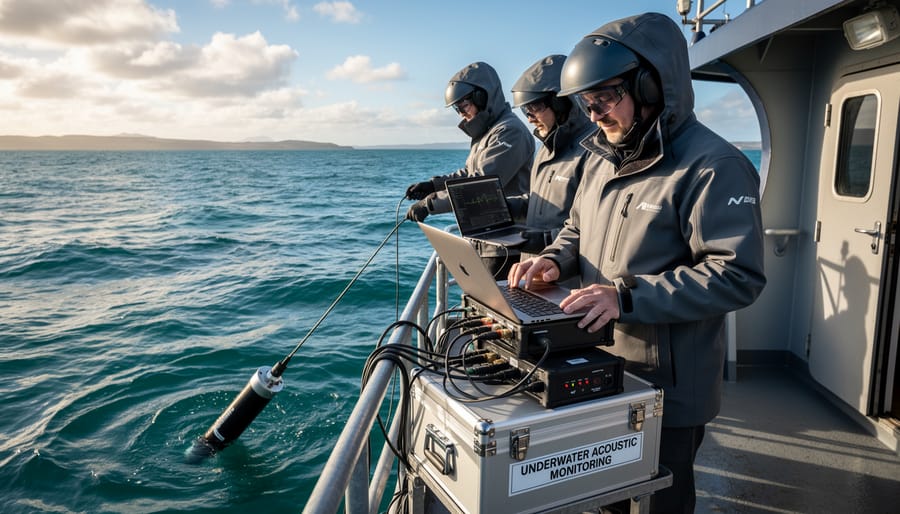
Volunteers monitoring coastal areas have documented how these combined sources create an almost constant din in some regions, transforming once-quiet marine sanctuaries into noisy highways.
How Marine Species Rely on Sound for Survival
Whales and Dolphins: The Ocean’s Acoustic Masters
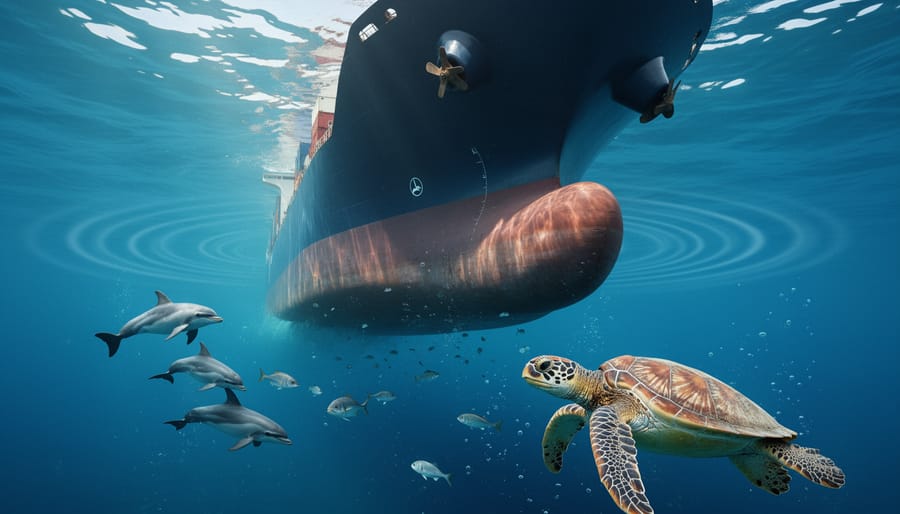
Cetaceans—whales, dolphins, and porpoises—represent some of the ocean’s most sophisticated acoustic communicators. These marine mammals have evolved remarkable abilities to navigate, hunt, and socialize in an environment where sound travels five times faster than in air.
Toothed whales like sperm whales and dolphins use echolocation, producing rapid clicks that bounce off objects and return as echoes. This biological sonar is so precise that bottlenose dolphins can distinguish between different types of fish and detect objects the size of a golf ball from over 100 meters away. Sperm whales generate the loudest sounds produced by any animal—up to 230 decibels—allowing them to hunt giant squid in complete darkness thousands of meters below the surface.
Baleen whales employ different strategies. Humpback whales are famous for their complex songs that can last up to 20 minutes and travel across entire ocean basins. Blue whales produce low-frequency calls below the range of human hearing, communicating with potential mates hundreds of kilometers away. These calls typically range between 10-40 Hz, perfectly adapted for long-distance transmission through water.
Marine biologist Dr. Sarah Chen, who has spent fifteen years studying Pacific gray whales, shares: “Watching a mother whale guide her calf through migration routes using vocal cues is profound. They’re teaching the next generation not just where to go, but how to listen to their environment.”
However, these acoustic abilities make cetaceans particularly vulnerable to underwater noise pollution, disrupting the very communication systems their survival depends upon.
Beyond Marine Mammals: Fish, Invertebrates, and Sound
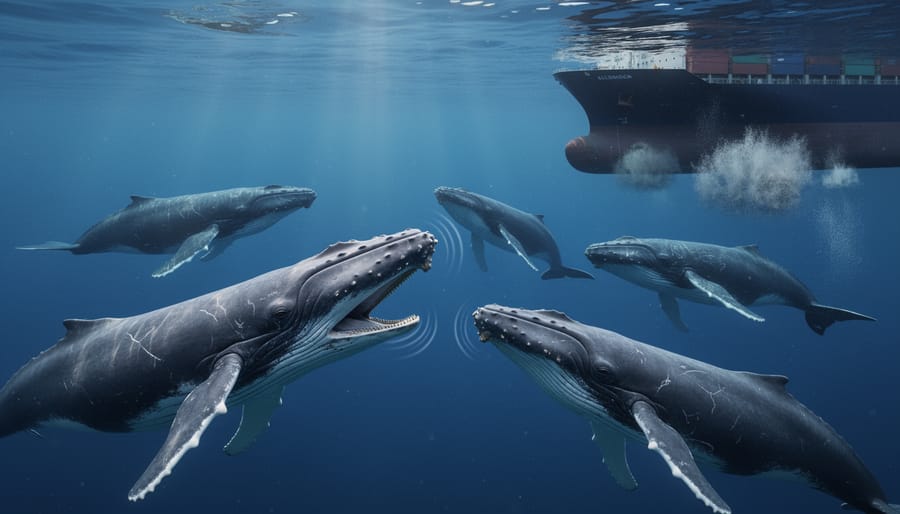
While marine mammals often dominate discussions about underwater noise pollution, countless other species depend critically on sound for survival. Fish, for instance, are far from the silent swimmers many imagine. Over 800 species produce sounds for communication, using their swim bladders, specialized muscles, or even grinding their teeth together. Male midshipman fish hum for hours to attract mates, while coral reef fish create dawn and dusk choruses that rival tropical rainforests in complexity. These acoustic signals guide spawning events, establish territories, and help fish locate suitable habitats.
Marine biologist Dr. Sarah Chen recalls a breakthrough moment during her research on coral reef fish: “We discovered that larval fish use reef sounds as acoustic beacons to find their way home. When we played recordings of healthy reefs, they swam toward the speakers. But shipping noise completely disrupted their navigation.” This finding reveals how noise pollution can prevent fish populations from replenishing themselves.
Invertebrates face similar challenges. Snapping shrimp, whose collective clicking creates one of the ocean’s loudest natural soundscapes, rely on these sounds for communication and predator detection. Studies show that boat noise masks their signals by up to 80 percent. Even crabs and squid, which detect vibrations through specialized sensory organs, experience stress responses and altered behaviors in noisy environments. Understanding these impacts across all marine life forms the foundation for developing comprehensive solutions that protect entire ocean ecosystems rather than single species.
The Devastating Impact on Marine Biodiversity
Physical Harm and Behavioral Changes
The consequences of underwater noise pollution extend far beyond simple disturbance, creating measurable physical harm and fundamentally altering marine animal behavior. Marine mammals, particularly those relying heavily on echolocation like dolphins and whales, can suffer temporary or permanent hearing loss when exposed to intense sound events such as seismic surveys or military sonar. This damage is similar to how humans experience hearing loss from prolonged exposure to loud environments, except marine animals cannot simply leave the ocean.
Dr. Maria Santos, a marine biologist who has studied beaked whales for over fifteen years, recalls a particularly troubling incident: “We documented a pod that abandoned their traditional feeding grounds immediately after nearby naval exercises. Some individuals showed signs of acoustic trauma, and the group never returned to that area during our three-year monitoring period.” Such displacement represents more than inconvenience; it forces animals to expend precious energy finding new habitats while potentially facing increased competition and reduced food availability.
Chronic noise exposure triggers elevated stress hormones in marine species, weakening immune systems and reducing reproductive success. Studies on North Atlantic right whales revealed that decreased shipping noise during the COVID-19 pandemic correlated with lower stress hormone levels in these critically endangered animals, providing powerful evidence of the connection.
Migration patterns have shifted dramatically in response to persistent noise. Gray whales now detour around busy shipping lanes, adding hundreds of miles to their already exhausting journeys. Feeding efficiency drops when fish cannot communicate effectively about predator threats or food sources, while breeding behaviors requiring specific vocalizations become disrupted in noisy environments.
Perhaps most concerning is the growing documentation of permanent habitat abandonment. When noise persists, marine animals must choose between staying in acoustically hostile environments or relocating entirely, fragmenting populations and potentially reducing genetic diversity essential for species survival.
The Ripple Effect Through Marine Ecosystems
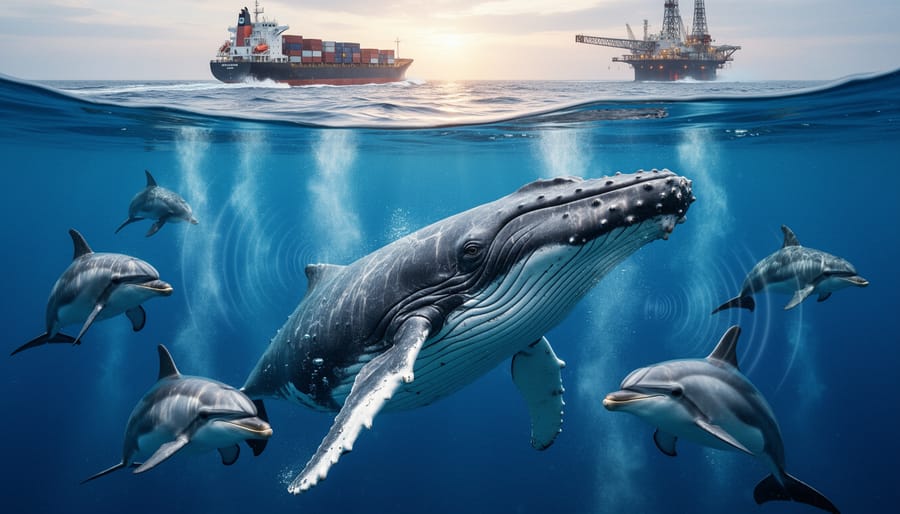
Underwater noise pollution doesn’t just affect individual animals—it triggers a domino effect that reverberates through entire marine ecosystems. When apex predators like orcas struggle to hunt due to acoustic interference, prey populations can surge unnaturally, disrupting the delicate balance of food webs. Dr. Marina Chen, a marine ecologist studying the Pacific Northwest, witnessed this firsthand: “We observed that when shipping traffic increased near critical feeding grounds, resident orca pods spent 30% more time searching for salmon. This hunting inefficiency doesn’t just impact the whales—it affects everything connected to them.”
The consequences extend beyond predator-prey relationships. Noise-stressed fish populations may abandon traditional spawning grounds, leading to recruitment failures that ripple through commercial fisheries. Marine invertebrates, the foundation of ocean food chains, show reduced feeding rates in noisy environments, potentially weakening the entire ecosystem’s productivity. When combined with other stressors like ocean acidification and overfishing impacts, noise pollution creates a perfect storm of environmental pressures.
These ecosystem disruptions ultimately affect human communities dependent on healthy oceans—from fishing industries to coastal tourism. Understanding these interconnections helps us recognize that protecting marine life from noise pollution isn’t just about individual species; it’s about preserving the intricate web of life that sustains us all.
Voices from the Field: A Marine Biologist’s Perspective
Dr. Maya Patel still remembers the moment that changed her research focus forever. While conducting a routine biodiversity survey off the California coast in 2018, she noticed something unsettling. The humpback whales she’d been studying for years were behaving erratically, surfacing more frequently and appearing disoriented near shipping lanes.
“I watched a mother and calf struggle to communicate,” she recalls, her voice tinged with concern. “The calf kept swimming away from its mother, clearly unable to hear her calls over the roar of passing container ships. In that moment, I realized we’d been overlooking a critical threat to marine life.”
Dr. Patel, now a leading researcher in underwater acoustics at the Monterey Bay Marine Institute, has spent the past five years documenting how noise pollution disrupts marine ecosystems. Her work reveals that chronic exposure to vessel noise can elevate stress hormones in whales by up to 300 percent, compromising their immune systems and reproductive success.
What drives her research forward isn’t just data collection. It’s the hope that understanding leads to action. “Every person who learns about this issue becomes a potential advocate,” she explains. “Whether you’re volunteering for coastal monitoring programs, supporting quieter shipping technologies, or simply spreading awareness, you’re contributing to solutions.”
Dr. Patel regularly mentors students and citizen scientists, believing that conservation requires diverse voices. “The ocean’s silence is breaking,” she says. “But if we listen carefully and act collectively, we can restore the acoustic balance that marine life depends on for survival.”
Solutions and Hope: What’s Being Done to Quiet the Seas
Technological Innovations and Quieter Practices
The maritime industry has begun embracing innovative technologies that significantly reduce underwater noise pollution, offering hope for quieter oceans. Engineers are redesigning ship hulls and propeller systems to minimize the acoustic footprint of vessels traveling through marine habitats. Modern propeller designs incorporate specialized blade shapes and coatings that reduce cavitation, the formation of tiny bubbles that collapse and create loud popping sounds as propellers spin through water. Some shipping companies have voluntarily reduced vessel speeds in sensitive areas, cutting noise levels while also decreasing fuel consumption and air pollution.
Marine biologist Dr. Elena Torres, who has studied whale populations off California’s coast for fifteen years, recalls the moment she first witnessed the impact of quieter shipping lanes. “We documented a 30% increase in successful whale communications after a voluntary speed reduction program was implemented. The mothers could finally hear their calves clearly,” she shares, her voice filled with emotion.
Alternative technologies for underwater exploration and resource assessment are also emerging. Air gun arrays used in seismic surveying, which produce some of the ocean’s loudest artificial sounds, are being replaced with marine vibroseis systems that generate lower-intensity signals. These innovations allow scientists and industries to gather necessary data while minimizing harm to marine life.
Seasonal route modifications represent another practical solution, where ships avoid critical habitats during sensitive periods like breeding seasons or migration corridors. Many of these advances require collaboration between researchers, industry leaders, and policymakers, demonstrating that meaningful change happens when diverse stakeholders unite for ocean conservation.
Policy, Regulation, and International Cooperation
Addressing underwater noise pollution requires coordinated efforts across borders and jurisdictions. Several international frameworks provide pathways for protection, though many are still evolving to specifically address acoustic impacts on marine life.
The International Maritime Organization has taken significant steps through voluntary guidelines for ship noise reduction, though these measures aren’t yet mandatory. Meanwhile, regional agreements like the European Union’s Marine Strategy Framework Directive explicitly recognize underwater noise as a pollutant requiring monitoring and mitigation.
In North America, the Marine Mammal Protection Act and Canada’s Species at Risk Act offer legal protections that increasingly consider acoustic impacts. These laws have led to shipping lane modifications in critical habitats and seasonal speed restrictions in whale feeding areas. Dr. Elena Vasquez, a conservation policy specialist, shares an encouraging perspective: “Ten years ago, underwater noise wasn’t even part of the conversation. Now we’re seeing governments and industries proactively seeking solutions.”
Marine protected areas are expanding to include acoustic sanctuaries, where noise-generating activities face restrictions during sensitive periods like breeding seasons. The Stellwagen Bank National Marine Sanctuary pioneered such protections, demonstrating measurable benefits for whale populations.
International cooperation remains essential since sound travels across boundaries. The Convention on Biological Diversity now recognizes ocean noise in its conservation targets, while regional fisheries management organizations are incorporating acoustic considerations into their practices. These frameworks create opportunities for citizens to participate through public comment periods and advocacy, ensuring that ocean protection reflects collective values and scientific understanding.
How You Can Make a Difference
Volunteer and Research Opportunities
The Marine Biodiversity Science Center offers multiple pathways for getting involved in underwater noise pollution research and mitigation. Our Citizen Science Hydrophone Network welcomes volunteers to monitor acoustic conditions in coastal waters using specialized equipment and smartphone apps. No prior experience is necessary, as we provide comprehensive training and ongoing support.
For those seeking deeper engagement, our Marine Acoustics Research Fellowship provides opportunities to work alongside professional researchers studying how different marine species respond to noise pollution. Dr. Elena Rodriguez, who leads our acoustic ecology program, shares: “Some of our most valuable insights have come from dedicated volunteers who spend time observing and documenting marine behavior patterns in noisy versus quiet environments.”
Students can apply for internships focusing on data analysis, field monitoring, or community outreach programs. We also partner with local schools and universities to facilitate research projects examining noise impacts on regional marine populations.
Beyond our center, organizations like Ocean Conservation Research and the International Quiet Ocean Experiment offer global opportunities ranging from beach cleanup coordination to professional research positions. Whether you can contribute a few hours monthly or pursue a career in marine conservation, every action helps protect ocean soundscapes and the creatures that depend on them.
The ocean’s soundscape is changing, and we have both the knowledge and the power to restore its natural rhythms. While underwater noise pollution presents a serious threat to marine ecosystems, the growing awareness of this issue brings genuine hope. Scientists, policymakers, and conservation organizations worldwide are working together to develop quieter technologies, establish marine protected acoustic zones, and implement shipping route modifications that reduce disturbance to critical habitats.
Your voice matters in this movement. Whether you’re a marine biologist, educator, student, or simply someone who cares about ocean health, there are meaningful ways to contribute. Join our center’s e-network to stay informed about the latest research, volunteer opportunities, and advocacy campaigns. Share what you’ve learned with your community, support legislation that addresses noise pollution, and consider participating in citizen science projects that monitor marine soundscapes.
Marine conservationist Dr. Elena Torres reminds us why this work is essential: “Every time we reduce noise pollution, we give marine animals back their ability to communicate, navigate, and thrive. The results can be remarkably fast.”
Imagine a future where cargo ships glide silently through shipping lanes, where construction projects pause during critical breeding seasons, and where whales, dolphins, and fish can once again rely on sound as nature intended. This quieter, healthier ocean is within reach, but only if we act together. The time to listen, learn, and take action is now.

jessica
Ava Singh is an environmental writer and marine sustainability advocate with a deep commitment to protecting the world's oceans and coastal communities. With a background in environmental policy and a passion for storytelling, Ava brings complex topics to life through clear, engaging content that educates and empowers readers. At the Marine Biodiversity & Sustainability Learning Center, Ava focuses on sharing impactful stories about community engagement, policy innovations, and conservation strategies. Her writing bridges the gap between science and the public, encouraging people to take part in preserving marine biodiversity. When she’s not writing, Ava collaborates with local initiatives to promote eco-conscious living and sustainable development, ensuring her work makes a difference both on the page and in the real world.