Marine Biodiversity Science Center

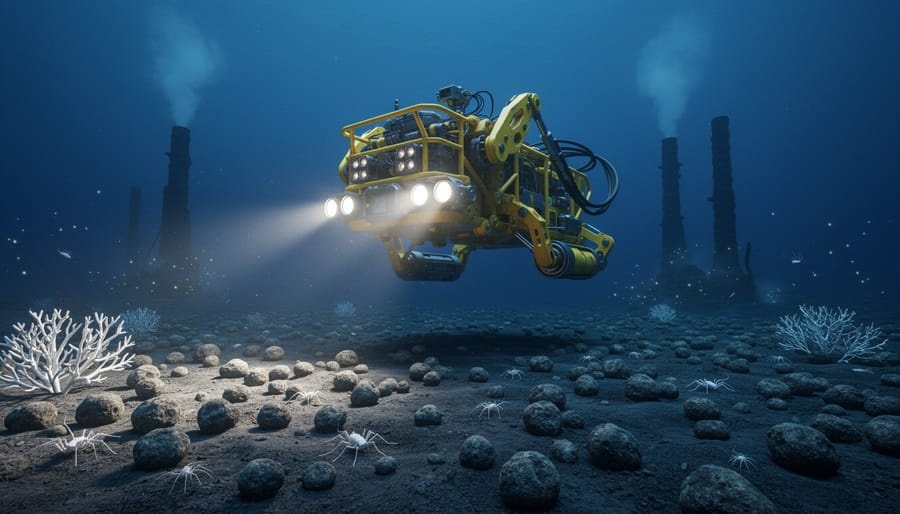
The ocean floor holds massive deposits of cobalt, nickel, and other metals essential for renewable energy technologies, yet extracting them could devastate ecosystems we barely understand. As nations and corporations eye the abyssal plains for deep-sea mining operations, a fierce debate has emerged between those who see untapped economic potential and scientists warning of irreversible environmental damage to the last frontier on Earth.
Deep-sea mining involves extracting mineral-rich nodules, crusts, and sulfide deposits from depths exceeding 200 meters, often in international waters where governance remains fragmented. Proponents argue these operations could supply critical materials for electric vehicles and solar panels while reducing dependence on terrestrial mining. Critics counter that industrial-scale disruption of seafloor habitats—including hydrothermal vent communities that took millions of years to form—threatens species found nowhere else on our planet, many still undiscovered by science.
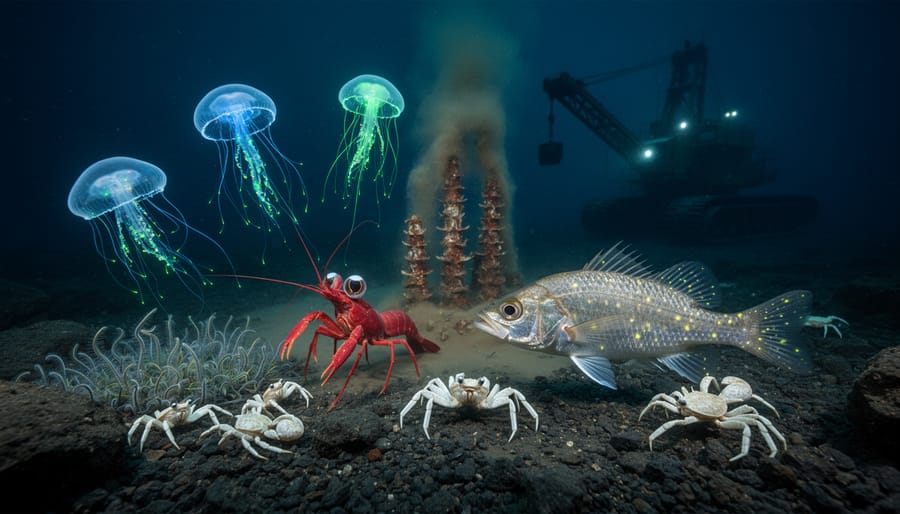
Understanding both perspectives requires examining how current legal frameworks shape mining outcomes. The International Seabed Authority, established under the UN Convention on the Law of the Sea, faces pressure to finalize mining regulations despite warnings from marine biologists that we lack sufficient baseline data to assess true environmental costs. Recent expeditions have revealed extraordinary biodiversity in proposed mining zones, from bioluminescent organisms to ancient coral forests, raising urgent questions about whether short-term mineral gains justify permanent ecosystem loss.
This tension between resource extraction and conservation defines one of the most consequential environmental decisions of our generation. The policies we establish now will determine whether the deep ocean remains a thriving biological treasure or becomes an industrial sacrifice zone, making informed engagement from scientists, policymakers, and citizens more crucial than ever.
What Deep-Sea Mining Actually Means for Ocean Ecosystems
The Resources at Stake
The ocean floor holds mineral treasures that took millions of years to form, and understanding these resources helps us appreciate what’s at stake. Deep-sea mining targets three primary types of mineral deposits, each with unique characteristics and formation stories.
Polymetallic nodules, often called manganese nodules, are potato-sized rocks scattered across vast abyssal plains at depths of 4,000 to 6,000 meters. These remarkable formations grow incredibly slowly, adding just millimeters every million years as metals like manganese, nickel, copper, and cobalt precipitate from seawater around a tiny nucleus such as a shark tooth or shell fragment. The Clarion-Clipperton Zone in the Pacific Ocean contains the world’s richest deposits, covering an area larger than the continental United States.
Hydrothermal vents, sometimes called “black smokers,” form where tectonic plates meet and seawater seeps into the Earth’s crust, becomes superheated, and erupts back through the seafloor. These dramatic geological features deposit minerals rich in copper, zinc, gold, and silver as the hot, mineral-laden water meets cold ocean water. Beyond their mineral value, these vents support extraordinary ecosystems with species found nowhere else on Earth.
Cobalt-rich crusts coat the slopes of underwater mountains called seamounts, forming layers up to 25 centimeters thick over millions of years. These crusts contain high concentrations of cobalt, nickel, and rare earth elements crucial for modern technologies.
The geological timescales involved in creating these resources stand in stark contrast to the speed at which we could extract them, raising fundamental questions about irreversible impacts.
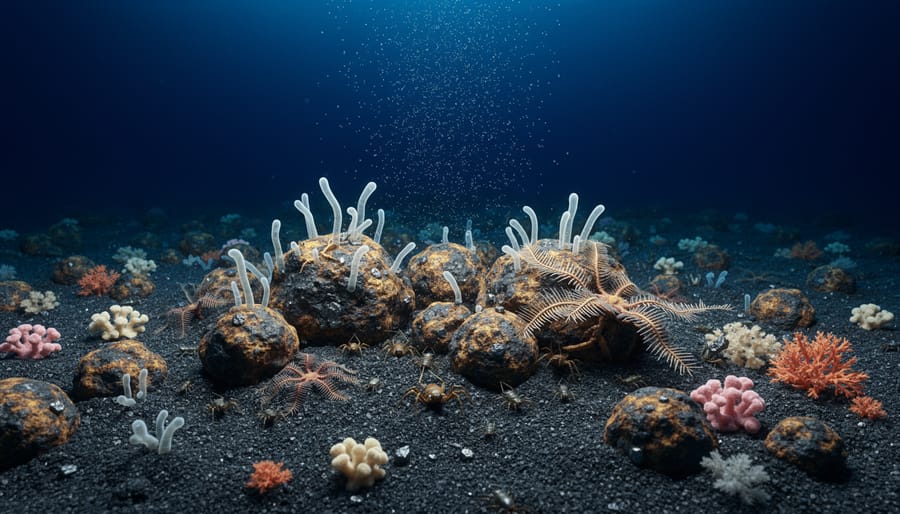
How Mining Operations Would Work
Deep-sea mining operations would involve deploying massive machines onto the ocean floor, typically at depths between 1,000 and 6,000 meters. The most common technique uses remotely operated vehicles equipped with collector systems that function similarly to giant vacuum cleaners. These machines would scrape, cut, or suction polymetallic nodules, cobalt crusts, and mineral deposits from the seafloor, breaking up the substrate in the process.
The collected material would be pumped through vertical riser pipes to surface vessels, where minerals are separated from sediment. The remaining sediment and seawater mixture would then be discharged back into the ocean, creating plumes of suspended particles that could drift for kilometers. A single mining operation might cover hundreds of square kilometers, with each pass leaving behind bare, compacted seafloor devoid of its original structure.
The physical footprint extends beyond the immediate mining site. Support vessels, equipment staging areas, and the sediment plumes themselves affect surrounding ecosystems. Once operations begin, recovery times for these deep-sea environments could span decades or even centuries, as the deep ocean’s extreme conditions mean biological processes occur at remarkably slow rates.
The Current State of Deep-Sea Mining Governance
The International Seabed Authority’s Role
The International Seabed Authority (ISA) stands as the primary governing body tasked with managing deep-sea mining activities in international waters. Established under the United Nations Convention on the Law of the Sea (UNCLOS), the ISA has a dual mandate that creates an inherent tension: it must both facilitate mineral resource exploitation and protect the marine environment. The Authority operates from its headquarters in Kingston, Jamaica, where member states gather to shape the future of our ocean floor.
Currently, the ISA is developing a comprehensive Mining Code to regulate commercial extraction activities. This regulatory framework includes environmental standards, inspection procedures, and liability provisions. However, many marine scientists and conservationists express concern that the rush to finalize these regulations may prioritize industry interests over adequate environmental protections. Dr. Maria Santos, a marine biologist who has participated in ISA stakeholder meetings, notes that “we’re essentially writing the rulebook while still discovering what lives in these ecosystems and how they function.”
The decision-making process involves 167 member states, but critics point out that developing nations, which often lack deep-sea research capacity, may support mining for potential revenue without fully understanding environmental consequences. This highlights the critical importance of international environmental agreements that prioritize precautionary approaches. As the ISA progresses toward enabling commercial mining, concerned citizens and scientists worldwide are calling for transparency, stronger environmental safeguards, and meaningful public participation in shaping these pivotal decisions.
National Jurisdiction vs. International Waters
The ocean’s legal landscape is divided into two distinct zones that determine who governs deep-sea mining activities. Within 200 nautical miles of a country’s coastline lies the Exclusive Economic Zone (EEZ), where that nation holds sovereign rights over resources, including seabed minerals. Countries can grant mining permits within their EEZs following their own environmental regulations and approval processes.
Beyond these zones stretches the high seas, also called “the Area,” which belongs to no single nation. Here, the International Seabed Authority (ISA), established under the United Nations Convention on the Law of the Sea, manages all mining activities. The ISA operates on the principle that deep-sea resources are the “common heritage of mankind,” meaning benefits should theoretically be shared globally.
This division creates significant governance challenges. While coastal nations can tailor regulations to their specific ecosystems, standards vary widely between countries. In international waters, the ISA faces the complex task of balancing economic interests from multiple nations with environmental protection for ecosystems that transcend political boundaries. Marine biologist Dr. Elena Rodriguez, who has advocated at ISA meetings, notes that effective conservation requires consistent standards across both zones, as ocean currents and marine species don’t recognize these human-drawn lines.
The Economic and Technological Arguments for Deep-Sea Mining
Meeting Green Technology Demands
Proponents of deep-sea mining argue that these underwater mineral deposits are essential for our transition to renewable energy. The ocean floor contains vast concentrations of cobalt, nickel, manganese, and rare earth elements that power lithium-ion batteries in electric vehicles and store energy from solar panels and wind turbines. As nations commit to reducing carbon emissions, demand for these minerals is projected to increase dramatically over the next three decades.
Industry advocates point out that a single polymetallic nodule field could yield enough battery metals to support millions of electric vehicles, potentially reducing our dependence on terrestrial mining operations that have devastated rainforests and communities. They suggest that deep-sea mining could provide a more concentrated, efficient source of these critical materials.
However, marine biologists caution that this framing oversimplifies complex choices. Dr. Elena Martinez, who has studied hydrothermal vent ecosystems for fifteen years, explains that we must consider whether destroying ancient seafloor habitats is truly our only path forward. Alternative solutions including improved battery recycling, developing new battery technologies that use more abundant materials, and reducing overall consumption deserve equal investment and consideration before we commit to extracting resources from one of Earth’s least understood environments.
Economic Development Potential
Proponents of deep-sea mining argue it could unlock significant economic opportunities, particularly for developing coastal nations. Companies and supporting governments claim these underwater mineral deposits, rich in cobalt, nickel, copper, and rare earth elements, represent untapped wealth that could generate substantial revenue through extraction licenses, taxation, and job creation. For island nations in the Pacific, where mining applications are concentrated, this industry promises an alternative income stream beyond traditional fisheries and tourism.
The technology sector especially emphasizes the need for these minerals to manufacture batteries, smartphones, and renewable energy infrastructure like wind turbines and solar panels. Advocates suggest deep-sea mining could reduce dependence on terrestrial mining operations, some of which involve problematic labor practices or deforestation, while positioning countries as key players in the global green technology supply chain.
However, marine conservationists urge caution about these economic projections. Past resource extraction ventures have often failed to deliver promised benefits to local communities, instead concentrating wealth among corporations and creating environmental liabilities. The actual job numbers may be limited, as deep-sea mining requires highly specialized equipment and technical expertise rather than substantial local labor forces. Without robust governance frameworks ensuring benefit-sharing, transparency, and environmental safeguards, developing nations risk trading irreplaceable marine ecosystems for uncertain economic gains that may never materialize as promised.
The Environmental Case Against Deep-Sea Mining
Biodiversity Loss in Unexplored Ecosystems
More than 80% of our ocean remains unexplored, with the deep sea representing Earth’s final frontier. Scientists estimate that up to 90% of deep-sea species remain undiscovered, making every mining expedition a potential catastrophe for biodiversity we don’t even know exists yet. These remote ecosystems, existing in complete darkness under crushing pressure, harbor organisms with remarkable adaptations that took millions of years to evolve.
Dr. Maria Santos, a deep-sea biologist who has spent fifteen years studying hydrothermal vents, shares a sobering reality: “Every time we send a submersible down, we discover new species. Then I think about how mining operations could destroy entire communities before we’ve documented them. It’s like burning a library before reading the books.”
Deep-sea creatures possess extraordinary characteristics that could revolutionize medicine and technology. Organisms near hydrothermal vents survive in extreme conditions, producing enzymes and compounds with potential applications in cancer treatment and industrial processes. The yeti crab, discovered only in 2005, farms bacteria on its claws for food, while certain deep-sea sponges can live for thousands of years.
The slow growth rates and limited ranges of many deep-sea species make them particularly vulnerable to extinction. Unlike terrestrial ecosystems that might recover within decades, deep-sea habitats could take centuries or millennia to regenerate, if they recover at all. Effective marine biodiversity protection requires understanding these ecosystems before we irreversibly damage them.
Sediment Plumes and Long-Term Habitat Destruction
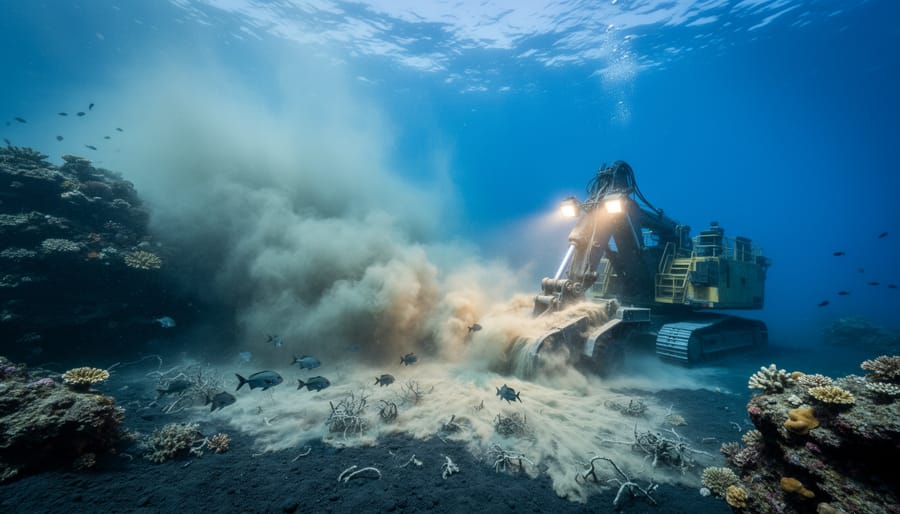
Deep-sea mining operations generate massive sediment plumes that behave like underwater dust storms, spreading far beyond the immediate extraction site. These clouds form when mining equipment disturbs the seafloor and when waste sediment gets discharged back into the water column. Recent studies show these plumes can travel hundreds of kilometers from mining sites, carried by deep ocean currents that flow slowly but persistently.
The impacts on marine life are particularly severe for filter feeders like sponges, corals, and sea cucumbers. These organisms strain food particles from water but cannot distinguish between nutrients and sediment. When plumes pass through their habitats, they become clogged with particles, essentially suffocating as they struggle to feed and breathe. Marine biologist Dr. Lisa Chen, who has studied these ecosystems for fifteen years, explains: “What we’re seeing is that even a thin layer of settled sediment can fundamentally alter these communities for decades or longer.”
The timeline for recovery remains uncertain, with some scientists projecting that deep-sea habitats may need fifty to one hundred years to recover, if recovery is even possible. Understanding these long-term consequences is essential for developing effective protective policies.
The Recovery Time Problem
Deep-sea ecosystems operate on vastly different timescales than those near the surface, making recovery from mining disturbances particularly concerning. Scientific studies reveal a sobering reality: these ancient habitats may require centuries to millennia for regeneration, assuming recovery is even possible.
Research from the Peru Basin, where simulated mining experiments were conducted in 1989, shows that even after 26 years, disturbed areas show minimal signs of recovery. The seafloor remains largely barren, with few organisms recolonizing the scarred sediments. Marine biologist Dr. Lisa Chen, who has studied these sites firsthand, shares: “Standing before these decades-old scars reminds me that we’re making decisions whose consequences will outlive multiple human generations.”
The extreme conditions of the deep sea contribute to this prolonged recovery timeline. Growth rates for deep-sea organisms are extraordinarily slow due to cold temperatures, high pressure, and limited food availability. Some species may take decades simply to reach maturity. Manganese nodules themselves form at rates of mere millimeters per million years.
Furthermore, scientists cannot predict whether disturbed ecosystems will return to their original state or transition into entirely different biological communities. This uncertainty represents an irreversible gamble with biodiversity we’re only beginning to understand, making the precautionary approach to deep-sea mining critically important for protecting these ancient ecosystems.
Critical Gaps in Current Governance Frameworks
Insufficient Environmental Baselines
One of the most significant challenges facing deep-sea mining regulation is our profound lack of knowledge about these remote ecosystems. Scientists estimate we’ve explored less than 20% of the ocean floor, leaving vast areas completely uncharted. This knowledge gap creates a troubling dilemma: how can we assess mining impacts when we don’t fully understand what exists in these environments?
Dr. Maria Santos, a marine biologist who has spent fifteen years studying abyssal plains, explains the problem clearly: “We’re essentially being asked to predict how surgery will affect a patient we’ve never examined. Without comprehensive baseline data on species diversity, population sizes, and ecosystem functions, we can’t accurately measure what mining destroys or how long recovery might take.”
The deep sea hosts incredibly slow-growing organisms, some living for centuries. Many species remain undiscovered and undescribed by science. When mining companies conduct environmental impact assessments, they’re working with incomplete information about biodiversity, nutrient cycles, and interconnected food webs. This means we risk losing species before we even know they exist, making truly informed decision-making nearly impossible. Establishing robust baseline studies before any mining begins isn’t just good science; it’s essential for responsible ocean stewardship.
Enforcement and Monitoring Challenges
The vastness of the deep ocean presents extraordinary enforcement challenges that could undermine even the most carefully crafted regulations. Picture trying to monitor an area larger than all Earth’s continents combined, at depths where sunlight never reaches and pressure would crush conventional equipment. This is the reality facing regulators attempting to oversee deep-sea mining operations.
Currently, no satellite system can penetrate ocean depths to track mining activities in real-time. Vessel monitoring systems help track surface ships, but they cannot verify what happens thousands of meters below. The International Seabed Authority, tasked with regulating mining in international waters, operates with limited resources and faces the challenge of inspecting operations across millions of square kilometers of ocean floor.
Dr. Maria Chen, a marine policy expert who previously worked in fisheries enforcement, shares a sobering perspective: “Even with modern technology, we struggle to prevent illegal fishing in international waters. Deep-sea mining adds layers of complexity we’ve never encountered.”
The cost of enforcement presents another barrier. Deep-sea monitoring requires specialized vessels, remotely operated vehicles, and trained personnel—investments many nations cannot afford. This creates concerning gaps where mining companies might operate with minimal oversight, particularly in remote regions far from national jurisdictions. Without adequate monitoring infrastructure and international cooperation, regulations risk becoming guidelines without teeth, leaving vulnerable ecosystems unprotected.
The Precautionary Principle Problem
The precautionary principle, which suggests that lack of scientific certainty shouldn’t prevent protective action when environmental harm is possible, remains inadequately applied to deep-sea mining governance. Current frameworks from the International Seabed Authority require environmental impact assessments, yet Dr. Elena Rodriguez, a marine biologist who has testified at ISA meetings, notes a troubling gap: “We’re being asked to approve activities in ecosystems we barely understand, with species we haven’t even discovered yet.” The burden of proof often falls on conservationists to demonstrate harm rather than on mining companies to prove safety. This reversal is particularly problematic given that recovering deep-sea ecosystems could take centuries or prove impossible. While some regulations acknowledge uncertainty, enforcement mechanisms remain weak, and economic pressures frequently override caution. For those concerned about these gaps, participating in public comment periods during ISA sessions offers a concrete way to advocate for stronger precautionary measures that truly protect our ocean’s least-known frontiers.
What Strong Governance Could Look Like
Protected Areas and No-Mining Zones
Growing international momentum supports establishing marine protected areas in deep-sea regions to safeguard unique ecosystems before mining begins. Scientists advocate for protecting representative samples of all major deep-sea habitat types, ensuring biodiversity preservation even if some areas are mined. The International Seabed Authority has discussed designating Areas of Particular Environmental Interest, though these zones remain under-defined and legally weak.
Conservation biologists emphasize that we should protect what we don’t yet understand. Dr. Elena Torres, a deep-sea ecologist, shares her perspective: “When I discovered three potentially new species in one seamount dive, I realized how much we’d lose if mining proceeded without adequate protection. We need comprehensive no-mining zones covering at least 30-40% of the seabed to maintain ecosystem resilience.”
Current proposals often protect only small buffer zones around mining sites, which scientists argue is insufficient. Effective protection requires large, connected networks of reserves that allow species migration and genetic exchange, ensuring deep-sea communities can survive and adapt to changing ocean conditions.
Robust Environmental Impact Assessment Requirements
Before any deep-sea mining permits are granted, comprehensive Environmental Impact Assessments (EIAs) must become the cornerstone of responsible decision-making. These assessments should evaluate baseline biodiversity in proposed mining areas, including microbial communities, invertebrates, and fish populations that scientists are only beginning to catalog. A thorough EIA needs to model sediment plume dispersal patterns, assess noise pollution impacts on marine mammals, and project ecosystem recovery timelines—which may span decades or centuries in these slow-growing habitats.
Independent scientific review is essential. Marine biologist Dr. Sarah Chen, who has participated in deep-sea expeditions, emphasizes that “industry-funded assessments alone cannot protect our oceans. We need peer-reviewed, publicly accessible studies conducted by researchers without financial ties to mining companies.” International protocols should mandate long-term monitoring programs extending at least twenty years beyond mining operations.
Transparency matters too. EIA findings must be publicly available in accessible language, allowing concerned citizens, educators, and conservation organizations to provide meaningful input. By demanding rigorous, independent assessments, we create accountability structures that prioritize ocean health over short-term economic gains. This precautionary approach acknowledges how much we still don’t understand about deep-sea ecosystems and their irreplaceable role in planetary health.
How You Can Influence Deep-Sea Mining Policy
Supporting Scientific Research and Public Awareness
The future of deep-sea ecosystems depends not only on policy decisions but also on robust scientific research and public engagement. The Marine Biodiversity Science Center offers numerous opportunities for individuals to contribute meaningfully to deep-sea conservation efforts. Through citizen science initiatives, volunteers can assist researchers in documenting marine species, analyzing seafloor imagery, and monitoring ocean health indicators from their own computers.
Educational programs connect students and educators with marine biologists who share firsthand experiences from research expeditions. Dr. Sarah Chen, who studies hydrothermal vent communities, recalls how volunteer data analysis helped her team identify previously unknown species assemblages: “Citizen scientists brought fresh perspectives that enriched our research and expanded what we could accomplish.”
Whether you’re an environmental scientist seeking collaboration opportunities, a student exploring marine careers, or simply someone passionate about ocean conservation, participating in these initiatives amplifies the collective voice advocating for responsible deep-sea stewardship. By supporting research that fills critical knowledge gaps about deep-sea ecosystems, we strengthen the scientific foundation needed to inform protective policies and challenge premature mining approvals. Every contribution, from data collection to raising awareness in your community, helps build the case for preserving these irreplaceable ecosystems.
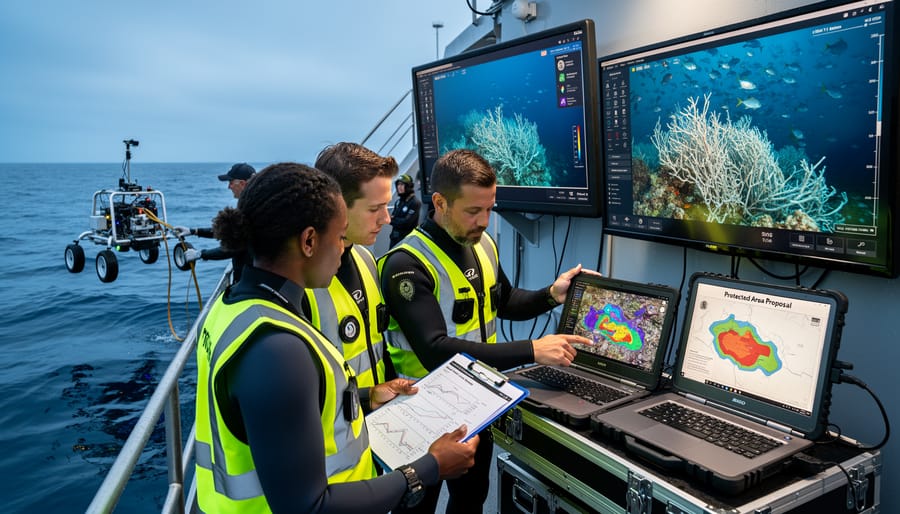
Engaging with Policy Processes
Your voice matters in shaping deep-sea mining policy. International bodies like the International Seabed Authority accept public comments during regulatory development periods. Review draft regulations, submit written testimonials drawing on scientific evidence, and encourage others to participate. These consultation windows represent critical opportunities to influence global ocean governance.
Supporting marine conservation organizations amplifies your impact. Groups working on deep-sea protection need volunteer researchers, communications support, and fundraising assistance. Dr. Elena Martinez, a marine policy specialist, recalls how citizen letters helped pause a mining license: “Two thousand personalized submissions from concerned individuals made regulators reconsider. Every voice counted.”
Learn effective advocacy strategies through workshops and webinars offered by conservation networks. Contact elected representatives with clear asks—support for mining moratoriums, increased research funding, or stronger environmental standards. Share credible information on social media to educate your networks.
Join campaigns calling for precautionary approaches until comprehensive environmental assessments are completed. Collective action has already influenced several nations to support mining pauses, demonstrating that informed, persistent advocacy creates meaningful policy change for ocean protection.
We stand at a critical juncture in ocean history. The deep sea, Earth’s largest and least understood ecosystem, faces unprecedented pressure from mining interests before we’ve even cataloged a fraction of its biodiversity. What makes this moment particularly urgent is the irreversible nature of deep-sea mining impacts. Unlike forests that can regenerate or coral reefs that might recover under ideal conditions, deep-sea ecosystems operate on geological timescales. Disturbance to these environments could persist for thousands, even millions of years.
But here’s the encouraging truth: we have a window of opportunity right now to get this right. The industry hasn’t fully scaled up yet, and governance frameworks are still being negotiated. This means your voice, whether you’re a student, scientist, educator, or concerned citizen, carries real weight in shaping policy outcomes.
Marine biologist Dr. Elena Vasquez reminds us that “every comment submitted during public consultation periods, every letter to representatives, every conversation that raises awareness contributes to building the political will for protective regulations.” Scientific advocacy has already delayed premature mining approvals and strengthened environmental standards.
The collective power of informed communities has protected oceans before, from establishing marine protected areas to banning harmful fishing practices. By staying engaged, supporting research institutions, and demanding precautionary policies, we can ensure that deep-sea ecosystems receive the protection their irreplaceability demands. The future of these extraordinary environments depends on decisions being made today, and you’re part of that decision-making process.

jessica
Ava Singh is an environmental writer and marine sustainability advocate with a deep commitment to protecting the world's oceans and coastal communities. With a background in environmental policy and a passion for storytelling, Ava brings complex topics to life through clear, engaging content that educates and empowers readers. At the Marine Biodiversity & Sustainability Learning Center, Ava focuses on sharing impactful stories about community engagement, policy innovations, and conservation strategies. Her writing bridges the gap between science and the public, encouraging people to take part in preserving marine biodiversity. When she’s not writing, Ava collaborates with local initiatives to promote eco-conscious living and sustainable development, ensuring her work makes a difference both on the page and in the real world.