Marine Biodiversity Science Center

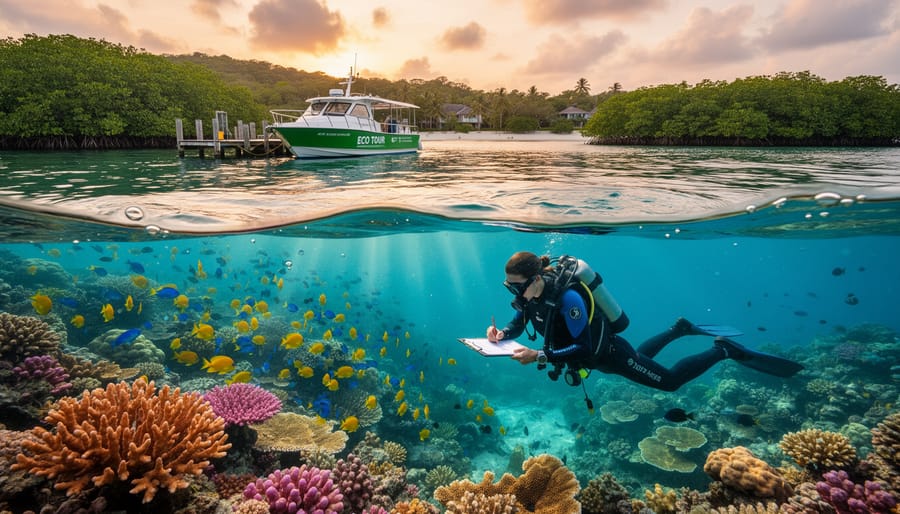
The world’s oceans face a $700 billion funding gap for achieving conservation targets by 2030, yet traditional philanthropy and government budgets can barely cover a fraction of this need. Conservation financing bridges this chasm by applying investment principles to environmental protection, transforming marine conservation from a cost center into an opportunity that generates both ecological and economic returns.
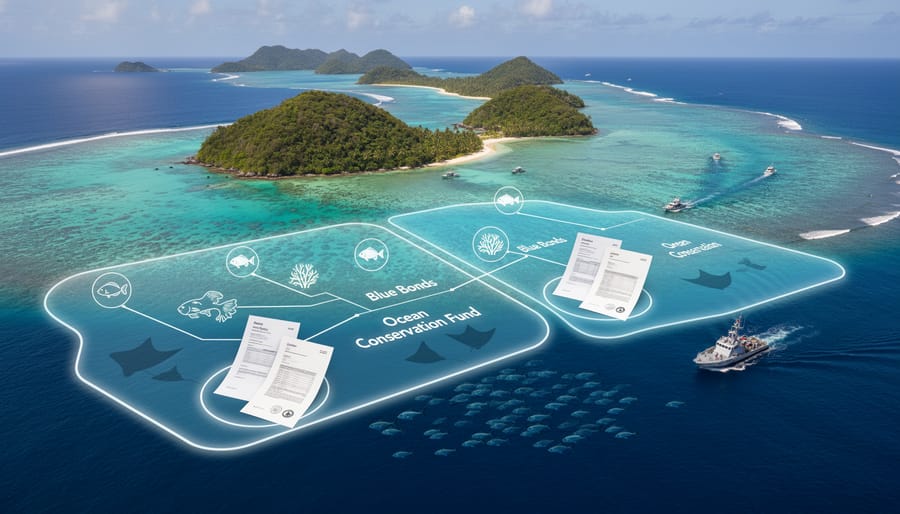
Unlike conventional grant-making that provides one-time donations, conservation financing creates sustainable revenue streams through innovative mechanisms. Blue bonds fund coral reef restoration while repaying investors through coastal tourism revenues. Debt-for-nature swaps allow nations to redirect loan payments toward marine protected areas. Impact investors purchase fishing rights to establish no-take zones, later profiting from recovered fish stocks in surrounding waters. These aren’t theoretical concepts—Seychelles restructured $21 million in national debt to protect 410,000 square kilometers of ocean, an area larger than Germany.
The approach works because healthy marine ecosystems provide measurable economic value. Mangrove forests prevent $65 billion in coastal flood damage annually. Sustainable fisheries support 260 million jobs worldwide. When conservation projects quantify these benefits, they attract private capital that demands financial returns alongside environmental impact.
Marine biologist Dr. Elena Torres spent fifteen years writing grant proposals before embracing conservation finance. “I watched a single blue bond accomplish more reef protection in two years than a decade of traditional funding,” she explains. “We’re not abandoning conservation values—we’re multiplying our capacity to act.”
This shift requires new skills and partnerships between scientists, financiers, communities, and policymakers. The learning curve is steep, but the potential to permanently fund ocean protection makes conservation financing essential for anyone serious about reversing marine decline.
The Funding Gap: Why Traditional Conservation Models Are Falling Short
The Real Cost of Protecting Our Oceans
Understanding the true financial scope of marine conservation can feel overwhelming, but breaking down the numbers reveals a clearer picture. Experts estimate that effectively protecting 30% of the world’s oceans by 2030 requires approximately $175 billion in total investment. To put this in perspective, that’s roughly what the world spends on bottled water every two years.
Conservation costs fall into several categories. Establishment costs cover the initial setup of marine protected areas, including scientific surveys, community consultations, and legal framework development. These typically range from $50,000 to $2 million per site, depending on size and complexity. Recurring costs, which include ongoing monitoring, enforcement, and management, often total $500 to $5,000 per square kilometer annually. These operational expenses, sometimes called baseline conservation funding, ensure protected areas function effectively rather than existing only on paper.
Marine biologist Dr. Sarah Chen, who helped establish a community-managed reserve in the Philippines, shares: “People often focus on the big numbers, but conservation happens in practical increments. Our 15-square-kilometer reserve operates on just $30,000 annually, supporting three rangers and monthly research dives.”
The funding gap, the difference between available resources and actual needs, currently sits at about $20 billion yearly for global ocean conservation. Closing this gap doesn’t require unrealistic commitments from individuals. Instead, innovative conservation financing mechanisms are mobilizing capital from diverse sources, transforming how we fund ocean protection while creating sustainable economic models that benefit both marine ecosystems and coastal communities.
Where Traditional Funding Falls Short
Traditional funding streams for marine conservation efforts face significant challenges that limit their effectiveness. Government budgets for ocean protection remain chronically underfunded, often representing less than 1% of national environmental spending in many countries. When economic downturns occur, conservation programs are typically among the first to face cuts.
Grant-based funding creates another obstacle: the boom-and-bust cycle. Dr. Sarah Chen, a marine biologist working on coral reef restoration in the Caribbean, shares her frustration: “We secured a three-year grant to establish artificial reefs, but when funding ended, we had to abandon monitoring just as the ecosystem was becoming established. Years of work risked being lost.”
Donor fatigue compounds these problems. Individual and corporate donors, while passionate about ocean health, cannot sustain long-term projects through periodic donations alone. Competition for limited philanthropic dollars means promising initiatives often go unfunded.
Perhaps most critically, traditional funding rarely generates revenue, creating dependency rather than sustainability. A marine protected area might receive startup grants but lacks mechanisms to fund ongoing management, enforcement, and research. This gap between short-term funding and long-term conservation needs demands innovative solutions.
What Is Conservation Financing? A New Paradigm for Ocean Protection
The Core Principles That Make It Work
Conservation financing operates on three interconnected principles that distinguish it from traditional grant-based funding. Understanding these core concepts helps demystify how innovative financial strategies are protecting our oceans for generations to come.
The first principle involves blending public and private capital. Rather than relying solely on government grants or philanthropic donations, conservation financing brings together diverse funding sources. Think of it as creating a financial recipe where government seed money, private investment, and philanthropic support combine to achieve greater impact than any single source could alone. This approach leverages the strengths of each sector: governments provide policy support and initial capital, private investors bring market discipline and additional resources, while nonprofits contribute expertise and community connections.
The second principle centers on creating revenue-generating mechanisms. Unlike traditional conservation funding that depletes over time, these mechanisms produce ongoing income streams. Examples include sustainable fisheries that generate profits while maintaining healthy fish populations, marine ecotourism fees that directly fund protected areas, or blue bonds where investors receive financial returns while supporting ocean health projects. Marine biologist Dr. Sarah Chen explains it simply: “We’re designing conservation projects that pay for themselves by creating economic value alongside environmental benefits.”
The third principle ensures long-term sustainability through clear financial structures and accountability measures. Conservation financing establishes measurable environmental outcomes, transparent reporting systems, and performance benchmarks. This creates confidence among all stakeholders that investments will deliver both ecological and financial returns, making ocean protection economically viable far into the future.
Why This Approach Matters for Marine Ecosystems
Marine ecosystems face unprecedented threats from climate change, overfishing, pollution, and habitat destruction, making traditional funding approaches insufficient for the scale of protection needed. Conservation financing bridges this critical gap by bringing sustainable, long-term funding streams to marine biodiversity protection. Unlike conventional grant-based models that create year-to-year uncertainty, these innovative mechanisms generate consistent revenue that supports proven conservation strategies for endangered species like sea turtles, coral reefs, and marine mammals. Marine biologist Dr. Sarah Chen explains that conservation financing allows her team to implement multi-year recovery programs rather than rushing through short-term projects. By aligning economic incentives with ecological outcomes, these approaches transform how we protect our oceans, creating partnerships between governments, communities, and private sectors that ensure marine ecosystems receive the ongoing support they desperately need to thrive.
Innovative Financing Mechanisms That Are Working Right Now
Blue Bonds: Borrowing for Ocean Health
Imagine a financial tool that transforms debt into ocean protection. That’s exactly what blue bonds accomplish. These innovative debt instruments raise capital specifically for projects supporting healthy oceans, sustainable fisheries, and marine economies. Like green bonds for environmental projects, blue bonds attract investors who want market-rate returns while funding measurable conservation outcomes.
Here’s how they work: governments or organizations issue bonds to investors, promising repayment with interest. The crucial difference? Bond proceeds must finance verified ocean-related projects, from establishing marine protected areas to developing sustainable aquaculture or reducing plastic pollution.
The Seychelles blazed the trail in 2018, issuing the world’s first sovereign blue bond. This groundbreaking $15 million bond, supported by the World Bank and Global Environment Facility, expanded marine protected areas to cover 30% of Seychelles’ waters while improving fisheries management. The success demonstrated that ocean conservation could attract mainstream investors.
Marine biologist Dr. Angelique Pouponneau, who worked on the Seychelles initiative, recalls the excitement: “We proved that protecting our ocean wasn’t just environmentally essential but financially viable. Local fishing communities gained sustainable livelihoods while critical ecosystems received protection.”
Since then, countries including Belize and Barbados have launched similar programs, creating a blueprint for nations worldwide to fund ocean health through capital markets.
Debt-for-Nature Swaps: Turning Financial Burden Into Conservation Victory
Imagine a country burdened by crushing debt, forced to choose between economic survival and protecting its precious coral reefs. Debt-for-nature swaps offer a remarkable solution, converting financial obligations into conservation commitments. Here’s how it works: international creditors agree to reduce or forgive a portion of a nation’s debt in exchange for that country investing in environmental protection within its borders.
The Seychelles pioneered this approach for marine conservation in 2016, restructuring $21.6 million in debt to establish two massive marine protected areas covering 410,000 square kilometers. This innovative financing mechanism didn’t just relieve financial pressure; it safeguarded critical habitats for sea turtles, whale sharks, and countless reef species while supporting sustainable fishing practices for local communities.
Belize followed suit in 2021 with the world’s largest marine debt conversion, protecting 30 percent of its ocean territory. Marine biologist Dr. Janet Gibson, who worked on the Belize Blue Bond project, shares: “Watching governments prioritize ocean health through creative financing showed me that economic constraints don’t have to mean environmental sacrifice. We’re proving that protecting nature can align with fiscal responsibility.”
These swaps create dedicated conservation trust funds, ensuring long-term financing for marine protection even as political priorities shift. They transform what seemed like an impossible choice into a conservation victory that benefits both people and planet.

Marine Protected Area Trust Funds: Building Financial Fortresses
Endowment funds represent a powerful financial fortress for marine protected areas, creating sustainable funding streams that can last generations. These trust funds work like financial guardians: donors contribute a large initial investment, which is then carefully managed so that only the interest earnings fund conservation activities, leaving the principal untouched to generate perpetual income.
The Great Barrier Reef Foundation’s Reef Trust Partnership exemplifies this approach brilliantly, managing substantial endowments that ensure consistent funding for coral restoration and monitoring programs regardless of annual budget fluctuations. Similarly, the Caribbean Biodiversity Fund pools resources from multiple countries, generating reliable income that supports protected area management across the region.
Marine biologist Dr. Elena Rodriguez, who works with these trust funds, shares: “Watching our team plan five-year research programs without worrying about funding gaps has transformed our conservation impact. We can finally think long-term.”
These financial fortresses provide stability that traditional grant-based funding simply cannot match, allowing conservation teams to hire permanent staff, invest in infrastructure, and build community programs that strengthen over time rather than starting and stopping with funding cycles.
Payment for Ecosystem Services: When Nature Pays for Itself
Marine ecosystems provide invaluable services that keep our planet healthy, from coastal protection to carbon sequestration. Payment for Ecosystem Services (PES) programs recognize these contributions by creating financial incentives for conservation. Instead of viewing nature as a free resource, PES assigns economic value to what oceans naturally provide, transforming conservation from a cost into a revenue-generating investment.
Blue carbon credits represent one of the most promising PES mechanisms. Coastal ecosystems like mangroves, seagrass beds, and salt marshes capture and store carbon dioxide up to ten times more efficiently than terrestrial forests. Through blue carbon markets, organizations can sell verified carbon credits to companies seeking to offset their emissions. A mangrove restoration project in Madagascar, for example, generated revenue by protecting over 2,000 hectares while simultaneously creating employment for local communities who now earn income as forest guardians.
Fisheries management fees offer another pathway. When fishing licenses and access fees are tied directly to sustainable practices and ecosystem health, they create accountability. The revenue funds monitoring programs, research, and enforcement, ensuring fish populations remain robust for future generations.
Dr. Maria Santos, a marine economist working on Caribbean reef protection, shares her perspective: “When communities see direct financial benefits from healthy reefs through dive tourism fees and sustainable fishing permits, conservation becomes economically logical, not just environmentally necessary.”
These approaches demonstrate that protecting marine ecosystems doesn’t require charity alone. Nature can indeed pay for its own preservation when we acknowledge its true value.
The Players: Who Makes Conservation Financing Happen
Governments and International Bodies Leading the Charge
Major international institutions and national governments serve as critical architects of conservation financing, bringing together resources, expertise, and credibility to transform innovative ideas into actionable deals. The World Bank has emerged as a pioneer, channeling billions toward marine and coastal conservation projects while helping developing nations structure complex financing arrangements. Through initiatives like its PROBLUE fund, the Bank provides technical assistance to countries designing blue bonds and debt-for-nature swaps.
The Global Environment Facility acts as a crucial funding mechanism, having invested over $1 billion in ocean projects since its inception. This partnership of 186 countries works alongside organizations to de-risk conservation investments, making them attractive to private investors who might otherwise hesitate.
National governments play equally vital roles. Seychelles created history by issuing the world’s first sovereign blue bond in 2018, raising $15 million for marine protected areas and sustainable fisheries. Belize restructured $553 million in debt through a conservation agreement in 2021, freeing funds for coastal protection while expanding ocean sanctuaries.
These governmental leaders don’t just provide capital—they establish the legal frameworks, policy incentives, and international cooperation that allow conservation financing to flourish. Their involvement signals legitimacy, attracting additional partners and demonstrating that protecting our oceans makes economic and environmental sense.
Private Sector Partners: When Business Meets Conservation
The private sector is increasingly recognizing that healthy oceans mean healthy economies. Impact investors are channeling capital into ventures that generate both financial returns and measurable conservation outcomes, such as sustainable aquaculture operations that restore coastal habitats while producing seafood. Major banks now offer conservation credit facilities, providing low-interest loans to projects that protect marine ecosystems. For example, The Nature Conservancy partnered with Credit Suisse to develop the world’s first blue bonds for ocean conservation in the Seychelles, refinancing national debt in exchange for marine protection commitments.
Corporations are also stepping up, bringing not just funding but technical expertise. Technology companies provide satellite monitoring systems to track illegal fishing, while shipping firms invest in whale-safe navigation routes. Marine biologist Dr. Sarah Chen recalls working with a Fortune 500 company whose supply chain depended on healthy reefs: “They didn’t just write a check—they embedded sustainability experts within our team, transforming how we approached restoration.” This collaboration between business acumen and scientific knowledge creates innovative solutions that neither sector could achieve alone, proving that conservation and commerce can thrive together.
Conservation Organizations and Scientific Institutions
Scientific institutions and conservation organizations play a vital role in bridging the gap between research and action in marine conservation financing. Groups like the Marine Biodiversity Science Center use cutting-edge research to identify where funding will have the greatest impact, ensuring every dollar invested creates measurable ecological outcomes. By conducting baseline assessments and long-term monitoring, these institutions provide the data investors need to make informed decisions about blue bonds, reef insurance programs, and habitat restoration projects.
Dr. Sarah Chen, a marine biologist with fifteen years of field experience, explains: “Our research doesn’t just sit in journals. We use it to design projects that attract diverse funding sources, from government grants to private impact investments.”
Many organizations welcome volunteers to assist with data collection, habitat surveys, and community outreach efforts. These opportunities allow passionate individuals to contribute directly to conservation science while gaining hands-on experience that shapes future financing strategies.
Success Stories: Conservation Financing in Action
How One Island Nation Protected 30% of Its Ocean
In 2020, the Pacific island nation of Niue made headlines by protecting nearly a third of its ocean territory through an innovative blue bond financing mechanism. This small country, with a population of just 1,600 people, partnered with conservation organizations and impact investors to raise $18 million through the world’s first sovereign blue bond for ocean conservation.
The funds enabled Niue to establish a massive marine protected area spanning 127,000 square kilometers, creating vital habitat for endangered species including humpback whales, hawksbill turtles, and numerous shark species. Within just two years, marine biologist Dr. Kalisi Manu reported a 40% increase in reef fish populations within the protected zones.
“What struck me most was watching local fishers become ocean guardians,” Dr. Manu shares. “They went from skeptics to champions when they saw fish populations rebounding in adjacent fishing areas. One fisher told me he caught more in a morning than he previously did in a week.”
The blue bond structure allowed Niue to refinance existing debt at lower interest rates while directing savings toward marine conservation. This created a sustainable funding stream for ongoing patrol operations, scientific monitoring, and community education programs. Volunteer opportunities now exist for citizen scientists to participate in reef surveys alongside local conservation teams, strengthening community connections to ocean protection while gathering crucial biodiversity data that informs adaptive management strategies.
Coral Reef Restoration Financed for the Long Haul
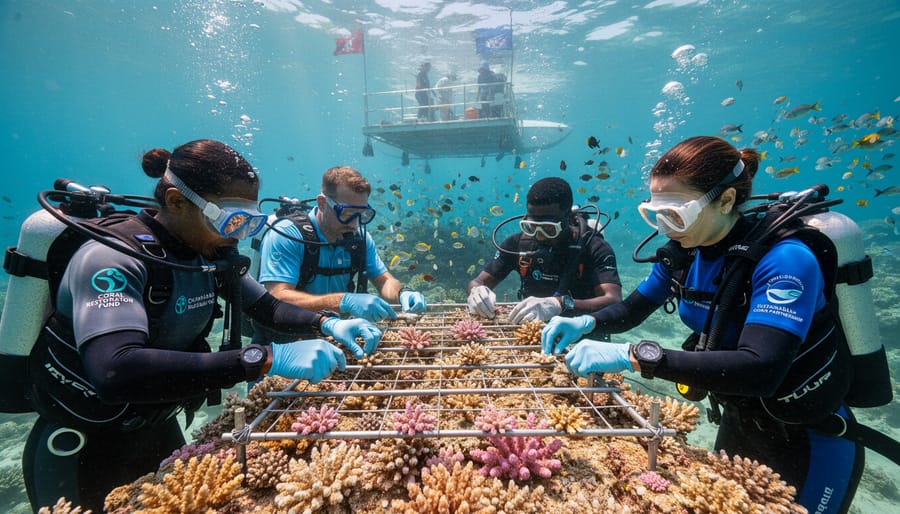
The Mesoamerican Reef, stretching across four countries and supporting over a million people, faced a crisis. Warming waters, pollution, and physical damage from storms were degrading this vital ecosystem faster than traditional grant cycles could address. Enter a groundbreaking $625,000 insurance policy—the first-ever parametric insurance for a coral reef.
This innovative financing mechanism operates differently from conventional conservation funding. When Hurricane Delta struck in 2020, the policy automatically triggered a payout within weeks, releasing funds immediately for emergency reef restoration. Local dive operators and trained volunteers mobilized quickly, removing debris and stabilizing coral fragments before further damage occurred.
Marine biologist Rosa Martínez, who coordinated the restoration efforts, recalls the difference: “In previous storms, we waited months for funding approval while broken corals died. This time, we were in the water within days, saving colonies that would have been lost forever.”
The insurance model demonstrates how conservation financing creates resilient funding streams. Annual premiums, paid through a combination of tourism fees and philanthropic contributions, ensure rapid response capability. Since implementation, the program has protected over 160,000 square meters of reef, safeguarding biodiversity and the coastal communities depending on healthy reefs for fishing and tourism income. This sustainable approach proves that investing in nature’s infrastructure pays dividends for both ecosystems and economies.
How You Can Be Part of the Solution
Supporting Organizations That Use Innovative Financing
Finding organizations that embrace innovative financing models starts with research into their funding transparency and long-term sustainability strategies. Look for groups that publish annual reports detailing diverse revenue streams beyond traditional grants, including blue bonds, conservation trust funds, or payment for ecosystem services programs.
The Marine Biodiversity Science Center exemplifies this approach through partnerships that blend scientific research with sustainable funding mechanisms. Our programs demonstrate how community-led conservation can attract impact investors while maintaining ecological integrity. Volunteer opportunities at our field stations allow participants to witness firsthand how innovative financing supports ongoing research and habitat restoration.
When evaluating organizations, ask specific questions: How do they measure conservation outcomes? What percentage of funding supports long-term projects versus short-term initiatives? Do they engage local communities in both conservation and economic benefits?
Supporting these forward-thinking organizations, whether through donations, volunteering, or spreading awareness, strengthens the entire conservation financing ecosystem and demonstrates public demand for sustainable solutions.
Advocating for Policy Changes
Supporting conservation financing doesn’t require taking political sides—it’s about championing practical solutions that benefit our oceans and communities alike. You can make a meaningful difference by engaging with decision-makers at multiple levels. Contact your local representatives to express support for marine protected area funding, sustainable fisheries management, and blue bond initiatives. Many conservation organizations provide simple templates and talking points that make this process accessible, even if you’ve never advocated before.
Consider sharing your knowledge within your community. Dr. James Chen, a marine biologist who regularly speaks at town halls, notes that “when people understand how conservation financing creates jobs while protecting ecosystems, support naturally follows.” Attend public meetings about coastal development or fisheries policy, where your informed voice can highlight the economic and environmental benefits of conservation investments.
Stay informed about upcoming legislation related to ocean conservation and climate adaptation funding. Subscribe to updates from non-partisan conservation groups that track relevant policies. Remember, advocating for science-based, economically sound conservation measures transcends traditional political divisions—healthy oceans benefit everyone, from fishing communities to tourism operators to future generations who deserve thriving marine ecosystems.
Spreading Awareness and Joining the Conversation
Conservation financing isn’t just for policy makers and large organizations—everyone can play a role in supporting these vital initiatives. Start by educating yourself about marine conservation funding mechanisms and sharing this knowledge with your networks. Social media platforms offer powerful opportunities to amplify conservation messages and success stories, helping build momentum for ocean protection.
Consider joining specialized communities dedicated to marine conservation, such as the Marine Biodiversity Science and Conservation e-network, where scientists, educators, and passionate individuals exchange ideas and collaborate on projects. These platforms connect you with like-minded people and provide access to the latest research and volunteer opportunities.
Your voice matters. Whether you’re a student exploring career paths, an educator inspiring the next generation, or simply someone who cares about our oceans, engaging in conversations about conservation financing helps normalize innovative funding solutions and demonstrates public support for marine protection efforts.
The emergence of conservation financing marks a transformative moment in our relationship with the ocean. For too long, marine conservation operated on the margins of economic systems, relying primarily on grants and donations that couldn’t match the scale of threats facing our seas. Today, we’re witnessing a fundamental paradigm shift—one where protecting marine biodiversity aligns with economic incentives, investment opportunities, and sustainable development goals.
This shift isn’t merely theoretical. From blue bonds funding coral reef restoration to debt-for-nature swaps that redirect national budgets toward marine protected areas, we’re seeing tangible results. When the Seychelles restructured $21 million of its national debt to expand ocean protection to 30% of its waters, it demonstrated that ambitious conservation goals are financially achievable. These mechanisms prove that we don’t have to choose between economic stability and environmental stewardship—we can advance both simultaneously.
What makes this moment particularly hopeful is the diversity of players now engaged in ocean conservation. Investment firms, philanthropists, local fishing communities, and marine biologists are collaborating in unprecedented ways, each bringing unique perspectives and resources. This collective approach multiplies our impact exponentially.
The financial tools exist. The success stories are real. What we need now is sustained commitment and continued innovation. Whether you’re a marine scientist contributing research that informs investment decisions, a student exploring career paths in conservation finance, or simply someone who cares deeply about the ocean’s future, your engagement matters. Every action—from supporting conservation projects to spreading awareness about sustainable financing—contributes to building the momentum we need.
The ocean has sustained humanity for millennia. Now, through conservation financing, we finally have the means to sustain it in return. The future of marine biodiversity isn’t just possible—it’s within our grasp.

jessica
Ava Singh is an environmental writer and marine sustainability advocate with a deep commitment to protecting the world's oceans and coastal communities. With a background in environmental policy and a passion for storytelling, Ava brings complex topics to life through clear, engaging content that educates and empowers readers. At the Marine Biodiversity & Sustainability Learning Center, Ava focuses on sharing impactful stories about community engagement, policy innovations, and conservation strategies. Her writing bridges the gap between science and the public, encouraging people to take part in preserving marine biodiversity. When she’s not writing, Ava collaborates with local initiatives to promote eco-conscious living and sustainable development, ensuring her work makes a difference both on the page and in the real world.