Marine Biodiversity Science Center

The ocean and carbon cycle is the continuous movement of carbon between seawater, marine life, the atmosphere, and the seafloor. Carbon dioxide dissolves into surface waters, tiny organisms turn it into living tissue, and some of that carbon sinks into the deep, where it can stay locked away for centuries or longer. The ocean holds roughly fifty times more carbon than the atmosphere, which makes it the planet’s largest active carbon reservoir and a major steadying force on our climate.
Why does this matter to you? Because every breath of the climate system passes through this cycle. The ocean has absorbed around a quarter of the carbon dioxide people have released since the industrial era, slowing atmospheric warming but also changing seawater chemistry along the way. Understanding how carbon enters the sea, where it travels, and how long it stays is the foundation for understanding both climate and marine life.
This article walks through the cycle in plain language. You’ll see the three main engines that move carbon, the solubility pump, the biological pump, and the microbial loop. You’ll meet the major carbon pools, including dissolved organic carbon, a vast and often overlooked reservoir that scientists are watching closely as the climate shifts. We’ll also look at how this knowledge is applied in practice, and how you can take part, from citizen science to volunteer work on coastlines.
Marine biologists often describe the first time they watch this cycle at work, a plankton bloom turning green water cloudy and then fading as its carbon drifts downward. It’s a quiet process, and it’s one reason healthy oceans matter so much to all of us.
What the Ocean Carbon Cycle Means
The ocean carbon cycle is the constant exchange of carbon between the atmosphere, the sea surface, the deep ocean, living organisms, and seafloor sediments. Carbon never sits still here. It dissolves, gets eaten, sinks, gets recycled, and sometimes stays locked away for centuries.
The ocean is often called Earth’s largest active carbon reservoir because it holds roughly fifty times more carbon than the atmosphere, and it keeps trading that carbon with the air above it. Land plants and soils matter enormously, but the sea is both bigger and more dynamic.
Carbon shows up in the water in several forms:
– Dissolved gas: carbon dioxide that slips into surface water from the air.
– Living tissue: the bodies of plankton, fish, whales, and everything in between.
– Shells and skeletons: calcium carbonate built by corals, snails, and tiny plankton.
– Dissolved organic matter: a invisible soup of molecules released by living and decaying organisms.
Here is a short glossary to keep these straight:
- Dissolved inorganic carbon
- Carbon dissolved in seawater as carbon dioxide, bicarbonate, and carbonate. It is the ocean’s largest carbon pool.
- Dissolved organic carbon (DOC)
- Carbon in organic molecules small enough to pass through a fine filter, released by plankton, microbes, and decaying matter.
- Particulate organic carbon
- Carbon in solid bits of living or dead material, such as plankton cells and sinking debris.
- Biological pump
- The process by which marine life moves carbon from surface waters to the deep ocean.
- Solubility pump
- The physical process by which cold, dense water absorbs carbon dioxide and carries it downward.
- Microbial loop
- The web of bacteria and tiny grazers that consume and recycle dissolved organic carbon, passing it back into the food web.
This cycle is also the foundation of marine biodiversity. Every food web starts with carbon captured by phytoplankton, so the way carbon moves through the water shapes how much food is available to everything from krill to seabirds.
How the Ocean Moves and Stores Carbon
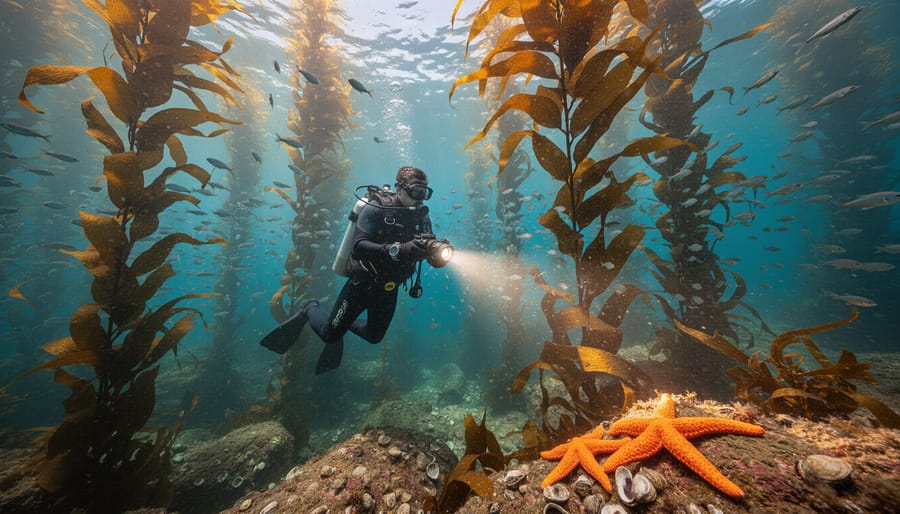
Gas Exchange and the Solubility Pump
Every day, the sea surface quietly trades gases with the air above it. When atmospheric carbon dioxide meets seawater, some of it dissolves, much like fizz staying in a cold bottle of soda. Cold water holds more dissolved gas than warm water, so the polar regions are especially good at drawing carbon dioxide in.
This is where the solubility pump begins. In places like the North Atlantic and around Antarctica, surface water chills, becomes saltier as sea ice forms, and grows dense enough to sink. As it descends, it carries its load of dissolved carbon down with it, away from the atmosphere and into the deep ocean.
Once at depth, that carbon is on a very long journey. The sinking water joins a vast, slow conveyor of ocean currents that stretches across every basin. Deep water can travel for hundreds of years before rising again in far-off regions, where it warms, releases some carbon dioxide back to the air, and starts the cycle anew.
Chemistry adds a twist. Much of the dissolved carbon dioxide reacts with seawater to form bicarbonate and carbonate ions, which lets the ocean hold far more carbon than simple dissolving would allow. That same reaction is also why added carbon dioxide makes seawater more acidic, a thread we will return to later.
The Biological Pump: Life as a Carbon Engine
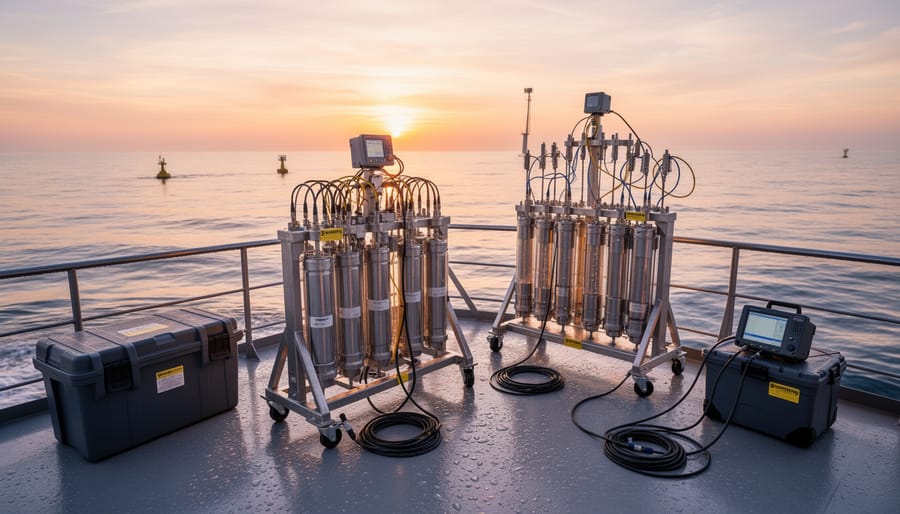
Every sunlit patch of ocean is quietly pulling carbon out of the air. Phytoplankton, the microscopic drifting plants of the sea, use photosynthesis to turn dissolved carbon dioxide into living matter. They are tiny, but together they fix roughly as much carbon each year as all the forests on land.
From there, the carbon moves up the food chain. Zooplankton graze on phytoplankton, small fish eat the zooplankton, and larger predators follow. At every step, some carbon is breathed back out as carbon dioxide, and some is packaged into waste.
Here’s where the pump earns its name. Zooplankton produce dense fecal pellets that can sink hundreds of meters in a matter of days. Dead cells clump into “marine snow,” a slow drizzle of particles falling through the dark. Even whale carcasses and fish remains drop to the seafloor, carrying their carbon with them. Once that material reaches deep water, the carbon can stay out of contact with the atmosphere for centuries.
Marine biologists who study this process often describe the moment it clicks. One researcher, recalling her first research cruise, spoke of hauling a net at dawn and finding a jar of seawater that looked clear but, under the microscope, teemed with glittering diatoms. “I realized I was looking at the engine,” she said. “Everything else in the ocean runs on what these cells do.”
Most of the carbon captured at the surface never makes it to the bottom, because hungry microbes and animals recycle it on the way down. Only a small fraction is exported for the long term, yet that sliver matters enormously for the global carbon balance.
The Microbial Loop and Dissolved Organic Carbon
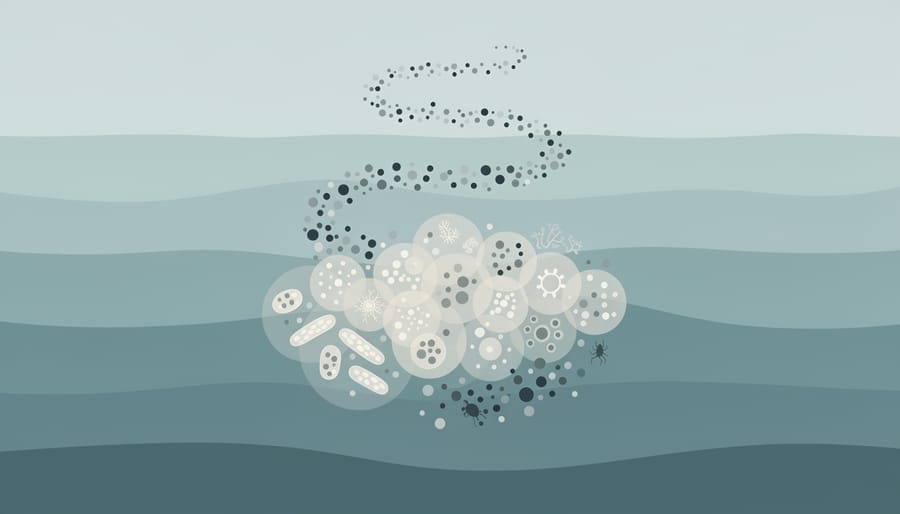
Dissolved organic carbon, or DOC, is the carbon-rich material that slips through a fine filter and stays suspended in seawater. It comes from phytoplankton leaking sugars and amino acids, from messy feeding by zooplankton, and from viruses that burst microbial cells open. Once it’s in the water, bacteria and archaea go to work.
This is the microbial loop. Microbes take up the DOC, breathe much of it back into carbon dioxide, and turn some into new biomass. Grazers eat those microbes, and the carbon moves up the food web again. Very little goes to waste.
Not all DOC is equal, though. The simplest molecules, like fresh sugars, can vanish within hours or days. Other compounds are harder to digest, and some are so chemically complex or so dilute that microbes can’t use them efficiently. These forms can drift through the ocean for thousands of years.
That persistent pool holds roughly as much carbon as the carbon dioxide in our atmosphere, which is why it matters so much. A small shift in how fast microbes consume it, or how much stays unused, can change how much carbon the sea holds over long timescales. Tiny organisms, working quietly, help set the balance for the whole planet.
The Main Carbon Reservoirs in the Sea
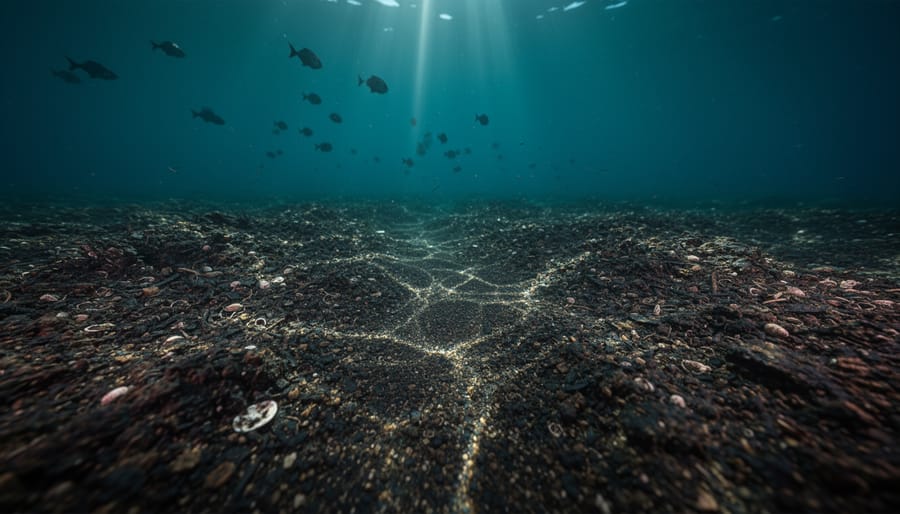
When people picture ocean carbon, they often imagine only dissolved carbon dioxide. In reality, the sea holds carbon in several very different forms, and the amounts vary enormously from one pool to the next. Seeing these pools side by side makes it easier to understand where dissolved organic carbon (DOC) sits in the bigger picture.
Here are the major reservoirs:
- Dissolved inorganic carbon: carbon dioxide, bicarbonate, and carbonate dissolved in seawater, by far the largest pool in the ocean.
- Dissolved organic carbon: carbon in tiny molecules from living and decaying organisms that pass through a fine filter, making it a huge but often overlooked reserve.
- Particulate organic carbon: bits of dead plankton, fecal pellets, and debris that are large enough to be caught on a filter and often sink toward the deep.
- Living biomass: the carbon stored in the bodies of plankton, fish, whales, corals, and every other marine organism.
- Seafloor sediments: carbon buried in mud and shell material, where it can stay locked away for thousands to millions of years.
Dissolved inorganic carbon dwarfs the others in sheer size. Even so, DOC is remarkable. Scientists estimate it holds roughly as much carbon as all the carbon dioxide in Earth’s atmosphere. That is a striking amount packed into a form most of us never see, and it means small changes in how DOC is made or consumed could matter at a global scale.
Living biomass is tiny by comparison, yet it drives the whole system. Plankton turn dissolved carbon into living matter, and that matter feeds the particulate and dissolved pools. Coastal habitats such as mangroves, seagrass meadows, and salt marshes also store carbon in plants and sediments, a process often called blue carbon. Together, these reservoirs form one connected web rather than separate boxes.
How Climate Change Is Reshaping Ocean DOC Dynamics
Warmer Waters and Hungrier Microbes
Microbes work faster when it’s warmer. Like most living things, marine bacteria have a temperature sweet spot, and across much of the ocean, a few extra degrees can speed up their metabolism. That means the bacteria that feed on dissolved organic carbon (DOC) may consume it more quickly than they once did.
The catch is that not all DOC is equally tasty. Simple sugars and amino acids vanish within hours or days. Tougher, more complex molecules resist breakdown and can linger for millennia. Warmer water may let microbes chew through some of that more stubborn material, or shift which compounds are left over.
Scientists don’t yet agree on how large this effect is. Some lab studies suggest warming trims the long-lived pool, while field observations show a more mixed picture. Microbes may also adapt over time. It’s a live question, and that honest uncertainty is exactly why long-term ocean monitoring matters.
Changing Plankton, Changing Carbon
Phytoplankton are the source of most marine DOC, so when the community changes, the carbon they release changes too. Small cells such as picoplankton tend to leak more dissolved organic matter than large diatoms, which often sink as whole particles. If warming and stratification favor smaller species in some regions, a larger share of fixed carbon could stay in the dissolved pool rather than sinking.
Chemistry matters as well. As ocean acidification lowers seawater pH, some experiments show phytoplankton releasing more DOC, though results vary widely between species and conditions. Nutrient supply adds another layer. When nitrogen or phosphorus is scarce, cells often release extra carbon-rich compounds that microbes find harder to digest.
Scientists don’t yet know how these effects add up across the open ocean, which is why long-term monitoring is so valuable.
Open Questions Scientists Are Working On
Scientists still have plenty to figure out about dissolved organic carbon. We don’t yet know how much of the ocean’s long-lived DOC can be consumed by microbes as waters warm, or whether new plankton communities will release the same kinds of compounds as the old ones. Measuring DOC is also painstaking, and ship-based sampling leaves large gaps, especially in remote regions and during winter months.
Long-term monitoring programs, autonomous floats, and satellite observations are slowly filling those gaps. Still, more eyes and more data points would help, which is where coastal communities and volunteers can make a real difference.
How Understanding Ocean Carbon Is Put to Use
Knowing how carbon moves through the sea isn’t just academic. It shapes decisions made every day, from global climate projections to the design of a local marine reserve.
Climate modelers use what we’ve learned about the solubility and biological pumps, and about dissolved organic carbon, to estimate how much carbon dioxide the ocean can keep absorbing. Better data on how microbes process DOC makes those projections more reliable, which helps governments plan with fewer blind spots.
Fisheries and ecosystem managers lean on the same science. Because plankton form the base of the food web, changes in their abundance ripple upward to the fish we catch. Tracking carbon flow helps managers spot stress in a food web early and set catch limits that keep populations healthy.
Marine protected area design benefits too. Habitats like kelp forests, seagrass meadows, and productive coastal waters play a real role in carbon storage so protecting them supports both wildlife and the climate. Planners can weigh that benefit alongside biodiversity when deciding where to draw boundaries.
Public education ties it all together. When people understand that the ocean is a living part of the carbon cycle, they’re more likely to care about protecting it.
This is where volunteers matter most. Citizen scientists help monitor coastal conditions, join beach and water-quality surveys, and carry these ideas into their communities through outreach. Their observations add up to long-term records that researchers rarely have the budget to collect alone.
If you’d like to help, the center’s volunteer programs offer hands-on ways to get involved, and our online e-network connects you with others who share your curiosity and commitment to healthy seas.
Common Questions About the Ocean Carbon Cycle
The ocean carbon cycle raises plenty of questions, and the short answers below cover the ones people ask most often.
Why is dissolved organic carbon (DOC) important?
DOC is one of the largest pools of carbon in the sea, and it fuels the microbes at the base of the food web. Some forms are eaten within hours, while others persist for thousands of years, which makes DOC a quiet but powerful link between tiny organisms and the global carbon balance.
How much carbon does the ocean hold?
The ocean holds far more carbon than the atmosphere, mostly as dissolved inorganic carbon in deep water, with smaller amounts in living things, sediments, and DOC. Exact figures vary between estimates, so scientists usually describe it as Earth’s largest active carbon reservoir.
Does more carbon in the ocean harm marine life?
It can. As seawater absorbs extra carbon dioxide it becomes more acidic, which makes it harder for shell-building animals like oysters, pteropods, and corals to form their shells and skeletons. Researchers are still working out how different species and food webs will respond.
Can the ocean keep absorbing carbon indefinitely?
No. Warmer water holds less dissolved gas, and stronger layering of the water column can slow the movement of carbon to depth, so the ocean’s capacity to act as a buffer is likely to weaken over time.
So what can everyday people do? Quite a lot, as it turns out. You can support coastal habitats that lock away carbon, such as mangrove blue carbon ecosystems, along with seagrass meadows and salt marshes. Cutting your own carbon footprint helps too, since less carbon dioxide in the air means less in the sea.
Closer to home, volunteering for beach cleanups and water-quality surveys gives scientists real data and keeps local waters healthy. Even sharing what you’ve learned here with a friend or a classroom helps, because informed communities are better at protecting the ocean.
The ocean carbon cycle is not an abstract piece of climate science. It runs through every plankton bloom, every food web, and every drop of seawater that holds dissolved organic carbon. When that cycle stays balanced, marine life has the energy and stable chemistry it needs to thrive. When warming, acidification, and shifting plankton communities push on it, the effects can ripple outward to the animals and habitats we care about most.
Scientists still have open questions, especially about how DOC will behave in a changing sea. But every new measurement narrows the gap, and the picture grows clearer each year.
You don’t need a research vessel to help. Learn more about how the ocean works, share what you’ve discovered with friends and classmates, and consider joining a volunteer program near you. Signing up for our e-network is a simple first step toward becoming part of a community that protects the ocean through knowledge and action.

jessica
Ava Singh is an environmental writer and marine sustainability advocate with a deep commitment to protecting the world's oceans and coastal communities. With a background in environmental policy and a passion for storytelling, Ava brings complex topics to life through clear, engaging content that educates and empowers readers. At the Marine Biodiversity & Sustainability Learning Center, Ava focuses on sharing impactful stories about community engagement, policy innovations, and conservation strategies. Her writing bridges the gap between science and the public, encouraging people to take part in preserving marine biodiversity. When she’s not writing, Ava collaborates with local initiatives to promote eco-conscious living and sustainable development, ensuring her work makes a difference both on the page and in the real world.