Marine Biodiversity Science Center

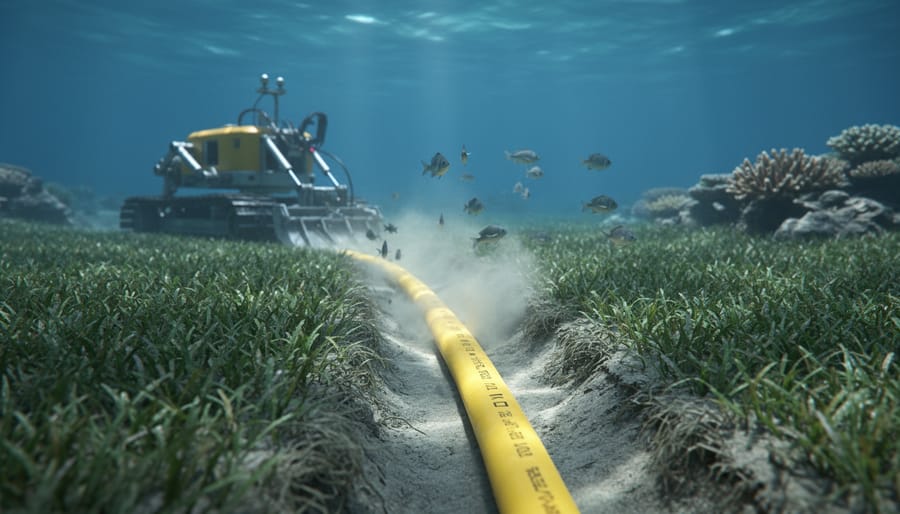
Beneath the ocean’s surface, a vast network of fiber optic cables carries more than 95% of international data traffic, connecting continents and enabling our digital world. Yet the installation of these technological lifelines creates a complex intersection between human innovation and marine ecosystem health that demands our attention and understanding.
When installation vessels plow through ocean waters, dragging cables weighing thousands of tons across the seafloor, they disturb sediments, displace marine organisms, and alter habitats that have remained undisturbed for millennia. The process involves cutting trenches up to three meters deep through coral reefs, seagrass meadows, and deep-sea environments we’re only beginning to understand. Marine biologist Dr. Elena Rodriguez, who has monitored cable installation sites for over a decade, recalls witnessing the immediate displacement of entire fish communities and the smothering of benthic organisms under sediment plumes that persisted for weeks.
The global demand for faster internet connectivity shows no signs of slowing. Engineers plan to install over 500 new submarine cables by 2030, each requiring careful navigation through increasingly crowded ocean corridors. This expansion presents both challenge and opportunity for marine conservation.
Understanding the technical realities of cable installation—from route surveying to burial methods—empowers us to advocate for better practices. The good news is that innovative mitigation strategies are emerging, proven effective through scientific monitoring, and increasingly adopted by forward-thinking telecommunications companies. By examining both the impacts and solutions, we can ensure that our connected future doesn’t come at the expense of ocean health. The path forward requires informed engagement from environmental advocates, rigorous scientific assessment, and collaborative action between technology sectors and conservation communities.
The Journey of a Cable: Understanding Submarine Fiber Optic Installation
Survey and Planning: The First Line of Defense
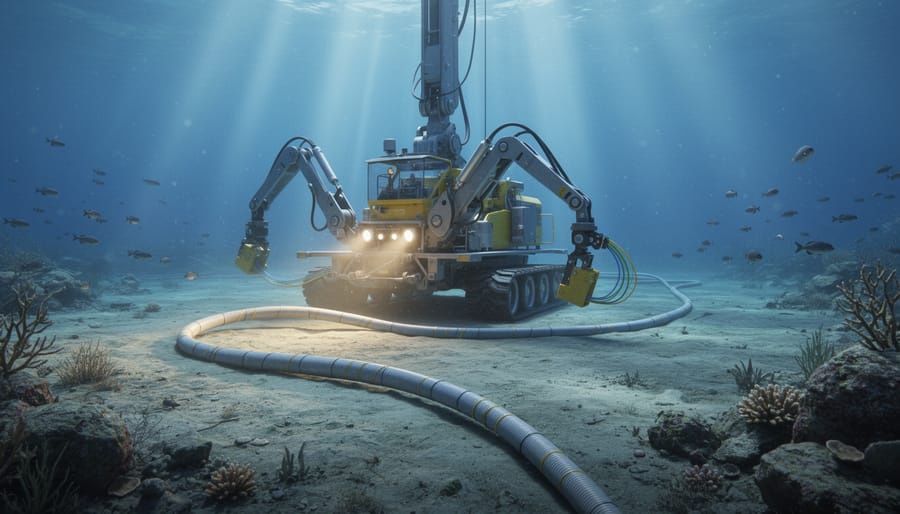
Before a single cable touches the seafloor, modern installation projects begin with comprehensive marine surveys that serve as crucial environmental safeguards. These pre-installation assessments involve sophisticated sonar mapping, remotely operated vehicles (ROVs), and collaboration with marine scientists to identify sensitive habitats like coral reefs, seagrass meadows, and breeding grounds for endangered species.
Dr. Maria Chen, a marine biologist who has worked with cable installation companies for over a decade, shares her experience: “When I first started consulting on these projects, environmental surveys were often afterthoughts. Now, I’m brought in during the earliest planning stages. We map every coral formation, every rocky reef that might harbor vulnerable species. It’s become standard practice to reroute cables around these areas, even if it adds significant distance and cost.”
Leading companies have established partnerships with oceanographic institutions to conduct year-long baseline studies before installation begins. These studies document species abundance, migration patterns, and seasonal breeding cycles. For instance, recent projects in the Mediterranean collaborated with local universities to time installations outside critical spawning periods for commercially important fish species.
Habitat mapping technology has advanced dramatically, allowing surveyors to create detailed three-dimensional models of the seafloor. This precision enables installers to thread cables through sandy corridors between sensitive habitats, minimizing disturbance. Some organizations now offer volunteer opportunities for citizen scientists to help analyze survey footage, identifying marine life and contributing to conservation databases that inform future cable routes.
Cable-Laying Techniques and Their Footprint
Installing submarine fiber optic cables involves three primary techniques, each leaving distinct marks on the seafloor. Understanding these methods helps us grasp their environmental implications and work toward minimizing harm to marine ecosystems.
Plowing creates the deepest impact, similar to how a farmer tills soil on land. A specialized plow blade cuts a trench up to three meters deep, deposits the cable, and covers it with sediment. This method offers excellent cable protection but significantly disturbs the seafloor, temporarily displacing marine organisms and altering sediment composition. Think of it as major surgery for the ocean floor—effective but invasive.
Jetting uses high-pressure water streams to create a channel for the cable, much like using a garden hose to carve pathways in sand. This technique penetrates one to two meters deep and causes less disruption than plowing. The sediment settles back relatively quickly, making it a middle-ground option between protection and environmental consideration. Marine biologist Dr. Sarah Chen notes that recovery times for jetted areas often prove faster than plowed sections, with benthic communities reestablishing within months rather than years.
Surface-laying simply places cables directly on the seafloor without burial, comparable to laying a garden hose across your lawn. While this minimizes immediate disturbance, cables remain vulnerable to fishing gear and ship anchors. This method is typically reserved for deep-water sections where such risks decrease.
Each technique shares similarities with ocean floor installation processes in other marine infrastructure projects, creating opportunities for shared conservation strategies and mitigation approaches across industries.
When Cables Meet Coral: Immediate Impacts on Marine Habitats
Seafloor Disturbance and Sediment Plumes
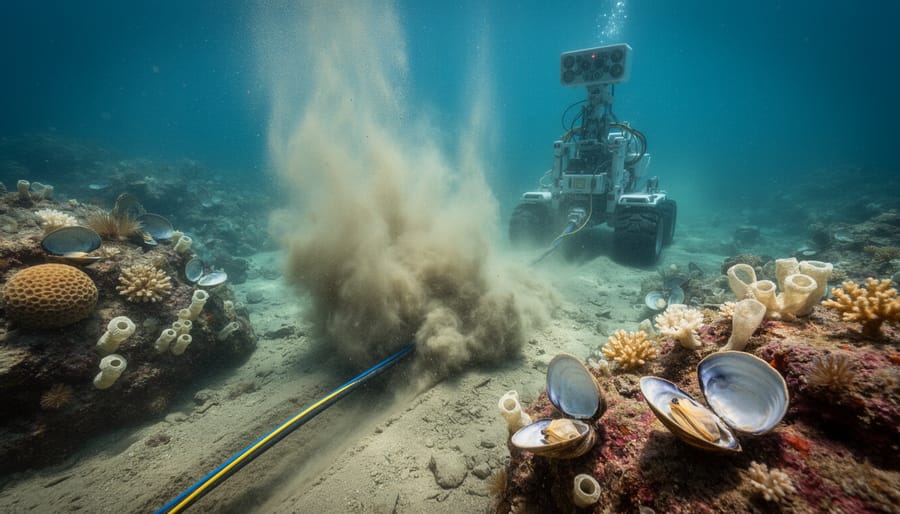
When submarine cables are buried into the seabed, the process creates sediment plumes that temporarily cloud the surrounding waters. The plowing or jetting equipment displaces sand, silt, and organic matter, sending particles into suspension. While this seafloor disturbance might sound alarming, research shows these impacts are typically short-lived and localized to the immediate cable corridor.
The sediment plumes affect water clarity for hours to days, depending on water currents and sediment composition. Filter-feeding organisms like sponges, mussels, and soft corals can experience temporary stress from increased particle loads, though studies indicate most healthy populations recover quickly once the sediment settles. Benthic communities—the organisms living on or in the seafloor—experience the most direct impact as burial equipment disturbs their habitat.
Dr. Sarah Chen, a marine ecologist who has monitored multiple cable installation sites, shares an encouraging perspective: “We’ve observed that in sandy substrates, communities typically return to baseline conditions within six to eighteen months. The key is proper planning to avoid sensitive areas like coral reefs or seagrass beds.”
Recovery timeframes vary by ecosystem. Soft-bottom habitats in high-current areas may recover within months, while more delicate environments require longer periods. For those interested in contributing to marine monitoring efforts, several organizations offer volunteer opportunities to document benthic recovery after infrastructure projects, helping scientists better understand and minimize future impacts.
Sensitive Ecosystems at Risk
Certain marine habitats face heightened vulnerability during submarine cable installation due to their ecological fragility and the species they support. Understanding these sensitive ecosystems helps inform protective measures that balance our connectivity needs with ocean stewardship.
Coral reefs rank among the most threatened habitats during cable laying operations. These complex structures, built over centuries by tiny polyps, support approximately 25% of all marine species despite covering less than 1% of the ocean floor. When installation vessels anchor near reefs or cables are dragged across these formations, the physical damage can devastate colonies that took decades to establish. The Mediterranean’s red coral beds and Indonesia’s Raja Ampat reefs exemplify areas where careful routing became essential. Marine biologist Dr. Elena Rodriguez, who surveyed cable routes near the Mesoamerican Reef, recalls: “We identified alternative pathways that added only 12 kilometers to the route but avoided critical spawning grounds for endangered Nassau grouper. That small adjustment protected nursery habitat for thousands of juvenile fish.”
Seagrass meadows present similar concerns. These underwater flowering plants stabilize sediments, filter water, and serve as nurseries for commercially important species. Cable trenching through seagrass beds creates long scars that may take years to heal, disrupting the intricate network of roots that prevents erosion. Tasmania’s giant kelp forests and Florida’s turtle grass beds require specialized burial techniques that minimize sediment plumes and root disturbance.
Areas harboring endangered species demand particular attention. The Mediterranean monk seal, with fewer than 700 individuals remaining, depends on undisturbed coastal caves. North Atlantic right whales, numbering around 350, face additional stress when cable ships operate in their migration corridors. Protecting marine biodiversity requires comprehensive pre-installation surveys, seasonal restrictions during breeding periods, and real-time monitoring to adjust operations when sensitive species appear nearby.
The Long View: How Marine Life Adapts to Cable Presence
Artificial Reef Effects and Unexpected Benefits
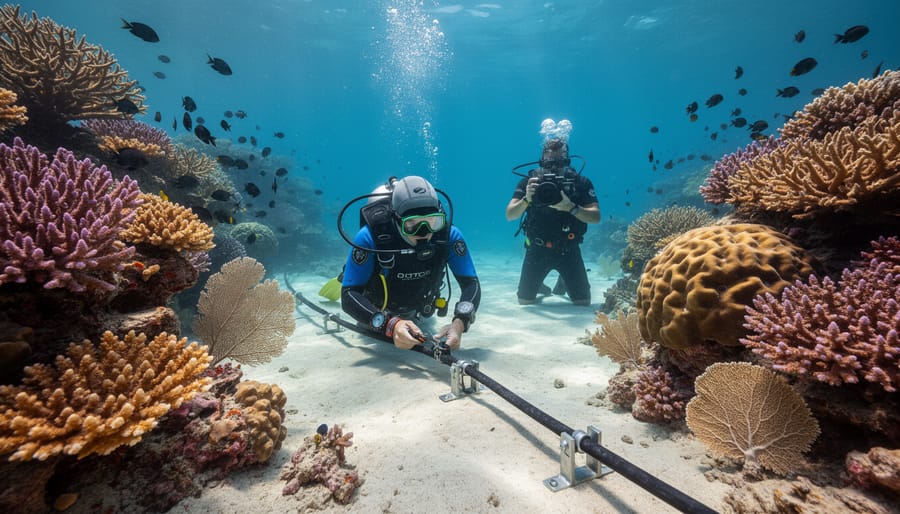
In an unexpected twist, submarine fiber optic cables can sometimes function as artificial reefs, creating hard substrate in areas where natural rocky surfaces are scarce. Marine biologist Dr. Sarah Chen has observed this phenomenon firsthand during her research dives in sandy coastal regions. “We’ve documented increased biodiversity around certain cables,” she notes, “with sessile organisms like barnacles, mussels, and algae colonizing the cable surfaces, which then attract fish and crustaceans seeking food and shelter.”
This colonization process mirrors what happens with intentionally deployed artificial reefs. The cables provide stable surfaces in otherwise featureless sediment environments, potentially supporting small-scale habitat development. Some studies have documented localized increases in fish populations near cable installations, particularly in areas with limited natural hard substrate.
However, this interesting ecological phenomenon should not be misinterpreted as an environmental benefit that justifies inadequate planning or poor installation practices. The potential for habitat creation varies greatly depending on cable design, burial depth, and local conditions. Many cables remain completely buried and provide no colonization opportunity whatsoever.
Conservation organizations emphasize that any positive effects are incidental and cannot offset damage caused by destructive installation methods or placement through sensitive habitats. Proper environmental impact assessments, careful route selection, and appropriate mitigation measures remain essential priorities for protecting marine ecosystems during all cable installation projects.
Electromagnetic Fields and Marine Navigation
Submarine fiber optic cables generate low-frequency electromagnetic fields that have caught the attention of marine researchers studying species that rely on Earth’s magnetic field for navigation. Sharks, rays, sea turtles, and certain fish possess specialized sensory organs called electroreceptors that detect electrical signals in the water, helping them hunt prey, avoid predators, and navigate vast ocean distances during migration.
Current research on cable EMF emissions presents a complex picture. Laboratory studies have demonstrated that some elasmobranch species (sharks and rays) can detect the electromagnetic signatures produced by subsea cables, with power transmission cables generating stronger fields than communication cables. However, scientists emphasize that detecting a signal doesn’t necessarily mean it causes harmful behavioral changes. Field observations remain limited, making it challenging to draw definitive conclusions about real-world impacts on migration patterns or habitat use.
Dr. Sarah Chen, a marine biologist who has spent fifteen years studying sea turtle navigation, notes that “we’re still in the early stages of understanding these interactions. What we’ve learned from tagging studies is that marine animals are remarkably adaptable, often adjusting their routes around human infrastructure.” Her research team welcomes citizen scientists to participate in coastal monitoring programs, helping track turtle movements near cable landing sites.
The electromagnetic output from fiber optic cables is considerably lower than power cables, though questions persist about cumulative effects in areas where multiple cables converge. Some deep-water ecosystems may experience overlapping disturbances that warrant continued monitoring and adaptive management strategies.
Stories from the Field: Marine Biologists Monitoring Cable Projects
Dr. Maria Santos still remembers her first submarine cable monitoring assignment off the coast of Portugal in 2019. “I expected devastation,” she admits, “but what I found six months post-installation surprised me. Small fish had already returned to the burial trench, and invertebrates were colonizing the exposed cable sections.” Her observation underscores a critical reality: while cable installation temporarily disrupts marine habitats, ecosystems often demonstrate remarkable resilience when projects employ proper mitigation strategies.
During her monitoring work, Dr. Santos documented an innovative approach that made a significant difference. The installation team used real-time acoustic monitoring to track marine mammal movements, adjusting cable-laying operations when dolphins approached the work zone. “This adaptive management prevented displacement of a resident pod,” she explains. “It showed me that industry and conservation can work together when there’s commitment.”
Marine biologist James Chen has spent five years studying benthic recovery at cable sites in the Pacific. His research reveals encouraging patterns. “We’ve observed that soft-sediment communities typically recover within 12 to 18 months,” he notes, “though rocky habitat restoration takes longer.” Chen’s work has influenced new industry guidelines requiring habitat mapping before route selection, helping companies avoid sensitive areas entirely.
What motivates these scientists to continue this demanding work? For Dr. Santos, it’s about shaping better practices. “Every project we monitor generates data that improves the next installation,” she says. “We’re building a knowledge base that didn’t exist a decade ago.”
Their work matters beyond academic research. These field observations inform regulatory frameworks, guide restoration efforts, and provide the evidence needed to hold companies accountable. As our digital infrastructure expands across ocean floors, these marine biologists serve as essential witnesses and advocates, ensuring that progress doesn’t come at the irreversible cost of marine biodiversity. Their stories remind us that careful stewardship and technological advancement can coexist.
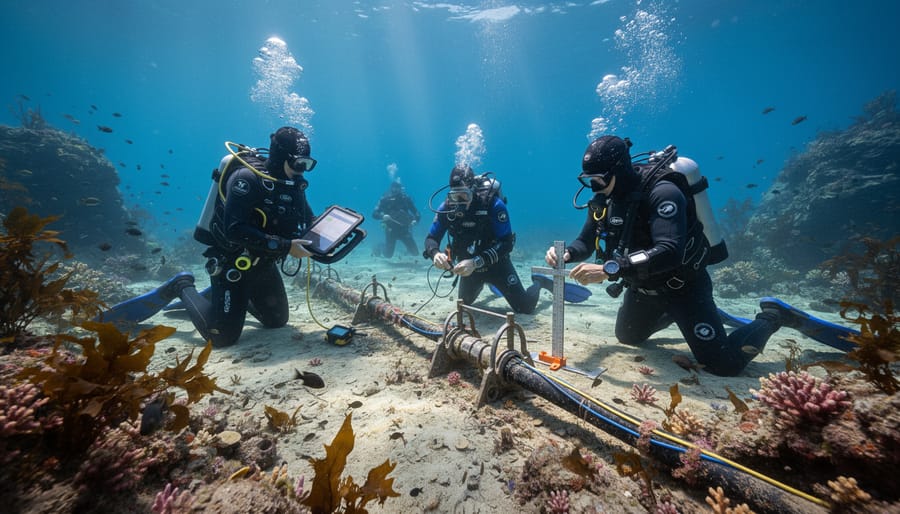
Building Better: Sustainable Cable Installation Practices
Route Optimization and Marine Protected Areas
The telecommunications industry has made remarkable strides in minimizing environmental impacts through careful route planning and unprecedented collaboration with conservation groups. Several recent projects demonstrate how technology and conservation can work hand-in-hand.
The 2019 MAREA cable connecting Virginia to Spain serves as an inspiring example. Project managers worked closely with the National Oceanic and Atmospheric Administration to identify and avoid critical habitats for North Atlantic right whales and sea turtle nesting grounds. By adjusting the cable route by just 15 kilometers in certain sections, the project successfully bypassed sensitive spawning areas while maintaining technical efficiency.
The role of marine spatial planning has become essential in these efforts. This systematic approach helps identify areas where cables can be installed with minimal ecological disruption. Countries like Norway and New Zealand now require comprehensive marine spatial assessments before approving cable permits, creating a framework that benefits both connectivity and conservation.
Dr. Elena Rodriguez, a marine biologist who consulted on the Pacific Light Cable Network, shares her experience: “Working with telecom engineers opened my eyes to their genuine commitment to environmental stewardship. Together, we mapped coral reef systems and identified installation windows that avoided fish breeding seasons. It felt like true partnership.”
Conservation organizations like The Ocean Foundation now actively participate in cable planning processes, offering expertise on marine protected areas and vulnerable ecosystems. Some companies have even established volunteer monitoring programs, allowing citizen scientists to document recovery in cable installation zones, turning infrastructure projects into opportunities for ongoing marine research and community engagement.
Minimizing Disturbance Through Technology
The cable-laying industry has made remarkable strides in reducing environmental footprints through innovative technology. Modern cable-laying vessels now employ remotely operated vehicles (ROVs) equipped with high-definition cameras and sensors that survey the seafloor in real-time before cables are placed. These ROVs can detect sensitive habitats like coral formations or seagrass beds, allowing operators to adjust routes instantaneously rather than disturbing these crucial ecosystems.
Precision burial technology represents another breakthrough. Contemporary cable plows use pressurized water jets or controlled cutting mechanisms that create narrow trenches, minimizing sediment displacement compared to older dragging methods. Some systems can even adjust burial depth automatically based on seafloor composition, ensuring cables are adequately protected while disturbing minimal substrate.
Environmental monitoring has become increasingly sophisticated. Marine biologist Dr. Sarah Chen, who has worked alongside installation teams, shares: “We now deploy acoustic sensors that detect marine mammal vocalizations during operations, allowing crews to pause work when whales or dolphins approach. This wasn’t standard practice even a decade ago.”
Adaptive installation techniques also include seasonal planning that avoids spawning periods for commercially important fish species and migration corridors for sea turtles. These coordinated efforts demonstrate how technological innovation, combined with ecological awareness, can make infrastructure development compatible with marine conservation goals.
Legal Frameworks and International Standards
The legal landscape surrounding submarine cable installation is evolving to better protect marine ecosystems. Most coastal nations require Environmental Impact Assessments before permits are issued, evaluating potential harm to seafloor habitats, migration corridors, and protected species. The United Nations Convention on the Law of the Sea provides the foundational framework, balancing infrastructure development with ocean stewardship.
Recent developments include stricter guidelines from organizations like the International Cable Protection Committee, which now emphasizes ecological best practices alongside cable security. Marine Protected Areas often require specialized routing studies and seasonal installation windows to avoid disrupting breeding cycles or sensitive habitats.
What’s encouraging is that conservation groups increasingly participate in permitting processes, bringing marine biology expertise to planning discussions. Dr. Maria Santos, a marine ecologist who volunteers with regulatory review panels, shares: “Ten years ago, we weren’t at the table. Now, our habitat data directly influences route selection and mitigation requirements.”
These frameworks create opportunities for citizens to engage through public comment periods during the permitting process, ensuring local knowledge and conservation priorities shape how these vital communication networks are deployed beneath our oceans.
How You Can Make a Difference
Understanding the environmental impacts of submarine fiber optic cables is only the first step. The real power lies in taking action to protect our marine ecosystems while supporting the infrastructure our connected world depends on.
One of the most direct ways to contribute is through volunteer opportunities at the Marine Biodiversity Science Center. The center regularly hosts citizen science programs where volunteers assist with monitoring marine habitats along known cable routes. These programs require no previous scientific training—just enthusiasm and a willingness to learn. Volunteers help collect data on benthic communities, document changes in sediment composition, and observe marine life behavior near cable corridors. This hands-on experience not only contributes valuable data to ongoing research but also deepens your understanding of marine ecosystems.
For those unable to participate in fieldwork, remote citizen science projects offer meaningful alternatives. Several organizations maintain online platforms where you can analyze underwater footage from cable route surveys, helping scientists identify species and assess habitat health. These virtual contributions are genuinely valuable, as researchers often have more data than they can process alone.
Advocacy represents another powerful avenue for impact. Contact your local representatives to support legislation requiring comprehensive environmental impact assessments before cable installations. Push for stronger enforcement of protective measures during construction and advocate for international standards that prioritize marine conservation alongside technological development.
Education amplifies your impact exponentially. Share what you’ve learned about submarine cables with your community, schools, or social networks. Many people remain unaware of this hidden infrastructure beneath our oceans, and raising awareness creates a broader coalition for protection.
Consider supporting organizations dedicated to marine conservation through donations or memberships. These groups conduct the research, legal advocacy, and public education campaigns that drive meaningful policy changes.
Every action matters. Whether you’re collecting data on a research vessel, analyzing images from your home, or simply having conversations about ocean protection, you’re contributing to a future where technology and marine biodiversity thrive together.
The fiber optic cables crisscrossing our ocean floors represent more than technological infrastructure—they are the digital lifelines connecting our global community. Yet as we’ve explored throughout this article, these essential pathways cannot come at the expense of marine ecosystem health. The relationship between our connectivity and ocean vitality is deeply interconnected, and acknowledging this connection is the first step toward meaningful change.
Submarine cable installation practices must continue evolving alongside our growing understanding of marine ecosystems. What we know today about sediment disturbance, habitat disruption, and species behavior far exceeds our knowledge from even a decade ago. This scientific progress opens doors to more thoughtful installation methods, better route planning, and comprehensive monitoring programs that protect vulnerable species while maintaining the digital connections our world depends on.
The encouraging news is that change is already underway. Marine biologists like Dr. Sarah Chen, who has spent years documenting cable installation impacts in the Mediterranean, reminds us that “every conservation victory starts with awareness and commitment.” Industry leaders, environmental scientists, and conservation organizations are increasingly collaborating to establish best practices that honor both technological needs and ecological preservation.
You can be part of this transformation. Whether through supporting marine conservation initiatives, volunteering for coastal monitoring programs, or simply staying informed about infrastructure projects in your region, collective action creates lasting impact. Our oceans sustain life on this planet, and protecting them while advancing human connectivity is not just possible—it’s essential for our shared future.

jessica
Ava Singh is an environmental writer and marine sustainability advocate with a deep commitment to protecting the world's oceans and coastal communities. With a background in environmental policy and a passion for storytelling, Ava brings complex topics to life through clear, engaging content that educates and empowers readers. At the Marine Biodiversity & Sustainability Learning Center, Ava focuses on sharing impactful stories about community engagement, policy innovations, and conservation strategies. Her writing bridges the gap between science and the public, encouraging people to take part in preserving marine biodiversity. When she’s not writing, Ava collaborates with local initiatives to promote eco-conscious living and sustainable development, ensuring her work makes a difference both on the page and in the real world.