Marine Biodiversity Science Center

Short version: an electric motor fixes two of the four ways a small boat harms marine life. The other two stay with the person steering. |
Partly, and the honest version of the answer is more useful than the enthusiastic one. Electric propulsion removes two specific pressures on marine life: the continuous broadband noise a combustion engine puts into the water, and the fuel and oil that leaks or discharges from it. It does nothing about the other two, which are physical disturbance from wake and the risk of striking an animal. Those depend entirely on how and where the boat is driven.
What changes the moment the engine is electric
The immediate difference is mechanical. A brushless electric motor has no combustion, no exhaust and no fuel path, so nothing is discharged into the water at all. The acoustic signature also drops, because most of what a small outboard radiates underwater comes from combustion and from the mechanical gearing around it rather than from the propeller alone.
The trade is range, and it is a real one. An electric outboard motor in the small-craft class delivers useful power for a few hours rather than a full day, and refuelling means recharging.
Two power classes cover almost all of the small-craft fleet. A 700W unit, roughly equivalent to a 2 HP petrol outboard and weighing 13.45 lbs, is rated for hulls of 2.5 to 4.0 metres carrying up to 350 kg. A 2,000W unit, closer to 5 HP and weighing 16.53 lbs, takes hulls of 3 to 5 metres and up to 700 kg.
|
Rated hull length |
Rated load |
Approximate petrol equivalent |
|
2.5 to 4.0 m |
350 kg |
2 HP |
|
3 to 5 m |
700 kg |
5 HP |
That band covers tenders, dinghies, inflatables, small aluminium boats and most of what actually moves around in estuaries, inlets and river mouths. It is also the band where noise and fuel discharge happen closest to the animals affected by them.
Noise is the part regulators moved on first
Sound is the primary sense for most marine life. Whales, dolphins and porpoises use it to find food, to navigate and to stay in contact with each other, and vessel noise masks all three. Fish and invertebrates are affected too, though less visibly.
Canada has been working this problem for several years. Fisheries and Oceans Canada maintains a public list of ocean noise-related initiatives, which includes the Quiet Vessel Initiative launched in 2019 to fund quieter vessel design and retrofits, voluntary slowdowns in the Salish Sea, seasonal measures for bowhead and beluga habitat in the Arctic, and a request that vessels reduce speed below 10 knots in the Gully Marine Protected Area. One 2022 trial recorded a 48% drop in background noise compared with the 60 days before it started.
Measuring that kind of change is harder than it sounds, which is why acoustic modelling has become central to conservation planning. Anyone curious about how researchers reconstruct underwater soundscapes without being in the water will find the explanation of virtual acoustic environments a useful companion to this.
The 2026 rules put numbers on it
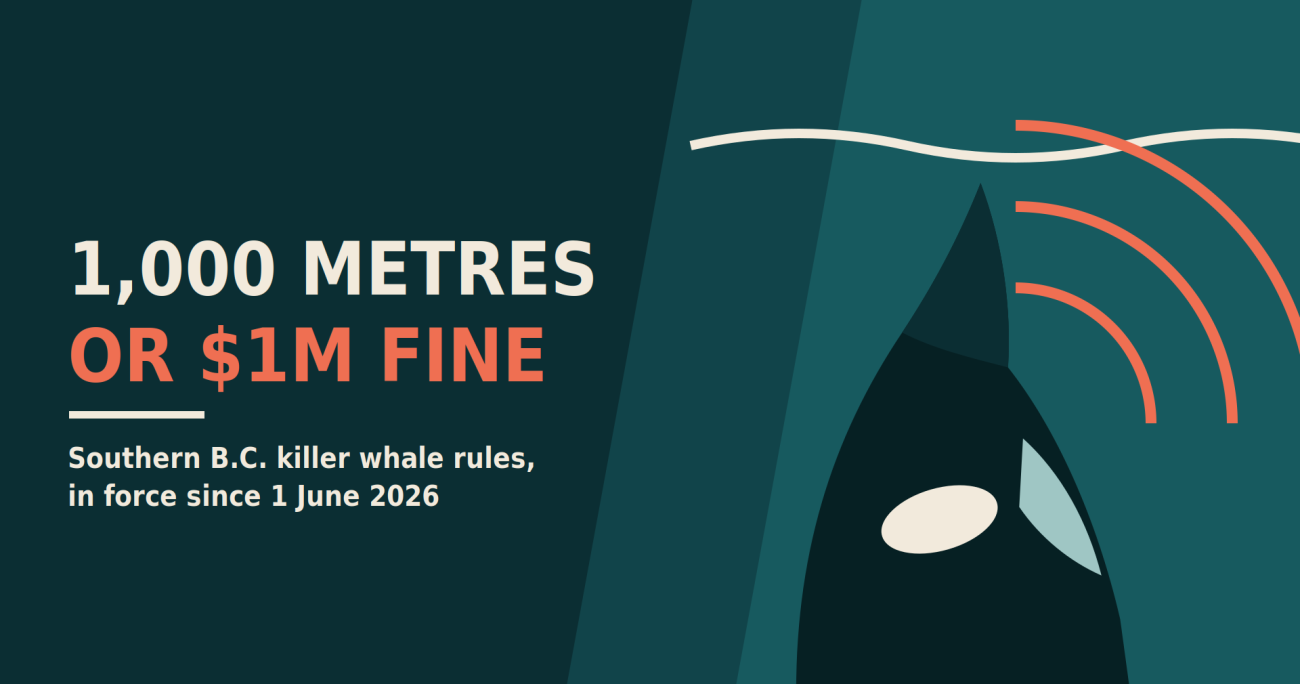
Transport Canada’s Ship Safety Bulletin for the current season sets out what applies in southern B.C. waters. Under Ship Safety Bulletin 08/2026, vessels must stay at least 1,000 metres from Southern Resident killer whales from 1 June 2026 to 31 May 2027. Two speed-restricted zones at Swiftsure Bank hold vessels under 10.0 knots over ground from 1 June to 30 November 2026, with a voluntary reduction in Tumbo Channel over the same period, and two vessel-restricted zones near Saturna and Pender Islands are closed to traffic.
The penalties are not nominal. Non-compliance can draw an administrative monetary penalty of up to $250,000, a fine of up to $1 million, and up to 18 months in prison on summary conviction.
Nothing in those rules cares what kind of engine you have. Regulation targets proximity and speed, because those are the variables that produce harm regardless of what turns the propeller.
What an electric motor does not fix
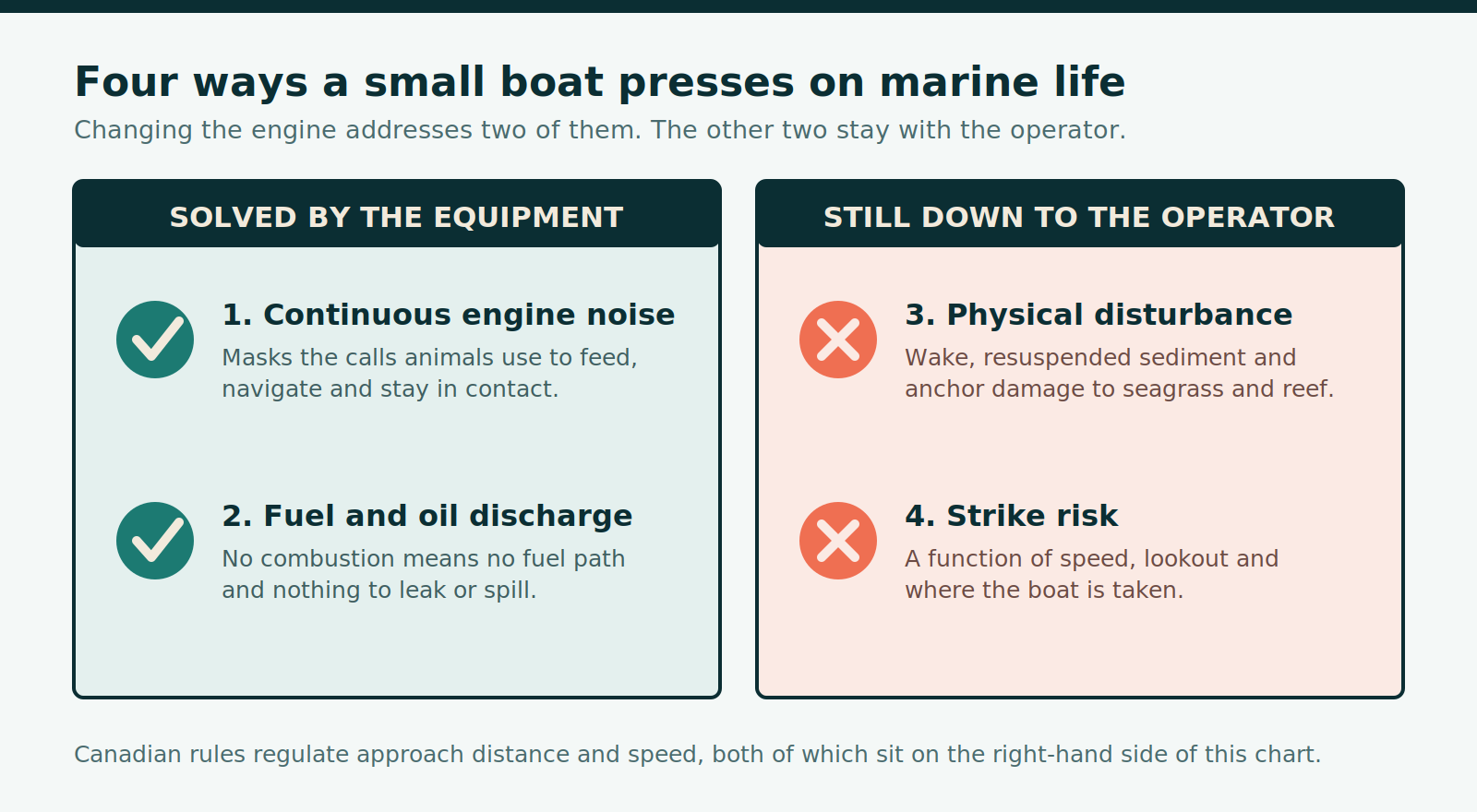
Two of the four pathways are closed by the equipment. Two are closed by the operator, or not at all.
Physical disturbance is the first. A hull moving at speed generates the same wake whatever is turning the propeller, and in shallow water that wake resuspends sediment, erodes banks and disturbs spawning habitat. Anchor damage to eelgrass and reef belongs in the same category, since it has nothing to do with the engine at all.
Strike risk is the second, and it deserves more than a line. Collisions with whales, turtles and basking sharks are a function of speed, lookout and where the boat is taken. An electric boat travelling at 15 knots is exactly as dangerous as a petrol one, and arguably slightly worse, because the animal hears it later. Quieter is better for communication and worse for warning. That tension is one reason speed limits and approach distances do more work than any technology choice.
Choosing for a small boat, honestly
If you run a tender, a dinghy or a small aluminium boat on sheltered water, an electric outboard is a straightforwardly good swap: shorter range, no fuel to carry or spill, and much less noise going into water where animals live. If you run long distances offshore, current battery energy density makes the case much weaker, and there is no point pretending otherwise.
What holds either way is the operating discipline. Keep the speed down near shore. Watch for blows and dorsal fins. Give animals the legal distance and then some. Anchor on sand, not on grass.
The part the equipment cannot do
An electric motor is a genuine improvement to two of the four pressures a small boat puts on marine life, and it is measurable rather than symbolic. But the pressures it leaves untouched are the ones enforcement agencies have chosen to regulate, which tells you something about their relative weight. The engine is the easy half. The habits are the half that decides whether the animals notice any difference at all.

jessica
Ava Singh is an environmental writer and marine sustainability advocate with a deep commitment to protecting the world's oceans and coastal communities. With a background in environmental policy and a passion for storytelling, Ava brings complex topics to life through clear, engaging content that educates and empowers readers. At the Marine Biodiversity & Sustainability Learning Center, Ava focuses on sharing impactful stories about community engagement, policy innovations, and conservation strategies. Her writing bridges the gap between science and the public, encouraging people to take part in preserving marine biodiversity. When she’s not writing, Ava collaborates with local initiatives to promote eco-conscious living and sustainable development, ensuring her work makes a difference both on the page and in the real world.