Marine Biodiversity Science Center

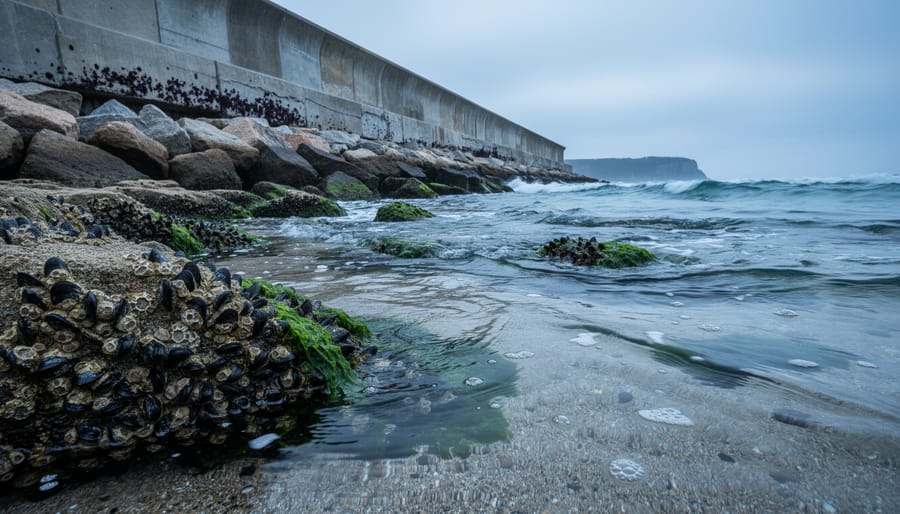
Shoreline hardening is the practice of installing rigid structures like seawalls, bulkheads, riprap, and revetments along coastlines to prevent erosion and protect coastal property from wave action and storm surge. While these engineered barriers have lined thousands of miles of coastline worldwide, primarily to safeguard buildings, roads, and infrastructure, they fundamentally alter the natural dynamics of vital coastal ecosystems with some of the most severe consequences unfolding in the intertidal zone.
The intertidal zone, that narrow band where ocean meets land, ranks among the most biologically productive habitats on Earth. It pulses with life: barnacles, mussels, crabs, sea stars, anemones, algae, and countless microorganisms adapted to survive the twice-daily rhythm of submersion and exposure. These communities provide critical nursery habitat for juvenile fish, feeding grounds for shorebirds, and natural water filtration that benefits entire coastal food webs. When we replace natural shorelines with concrete and stone, we don’t just change the scenery. We eliminate habitat, disrupt sediment flow, reflect wave energy that scours adjacent beaches, and create ecological dead zones where diverse communities once thrived.
Understanding shoreline hardening matters now more than ever. As coastal development intensifies and sea levels continue to rise, property owners and municipalities face mounting pressure to fortify shorelines. Yet the ecological costs of hardening often go unrecognized until the damage becomes irreversible. This article explains how shoreline hardening works, examines the major types of hard structures in use today, and details the cascading impacts on intertidal biodiversity. Most importantly, it highlights nature-based alternatives and opportunities for you to participate in protecting these irreplaceable coastal habitats through monitoring programs and restoration volunteer work.
What Shoreline Hardening Means
Shoreline hardening refers to the installation of permanent, rigid structures along coastlines designed to prevent erosion and protect property from waves and rising water levels. These engineered barriers, typically made of concrete, steel, or large rocks, create a fixed boundary between land and water, replacing the naturally dynamic interface where beaches, marshes, and mudflats once absorbed wave energy and adapted to changing conditions.
The practice emerged as coastal populations grew and valuable development spread along vulnerable shorelines. Property owners and municipalities turned to hardening as a seemingly straightforward solution: build a wall, stop the erosion, save the buildings. Over the past century, this approach has become the default response to coastal threats in many regions, with thousands of miles of once-natural coastline now fortified with artificial structures.
- Armoring
- The general term for protecting shorelines with hard, engineered structures such as seawalls, bulkheads, or riprap. It contrasts with natural or soft stabilization methods that work with coastal processes.
- Revetment
- A sloped layer of rocks, concrete blocks, or other material placed on a bank or shoreline to absorb and deflect wave energy. Unlike vertical walls, revetments follow the natural slope of the land.
- Bulkhead
- A vertical or near-vertical retaining wall built parallel to the shore, typically made of wood, steel, or concrete. Bulkheads create a sharp boundary between water and land.
- Natural shoreline
- An unarmored coastline where beaches, dunes, marshes, or bluffs respond dynamically to waves, tides, and sediment movement. These systems provide habitat while naturally buffering wave energy.
- Soft stabilization
- Erosion control methods that use vegetation, natural materials, or beach nourishment to protect shorelines while maintaining ecological function. Also called living shorelines or nature-based solutions.
Understanding what hardening is and how widespread it’s become sets the stage for examining how these structures actually work and, more importantly, what happens to the intertidal zone when natural shorelines disappear beneath concrete and steel.
How Shoreline Hardening Works
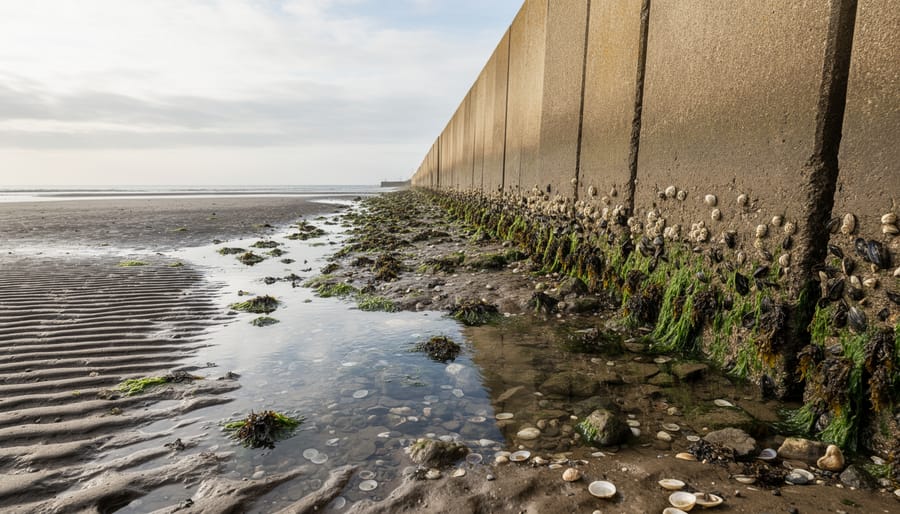
When waves crash against a natural shoreline, their energy dissipates gradually as water moves up the beach, through sand and vegetation, or across marshland. Shoreline hardening interrupts this process by placing a solid barrier directly in the path of incoming waves. The core engineering principle is straightforward: create an immovable obstacle that either absorbs or redirects wave energy before it can erode the land behind.
Most hardening structures work through one of two mechanisms. Vertical structures like seawalls reflect wave energy back toward the water. When a wave hits a concrete bulkhead, it bounces off at roughly the same angle it arrived, much like a ball thrown against a wall. This reflection protects the land immediately behind the wall but concentrates wave force at the structure’s base and can intensify turbulence in front of it.
Sloped structures like riprap take a different approach. They dissipate energy by forcing water to flow through gaps between rocks or concrete pieces. As waves wash over and between the irregular surfaces, friction converts kinetic energy into heat. The water loses power progressively rather than bouncing back in a single pulse.
Both types create a hard boundary between terrestrial and marine environments. Natural shorelines feature gradual transitions, a beach slopes gently into the surf zone, or marsh grass extends into shallow water. Hardened shorelines end abruptly. The structure marks a fixed line where land stops and water begins, eliminating the buffer zone that normally shifts with tides, seasons, and storms.
Hardening also locks the shoreline in place, preventing the natural inland migration that occurs as sea levels rise or storm patterns change. Sediment that would typically move alongshore, nourishing beaches downcurrent, gets trapped or deflected. The combination of wave reflection, sediment interruption, and habitat loss makes these structures highly effective at protecting specific properties while fundamentally altering coastal processes across broader areas.
Common Types of Hardening Structures
Seawalls and Bulkheads
Seawalls and bulkheads are the most recognizable form of shoreline hardening, tall, vertical barriers that create a sharp boundary between property and water. These structures typically stand anywhere from a few feet to over twenty feet high, constructed from materials like concrete, steel sheet piling, timber, or stone masonry. Their defining feature is the near-vertical face that meets incoming waves head-on.
The engineering logic is straightforward: deflect wave energy upward and back toward the ocean rather than letting it reach the land. When waves hit these smooth, rigid walls, they bounce off with considerable force, creating turbulent conditions at the structure’s base. This reflected energy scours away sediment that would normally cushion the shoreline, often requiring additional rock or concrete toe protection at the wall’s foot to prevent undermining.
Bulkheads serve primarily as property retention structures in calmer waters, marinas, canals, and protected harbors, while seawalls face the open ocean’s full force. Both create an abrupt habitat transition where the gradual slope of a natural beach or marsh edge once existed, fundamentally changing what can live there.
Revetments and Riprap
Revetments and riprap take a different approach than vertical walls, instead of deflecting wave energy head-on, they absorb and dissipate it through a sloped armor of loosely placed materials. Picture a bank of large stones cascading down toward the water at an angle, typically between 30 and 45 degrees. When waves hit this rocky slope, water flows through the gaps between stones, breaking up the wave’s force before it can erode the shoreline behind.
Riprap usually consists of angular quarried stone ranging from basketball to car-hood size, dumped and arranged to create stable interlocking layers. Revetments follow the same principle but often incorporate more engineered design, precisely sized rock classes, geotextile fabric underneath to prevent soil washout, and sometimes concrete blocks shaped to enhance wave dissipation. You’ll find these structures protecting highway embankments, riverbanks, and eroding coastal bluffs where property owners want protection that looks more “natural” than a concrete seawall.
The sloped design does allow some wave overtopping during storms, which means they need more space than vertical structures. That footprint extends well into what would otherwise be intertidal beach habitat.
Groins and Jetties
Groins and jetties are linear structures that project from the shore out into the water, typically built from rock, concrete, timber, or sheet piling. Unlike the parallel walls of bulkheads and seawalls, these run perpendicular to the coastline to interrupt the natural flow of water and sediment along the shore.
Groins are shorter structures, often built in series called groin fields, designed to trap sand moving parallel to the beach through longshore drift. As waves hit the coast at an angle, they push sediment along the shore in one direction. A groin blocks this movement, causing sand to accumulate on the updrift side while the downdrift side experiences erosion and beach loss. This creates the characteristic saw-tooth beach profile visible along many developed coastlines.
Jetties are longer, more substantial structures typically built in pairs at harbor entrances or river mouths. They stabilize navigation channels by preventing sediment from filling them in, but they also dramatically alter sediment transport patterns across much wider stretches of coast. The zone immediately around jetties experiences strong currents and scour that can strip away all fine sediments, leaving only hard substrate where natural intertidal habitat once thrived.
Where and Why Hardening Is Used
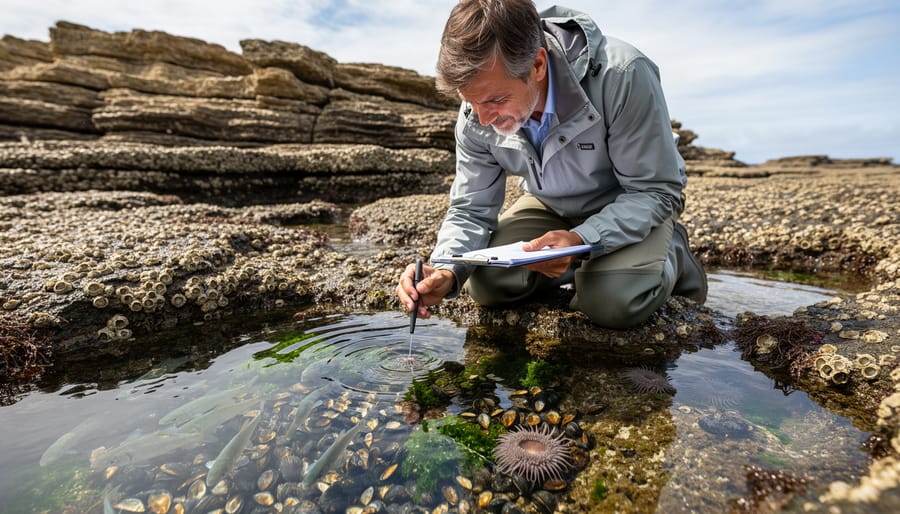
Shoreline hardening addresses an immediate problem that keeps coastal planners, property owners, and municipal officials awake at night: the advancing tide. As sea levels rise and storm intensity increases, communities face the real prospect of losing valuable land, infrastructure, and property to erosion. The appeal of hardening is straightforward, it creates a fixed boundary between land and water, offering a sense of permanence in an inherently dynamic system.
High-value property drives many hardening decisions. Beachfront homes, resort hotels, and commercial developments represent millions in investment, and protecting that investment often takes priority over preserving natural shoreline processes. When a home worth half a million dollars sits thirty feet from an eroding bluff, the calculus for individual owners becomes simple: build a seawall or watch the property disappear. Multiply that scenario across hundreds of parcels, and entire stretches of coast become armored.
Infrastructure protection provides another powerful rationale. Coastal roads, wastewater treatment plants, power lines, and port facilities serve entire communities, making their defense a public interest. Engineers and decision-makers often view hardening as the most cost-effective solution when weighing initial construction costs against the economic disruption of relocating critical infrastructure.
You’ll find hardening structures deployed in several predictable contexts:
- Urban waterfronts where commercial districts meet harbor waters
- Developed beachfront neighborhoods with legacy construction built before modern setback regulations
- Harbor and port facilities requiring stable edges for vessel moorage and cargo operations
- Coastal highways and bridges where road realignment would be prohibitively expensive
The decision to harden typically follows a pattern: erosion threatens something valuable, alternative solutions appear too slow or uncertain, and the political pressure for immediate action overrides concerns about long-term ecological costs. Budget constraints matter too, a concrete seawall offers a one-time expenditure with minimal maintenance, while nature-based alternatives often require ongoing stewardship and adaptive management that cash-strapped municipalities struggle to fund.
How Hardening Transforms Intertidal Zones
Loss of Natural Beach and Tidal Habitat
When a seawall or bulkhead goes up, the intertidal zone doesn’t just change, it vanishes. These structures occupy the physical space where sandy beaches, mudflats, and salt marsh edges once graded naturally from land to sea. A natural shoreline provides a gradual transition with diverse substrate types: coarse sand gives way to fine sediment, patches of marsh grass stabilize mud, small tidal pools hold water between waves. Hardening replaces this mosaic with a single vertical or steeply sloped surface of concrete, steel, or quarried rock.
The biological cost is immediate. Shorebirds that probe soft sediment for worms and small crustaceans find nothing on bare concrete. Juvenile crabs and fish that hide among marsh roots during high tide lose their refuge. The intertidal plant loss cascades through the food web, without cordgrass and pickleweed, the invertebrates they support disappear, and so do the predators that feed on those invertebrates.
Coastal squeeze compounds the problem. As sea levels rise, natural beaches can migrate landward. A seawall blocks that retreat, trapping the intertidal zone in a shrinking band that eventually disappears beneath the waves. What was once a hundred-meter-wide foraging ground becomes a narrow strip, then nothing at all, just deep water lapping against stone.
Disruption of Sediment Movement
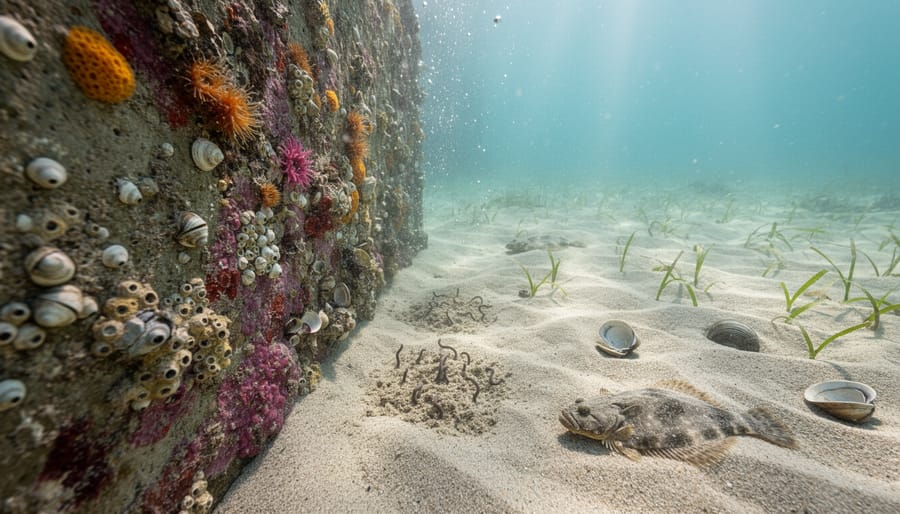
Beaches are naturally dynamic systems where sand and sediment constantly shift with currents, waves, and tides. Hardening structures interrupt this flow. When a seawall or bulkhead blocks the landward source of sediment, material that would normally erode from bluffs or dunes during storms, the beach in front of it begins to starve. Without fresh sediment input, waves carry away what’s there, and the beach narrows or disappears entirely during high tides.
This process, called coastal squeeze, traps intertidal zones between rising water and immovable structures. The habitat physically shrinks. Where a gently sloping beach once provided meters of foraging area across different tidal elevations, hardened shores offer only a narrow strip or nothing at all at high water.
Groins and jetties create a different problem. By trapping sediment on one side, they starve beaches downdrift, sometimes for kilometers. Communities that harden their coastline often inadvertently export erosion problems to their neighbors.
The loss goes beyond quantity. Natural beaches contain mixed substrate, coarse sand, fine particles, shell fragments, pebbles, that support different species. Clams burrow in soft sediment, while certain algae anchor to small stones. Hardened shores typically offer only uniform rock or concrete. This monotony eliminates microhabitats and the creatures that depend on substrate variety. The entire food web feels the absence of these foundation species.
Changes to Wave Energy and Water Flow
When waves strike a natural shoreline, they dissipate energy gradually across beaches, marshes, and rocky slopes. Hardening structures change this completely. Seawalls and bulkheads reflect wave energy back toward the ocean rather than absorbing it, creating turbulent conditions directly offshore. This reflected energy scours the seafloor, stripping away sediment that would normally settle during calm periods.
The altered wave patterns affect organisms at every life stage. Larvae drifting in the water column struggle to attach to substrates in high-energy zones created by reflected waves. Juvenile invertebrates that depend on calmer pockets of water find fewer refuges. Adult species adapted to specific flow regimes, like filter-feeding mussels that position themselves where currents deliver optimal food particles, face either insufficient or excessive water movement.
Groins and jetties redirect longshore currents, fundamentally changing how nutrients, larvae, and detritus move along the coast. Areas downdrift of these structures often experience accelerated erosion and altered salinity patterns, particularly where freshwater normally mixes with seawater. These hydrodynamic shifts force intertidal communities to adapt to conditions far different from those that shaped their evolution.
Impacts on Intertidal Marine Life
Effects on Invertebrates and Algae
Hardened shorelines create fundamentally different habitats than the natural substrates intertidal invertebrates and algae evolved to colonize. On natural rocky shores, barnacles and mussels settle in zones dictated by wave exposure, tide height, and the texture of irregular rock surfaces that offer refuge from predators and desiccation. Concrete seawalls and riprap provide smoother, more uniform surfaces that often support lower species diversity and different community structures, dominated by opportunistic fouling organisms rather than the balanced assemblages found on natural reefs.
Sea stars, which hunt across varied terrain in natural intertidal zones, struggle on vertical walls that eliminate their typical foraging grounds. The loss of tide pools, crevices, and the gradual slope of natural beaches removes microhabitats critical for juvenile invertebrates and smaller species. Kelp and other macroalgae face similar challenges: they require specific attachment surfaces, light conditions, and wave action patterns that hardening structures disrupt. The result is often a biologically impoverished zone where a few generalist species dominate, replacing the rich tapestry of specialized intertidal life.
Consequences for Fish and Birds
Juvenile fish rely on shallow intertidal zones as nurseries where they find shelter from predators and abundant food in the form of small invertebrates and algae. When hardening replaces natural substrate with vertical walls, these nursery functions collapse. Young salmon, perch, and herring lose the vegetated margins and complex underwater topography they need during their vulnerable early stages. Studies show significantly lower juvenile fish densities along hardened shorelines compared to natural beaches, a reduction that ultimately affects adult fish populations and commercial fisheries.
Shorebirds face equally serious consequences. Migrating species like sandpipers, plovers, and dunlins depend on intertidal mudflats and beaches to refuel during their transcontinental journeys, probing the sediment for worms, clams, and crustaceans. Hardened shorelines eliminate these feeding grounds. The narrow beaches that remain often lack the invertebrate communities birds need. During a single stopover, some shorebird species must double their body weight to complete migration, without access to productive intertidal zones, many simply can’t survive the journey. Coastal hardening has contributed measurably to shorebird population declines documented across multiple flyways.
The Bigger Picture: Cascading Ecosystem Effects
When intertidal zones degrade under hardened shorelines, the damage doesn’t stay contained. These narrow strips of habitat function as critical connectors in coastal food webs, and their loss triggers consequences that spread upward through predator-prey relationships and outward into adjacent marine environments.
Consider the fate of juvenile fish. Many commercially and ecologically important species, rockfish, surfperch, salmon, depend on intertidal refuges during their vulnerable early life stages. When hardening eliminates shallow, vegetated edges and replaces complex natural substrates with uniform concrete, these nursery functions collapse. Fewer juveniles survive to adulthood, weakening fish populations that support everything from seabirds and marine mammals to human fisheries. A 2019 study in Puget Sound found that armored shorelines produced 75% fewer juvenile salmon compared to natural beaches, a deficit that reverberates through the entire Salish Sea ecosystem.
Water quality suffers too. Natural intertidal zones filter nutrients, trap sediments, and support algae and eelgrass beds that produce oxygen and sequester carbon. Hardening structures eliminate these ecosystem services. Without marsh plants to absorb nitrogen or mudflats to settle out suspended particles, coastal waters become murkier and more prone to harmful algal blooms. The loss compounds other stressors, warming temperatures, acidification, pollution, pushing nearshore environments closer to ecological tipping points.
Shorebirds face diminishing refueling stations along migration routes. Species like dunlins and western sandpipers time their journeys around the abundance of intertidal invertebrates. When beaches narrow and invertebrate populations crash behind seawalls, these birds arrive to find empty tables. Migration success drops, breeding productivity falls, and populations decline across flyways spanning continents.
The spatial scale matters enormously. A single armored property might seem insignificant, but when shoreline hardening proliferates, often driven by reactive urban planning after storm events, cumulative impacts fragment habitat corridors and isolate populations. Regional biodiversity declines not from one dramatic event but from a thousand incremental losses, each removing another thread from the coastal ecosystem’s fabric.
Alternatives and Solutions in Coastal Management
Coastal communities facing erosion and sea level rise now have viable alternatives to conventional hardening, approaches that protect shorelines while preserving or restoring intertidal habitat. These nature-based and hybrid solutions work with coastal processes rather than fighting them, often providing better long-term resilience at lower ecological cost.
Living shorelines represent the most promising shift in coastal management. Instead of concrete barriers, these projects use natural materials and native vegetation to stabilize shorelines. A salt marsh edge planted with cordgrass dissipates wave energy while providing nursery habitat for fish and invertebrates. Oyster reefs installed parallel to shore break waves and filter water while supporting diverse communities of barnacles, crabs, and small fish. These systems adapt and grow over time, unlike rigid structures that degrade and fail.
Nature-based approaches gaining traction include:
- Constructed oyster reefs that provide wave attenuation and habitat simultaneously
- Salt marsh restoration along eroding shorelines to stabilize sediment naturally
- Dune enhancement and native vegetation planting to buffer upland areas
- Strategic removal of failing seawalls to restore natural beach profiles
Beach nourishment, adding sand to eroding beaches, maintains recreation value and storm protection without permanent structures, though it requires periodic replenishment and careful sediment matching to support native species. Hybrid solutions combine modest hardening with natural elements: a low sill or breakwater offshore allows marsh to establish behind it, or a gradual revetment incorporates tidal pools and texture that intertidal organisms can colonize.
Managed retreat, though politically challenging, represents the most ecologically sound option in high-risk areas. Moving vulnerable structures inland and allowing natural shoreline migration restores intertidal habitat while eliminating the need for perpetual engineering interventions. Successful programs in Maryland, North Carolina, and the Pacific Northwest demonstrate that buyouts and land conservation can protect both communities and ecosystems.
The transition to softer approaches requires community buy-in. Effective coastal planning involves property owners early, demonstrates long-term cost savings, and highlights co-benefits like improved water quality, enhanced fisheries, and increased property values near restored habitats. Regional collaborations between municipalities, conservation groups, and marine science centers help communities learn from successful projects elsewhere and adapt solutions to local conditions. As awareness grows that healthy intertidal zones provide valuable coastal defense services, the momentum toward nature-based protection continues building.
Frequently Asked Questions
Coastal property owners and conservation advocates alike often face confusion about shoreline hardening options, regulations, and long-term consequences. These common questions reflect real concerns about balancing property protection with marine ecosystem health.
Can existing shoreline hardening be removed?
Yes, many hardening structures can be removed and replaced with nature-based alternatives through a process called “living shoreline restoration.” While removal requires permits and engineering assessment, numerous successful projects have transformed seawalls back into marsh edges and natural beaches, with measurable recovery of intertidal habitat within just a few years.
Are there regulations limiting shoreline hardening?
Regulations vary significantly by state and locality, with some coastal areas now requiring alternatives to hard armoring for new construction while others permit hardening freely. Most jurisdictions require environmental permits that consider impacts to public beaches and marine life, though enforcement and standards differ widely.
What can homeowners do instead of building seawalls?
Property owners have several marine-friendly alternatives including living shorelines that use native marsh plants and natural materials, strategic beach nourishment, or hybrid approaches combining modest structure with vegetation. Working with coastal engineers experienced in nature-based solutions often reveals effective protection strategies that maintain or enhance intertidal habitat.
How does climate change factor into shoreline hardening decisions?
Rising sea levels and increased storm intensity make hardening structures less effective over time, as they cannot adapt to changing conditions the way natural systems can. Many coastal planners now recognize that rigid structures may create false security while accelerating habitat loss, making flexible, nature-based approaches more resilient long-term investments.
Individual action matters more than many people realize. Homeowners considering coastal protection can request assessments that include living shoreline options, not just conventional hardening. Speaking up at local planning meetings, supporting marine-friendly building codes, and choosing contractors with ecological expertise all contribute to shifting the default away from hard armoring. Communities that have embraced alternatives report not only healthier intertidal zones but also improved storm resilience and property values, demonstrating that protecting marine life and protecting property are not mutually exclusive goals.
Getting Involved in Coastal Conservation
Understanding shoreline hardening’s impacts is only the beginning. Real change happens when informed individuals step forward to protect these vital coastal habitats.
The Marine Biodiversity Science Center offers hands-on volunteer opportunities throughout the year. You can join intertidal monitoring teams that document species diversity along both hardened and natural shorelines, contributing data that shapes coastal management decisions. Our beach cleanup initiatives combine debris removal with habitat assessment, and no prior experience is required. These programs welcome anyone willing to get their feet wet, literally and figuratively.
Citizen science initiatives put conservation tools directly in your hands. Apps like iNaturalist allow you to photograph and identify intertidal organisms during your coastal visits, building databases scientists use to track population changes. The center’s ShoreWatch program trains volunteers to recognize signs of habitat stress and report them through simple online forms.
Your voice matters in coastal planning processes. Attend local zoning hearings when shoreline projects are proposed. Contact your representatives about bills strengthening coastal habitat protections. Many communities are receptive to resident input, especially when it comes with scientific backing.
Join the Marine Biodiversity Science Center’s e-network to receive monthly updates on conservation opportunities, research findings, and advocacy alerts. You’ll connect with a community committed to healthier oceans, one shoreline at a time. Small actions multiply when we work together.
Shoreline hardening delivers immediate protection for coastal property and infrastructure, but the science is clear: its long-term costs to intertidal ecosystems are substantial. When we replace dynamic beaches, mudflats, and marsh edges with seawalls and riprap, we’re not just changing the scenery, we’re eliminating essential habitat, disrupting sediment flows, and undermining the complex food webs that support marine biodiversity from the shoreline outward.
The good news? Awareness of these impacts is growing rapidly among coastal planners, engineers, and property owners. Communities across the country are increasingly turning to living shorelines, beach nourishment, and hybrid approaches that protect both people and nature. Each successful project demonstrates that we don’t have to choose between coastal resilience and healthy marine ecosystems.
Science-informed coastal planning is the foundation for this shift. When decisions about shoreline protection incorporate ecological data, site-specific conditions, and long-term thinking rather than simply defaulting to hard structures, we get solutions that work better for everyone, including the countless organisms that depend on intact intertidal zones.
The challenge ahead is significant, but so is the opportunity. Every coastline we restore, every seawall we replace with marsh grass, and every community that chooses nature-based solutions over concrete represents progress. Your voice, participation, and informed advocacy matter in shaping how we protect our coasts while preserving the marine life that makes them extraordinary.

jessica
Ava Singh is an environmental writer and marine sustainability advocate with a deep commitment to protecting the world's oceans and coastal communities. With a background in environmental policy and a passion for storytelling, Ava brings complex topics to life through clear, engaging content that educates and empowers readers. At the Marine Biodiversity & Sustainability Learning Center, Ava focuses on sharing impactful stories about community engagement, policy innovations, and conservation strategies. Her writing bridges the gap between science and the public, encouraging people to take part in preserving marine biodiversity. When she’s not writing, Ava collaborates with local initiatives to promote eco-conscious living and sustainable development, ensuring her work makes a difference both on the page and in the real world.