Marine Biodiversity Science Center

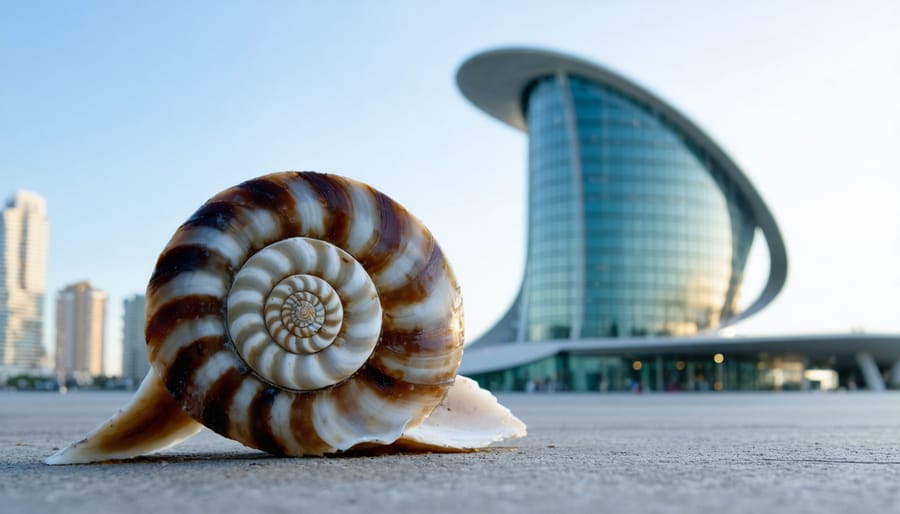
Nature’s most ingenious architects don’t build with concrete and steel – they construct with calcium carbonate, chitin, and living tissue. Marine organisms have perfected sustainable design over millions of years, inspiring a revolutionary approach to human architecture that’s reshaping our built environment. Through advanced marine science visualization, we’re now understanding how coral reefs, mollusc shells, and deep-sea structures offer blueprints for resilient, energy-efficient buildings.
From the hexagonal efficiency of coral polyps to the pressure-resistant geometry of nautilus shells, marine architecture represents nature’s solutions to complex engineering challenges. These biological designs are increasingly informing sustainable urban development, creating buildings that not only minimize environmental impact but actively contribute to ecosystem health.
As climate change threatens coastal communities worldwide, architects are turning to marine organisms for innovative approaches to flood resistance, thermal regulation, and carbon sequestration. By studying and adapting these time-tested biological systems, we’re developing architectural solutions that work in harmony with natural processes rather than against them.
Nature’s Perfect Blueprints: Marine Life in Architecture
Shell Structures and Load Distribution
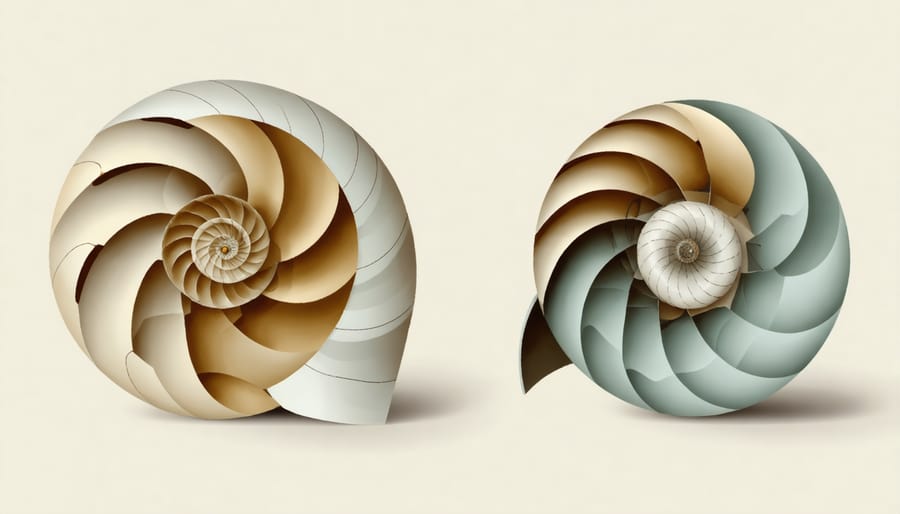
Nature’s most remarkable architectural achievements can be found in the humble mollusk shell, inspiring countless sustainable building designs worldwide. The nautilus shell, with its logarithmic spiral structure, has influenced architects to create buildings that distribute weight and stress efficiently while minimizing material usage. These biomimetic designs demonstrate remarkable structural stability and resilience against external forces.
The Sydney Opera House stands as a prime example, with its iconic shell-like structures that not only create dramatic visual impact but also provide exceptional acoustic properties and natural ventilation. Similarly, the Milwaukee Art Museum’s Burke Brise Soleil features moveable shell-formed wings that protect the building from harsh weather while regulating internal temperature.
Modern architects are increasingly turning to mollusks for sustainable design solutions. The internal chamber structure of nautilus shells has inspired innovative building techniques that reduce material consumption while maintaining structural integrity. These nature-inspired designs often require 30-50% less building material than traditional structures, making them both environmentally friendly and cost-effective.
The success of these shell-inspired structures demonstrates how marine life continues to influence sustainable architecture, offering solutions to modern construction challenges while promoting environmental consciousness.
Coral Colony Organization
Coral colonies serve as remarkable natural blueprints for modular building design, offering insights into creating resilient and adaptable structures. These marine architects construct intricate calcium carbonate frameworks that efficiently maximize space while maintaining structural integrity under challenging ocean conditions.
The organization of coral polyps, which build their colonies through repetitive, interconnected units, has inspired numerous sustainable building projects worldwide. Architects study how coral colonies create spaces that facilitate water flow, nutrient distribution, and waste removal – essential features that can be applied to modern building ventilation and waste management systems.
The modular growth patterns of coral reefs demonstrate how individual units can connect to form larger, more complex structures while maintaining flexibility and strength. This principle has influenced the development of prefabricated building components and adaptable living spaces. Additionally, the way coral colonies respond to environmental stresses by modifying their growth patterns provides valuable lessons for designing climate-resilient architecture.
These marine-inspired design principles not only create more sustainable buildings but also help raise awareness about the importance of preserving coral reef ecosystems for future generations.
Sustainable Solutions from the Sea
Water Management Systems
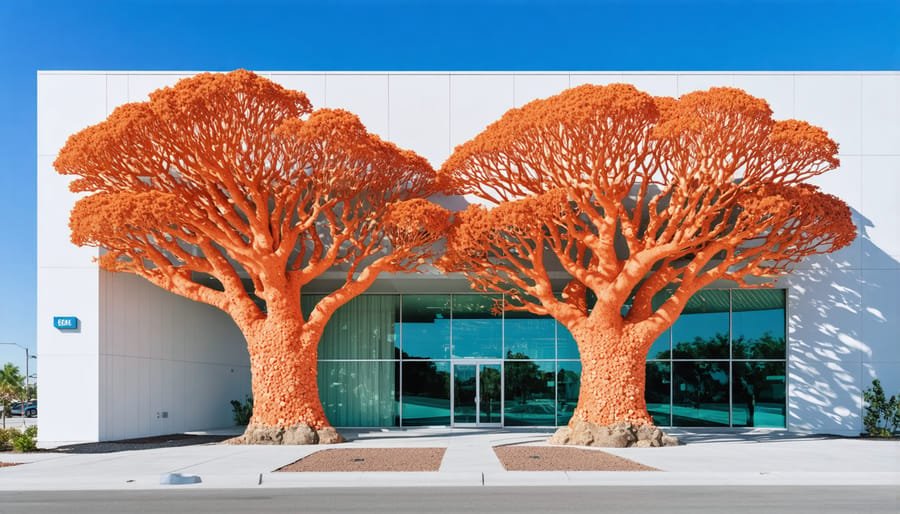
Marine organisms have developed remarkable water filtration and management systems through millions of years of evolution, inspiring innovative architectural solutions for sustainable building design. The humble sea squirt, for example, demonstrates an efficient water filtration mechanism that architects and engineers now emulate in modern building systems.
These bio-inspired water management systems typically incorporate three key elements: collection, filtration, and distribution. Much like how mussels filter particles from seawater, building-scale filtration systems use multi-stage processes to purify rainwater and greywater. Some cutting-edge designs even mirror the water-processing capabilities of marine sponges, which can filter up to 20,000 times their body volume in water daily.
Architects have successfully implemented these principles in various projects worldwide. The Pearl River Tower in Guangzhou, China, features a water management system inspired by deep-sea creatures that operate in high-pressure environments. This system captures and recycles moisture from the air while maintaining optimal pressure throughout the building.
Living walls and roof gardens, inspired by intertidal ecosystems, play a crucial role in these systems. They act as natural filters while providing additional benefits such as temperature regulation and increased biodiversity. These features can reduce a building’s water consumption by up to 30% compared to conventional systems.
The future of water management in architecture continues to evolve with new discoveries in marine biology. Researchers are currently studying the water-preservation techniques of tide pool organisms to develop more efficient systems for arid regions, demonstrating the endless potential of marine-inspired architectural innovation.
Energy-Efficient Designs
Marine organisms have evolved remarkable adaptations for energy efficiency, providing architects with innovative solutions for sustainable building design. Through bio-inspired sustainable design, architects are revolutionizing how buildings interact with their environment.
Consider the harbor seal’s fur, which inspired the development of dynamic facade systems that regulate heat absorption and release. These systems adapt to changing environmental conditions, reducing energy consumption for heating and cooling by up to 30%. Similarly, the sophisticated water filtration mechanisms of mussels have influenced the creation of smart building membranes that purify rainwater while minimizing energy use.
The bioluminescent properties of deep-sea creatures have led to advances in natural lighting solutions. Buildings incorporating these designs use specialized materials that capture and redistribute natural light, significantly reducing electricity demands. The wave-resistant structures of kelp forests have inspired flexible building materials that harness wind energy while maintaining structural integrity.
Perhaps most impressive is the translation of coral reef ecosystems into architectural designs. These structures optimize natural ventilation patterns, creating passive cooling systems that slash energy costs. The intricate channels within coral colonies have informed the development of efficient water circulation systems, while their calcium carbonate composition has inspired new sustainable building materials.
By mimicking these marine adaptations, modern architecture is achieving unprecedented levels of energy efficiency. Buildings incorporating these features typically show 40-60% reduced energy consumption compared to traditional structures, demonstrating how nature’s solutions can address our environmental challenges.
Iconic Marine-Inspired Buildings
The Sydney Opera House
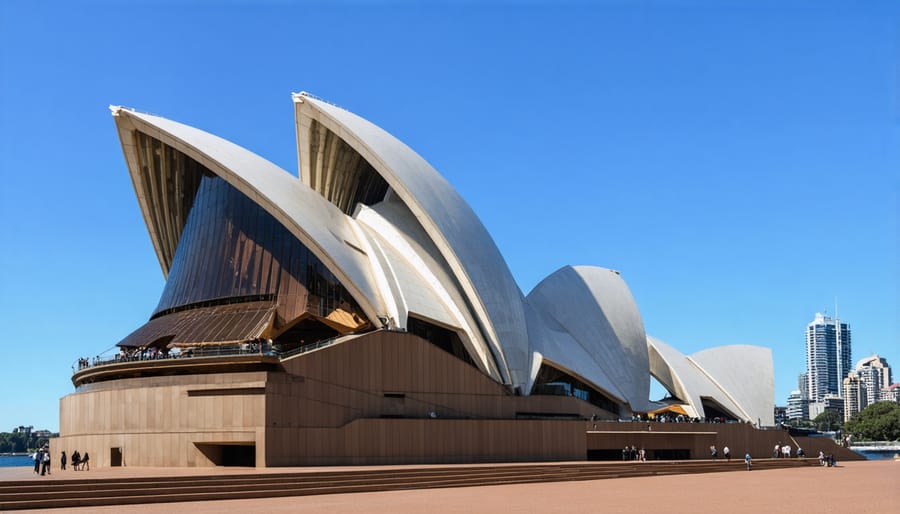
The Sydney Opera House stands as one of the most remarkable examples of biomimicry in architecture, drawing direct inspiration from marine life. Danish architect Jørn Utzon’s revolutionary design was influenced by the intricate structure of seashells, particularly the way they provide both strength and elegance through their natural geometry. Like many marine-inspired architectural exhibits, the building’s iconic shells demonstrate how nature’s solutions can be adapted for human engineering challenges.
The structure’s distinctive roof comprises pre-cast concrete shells that form a series of spherical sections, resembling the interlocking segments found in mollusk shells. This design not only creates the building’s distinctive appearance but also provides exceptional structural stability while minimizing material usage. The innovative use of spherical geometry allowed engineers to construct the shells using standardized components, making the seemingly complex structure more feasible to build.
The building’s relationship with its harbor setting further emphasizes its marine inspiration. The shells appear to emerge from the water like a living organism, while their white ceramic tiles reflect sunlight similarly to the iridescent inner surface of seashells. This harmonious integration with the marine environment demonstrates how architectural innovation can respect and celebrate natural forms while creating functional spaces for human use. The Opera House continues to inspire architects and engineers to look to marine life for sustainable design solutions.
The Eastgate Centre
The Eastgate Centre in Harare, Zimbabwe, stands as a remarkable example of biomimicry in architecture, drawing inspiration from the intricate ventilation systems found in termite mounds and coral reef structures. Completed in 1996, this shopping center and office complex demonstrates how marine-inspired design can create sustainable, energy-efficient buildings in challenging climates.
The building’s innovative cooling system mirrors the natural ventilation patterns observed in coral reefs, where complex channels facilitate water and nutrient flow. Similarly, the Eastgate Centre employs a network of chimneys, fans, and vents that work in harmony to maintain comfortable indoor temperatures without conventional air conditioning. This system draws cool air from the lower levels and naturally expels warm air through the building’s upper sections.
The results are remarkable: the Eastgate Centre uses only 10% of the energy required by traditional buildings of similar size. By incorporating these coral-inspired principles, the building maintains a steady temperature of 24-25°C (75-77°F) throughout the year, despite external temperatures fluctuating between 10-40°C (50-104°F).
This successful implementation of marine-inspired architecture not only reduces energy consumption but also demonstrates how studying marine ecosystems can revolutionize sustainable building practices. The Eastgate Centre serves as a blueprint for future architectural projects, showing how nature’s time-tested solutions can address modern environmental challenges.
Future of Marine Architecture
The future of marine architecture stands at an exciting intersection of biomimicry, sustainability, and technological innovation. Building upon centuries of marine influence on human innovation, architects and engineers are now developing groundbreaking designs inspired by marine ecosystems.
Emerging trends include buildings that mimic coral reef structures, incorporating living walls that filter pollutants and create microhabitats for urban wildlife. These bio-responsive facades adapt to environmental conditions, much like how sea creatures respond to changing ocean conditions. Some pioneering projects feature self-cleaning surfaces inspired by shark skin, reducing maintenance needs while minimizing chemical use.
Water management systems based on marine organisms are revolutionizing sustainable architecture. Buildings now incorporate designs inspired by mangrove roots and coral polyps to manage stormwater naturally, while wave-inspired energy systems harness renewable power. These innovations not only reduce environmental impact but also create more resilient structures in the face of climate change.
The integration of floating architecture is gaining momentum, with designs that respond to rising sea levels. These structures draw inspiration from marine life that thrives in tidal zones, creating buildings that work with water rather than against it. Some developments feature underwater sections that provide unique perspectives on marine ecosystems while serving as artificial reefs.
Perhaps most promising is the development of self-healing materials inspired by marine organisms. Like sea creatures that can repair their shells or regenerate tissue, these materials can fix minor damage automatically, extending building lifespans and reducing maintenance costs.
Looking ahead, marine architects are exploring concepts like carbon-negative buildings that actively sequester CO2, mimicking the process of coral calcification. These innovations promise not just to minimize environmental impact, but to actively contribute to ecosystem restoration and marine conservation.
The intricate relationship between marine biodiversity and architectural innovation stands as a testament to nature’s profound influence on human creativity and sustainable design. As we’ve explored throughout this article, the diverse structures, adaptations, and survival strategies of marine organisms continue to inspire groundbreaking architectural solutions. However, this wellspring of inspiration depends entirely on the preservation of our ocean ecosystems.
The future of marine-inspired architecture relies on maintaining healthy marine environments where we can continue to study and learn from nature’s ingenious designs. From the strength of mollusk shells to the efficiency of coral structures, each species lost represents not just an ecological tragedy, but also the loss of potential architectural innovations that could help address our growing environmental challenges.
By protecting marine biodiversity, we safeguard not only the countless species that call our oceans home but also preserve an invaluable source of architectural inspiration for future generations. The convergence of marine conservation and architectural innovation demonstrates how environmental preservation directly benefits human advancement and creativity, making a compelling case for increased marine protection efforts worldwide.
Let us remember that every architectural breakthrough inspired by marine life serves as a powerful reminder of why we must act now to preserve our ocean’s biodiversity.

jessica
Ava Singh is an environmental writer and marine sustainability advocate with a deep commitment to protecting the world's oceans and coastal communities. With a background in environmental policy and a passion for storytelling, Ava brings complex topics to life through clear, engaging content that educates and empowers readers. At the Marine Biodiversity & Sustainability Learning Center, Ava focuses on sharing impactful stories about community engagement, policy innovations, and conservation strategies. Her writing bridges the gap between science and the public, encouraging people to take part in preserving marine biodiversity. When she’s not writing, Ava collaborates with local initiatives to promote eco-conscious living and sustainable development, ensuring her work makes a difference both on the page and in the real world.