Marine Biodiversity Science Center

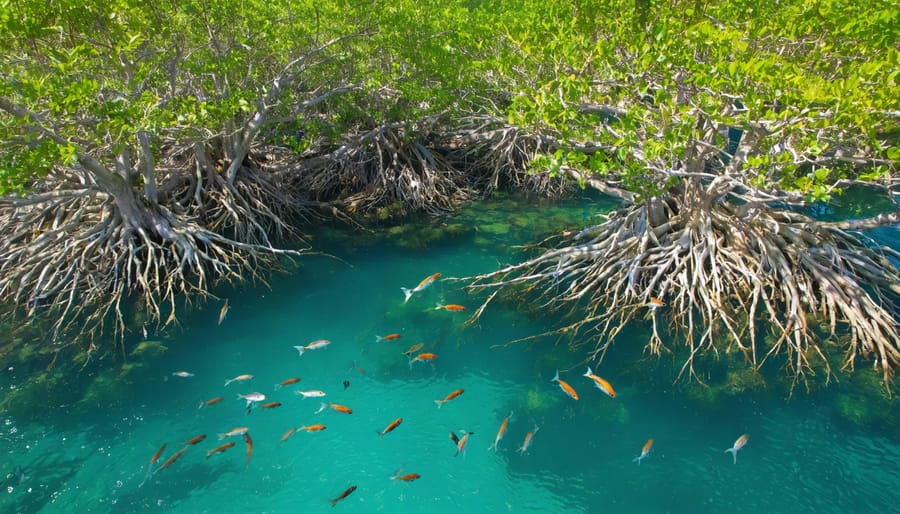
Standing as nature’s remarkable engineers between land and sea, mangrove forests represent one of Earth’s most critical yet underappreciated ecosystems. These extraordinary coastal guardians harbor vital biodiversity in mangroves, serving as nurseries for countless marine species and protecting coastlines from nature’s fury. Their intricate root systems create an underwater maze where juvenile fish find sanctuary, while their dense canopies provide essential habitat for diverse bird species and marine mammals. Beyond their role as biodiversity hotspots, mangroves act as powerful carbon sinks, sequestering up to four times more carbon than terrestrial forests and playing a crucial role in mitigating climate change. Despite occupying less than 1% of the world’s tropical forests, these remarkable ecosystems deliver ecosystem services worth an estimated $1.6 trillion annually, supporting coastal communities through sustainable fisheries, natural storm protection, and eco-tourism opportunities. Yet, these invaluable forests face unprecedented threats from coastal development, aquaculture expansion, and rising sea levels, making their conservation more urgent than ever.
Nature’s Marine Nursery: How Mangroves Foster Life
Safe Haven for Juvenile Marine Species
Mangrove root systems create an intricate underwater maze that serves as a vital nursery for countless marine species during their most vulnerable life stages. These complex networks of aerial and prop roots offer perfect hiding spots for juvenile fish, crustaceans, and other marine organisms, protecting them from larger predators that find it difficult to navigate through the dense root structure.
Studies have shown that mangrove habitats support up to 75% of tropical commercial fish species during their early life stages. Species like snappers, groupers, and barracudas spend their juvenile phases among mangrove roots before moving to coral reefs as adults. The calm, nutrient-rich waters between mangrove roots also provide ideal conditions for young marine life to feed and grow.
The root system’s protective function extends beyond fish to include various invertebrates. Young shrimp, crabs, and mollusks find shelter among the roots, contributing to the maintenance of healthy populations of commercially important species. Marine biologist Dr. Sarah Chen notes, “The relationship between mangroves and juvenile marine life is so crucial that we often see significant declines in adult fish populations in areas where mangroves have been removed.”
The protective service of mangroves is enhanced by the high turbidity of the water around their roots, which provides additional camouflage for young marine life. This combination of physical shelter and natural concealment makes mangrove ecosystems irreplaceable safe havens for marine biodiversity.

Breeding Ground Success Stories
Mangroves serve as essential nurseries for countless marine species, creating safe havens where young aquatic life can thrive. The intricate root systems of these coastal forests provide perfect shelter for juvenile fish, protecting them from larger predators while offering abundant food sources.
Notable success stories include the blacktip reef shark, which relies heavily on mangrove nurseries during its early life stages. Research in the Indo-Pacific region has shown that young sharks surviving in mangrove-protected areas have a 50% higher survival rate compared to those in unprotected waters.
Many commercial fish species also depend on mangroves for their early development. The snapper family, particularly the mangrove red snapper, spends its juvenile phase among the roots before moving to deeper waters as adults. In the Caribbean, studies have documented how spiny lobsters use mangrove roots as shelter during their vulnerable post-larval stage.
Birds find these coastal forests equally vital for reproduction. The magnificent frigatebird constructs its nests in the higher branches, while roseate spoonbills establish entire breeding colonies within mangrove canopies. In Florida’s mangrove forests, researchers have observed successful breeding populations of endangered wood storks, highlighting these ecosystems’ crucial role in species recovery.
Marine mammals also benefit from mangrove nurseries. Dugongs often give birth in mangrove-protected waters, where their calves can safely develop. This demonstrates how mangroves continue to play a vital role in maintaining healthy populations of various marine species, from the smallest fish to the largest marine mammals.
The Living Filter: Water Quality and Sediment Control
Natural Water Purification System
Mangroves serve as nature’s remarkable water filtration system, effectively removing pollutants and maintaining water quality in coastal ecosystems. Their intricate root systems, particularly the aerial roots, act as natural sieves that trap sediments, heavy metals, and other contaminants from both land runoff and tidal waters.
The process begins when water flows through the dense network of roots, where sediments become trapped and settle. This mechanical filtration is enhanced by chemical processes, as mangrove roots host beneficial bacteria that break down organic matter and neutralize certain pollutants. Research has shown that mangrove forests can remove up to 90% of coastal water contaminants, including nitrogen and phosphorus from agricultural runoff.
Moreover, mangroves’ ability to trap sediments helps prevent coastal erosion and maintains water clarity, which is crucial for the survival of nearby coral reefs and seagrass beds. This clarity allows sunlight to penetrate the water, supporting photosynthesis in marine plants and ensuring the health of the entire coastal ecosystem.
Marine biologist Dr. Sarah Chen notes, “What’s fascinating about mangroves is their dual role – they not only filter water but also create cleaner, more stable environments for countless marine species to thrive. It’s like having a natural water treatment plant that also serves as a nursery for marine life.”

Sediment Trap Excellence
Mangroves serve as nature’s coastal engineers, deploying an intricate network of roots that excel at trapping and stabilizing sediments. As waves and tidal waters move through these root systems, they slow down significantly, allowing suspended particles to settle and accumulate among the roots. This process creates a natural filtration system that not only prevents coastal erosion but also helps maintain water quality.
The aerial roots of mangroves, particularly their distinctive prop roots and pneumatophores, form a complex underwater matrix that acts like a protective barrier. During storms and high tides, this root network reduces wave energy by up to 75%, significantly decreasing the impact of coastal erosion. Over time, the trapped sediments build up, creating new land and expanding the shoreline naturally.
What makes mangroves particularly effective at sediment trapping is their ability to adapt to changing conditions. As sediment levels rise, the trees respond by growing new roots at higher levels, creating a continuous cycle of sediment accumulation and stabilization. This dynamic process helps maintain shoreline stability and protects coastal communities from storm surges and sea-level rise.
Research has shown that areas with healthy mangrove forests experience significantly less coastal erosion compared to deforested coastlines, highlighting their crucial role in maintaining coastal integrity.
Carbon Warriors: Climate Change Mitigation
Mangroves are nature’s unsung heroes in the fight against climate change, earning their reputation as powerful carbon warriors through their exceptional ability to sequester and store carbon dioxide. These remarkable ecosystems can store up to five times more carbon than terrestrial forests, making them crucial allies in climate change mitigation efforts.
The secret to mangroves’ carbon-storing prowess lies in their unique root systems and the waterlogged soils they inhabit. When mangrove leaves, branches, and roots die, they don’t decompose quickly due to the low-oxygen conditions in the soil. Instead, this organic matter becomes trapped in the sediment, creating vast carbon reserves known as “blue carbon.” Scientists estimate that mangroves globally sequester approximately 24 million metric tons of carbon in their soils annually.
Beyond carbon storage, mangroves demonstrate remarkable resilience to climate change impacts. Their intricate root systems help protect coastlines from rising sea levels and increasingly intense storms, while their ability to trap sediments allows them to gradually build land elevation – a natural adaptation mechanism against sea-level rise.
Dr. Maria Santos, a marine biologist working in the Gulf of Mexico, shares her perspective: “What’s fascinating about mangroves is their dual role in climate change. They’re not just storing carbon; they’re actively building resilience in coastal communities against climate impacts. It’s like having a natural insurance policy for our shorelines.”
However, the carbon-fighting capacity of mangroves is under threat. When these ecosystems are destroyed, their stored carbon is released back into the atmosphere, contributing to the very problem they help combat. Conservation efforts are now focusing on both protecting existing mangrove forests and restoring degraded areas, with successful projects showing that restored mangroves can resume their carbon sequestration roles within 5-10 years of replanting.
Community-led initiatives worldwide are recognizing the value of these ecosystem services. Local conservation groups organize regular mangrove planting events, combining climate action with coastal protection while providing opportunities for public engagement in environmental stewardship.
Interconnected Ecosystems: The Ripple Effect
Coral Reef Connections
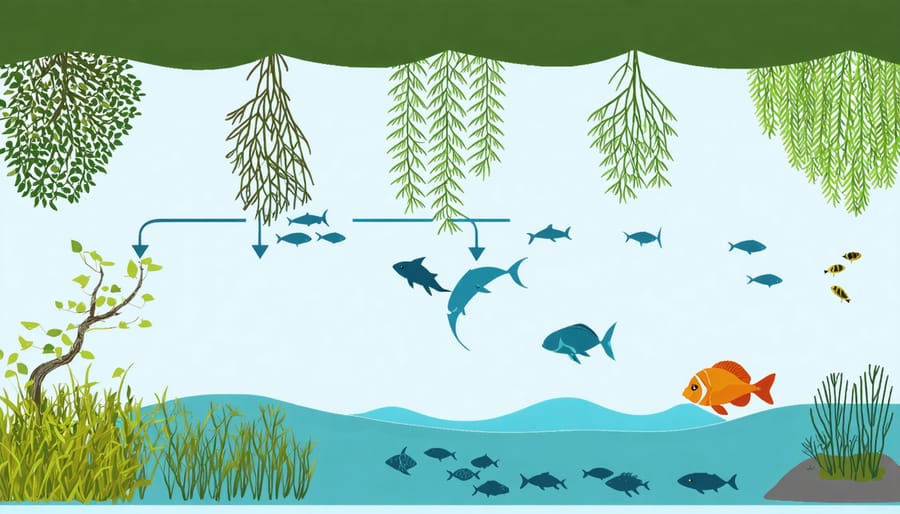
Mangroves and coral reef ecosystems share a vital ecological partnership that enhances marine biodiversity and coastal resilience. These two ecosystems work together in a remarkable symbiotic relationship, with mangroves acting as natural filters and nurseries that support reef health.
The dense root systems of mangroves trap sediment and pollutants that would otherwise flow onto reefs, helping maintain the clear water conditions that corals need to thrive. This filtering process is especially crucial during heavy rains and storm events when terrestrial runoff increases dramatically.
Young reef fish find sanctuary among mangrove roots during their early life stages. Marine biologist Dr. Sarah Chen notes, “We’ve observed over 70% of commercially important reef fish species using mangroves as nursery grounds during their juvenile phase.” These protected areas provide essential shelter from predators and abundant food sources, allowing fish populations to grow before migrating to nearby reefs.
The connection between these ecosystems extends to nutrient cycling as well. Mangroves export organic materials that feed reef organisms, while reef structures help buffer wave energy, creating calmer conditions that support mangrove seedling establishment. This mutual support system demonstrates nature’s intricate design in coastal protection and marine life preservation.
Conservation efforts targeting both ecosystems have shown greater success than isolated approaches, highlighting the importance of integrated coastal management strategies.
Seagrass Meadow Synergy
Mangroves and seagrass meadows form a remarkable partnership in coastal ecosystems, creating a powerful synergy that enhances marine biodiversity and ecosystem resilience. These two distinct habitats work together as natural filters, with mangroves first catching and settling larger sediments, while seagrass beds trap finer particles, resulting in clearer, healthier waters for marine life.
This collaborative relationship creates an essential corridor for numerous marine species. Juvenile fish often begin their life journey in the protective shelter of mangrove roots before transitioning to seagrass beds as they mature. This sequential habitat use significantly increases their survival rates and supports sustainable fish populations.
The partnership also strengthens coastal protection. Mangroves serve as the first line of defense against waves and storms, while seagrass beds help stabilize the seafloor and reduce wave energy further offshore. Together, they prevent coastal erosion more effectively than either ecosystem could alone.
Their combined nutrient cycling capabilities are equally impressive. Mangroves contribute organic matter and nutrients that enrich seagrass beds, while seagrass communities help maintain water quality that benefits mangrove health. This nutrient exchange supports a diverse food web and creates optimal conditions for species like dugongs, sea turtles, and commercially important fish species that depend on both habitats during different life stages.
Conservation in Action: Protecting Our Mangrove Heritage
Global conservation efforts are gaining momentum as communities recognize the urgent need to protect mangrove ecosystems from threats to marine biodiversity. Organizations worldwide are implementing innovative strategies to preserve these vital coastal habitats. The Mangrove Action Project, for instance, has successfully restored thousands of hectares through their “Community-Based Ecological Mangrove Restoration” approach, which emphasizes natural regeneration over artificial planting.
Local communities are becoming guardians of their mangrove heritage through educational programs and sustainable management practices. In Southeast Asia, former shrimp farmers now lead eco-tourism initiatives, providing alternative livelihoods while protecting mangrove forests. These success stories demonstrate how conservation can benefit both nature and communities.
You can contribute to mangrove conservation in several ways:
• Join local mangrove planting events organized by environmental groups
• Support organizations dedicated to mangrove protection through donations or volunteer work
• Participate in citizen science projects monitoring mangrove health
• Spread awareness about mangrove importance in your community
• Choose sustainable seafood products from companies that protect mangrove habitats
Marine biologist Dr. Sarah Chen shares, “Every restored mangrove forest represents hope for our coastal ecosystems. When communities get involved, the impact is exponential.” Conservation groups are now using satellite monitoring and AI technology to track mangrove health and identify areas needing immediate protection.
The future of mangrove conservation depends on continued collaboration between scientists, local communities, and concerned citizens. Together, we can ensure these vital ecosystems continue to thrive for generations to come.
Mangroves stand as irreplaceable guardians of our coastal ecosystems, providing vital services that extend far beyond their muddy roots. From nurturing marine biodiversity and protecting shorelines to sequestering carbon and supporting local economies, these remarkable forests are true champions of environmental sustainability. Yet, despite their critical importance, mangroves face unprecedented threats from coastal development, climate change, and resource exploitation. The time for action is now. By supporting local conservation initiatives, participating in mangrove restoration projects, and spreading awareness about their ecological significance, we can help protect these vital ecosystems for future generations. Together, we can ensure that mangroves continue their essential role in maintaining the delicate balance of our coastal environments and supporting the countless species that depend on them.

jessica
Ava Singh is an environmental writer and marine sustainability advocate with a deep commitment to protecting the world's oceans and coastal communities. With a background in environmental policy and a passion for storytelling, Ava brings complex topics to life through clear, engaging content that educates and empowers readers. At the Marine Biodiversity & Sustainability Learning Center, Ava focuses on sharing impactful stories about community engagement, policy innovations, and conservation strategies. Her writing bridges the gap between science and the public, encouraging people to take part in preserving marine biodiversity. When she’s not writing, Ava collaborates with local initiatives to promote eco-conscious living and sustainable development, ensuring her work makes a difference both on the page and in the real world.