Marine Biodiversity Science Center

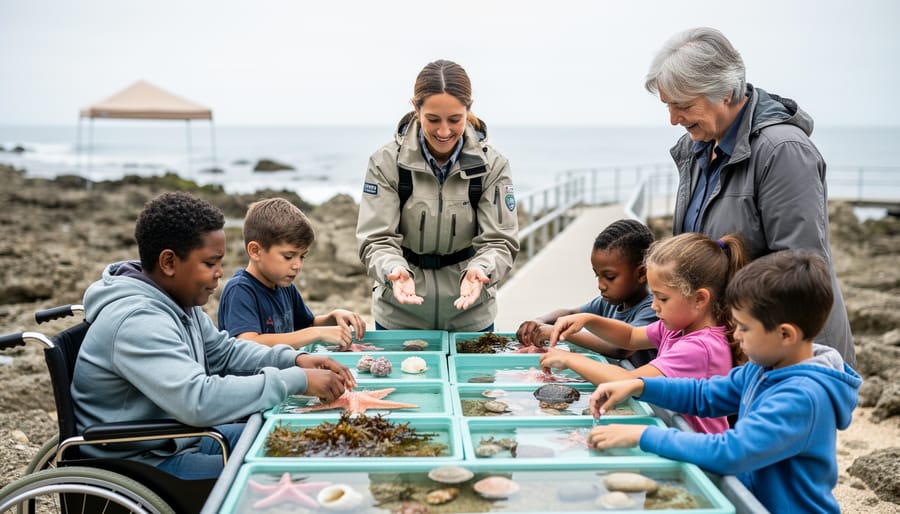
Audit your current marine education program by examining who participates and who doesn’t. Survey local demographics, review registration data from the past three years, and identify gaps in age, income level, cultural background, and physical ability representation. Contact community centers, schools in underserved neighborhoods, and disability advocacy groups to understand specific barriers preventing participation in your programs.
Remove financial obstacles by implementing sliding-scale fees, creating scholarship funds through donor partnerships, and offering payment plans that spread costs across multiple months. The Vancouver Aquarium’s community access program demonstrates this effectively, providing free annual passes to families receiving social assistance, resulting in a 40% increase in diverse visitor participation within two years.
Redesign program materials and delivery methods to accommodate different learning styles and abilities. Provide content in multiple languages based on your community’s demographics, create visual aids and hands-on activities for non-verbal learners, and ensure physical spaces meet accessibility standards with wheelchair ramps, accessible restrooms, and sensory-friendly options. When marine education transforms lives, it reaches beyond traditional audiences to engage entire communities in ocean stewardship.
Partner with organizations already serving diverse communities rather than expecting these groups to find you. Marine biologist Dr. Ayana Elizabeth Johnson emphasizes that meaningful inclusion requires going where people are, building trust through consistent presence, and co-creating programs that reflect community interests. Reach out to cultural centers, disability resource networks, and youth organizations serving marginalized populations to develop collaborative programming that addresses their specific needs while advancing marine conservation goals.
The Real Cost of Exclusion in Marine Conservation
Missing Voices, Missing Solutions
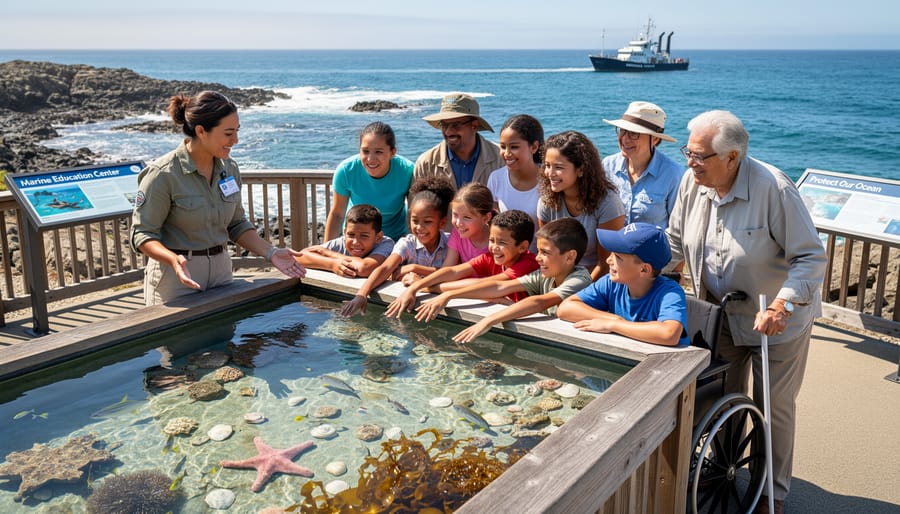
When we exclude communities from marine education, we don’t just create gaps in participation—we lose invaluable knowledge and creative solutions that could transform ocean conservation. Indigenous coastal communities hold generations of traditional ecological knowledge about marine ecosystems, fish migration patterns, and sustainable harvesting practices that modern science is only beginning to document and validate. Their ancestral wisdom offers time-tested approaches to maintaining healthy ocean ecosystems.
People with disabilities bring unique perspectives on accessibility and adaptive problem-solving that can revolutionize how we design research equipment, educational materials, and conservation programs. Marine biologist Dr. Ayana Elizabeth Johnson, who studies diverse perspectives in conservation, notes that innovation flourishes when we include voices from varied backgrounds and experiences.
Low-income populations living in coastal areas often have direct, daily interactions with marine environments through fishing, recreation, and local economies. Their practical observations about changing ocean conditions, declining fish stocks, and pollution impacts provide essential real-time data that complements formal scientific monitoring.
Even landlocked communities contribute vital perspectives. People far from coastlines often work in industries affecting ocean health through plastic production, agriculture runoff, or water conservation. Their insights into behavioral change and inland-to-ocean connections are crucial for comprehensive conservation strategies.
By excluding these voices, we create incomplete solutions based on limited viewpoints. True marine conservation requires weaving together scientific expertise with community knowledge, traditional practices with innovative thinking, and coastal experiences with inland perspectives. Every excluded voice represents lost opportunities for breakthrough discoveries and more effective, culturally responsive conservation approaches.
The Pipeline Problem
The exclusion begins early, often before students even realize marine science could be a career path. Children from inland communities, lower-income families, or underrepresented backgrounds frequently lack access to ocean experiences, aquarium visits, or marine education programs. Dr. Ayana Elizabeth Johnson, a marine biologist and policy expert, shares how her Brooklyn upbringing might have led her away from ocean science if not for a transformative summer program that introduced her to the marine world. This early exclusion creates a pipeline problem where the pool of aspiring marine scientists lacks diversity from the start.
The consequences ripple through the entire field. When marine research teams lack diverse perspectives, they may overlook critical conservation issues affecting coastal communities of color or indigenous populations who depend on marine resources. Research priorities can become skewed toward topics that resonate with a homogeneous group of scientists, potentially missing innovative solutions that emerge from varied cultural approaches to ocean stewardship. Communities closest to marine ecosystems often hold valuable traditional ecological knowledge, yet their voices remain underrepresented in conservation planning and policy decisions that directly impact their livelihoods and cultural practices.
Breaking Down the Barriers: What Keeps People Out
Economic and Geographic Barriers
Economic barriers significantly limit participation in marine education and conservation programs. Program fees, specialized equipment costs, and travel expenses create substantial obstacles for many communities. A marine biology summer camp charging $500-$1,500 per week remains inaccessible to families with limited financial resources, effectively excluding talented, passionate young people from marine science pathways based solely on economic circumstances.
Geographic location compounds these challenges. Coastal communities enjoy natural proximity to marine environments, while inland populations face considerable travel costs and logistical hurdles to access ocean-based programs. Students in landlocked states may never experience tide pools or coral reefs firsthand, creating an educational disparity that shapes career opportunities and conservation awareness.
These barriers disproportionately affect low-income families, rural communities, and marginalized groups who already face systemic obstacles in STEM fields. When marine education requires significant financial investment or coastal proximity, we inadvertently narrow the diversity of voices contributing to ocean conservation. Organizations can address these challenges by offering scholarships, developing virtual programming that brings marine environments to inland classrooms, partnering with local aquariums for accessible experiences, and creating sliding-scale fee structures. By removing economic and geographic barriers, we expand marine conservation’s reach and ensure diverse perspectives shape our collective efforts to protect ocean ecosystems.
Physical and Sensory Accessibility Challenges
Marine education and conservation programs often inadvertently exclude people with disabilities through physical and sensory barriers that limit participation. Field sites frequently lack wheelchair-accessible pathways, making coastal surveys or tide pool explorations impossible for those with mobility challenges. Research vessels and dive boats rarely accommodate wheelchair users, while the rocking motion can pose difficulties for people with balance disorders or vestibular conditions.
Educational facilities face similar challenges. Many aquariums and marine centers lack tactile exhibits or audio descriptions for visitors with visual impairments, missing opportunities to share the texture of shark skin or the intricate structure of coral polyps through touch. Meanwhile, video presentations without captions exclude deaf and hard-of-hearing participants from crucial learning experiences.
Learning materials compound these issues when designed without diverse needs in mind. Dense text-heavy handouts overlook people with dyslexia or cognitive processing differences, while small font sizes challenge those with low vision. Lab equipment and microscopes may be positioned at heights inaccessible to wheelchair users, and field guides rarely include braille or large-print options.
Dr. Maria Santos, a marine biologist who uses a wheelchair, shares: “I’ve had to decline fascinating research opportunities simply because the boat wasn’t accessible. We’re missing out on talented scientists because of preventable barriers.”
Cultural and Language Disconnects
Marine education programs often inadvertently exclude communities by presenting ocean conservation through a predominantly Western, English-speaking lens. Many coastal communities worldwide have generations-deep relationships with the ocean that differ significantly from the perspectives typically emphasized in mainstream marine science curricula. For instance, Indigenous peoples and fishing communities possess traditional ecological knowledge that’s rarely incorporated into formal education materials, creating a disconnect that suggests their ocean experiences are less valuable.
The lack of multilingual resources presents another significant barrier. While ocean conservation is a global imperative, educational materials predominantly exist in English, limiting access for non-English speakers who may live in critical marine biodiversity hotspots. A marine biologist working in Southeast Asia shared how her community engagement efforts transformed when materials were translated into local languages and incorporated cultural fishing traditions rather than simply presenting Western conservation frameworks.
Educational programs that ignore these cultural and linguistic disconnects miss opportunities to build truly inclusive movements. By recognizing that people relate to the ocean through diverse cultural lenses—whether as a source of livelihood, spiritual connection, recreation, or sustenance—we can develop resources that resonate authentically across communities and strengthen collective conservation action.
Building Inclusive Marine Education Programs That Actually Work
Designing for Universal Access
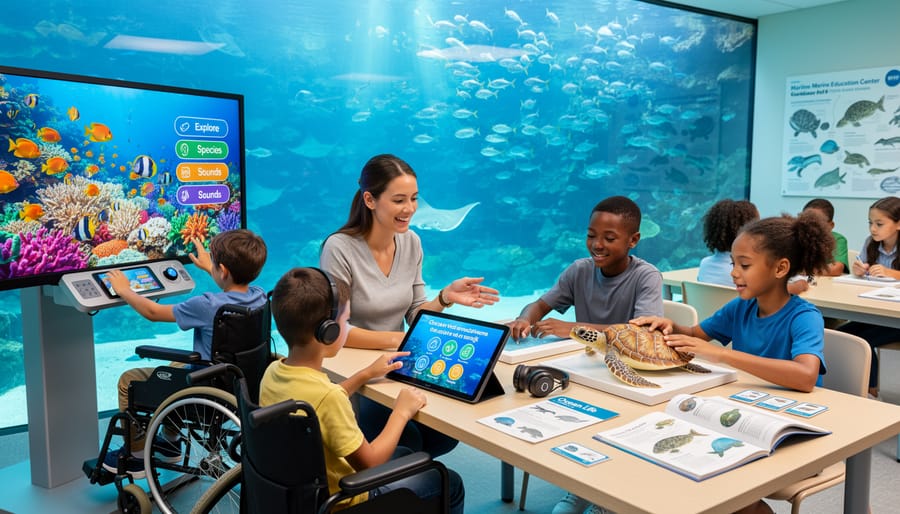
Creating truly accessible marine education requires thoughtful design that removes physical, sensory, and technological barriers. Forward-thinking programs are proving that everyone can experience the wonder of ocean science, regardless of mobility, sensory processing, or geographic limitations.
Physical accessibility starts with adaptive equipment. The Marine Science Consortium in Pennsylvania offers specialized beach wheelchairs with wide, balloon-like tires that navigate sand and shallow water, allowing wheelchair users to participate directly in shoreline investigations. Touch tanks can be designed at varying heights with textured railings, while waterproof communication boards help visitors with speech differences ask questions during programs.
For those who cannot visit the coast, virtual ocean experiences bridge the distance. The Monterey Bay Aquarium’s live webcams and 360-degree virtual dives bring kelp forests and deep-sea environments to classrooms worldwide. These digital tools serve not only landlocked communities but also individuals with compromised immune systems or anxiety disorders who may struggle with crowded public spaces.
Sensory-friendly programming recognizes that not everyone processes stimulation the same way. Seattle Aquarium hosts quiet hours with dimmed lighting and reduced crowds for visitors with autism or sensory processing differences. Staff receive training to recognize and accommodate diverse needs, from providing noise-canceling headphones to offering fidget tools during presentations.
Marine biologist Dr. Alison Gill, who uses a wheelchair, transformed her institution’s field program by developing modified sampling protocols. “Adaptive equipment isn’t about lowering standards,” she explains. “It’s about removing unnecessary obstacles so everyone can contribute their full potential to ocean conservation.” Her approach has inspired numerous volunteer opportunities for disabled scientists nationwide.
Meeting Communities Where They Are
True inclusivity means bringing ocean education to people who may never see the coast. Marine science doesn’t need to be confined to coastal communities—effective community-based marine education can thrive anywhere with creative approaches and committed partnerships.
Dr. Maya Rodriguez, a marine biologist from California, transformed her approach after realizing her coastal programs reached only a narrow demographic. She developed portable ocean education kits and partnered with community centers, libraries, and youth organizations in inland cities across the Southwest. “I brought touchable specimens, microscopes, and virtual reality experiences to places where families had never considered the ocean relevant to their lives,” she explains. “Within months, we connected thousands of students to marine ecosystems they’d never imagined exploring.”
Successful inland programs utilize traveling exhibits, virtual dive experiences, and connections between local watersheds and ocean health. Even landlocked rivers eventually flow to the sea, creating natural teaching opportunities about interconnected ecosystems.
Financial accessibility remains equally critical. Organizations should offer sliding-scale fees, scholarship programs, or completely free sessions to remove economic barriers. Partner with community organizations already trusted by diverse populations—they understand cultural contexts and communication styles that resonate with their communities.
Creating culturally relevant content means incorporating diverse languages, recognizing different cultural relationships with water and nature, and featuring scientists from varied backgrounds. When people see themselves represented in marine science, they’re more likely to engage meaningfully with conservation efforts. This approach doesn’t dilute scientific content—it expands who gets to participate in protecting our oceans.
Creating Multilingual and Multicultural Resources
Developing truly inclusive marine education materials requires intentional effort to transcend linguistic and cultural boundaries. Start by partnering with professional translators who understand both marine science terminology and cultural nuances, rather than relying on automated translation tools. This ensures accuracy while respecting how different communities relate to ocean ecosystems.
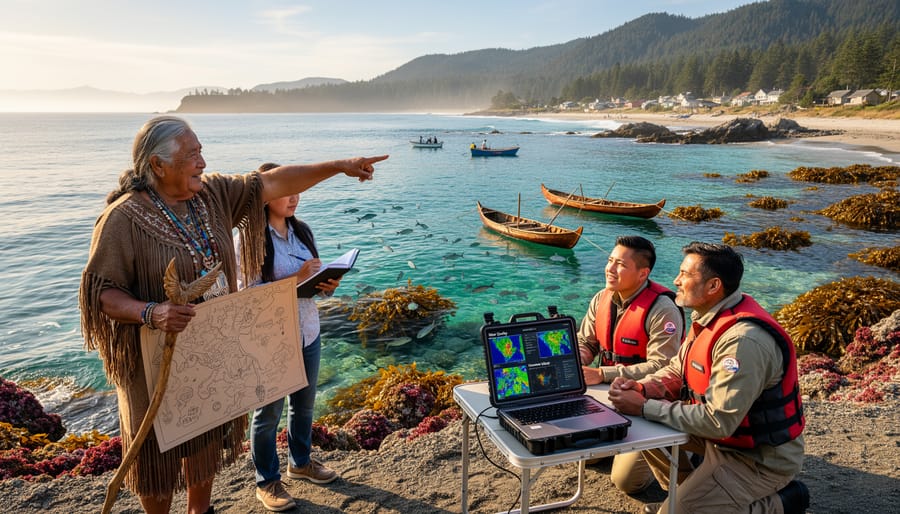
Indigenous knowledge systems offer invaluable perspectives on marine conservation that complement Western scientific approaches. Collaborate with Indigenous educators and community leaders to co-create content that honors traditional ecological knowledge, sustainable fishing practices, and spiritual connections to the sea. For example, Pacific Islander navigation techniques and Aboriginal Australian reef management systems provide rich educational content that demonstrates humanity’s diverse relationships with marine environments.
Representation matters profoundly in curricula. Include case studies featuring marine scientists from various backgrounds, showcase conservation projects led by diverse communities, and highlight how different cultures have historically protected ocean resources. Marine biologist Dr. Ayana Elizabeth Johnson shares how seeing scientists who looked like her inspired her career path, emphasizing why diverse role models in educational materials can transform students’ aspirations.
Consider creating modular resources that educators can adapt to local contexts, incorporating regional marine species, coastal traditions, and community-specific conservation challenges. This flexibility ensures materials resonate authentically across different cultural settings.
Inclusive Volunteer and Career Pathways in Marine Conservation
Reimagining Volunteer Requirements
Making volunteer opportunities accessible to diverse participants requires rethinking traditional models that often favor those with flexibility, financial resources, and physical abilities. The Marine Biodiversity Science Center has pioneered inclusive volunteer programs that demonstrate how organizations can expand participation while maintaining meaningful conservation impact.
Remote volunteering has emerged as a powerful tool for inclusion. Citizen scientists can now contribute by analyzing underwater footage, identifying species in photographs, or transcribing historical marine data from their own homes. These opportunities particularly benefit individuals with mobility challenges, caregivers who cannot commit to fixed schedules, and people living far from coastal areas who still want to support ocean conservation.
Skill-based volunteering recognizes that conservation needs extend beyond field work. Graphic designers create educational materials, translators make resources accessible in multiple languages, and data analysts help interpret research findings. A retired accountant recently volunteered to manage grant reporting for the Center, freeing scientists to focus on research while demonstrating that everyone has valuable skills to contribute.
Physical accommodations transform field opportunities. The Center provides accessible boats with wheelchair ramps, modified equipment for different grip strengths, and alternative tasks during beach cleanups. One volunteer with chronic fatigue contributes by photographing and cataloging specimens while seated, a role equally vital to research success.
Flexible scheduling options, including weekend and evening programs, remove barriers for working professionals and students. By meeting people where they are, organizations build diverse volunteer communities that strengthen both conservation outcomes and public engagement.
Mentorship and Support Systems
Mentorship programs and support networks serve as crucial bridges for underrepresented groups entering marine conservation. Organizations like the Association for the Sciences of Limnology and Oceanography offer targeted scholarships and mentorship initiatives that pair emerging scientists with established professionals, creating pathways that might otherwise remain closed.
Dr. Ayana Elizabeth Johnson, a marine biologist and policy expert, credits early mentorship with helping her navigate a field where she rarely saw people who looked like her. “Having someone who understood both the science and the unique challenges I faced made all the difference,” she shares. Similarly, the Marine Conservation Institute’s diversity fellowship program provides not just funding, but ongoing guidance and professional networks that help recipients establish lasting careers.
Support systems extend beyond formal programs. Online communities, peer networks, and resource-sharing platforms help diverse conservationists find opportunities and overcome barriers. Universities increasingly offer affinity groups where students from underrepresented backgrounds can connect, share experiences, and build confidence in their scientific pursuits.
For those interested in supporting these efforts, volunteer opportunities exist through mentorship matching programs, scholarship fundraising initiatives, and by serving as advisors to emerging scientists. Creating these supportive ecosystems ensures that marine conservation benefits from the broadest possible range of perspectives and talents.
How You Can Champion Inclusivity in Marine Education
Creating inclusive marine education starts with individual commitment and grows through collective action. Whether you’re an educator, scientist, or passionate volunteer, you have the power to make a difference.
Begin by examining your own programs and materials. Are your resources available in multiple formats? Do your examples represent diverse communities and perspectives? Simple changes, like adding closed captions to videos or incorporating stories from Indigenous marine knowledge keepers, can dramatically increase accessibility.
Educators can attend specialized marine education workshops that focus on inclusive teaching methods. These professional development opportunities provide practical tools for adapting curriculum and creating welcoming learning environments for students of all backgrounds and abilities.
Organizations should actively recruit diverse voices for their teams and advisory boards. Partner with community groups serving underrepresented populations to co-develop programs that meet their specific needs and interests. Consider offering scholarships, transportation assistance, or flexible scheduling to remove participation barriers.
Join our e-network community to connect with like-minded individuals championing inclusivity in marine conservation. Share your successes, learn from others’ experiences, and access resources designed to support inclusive practices. Together, we can ensure that everyone has the opportunity to discover, learn about, and protect our ocean’s incredible biodiversity. Your voice matters, and your actions inspire others to follow.
Creating inclusive marine education programs isn’t simply a matter of doing the right thing—it’s absolutely essential for the future of ocean conservation. When we broaden participation to include voices from diverse backgrounds, abilities, and communities, we strengthen the collective intelligence needed to tackle complex marine challenges. Every perspective matters, from coastal communities with generations of ocean knowledge to young students discovering marine science for the first time.
The ocean doesn’t recognize the boundaries we create, and neither should marine education. By removing barriers to access and actively welcoming everyone to the table, we build a more resilient, innovative conservation movement. Research consistently shows that diverse teams develop more creative solutions and make better decisions. In marine conservation, where challenges are interconnected and urgent, this diversity isn’t optional—it’s critical.
The Marine Biodiversity Science Center offers numerous pathways for you to engage with inclusive marine learning. Whether you’re an educator looking to transform your curriculum, a student eager to explore marine science, or a community member passionate about ocean protection, there’s a place for you in this movement. Our volunteer programs provide hands-on opportunities to contribute to research while learning alongside marine biologists who share their personal journeys and discoveries.
The future of our oceans depends on all of us working together. Start today by exploring our programs, sharing your unique perspective, and helping us create a truly inclusive marine conservation community. Together, we can ensure that ocean protection benefits from humanity’s full spectrum of knowledge, experience, and dedication.

jessica
Ava Singh is an environmental writer and marine sustainability advocate with a deep commitment to protecting the world's oceans and coastal communities. With a background in environmental policy and a passion for storytelling, Ava brings complex topics to life through clear, engaging content that educates and empowers readers. At the Marine Biodiversity & Sustainability Learning Center, Ava focuses on sharing impactful stories about community engagement, policy innovations, and conservation strategies. Her writing bridges the gap between science and the public, encouraging people to take part in preserving marine biodiversity. When she’s not writing, Ava collaborates with local initiatives to promote eco-conscious living and sustainable development, ensuring her work makes a difference both on the page and in the real world.