Marine Biodiversity Science Center

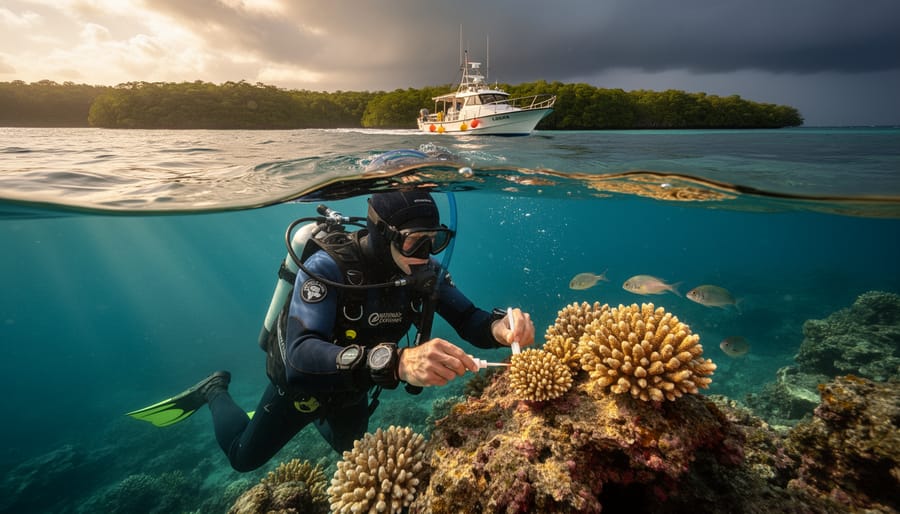
The world’s oceans face unprecedented threats—from coral bleaching to overfishing—yet a surprising financial tool is emerging as a powerful ally in marine conservation: insurance. Marine insurance policies, traditionally designed to protect ships and cargo, are being reimagined to safeguard entire ecosystems, offering a innovative bridge between economic sustainability and environmental protection.
Consider this: when a hurricane damaged coral reefs off Mexico’s coast in 2020, an insurance policy paid out $800,000 within weeks to fund immediate restoration efforts. This wasn’t standard business insurance—it was a parametric policy designed specifically to protect coastal ecosystems. The payout happened automatically when wind speeds reached predetermined thresholds, enabling rapid response that saved countless marine species and protected coastal communities from devastating storm surges.
Marine insurance for conservation operates on a compelling premise: healthy ocean ecosystems provide measurable economic value through storm protection, fisheries support, and tourism revenue. By quantifying these benefits, conservationists can purchase insurance policies that trigger payments when natural disasters threaten critical habitats like mangroves, seagrass beds, and coral reefs. The funds immediately deploy for restoration, ensuring ecosystems recover quickly and continue delivering their protective services.
This approach transforms abstract conservation goals into concrete financial mechanisms. Insurance companies assess ecosystem value using satellite monitoring, underwater sensors, and marine surveys, creating objective metrics that justify coverage. When damage occurs, predetermined triggers activate payments without lengthy claims processes, allowing marine biologists and restoration teams to act while conditions remain optimal for recovery.
Understanding these policies empowers environmental professionals, students, and concerned citizens to advocate for similar protections in their regions, potentially scaling this innovative model to safeguard marine biodiversity worldwide while demonstrating that conservation and economic resilience are inseparable partners.
What Marine Insurance Policies Actually Cover
Traditional Marine Insurance: A Quick Overview
Traditional marine insurance has protected seafaring commerce for centuries, providing financial security for ships, cargo, and maritime operations. At its core, this insurance system covers physical assets against perils of the sea—storms, collisions, piracy, and other hazards that threaten vessels and their contents during ocean voyages.
Marine insurance typically divides into three main categories: hull insurance protects the vessel itself, cargo insurance covers goods being transported, and liability insurance addresses legal responsibilities when accidents occur. Ship owners, freight companies, and cargo handlers purchase these policies to safeguard against potentially catastrophic financial losses.
This traditional framework emerged from the needs of global trade, where a single shipwreck could devastate a merchant’s livelihood. Insurance pools spread risk across many voyages, making maritime commerce economically viable. While designed primarily for commercial protection, this centuries-old system now inspires innovative conservation approaches. Understanding conventional marine insurance helps us appreciate how similar risk-management principles can protect ocean ecosystems themselves—transforming financial tools originally built for commerce into mechanisms that safeguard coral reefs, mangroves, and marine biodiversity for future generations.
The Evolution Toward Environmental Coverage
The insurance industry’s relationship with the ocean has undergone a remarkable transformation over recent decades. Traditionally, marine insurance focused solely on protecting vessels, cargo, and coastal infrastructure from financial losses. However, as scientific understanding of climate change deepened and environmental disasters became more frequent, insurers recognized a critical gap: the environmental consequences of maritime incidents carried enormous costs that traditional policies never addressed.
The 1989 Exxon Valdez oil spill marked a watershed moment, revealing how inadequate existing coverage was for ecological damage. This catastrophe, which devastated Prince William Sound’s ecosystem, prompted insurers to develop environmental liability clauses. By the early 2000s, pollution liability and environmental impairment coverage became standard features in commercial marine policies.
Today, this evolution continues as marine conservation insurance emerges as an innovative tool. Marine biologist Dr. Elena Torres, who helped design reef insurance programs in the Caribbean, shares: “We realized insurance mechanisms could shift from merely responding to damage toward actively protecting ecosystems before disasters strike.” This paradigm shift represents insurance not just as financial protection, but as a proactive conservation strategy that values marine biodiversity alongside human assets.
The Breakthrough: Insurance Mechanisms for Marine Conservation
Reef Insurance: Protecting Natural Coastal Defenses
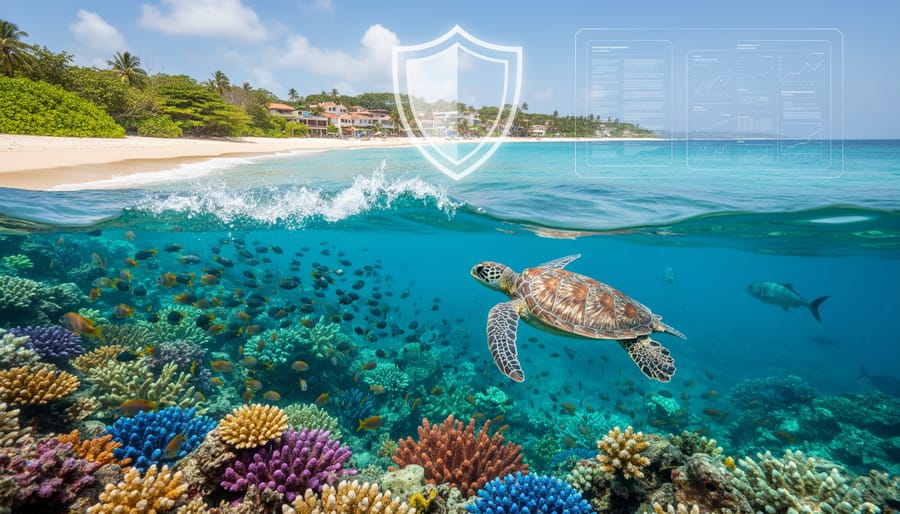
Coral reefs protect coastlines from storm surge and erosion, providing an estimated $1.8 billion in flood protection annually in the United States alone. Recognizing this vital service, groundbreaking insurance programs now treat these living ecosystems as valuable infrastructure worth protecting financially.
Mexico’s pioneering reef insurance program, established in 2019 along the Mesoamerican Reef, demonstrates how this innovative approach works. When hurricanes damage the reef structure, the policy triggers automatic payouts that fund immediate restoration efforts. This rapid response is crucial because damaged reefs lose their protective capacity within days, leaving communities vulnerable to subsequent storms. The program covers a 160-kilometer stretch of reef in Quintana Roo, with premiums paid jointly by government agencies, hotels, and local businesses who directly benefit from the reef’s protection.
What makes reef insurance particularly effective is its focus on speed. Traditional funding mechanisms for reef restoration can take months or years to mobilize resources. With insurance payouts arriving within weeks of a qualifying storm event, specially trained restoration teams can stabilize damaged coral structures and begin replanting coral fragments before permanent ecosystem degradation occurs.
Marine biologist Dr. Ana Rodriguez, who coordinates emergency response teams, shares: “Having guaranteed funding ready means we can deploy within 72 hours. We’ve seen remarkable recovery rates when we can act this quickly.”
The model is expanding globally, with similar programs being developed in Hawaii, the Philippines, and several Caribbean nations, creating a blueprint for protecting both human communities and marine biodiversity through innovative financial tools.
Parametric Insurance for Marine Protected Areas
Parametric insurance represents a groundbreaking approach to protecting marine ecosystems by providing rapid financial response when environmental disasters strike. Unlike traditional insurance that compensates for assessed losses after lengthy claims processes, parametric insurance triggers automatic payouts when predetermined environmental thresholds are breached.
This innovative mechanism works like a marine conservation emergency fund. When specific measurable events occur, such as ocean temperatures exceeding levels that cause mass coral bleaching or fish populations dropping below critical sustainability thresholds, funds are released immediately. The insurance is “index-based,” meaning it responds to objective data from satellite monitoring, ocean sensors, and scientific surveys rather than subjective damage assessments.
Consider a coral reef system insured against thermal stress: if water temperatures remain above 30°C for more than three consecutive weeks, the policy automatically disburses funds to conservation organizations. These resources enable immediate coral nursery deployment, emergency shading installations, or rapid response teams to relocate vulnerable species. The speed of payout can mean the difference between ecosystem resilience and collapse.
Marine biologist Dr. Sarah Chen, who helped implement parametric insurance for Caribbean reefs, shares: “We’ve reduced our response time from months to days. When bleaching events begin, we’re not scrambling for emergency funding; we’re already deploying solutions.”
This approach particularly benefits underfunded marine protected areas where traditional insurance premiums would be prohibitive. By using clear triggers tied to environmental data, parametric policies provide cost-effective protection that directly funds conservation action when ecosystems need it most.
Blue Carbon Insurance and Carbon Credit Mechanisms
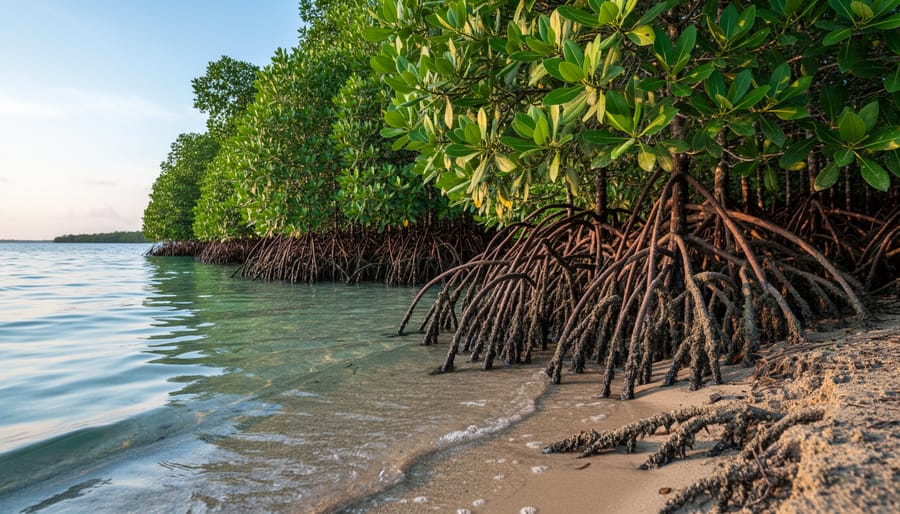
Marine ecosystems like mangroves, seagrass beds, and salt marshes are increasingly recognized as powerful carbon sinks, storing vast amounts of carbon dioxide in their biomass and sediments. This blue carbon has immense value in fighting climate change, yet these ecosystems face threats from development, pollution, and rising sea levels. Enter an innovative solution: blue carbon insurance policies that protect the carbon sequestration capacity of these vital habitats.
These specialized insurance products work by valuing the carbon storage services that coastal ecosystems provide. When hurricanes, coastal development, or other disasters damage these areas, the insurance compensates for the lost carbon sequestration potential. This financial protection incentivizes conservation and restoration efforts while providing tangible economic value to what was previously considered an intangible ecosystem service.
The connection between mangrove carbon markets and insurance creates a robust framework for protection. Communities can generate revenue through carbon credits while simultaneously maintaining insurance coverage that guards against catastrophic loss. For example, coastal villages in Southeast Asia now receive payments for maintaining mangrove forests while insurance policies protect against typhoon damage that could release stored carbon.
For those interested in supporting these initiatives, numerous volunteer opportunities exist in coastal restoration projects that contribute to insurable blue carbon reserves. Marine biologist Dr. Sarah Chen shares, “When communities understand their mangroves have measurable financial value through both carbon credits and insurance protection, conservation becomes everyone’s priority.”
How These Insurance Policies Actually Work to Save Marine Life
The Players: Who’s Involved in Marine Conservation Insurance
Marine conservation insurance brings together diverse stakeholders, each contributing unique expertise and resources to protect our oceans. Understanding who’s involved helps illustrate how innovative financial mechanisms translate into real-world conservation outcomes.
Governments and international organizations establish the regulatory frameworks that enable these insurance mechanisms. They provide initial funding, develop policy structures, and ensure legal compliance across borders. Their involvement legitimizes conservation insurance as a viable tool for protecting marine ecosystems while supporting coastal economies.
Insurance companies bring technical expertise in risk assessment and financial structuring. These institutions calculate premiums, evaluate environmental data, and process claims when insured ecosystems fail to provide expected services. Progressive insurers are increasingly recognizing that healthy marine environments represent sound investments with measurable returns.
NGOs and conservation organizations serve as crucial intermediaries, bridging scientific knowledge with practical implementation. They identify suitable locations for coverage, monitor ecosystem health, and connect funding with communities most affected by marine degradation. Many organizations also recruit volunteers to participate in monitoring efforts, creating opportunities for citizen scientists to contribute directly to conservation success.
Scientific institutions provide the empirical foundation through ongoing research and monitoring. Marine biologists track coral health, fish populations, and water quality, generating the data that determines whether insurance claims are valid. Dr. Maria Castillo, a marine biologist working with reef insurance programs in the Caribbean, shares: “Our monitoring data doesn’t just inform insurance decisions—it creates accountability and demonstrates tangible conservation progress to all stakeholders.”
Local communities remain the ultimate beneficiaries and essential partners. Their traditional knowledge, combined with scientific expertise, ensures conservation strategies respect cultural contexts while achieving environmental goals.
From Premium to Protection: Following the Money
Understanding how premiums transform into conservation action is key to appreciating marine insurance policies’ real-world impact. When organizations or governments purchase marine insurance to protect specific ecosystems, they pay regular premiums into a pooled fund. These payments function similarly to traditional insurance, creating a financial safety net that activates when predetermined environmental thresholds are triggered.
When a covered event occurs—such as coral bleaching, storm damage to mangrove forests, or oil spills—the policy releases funds rapidly, often within weeks rather than months. This speed is crucial because marine ecosystems deteriorate quickly without intervention. The payout amounts are predetermined based on scientific measurements like water temperature, satellite imagery, or physical damage assessments, eliminating lengthy claim disputes.
Once funds are disbursed, local conservation groups, marine biologists, and trained volunteers spring into action. The money directly finances habitat restoration activities including coral fragment replanting, mangrove seedling cultivation, debris removal, and water quality improvement projects. In the Mesoamerican Reef, for example, insurance payouts funded teams who cleared storm debris and stabilized damaged coral formations within days of Hurricane Delta.
Dr. Maria Gonzalez, a marine biologist working with insured reef systems, explains: “Having guaranteed funding means we’re not scrambling for emergency grants while the reef dies. We can mobilize immediately with equipment, boats, and trained hands ready to restore what’s been damaged.” This direct connection between financial protection and boots-on-the-ground conservation represents a revolutionary approach to safeguarding our ocean’s future.
The Science Behind Risk Assessment for Marine Ecosystems
Marine Monitoring Technologies That Make Insurance Possible
Modern marine insurance policies rely on sophisticated monitoring technologies that make accurate risk assessment possible while advancing our understanding of ocean ecosystems. Satellite monitoring systems track everything from sea surface temperatures and coral bleaching events to illegal fishing activities, providing real-time data across vast ocean territories. These orbital observers can detect changes in water quality, algae blooms, and even measure the health of kelp forests from space.
Beneath the waves, underwater sensors and autonomous vehicles collect crucial information about ocean acidification, dissolved oxygen levels, and biodiversity patterns. These instruments create comprehensive baseline data that insurers need to evaluate risks and verify conservation outcomes. Marine biologist Dr. Sarah Chen shares her experience: “When we deployed acoustic monitoring equipment around protected reefs, we could finally quantify fish populations with unprecedented accuracy. This data became the foundation for the first parametric insurance policy protecting that ecosystem.”
Biodiversity surveys using environmental DNA sampling and photographic databases help establish species inventories and track population changes over time. Drone technology complements these efforts, surveying coastal areas and detecting marine debris or habitat degradation that might affect policy coverage. Together, these technologies transform marine conservation from hopeful effort into measurable, insurable outcomes, opening doors for broader financial protection of our oceans.

Valuing the Priceless: How We Calculate Ecosystem Worth
How do you put a price tag on a coral reef or a mangrove forest? Scientists use ecosystem service valuation to calculate the economic benefits these environments provide, translating nature’s work into numbers that insurers and policymakers can understand.
The process involves measuring tangible services like fish production, storm protection, and carbon sequestration. For example, researchers calculate how many tons of carbon dioxide mangroves absorb annually, then multiply this by the market price of carbon credits. Similarly, they estimate the cost of artificial barriers that would be needed to replace the wave-breaking function of coral reefs during storms.
Marine biologist Dr. Sarah Chen explains the approach simply: “We’re not saying nature only matters because it has dollar value, but speaking the language of economics helps decision-makers recognize what we’d lose.” Her team documented that Caribbean mangroves provide approximately 15,000 dollars per hectare annually through fisheries support and coastal protection.
These valuations create the foundation for marine insurance policies. When insurers know a reef provides 2 million dollars in annual storm protection, they can justify investing thousands in reef restoration as a sound business decision that protects their coastal property portfolios.
Real Impact: Success Stories from Marine Insurance Programs
The power of marine insurance programs becomes vividly clear when we examine their real-world impact on ocean conservation. These innovative financial mechanisms are generating measurable results that traditional conservation funding often struggles to achieve.
The Caribbean Coral Triangle Initiative stands as a compelling example. Through a parametric insurance policy covering 160 kilometers of Mexico’s Mesoamerican Reef, the program activated within 48 hours of Hurricane Delta’s landfall in 2020. The policy disbursed $850,000 for emergency reef restoration, enabling rapid deployment of coral stabilization teams. Within six months, marine biologists documented a 34% improvement in coral survival rates compared to uninsured reef sections after similar storms. Dr. Maria Castellanos, who coordinated the restoration effort, recalls the transformation: “Before insurance, we’d spend months securing emergency funds while damaged reefs deteriorated. Now we mobilize immediately, and the difference in recovery outcomes is remarkable.”
In the Pacific, Palau’s marine sanctuary insurance has protected 500,000 square kilometers of ocean since 2018. The program combines traditional coverage with conservation performance bonds, creating financial incentives for maintaining healthy fish populations. Recent assessments show a 28% increase in commercially important species within insured zones. Local marine biologist Thompson Telii shares his experience: “The insurance framework changed everything. Fishing communities now actively participate in monitoring because they understand their livelihoods are directly tied to ecosystem health. We’ve trained over 200 volunteer citizen scientists who collect data that feeds into our insurance assessments.”
The Great Barrier Reef’s parametric insurance pilot, launched in 2021, demonstrates scalability potential. After its first payout following a bleaching event, the program funded targeted cooling interventions across 40 hectares of critical reef habitat. Early data indicates 15% higher coral survival in treated areas, with projections suggesting exponential benefits as the program expands.
These successes share common elements: rapid response capabilities, community engagement, and measurable outcomes that attract continued investment. For aspiring marine conservationists, these programs offer exciting volunteer opportunities in data collection, reef monitoring, and community education. Students can participate through university partnerships, gaining hands-on experience while contributing to cutting-edge conservation finance models.
The financial sustainability of these programs proves particularly encouraging. Unlike grant-dependent projects that face constant funding uncertainty, insurance-backed initiatives create self-reinforcing cycles where successful conservation outcomes justify premium investments, attracting broader participation and scaling impact across vulnerable marine ecosystems worldwide.
Why This Matters for Endangered Marine Species
When endangered sea turtles face an oil spill, or coral reefs encounter sudden temperature spikes, the difference between survival and extinction often comes down to one critical factor: speed. Marine insurance policies designed for conservation create something traditional funding mechanisms cannot provide—immediate financial resources when marine species need them most.
Think of these insurance tools as emergency response systems for endangered populations. When a covered threat materializes, funds become available within days rather than months or years. This rapid response capability has proven essential for species like the North Atlantic right whale, where fewer than 350 individuals remain. Insurance mechanisms can trigger immediate action when whales face ship strikes or entanglement risks, funding emergency rescue operations, temporary shipping lane modifications, or enhanced monitoring systems before catastrophic losses occur.
Beyond emergency response, these financial instruments fundamentally change how we protect critical habitats. Traditional conservation funding often arrives after damage has occurred, leaving gaps in protection during vulnerable periods. Insurance policies, however, incentivize proactive habitat preservation by reducing premiums when protective measures are implemented. Coastal communities managing sea turtle nesting beaches, for instance, receive tangible financial benefits for maintaining protective buffers and reducing light pollution—creating economic alignment with conservation goals.
Dr. Maria Chen, a marine biologist working with Hawaiian monk seals, shares how insurance-backed funding transformed her team’s capabilities: “We went from reactive crisis management to strategic protection. When a protected pupping beach faced storm damage, insurance proceeds allowed us to restore habitat immediately and install monitoring equipment we’d dreamed about for years. We didn’t lose a single pup that season.”
Perhaps most importantly, these mechanisms provide the long-term financial stability that endangered species recovery demands. Recovery isn’t measured in months but decades. Insurance frameworks create predictable funding streams that support multi-generational conservation efforts, enabling researchers and conservationists to plan comprehensive protection strategies rather than lurching between funding cycles. For species on the brink, this stability could mean the difference between managed recovery and extinction.
How You Can Support Marine Conservation Insurance Initiatives
The power to strengthen marine conservation insurance initiatives lies in collective action, and there are numerous ways you can make a meaningful difference. Whether you’re an environmental professional, student, or concerned citizen, your engagement matters.
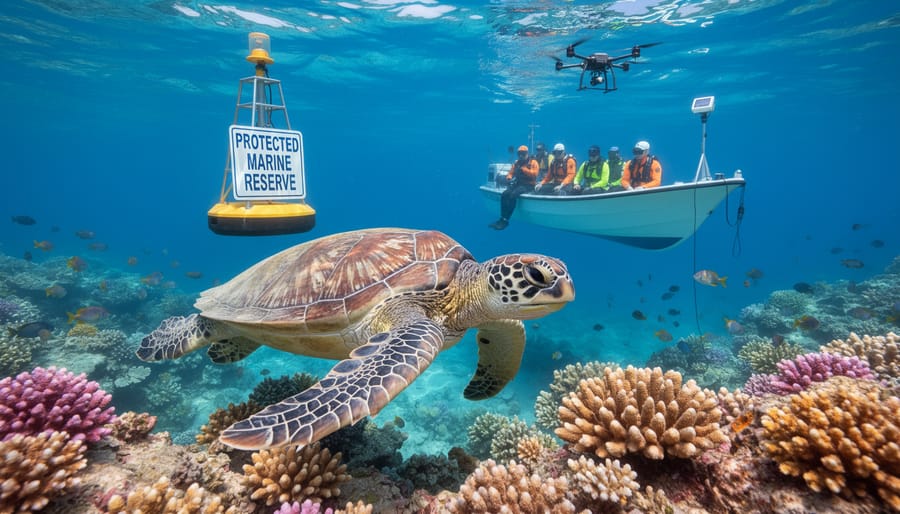
Start by supporting organizations pioneering these mechanisms. The Nature Conservancy, World Wildlife Fund, and Environmental Defense Fund are developing innovative conservation funding approaches that include insurance-based solutions. Consider making donations specifically designated for their marine insurance programs, which directly fund reef restoration bonds, parametric insurance for coastal ecosystems, and blue carbon credit initiatives.
Volunteer opportunities abound for those wanting hands-on involvement. Many coastal communities need citizen scientists to monitor coral health, document ecosystem changes, and collect data that feeds into insurance risk models. Marine biologist Dr. Elena Rodriguez shares, “Volunteers who participate in our reef monitoring program provide invaluable data that helps insurers understand ecosystem resilience. Their observations directly influence policy pricing and conservation prioritization.”
Advocate for policy change by contacting local representatives about legislation supporting marine conservation insurance. Encourage your elected officials to fund pilot programs and provide incentives for businesses adopting these mechanisms. Join online advocacy campaigns through organizations like Ocean Conservancy that push for expanded use of parametric insurance in marine protected areas.
Educational institutions and workplaces offer platforms for raising awareness. Organize seminars, share resources, or invite speakers from conservation finance organizations. If you work in the insurance or finance sector, explore how your organization might participate in emerging blue economy initiatives.
Students can pursue research opportunities examining the effectiveness of these mechanisms, contributing academic insights that strengthen program design. Every action, from sharing information on social media to participating in coastal cleanups that demonstrate ecosystem value, helps build the foundation for successful marine conservation insurance.
The emergence of insurance mechanisms for marine conservation represents a transformative moment in our collective effort to protect ocean biodiversity. These innovative financial tools bridge the gap between economic realities and environmental imperatives, creating sustainable pathways for safeguarding the ecosystems that cover more than 70% of our planet. From parametric insurance protecting coral reefs to blue bonds funding restoration projects, we’re witnessing a fundamental shift in how society values and protects marine resources.
What makes this approach particularly promising is its ability to mobilize capital at scales matching the magnitude of ocean challenges. Traditional conservation funding, while essential, often struggles to provide the rapid response needed when disasters strike or to maintain long-term protection commitments. Insurance mechanisms offer predictable, scalable solutions that can deploy resources immediately when ecosystems face crisis, ensuring that restoration begins before damage becomes irreversible.
The success stories emerging from early implementations demonstrate that this isn’t merely theoretical. Coastal communities are experiencing tangible benefits, marine habitats are receiving faster protection, and the financial sector is increasingly recognizing ocean health as both a risk management priority and an investment opportunity.
Your role in this transformation matters. Whether you’re an environmental scientist contributing research, an educator sharing these concepts with students, or a concerned citizen supporting ocean-focused organizations, every action amplifies this movement. Consider volunteering with marine conservation groups implementing these programs, advocating for policies that support innovative financing, or simply spreading awareness about how financial tools can protect the underwater world we all depend on. Together, we can ensure that future generations inherit oceans as vibrant and biodiverse as those we’ve been privileged to know.

jessica
Ava Singh is an environmental writer and marine sustainability advocate with a deep commitment to protecting the world's oceans and coastal communities. With a background in environmental policy and a passion for storytelling, Ava brings complex topics to life through clear, engaging content that educates and empowers readers. At the Marine Biodiversity & Sustainability Learning Center, Ava focuses on sharing impactful stories about community engagement, policy innovations, and conservation strategies. Her writing bridges the gap between science and the public, encouraging people to take part in preserving marine biodiversity. When she’s not writing, Ava collaborates with local initiatives to promote eco-conscious living and sustainable development, ensuring her work makes a difference both on the page and in the real world.