Marine Biodiversity Science Center

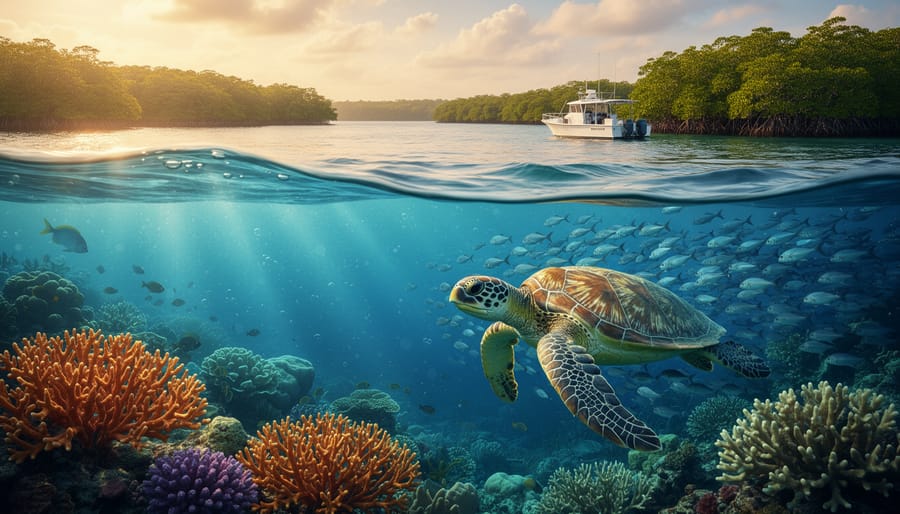
Imagine a developing nation carrying crushing debt while its coral reefs crumble and mangrove forests disappear. Now imagine that same debt transformed into protected marine reserves, thriving fisheries, and resilient coastal communities. This is the promise of debt-for-nature swaps, an innovative financial mechanism that’s quietly revolutionizing ocean conservation across the globe.
Debt-for-nature swaps work through a simple yet powerful exchange: creditor nations or organizations agree to forgive or reduce a portion of a country’s debt in return for that country’s commitment to invest in environmental protection. When paired with sovereign blue bonds, these arrangements channel millions of dollars directly into marine conservation projects that would otherwise remain underfunded dreams on a policy maker’s desk.
The mechanics are straightforward but the impact is profound. A conservation organization negotiates with creditors to purchase debt at a discount, then forgives it in exchange for the debtor nation establishing marine protected areas, implementing sustainable fishing practices, or restoring critical coastal habitats. The debtor country redirects funds previously allocated for debt repayment into concrete conservation action, creating a win-win scenario where financial relief meets environmental stewardship.
These swaps represent more than creative accounting. They offer cash-strapped nations a genuine pathway to protect their ocean resources while alleviating economic burdens, proving that environmental conservation and economic development need not be opposing forces but can instead fuel each other’s success.
What Are Debt-for-Nature Swaps?
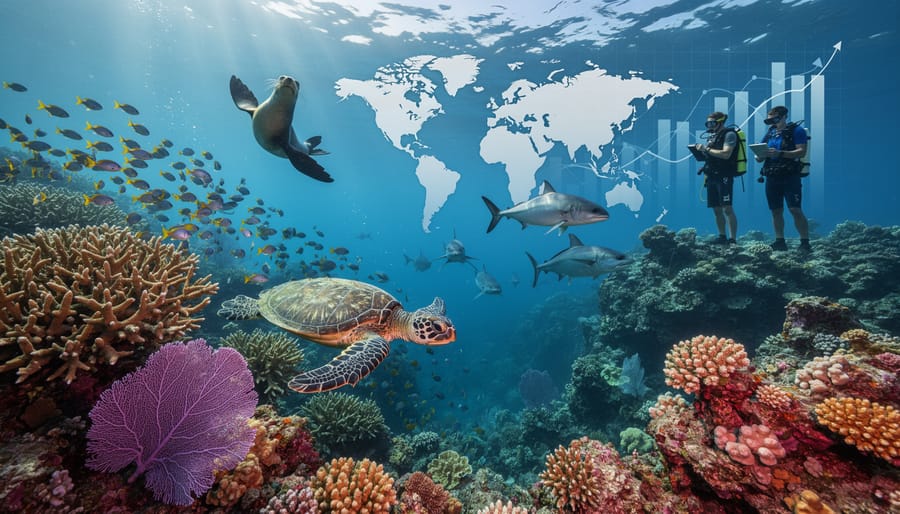
The Basic Mechanics: How These Swaps Actually Work
At their core, debt-for-nature swaps represent one of the most creative biodiversity finance mechanisms available today. The process involves several key players working together to transform financial obligations into environmental action.
Here’s how it works: A developing nation carries significant debt owed to international creditors or foreign governments. Conservation organizations step in as intermediaries, often partnering with philanthropic foundations or development banks. These organizations either purchase the debt at a reduced rate on secondary markets or negotiate directly with creditors for debt forgiveness.
In exchange for reducing or eliminating this financial burden, the debtor nation commits to investing a portion of the saved funds into specific conservation projects. This commitment is legally binding and typically spans 10 to 30 years. The funds remain in local currency and support marine protected areas, coral reef restoration, sustainable fisheries management, or other biodiversity initiatives.
The parties involved include the debtor country’s government, creditor nations or institutions, conservation NGOs (like The Nature Conservancy or World Wildlife Fund), and local communities who become stewards of protected areas. Often, development banks provide guarantees or insurance to reduce risk.
Marine biologist Dr. Sofia Chen, who worked on Belize’s landmark swap, explains: “We transformed what seemed like an impossible financial situation into a lifeline for our barrier reef. The local fishers I work with now have training opportunities and alternative livelihoods while our marine ecosystems recover.”
From Rainforests to Reefs: The Evolution to Marine Conservation
The concept of debt-for-nature swaps first emerged in the 1980s when economist Thomas Lovejoy proposed an innovative solution to two pressing global challenges: the crushing debt burden facing developing nations and the accelerating destruction of tropical rainforests. The idea was elegantly simple—creditor nations or organizations would forgive portions of a country’s debt in exchange for commitments to protect and restore critical ecosystems.
The earliest swaps focused primarily on terrestrial habitats, particularly the biodiverse rainforests of Latin America and Africa. Bolivia pioneered the first official debt-for-nature swap in 1987, setting aside funds for protected areas in the Amazon basin. These initial successes demonstrated that financial mechanisms could indeed drive meaningful conservation outcomes.
By the early 2000s, as scientists increasingly recognized the urgency of ocean conservation, the model began expanding seaward. Marine ecosystems faced mounting pressures from overfishing, pollution, and climate change, yet they remained chronically underfunded compared to land-based conservation efforts. The transition to blue finance represented a natural evolution of the debt-for-nature concept, adapting proven terrestrial strategies to address the unique challenges of protecting coral reefs, mangroves, and the open ocean. Today, these marine-focused swaps have become powerful tools for safeguarding our planet’s blue heart.
Sovereign Blue Bonds: The Ocean-Focused Innovation
How Blue Bonds Differ from Traditional Conservation Financing
Blue bonds represent a specialized evolution in conservation finance, distinguished from traditional funding mechanisms by their laser focus on ocean health and coastal resilience. Unlike conventional green bonds that support broad environmental projects, blue bonds channel investments specifically toward marine and coastal ecosystem protection, sustainable fisheries management, and pollution reduction in our seas.
The structural innovation lies in how these instruments blend debt relief with conservation mandates. When a nation issues a blue bond, the proceeds directly fund ocean-focused initiatives, often managed through independent marine conservation trusts. This creates transparent accountability that traditional conservation grants sometimes lack. The terms typically span 15 to 30 years, allowing long-term planning for ecosystem recovery that short-term funding cycles cannot support.
What truly sets blue bonds apart is their dual-benefit structure. Participating nations reduce their debt burden while simultaneously securing dedicated funding streams for marine protected areas, coral reef restoration, and sustainable fishing practices. The financial terms are often more favorable than market rates, making ocean conservation economically attractive rather than burdensome.
Consider the experience of marine biologist Dr. Sarah Chen, who helped design monitoring protocols for a Caribbean blue bond project. She describes how the guaranteed, multi-year funding allowed her team to track coral recovery patterns comprehensively, something impossible with traditional grant cycles. This stability enables scientists and conservationists to implement comprehensive strategies rather than piecemeal interventions.
The ocean-specific focus ensures that funding addresses unique marine challenges, from plastic pollution to overfishing, creating measurable impacts on biodiversity that generalized environmental financing often dilutes.
The Players: Who Makes Blue Bonds Possible
Blue bond debt-for-nature swaps represent a collaborative effort that brings together diverse players, each contributing unique expertise to make these innovative conservation financing mechanisms possible.
International organizations like The Nature Conservancy and Conservation International often serve as architects of these deals, providing technical expertise and credibility. They work alongside multilateral development banks such as the Inter-American Development Bank and the World Bank, which offer credit guarantees that reduce risk for investors and make the restructured debt more attractive.
Commercial banks and investment firms play a crucial role by purchasing the original debt at a discount and structuring new bonds with favorable terms. These financial institutions recognize both the environmental value and the economic stability that comes from countries investing in their natural resources rather than struggling with unsustainable debt burdens.
Governments of debtor nations are central players, committing to direct savings toward specific marine conservation projects. Meanwhile, donor governments and philanthropic foundations often provide grants or guarantees that bridge financing gaps and demonstrate the viability of these transactions.
Environmental NGOs contribute scientific expertise, helping design effective conservation programs and monitoring outcomes. Local communities and marine biologists bring invaluable on-the-ground knowledge, ensuring projects address real ecosystem needs while supporting sustainable livelihoods.
This partnership model demonstrates how combining financial innovation with conservation science creates powerful tools for protecting our oceans while addressing economic challenges facing coastal nations.
Real-World Success Stories: Nations Choosing Ocean Conservation
Belize’s Barrier Reef Rescue: The $364 Million Breakthrough
In 2021, Belize achieved something remarkable for both its economy and its ocean. The small Central American nation restructured $553 million in external debt—reducing it by $364 million—while simultaneously committing to protect 30% of its marine environment. This landmark deal targeted the Mesoamerican Reef, the second-largest barrier reef system on Earth and home to more than 500 fish species, six threatened marine turtle species, and vital coral ecosystems.
Here’s how it worked: The Nature Conservancy purchased Belize’s commercial debt at a discount, then issued a lower-interest “blue bond” backed by international guarantees. This financial restructuring freed up approximately $4 million annually over 20 years for marine conservation. Marine biologist Dr. Valerie Woods, who helped design Belize’s conservation commitments, recalls the transformative moment: “We suddenly had predictable, long-term funding to expand marine protected areas and strengthen enforcement against illegal fishing—resources we’d never had before.”
The results have been tangible. Belize expanded its no-take marine reserves, improved monitoring of fish populations, and created new employment opportunities for coastal communities as marine park rangers and conservation technicians. Local fishers participated in developing sustainable fishing zones, ensuring that conservation efforts aligned with community needs.
This breakthrough demonstrated that small island nations facing both debt burdens and environmental threats could address both challenges simultaneously, creating a replicable model for ocean conservation worldwide.
The Galápagos and Ecuador: Protecting Darwin’s Living Laboratory
In May 2023, Ecuador made conservation history with the world’s largest debt-for-nature swap, converting $656 million in sovereign debt into dedicated funding for marine protection. This groundbreaking agreement, facilitated by the United States International Development Finance Corporation and supported by Pew Charitable Trusts, will generate approximately $323 million over 18 years for the protection of the Galápagos Marine Reserve.
The deal works through a refinancing mechanism where Ecuador’s debt was restructured at more favorable terms, with the savings redirected into a conservation trust fund. These funds will support expanded marine protection covering 60,000 square kilometers around the archipelago, enhancing enforcement against illegal fishing, supporting scientific research, and developing sustainable livelihoods for local communities who depend on these waters.
Dr. María Salazar, a marine biologist who has studied Galápagos ecosystems for over a decade, shares her perspective: “This isn’t just about protecting marine iguanas and hammerhead sharks. The funding allows us to engage fishing communities directly, helping them transition to sustainable practices while maintaining their cultural connection to the sea.”
The agreement demonstrates how innovative financing can address the dual challenges of economic development and environmental protection. For Ecuador, it provides fiscal relief while ensuring that one of the planet’s most biodiverse marine ecosystems receives the long-term protection it desperately needs. The Galápagos Reserve supports over 2,900 marine species, many found nowhere else on Earth, making this conservation investment globally significant.
Small Island Nations: Big Ocean Conservation Wins
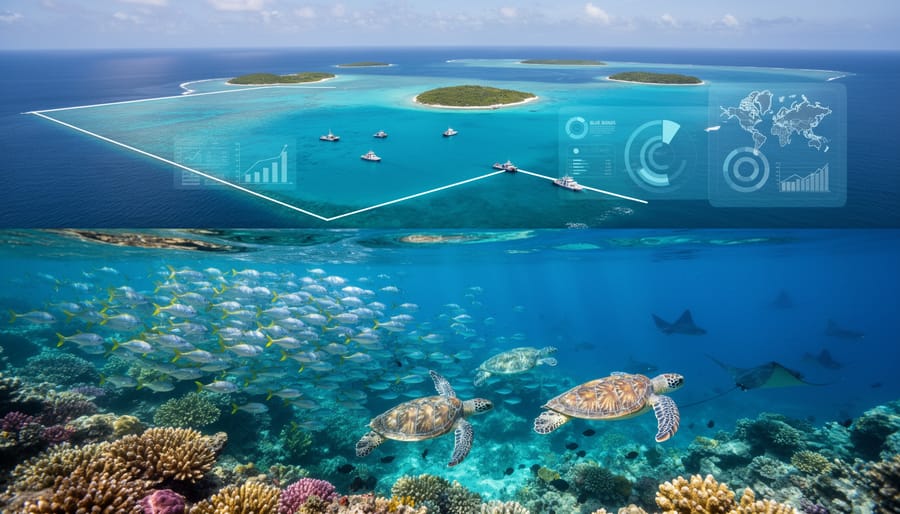
While major deals like Belize and Gabon capture headlines, smaller island nations are collectively making significant waves in ocean conservation through debt-for-nature swaps. Caribbean nations including Barbados and Antigua have negotiated agreements protecting critical coral reef ecosystems and mangrove forests that serve as nurseries for countless marine species. These habitats support not only biodiversity but also fishing communities that depend on healthy oceans.
In the Pacific, island nations facing both crushing debt and rising sea levels have embraced these innovative financing tools with remarkable results. The cumulative impact of these smaller deals—often ranging from $20-80 million—adds up to hundreds of thousands of square miles of protected ocean. Marine biologist Dr. Anika Patel, who has worked with several Pacific island conservation teams, shares that “these communities have been ocean stewards for generations. Debt-for-nature swaps simply provide the financial breathing room to formalize and expand their traditional conservation practices.” The collective protection gained through these numerous smaller agreements demonstrates that ocean conservation doesn’t always require billion-dollar deals to create meaningful, lasting change for marine ecosystems and the communities that depend on them.
The Marine Biodiversity Impact: What Conservation Looks Like on the Ground
Protected Areas and Marine Reserves: Expanding Ocean Sanctuaries
Debt-for-nature swaps are transforming ocean conservation by channeling resources directly into marine protected areas (MPAs) where they matter most. These financial mechanisms have enabled countries to expand their protected waters significantly, creating safe havens for endangered species and critical habitats.
In Belize, swap funding helped establish the largest marine reserve in the Caribbean, protecting over 400 square miles of barrier reef ecosystem. This expansion safeguards nesting grounds for endangered hawksbill and loggerhead sea turtles, while providing refuge for threatened Nassau grouper spawning aggregations. Marine biologist Dr. Elena Rodriguez, who monitors the reserve, shares: “We’ve documented a 40% increase in juvenile fish populations since protection began—it’s proof that when we give ecosystems breathing room, they respond.”
Similarly, Ecuador’s recent swap dedicated funds to the Galápagos Marine Reserve, supporting enforcement patrols that protect hammerhead shark nurseries and penguin foraging areas. The funding also maintains research stations where volunteers assist scientists in monitoring coral recovery and fish populations.
These marine restoration projects demonstrate how creative financing can deliver measurable conservation wins. From mangrove forests in Seychelles to deep-sea coral gardens off Costa Rica, swap-funded MPAs are becoming blueprints for protecting marine biodiversity while honoring financial obligations.
Local Communities as Conservation Partners
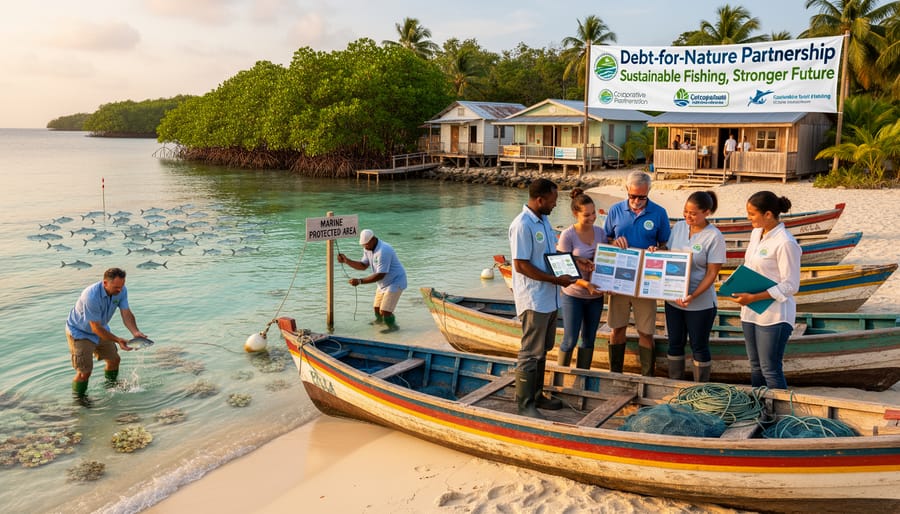
Debt-for-nature swaps create meaningful pathways for local communities to become active conservation partners rather than bystanders. These agreements typically allocate funds toward community-based initiatives that simultaneously protect marine environments and strengthen local economies.
Sustainable fishing programs represent a cornerstone of this approach. In the Seychelles, debt swap funding helped train artisanal fishers in selective harvesting techniques and provided equipment for reducing bycatch. This investment protects fish populations while ensuring families maintain their livelihoods for generations to come.
Ecotourism development offers another promising avenue. Communities in Belize received funding to establish snorkeling and diving operations in newly protected areas, transforming former extractive practices into conservation-minded businesses. Maria Santos, a marine biologist working with coastal communities in Ecuador, shares: “When locals see tourists willing to pay to experience healthy reefs, the value of marine ecosystem services becomes tangible and personal.”
Community-based management programs empower residents as stewards of their waters. Funds support training programs in ecosystem monitoring, patrol operations, and sustainable resource management. In Cabo Verde, community members now conduct regular reef assessments and participate in decision-making processes about marine protected areas. This collaborative model ensures conservation efforts reflect local knowledge while building long-term environmental guardianship within communities themselves.
The Challenges: Why This Isn’t a Silver Bullet
Ensuring Long-Term Commitment and Transparency
The success of debt-for-nature swaps hinges on robust monitoring systems and transparent governance structures that verify conservation promises are fulfilled over decades. Without proper oversight, these agreements risk becoming paperwork exercises rather than genuine environmental victories.
One significant challenge involves establishing clear, measurable conservation targets. Marine biologist Dr. Elena Rodriguez, who monitors a Caribbean reef protection program funded through a debt swap, explains that tracking ecosystem health requires consistent data collection across remote areas with limited infrastructure. “We’ve trained local volunteers to conduct regular fish counts and coral health assessments,” she shares. “Their commitment has been extraordinary, but maintaining funding for monitoring equipment and training remains an ongoing challenge.”
International conservation organizations typically oversee compliance, but questions arise about who holds nations accountable when targets aren’t met. Some agreements include provisions allowing creditor nations to reinstate debt if conservation milestones fail, though enforcement mechanisms vary widely.
Transparency proves equally crucial. Publishing regular reports on conservation outcomes, financial flows, and stakeholder engagement builds public trust and enables civil society to participate in oversight. Several recent agreements have incorporated independent third-party audits and established multi-stakeholder committees including local communities, ensuring diverse voices shape implementation decisions and maintain pressure for genuine, lasting conservation impact.
Scale Limitations: The Gap Between Need and Availability
While debt-for-nature swaps represent an innovative financing tool, we must honestly assess their capacity to address ocean conservation needs. To date, these swaps have generated hundreds of millions of dollars for marine protection—a significant achievement. However, scientists estimate that effectively protecting 30% of our oceans by 2030 requires annual investments exceeding $20 billion.
The mathematics reveal a sobering reality: even the most ambitious swap agreements fund only a fraction of what’s needed. Ecuador’s groundbreaking $656 million deal, though impressive, addresses conservation in one nation’s waters while threats like overfishing, plastic pollution, and climate change operate on a global scale.
Marine biologist Dr. Sofia Alvarez, who has worked on implementing swap-funded projects, shares this perspective: “These agreements open crucial doors and demonstrate what’s possible. But they’re pieces of a larger puzzle, not the complete solution.”
The funding gap means debt-for-nature swaps work best as catalysts—jumpstarting conservation efforts, building local capacity, and proving concepts that attract additional investment. They complement rather than replace other funding sources like government budgets, philanthropic grants, and innovative mechanisms such as blue carbon credits. Understanding these limitations helps us advocate for comprehensive financing strategies that match the ocean’s vast needs.
How You Can Support Ocean-Focused Financial Innovation
Volunteer and Research Opportunities in Marine Conservation Finance
The Marine Biodiversity Science Center welcomes professionals and students eager to contribute to marine conservation finance initiatives. We actively seek partnerships with economists, environmental scientists, and policy analysts to evaluate debt-for-nature swap effectiveness and develop new innovative funding strategies for ocean protection.
Current volunteer opportunities include data collection for monitoring marine protected areas established through swap agreements, financial modeling for proposed blue bond initiatives, and community outreach programs in coastal regions benefiting from these arrangements. Research collaborators can access our growing database of swap outcomes, contributing to publications that shape future conservation finance policy.
Dr. Maria Santos, who coordinates our finance research program, shares: “Every volunteer brings unique perspectives that strengthen our understanding of how these complex mechanisms translate into real ocean protection. Whether you’re analyzing economic data or interviewing fishing communities, your contribution directly supports marine biodiversity.”
Visit our partnerships page to explore current projects matching your expertise and availability.
Amplifying Impact Through Education and Advocacy
Understanding debt-for-nature swaps is just the beginning—amplifying their impact requires collective action. You can start by joining conservation finance networks like The Nature Conservancy or the Blue Finance Initiative, which regularly share insights on innovative funding mechanisms and connect advocates worldwide.
Support policy changes by contacting your representatives about prioritizing ocean conservation in international debt negotiations. Many environmental organizations provide easy-to-use advocacy tools and templates to make your voice heard effectively.
Educational outreach matters too. Share information about these financial instruments through social media, community presentations, or classroom discussions. Marine biologist Dr. Sofia Reyes notes, “When I explain debt-for-nature swaps at public lectures, people are amazed that solutions exist beyond traditional charity models—it empowers them to demand more from policymakers.”
Consider volunteering with organizations monitoring swap implementation or participating in citizen science projects that document marine biodiversity improvements in protected areas. These hands-on experiences strengthen the data supporting future swaps while deepening your connection to ocean conservation. Every conversation started and every petition signed builds momentum toward protecting our ocean ecosystems through innovative finance.
Debt-for-nature swaps and blue bonds represent more than innovative financial instruments—they’re pathways toward reimagining how we value and protect our ocean ecosystems. While these mechanisms aren’t silver bullets, they demonstrate that economic challenges and conservation goals don’t have to conflict. When structured thoughtfully and implemented with genuine community involvement, these tools can redirect substantial resources toward marine protection while simultaneously relieving the financial burdens facing vulnerable nations.
The success stories from Belize, Seychelles, and Ecuador show us what’s possible when creativity meets commitment. Yet scaling these solutions requires continued engagement from all of us—whether you’re a marine biologist documenting ecosystem recovery, an educator inspiring the next generation of ocean advocates, or simply someone who cares about our planet’s blue heart.
Stay informed about emerging conservation finance initiatives in your region. Support organizations working to expand these mechanisms responsibly. Share what you’ve learned with your networks. Consider volunteering with marine conservation groups that monitor the outcomes of these agreements. Our oceans need diverse solutions, sustained attention, and collective action. Debt-for-nature swaps are one powerful tool in our conservation toolkit—let’s ensure they reach their full potential.

jessica
Ava Singh is an environmental writer and marine sustainability advocate with a deep commitment to protecting the world's oceans and coastal communities. With a background in environmental policy and a passion for storytelling, Ava brings complex topics to life through clear, engaging content that educates and empowers readers. At the Marine Biodiversity & Sustainability Learning Center, Ava focuses on sharing impactful stories about community engagement, policy innovations, and conservation strategies. Her writing bridges the gap between science and the public, encouraging people to take part in preserving marine biodiversity. When she’s not writing, Ava collaborates with local initiatives to promote eco-conscious living and sustainable development, ensuring her work makes a difference both on the page and in the real world.