Marine Biodiversity Science Center

Beneath the ocean’s surface, a quiet revolution is underway. Artificial intelligence now analyzes thousands of underwater images in minutes—a task that once took marine biologists months to complete. Machine learning algorithms track whale migrations across entire ocean basins, predict coral bleaching events before they devastate reefs, and identify illegal fishing vessels in real-time from satellite data. This technological transformation isn’t replacing the dedicated scientists and conservationists who’ve long protected our oceans; it’s amplifying their impact in ways previously unimaginable.
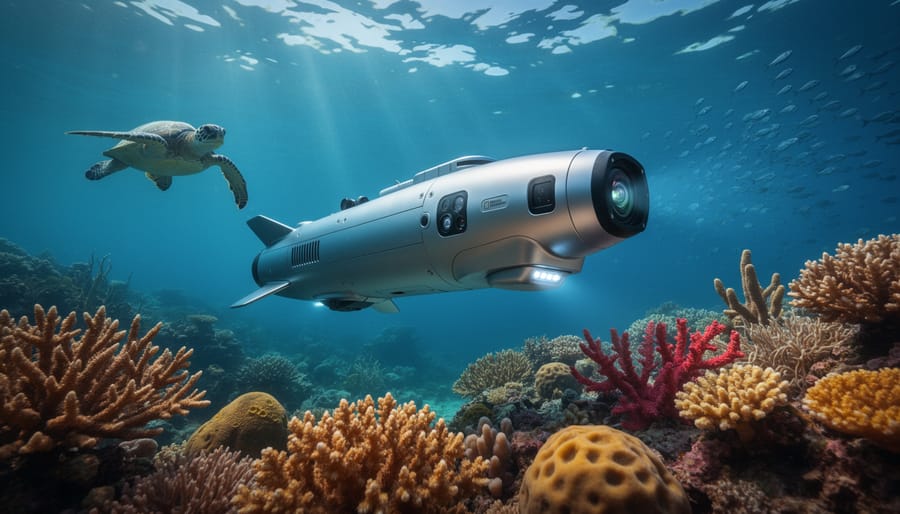
The integration of AI into marine conservation represents more than just efficiency gains. It’s fundamentally changing how we understand and respond to threats facing ocean ecosystems. Autonomous underwater vehicles equipped with AI-powered sensors can survey deep-sea habitats humans cannot safely reach. Computer vision systems trained on millions of marine species photographs help citizen scientists accurately identify creatures during beach surveys and diving expeditions. Predictive models analyze decades of oceanographic data to forecast where endangered species will relocate as waters warm, enabling proactive protection measures rather than reactive crisis management.
Yet this technological leap forward raises essential questions. How do small conservation organizations with limited budgets access these tools? Can AI truly capture the nuanced ecological relationships that experienced field researchers observe? What happens when algorithms make mistakes in high-stakes conservation decisions? The answers lie not in viewing AI as a silver bullet, but as a powerful complement to human expertise, local knowledge, and on-the-ground conservation work. Understanding how these technologies integrate into existing marine protection efforts—their remarkable capabilities and honest limitations—empowers everyone from professional scientists to concerned ocean advocates to harness AI’s potential responsibly and effectively.
The Ocean Crisis That Demands Smarter Solutions
Our oceans face unprecedented challenges that threaten marine life on a scale humanity has never witnessed. Overfishing has pushed numerous species toward collapse, with the United Nations estimating that over one-third of global fish stocks are now harvested at unsustainable levels. Meanwhile, climate change transforms marine environments faster than many species can adapt, warming waters and acidifying oceans in ways that disrupt entire ecosystems. Coastal development and destructive fishing practices continue to demolish critical habitats like coral reefs and seagrass beds, which serve as nurseries for countless marine species.
Perhaps most frustrating is the persistence of illegal, unreported, and unregulated fishing, which accounts for up to 26 million tons of fish caught annually. These operations rob legitimate fishers of their livelihoods while devastating vulnerable populations that lack adequate monitoring and protection.
Traditional conservation methods have achieved remarkable successes. Marine protected areas, fishing quotas, and community-based management programs remain essential tools. Dedicated marine biologists spend countless hours conducting surveys, analyzing samples, and advocating for policy changes. Dr. Elena Martinez, a marine ecologist with twenty years of field experience, puts it plainly: “The challenge isn’t that our methods don’t work. It’s that we’re trying to monitor an area covering 71 percent of Earth’s surface with limited resources and outdated tools.”
The numbers tell the story. Our oceans span 140 million square miles, yet conservation teams can physically monitor only tiny fractions of this vast expanse. When researchers identify threats, the response time often allows illegal operators to disappear or damaged ecosystems to deteriorate beyond recovery points.
This isn’t about replacing the dedicated conservationists doing critical work. Rather, we need to augment their capabilities with tools that match the scale and speed of modern threats. Artificial intelligence offers precisely this opportunity, processing enormous datasets, identifying patterns invisible to human observation, and enabling rapid responses that traditional methods simply cannot achieve alone.
What AI Actually Means for Marine Conservation
When marine biologist Dr. Sarah Chen describes her work with artificial intelligence, she uses a simple analogy: “Think of AI as a tireless research assistant that never gets seasick and can analyze thousands of underwater images in the time it takes me to finish my morning coffee.” This practical perspective cuts through the science fiction mystique that often surrounds AI in marine conservation.
At its core, artificial intelligence refers to computer systems that can learn from data and make decisions or predictions without being explicitly programmed for every scenario. Machine learning, a subset of AI, works by identifying patterns in massive datasets—much like how you might learn to recognize different whale species by studying hundreds of photographs, except AI can process millions of images exponentially faster.
In the marine context, imagine trying to identify all the fish species captured in thousands of hours of underwater footage. A human researcher might take years to complete this task. A trained AI system can accomplish it in days, learning to distinguish a yellowfin tuna from a bigeye tuna by analyzing subtle differences in fin shape, body proportions, and coloration patterns.
However, AI is not a magic solution. It cannot replace the expertise of trained marine scientists who understand ecosystem dynamics, species behavior, and conservation priorities. What AI excels at is processing enormous amounts of data quickly and consistently—tasks that would otherwise overwhelm human capacity. It identifies the needle in the haystack so researchers can focus on understanding why that needle matters and what to do about it. The technology works best as a powerful tool amplifying human intelligence, not replacing it.
AI Tools Already Protecting Marine Life
Smart Monitoring Systems That Never Sleep
Artificial intelligence has revolutionized how we track marine life, creating marine monitoring systems that operate continuously without human intervention. These tireless digital guardians are transforming conservation by gathering data at scales previously impossible.
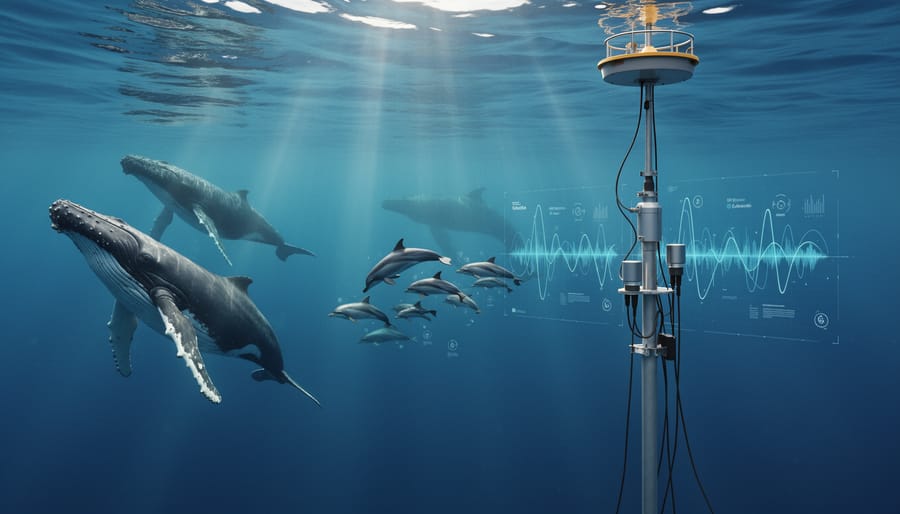
Acoustic monitoring represents one of the most promising applications. In the waters off British Columbia, researchers deployed AI-powered hydrophones that distinguish between different whale and dolphin vocalizations with 95% accuracy. The system, developed by Cornell University’s Bioacoustics Research Program in partnership with Ocean Networks Canada, has identified previously unknown migration patterns for endangered southern resident killer whales. Dr. Sarah Chen, a marine biologist who helped implement the technology, shares: “We’re now detecting whale calls 24/7 across hundreds of square kilometers. It’s like having a thousand expert ears listening simultaneously.”
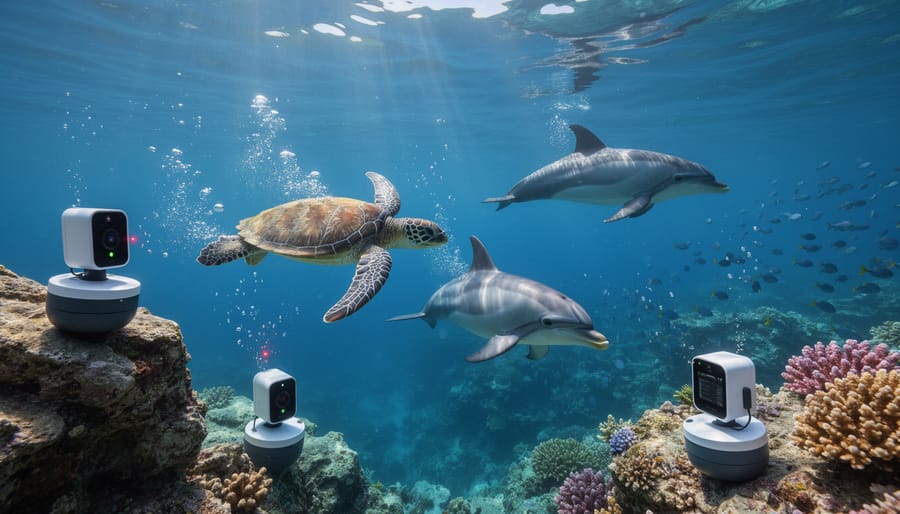
Underwater camera systems equipped with machine learning can now identify species in real-time. The ReefScan project in Australia’s Great Barrier Reef processes thousands of images daily, recognizing over 400 fish species and detecting coral bleaching events. Since 2021, the system has documented recovery in previously damaged areas, providing hope and actionable data for targeted interventions.
Satellite imagery analysis offers another breakthrough. Planet Labs’ high-resolution satellites combined with AI algorithms now monitor coral reef health across entire ocean regions. This technology detected early warning signs of coral stress three weeks before visible bleaching occurred in the Caribbean, enabling rapid response teams to investigate potential causes and implement protective measures. The system monitors 75% of the world’s coral reefs, analyzing changes in water temperature, chlorophyll levels, and reef coloration patterns with unprecedented precision.
Tracking Illegal Fishing in Real Time
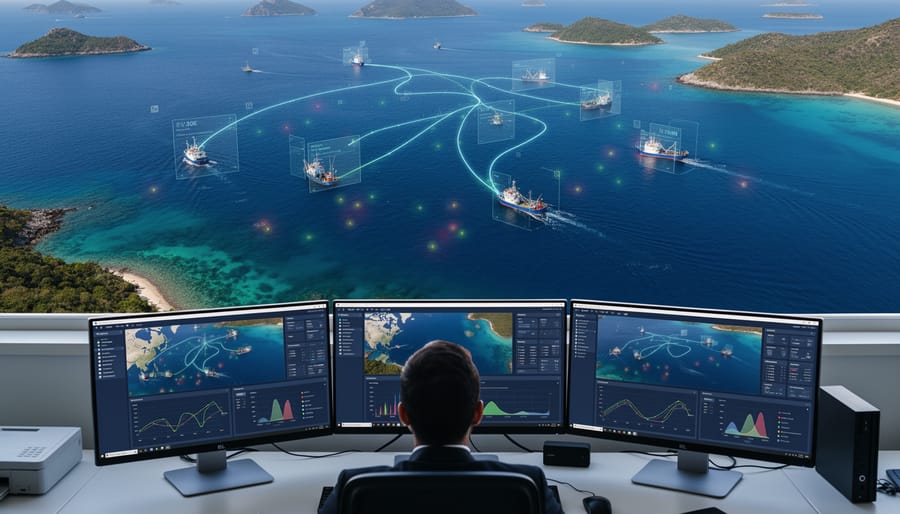
AI-powered monitoring systems are revolutionizing how we detect and respond to illegal fishing activities in marine protected areas. These systems analyze vast amounts of satellite data, automatic identification system (AIS) signals, and vessel movement patterns to identify suspicious behavior in real time. Machine learning algorithms can recognize when ships disable their tracking systems, enter restricted zones, or display movement patterns consistent with illegal trawling or fishing. This technology has proven essential in combating illegal fishing across vast ocean territories that would be impossible to patrol with traditional methods alone.
Dr. Marina Chen, a marine conservation officer working in Pacific marine reserves, shares her experience: “Before AI integration, we might discover illegal fishing weeks after it occurred. Now, we receive alerts within hours when a vessel exhibits suspicious behavior near our protected coral reefs. Last year, this technology helped us intercept three illegal fishing operations that would have devastated breeding populations of endangered grouper species.”
The impact extends beyond just catching violators. The presence of AI monitoring systems acts as a powerful deterrent, as fishing vessels know their activities are being tracked continuously. Enforcement agencies can now allocate limited patrol resources more effectively, responding to verified threats rather than conducting random patrols. This combination of real-time detection and strategic response has reduced illegal fishing incidents by up to sixty percent in some monitored areas, giving marine ecosystems crucial time to recover and thrive.
Predicting Where Marine Species Will Go Next
Ocean currents shift, temperatures rise, and marine species are on the move. Understanding where animals will go next has transformed from educated guesswork into precise forecasting, thanks to artificial intelligence. By analyzing decades of oceanographic data, temperature patterns, and historical migration routes, AI models now predict how species will respond to changing conditions before those movements occur.
These predictive capabilities enable a fundamentally different approach to marine conservation. Rather than scrambling to protect areas after discovering species have relocated, scientists can now anticipate where critical habitats will emerge. Machine learning algorithms process vast datasets including sea surface temperatures, current patterns, salinity levels, and prey distribution to forecast habitat suitability years in advance.
Dr. Sarah Chen, a marine ecologist who has worked with AI prediction models for five years, explains the transformation: “We used to establish marine protected areas based on where species were. Now we can design them for where species will be. That shift from reactive to proactive conservation is genuinely revolutionary.”
This forecasting proves especially valuable for migratory species like sea turtles and whales, whose routes shift as ocean temperatures change. AI models help identify future feeding grounds and breeding sites, allowing conservationists to advocate for protections before development threatens these areas. The technology also reveals climate refugia, pockets where conditions will remain stable even as surrounding waters warm, helping prioritize limited conservation resources where they will provide the greatest long-term benefit for marine biodiversity.
Citizen Science Amplified by Machine Learning
You don’t need a laboratory or advanced degree to contribute meaningfully to marine conservation research. Today, citizen science platforms powered by machine learning are transforming casual beach observations into valuable scientific data, creating an unprecedented opportunity for public participation in ocean protection.
Applications like iNaturalist and eBird have revolutionized how we collect biodiversity data. When you photograph a marine species and upload it through these platforms, AI algorithms instantly analyze the image, suggesting possible identifications based on visual characteristics, geographic location, and seasonal patterns. Expert volunteers then verify these AI-assisted identifications, creating a quality-controlled dataset that researchers worldwide can access. This hybrid approach—combining machine learning efficiency with human expertise—has generated millions of verified observations that inform conservation decisions and track species distribution changes.
The real power emerges when thousands of observers contribute simultaneously. AI processes this flood of data to detect patterns invisible to individual observers: unusual species appearances, range expansions related to warming waters, or population declines requiring immediate attention. Marine biologist Dr. Elena Rodriguez recalls how citizen reports processed through AI helped her team identify a significant seahorse population in an unexpected location, leading to new protective measures for that coastal area.
For those wanting to contribute more directly, specialized platforms like Whale FM and Floating Forests allow volunteers to analyze marine mammal calls or identify kelp forests in satellite imagery, with machine learning algorithms learning from each human classification to improve their accuracy.
Getting started is straightforward. Download a citizen science app, begin documenting your coastal encounters, and watch how your observations contribute to real research. Consider joining our volunteer network to connect with other citizen scientists, access training resources, and participate in coordinated observation efforts. Your smartphone and curiosity are all the equipment required to become part of this global conservation community.

The Human Element: Why AI Needs Marine Biologists
Despite remarkable advances in artificial intelligence, no algorithm can replace the trained eye and intuitive understanding that marine biologists bring to ocean conservation. AI excels at processing vast quantities of data, but it’s marine scientists who teach these systems what to look for, validate their findings, and translate results into meaningful conservation action.
Dr. Sarah Chen, a coral reef ecologist working off British Columbia’s coast, describes her relationship with AI as a partnership rather than a replacement. “I spent months training our image recognition system to identify different coral species and stress indicators,” she explains. “The AI can now scan thousands of underwater photographs in hours, but I’m the one who knows why a particular bleaching pattern matters, what local conditions might be causing it, and what interventions could help.”
This collaboration between human expertise and technology in marine science proves essential at every stage. Marine biologists design research questions that AI helps answer. They collect field samples that train machine learning models. When AI flags unusual patterns in ocean temperature or species distribution, scientists investigate the ecological context that explains these changes.
Consider the work of Marcus Thompson, a marine mammal specialist who uses AI to analyze whale vocalizations. “The system identifies call types faster than I ever could,” he notes, “but understanding what those calls mean, whether the population is healthy, and how shipping noise affects their communication requires years of field experience that no algorithm possesses.”
The future of marine conservation depends on this human-AI collaboration. As younger scientists enter the field, they’re learning both traditional research methods and AI integration skills, becoming bilingual in ecology and technology. Universities now offer programs combining marine biology with data science, preparing students to be the interpreters between natural systems and artificial intelligence. This next generation won’t choose between fieldwork and technology but will seamlessly blend both approaches to protect our oceans more effectively than either could alone.
Challenges We’re Working to Overcome
While AI offers tremendous promise for marine conservation, we’re navigating several genuine challenges as we work to integrate these technologies effectively. Being transparent about these obstacles helps us address them collectively and set realistic expectations for what AI can accomplish today.
Data quality remains our most significant hurdle. Machine learning algorithms are only as good as the information they’re trained on, and marine environments present unique data collection difficulties. Underwater visibility varies dramatically, lighting conditions change with depth and weather, and many species appear similar to algorithms still learning to distinguish between them. Dr. Sarah Chen, who leads our AI training initiatives, explains it simply: “We need thousands of high-quality images of each species in different conditions before our models become reliably accurate. Building those datasets takes time and countless volunteer hours.”
Funding constraints also shape how quickly we can expand AI integration. While the technology itself is becoming more accessible, purchasing underwater camera systems, maintaining computing infrastructure, and compensating specialized technical staff requires sustained financial support. We’re actively seeking partnerships and grants to overcome these barriers.
Remote locations where conservation work is most critical often lack the internet connectivity and power infrastructure that AI systems require. We’re exploring solutions like edge computing devices that process data locally, but these adaptations add complexity and cost.
Training our team and volunteers to work alongside AI tools presents an ongoing challenge. Not everyone arrives with technical skills, so we’ve developed workshops that make AI literacy accessible to people from all backgrounds.
Finally, we’re carefully considering ethical dimensions of data collection, particularly regarding traditional fishing communities and indigenous knowledge. We’re committed to implementing AI in ways that respect privacy, support local livelihoods, and enhance rather than replace human expertise in marine stewardship.
How You Can Join This Conservation Revolution
The AI conservation revolution isn’t just happening in research labs—it’s a movement you can join right now, regardless of your background or experience level.
For students and aspiring scientists, numerous opportunities await. Many universities now offer specialized courses in conservation technology and AI applications in environmental science. Organizations like Wildlife Insights and Wildbook welcome student volunteers to help train AI models by reviewing and tagging wildlife images. Dr. Sarah Chen, a marine biologist who started as a citizen scientist, shares: “I began by classifying coral photos from my laptop. That experience showed me how technology could amplify my passion for ocean protection and ultimately shaped my career path.”
Educators can access free curriculum resources from organizations like Ocean Wise and the National Geographic Society, which provide lesson plans integrating AI concepts with marine conservation. These materials help students understand how cutting-edge technology addresses real-world environmental challenges.
Professionals with AI, data science, or software development backgrounds can contribute specialized skills through platforms like DataKind or Conservation X Labs. These organizations connect tech experts with conservation projects needing computational support, from developing acoustic monitoring algorithms to creating predictive models for species distribution.
The general public can participate through citizen science initiatives. Apps like iNaturalist and Smithsonian’s eMammal let you contribute observations that feed into AI-powered biodiversity databases. Your smartphone photos become valuable data points helping researchers track marine species and ecosystem health.
Supporting financially matters too. Organizations implementing AI conservation tools—from the Coral Restoration Foundation to The Ocean Cleanup—rely on donations to maintain and expand their technological capabilities. When you take action for marine conservation, you’re investing in both immediate protection efforts and the innovative tools securing our oceans’ future.
Every contribution, whether time, expertise, or resources, strengthens this technological transformation protecting marine life.
The future of marine conservation isn’t about choosing between human expertise and artificial intelligence—it’s about recognizing how these forces amplify each other. Throughout our work at the Marine Biodiversity Science Center, we’ve witnessed AI tools transform data into insights, but it’s the human interpretation, ethical judgment, and passionate commitment that transform those insights into meaningful action. Technology provides the lens, but conservation requires the heart.
As Dr. Maria Chen, one of our senior marine biologists, often reminds her team: “AI helps us see patterns we might have missed, but it’s our responsibility to decide what those patterns mean for the creatures we’re trying to protect.” This collaborative approach has already yielded remarkable results, from identifying critical habitats before they’re lost to predicting coral bleaching events weeks in advance.
The invitation now extends to you. Whether you’re an experienced environmental professional looking to integrate new tools into your research, a student exploring how technology intersects with conservation, or simply someone who cares deeply about our oceans, there’s a place for your contribution. The Marine Biodiversity Science Center offers volunteer opportunities that range from citizen science data collection to assisting with AI-enhanced monitoring projects.
Together, we’re not just observing change—we’re creating it. Every data point collected, every pattern recognized, and every conservation decision informed by both technological capability and human wisdom brings us closer to thriving, resilient oceans. Join us in this work.

jessica
Ava Singh is an environmental writer and marine sustainability advocate with a deep commitment to protecting the world's oceans and coastal communities. With a background in environmental policy and a passion for storytelling, Ava brings complex topics to life through clear, engaging content that educates and empowers readers. At the Marine Biodiversity & Sustainability Learning Center, Ava focuses on sharing impactful stories about community engagement, policy innovations, and conservation strategies. Her writing bridges the gap between science and the public, encouraging people to take part in preserving marine biodiversity. When she’s not writing, Ava collaborates with local initiatives to promote eco-conscious living and sustainable development, ensuring her work makes a difference both on the page and in the real world.