Marine Biodiversity Science Center

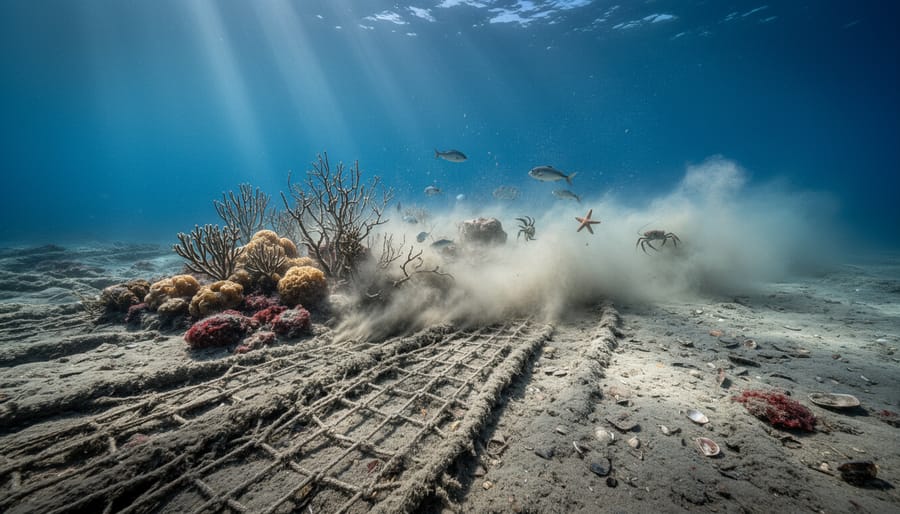
Bottom trawling poses four critical threats to marine biodiversity: habitat destruction through seafloor scouring, disruption of carbon sequestration systems, widespread bycatch mortality, and fragmentation of essential marine corridors. Each of these mechanisms operates at different scales, from the immediate physical devastation of benthic communities to longer-term ecosystem collapse, making trawling one of the most comprehensive threats facing ocean life today.
The scale of the damage is staggering. Recent assessments indicate that bottom trawling impacts an ocean area larger than all terrestrial agriculture combined, yet receives far less public attention than deforestation or land-use change. Dr. Maria Chen, a marine biologist who has surveyed trawled seafloors for over a decade, describes the aftermath as “an underwater clearcut, where centuries-old coral forests and sponge gardens are reduced to rubble in minutes.”
What makes trawling particularly insidious is its cumulative nature. A single trawl pass can devastate a thriving benthic community, but repeated trawling, which occurs in many commercially valuable fishing grounds, prevents recovery entirely. Species that took decades or centuries to establish simply cannot recolonize between disturbances. The result is a fundamentally altered ecosystem that supports far less biodiversity than undisturbed areas.
This article examines each of the four primary threats in detail, explaining the mechanisms of harm, presenting the scientific evidence, and exploring how marine conservation efforts are working to address this crisis. For those inspired to take action, opportunities exist to join citizen science initiatives monitoring seafloor recovery or to volunteer with organizations advocating for marine protected areas that exclude destructive fishing practices.
Understanding Trawling and Its Scope
Bottom trawling is an industrial fishing method that drags heavy nets, often weighing several tons, across the ocean floor to capture fish and shellfish living near or on the seabed. Imagine a massive net with weighted chains and metal doors scraping across an underwater landscape, sweeping up everything in its path. This technique targets commercially valuable species like shrimp, cod, and flatfish, but its reach extends far beyond the intended catch.
The scale of trawling’s impact on marine ecosystems is staggering:
- Trawlers disturb an ocean area roughly equivalent to twice the size of the contiguous United States each year
- A single pass can remove or damage up to 90% of bottom-dwelling organisms in the trawled path
- Some fishing grounds are trawled multiple times annually, preventing ecosystem recovery
- The practice occurs in waters from shallow coastal zones to depths exceeding 1,000 meters
Understanding why this bottom dragging causes such profound biodiversity loss requires recognizing that the seafloor isn’t a barren desert. These benthic environments support intricate communities of corals, sponges, anemones, and countless invertebrates that have developed over decades or centuries. When trawl gear plows through, it doesn’t just catch fish, it crushes three-dimensional habitat structures, exposes buried sediments, and removes the foundational organisms that countless other species depend on for food and shelter.
The fishing industry has used trawling for over a century, but technological advances have made modern vessels far more efficient and capable of reaching previously untouched areas. High-powered engines, GPS navigation, and sonar allow trawlers to work in deeper waters and rougher terrain than ever before. This expanded capacity means that even remote deep-sea ecosystems, which we once thought were safe from human impact, now face increasing pressure from trawl fisheries seeking new grounds as coastal populations decline.
Selection Criteria: Identifying the Primary Threats
Determining which impacts of bottom trawling pose the greatest risks to marine biodiversity threats requires rigorous scientific assessment. Marine scientists use a combination of long-term ecological monitoring, before-and-after studies of trawled areas, and meta-analyses of published research to identify patterns across different ecosystems. These studies examine not only the immediate, visible damage but also subtle changes in species composition, population genetics, and ecosystem function that may take years to manifest.
Conservation biologists prioritize threats based on several key factors: the spatial extent of the impact, the severity of damage to affected species and habitats, the recovery time required after disturbance ceases, and the cascading effects on broader ecosystem health. The four threats detailed in this article consistently emerge as the most significant across multiple ocean regions and habitat types, from shallow coastal waters to deep-sea environments.
The International Union for Conservation of Nature’s guidelines for assessing marine ecosystem threats, combined with fisheries impact assessments required by regional management bodies, provide standardized frameworks for this evaluation. Researchers also consider the cumulative nature of impacts, recognizing that threats rarely occur in isolation. A 2023 comprehensive review in Marine Ecology Progress Series synthesized data from over 300 studies worldwide, confirming that these four categories represent the most pervasive and severe consequences of trawling activity.
This evidence-based approach ensures we’re focusing on impacts with the strongest scientific consensus, rather than anecdotal concerns or single-study findings.
The Four Major Threats to Marine Biodiversity From Trawling
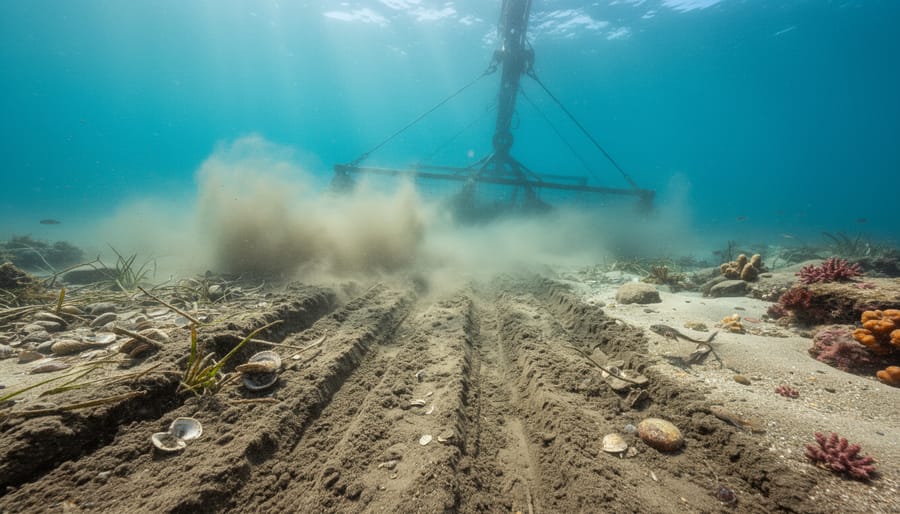
1. Habitat Destruction and Seafloor Degradation
Bottom trawling tears across the seafloor with the force of a bulldozer, leaving destruction in its wake that can persist for decades. Heavy nets and metal gear scrape away everything in their path, demolishing complex three-dimensional structures that took centuries to form. Deep-sea coral gardens, which grow at rates measured in millimeters per year, crumble into rubble. Sponge fields that filter vast quantities of seawater and provide shelter for countless organisms are ripped from the substrate. Seagrass meadows, critical nursery grounds for juvenile fish and seahorses, are torn up by the roots.
The physical damage extends far beyond the immediate destruction. When trawl gear gouges the seafloor, it resuspends sediments that smother surviving organisms and reduces water clarity for months. The slow recovery of seabeds means these ecosystems may never return to their original state within human timescales. Studies of trawled areas show that even after fishing stops, seafloor communities can take 5 to 10 years to show minimal recovery, and full ecosystem restoration may require a century or more for deep-sea habitats.
Dr. Elena Rodriguez, a marine biologist who has surveyed trawled seamounts off New Zealand, describes the contrast as heartbreaking. “On one side of the boundary, you see this incredible forest of black corals and basket stars, teeming with fish. Cross into the trawled zone, and it’s like a desert. Just bare rock and mud.” Her research documents how the loss of these structural habitats eliminates hiding places for prey species and hunting grounds for predators, triggering a cascade of biodiversity loss that ripples through the entire ecosystem. Species that depend on these habitats for spawning, feeding, or shelter simply disappear from trawled areas.
2. Disruption of Food Web Dynamics
When trawl nets sweep across the ocean floor, they don’t just remove the species fishers intend to catch, they extract critical components of marine food webs, setting off a cascade of ecological disruptions. Bottom trawling typically targets commercially valuable groundfish, crustaceans, and flatfish that occupy middle tiers of the food web, species that both consume smaller organisms and serve as prey for larger predators. Removing these populations in significant numbers creates food web imbalance that reverberates throughout the entire marine community structure. The consequences extend far beyond the immediate catch.
The selective removal of specific species fundamentally alters predator-prey dynamics. When trawling reduces populations of mid-level predators like cod or haddock, their prey species can explode in abundance, which then suppresses the plankton or small invertebrates those prey feed on. Conversely, removing prey species forces predators to shift their diets or expend more energy searching for food, potentially leading to population declines or behavioral changes that affect other species. Research on food web stability changes demonstrates how repeated trawling creates persistent shifts in community composition that can last for decades, even after fishing pressure decreases.
The disruption manifests in multiple ways across different trophic levels:
- Apex predators like sharks lose essential prey, forcing diet shifts that increase competition with other predators
- Scavenger populations surge temporarily as bycatch and damaged organisms provide abundant food sources
- Small opportunistic species colonize disturbed areas, outcompeting slower-growing specialists
- Planktivorous fish expand when their predators are removed, increasing grazing pressure on zooplankton communities
Perhaps most concerning is how trawling removes ecological redundancy, the presence of multiple species performing similar functions. Diverse food webs can absorb some disturbance because if one species declines, others fill that role. But trawling often removes entire functional groups simultaneously, leaving no backup species to maintain ecosystem processes. The result is simpler, less stable marine communities dominated by fast-growing generalists rather than the diverse assemblages that characterize healthy ocean ecosystems.
3. Bycatch and Non-Target Species Mortality
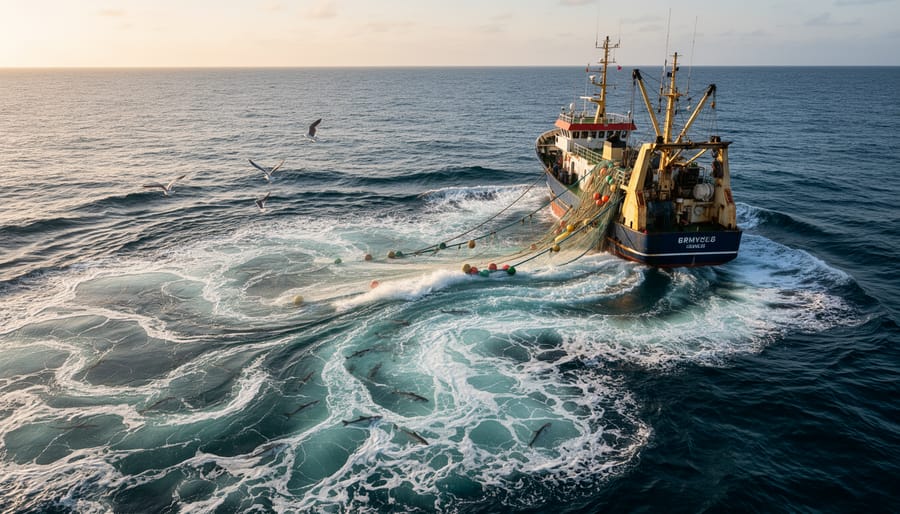
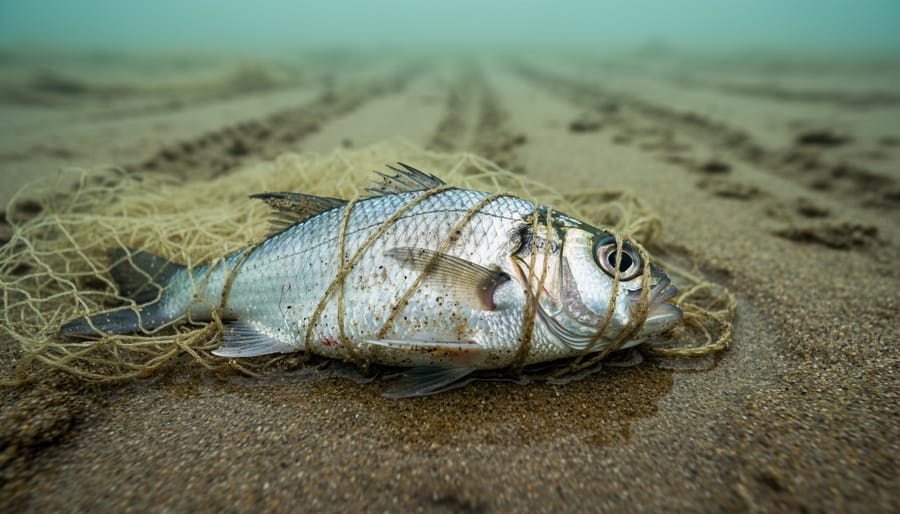
Bottom trawl nets are indiscriminate. When they scrape across the seafloor, they capture everything in their path, not just target species like shrimp or flatfish, but also sea turtles, sharks, rays, juvenile fish, marine mammals, and countless invertebrates that serve no commercial purpose. This unintended catch, called bycatch, represents one of trawling’s most devastating impacts on marine biodiversity. Unlike selective fishing methods such as pole-and-line or trap fishing, trawls cannot distinguish between species. The result is a staggering waste of marine life that undermines conservation efforts and depletes populations of already vulnerable species.
The scale becomes clearer when we examine specific fisheries. Shrimp trawling, for instance, typically catches 5 to 10 pounds of bycatch for every pound of shrimp landed. In tropical regions, that ratio can reach 20:1. Most of this bycatch dies before it can be returned to the ocean, either from injury sustained in the net or from rapid pressure changes as the catch is hauled to the surface. Even species that survive initial capture often perish from stress or predation once discarded.
Endangered species face particularly acute risks. Sea turtles drown in trawl nets when they cannot surface to breathe. Small cetaceans like harbour porpoises and dolphins suffer similar fates. Bottom trawls also capture juvenile fish before they reach reproductive age, disrupting recruitment and preventing populations from replenishing themselves. For species with slow reproductive rates, such as sharks that may take a decade to mature, this mortality compounds over time, driving populations toward collapse.
Trawling’s bycatch problem persists partly because it occurs out of sight, and enforcement of mitigation measures remains patchy across international waters. While turtle excluder devices and bycatch reduction devices exist, their adoption is inconsistent, and they cannot eliminate the problem entirely when nets sweep through diverse ecosystems. Every trawl pass removes not just commercial species but also the ecological connections that sustain marine biodiversity.
4. Loss of Genetic Diversity and Population Fragmentation
Repeated trawling operations don’t just remove fish from the ocean, they fundamentally alter the genetic makeup of marine populations in ways that compromise their long-term survival. When trawl nets repeatedly sweep through an area, they selectively harvest larger individuals and reduce overall population numbers below critical thresholds. This creates a genetic bottleneck that diminishes the diversity of traits within species, limiting their capacity to adapt to environmental stressors like ocean warming and acidification.
The mechanism works through what scientists call “evolutionary pressure.” Trawling preferentially catches faster-growing, larger individuals before they reach full reproductive potential, effectively removing the genes for these traits from the population. Over successive fishing cycles, this shifts the genetic profile toward slower growth and smaller adult sizes. Research on heavily trawled groundfish populations has documented measurable changes in maturation rates and body size occurring within just a few generations. While smaller size might seem like a clever adaptation, it actually reduces reproductive output, larger females produce exponentially more eggs, and undermines the population’s ability to recover.
Population fragmentation compounds these genetic effects. As trawling eliminates populations in certain areas while leaving others temporarily intact, it creates isolated pockets of survivors that can’t interbreed with distant groups. This geographic separation prevents gene flow between populations, meaning beneficial genetic variations that arise in one area can’t spread to others. For species with limited mobility or specific habitat requirements, this fragmentation can be permanent even if trawling eventually stops in some zones.
The consequences extend far beyond individual species. Genetically impoverished populations are less resilient to disease outbreaks, less capable of adapting to shifting ocean conditions, and more vulnerable to local extinction from subsequent disturbances. When these populations serve as prey for larger predators or perform essential ecosystem functions like nutrient cycling, their genetic decline reverberates through entire marine communities. Recovery becomes not just a matter of waiting for numbers to rebound, but of rebuilding the genetic foundation that makes resilient ecosystems possible.
The Cumulative Impact: How These Threats Interact
The four threats from bottom trawling don’t operate in isolation, they amplify one another in ways that devastate marine ecosystems far beyond their individual impacts. When trawl gear tears through seafloor habitats, it doesn’t just destroy physical structure. It simultaneously removes organisms that form the base of food webs, kills non-target species that maintain genetic diversity, and fragments populations that were already under stress. This creates a downward spiral: habitat destruction eliminates shelter and breeding grounds, which intensifies population fragmentation. Fragmented populations produce less genetic diversity, making species more vulnerable to environmental changes. Meanwhile, disrupted food webs can’t recover because the habitat foundation they depend on has been obliterated.
The synergy works both ways. Species weakened by genetic bottlenecks are less resilient when their food sources disappear. Ecosystems struggling with altered predator-prey dynamics lack the stability to regenerate damaged habitats. Each trawl pass compounds previous damage, preventing recovery and pushing systems toward collapse. Scientists have documented cases where coral gardens destroyed by trawling lost not just the corals themselves, but entire communities of fish, invertebrates, and microorganisms that took centuries to establish.
Understanding these interconnections is precisely why effective marine conservation programs take ecosystem-wide approaches rather than addressing single threats in isolation. Protecting marine biodiversity from trawling means recognizing that you can’t solve habitat destruction without also addressing food web disruption and genetic consequences.
Conservation Solutions and What’s Being Done
Despite the severity of trawling’s impact, the global conservation community has made significant strides in protecting marine ecosystems through science-driven solutions. Marine protected areas (MPAs) have proven remarkably effective where implemented with enforcement: Australia’s Great Barrier Reef Marine Park, which restricts trawling in critical zones, has shown measurable recovery of benthic communities and fish populations within protected sections. The European Union’s deep-sea fishing regulations, implemented in 2016, now prohibit bottom trawling below 800 meters in vulnerable marine ecosystems, safeguarding cold-water coral habitats that take millennia to develop.
Scientific research continues to drive innovation in sustainable fishing practices. Several approaches are showing real promise:
- Modified trawl nets with turtle excluder devices and bycatch reduction devices that allow non-target species to escape
- Real-time monitoring systems using satellite data to identify and avoid sensitive habitats
- Alternative gear types like traps and longlines that target specific species with minimal seafloor contact
- Seasonal closures during critical spawning periods, allowing population recovery
- Community-based management programs that give local fishers stake in long-term ecosystem health
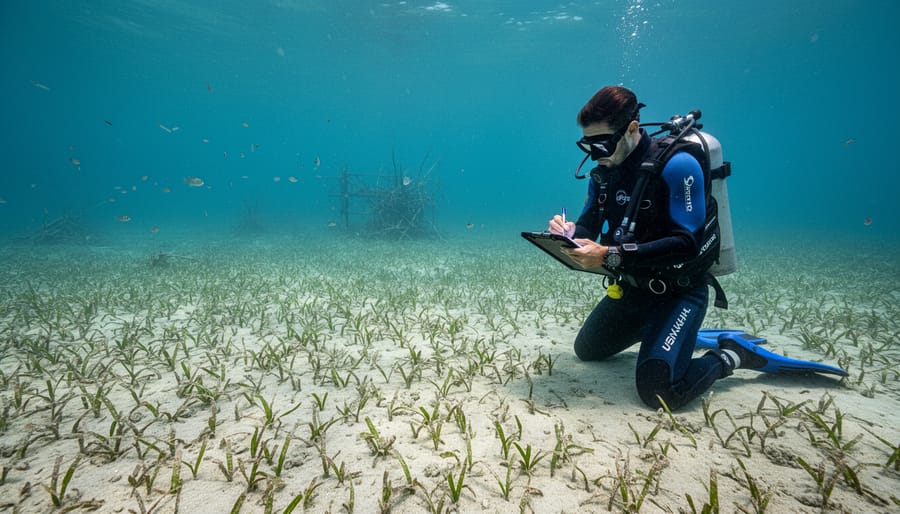
The Marine Biodiversity Science Center leads several research initiatives documenting these conservation successes and training the next generation of marine scientists. Their citizen science programs collect crucial data on ecosystem recovery in formerly trawled areas, demonstrating that understanding why marine biodiversity matters translates directly into effective conservation action. Countries including New Zealand, Norway, and Canada have established networks of bottom-trawl exclusion zones based on habitat mapping research, protecting essential fish habitat while maintaining sustainable fisheries in less vulnerable areas. These policy victories prove that balancing economic needs with ecosystem protection is achievable when guided by robust science.
How You Can Help Protect Marine Biodiversity
Understanding the threats trawling poses to marine biodiversity is the first step, taking action is what creates real change. You don’t need to be a marine biologist to make a meaningful difference in ocean conservation.
Start with your seafood choices. Look for certifications like Marine Stewardship Council (MSC) or Ocean Wise when purchasing fish, and use apps like Seafood Watch to identify sustainable options. Choosing hook-and-line caught fish over trawl-caught species directly reduces demand for destructive fishing methods. Ask restaurants and fish counters about their sourcing practices. Consumer pressure works: several major retailers have committed to trawl-free policies in response to customer concerns.
Supporting marine protected areas makes a tangible impact. Contact your representatives to advocate for expanding no-trawl zones in critical habitats. Sign petitions calling for stronger fishing regulations, and stay informed about local marine conservation issues. Policy changes often start with grassroots momentum.
Share what you’ve learned. Education multiplies impact exponentially. Talk to friends and family about sustainable seafood, post about marine conservation on social media, or organize a screening of ocean documentaries in your community. Many people simply don’t know about trawling’s effects.
Consider financial support for organizations working on the front lines of marine conservation. Even small monthly donations fund critical research, habitat restoration projects, and advocacy campaigns that influence fishing policy at national and international levels.
Every action counts. When thousands of people make informed choices and speak up for ocean health, we create the collective force needed to protect marine biodiversity for future generations.
Recap: Understanding and Addressing Trawling’s Impact
Bottom trawling presents four interconnected threats that fundamentally reshape marine ecosystems: physical habitat destruction that can take decades to recover, disruption of food web relationships that destabilizes entire communities, massive bycatch mortality that endangers vulnerable species, and loss of genetic diversity that compromises long-term resilience. Understanding these threats reveals why trawling stands among the most damaging fishing practices for ocean biodiversity.
The science is clear, but the story doesn’t end there. Marine protected areas, improved fishing technologies, and policy reforms demonstrate that meaningful change is possible when communities, scientists, and policymakers work together. Every piece of research conducted, every volunteer hour contributed, and every informed seafood choice made builds toward healthier oceans.
How long does it take for trawled seafloor habitats to recover?
Recovery times vary dramatically by ecosystem type, from several years for soft-bottom communities to decades or even centuries for slow-growing structures like deep-sea corals and sponge gardens.
Are there sustainable alternatives to bottom trawling?
Yes, several fishing methods have lower environmental impacts, including hook-and-line fishing, trap fishing, and mid-water trawling that doesn’t contact the seafloor. Consumers can support these by choosing sustainably certified seafood.
Can marine protected areas really make a difference against trawling impacts?
Scientific evidence shows that well-enforced marine protected areas allow ecosystems to rebuild, with increased biodiversity, larger fish populations, and restored habitat complexity within their boundaries.
Your engagement matters more than you might think. The Marine Biodiversity Science Center connects people with research opportunities that directly contribute to understanding and protecting marine life. When citizens become ocean advocates, they amplify scientific voices and accelerate the transition toward fishing practices that work with nature rather than against it.

jessica
Ava Singh is an environmental writer and marine sustainability advocate with a deep commitment to protecting the world's oceans and coastal communities. With a background in environmental policy and a passion for storytelling, Ava brings complex topics to life through clear, engaging content that educates and empowers readers. At the Marine Biodiversity & Sustainability Learning Center, Ava focuses on sharing impactful stories about community engagement, policy innovations, and conservation strategies. Her writing bridges the gap between science and the public, encouraging people to take part in preserving marine biodiversity. When she’s not writing, Ava collaborates with local initiatives to promote eco-conscious living and sustainable development, ensuring her work makes a difference both on the page and in the real world.