Marine Biodiversity Science Center

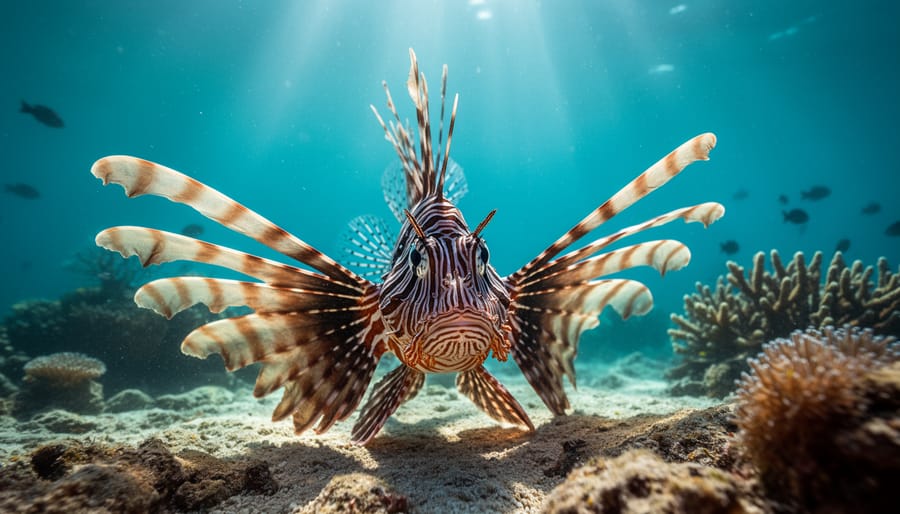
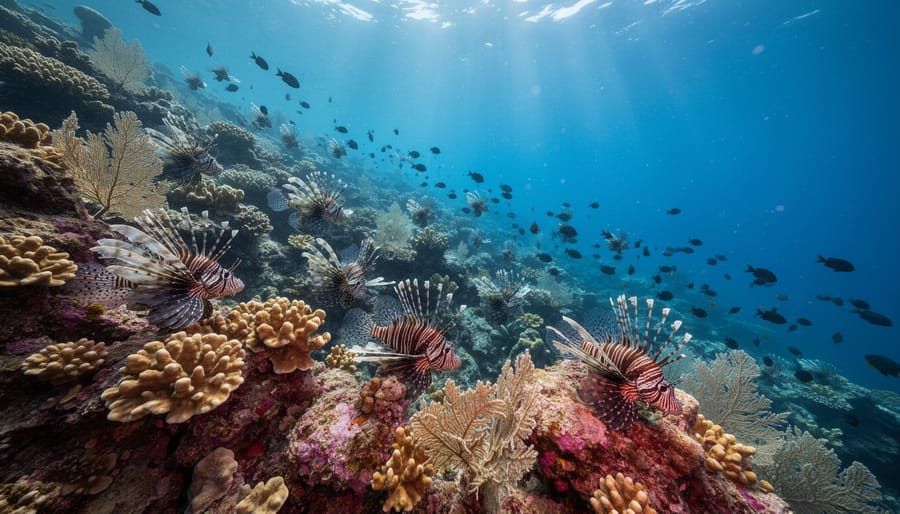
Lionfish in coral reefs are strikingly beautiful venomous fish native to the Indo-Pacific that have become one of the most damaging invasive species in Atlantic, Caribbean, and Mediterranean reef ecosystems. These distinctive predators, with their fan-like pectoral fins and bold red, white, and brown stripes, use elaborate visual signaling to communicate threat, hunt prey, and navigate complex reef structures. Understanding how lionfish interact with coral reef communities through their visual adaptations and hunting behaviors reveals why they’ve achieved such devastating success in invaded waters.
Since their first confirmed sighting off the Florida coast in 1985, lionfish have spread throughout the Western Atlantic at unprecedented rates. By 2026, these voracious predators occupy reef habitats from North Carolina to Brazil, consuming juvenile fish at rates that threaten the recovery of already stressed reef systems. A single lionfish can reduce juvenile fish populations on a reef patch by up to 79% in just five weeks.
What makes lionfish particularly dangerous isn’t just their appetite. Their venomous spines deter native predators that haven’t evolved alongside them. Their rapid reproduction, with females releasing up to 2 million eggs annually, outpaces nearly every other reef fish. Their ability to survive in diverse conditions, from shallow reefs to depths exceeding 300 meters, means few coral habitats remain beyond their reach.
This article explores the biological characteristics that make lionfish such effective reef predators, examines the mechanisms behind their visual communication and hunting strategies, and details the ecological impacts reshaping invaded reef communities. You’ll discover the innovative removal efforts underway, volunteer opportunities to join control programs, and conservation approaches that offer genuine hope for protecting reef biodiversity from this ongoing invasion.
Defining Lionfish: Invasive Predators with Striking Signals
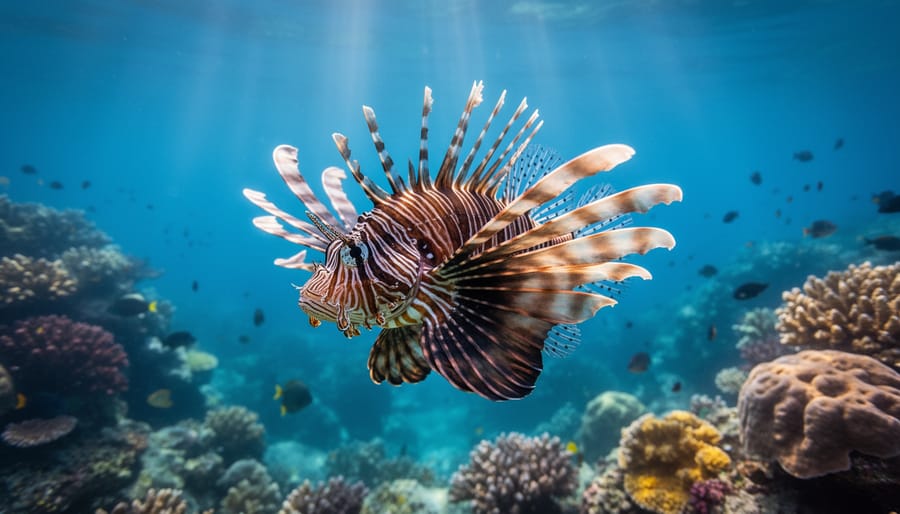
Lionfish are venomous marine predators belonging to the genus *Pterois*, a group of scorpionfish that have become one of the most ecologically disruptive invaders in coral reef ecosystems worldwide. These carnivorous fish are native to Indo-Pacific waters, ranging from the Red Sea and East Africa through Southeast Asia to Australia and Japan. However, since the mid-1980s, lionfish have established breeding populations throughout the western Atlantic Ocean, Caribbean Sea, and Gulf of Mexico, where they have no natural predators and native reef fish lack evolved defenses against their hunting strategies.
Within the taxonomic class Actinopterygii (ray-finned fishes), lionfish belong to the family Scorpaenidae, with two species dominating invasion zones: the red lionfish (*Pterois volitans*) and the devil firefish (*Pterois miles*). Both species share remarkably similar morphology and behavior, making field distinction difficult even for experienced divers.
- Aposematic Coloration
- Bold, high-contrast warning patterns (typically reddish-brown stripes against white or cream backgrounds) that advertise danger to potential predators. This visual signal communicates the presence of defensive weapons without requiring physical contact.
- Venomous Spines
- Eighteen needle-sharp spines (thirteen dorsal, three anal, two pelvic) equipped with venom glands that deliver painful defensive toxins. The venom causes severe pain, swelling, and systemic effects in humans, though fatalities are extremely rare.
- Invasive Species
- An organism introduced to an ecosystem outside its native range that establishes self-sustaining populations and causes ecological or economic harm. Lionfish exemplify this designation through their rapid population growth and devastating impact on Caribbean reef fish communities.
- Native Range
- The geographic area where a species evolved and naturally occurs without human introduction. For lionfish, this encompasses tropical and subtropical Indo-Pacific coral reefs, rocky outcrops, and lagoons.
What makes lionfish particularly recognizable are their extravagant physical features. They possess elaborate, feather-like pectoral fins that fan outward like ornamental fans, coupled with tall dorsal fin spines that form a dramatic mane along their backs. This morphology isn’t merely decorative. The enlarged fins increase their apparent size during threat displays and create visual barriers that corral prey during hunts. Their bold striping patterns serve dual purposes: warning potential predators about their venomous defenses while simultaneously breaking up their body outline against the complex visual backdrop of coral reefs. Adult lionfish typically reach 12 to 15 inches in length, though specimens over 18 inches have been documented in invaded territories where they face minimal predation pressure.
How Lionfish Visual Signaling Works in Reef Environments
Aposematic Coloration: Warning Signals
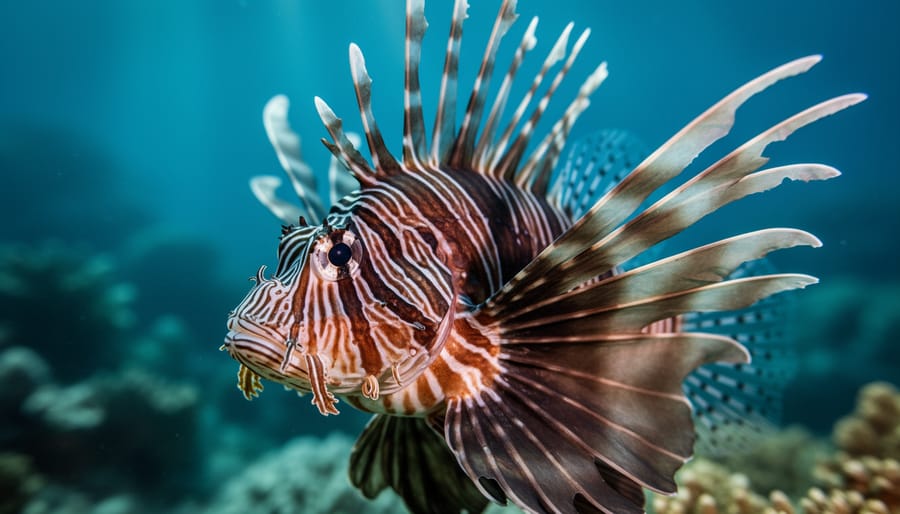
Lionfish stripes aren’t decorative, they’re a biological billboard announcing danger. The alternating bands of red, white, brown, and black create high-contrast patterns visible even in low-light reef conditions, warning potential predators that these fish pack venomous spines capable of delivering painful, incapacitating stings. This aposematic coloration follows the same evolutionary principle as poison dart frogs and monarch butterflies: advertise your defenses to avoid conflict altogether.
In their native Indo-Pacific reefs, larger predators like groupers learned to read these signals generations ago, giving lionfish space and avoiding costly encounters. But in invaded Caribbean and Atlantic waters, native predators lack this evolutionary education. They haven’t developed the visual associations between bold patterns and venom that make color communication so effective in coral reef ecosystems. This gap partly explains why lionfish thrive unchecked, their warning system speaks a language local predators never learned to understand, removing a natural check on their population growth.
Fin Displays and Body Language
Lionfish deploy their elaborate fins as dynamic communication tools, transforming their body outline to manipulate both prey and potential threats. When hunting, lionfish gradually spread their large, fan-like pectoral fins to create a visual barrier, herding small fish into confined spaces where escape routes vanish. This fin-spread behavior increases their apparent size by up to three times, making them appear as a moving wall that channels prey toward their strike zone. Observers note that the slow, deliberate spreading of these fins seems to mesmerize smaller reef fish, reducing their flight response, a phenomenon likely enhanced by the prey’s simultaneous processing of water flow cues from the lionfish’s movements.
Beyond hunting, fin displays signal threat intensity to competitors and potential predators. A lionfish encountering a rival will erect its venomous dorsal spines to maximum height while flaring all fins outward, creating an unmistakable visual statement: approach means injury. During less intense encounters, partial fin extensions and subtle body tilting convey graduated warnings. This postural vocabulary allows lionfish to resolve most territorial disputes without physical contact, conserving energy while maintaining their position in the reef’s visual hierarchy.
Visual Hunting Strategies
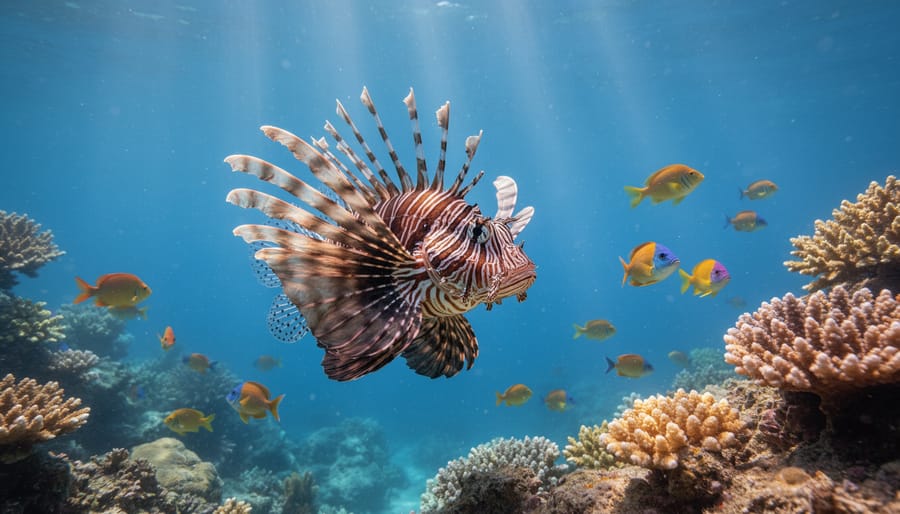
Lionfish exploit their visual appearance as a sophisticated hunting tool that disorients and traps small reef fish. The predator’s slow, deliberate approach combines with its dramatic fin displays to create visual confusion: prey species perceive the flowing fins as harmless seaweed or non-threatening objects rather than an approaching threat. This deceptive appearance allows lionfish to drift within striking distance before flaring their pectoral fins in a rapid cornering maneuver that herds prey into confined spaces against coral structures.
The striped patterns further reduce escape responses by disrupting the prey’s ability to judge distance and direction. Small reef fish that rely primarily on visual cues for predator detection fail to recognize the lionfish’s hunting sequence until it’s too late, unlike native predators whose attack patterns these fish have evolved to avoid. While scent communication plays a role in some reef predator-prey interactions, lionfish hunting success depends heavily on this visual deception. Once cornered, prey face the lionfish’s lightning-fast suction feeding, which creates negative pressure that pulls victims into its expandable mouth from several centimeters away.
Types and Components of Lionfish Visual Signals
Morphological Components
Lionfish possess several specialized anatomical structures that work together to produce their distinctive visual signals in coral reef environments. The most prominent features are the elongated dorsal and pectoral fins, which extend far beyond typical reef fish proportions. These fins contain delicate, flexible rays that create a fan-like display when fully extended, dramatically increasing the lionfish’s apparent size, a crucial element in both predator deterrence and prey intimidation.
The spine arrays themselves serve dual functions as both weapons and visual components. Thirteen venomous dorsal spines, three anal spines, and two pelvic spines create a pronounced silhouette that reef fish recognize as dangerous. The spines’ alternating light and dark banding patterns enhance their visibility against the reef background, functioning as distance markers that help other fish gauge safe approach distances.
Body shape contributes significantly to signal effectiveness. Lionfish have laterally compressed bodies with deep profiles that appear larger from frontal views, the angle most relevant during territorial confrontations and predatory approaches. The head structure features pronounced brow ridges and protruding eyes positioned for binocular vision, creating an intimidating frontal aspect. Together, these morphological components create a coherent visual package that functions across multiple ecological contexts in coral reef systems.
Color Pattern Types
Lionfish display remarkable variation in their striping patterns, which function as both species identifiers and ecological signals within coral reef environments. The classic pattern consists of alternating red-brown and white vertical bands, but the contrast intensity varies substantially between individuals and populations. High-contrast patterns, with crisp, well-defined borders between dark and light bands, appear most common in clear-water reef habitats where visual clarity is optimal. In turbid or deeper reef zones, some populations exhibit muted patterns with softer gradations, though the functional significance of this variation remains under study.
Regional color variations exist across lionfish distribution ranges in coral reefs. Red lionfish (*Pterois volitans*) in their native Indo-Pacific range show wider color diversity than invasive Atlantic populations, including specimens with darker burgundy tones or more pronounced white striping. Devil firefish (*Pterois miles*), often confused with red lionfish, typically display slightly narrower bands and a more uniform coloration. Some Caribbean invasive populations have developed subtle pattern differences, possibly due to founder effects or selective pressures in novel reef environments, though these variations don’t compromise the warning signal’s effectiveness across different reef fish communities.
Behavioral Display Categories
Lionfish deploy distinct behavioral displays that serve different ecological functions in coral reefs. Threat displays occur when lionfish face potential danger: they orient head-on toward the threat, spread all fins to maximum width, and hold position while slowly undulating their pectoral fins. This display maximizes their apparent size and prominently features their venomous dorsal spines, effectively communicating danger to curious predators or divers.
Hunting postures show markedly different characteristics. During active foraging, lionfish angle their bodies at 30-45 degrees, extend their large pectoral fins forward and outward like a net, and use slow, deliberate movements to herd small reef fish into corners or crevices. The fins create a visual barrier that small fish instinctively avoid, trapping prey against reef structures. Some researchers have documented lionfish using their fins to cast shadows that confuse prey about escape routes.
Territorial signals appear when lionfish encounter competitors or conspecifics near preferred hunting grounds or shelter sites. These displays involve rapid directional charges, quick fin flares, and aggressive body positioning that includes lateral displays where the lionfish turns broadside to emphasize body depth and spine arrays. In coral reef environments where visual communication dominates inter-species interactions, lionfish have adapted their native Indo-Pacific display repertoire to effectively dominate space and resources in invaded Atlantic and Caribbean reefs.
Ecological Uses of Lionfish Visual Signals in Coral Reefs
Defense and Predator Avoidance
Lionfish visual signals evolved primarily as defensive mechanisms against larger predators in their native Indo-Pacific reefs. The bold vertical stripes and dramatically contrasting colors function as aposematic warning coloration, advertising the presence of venomous dorsal, pelvic, and anal spines to potential threats like groupers, sharks, and large moray eels. When approached, lionfish rotate to face the threat and flare their ornate pectoral fins while erecting their dorsal spines, creating a larger visual profile that emphasizes the danger. This display is surprisingly effective: research shows that predators in native reef systems quickly learn to avoid lionfish after a single painful encounter, with the visual signals serving as memory cues that prevent future attacks.
In invaded Caribbean and Atlantic coral reefs, these same defensive displays remain highly effective, though for different reasons. Native predators in these regions lack evolutionary experience with lionfish and haven’t learned to associate the visual warning signals with venomous spines. The unfamiliar appearance actually provides lionfish with even greater protection than in their home range, as Caribbean reef predators typically avoid attacking prey with such unusual coloration and aggressive displays. Unlike other sensory modalities such as electric fields that sharks use for hunting, visual signals work across longer distances in clear reef waters, giving lionfish an early warning system and time to deploy defensive postures before close-range encounters.
Prey Capture and Foraging Efficiency
Lionfish have evolved a suite of visual tricks that turn their flamboyant appearance into a lethal hunting tool on coral reefs. Rather than relying on speed or stealth alone, they use their elaborate fins and bold stripes to confuse and herd prey into inescapable positions. When a lionfish approaches a small damselfish or goby, it slowly spreads its oversized pectoral fins like a net, creating a visual barrier that blocks escape routes. The prey fish, confronted with this moving wall of spines and stripes, often freezes or retreats directly into the lionfish’s strike zone.
This visual intimidation reduces the energy cost of hunting. Studies on invaded Atlantic reefs show lionfish can consume up to 20 small fish per hour during peak foraging, a rate far exceeding native predators of similar size. Their zebra-like stripes may also create motion camouflage, making it harder for prey to judge the predator’s approach speed. The combination of fin herding and disruptive coloration allows lionfish to capture prey with minimal effort, fueling their rapid population growth and devastating impact on reef fish communities.
Competitive Advantage in Invaded Reefs
In invaded Caribbean and Atlantic reefs, native predators such as groupers and barracudas have evolved alongside fish species with entirely different visual communication strategies. Lionfish visual signals operate outside this established system, creating a profound competitive advantage. Native predators don’t recognize lionfish warning displays as threats, while native prey species fail to interpret lionfish hunting postures as danger cues. This communication breakdown means lionfish can approach prey more closely than native predators before triggering escape responses.
Research from invaded reef systems shows lionfish successfully hunt in territories where native predators struggle, partly because their unfamiliar visual profile doesn’t activate the learned avoidance behaviors Caribbean reef fish have developed over millennia. A grouper’s approach pattern triggers immediate flight responses in small fish, but lionfish can position themselves within striking distance before prey recognize the threat. This naïveté extends upward too: larger reef predators that might compete with or prey upon lionfish often ignore their aposematic signals, allowing lionfish to occupy prime hunting grounds without significant challenge. The result is a predator operating with reduced competition and enhanced hunting success, contributing to their explosive population growth in invaded waters.
Conservation Implications: Disrupted Visual Communication Networks
When lionfish entered Caribbean and Atlantic coral reefs, they didn’t just bring a new predator, they introduced an entirely foreign visual language that native fish had never evolved to understand. This communication mismatch has created cascading disruptions throughout reef ecosystems, fundamentally altering how resident species interact, forage, and survive.
Caribbean reef fish have coexisted for millennia with predators like groupers and snappers, whose visual signals they recognize and respond to appropriately. Lionfish present unfamiliar warning patterns that many native species either misinterpret or ignore entirely. Juvenile damselfish and gobies, which would normally flee from recognized predator cues, often remain stationary when approached by a lionfish displaying its elaborate fins. This failure in visual threat recognition has contributed to localized prey depletion rates exceeding 80% in some invaded areas as of 2026.
The disruption extends beyond direct predation. Native predators that rely on visual intimidation for territory defense find themselves at a disadvantage against lionfish, whose bold aposematic displays and aggressive posturing often win contested spaces. Documented displacement of Nassau grouper and black grouper from preferred hunting grounds demonstrates how visual dominance translates to competitive exclusion. These territorial shifts compress native predators into marginal habitats, reducing their foraging efficiency and reproductive success.
Recruitment dynamics suffer perhaps the most severe impacts. Larval and juvenile reef fish depend on visual cues from adult populations to identify suitable settlement habitat. High concentrations of visually dominant lionfish in coral reefs alter these settlement patterns, steering recruits away from optimal locations or directly consuming them upon arrival. Studies from Bahamian reefs show 60-70% reductions in recruitment classes for several damselfish and wrasse species in lionfish-dense areas.
Current management strategies as of 2026 increasingly recognize these behavioral dimensions. Targeted removal programs now prioritize areas critical for native fish recruitment and spawning, aiming to restore natural visual communication networks. Regional lionfish derbies and systematic culling efforts have shown that consistent human intervention can reduce local populations enough for native predator-prey dynamics to re-establish. Marine protected areas in the Cayman Islands and Bonaire have demonstrated partial recovery of native fish behavior patterns following intensive lionfish control, offering measured optimism that reefs can regain their communication balance with sustained management commitment.
What We Can Do: Action and Participation
The invasion of lionfish in coral reefs has sparked an unprecedented wave of grassroots conservation action across the Caribbean and Atlantic. Anyone who cares about reef health can contribute directly to controlling this threat.
Lionfish removal derbies and dedicated control programs now operate year-round from Florida to Belize. Organizations like REEF (Reef Environmental Education Foundation) coordinate trained divers who safely spear lionfish, track removal data, and submit catch information that helps scientists map population densities. No prior experience? Many dive shops offer specialized lionfish hunter certification courses that teach safe handling, proper spearing techniques, and venom injury prevention. Beyond diving, coastal communities host lionfish cooking demonstrations and restaurant partnerships that turn invasive predators into sustainable seafood, creating economic incentives for ongoing removal.
Citizen science projects offer non-divers meaningful ways to participate. The Lionfish Reporter app lets snorkelers and observers log sightings with photos and GPS coordinates, building crucial distribution maps. Researchers also need volunteers to monitor native reef fish behavior in areas before and after lionfish removal, documenting the recovery of natural visual communication patterns and recruitment success.
Dr. Sofia Ramirez, who coordinates lionfish management across the Mesoamerican Reef, reflects on seven years of community engagement: “When we started removal efforts in 2019, I worried we were fighting a losing battle. But watching fishing cooperatives, recreational divers, and local students work together has been transformative. We’ve documented 60% population reductions in intensely managed zones, and native grouper populations are rebounding. What gives me genuine hope is seeing twelve-year-olds expertly identify lionfish and explain their impact to tourists. This generation owns the solution now.”
Educational outreach matters deeply. Schools and aquariums welcome volunteers to develop lionfish awareness programs, create visual guides comparing native versus invasive species, and lead community workshops. Every person who learns to identify lionfish and understands their disruption of coral reef ecosystems becomes an advocate for protection.
The data proves collective action works. Reefs with consistent removal pressure show measurable recovery in native fish diversity and coral recruitment rates.
Frequently Asked Questions
Can native predators learn to recognize lionfish visual signals?
Some large groupers and sharks in invaded reefs have begun predating on lionfish, suggesting learned recognition of their signals, but this adaptation occurs slowly and varies by region. Native predators that evolved alongside lionfish in the Indo-Pacific readily understand these warning displays, while Caribbean predators typically lack this innate recognition.
Are lionfish in coral reefs dangerous to divers and snorkelers?
Lionfish are not aggressive toward humans and will typically retreat when approached. Their venomous spines can cause painful stings if touched or stepped on, but these incidents are rare and occur mainly when lionfish are accidentally contacted or handled during removal efforts.
Do lionfish change their visual displays in different reef habitats?
Lionfish maintain consistent coloration patterns across habitat types, but they adjust their behavioral displays based on context. In open water they may spread their fins more dramatically, while in complex reef structures they often rely more on their warning coloration than active displays.
How effective are lionfish removal programs in protecting reef ecosystems?
Removal programs have demonstrated success in reducing local lionfish populations and allowing native fish communities to recover, particularly in heavily targeted areas with consistent removal efforts. However, sustained effort is required because lionfish reproduce rapidly and can recolonize cleared areas from nearby populations.
Can native reef fish species adapt to lionfish presence over time?
Some behavioral adaptations have been observed, such as increased wariness around lionfish-like stimuli in heavily invaded areas, but evolutionary adaptation occurs over many generations. Current evidence suggests that ecological impacts will persist without active management, making human intervention crucial for reef recovery.
Why don’t lionfish visual signals deter predators in invaded reefs?
Caribbean and Atlantic predators lack evolutionary experience with lionfish warning signals, so they do not instinctively recognize the striped patterns and fin displays as danger cues. This naivety gives lionfish a significant survival advantage in invaded territories compared to their native range where predators have learned these signals over millions of years.
Understanding these common questions helps connect the science of lionfish visual communication to practical concerns facing divers, conservationists, and coastal communities. The invasive success of lionfish stems partly from this signal mismatch between their evolved warning displays and the naive predator communities in Atlantic waters. While native reef ecosystems will take time to develop appropriate responses, targeted human action through removal programs and monitoring efforts provides immediate benefits for reef health and native fish populations.
Understanding how lionfish use visual signals in coral reefs gives us more than scientific knowledge, it provides a crucial lens for protecting these vital ecosystems. The striking patterns and elaborate displays that make lionfish such effective predators in their invaded territories reveal both the sophistication of reef communication networks and the vulnerability of these systems when disrupted. Caribbean and Atlantic coral reefs, evolved over millennia without encountering these visual cues, now face predators whose signals their native fish can’t properly interpret.
This knowledge translates directly into conservation action. When we understand the mechanisms behind lionfish success, we can design more effective removal programs, predict their impacts on reef fish communities, and measure recovery in protected areas. The encouraging news from 2026 is that targeted management works: reefs with consistent lionfish control show rebounding native fish populations and restored behavioral patterns. These results stem from coordinated efforts by marine biologists, dive operators, fishers, and volunteers who recognize that every removed lionfish helps rebalance the visual ecology of the reef.
Your engagement matters. Whether you participate in removal dives, support citizen science monitoring, or simply share what you’ve learned about lionfish in coral reefs, you contribute to a growing movement protecting marine biodiversity. These ecosystems have remarkable resilience when given the chance to recover. By combining scientific understanding with collective action, we’re not just studying reef ecology, we’re actively restoring it, one reef at a time.

jessica
Ava Singh is an environmental writer and marine sustainability advocate with a deep commitment to protecting the world's oceans and coastal communities. With a background in environmental policy and a passion for storytelling, Ava brings complex topics to life through clear, engaging content that educates and empowers readers. At the Marine Biodiversity & Sustainability Learning Center, Ava focuses on sharing impactful stories about community engagement, policy innovations, and conservation strategies. Her writing bridges the gap between science and the public, encouraging people to take part in preserving marine biodiversity. When she’s not writing, Ava collaborates with local initiatives to promote eco-conscious living and sustainable development, ensuring her work makes a difference both on the page and in the real world.