Marine Biodiversity Science Center

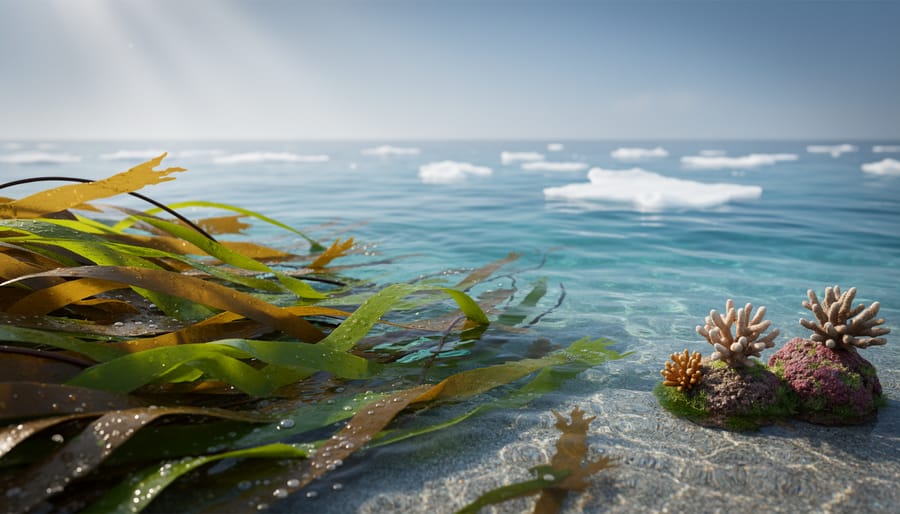
Resilience biology examines how living organisms and ecosystems absorb disturbances, reorganize, and maintain essential functions despite environmental stress or shock. In marine science, this concept has become central to understanding why some ocean ecosystems withstand pollution, warming waters, and overfishing while others collapse under similar pressures.
The urgency of studying biological resilience in our oceans has never been greater. Coral reefs that bleach yet recover. Kelp forests that rebound after storm damage. Coastal wetlands that buffer communities from hurricanes while filtering pollutants. These aren’t just fortunate outcomes. They represent measurable, biological mechanisms that scientists can now identify, quantify, and apply to conservation strategies.
What makes one population of sea stars survive mass die-off events while neighboring populations vanish? How do mangrove ecosystems recover from oil spills in months rather than decades? The answers lie in specific biological traits: genetic diversity that provides adaptation options, functional redundancy where multiple species perform similar roles, and physiological flexibility that allows organisms to tolerate changing conditions.
Understanding resilience biology transforms how we approach marine conservation. Rather than simply protecting pristine habitats, we can now design interventions that enhance an ecosystem’s inherent capacity to withstand and recover from disruption. This shift matters for communities dependent on marine resources, for coastal cities facing climate-related threats, and for the preservation of ocean biodiversity itself.
This article explores concrete examples of resilience biology across marine ecosystems. You’ll discover how different species and habitats demonstrate resilience, the underlying mechanisms that make recovery possible, and how conservation practitioners are translating these biological insights into practical strategies that work in real-world conditions.
What Resilience Biology Means for Marine Ecosystems
Resilience biology in marine ecosystems is the study of how ocean life recovers from disturbances. At its core, it examines the capacity of marine organisms and communities to absorb shocks, whether from storms, pollution, warming events, or overfishing, reorganize their structure and relationships, and continue performing the essential functions that keep the ecosystem alive. Think of it as the ocean’s ability to heal itself after injury, maintaining the processes that support life even when conditions change dramatically.
This concept differs fundamentally from resistance, which is about withstanding stress without changing. A resistant coral might survive a heat wave by tolerating high temperatures, while a resilient coral reef recovers after bleaching by recruiting new corals and rebuilding the community structure. Both matter, but resilience focuses on what happens after disturbance hits, not just whether something can tough it out.
- Resilience
- The capacity of a marine system to absorb disturbance and reorganize while retaining essentially the same functions, structure, and feedbacks. A resilient ecosystem can bounce back after major stress events.
- Resistance
- The ability of organisms or ecosystems to withstand stress without changing state. Resistant systems avoid damage during disturbance rather than recovering afterward.
- Adaptive Capacity
- The potential of a system to adjust to changing conditions through behavioral shifts, genetic changes, or structural reorganization. Higher adaptive capacity means more options for responding to new stressors.
- Ecological Memory
- The accumulated biological and physical legacies that help ecosystems reorganize after disturbance, including seed banks, surviving individuals, and intact habitat structures. It provides the foundation for recovery.
- Functional Redundancy
- When multiple species perform similar ecological roles, providing insurance if one species disappears. Redundancy buffers ecosystems against species loss and maintains critical functions.
- Regime Shift
- A sudden, persistent change to an alternative stable state, such as a coral reef transforming into an algae-dominated system. These shifts can make recovery extremely difficult or impossible.
These concepts work together to explain why some marine ecosystems recover quickly from disasters while others collapse. A kelp forest with high functional redundancy might maintain food web stability even if one herbivore population crashes, because other grazers fill that role. Ecological memory allows mangrove forests to regrow rapidly after hurricanes, drawing on surviving root systems and nearby seed sources that remember the pre-storm configuration.
Understanding these distinctions matters enormously for conservation planning in 2026. When we know whether an ecosystem needs help building resistance to future stressors or recovering resilience after past damage, we can target our efforts more effectively. The goal becomes supporting the ocean’s natural capacity to heal rather than trying to freeze ecosystems in place.
How Marine Resilience Biology Works
Biological Mechanisms at the Organism Level
At the cellular and physiological level, marine organisms deploy an impressive suite of biological mechanisms to survive and recover from environmental stress. These individual-level adaptations form the foundation of ecosystem-wide resilience.
Stress Response Proteins and Cellular Protection
When water temperatures spike during a marine heatwave, corals activate heat shock proteins, molecular chaperones that refold damaged proteins and prevent cellular breakdown. This rapid biochemical response can mean the difference between bleaching and survival. Similarly, fish exposed to pollutants upregulate detoxification enzymes that neutralize toxins before they cause irreparable harm. These protective molecules don’t eliminate stress, but they buy time for the organism to acclimate or for conditions to improve.
Phenotypic Plasticity: Flexibility Without Genetic Change
Many marine species demonstrate phenotypic plasticity, adjusting their physiology or behavior within a single generation. Sea anemones shift their symbiotic algae partners to heat-tolerant strains when temperatures rise. Fish alter their spawning timing in response to changing water temperatures, ensuring larvae hatch when food is plentiful. This flexibility allows organisms to track environmental changes without waiting for evolutionary adaptation.
Genetic Diversity as Insurance
Populations with high genetic variation harbor individuals with different stress tolerances. When a kelp forest experiences unusually warm water, genetically diverse populations are more likely to include heat-resistant individuals that survive to reproduce. This genetic insurance policy enables populations to bounce back after disturbances that would devastate genetically uniform groups.
Life History Strategies
Fast-growing species with high reproductive output, like certain mollusks and small fish, recover quickly from population crashes by rapidly rebuilding numbers when conditions improve.
Ecosystem-Level Resilience Processes
Resilience at the ecosystem scale emerges from a web of interactions far more intricate than any single organism’s survival strategy. When a disturbance strikes, whether a hurricane, disease outbreak, or sudden temperature spike, a diverse marine community can reorganize and maintain essential functions because different species respond in different ways. This functional redundancy means that if one species declines, others can step in to fill critical ecological roles like nutrient cycling, predation control, or habitat formation. Species diversity acts as a biological insurance policy: the more players in the system, the greater the chance that some will tolerate the stress and keep the ecosystem functioning.
Habitat complexity amplifies this effect by creating microenvironments where vulnerable species can shelter during disturbances. A structurally intricate reef with crevices, overhangs, and varied substrates offers more refuges than a flat, monotonous seabed. Connectivity networks, current systems, larval dispersal corridors, and migratory pathways, allow populations in damaged areas to receive recruits from healthier zones, speeding recovery. Even ocean microbes contribute by rapidly cycling nutrients and adjusting community composition in response to changing conditions.
Several processes underpin this ecosystem-level resilience:
- Species diversity providing functional redundancy and response diversity
- Habitat heterogeneity creating refuge spaces and environmental gradients
- Connectivity corridors enabling genetic exchange and population replenishment
- Trophic balance maintaining predator-prey relationships that prevent runaway shifts
- Reproductive capacity allowing rapid population rebounds after losses
Keystone species play an outsized role in these dynamics. Sea otters, for example, control sea urchin populations; without them, urchins overgraze kelp and collapse the entire forest ecosystem. Trophic cascades like this create feedback loops where the loss of one species ripples through multiple levels, sometimes pushing the system past a threshold into an alternative stable state, such as a reef dominated by algae instead of coral.
The Role of Disturbance Regimes
Natural disturbances like seasonal storms, wave action, and predator-prey cycles have shaped marine ecosystems for millennia, and organisms evolved to handle them. These regular perturbations actually strengthen resilience by preventing competitive exclusion, clearing space for recruitment, and maintaining genetic diversity within populations. A reef that experiences moderate wave stress, for instance, develops stronger coral skeletons and more robust community structure than one in perpetually calm waters.
The trouble starts when disturbances exceed historical norms, either in frequency, intensity, or type. Marine heat waves now strike with unprecedented duration, giving corals no recovery window between bleaching events. Novel pollutants introduce stressors that organisms never encountered in their evolutionary history. When disturbances pile up faster than communities can reorganize, systems cross tipping points into alternate stable states: kelp forests become urchin barrens, coral reefs shift to algae-dominated rubble. Understanding this threshold dynamic helps conservationists identify which ecosystems can bounce back naturally and which need active intervention before they flip permanently.
Examples of Resilience Biology in Marine Life
Coral Reefs: Recovery After Bleaching
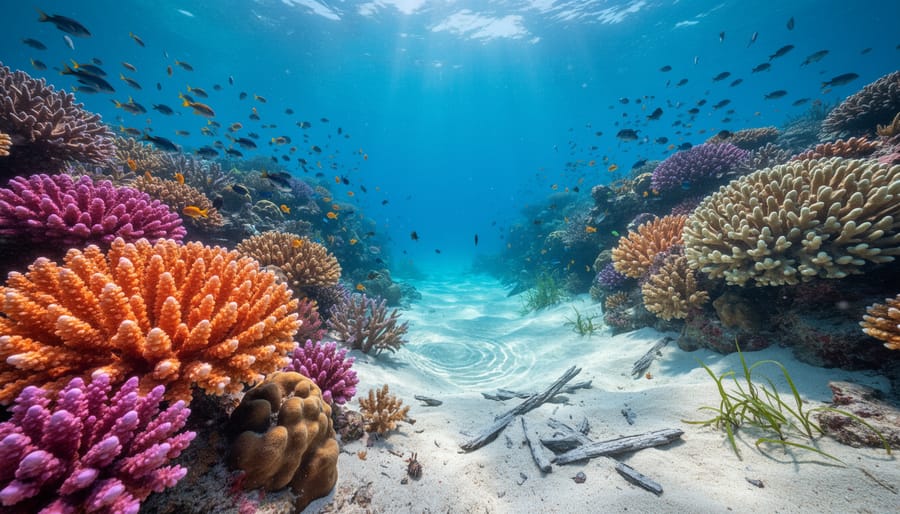
Coral reefs show remarkable resilience through several biological pathways. When water temperatures drop after a bleaching event, surviving corals can recover by hosting heat-tolerant zooxanthellae strains, a process called symbiont shuffling. Some species corals repopulate algae within weeks if conditions stabilize, restoring the photosynthetic partnership that fuels growth. Tissue regeneration allows partially bleached colonies to spread healthy polyps across damaged areas, while larval recruitment brings new genetic diversity when neighboring reefs release spawn that settles on recovering structures.
Recovery speed depends heavily on local conditions. Reefs with high water quality, abundant herbivorous fish to control algae, and structural complexity fare better than degraded systems. Repeated bleaching events within short intervals overwhelm these mechanisms, preventing full recovery and pushing ecosystems toward algae-dominated states. Understanding these natural repair processes now informs strategies for rebuilding coral reefs through restoration programs that prioritize resilient genotypes and optimal environmental conditions.
Kelp Forests: Bouncing Back from Sea Urchin Grazing
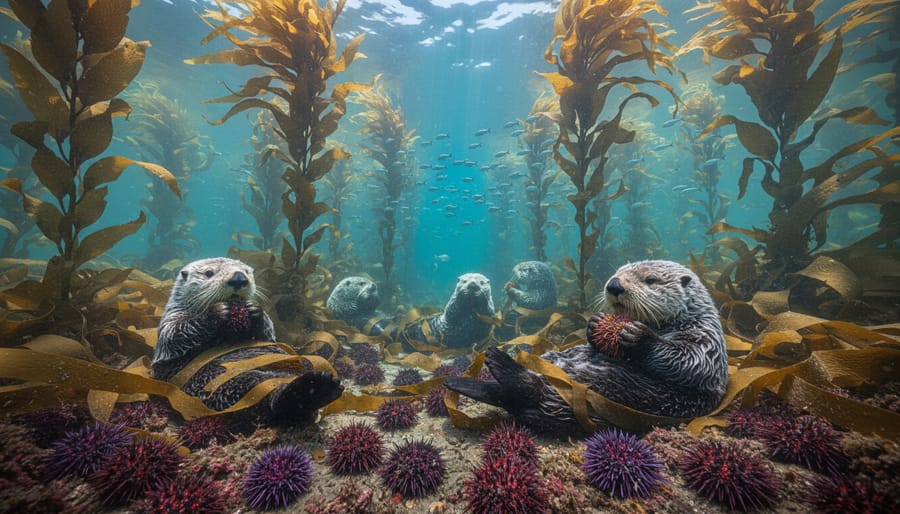
Kelp forests demonstrate resilience through both their inherent biological traits and ecosystem-level feedback loops. When sea urchin populations explode and graze kelp down to bare rock, creating what ecologists call “urchin barrens”, these marine forests possess remarkable recovery mechanisms once conditions shift.
Individual kelp plants grow astonishingly fast, up to two feet per day in optimal conditions, allowing them to quickly recolonize areas where grazing pressure decreases. Their reproductive strategy disperses millions of microscopic spores across currents, ensuring colonists arrive when habitat becomes available again.
The most dramatic resilience mechanism operates at the ecosystem level. When sea otter populations return to overgrazed areas, they consume urchins voraciously, a single otter eats roughly 25% of its body weight daily. This predation releases kelp from grazing pressure, allowing forests to regenerate within months to years.
The kelp-urchin-otter relationship illustrates functional redundancy and trophic cascades working together. California’s kelp forests have cycled between lush canopies and barren states multiple times, recovering when predator populations rebound. This system shows how resilience depends not just on the kelp itself, but on maintaining the web of interactions that regulate grazers and create conditions for recovery.
Mangrove Systems: Structural and Biological Adaptation
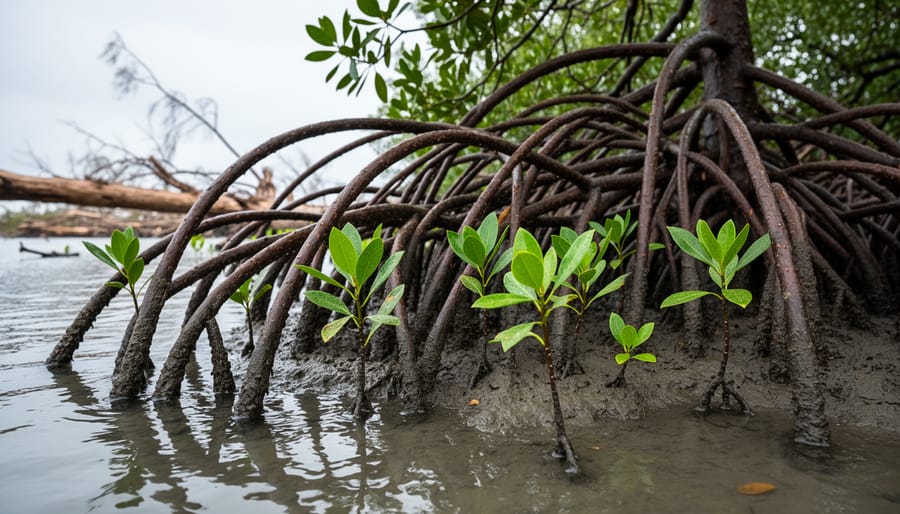
Mangroves stand as one of nature’s most resilient coastal ecosystems, engineered to withstand and recover from hurricanes, storm surges, and flooding that would devastate other plant communities. Their secret lies in a remarkable combination of structural adaptations and biological strategies that enable rapid recovery.
The distinctive prop root system does more than anchor mangroves in shifting sediment, it creates a flexible yet stable foundation that bends with storm forces rather than breaking. When cyclones snap trunks or strip foliage, these roots remain intact underground, ready to send up new shoots. The root network also traps sediment and organic matter, building soil that elevates the tree above rising waters and provides nutrients for regrowth.
Mangroves employ an unusual reproductive strategy called vivipary, where seeds germinate while still attached to the parent tree. These torpedo-shaped propagules drop when mature, floating on currents until they lodge in suitable substrate and immediately begin root development. This gives mangrove seedlings a head start compared to species requiring seed dormancy, allowing rapid colonization after disturbances clear space.
Following major storm damage, mangrove forests can regenerate within months through both resprouting from surviving root systems and recruitment of new propagules. This dual recovery mechanism, combined with their ability to stabilize coastlines against future impacts, makes mangroves a model system for understanding ecosystem resilience.
Fish Populations: Genetic and Behavioral Flexibility
Fish populations showcase resilience through remarkable behavioral and genetic flexibility. Many species adjust migration timing in response to temperature shifts, while others alter spawning locations when preferred habitats become unsuitable. Atlantic cod, for example, exhibit genetic diversity that enables some populations to tolerate warmer waters, and researchers have documented rapid evolutionary changes in life history traits, such as earlier maturation, among overfished stocks recovering under protection. This combination of behavioral plasticity and genetic adaptation allows fish communities to persist through environmental fluctuations that would otherwise collapse less flexible populations.
Bio-Inspired Structures That Enhance Marine Resilience
Artificial Reefs Modeled on Natural Structure
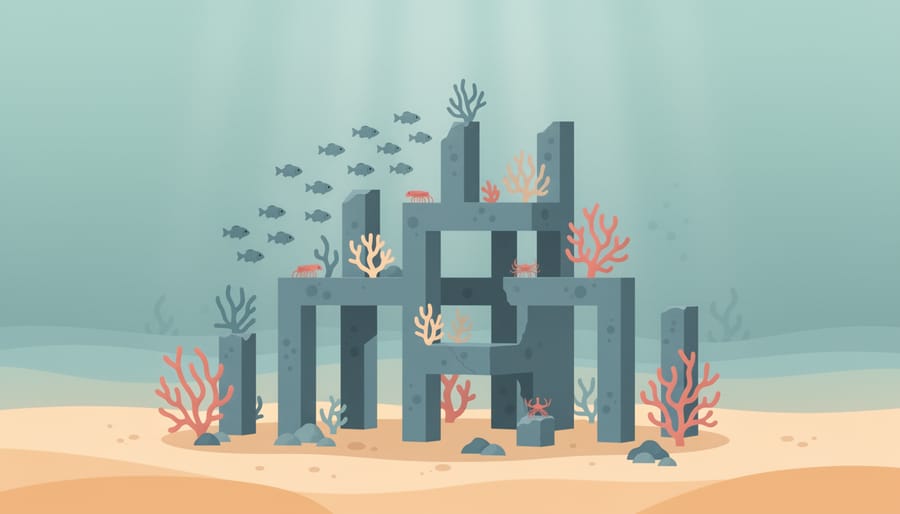
Artificial reef structures designed with resilience biology principles replicate the surface complexity and growth architecture of natural coral formations to jumpstart ecosystem recovery. Reef balls, dome-shaped concrete modules with precisely engineered holes and surface textures, mimic the three-dimensional matrix of healthy reefs, creating microhabitats that shelter juvenile fish while promoting coralline algae settlement and coral larval attachment. The varied hole sizes allow water flow patterns similar to natural reefs, distributing nutrients and larvae throughout the structure.
Recent 3D-printed reef modules go further by replicating the branching patterns and porous calcium carbonate chemistry of specific coral species. These designs match the surface area-to-volume ratios that maximize colonization sites for filter feeders, crustaceans, and early successional species. Researchers have found that artificial structures incorporating natural fractal patterns, repeating geometric complexity at multiple scales, achieve colonization rates two to three times faster than simple concrete blocks.
The key insight from resilience biology is that structural complexity itself drives recovery: more niches mean greater species diversity, which strengthens functional redundancy and adaptive capacity. When artificial reefs match the physical template of thriving natural systems, they don’t just provide habitat, they catalyze the ecological processes that sustain long-term resilience.
Living Shorelines and Hybrid Defenses
Living shorelines represent a practical application of resilience biology principles, blending native coastal vegetation with strategic engineered components to protect shorelines while maintaining ecosystem function. Unlike traditional hard structures such as seawalls, these hybrid systems work with natural processes rather than against them.
The biological foundation typically consists of salt marsh grasses, mangroves, or oyster reefs, species that naturally stabilize sediment, dissipate wave energy, and regenerate after disturbance. Engineers supplement this vegetation with low-profile structures like strategically placed stone sills, coir logs, or reef balls that reduce wave force during storms while allowing tidal flow and sediment exchange.
This combination amplifies natural resilience mechanisms. The vegetation roots bind soil and trap sediment, building elevation as sea levels rise, a self-adjusting response impossible with static concrete barriers. Meanwhile, the engineered elements buy time for plant establishment and provide immediate storm buffering until the living components mature.
The biodiversity benefits are substantial. These systems create nursery habitat for juvenile fish, foraging grounds for shorebirds, and filtration zones that improve water quality. When hurricane waves strike, the flexible vegetation bends rather than breaks, then springs back, demonstrating the same stress-and-recovery cycle that defines biological resilience at the cellular level, now scaled to coastal defense.
Restoration Frameworks Based on Resilience Science
Restoration frameworks grounded in resilience science take a fundamentally different approach than traditional methods that aimed to recreate a static “pristine” state. Instead, modern strategies design for future uncertainty by prioritizing functional diversity, ensuring multiple species can perform critical ecosystem roles like nutrient cycling or habitat formation. This redundancy creates insurance against species loss. Connectivity preservation forms another pillar: protecting migration corridors and larval dispersal pathways allows genetic exchange and recolonization after disturbances. Practitioners increasingly combine native species plantings with eco-friendly materials that support natural colonization processes. The framework emphasizes adaptive capacity, building systems that can reorganize and maintain function under changing conditions, rather than locking ecosystems into historical configurations that climate change has already made obsolete.
Why Resilience Biology Matters for Marine Conservation in 2026
Understanding resilience biology has shifted from academic curiosity to conservation necessity. As marine ecosystems face unprecedented, overlapping stressors, knowing which systems can recover, and which teeter on the brink, determines where limited conservation resources will have the greatest impact.
Climate change doesn’t respect management boundaries or species lists. Ocean temperatures in 2026 continue to break records, and acidification alters the fundamental chemistry marine organisms depend on. Resilience biology provides the framework to identify which coral reefs, kelp beds, and estuaries possess the adaptive capacity to withstand these changes versus those likely to collapse entirely. This predictive power transforms conservation from reactive crisis management to strategic, forward-looking planning.
Practical applications of resilience science now guide decisions across marine conservation:
- Identifying climate refugia where natural resilience mechanisms remain strong
- Predicting ecosystem tipping points before catastrophic regime shifts occur
- Designing adaptive management strategies that work with natural recovery processes
- Prioritizing restoration sites based on connectivity and functional diversity
- Building climate-ready marine protected areas around resilient core habitats
These applications integrate seamlessly with emerging technologies. AI monitoring systems now track stress indicators and recovery rates in real time, allowing managers to detect early warning signs of declining resilience and intervene before damage becomes irreversible.
The economic argument is equally compelling. Investing in resilient ecosystems yields compounding returns: mangroves and salt marshes that recover quickly from storms continue providing fisheries habitat, carbon sequestration, and coastal protection year after year. Understanding which systems possess this capacity helps direct billions in climate adaptation funding toward solutions that will actually persist through 2050 and beyond. Resilience biology doesn’t just explain how nature bounces back, it reveals where our conservation investments stand the best chance of success.
Common Questions About Marine Resilience Biology
Can all marine ecosystems recover from disturbance?
Not all ecosystems have equal resilience, and some disturbances can push systems past tipping points from which recovery becomes extremely difficult or impossible. Ecosystems with high biodiversity, strong connectivity, and intact functional groups typically demonstrate greater capacity to recover, while degraded systems with simplified food webs may lack the biological resources needed for recovery.
How long does marine ecosystem recovery typically take?
Recovery timelines vary dramatically depending on the ecosystem type, severity of disturbance, and environmental conditions. A kelp forest might regrow within months to a few years, while coral reef recovery from major bleaching can take decades, and deep-sea ecosystems damaged by trawling may require centuries to fully restore their structure and function.
What’s the difference between resilience and restoration?
Resilience refers to an ecosystem’s natural capacity to recover on its own after disturbance, while restoration involves human intervention to help degraded ecosystems return to a healthy state. Understanding resilience biology helps restoration practitioners work with natural recovery processes rather than against them, making interventions more effective and sustainable.
How does climate change affect marine ecosystem resilience?
Climate change reduces resilience by introducing novel stressors outside historical ranges, compressing recovery time between disturbances, and altering the fundamental conditions that species adapted to over millennia. When ecosystems face warming, acidification, and extreme weather simultaneously, their capacity to bounce back from any single disturbance diminishes significantly.
Can humans actively increase marine ecosystem resilience?
Yes, conservation actions like establishing marine protected areas, reducing pollution, restoring habitat complexity, and maintaining connectivity between populations all enhance natural resilience mechanisms. Scientists also use tools like underwater robots to monitor ecosystem health and identify which interventions best support recovery processes in different marine environments.
These questions reflect the practical concerns of people working to protect marine ecosystems or trying to understand what conservation actions actually accomplish. The key insight is that resilience isn’t a guaranteed feature of every ecosystem but rather a quality that depends on biological diversity, environmental conditions, and the nature of the stressors involved. Recognizing this helps conservationists prioritize efforts toward maintaining the ecological foundations that make resilience possible in the first place, rather than assuming nature will always bounce back regardless of how we treat it.
Understanding resilience biology transforms how we approach marine conservation. Rather than viewing ecosystems as fragile systems requiring constant protection from any disturbance, we recognize them as dynamic communities with inherent capacities to absorb shocks, reorganize, and recover, when we give them the chance.
The threats facing our oceans in 2026 are undeniably serious. Climate change, pollution, and overfishing continue to push marine systems toward critical thresholds. Yet the science of resilience biology offers genuine hope. Coral reefs that recover from bleaching, kelp forests that regrow after devastation, mangroves that rebuild after storms, these aren’t just isolated success stories. They’re demonstrations of the adaptive power woven into marine life through millions of years of evolution.
Our role is clear: support these natural recovery processes through informed conservation action. You can contribute directly through our volunteer programs, whether monitoring reef health, restoring coastal habitats, or participating in citizen science initiatives that track ecosystem recovery. Educational outreach helps spread this hopeful message to communities that depend on healthy oceans.
Dr. Maria Santos, a marine ecologist who’s worked with our center for fifteen years, recalls diving on a Philippine reef written off as dead in 2018. “Returning in 2024, I found juvenile corals everywhere, purple, green, brilliant orange. The reef was rebuilding itself. We just had to reduce fishing pressure and improve water quality. Nature did the rest. That’s resilience in action, and it never stops inspiring me.”

jessica
Ava Singh is an environmental writer and marine sustainability advocate with a deep commitment to protecting the world's oceans and coastal communities. With a background in environmental policy and a passion for storytelling, Ava brings complex topics to life through clear, engaging content that educates and empowers readers. At the Marine Biodiversity & Sustainability Learning Center, Ava focuses on sharing impactful stories about community engagement, policy innovations, and conservation strategies. Her writing bridges the gap between science and the public, encouraging people to take part in preserving marine biodiversity. When she’s not writing, Ava collaborates with local initiatives to promote eco-conscious living and sustainable development, ensuring her work makes a difference both on the page and in the real world.