Marine Biodiversity Science Center

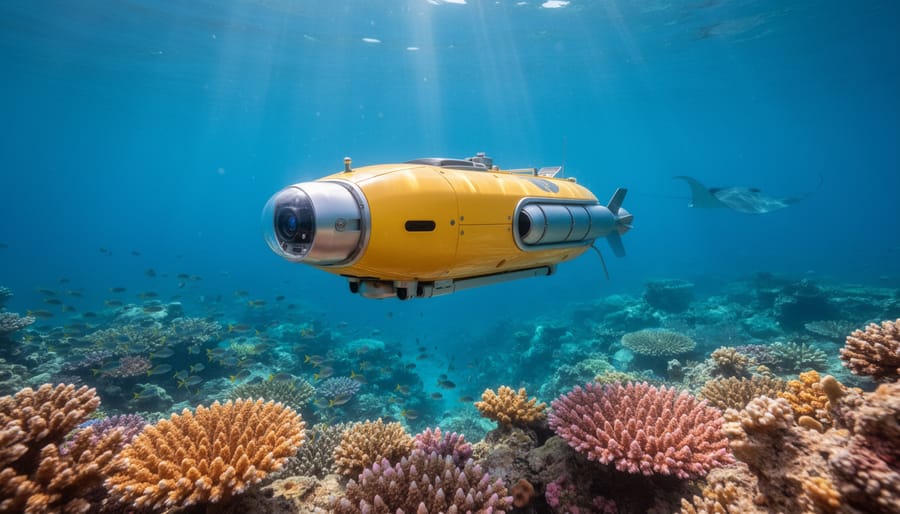
Beneath the ocean’s surface, where human divers face crushing pressure, limited oxygen, and fleeting visibility, autonomous underwater vehicles and remotely operated robots are revolutionizing how we protect marine ecosystems. These technological marvels now venture into the deepest trenches, navigate beneath polar ice, and monitor coral reefs for months at a time, gathering critical data that would be impossible or prohibitively expensive to obtain through traditional methods.
The challenge facing marine conservation is staggering: less than 25 percent of the ocean floor has been mapped in detail, and countless species remain undiscovered while existing populations face unprecedented threats from climate change, pollution, and overfishing. Underwater robots equipped with high-resolution cameras, environmental sensors, and artificial intelligence are changing this reality. They’re tracking endangered whale migrations across ocean basins, identifying illegal fishing operations in real-time, documenting bleaching events on coral reefs before recovery efforts begin, and discovering new hydrothermal vent ecosystems that reshape our understanding of marine life.
From softball-sized drones that cost less than a laptop to ship-sized autonomous vessels conducting multi-year research missions, these robotic systems are making ocean science more accessible, comprehensive, and impactful. The data they collect informs protected area designations, shapes fisheries management policies, and enables rapid response to environmental disasters, ultimately giving scientists and conservationists the tools needed to protect ocean biodiversity in an era of rapid environmental change.
The Ocean’s Silent Crisis: Why We Need New Conservation Tools
Our oceans are in crisis, and the numbers tell a sobering story. Over 90% of large fish populations have been depleted since 1950, while rising ocean temperatures have triggered mass coral bleaching events that have devastated reef systems worldwide. Meanwhile, an estimated 8 million tons of plastic waste enter our oceans each year, creating underwater pollution zones that threaten countless marine species. Climate change compounds these challenges, altering ocean chemistry and disrupting ecosystems that have existed for millennia.
Traditional conservation approaches, while valuable, face significant limitations in addressing these accelerating threats. Human divers can only reach certain depths and stay underwater for limited periods. Visual surveys conducted from boats miss the complex dynamics happening beneath the surface. Marine protected areas are difficult to monitor consistently, and illegal fishing often goes undetected in remote waters. The sheer scale of our oceans—covering 71% of Earth’s surface—makes comprehensive monitoring nearly impossible using conventional methods alone.
Dr. Sarah Chen, a marine biologist who has spent fifteen years studying coral reefs, explains the challenge: “When I started my career, we could document changes annually. Now, we’re witnessing ecosystem transformations in months. We simply cannot be everywhere at once, and some of the most critical habitats exist in conditions too dangerous or remote for regular human access.”
This is where technology in marine science becomes essential. We need tools that can dive deeper, stay longer, and gather data continuously without the constraints that limit human researchers. The question is not whether we should embrace technological innovation, but how quickly we can deploy it to protect what remains of our marine ecosystems before irreversible damage occurs.
What Are Underwater Robots and How Do They Work?
The ocean depths have long remained beyond human reach, but underwater robots are changing that reality, opening new frontiers for marine conservation. These remarkable machines serve as our eyes, hands, and sensors beneath the waves, collecting critical data and enabling protection efforts that were once impossible.
Three main types of underwater robots are revolutionizing marine research and conservation, each with unique capabilities suited to different tasks. Understanding how they work helps us appreciate their growing role in safeguarding ocean ecosystems.
Remotely Operated Vehicles, or ROVs, function like underwater puppets controlled by human operators on ships or shore stations. Connected by tethers that supply power and transmit data in real-time, ROVs allow marine biologists to explore underwater environments while remaining safely on the surface. These robots range from small, portable units diving to 300 feet to massive industrial ROVs capable of reaching depths exceeding 20,000 feet. Equipped with high-definition cameras, robotic arms, and various sensors, ROVs excel at detailed inspections of coral reefs, underwater archaeological sites, and deep-sea ecosystems. The real-time control means operators can respond immediately to discoveries, adjusting camera angles or collecting unexpected samples.
Autonomous Underwater Vehicles, known as AUVs, operate independently without tethers, following pre-programmed routes through the water. Think of them as underwater drones with a mission. After scientists program their path and tasks, AUVs dive and navigate using sophisticated sensors and computer systems. They typically operate for hours or days, mapping large ocean areas, measuring water temperature and chemistry, tracking marine animal movements, or monitoring pollution levels. Most AUVs dive between 1,000 and 20,000 feet, though some specialized models venture even deeper. Their independence makes them perfect for systematic surveys of vast marine protected areas.
Underwater drones represent the newest category, bridging ROVs and AUVs. These compact, increasingly affordable robots are democratizing ocean exploration. Many can switch between remote operation and autonomous modes, making them versatile tools for education and community science projects. Marine conservation organizations now deploy underwater drones for volunteer-led reef monitoring programs, enabling everyday citizens to contribute meaningful data to protection efforts.
Together, these robots extend our reach into the blue unknown, gathering information essential for evidence-based conservation decisions and inspiring the next generation of ocean guardians.
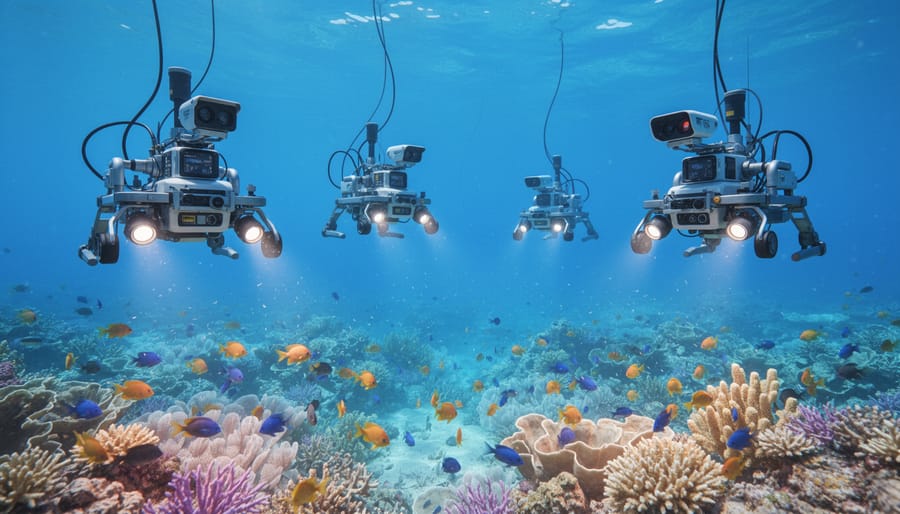
Five Ways Underwater Robots Are Protecting Marine Life
Monitoring Endangered Species Without Disturbing Them
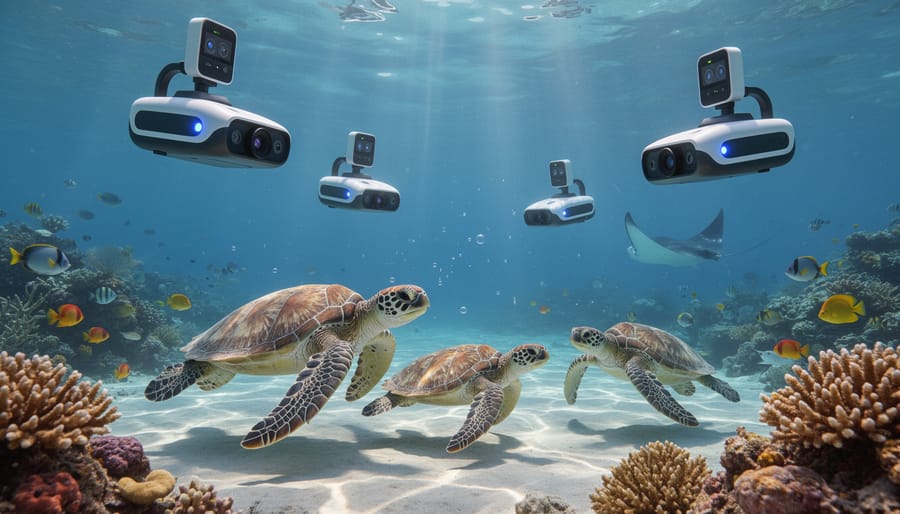
Underwater robots are revolutionizing how scientists study endangered marine species, offering a window into their lives without the stress of human presence. These autonomous vehicles can follow whale migration patterns across thousands of miles, photograph sea turtle nesting behaviors, and count monk seal populations in remote locations where research vessels would cause disruption.
Dr. Elena Martinez, a marine biologist with fifteen years studying North Atlantic right whales, recalls her first deployment of acoustic tracking robots. “We’d been using traditional boat surveys, but the engine noise was clearly affecting the whales’ communication,” she explains. “When we switched to silent underwater gliders equipped with hydrophones for marine monitoring, we captured whale songs we’d never heard before. These robots can stay submerged for months, gathering data on feeding grounds and calving areas without a single animal changing its behavior because we were there.”
Camera-equipped robots also document endangered species in challenging environments like deep coral reefs and polar waters. The footage helps researchers estimate population sizes, identify individuals through natural markings, and understand habitat use, all essential for effective conservation planning. This non-invasive approach provides unprecedented insights while respecting the animals we’re working to protect.
Mapping and Restoring Coral Reefs
Underwater robots are revolutionizing how we understand and protect coral reef ecosystems. Equipped with high-resolution cameras and advanced sensors, these autonomous vehicles create detailed three-dimensional maps of reef structures, documenting their health with unprecedented accuracy. Marine biologist Dr. Sarah Chen describes her experience: “When I first saw the 3D reconstruction our robot created, I could identify individual coral colonies and track their growth patterns over time. It’s transformed how we monitor these fragile ecosystems.”
These robots excel at detecting coral bleaching events early, scanning vast reef areas far more efficiently than human divers. Their sensors measure water temperature, light levels, and coral fluorescence, providing crucial data that helps scientists predict and respond to bleaching before it becomes catastrophic.
Perhaps most exciting is their role in coral restoration projects. Robots can precisely place coral fragments in optimal locations, monitor transplant success rates, and even distribute coral larvae during spawning events. Some newer models use machine learning to identify the healthiest restoration sites, dramatically improving survival rates. For those interested in contributing, many research institutions now offer volunteer opportunities to help analyze the massive datasets these robots collect, making reef conservation more accessible than ever.
Detecting and Removing Ocean Pollution
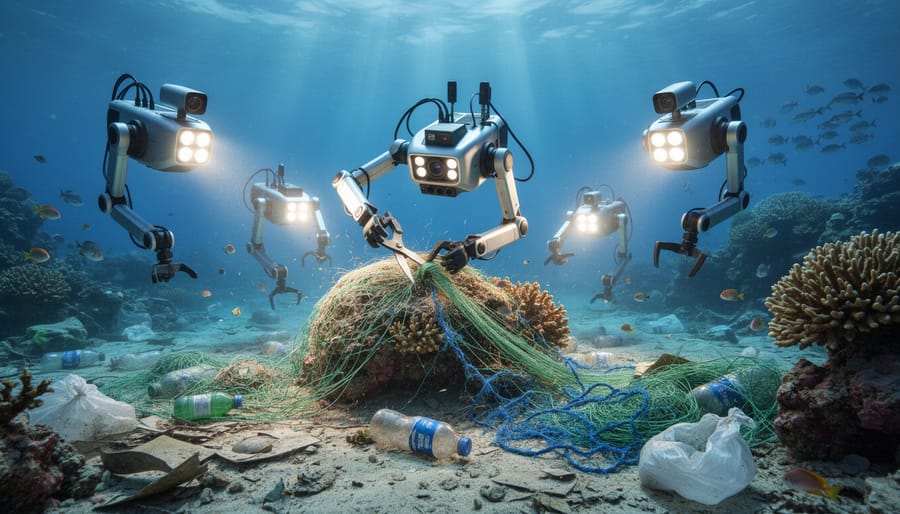
Our oceans face a mounting crisis from plastic debris, abandoned fishing gear, and other pollutants that harm marine life and ecosystems. Underwater robots are emerging as powerful allies in the fight against this contamination. Equipped with sophisticated cameras and sensors, these machines can detect and map pollution hotspots across vast ocean areas far more efficiently than human divers alone.
Advanced robots like the Ocean One and various autonomous underwater vehicles (AUVs) use computer vision to identify plastic accumulation, ghost nets—abandoned fishing equipment that continues trapping wildlife—and other debris on the seafloor. Some models feature mechanical arms capable of collecting smaller items, while others guide cleanup teams to larger concentrations of waste.
Dr. Sarah Chen, a marine roboticist working off the California coast, shares an inspiring example: “We deployed an AUV that located a massive ghost net killing dozens of sea turtles. Within 48 hours, our team removed it, saving countless future victims.”
These technological tools don’t replace human effort but amplify it dramatically. Organizations now combine robotic surveillance with volunteer dive teams, creating efficient cleanup operations. If you’re passionate about ocean health, many conservation groups offer opportunities to support robot-assisted cleanup initiatives through citizen science programs and beach-to-ocean monitoring projects.
Studying Deep-Sea Ecosystems We’ve Never Seen
The ocean’s deepest regions remain among Earth’s least explored frontiers. More than 80% of our ocean remains unmapped and unobserved, with depths beyond 1,000 meters presenting extreme challenges for human exploration. This is where underwater robots become invaluable scientific ambassadors.
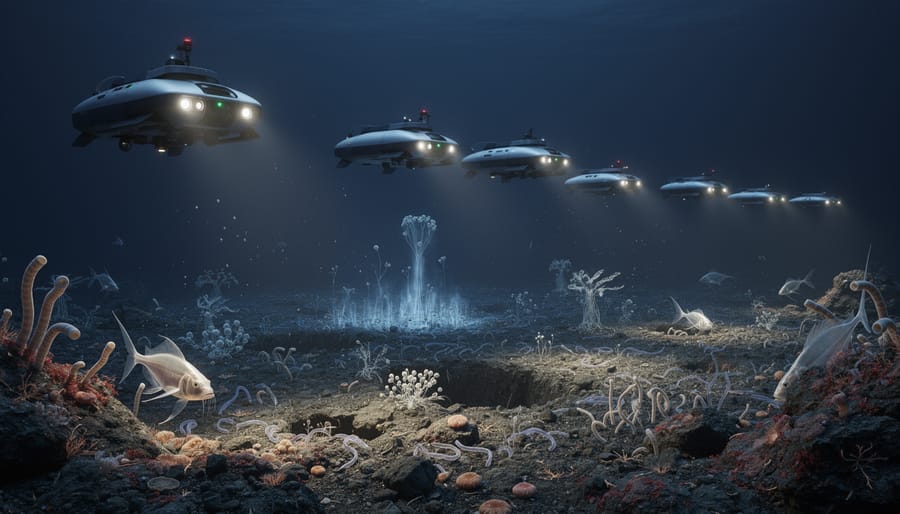
Advanced remotely operated vehicles (ROVs) and autonomous underwater vehicles (AUVs) now routinely dive to depths that would crush traditional equipment. These robots have revealed entire ecosystems thriving in conditions once thought impossible for life. In hydrothermal vent fields, for example, robotic explorers have documented communities of tube worms, blind shrimp, and bacteria that derive energy from chemicals rather than sunlight, fundamentally changing our understanding of where and how life can exist.
Dr. Samantha Chen, a marine biologist who operates deep-sea ROVs, describes the experience as “opening a door to an alien world on our own planet. Every dive brings discoveries—new species that rewrite taxonomy textbooks and behaviors we never imagined.”
These discoveries have profound implications for conservation. By documenting biodiversity in unexplored regions, robots help identify critical habitats requiring protection before industrial activities like deep-sea mining can damage them. You can support this research by participating in citizen science programs that help classify footage from these expeditions, contributing directly to our growing knowledge of marine life.
Combating Illegal Fishing and Poaching
Illegal fishing and poaching operations drain billions of dollars annually from the global economy while devastating marine ecosystems. Autonomous underwater robots are emerging as powerful allies for enforcement agencies tasked with protecting vulnerable marine areas. These tireless guardians patrol marine protected areas around the clock, documenting violations that would otherwise go undetected.
Equipped with acoustic sensors and cameras, these robots can identify vessels operating illegally in restricted zones, track fishing gear being deployed in protected waters, and even detect the acoustic signatures of blast fishing—a destructive practice that devastates coral reefs. The real-time data they collect transmits directly to enforcement agencies, enabling rapid response before significant damage occurs.
In Southeast Asia, underwater drones have helped authorities identify and prosecute illegal trawling operations within marine sanctuaries, leading to a 40% reduction in violations over two years. Marine biologist Dr. Elena Cortez, who works with enforcement teams in the Philippines, shares that “these robots give us eyes where we’ve never had them before. They’ve transformed our ability to actually protect the areas we’ve designated as sanctuaries.”
The continuous monitoring capability of these robots creates a deterrent effect, as illegal operators can no longer count on evading detection in remote waters.
The Technology Behind the Mission: Sensors and AI
Modern underwater robots represent a convergence of cutting-edge technologies working in harmony to unlock the ocean’s secrets. At their core, these machines rely on sophisticated sensor arrays that function as their eyes and ears in the murky depths where sunlight rarely reaches.
High-definition cameras equipped with specialized lighting systems capture stunning imagery in low-visibility conditions. These aren’t ordinary cameras—they use wavelengths optimized for underwater visibility and can compensate for the blue-green color shifts that occur at depth. Multi-beam sonar systems complement visual sensors by creating detailed three-dimensional maps of the seafloor and detecting objects in complete darkness or turbid water. Together, these technologies allow robots to navigate complex underwater terrain, from coral reefs to shipwrecks.
Environmental sensors continuously monitor water quality parameters including temperature, salinity, pH levels, and dissolved oxygen. This real-time data helps scientists understand habitat conditions and detect early warning signs of ecosystem stress, such as ocean acidification or warming events that threaten marine life.
Perhaps most revolutionary is the integration of artificial intelligence into these robotic platforms. Machine learning algorithms trained on millions of images can now identify individual species with remarkable accuracy, often matching or exceeding human expert capabilities. Dr. Maria Santos, a marine biologist working with autonomous underwater vehicles, shares her experience: “What used to take our team weeks of manual video analysis now happens in hours. The AI flags specific species, counts individuals, and even detects behavioral patterns we might have missed.”
The data collection capabilities extend beyond simple observation. These robots create permanent digital records, building comprehensive databases that track population changes over time. This longitudinal data proves invaluable for measuring conservation intervention success and identifying emerging threats before they become crises. When combined with cloud-based platforms, this information becomes accessible to researchers worldwide, democratizing ocean science and enabling collaborative conservation efforts on an unprecedented scale.
Real Results: Conservation Wins Powered by Robotics
The numbers tell a powerful story. In the Philippines’ Verde Island Passage, underwater robots equipped with artificial intelligence for species identification have documented a 34% increase in reef fish populations over three years in newly protected zones. These autonomous vehicles patrol 24/7, providing enforcement data that would require hundreds of human dive hours to collect manually.
Dr. Maria Santos, a marine biologist working with local conservation groups, shares her experience: “Before we had the robots, illegal fishing boats would simply wait until our patrol boats left. Now, with continuous robotic monitoring, we’ve seen a dramatic decrease in violations. The community has responded beautifully, with local fishers reporting 40% better catches in sustainable fishing zones adjacent to protected areas.”
Off the California coast, robotic gliders detected a massive kelp die-off two weeks earlier than traditional monitoring would have caught it. This early warning allowed researchers to identify warming water as the culprit and relocate threatened abalone populations before conditions worsened. The response saved an estimated 15,000 individuals of this endangered species.
In the Mediterranean, networked underwater drones have mapped 200 square kilometers of previously undocumented Posidonia seagrass meadows, leading to their legal protection. These meadows now sequester an estimated 50 tons of carbon annually while providing nursery habitat for commercially important fish species.
Perhaps most encouraging is the data accessibility. Conservation teams in developing nations can now afford entry-level robotic systems, democratizing ocean monitoring. Tanzania’s marine parks report that autonomous surface vehicles have reduced monitoring costs by 60% while tripling their survey coverage, proving that technology can level the playing field in global conservation efforts.
How You Can Be Part of the Solution
You don’t need to be a robotics engineer or marine biologist to contribute to underwater conservation efforts. The intersection of robotics and ocean protection offers numerous ways for people from all backgrounds to make a meaningful difference.
The Marine Biodiversity Science Center welcomes volunteers to assist with data analysis from underwater robot missions. These opportunities allow community members to help categorize marine species, identify coral health indicators, and track population changes captured by autonomous vehicles. No prior experience is necessary, as comprehensive training is provided to all participants.
Citizen science projects represent another accessible entry point. Platforms like Zooniverse feature programs where you can examine images and video footage collected by underwater robots, helping scientists process vast amounts of data that would take years to analyze alone. Your observations contribute directly to published research and conservation decisions.
Educational programs connect students and teachers with real-time robot missions. Many organizations offer virtual classroom visits where students can watch live feeds from underwater expeditions and interact with marine scientists, fostering the next generation of ocean advocates.
Supporting conservation initiatives financially, whether through donations to research organizations or adopting monitoring equipment, directly enables expanded robot deployment in critical habitats. Even small contributions help maintain existing technology and develop new monitoring capabilities.
Social media engagement matters too. Sharing stories about underwater robotics research, attending public lectures, and participating in beach cleanups all amplify conservation messages. Every action, regardless of scale, strengthens the collective effort to protect our oceans for future generations.
The transformative power of underwater robotics in marine conservation extends far beyond the technology itself. These remarkable tools have opened windows into previously inaccessible ocean realms, revealing both the challenges our oceans face and the incredible resilience of marine ecosystems when given proper protection. From mapping endangered coral reefs to monitoring deep-sea habitats, underwater robots are helping scientists gather the critical data needed to make informed conservation decisions that will shape the future of our oceans.
Yet technology alone cannot solve the complex challenges facing marine biodiversity. The real power lies in how we harness these tools to inspire action, inform policy, and engage communities worldwide. Dr. Sarah Chen, a marine biologist who has worked with remotely operated vehicles for over a decade, reminds us that “every data point collected by these robots represents an opportunity to tell a story that moves people to care about what happens beneath the waves.”
The future is bright, but the work ahead is substantial. We need continued innovation, expanded research efforts, and most importantly, more voices joining the conversation about ocean health. Whether you’re a student considering a career in marine science, an educator looking to bring ocean conservation into your classroom, or simply someone who cares about protecting our blue planet, there’s a place for you in this movement. Join our volunteer programs, connect with researchers through our e-network, or participate in citizen science initiatives. Together, we can ensure that underwater robotics serves as a catalyst for lasting marine conservation success.

jessica
Ava Singh is an environmental writer and marine sustainability advocate with a deep commitment to protecting the world's oceans and coastal communities. With a background in environmental policy and a passion for storytelling, Ava brings complex topics to life through clear, engaging content that educates and empowers readers. At the Marine Biodiversity & Sustainability Learning Center, Ava focuses on sharing impactful stories about community engagement, policy innovations, and conservation strategies. Her writing bridges the gap between science and the public, encouraging people to take part in preserving marine biodiversity. When she’s not writing, Ava collaborates with local initiatives to promote eco-conscious living and sustainable development, ensuring her work makes a difference both on the page and in the real world.